Free original lessons
Draw Isometric Octagon
Draw a regular octagon in a square before projecting it onto the chosen isometric plane. Draw the projected square using two axes, then join matching cut marks around all four corners. The corner cuts alternate between the two diagonals of the square; they do not all follow an isometric axis.
Letter & A4
PDF & SVG
What an isometric octagon is
An isometric drawing has three principal axis directions. A flat square frame uses two of them. Only the edges parallel to those two sides are required to follow the axes; diagonal edges project at directions determined by their endpoints.
A regular octagon can be made from a square by trimming the same length from both ends of each side. Set the trim to the square's side length divided by the sum (2 plus the square root of 2). The middle length and the diagonal cut are then both the same true length.
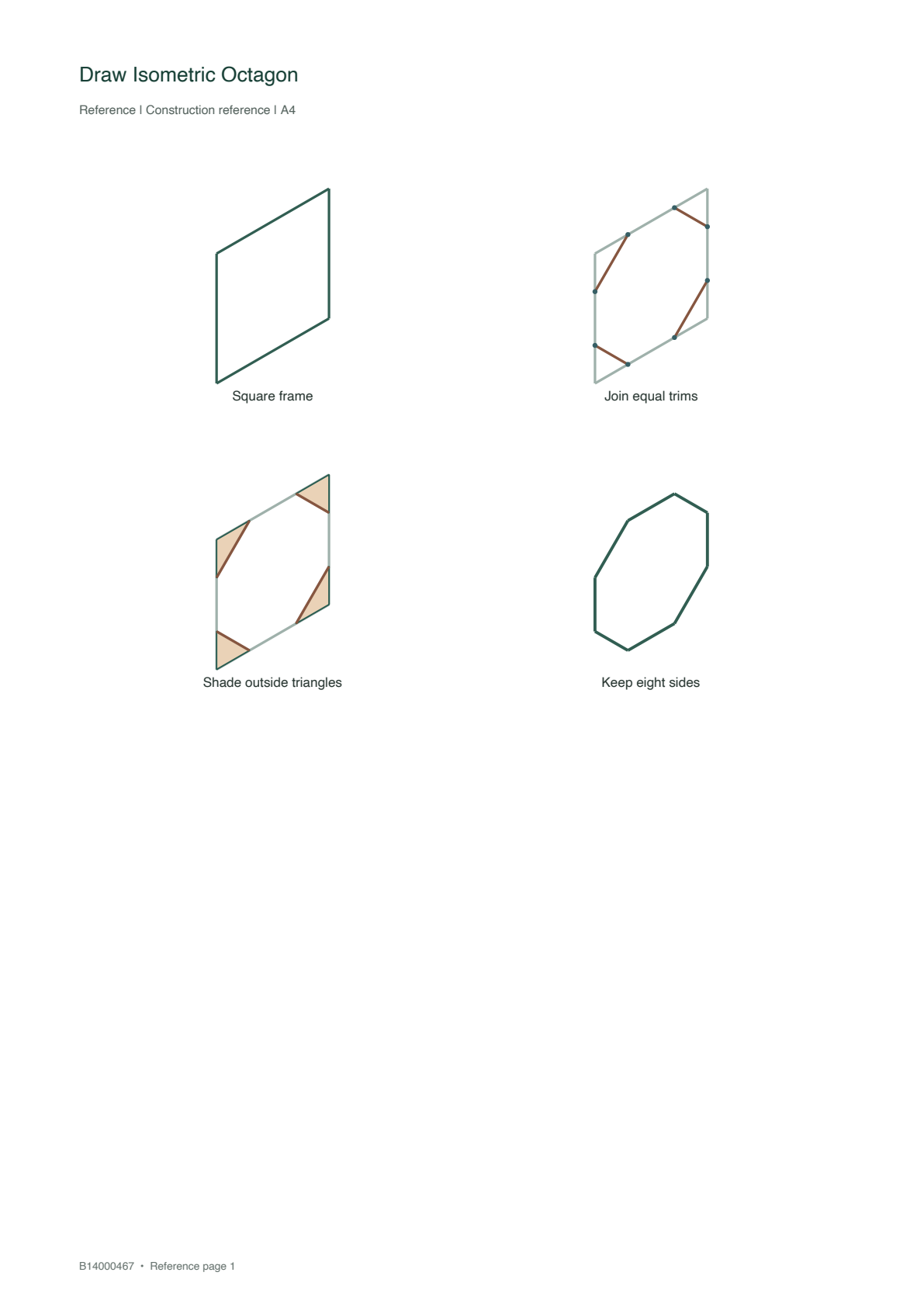
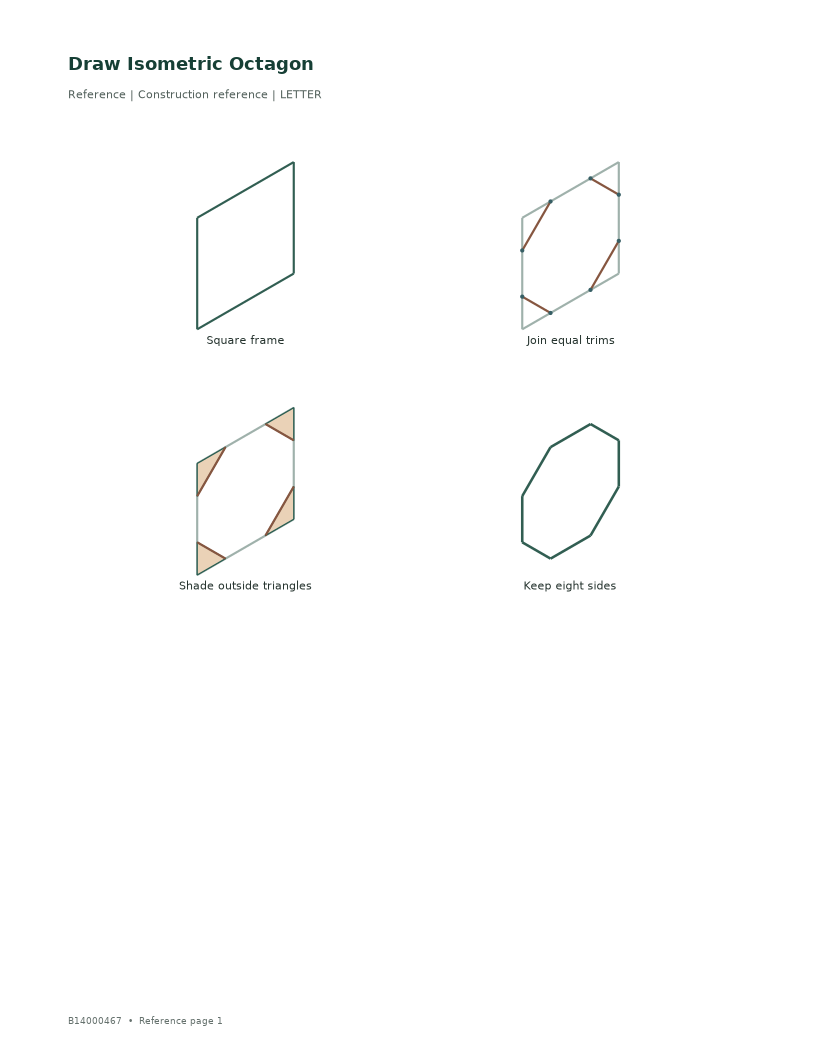
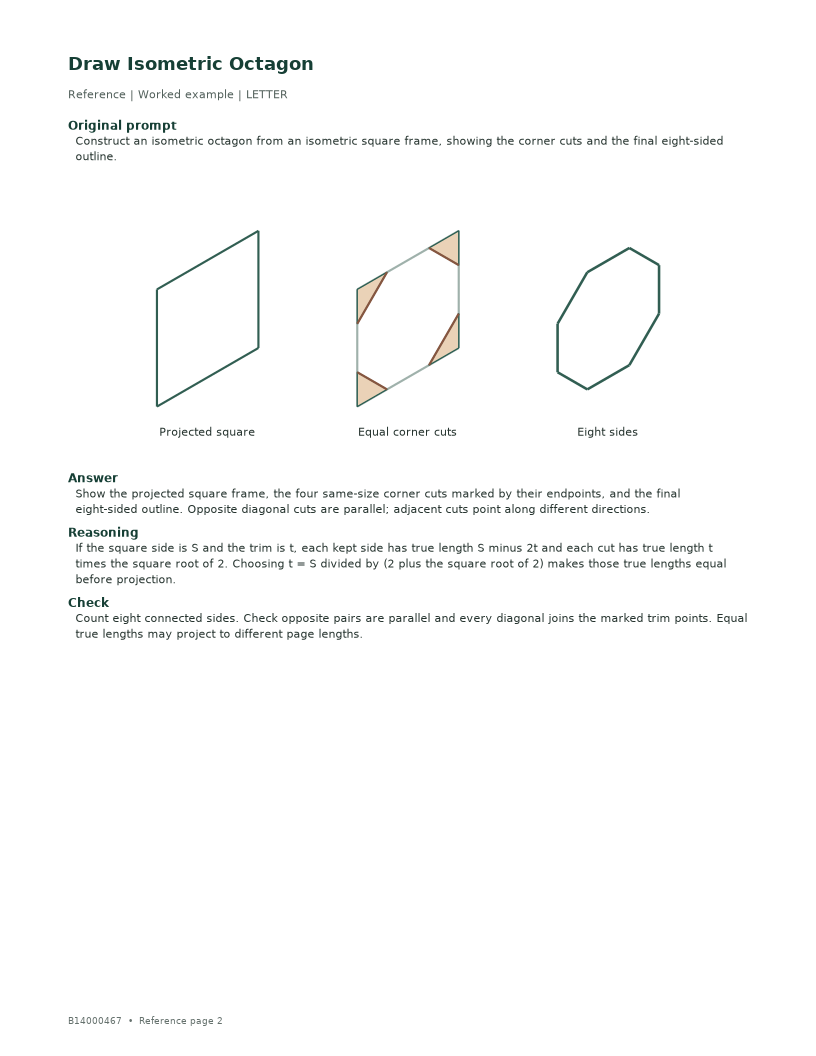
Reference plate: the construction
The plate shows four stages: draw the projected square and label its two directions, transfer the same trim onto each end of each side, shade the four right triangles outside the new outline, and check the eight edges that remain. The two types of diagonal cuts alternate.
The third axis appears as a separate guide. It is not a third family of frame edges. You can use a ruler on the flat square or transfer the same fractional mark to each side of the projected frame.
Worked example
Use the rising-right direction and the vertical direction to make a parallelogram whose paired sides each represent one side of a square. Mark the same fractional length at both ends of every side. In the chosen plate that fraction is 1 divided by (2 plus the square root of 2).
Connect the two marks at each corner. Cuts at opposite corners are parallel because those pairs belong to the same diagonal direction. The cuts at adjacent corners generally point in different directions. Erase the outer sides of the four cut triangles and keep the connected eight-sided outline.
Download the complete resource pack
All individual SVG pages (20)
- A4 reference page 1
- A4 reference page 2
- A4 student page 1
- A4 student page 2
- A4 student page 3
- A4 student page 4
- A4 answer page 1
- A4 answer page 2
- A4 answer page 3
- A4 answer page 4
- LETTER reference page 1
- LETTER reference page 2
- LETTER student page 1
- LETTER student page 2
- LETTER student page 3
- LETTER student page 4
- LETTER answer page 1
- LETTER answer page 2
- LETTER answer page 3
- LETTER answer page 4
Print at 100% / actual size. Use the stated scale on any schematic diagram; physical cutting templates are identified separately. A4 and US Letter are separate files. Free access, no signup; CC BY 4.0.
How to use these pages
- What an isometric octagon is
- Reference plate: the construction
- Worked example
Worked example
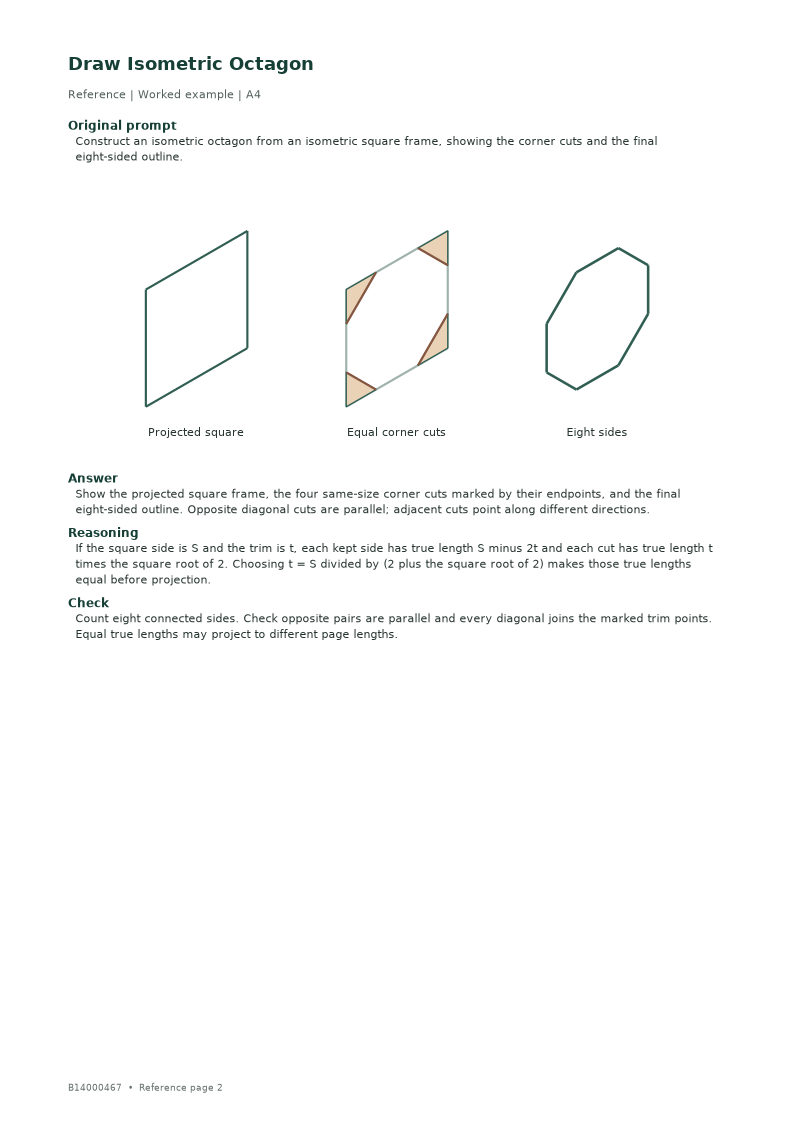
Example: Construct an isometric octagon from an isometric square frame, showing the corner cuts and the final eight-sided outline.
Answer: Show the projected square frame, the four same-size corner cuts marked by their endpoints, and the final eight-sided outline. Opposite diagonal cuts are parallel; adjacent cuts point along different directions.
Reasoning: If the square side is S and the trim is t, each kept side has true length S minus 2t and each cut has true length t times the square root of 2. Choosing t = S divided by (2 plus the square root of 2) makes those true lengths equal before projection.
Check: Count eight connected sides. Check opposite pairs are parallel and every diagonal joins the marked trim points. Equal true lengths may project to different page lengths.
Four practice tasks and complete answers
Task 1
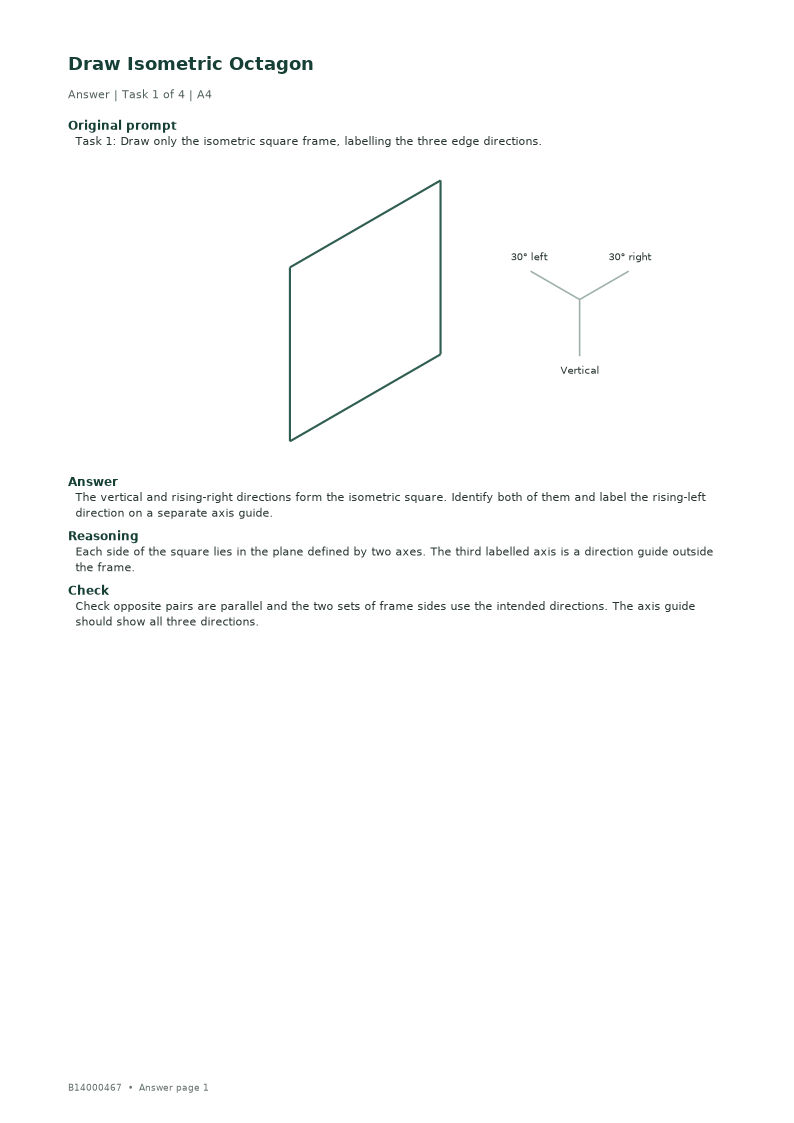
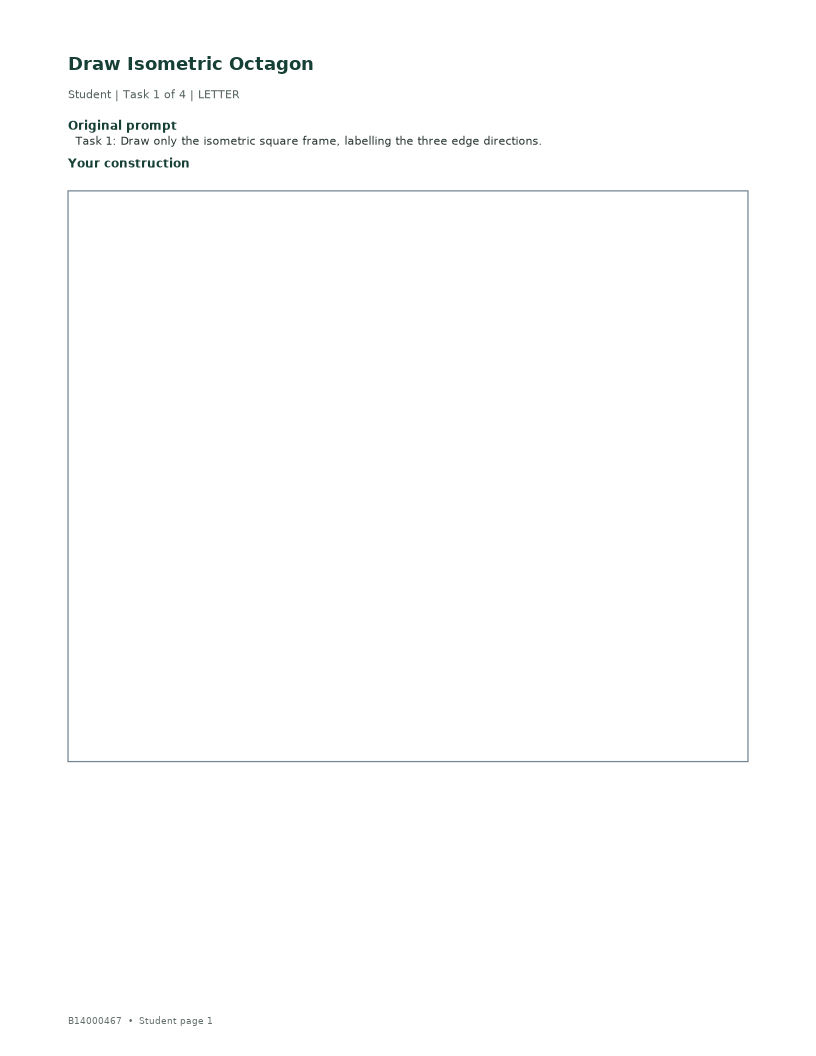
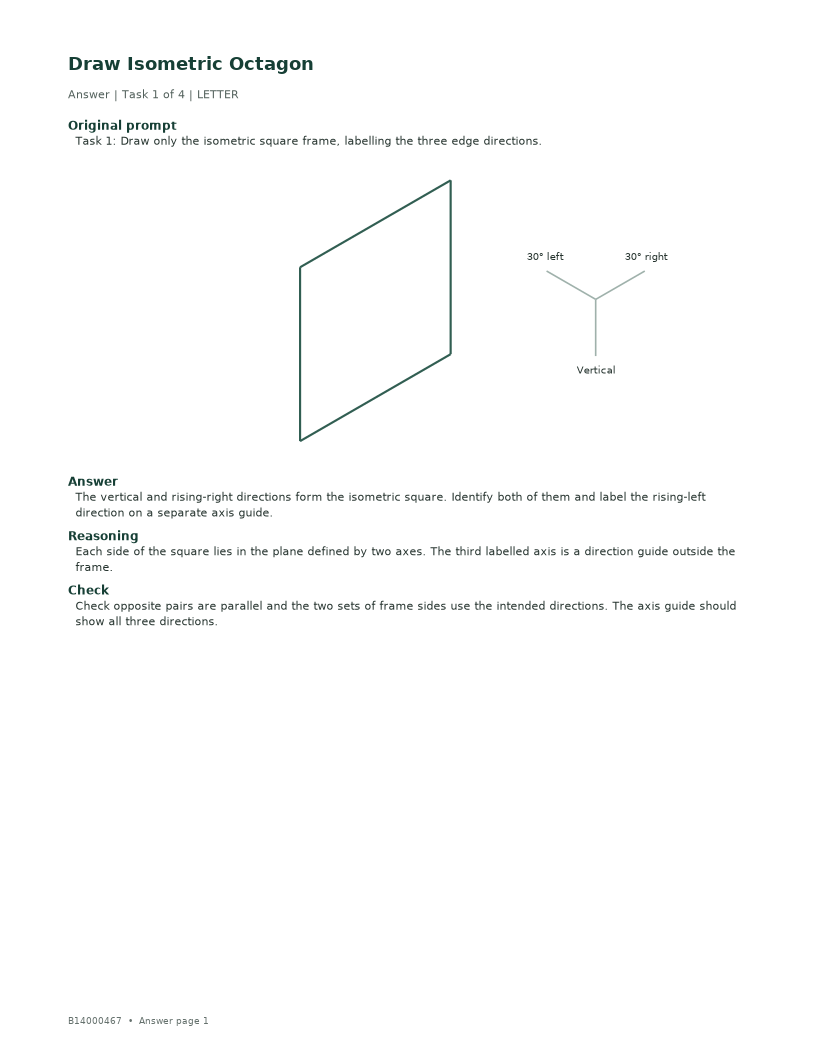
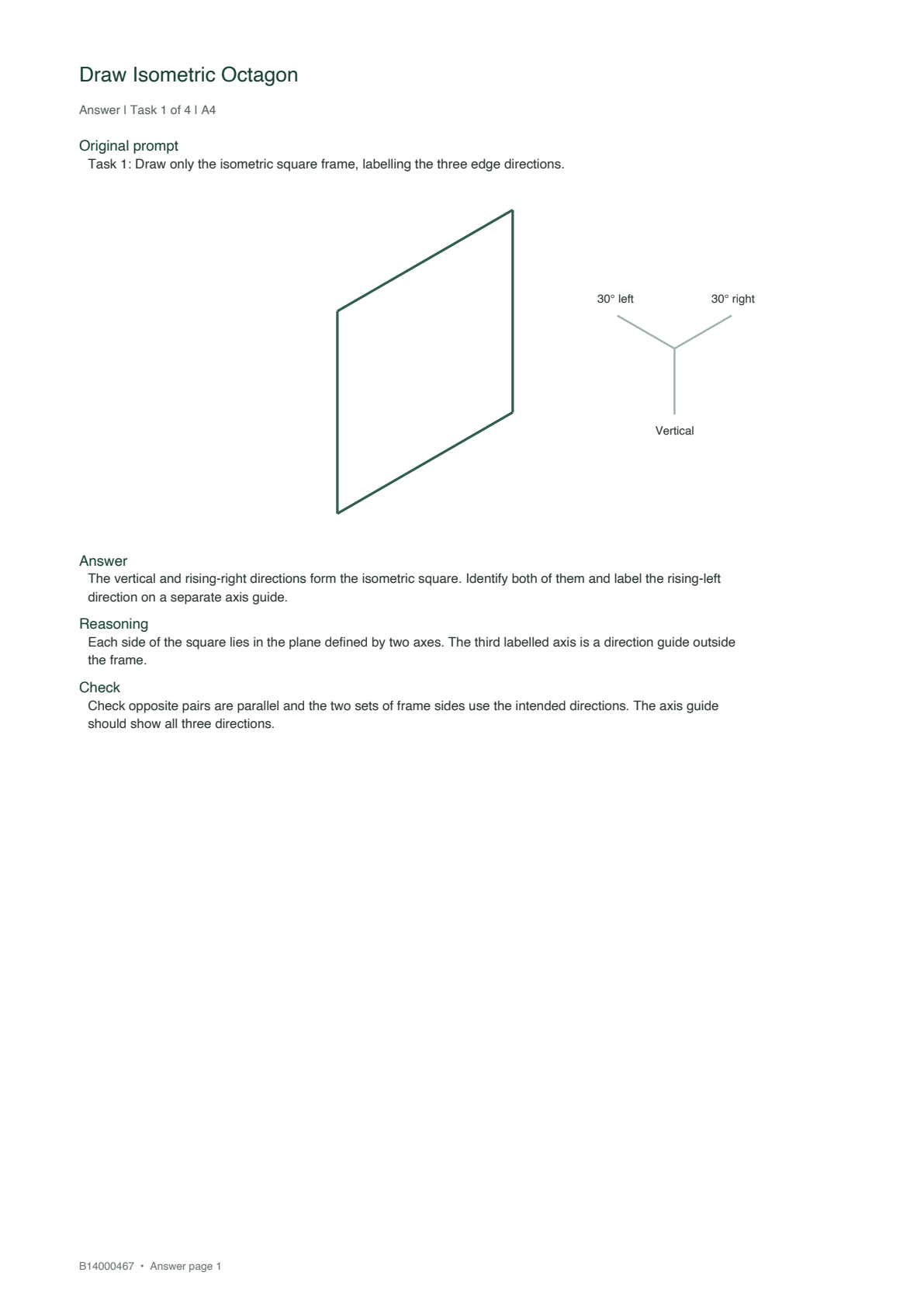
Task 1: Draw only the isometric square frame, labelling the three edge directions.
Show answer 1
The vertical and rising-right directions form the isometric square. Identify both of them and label the rising-left direction on a separate axis guide.
Each side of the square lies in the plane defined by two axes. The third labelled axis is a direction guide outside the frame.
Check: Check opposite pairs are parallel and the two sets of frame sides use the intended directions. The axis guide should show all three directions.
Task 2
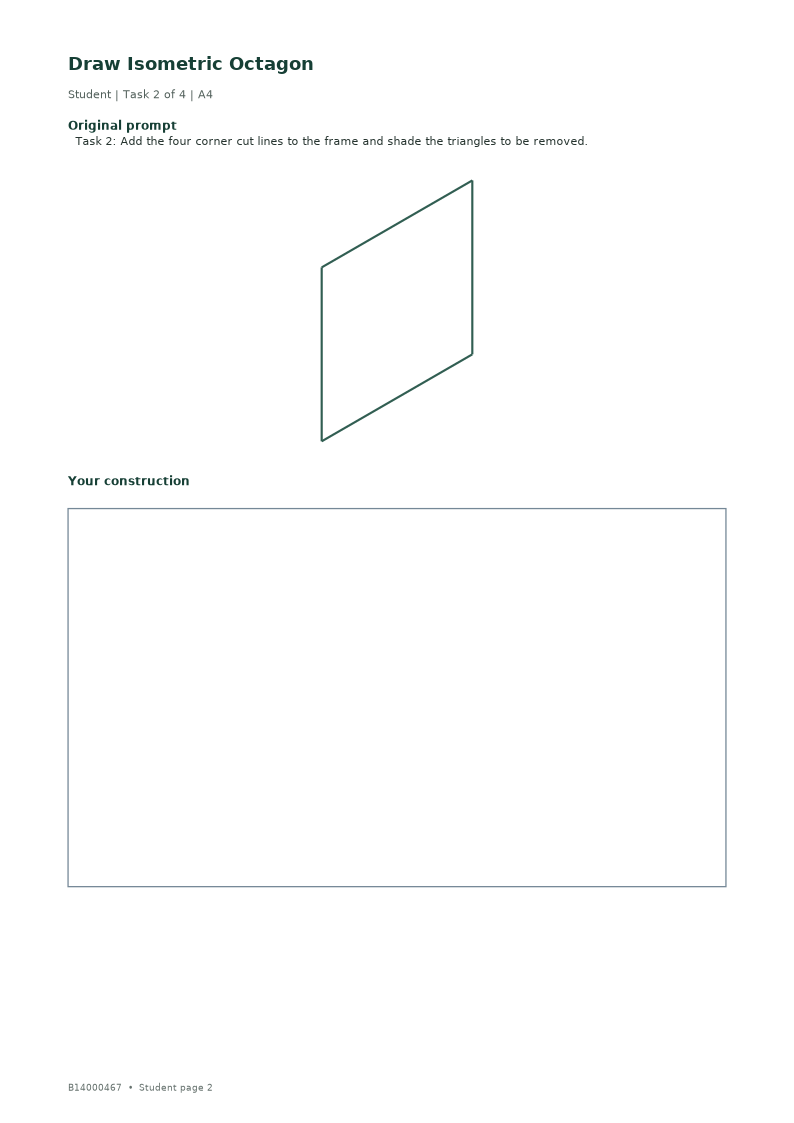
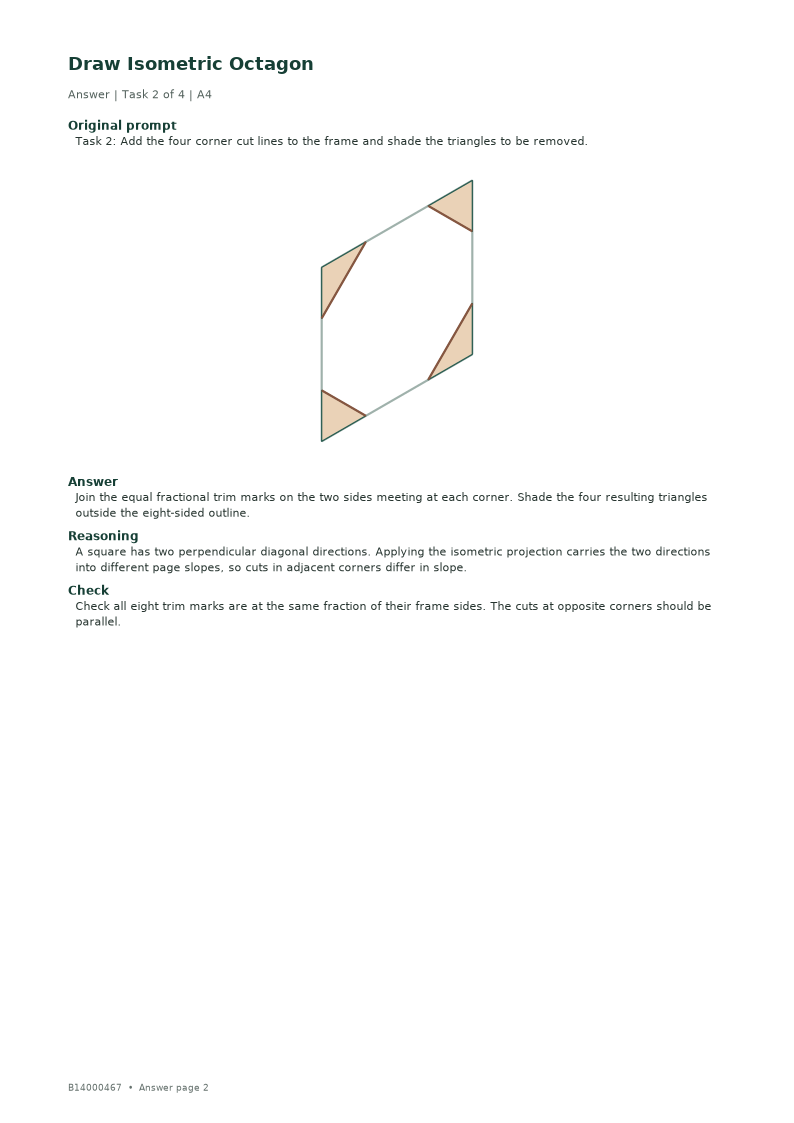
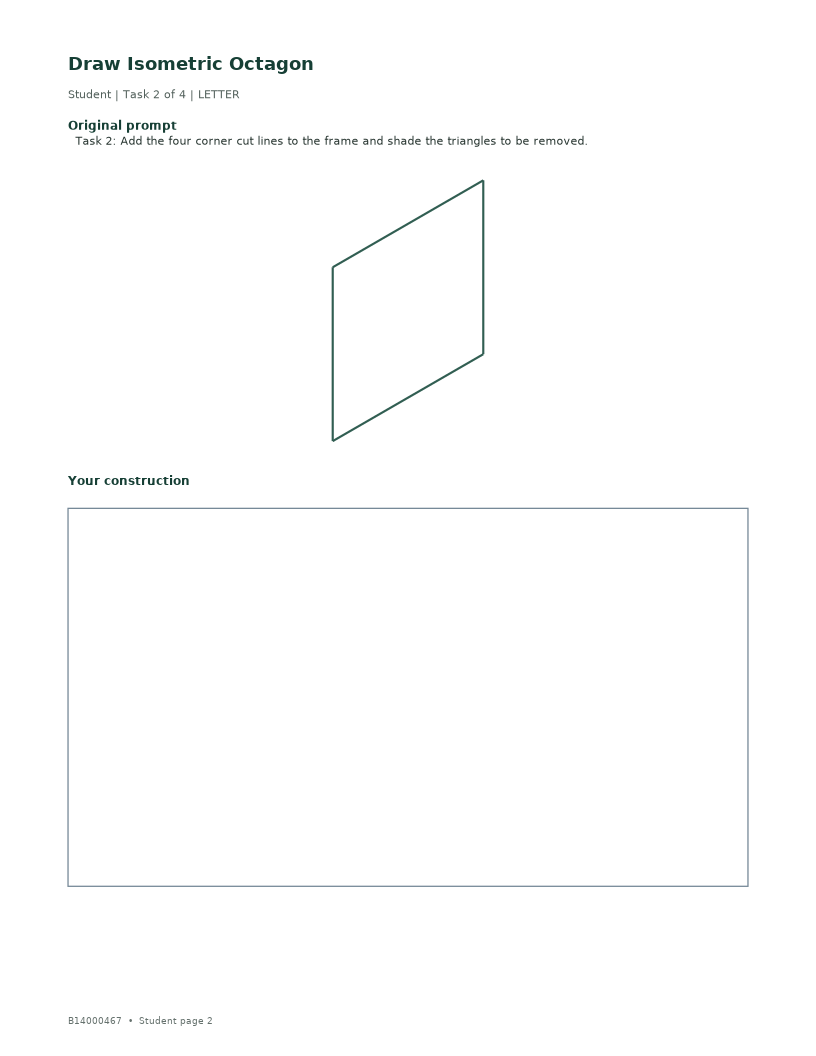
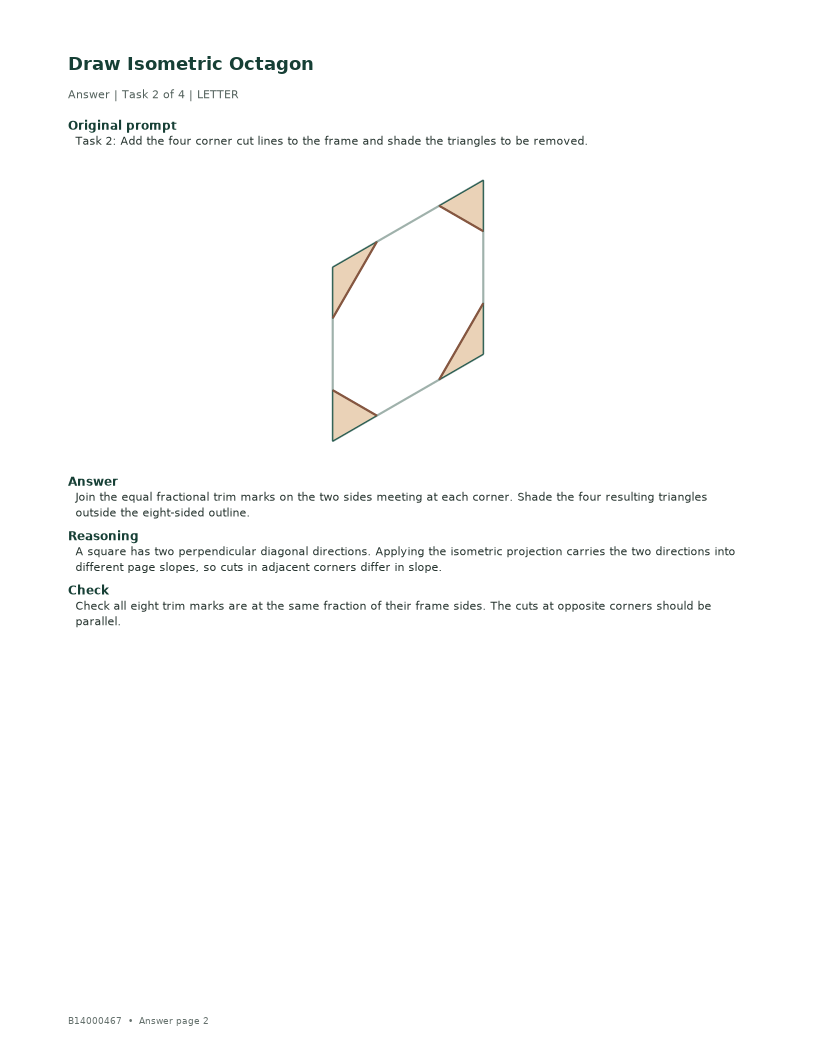
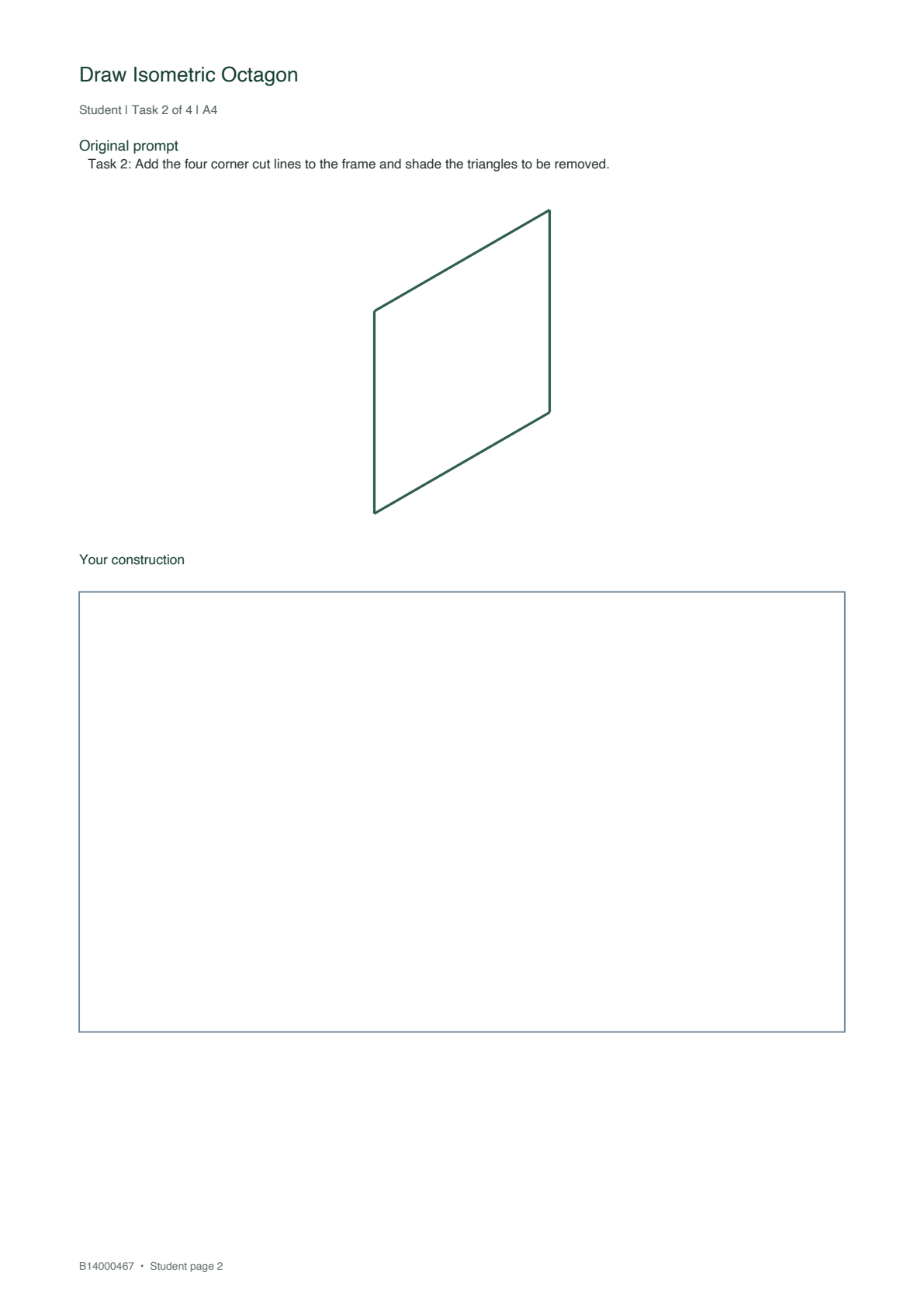
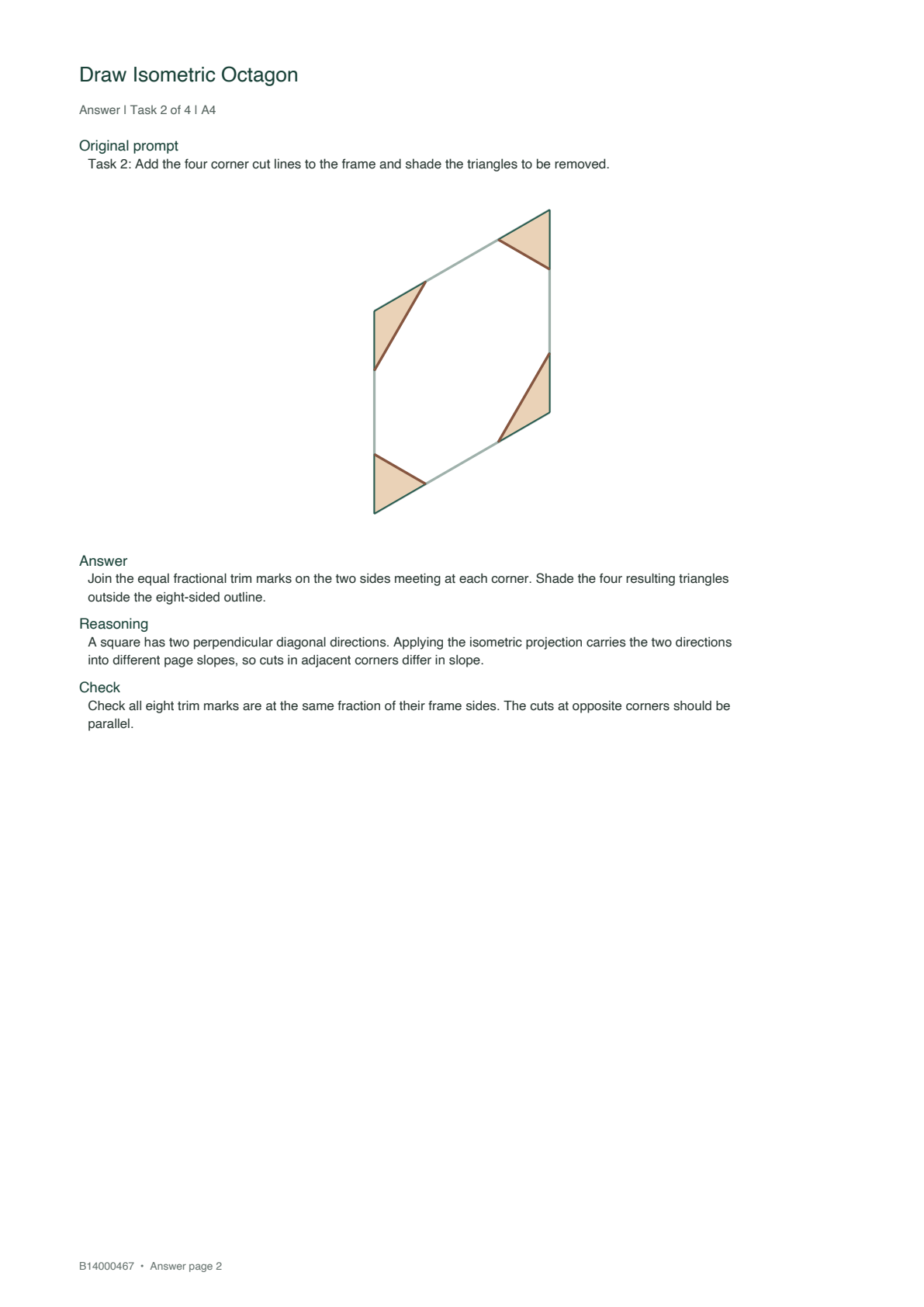
Task 2: Add the four corner cut lines to the frame and shade the triangles to be removed.
Show answer 2
Join the equal fractional trim marks on the two sides meeting at each corner. Shade the four resulting triangles outside the eight-sided outline.
A square has two perpendicular diagonal directions. Applying the isometric projection carries the two directions into different page slopes, so cuts in adjacent corners differ in slope.
Check: Check all eight trim marks are at the same fraction of their frame sides. The cuts at opposite corners should be parallel.
Task 3
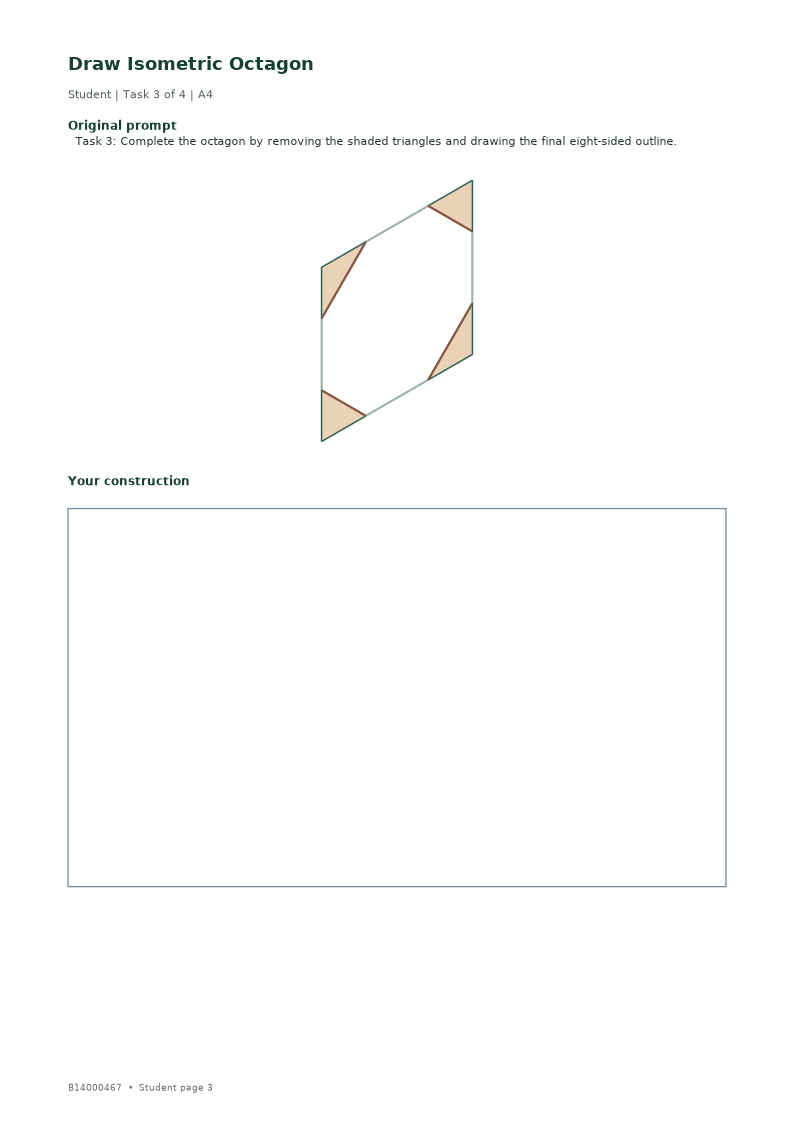
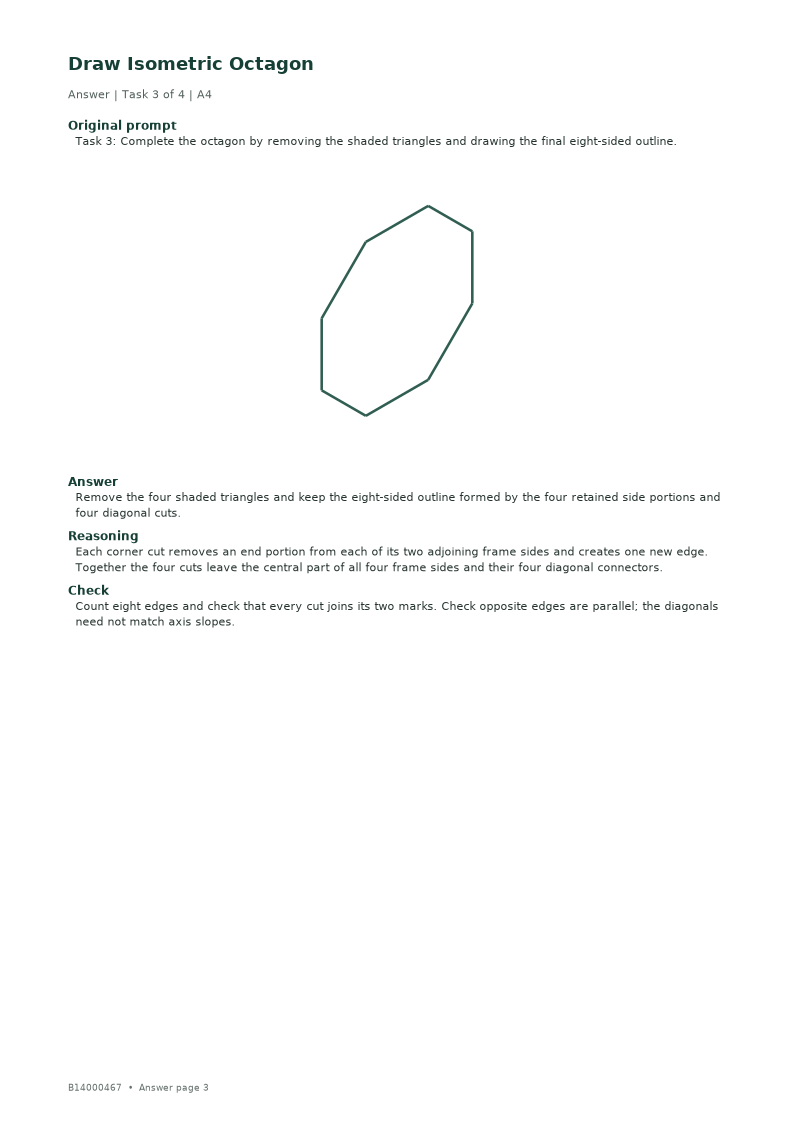
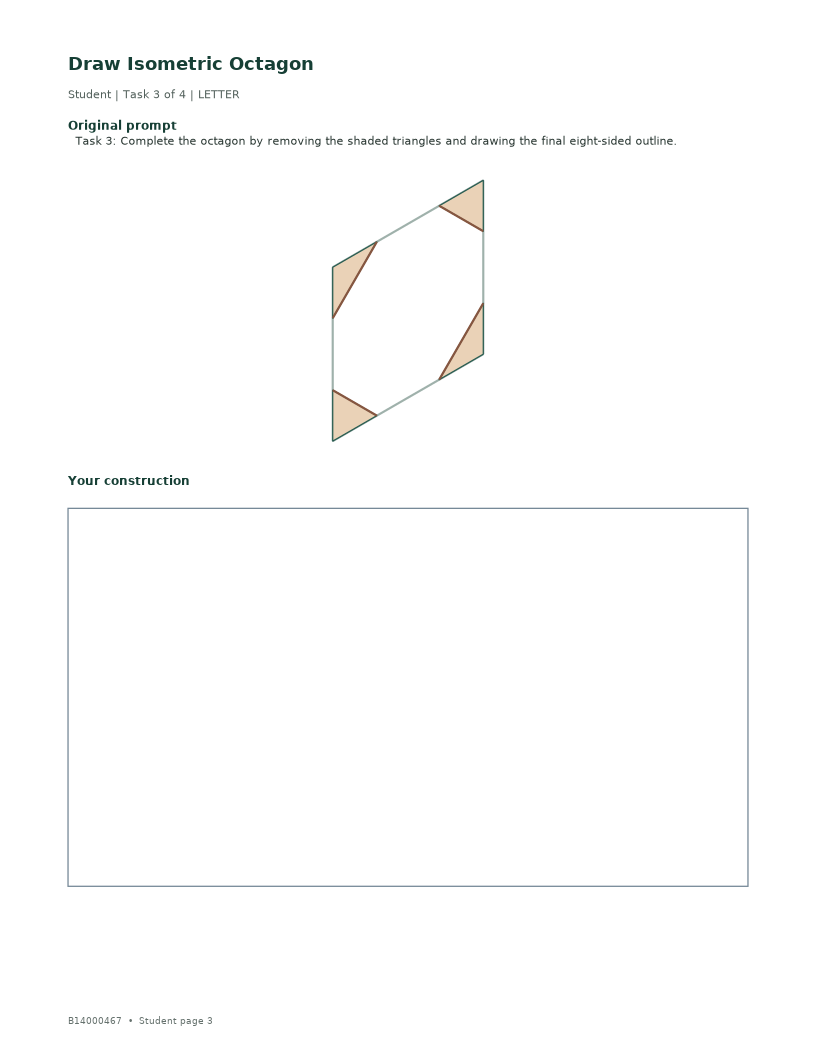
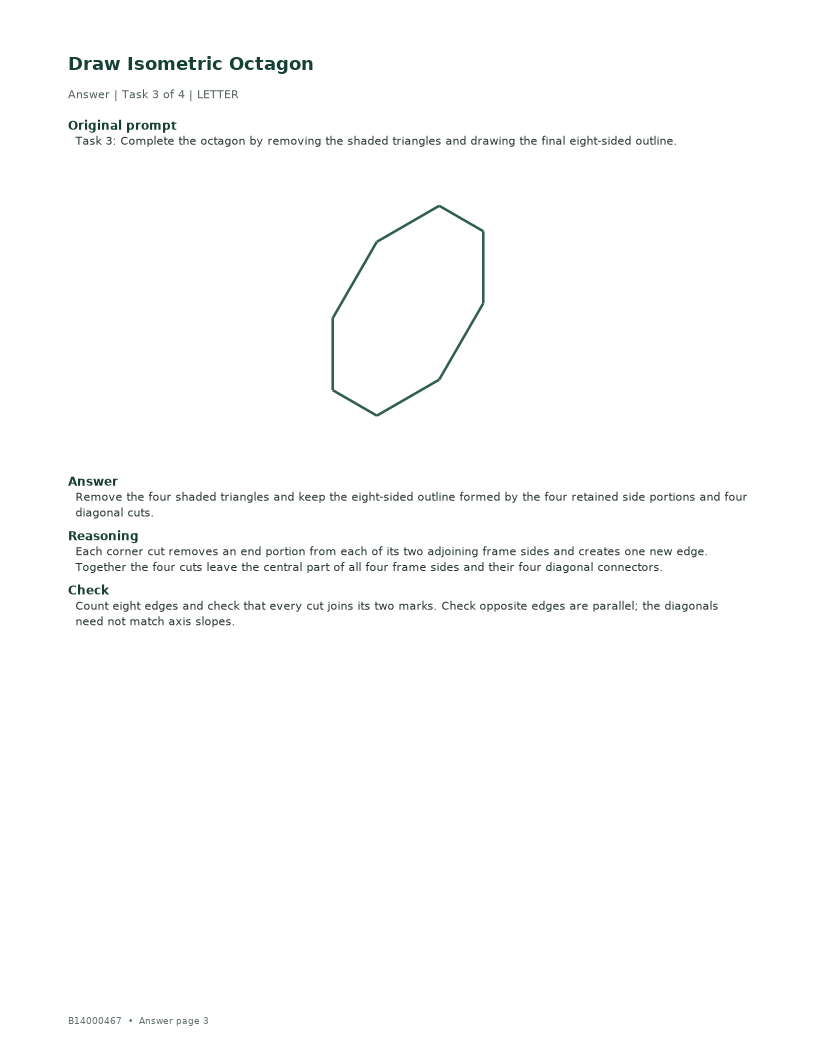
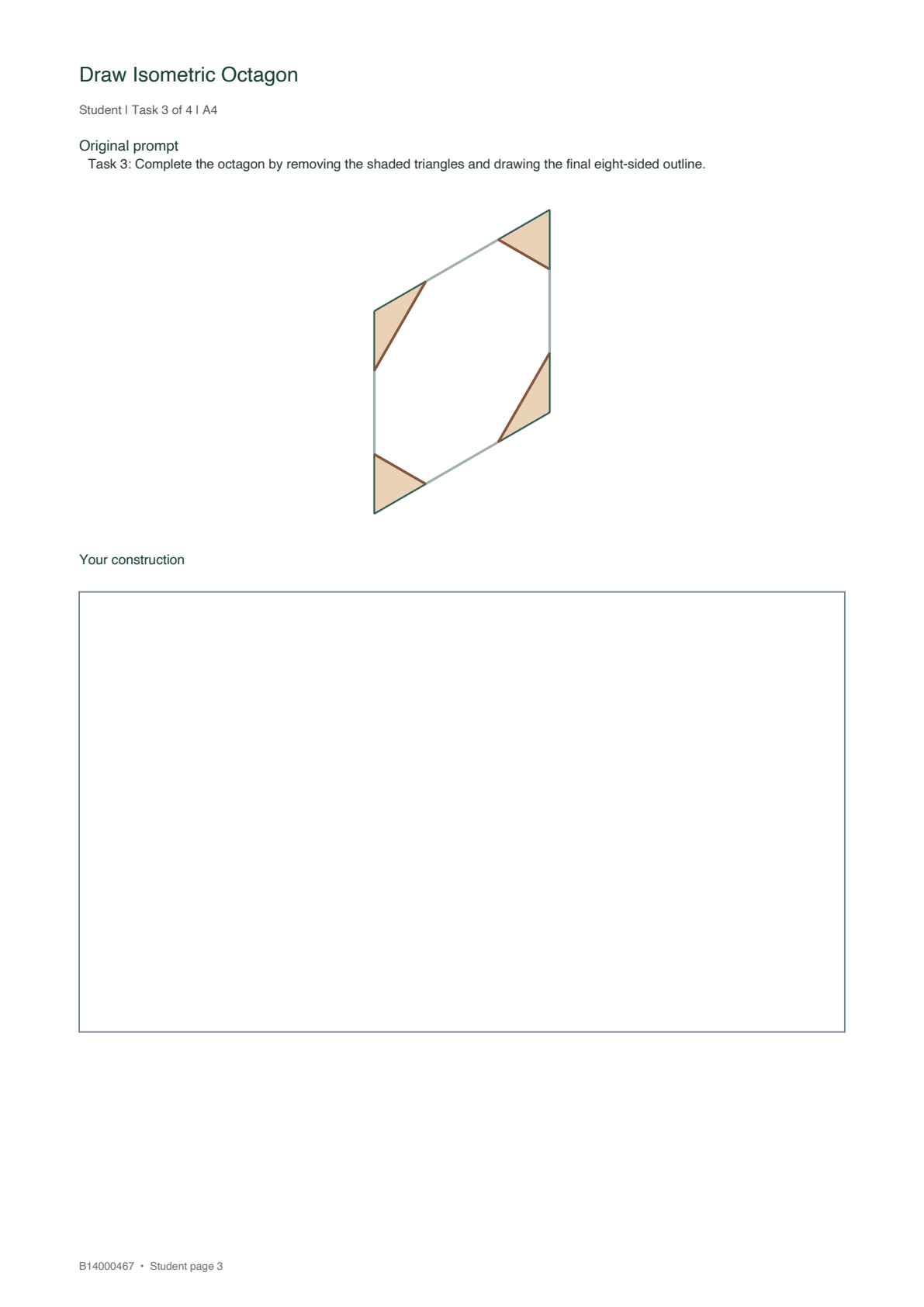
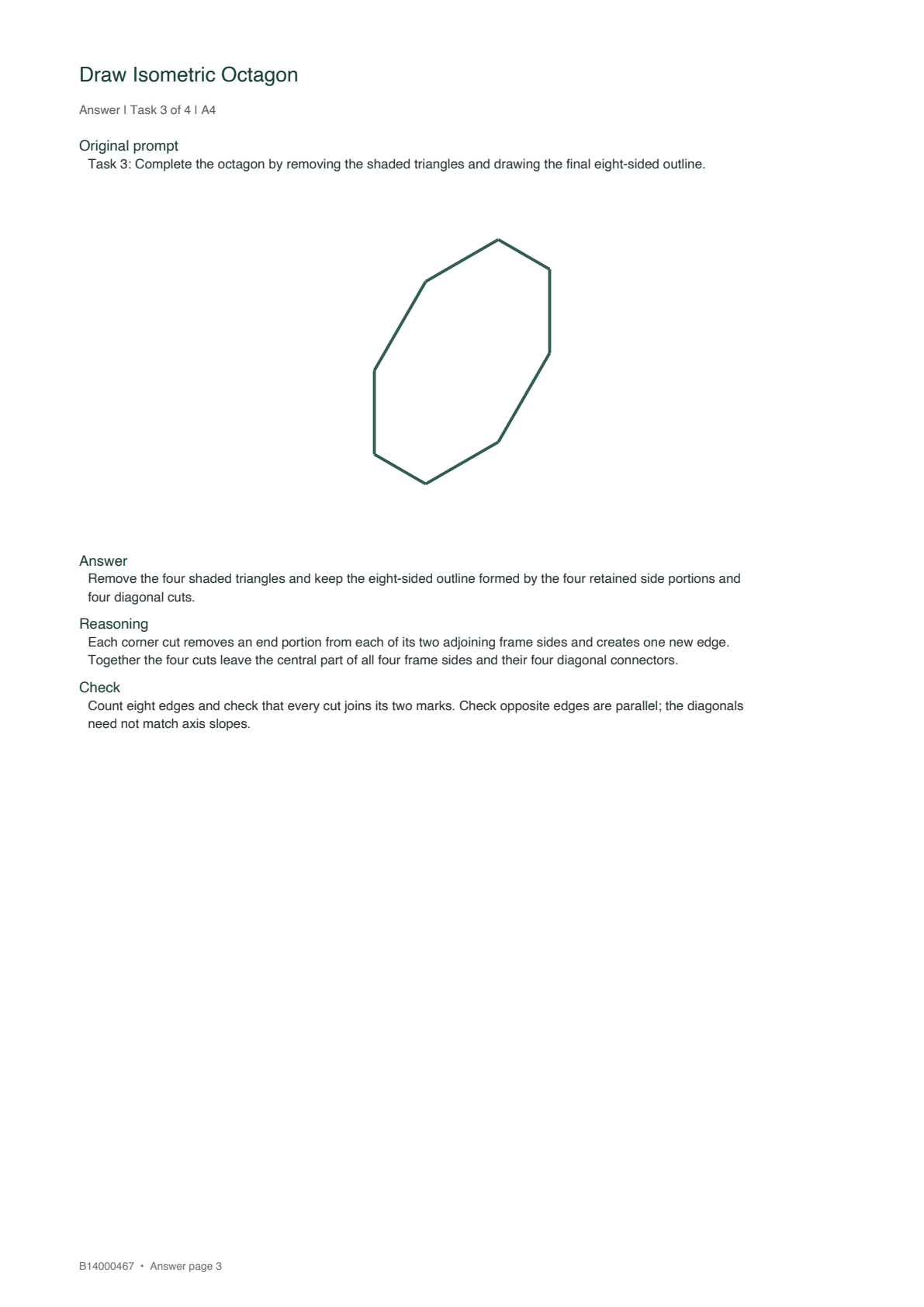
Task 3: Complete the octagon by removing the shaded triangles and drawing the final eight-sided outline.
Show answer 3
Remove the four shaded triangles and keep the eight-sided outline formed by the four retained side portions and four diagonal cuts.
Each corner cut removes an end portion from each of its two adjoining frame sides and creates one new edge. Together the four cuts leave the central part of all four frame sides and their four diagonal connectors.
Check: Count eight edges and check that every cut joins its two marks. Check opposite edges are parallel; the diagonals need not match axis slopes.
Task 4
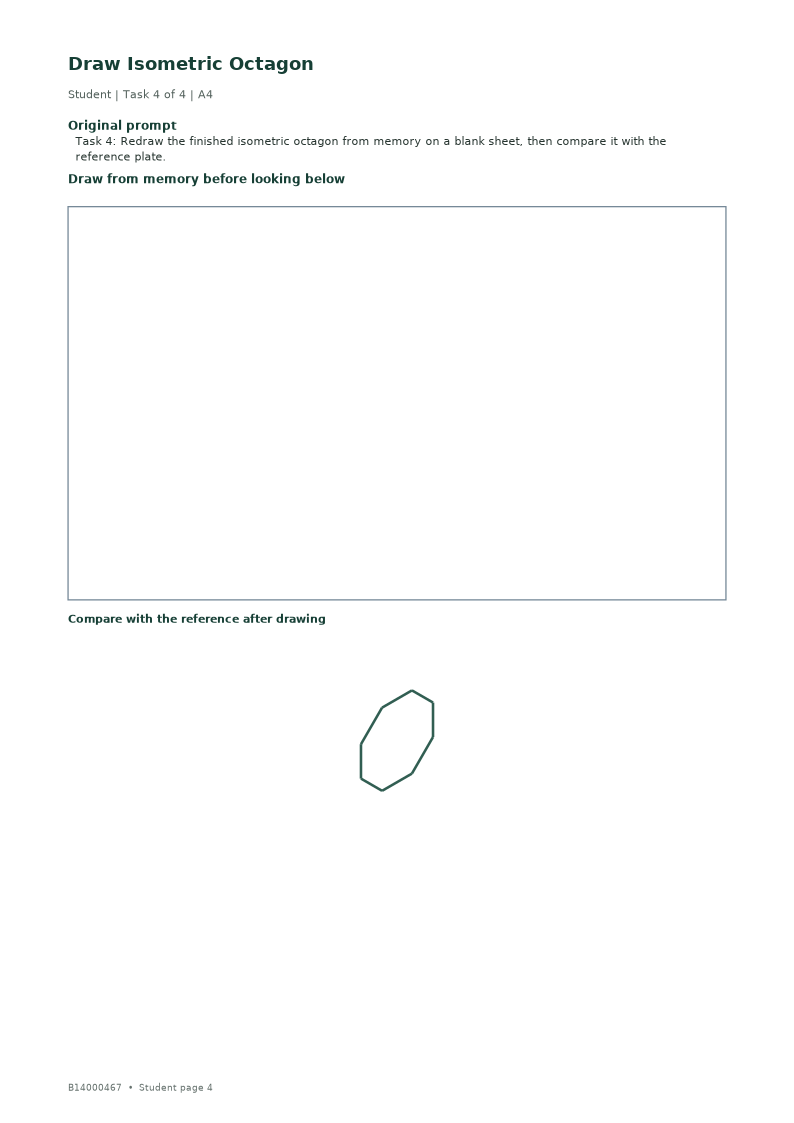
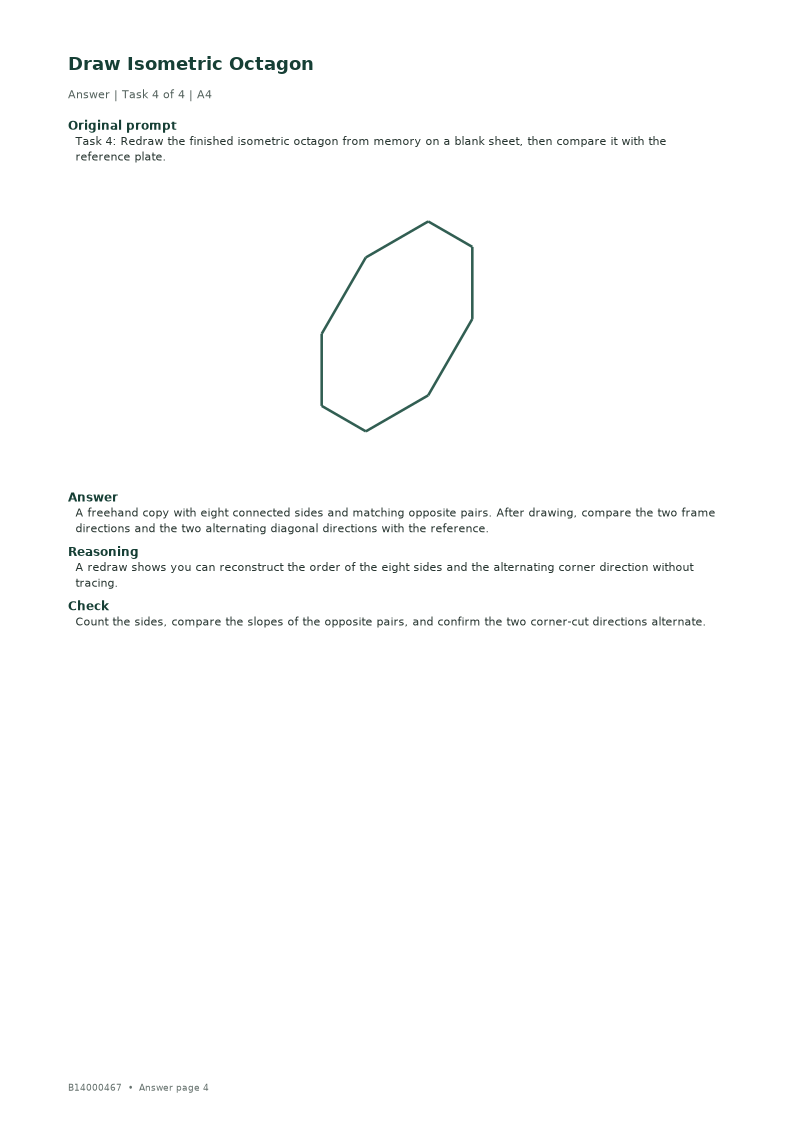
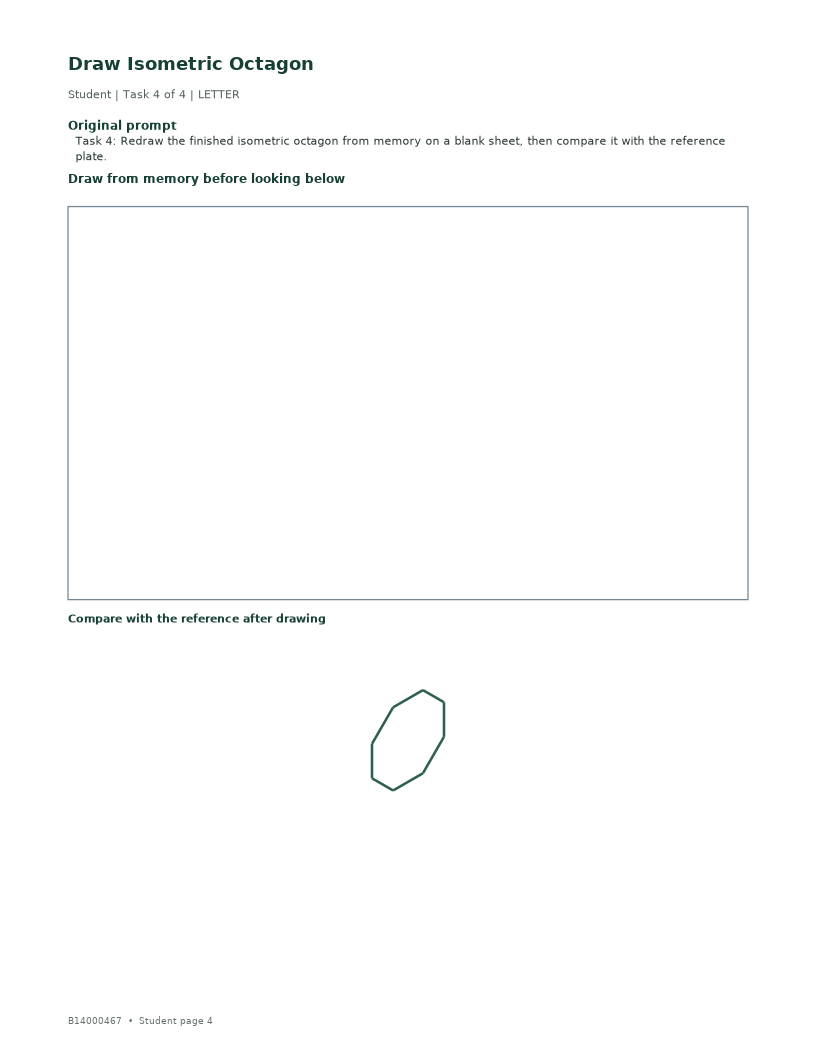
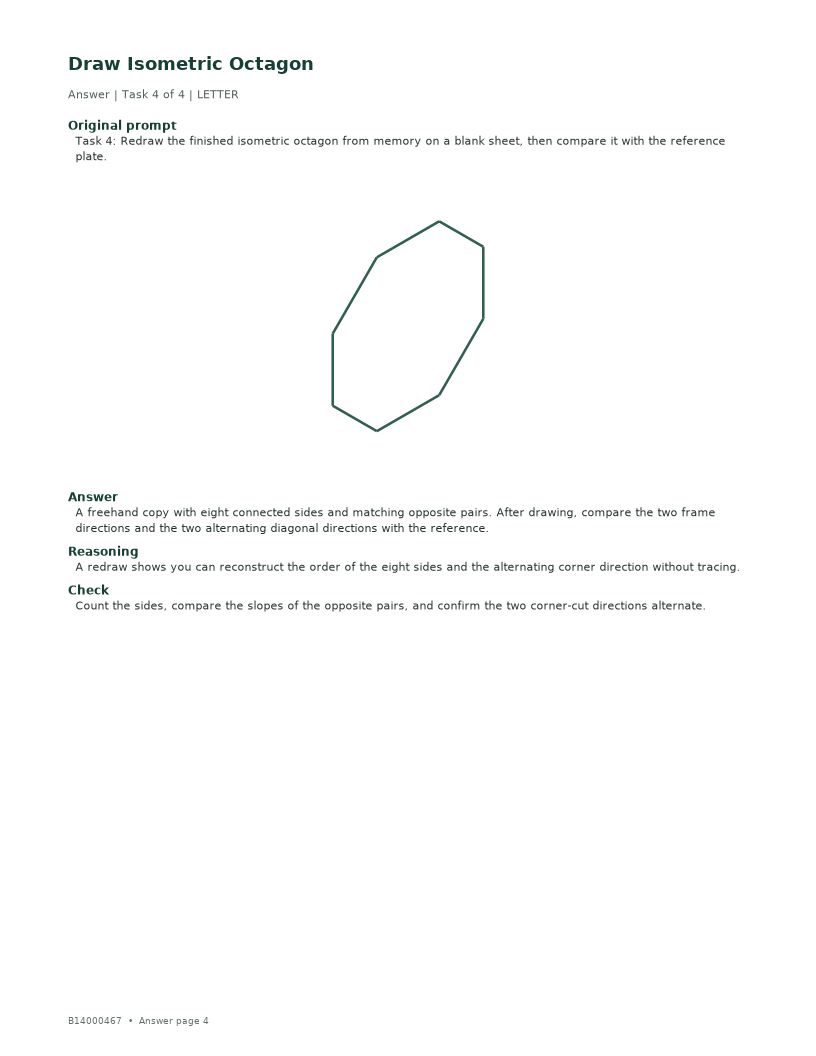
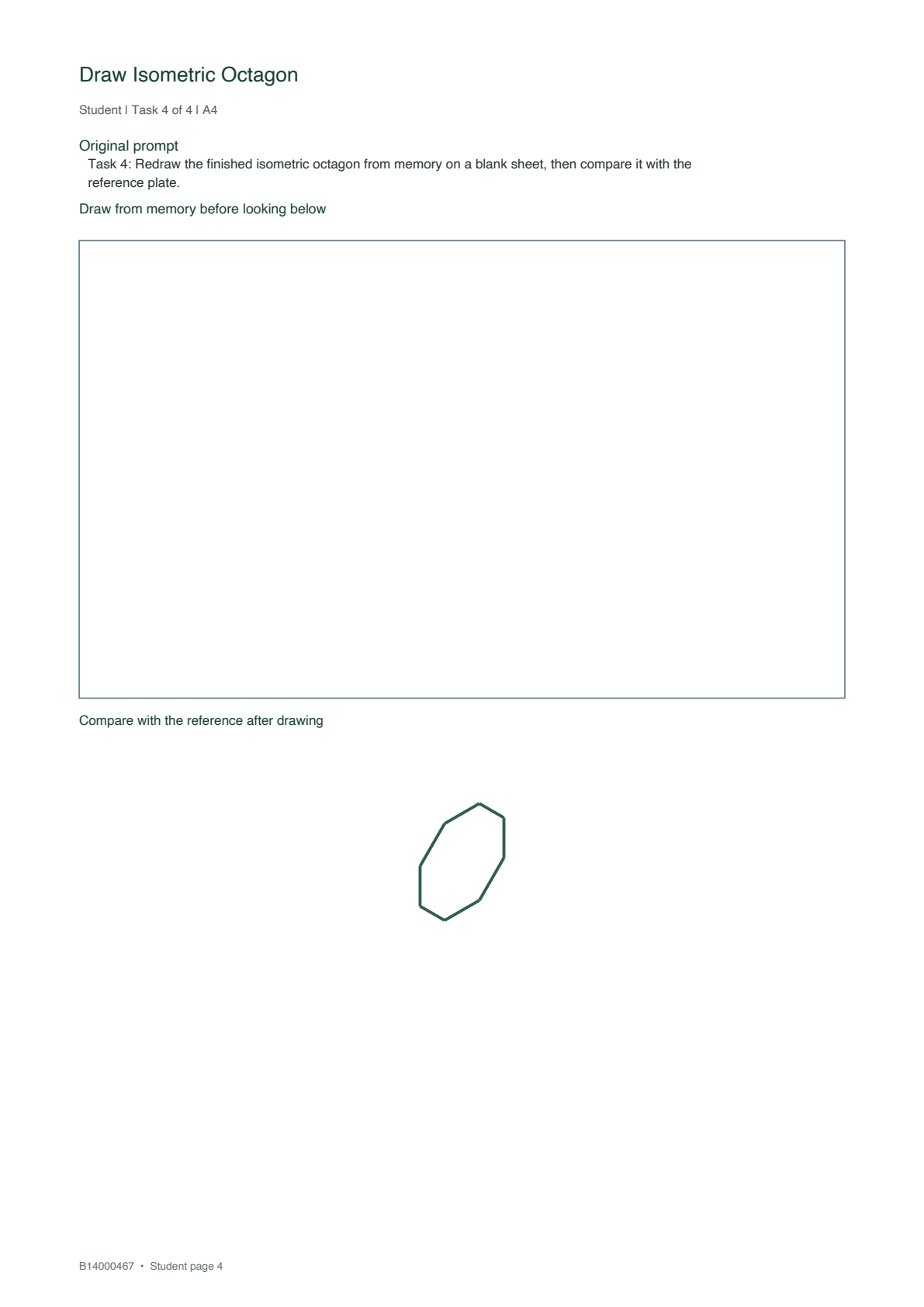
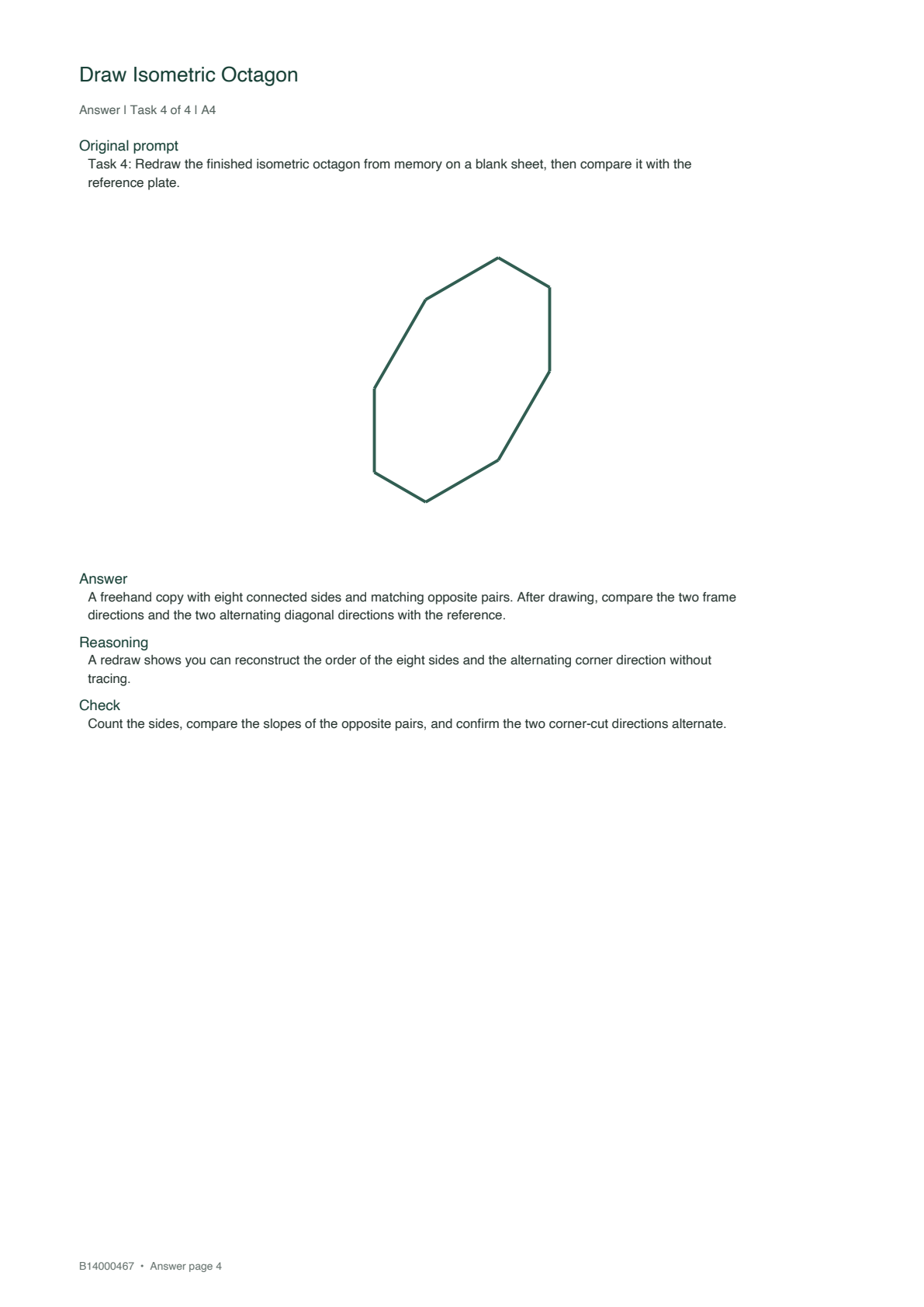
Task 4: Redraw the finished isometric octagon from memory on a blank sheet, then compare it with the reference plate.
Show answer 4
A freehand copy with eight connected sides and matching opposite pairs. After drawing, compare the two frame directions and the two alternating diagonal directions with the reference.
A redraw shows you can reconstruct the order of the eight sides and the alternating corner direction without tracing.
Check: Count the sides, compare the slopes of the opposite pairs, and confirm the two corner-cut directions alternate.
Useful checks
- Forcing all four cuts to follow one diagonal direction. Join each pair of trim marks directly. Opposite cuts are parallel; adjacent corners alternate between the two slopes.
- Making the corner cuts unequal so the shape looks lopsided. Mark the same short distance from each corner along both edges before drawing the cut line.
Questions about this resource
Do I need exact measurements?
For an accurate regular octagon, use the equal trim fraction shown in the worked example. In the memory sketch, judge the same trim visually.
Why does the octagon look tipped?
The square lies in a chosen isometric plane. Its two sides follow the plane's axes, while its diagonals project according to their endpoints.