Free original lessons
Tone a Drawing
Toning a drawing means controlling how light and dark values are placed to describe form. This pack teaches a value-scale strip and sphere toning through observation, construction and checking, with four self-contained practice tasks and complete answers.
Letter & A4
PDF & SVG
What toning a drawing means
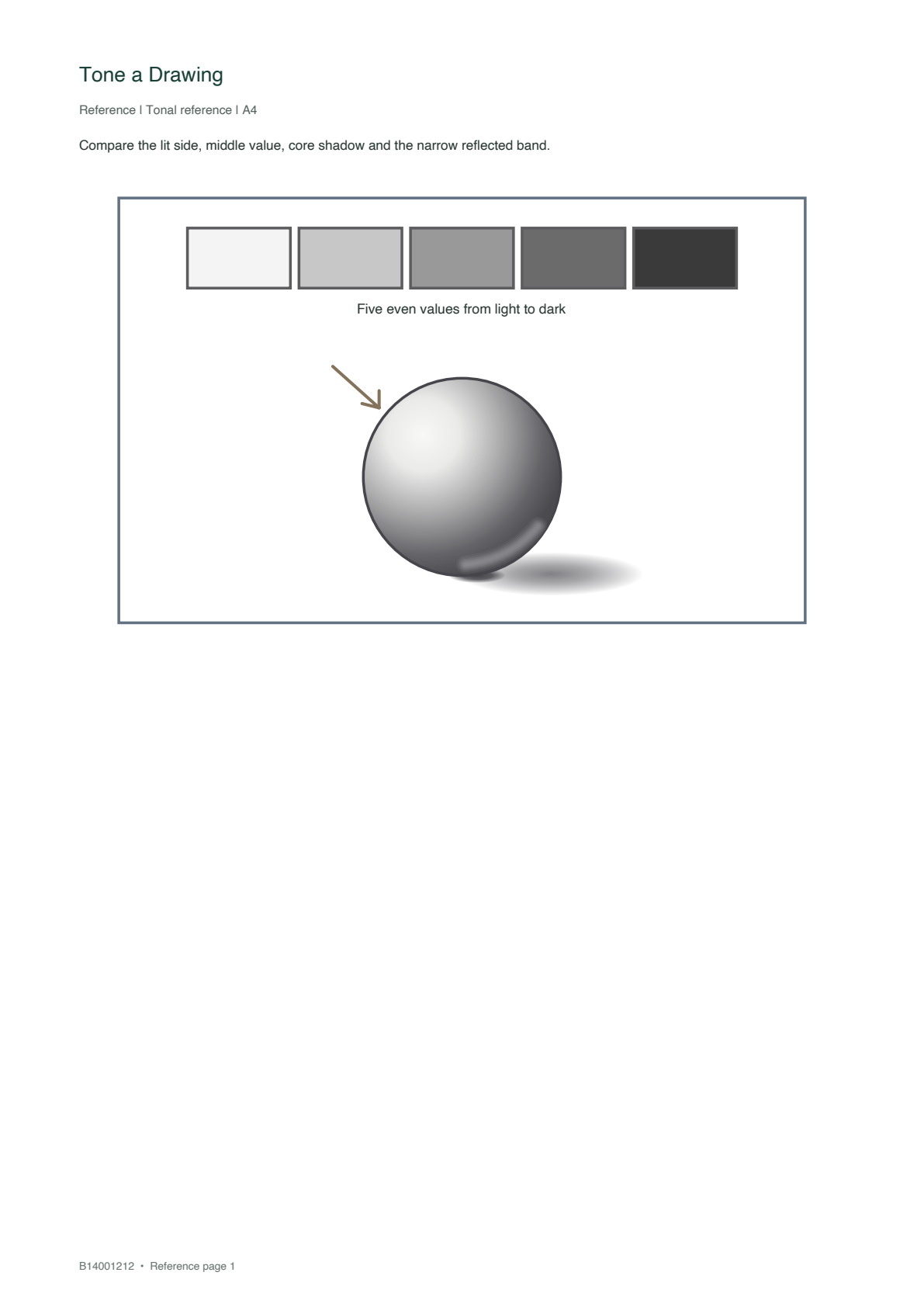
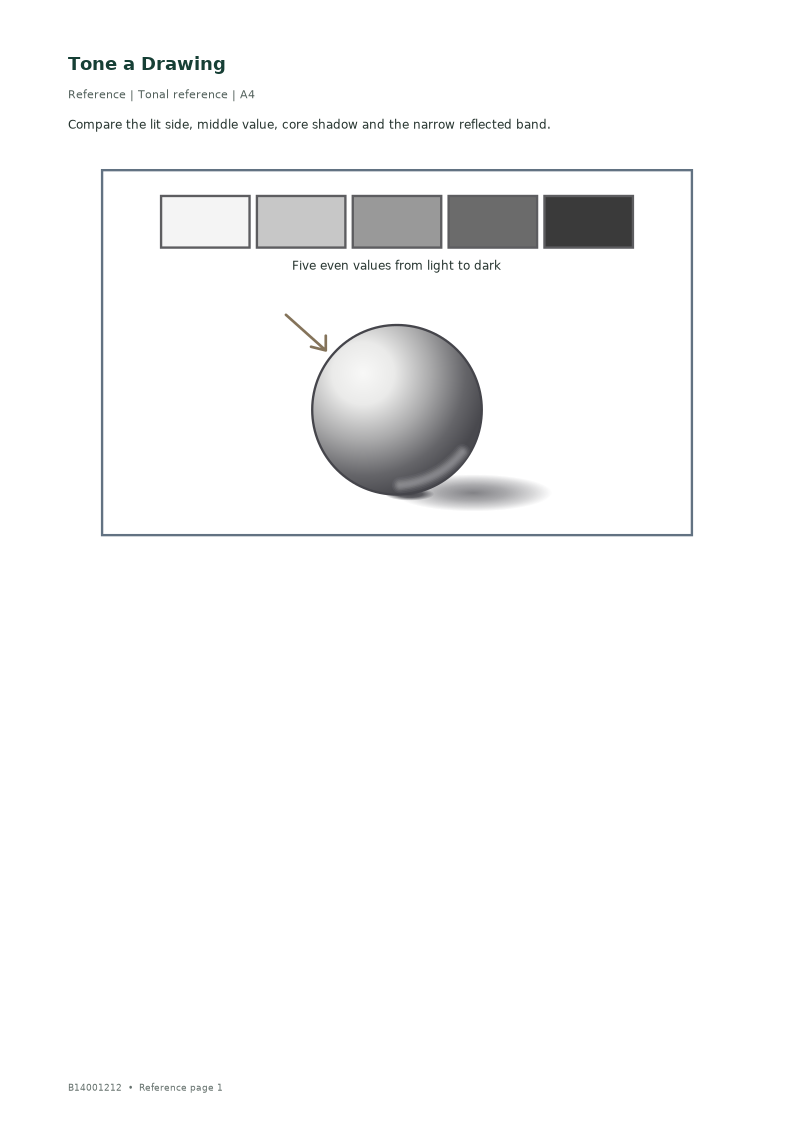
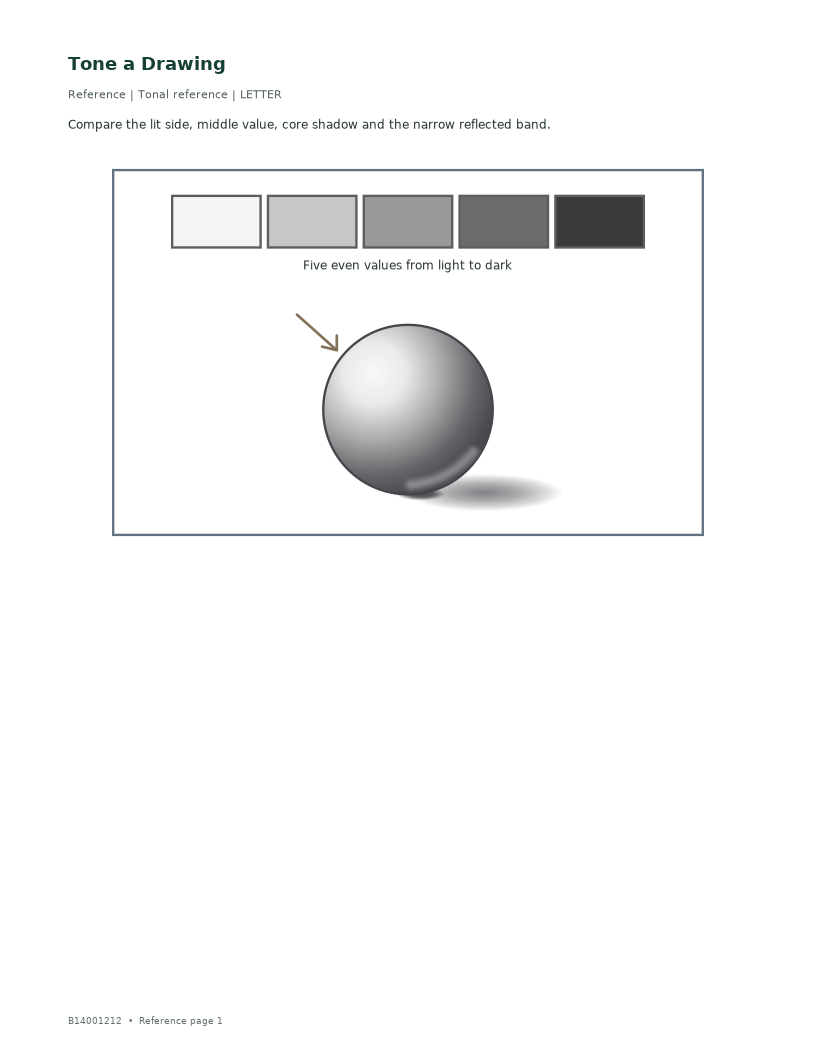
Toning places light, middle and dark values so a drawing reads as solid. A value scale is a strip of patches from the lightest tone to the darkest. The sphere in this lesson shows a gradual turn through those values and a faint reflected band near the lower edge on the shadow side.
Reading the reference
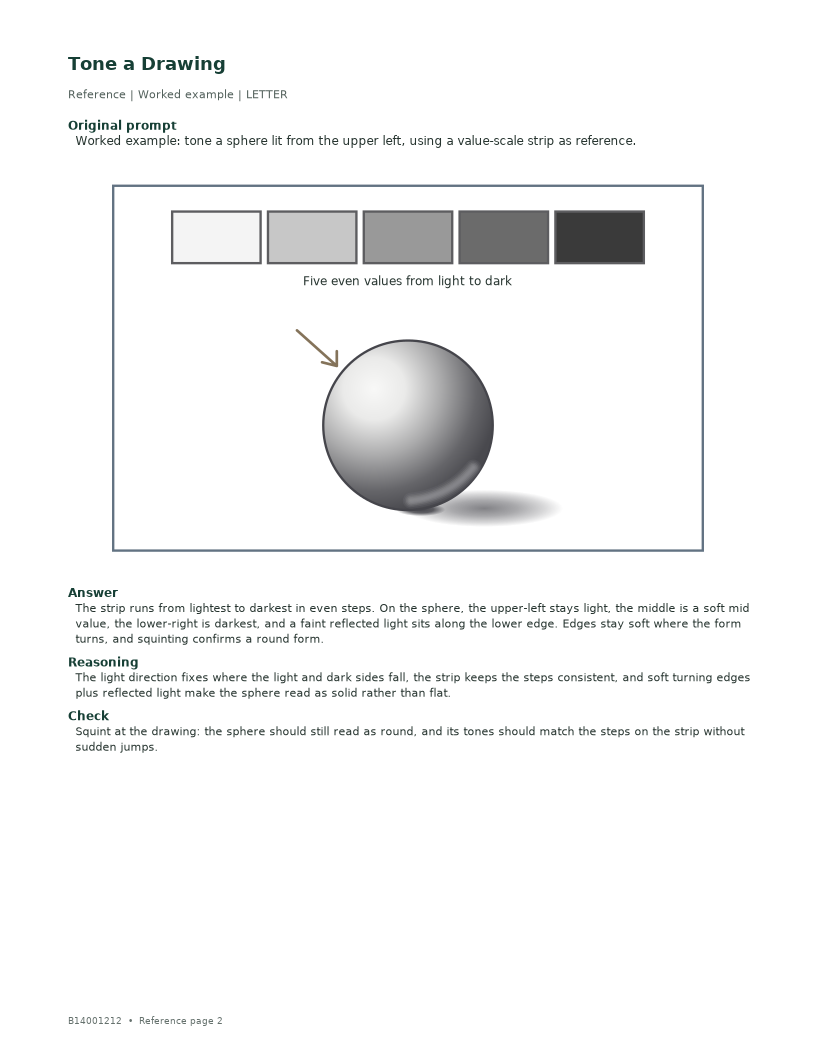
Before shading, look at the reference and name the light direction, the lightest area, the darkest area and any reflected light. In the sphere reference the light comes from the upper left, so the upper-left surface is lightest, the lower-right side is darkest, and a faint reflected light sits along the lower edge. These observations guide where each value belongs.
Building a value-scale strip
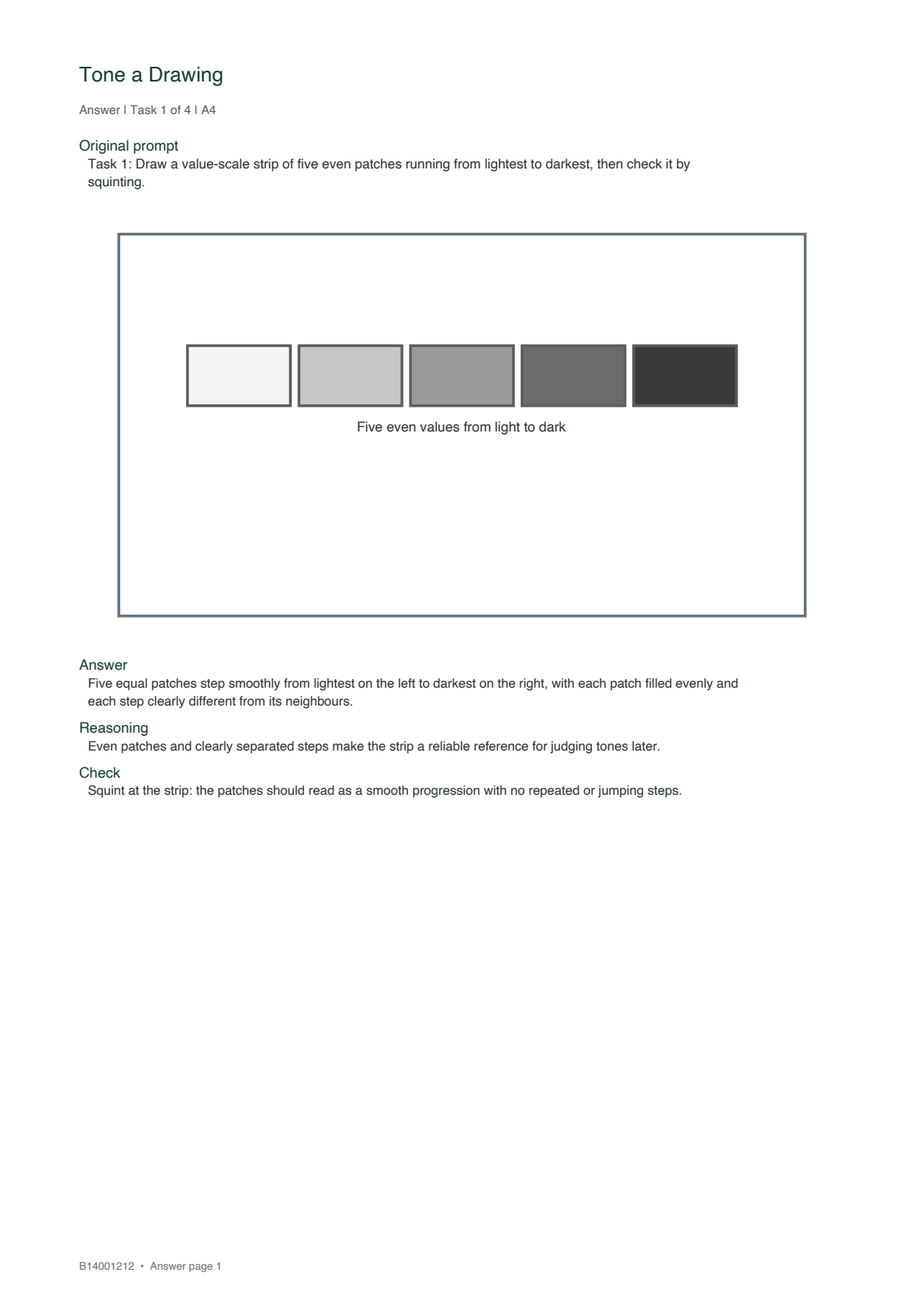
Draw a row of equal patches and fill them in steps from lightest to darkest, keeping each patch even and the steps clearly different. Check the strip by squinting: the patches should read as a smooth progression, not as jumps or repeats. The strip becomes your reference for judging tones in the sphere.
Toning the sphere
Start with a light outline of the sphere and mark the light direction. Block in the middle value over most of the surface, then build the dark side in layers, keeping edges soft where the form turns. Add reflected light near the lower edge and leave the light side mostly untouched. Check by comparing the sphere's tones against your strip and by squinting to confirm the form still reads as round.
Download the complete resource pack
All individual SVG pages (20)
- A4 reference page 1
- A4 reference page 2
- A4 student page 1
- A4 student page 2
- A4 student page 3
- A4 student page 4
- A4 answer page 1
- A4 answer page 2
- A4 answer page 3
- A4 answer page 4
- LETTER reference page 1
- LETTER reference page 2
- LETTER student page 1
- LETTER student page 2
- LETTER student page 3
- LETTER student page 4
- LETTER answer page 1
- LETTER answer page 2
- LETTER answer page 3
- LETTER answer page 4
Print at 100% / actual size. Use the stated scale on any schematic diagram; physical cutting templates are identified separately. A4 and US Letter are separate files. Free access, no signup; CC BY 4.0.
How to use these pages
- What toning a drawing means
- Reading the reference
- Building a value-scale strip
- Toning the sphere
Worked example
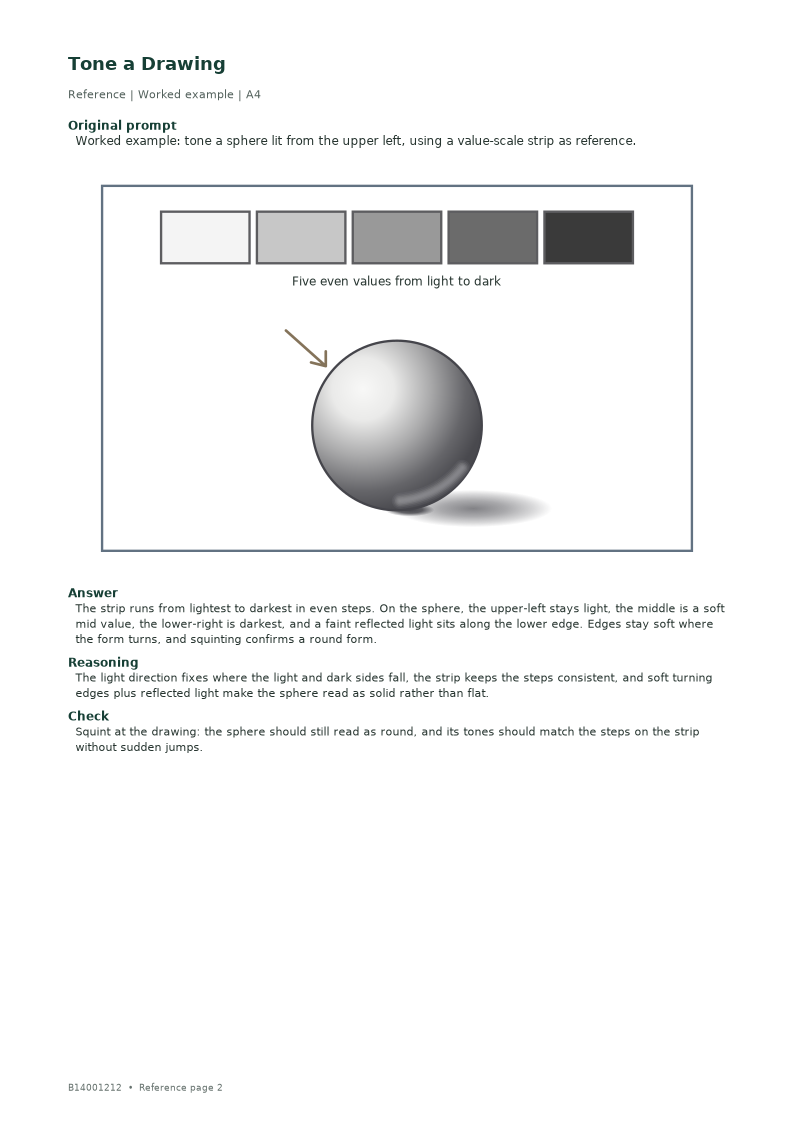
Example: Worked example: tone a sphere lit from the upper left, using a value-scale strip as reference.
Answer: The strip runs from lightest to darkest in even steps. On the sphere, the upper-left stays light, the middle is a soft mid value, the lower-right is darkest, and a faint reflected light sits along the lower edge. Edges stay soft where the form turns, and squinting confirms a round form.
Reasoning: The light direction fixes where the light and dark sides fall, the strip keeps the steps consistent, and soft turning edges plus reflected light make the sphere read as solid rather than flat.
Check: Squint at the drawing: the sphere should still read as round, and its tones should match the steps on the strip without sudden jumps.
Four practice tasks and complete answers
Task 1
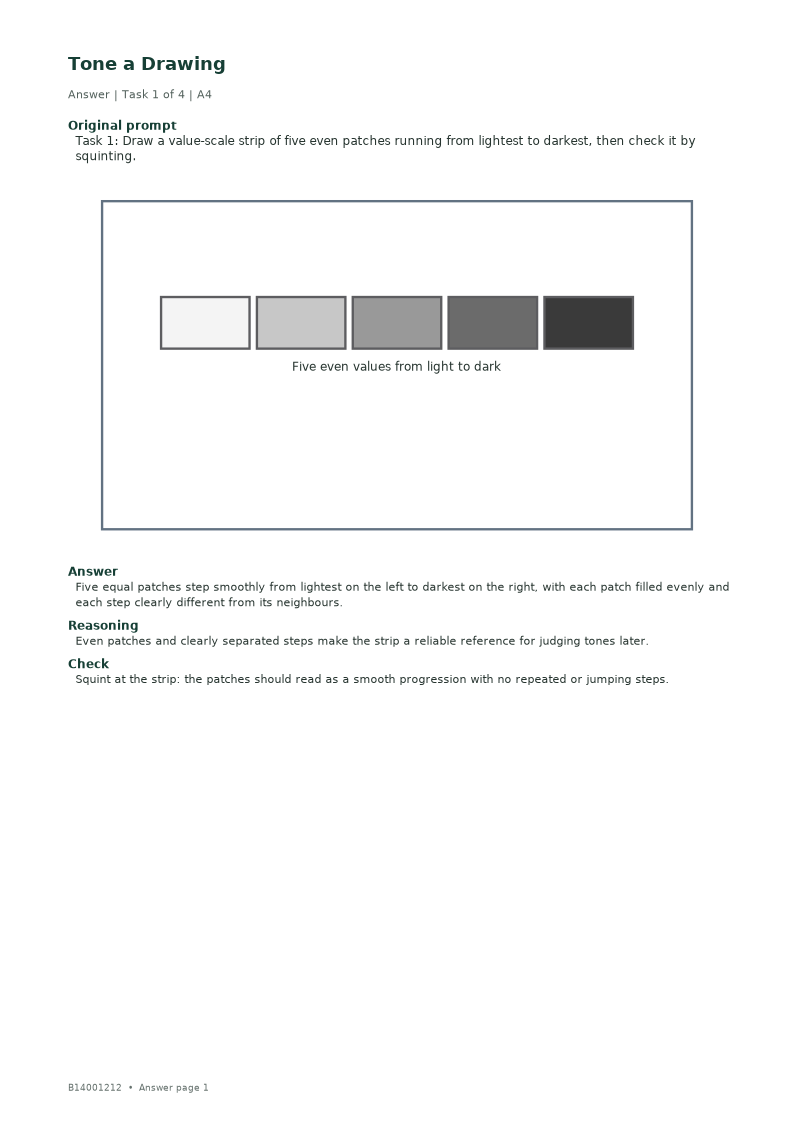
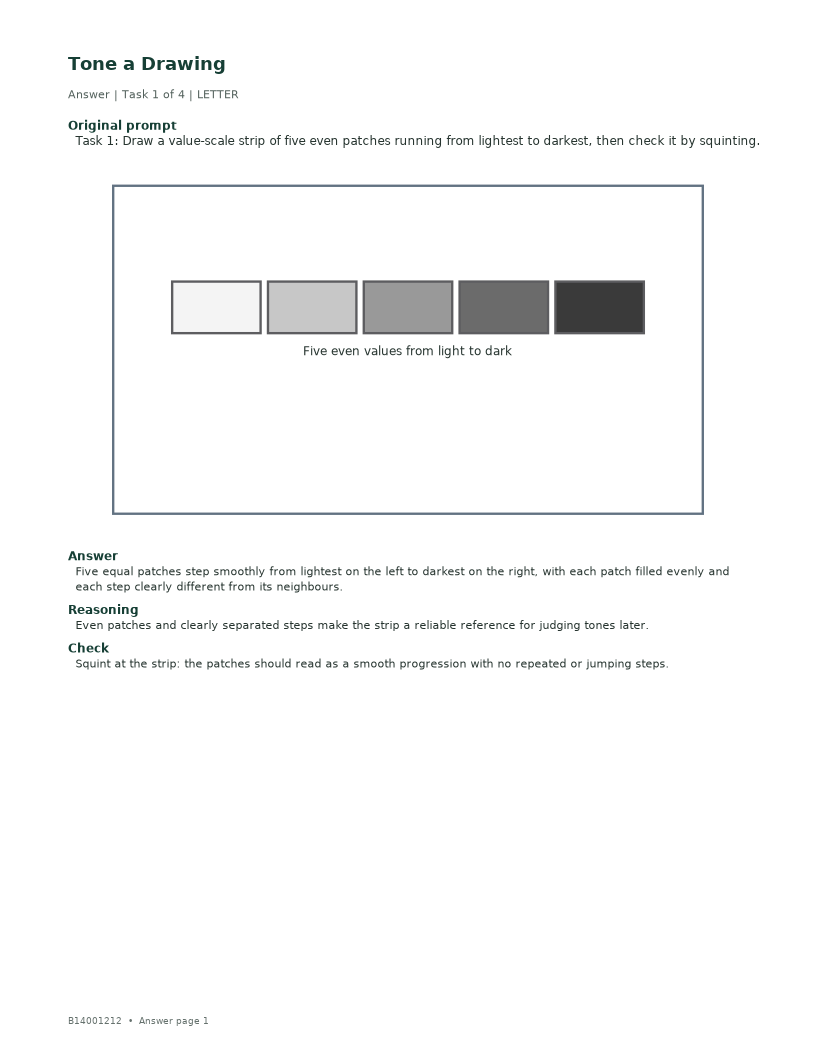
Task 1: Draw a value-scale strip of five even patches running from lightest to darkest, then check it by squinting.
Show answer 1
Five equal patches step smoothly from lightest on the left to darkest on the right, with each patch filled evenly and each step clearly different from its neighbours.
Even patches and clearly separated steps make the strip a reliable reference for judging tones later.
Check: Squint at the strip: the patches should read as a smooth progression with no repeated or jumping steps.
Task 2
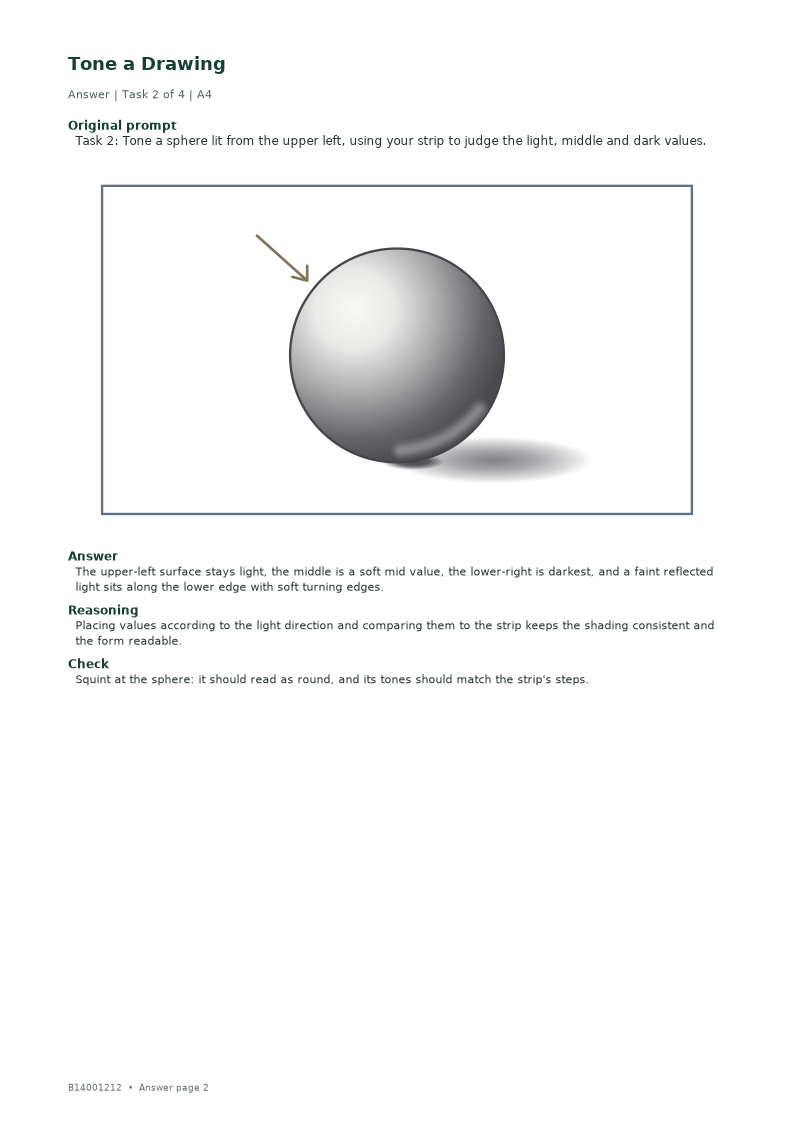
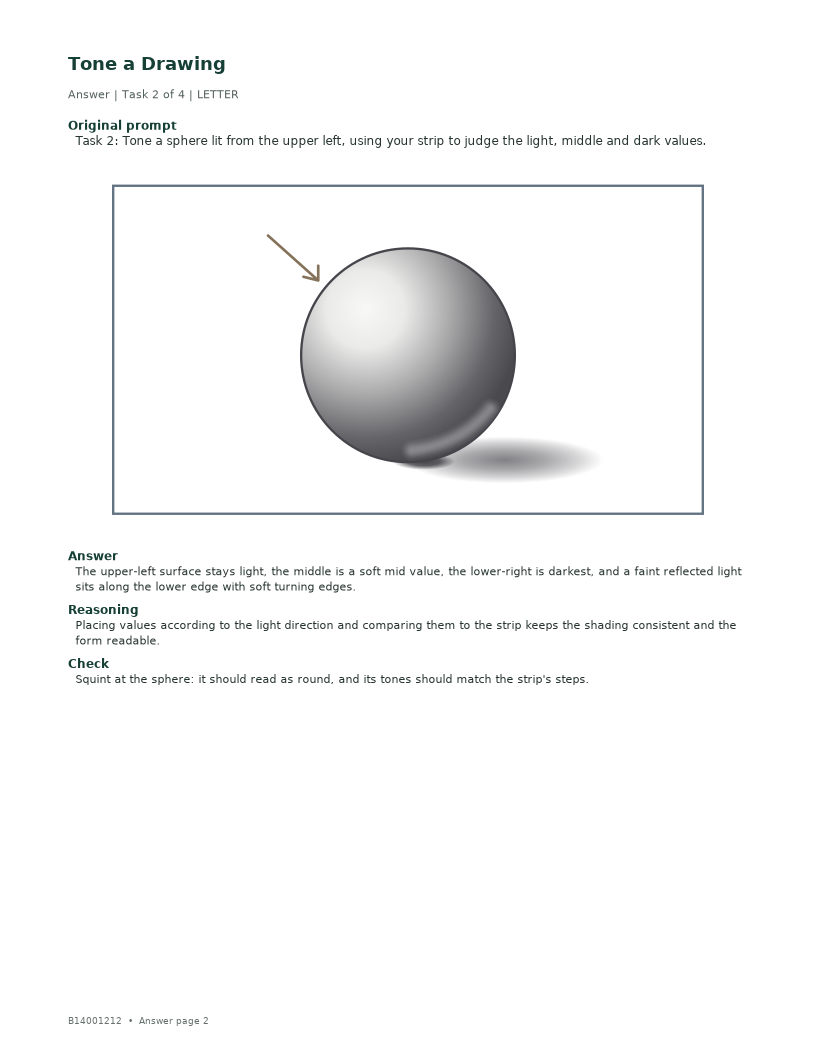
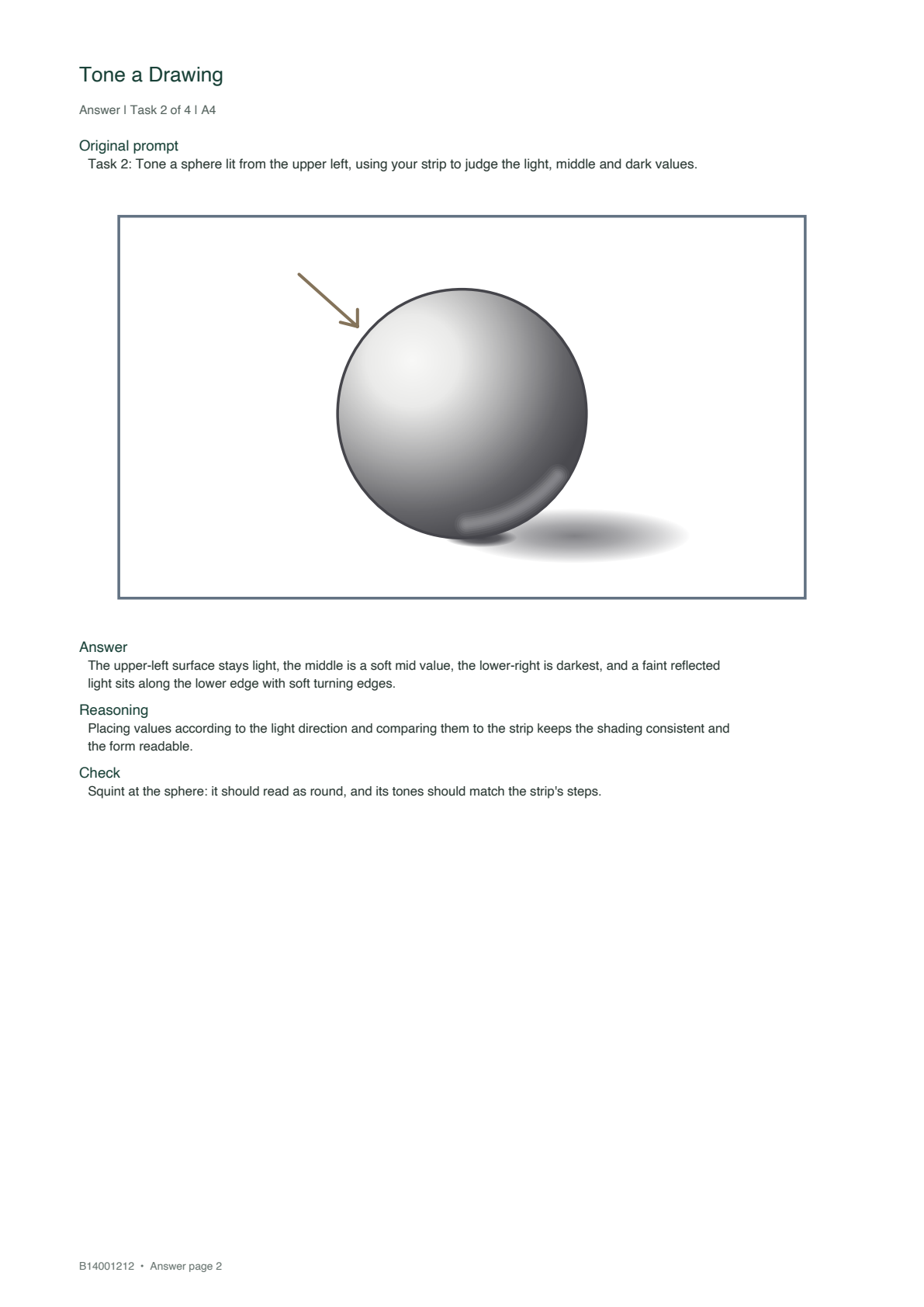
Task 2: Tone a sphere lit from the upper left, using your strip to judge the light, middle and dark values.
Show answer 2
The upper-left surface stays light, the middle is a soft mid value, the lower-right is darkest, and a faint reflected light sits along the lower edge with soft turning edges.
Placing values according to the light direction and comparing them to the strip keeps the shading consistent and the form readable.
Check: Squint at the sphere: it should read as round, and its tones should match the strip's steps.
Task 3
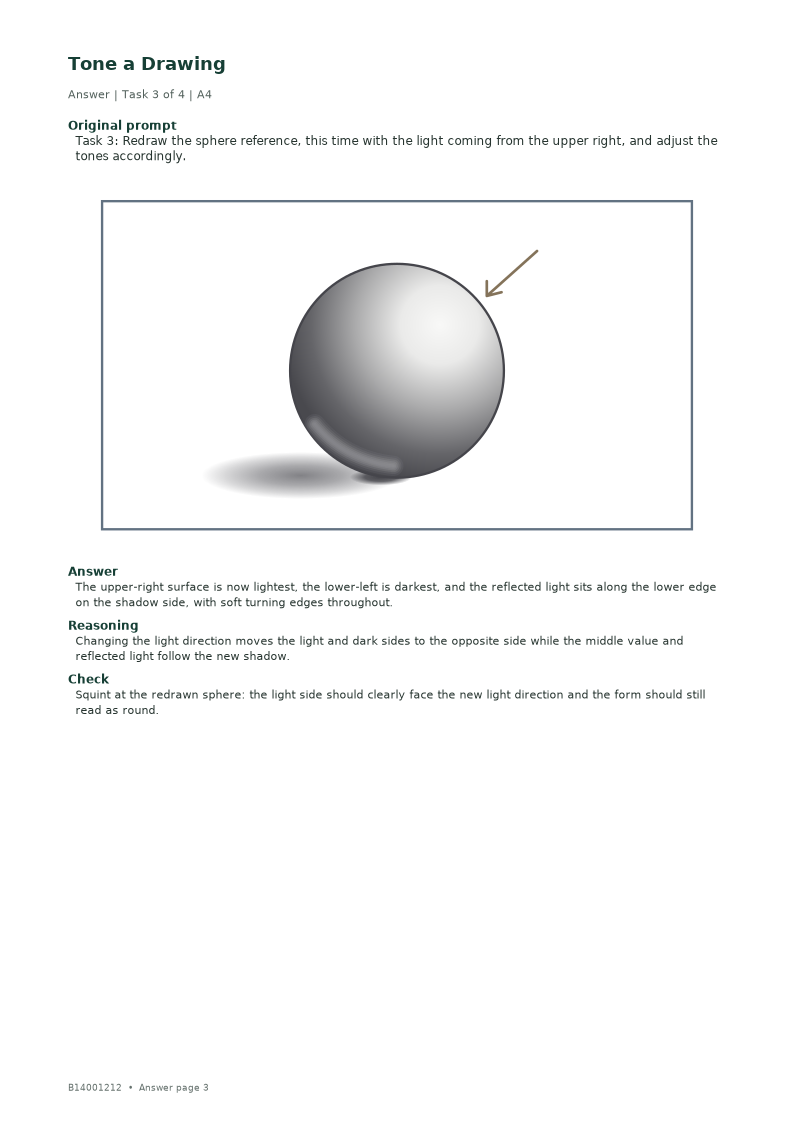
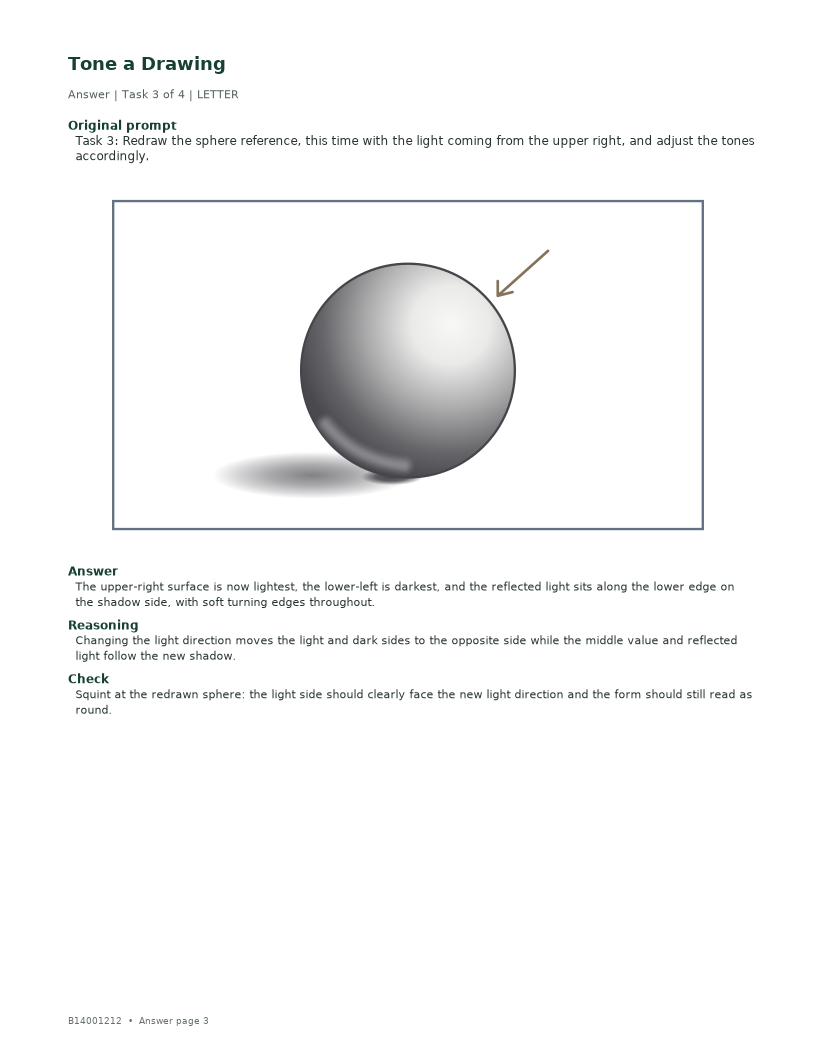
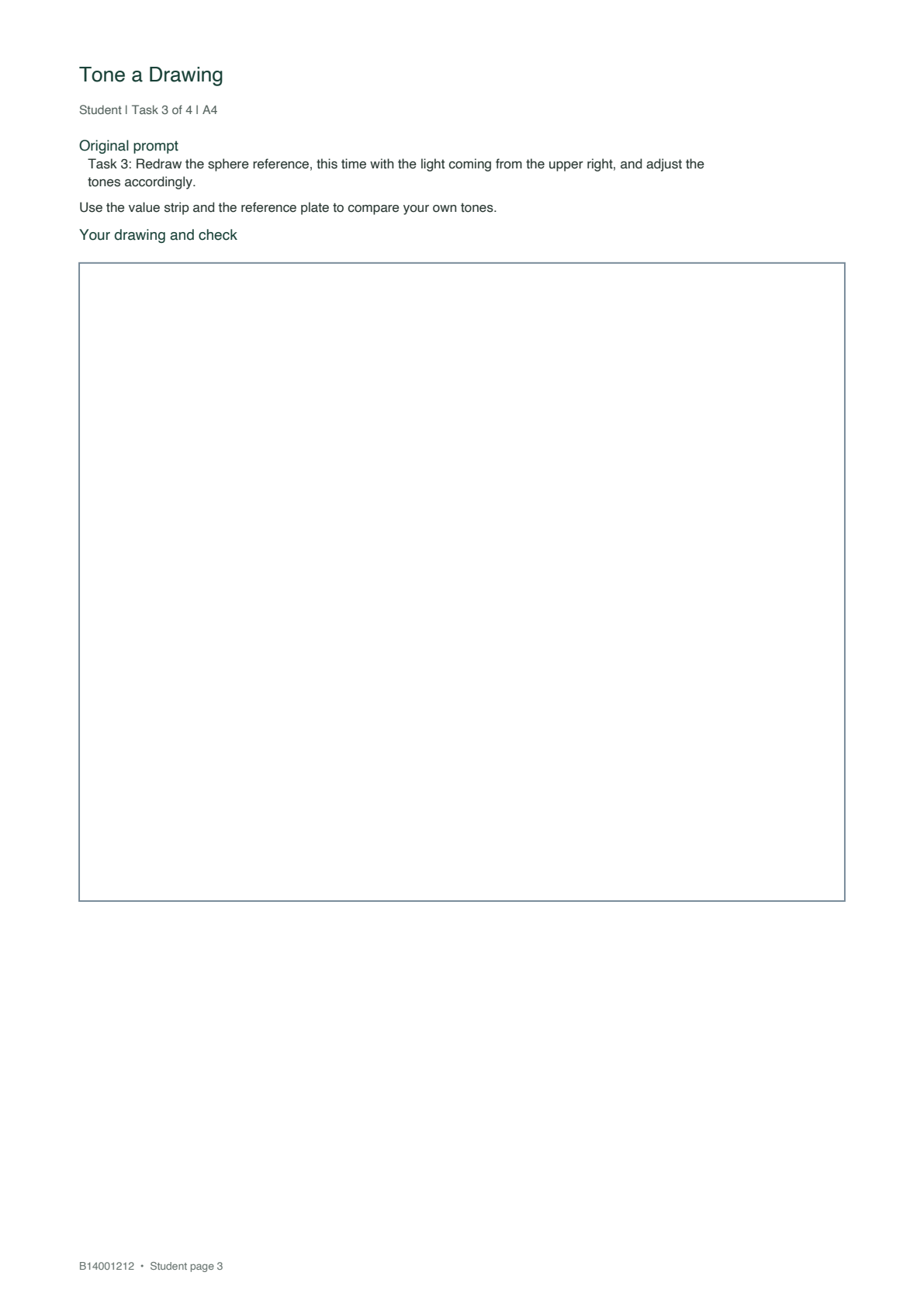
Task 3: Redraw the sphere reference, this time with the light coming from the upper right, and adjust the tones accordingly.
Show answer 3
The upper-right surface is now lightest, the lower-left is darkest, and the reflected light sits along the lower edge on the shadow side, with soft turning edges throughout.
Changing the light direction moves the light and dark sides to the opposite side while the middle value and reflected light follow the new shadow.
Check: Squint at the redrawn sphere: the light side should clearly face the new light direction and the form should still read as round.
Task 4
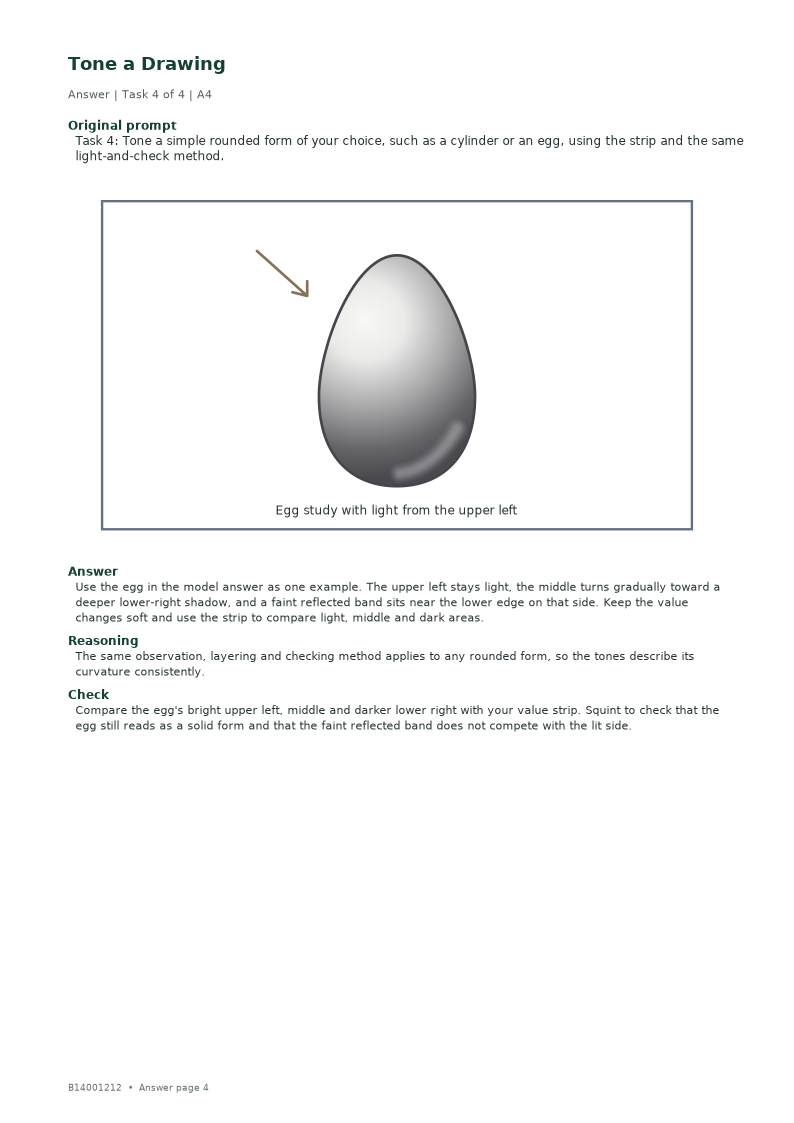
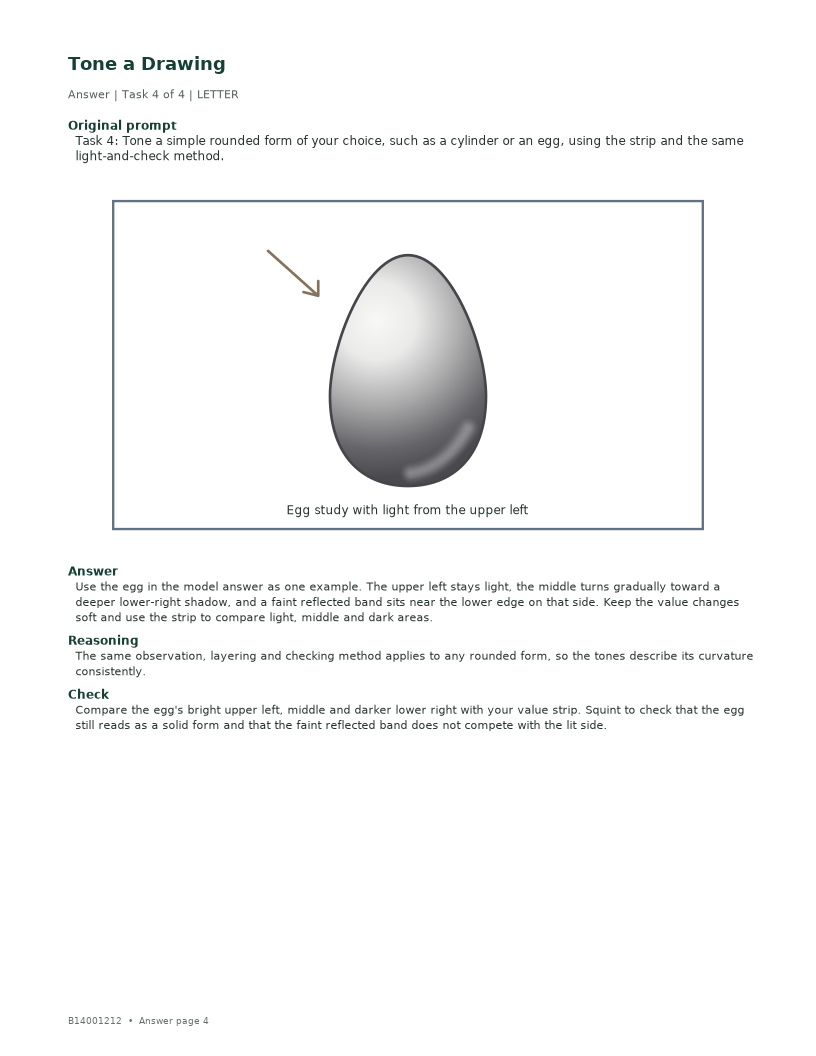
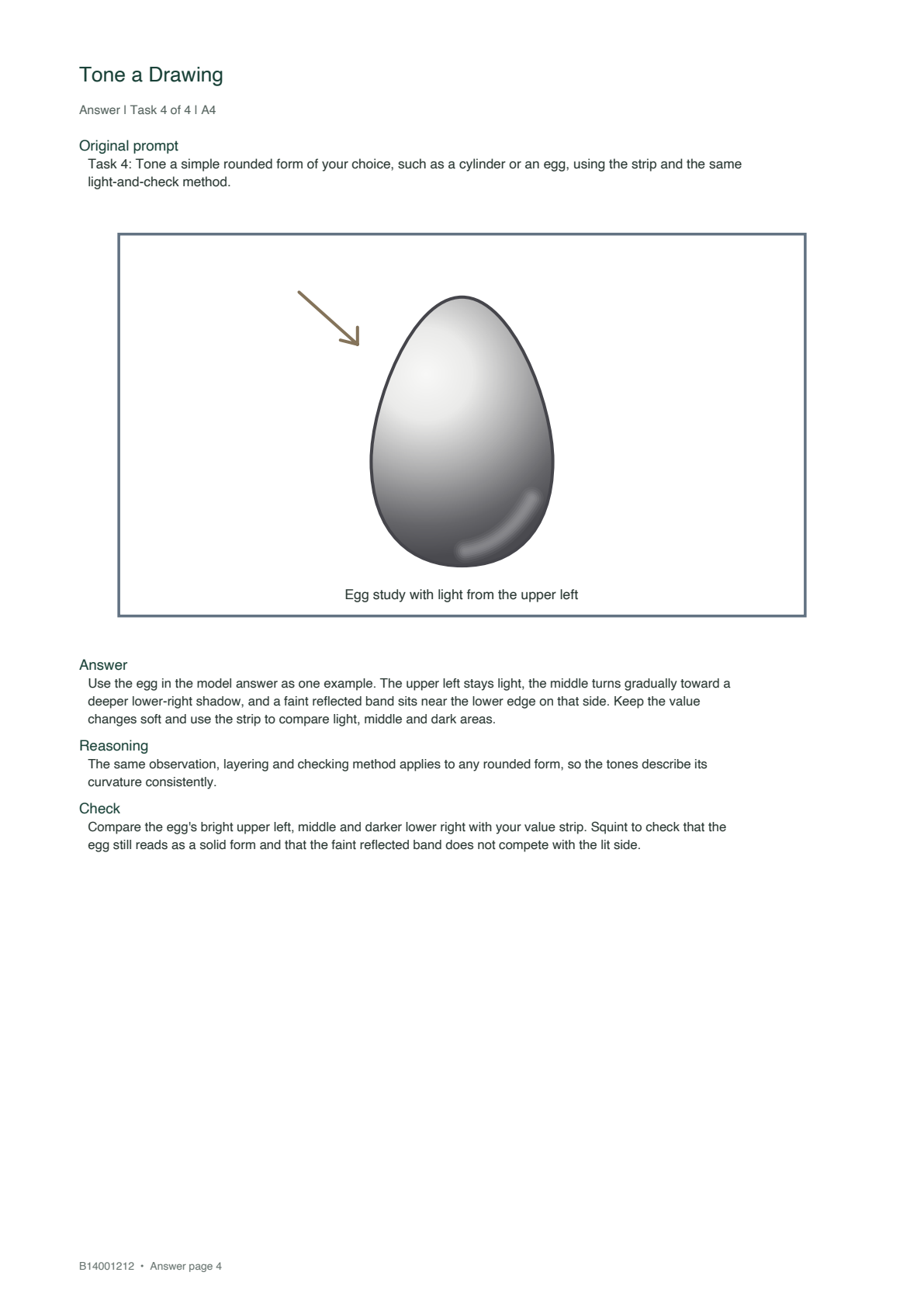
Task 4: Tone a simple rounded form of your choice, such as a cylinder or an egg, using the strip and the same light-and-check method.
Show answer 4
Use the egg in the model answer as one example. The upper left stays light, the middle turns gradually toward a deeper lower-right shadow, and a faint reflected band sits near the lower edge on that side. Keep the value changes soft and use the strip to compare light, middle and dark areas.
The same observation, layering and checking method applies to any rounded form, so the tones describe its curvature consistently.
Check: Compare the egg's bright upper left, middle and darker lower right with your value strip. Squint to check that the egg still reads as a solid form and that the faint reflected band does not compete with the lit side.
Useful checks
- Filling the whole sphere with one flat tone. Block in a middle value first, then build the dark side in layers and leave the light side mostly untouched.
- Making the dark side too hard-edged. Keep edges soft where the form turns, so the shading describes curvature rather than a flat patch.
- Skipping the value-scale strip. Build the strip first and compare the sphere's tones against it, so the steps stay consistent.
Questions about this resource
Do I need special materials?
No. A pencil and paper are enough; the strip and sphere can be drawn with any ordinary drawing tool.
How do I know my tones are right?
Compare them against your value-scale strip and squint at the drawing to confirm the form still reads as round.