Free original lessons
Draw a Shaded Sphere
This pack teaches you to draw and shade an eight-ball. You will construct a round ball, place the white number circle on its surface, and build light and shadow so the ball reads as a solid glossy sphere resting on a surface. The same shading logic also works for a plain sphere; the eight-ball adds the number circle and a glossier surface treatment.
Letter & A4
PDF & SVG
What you are drawing
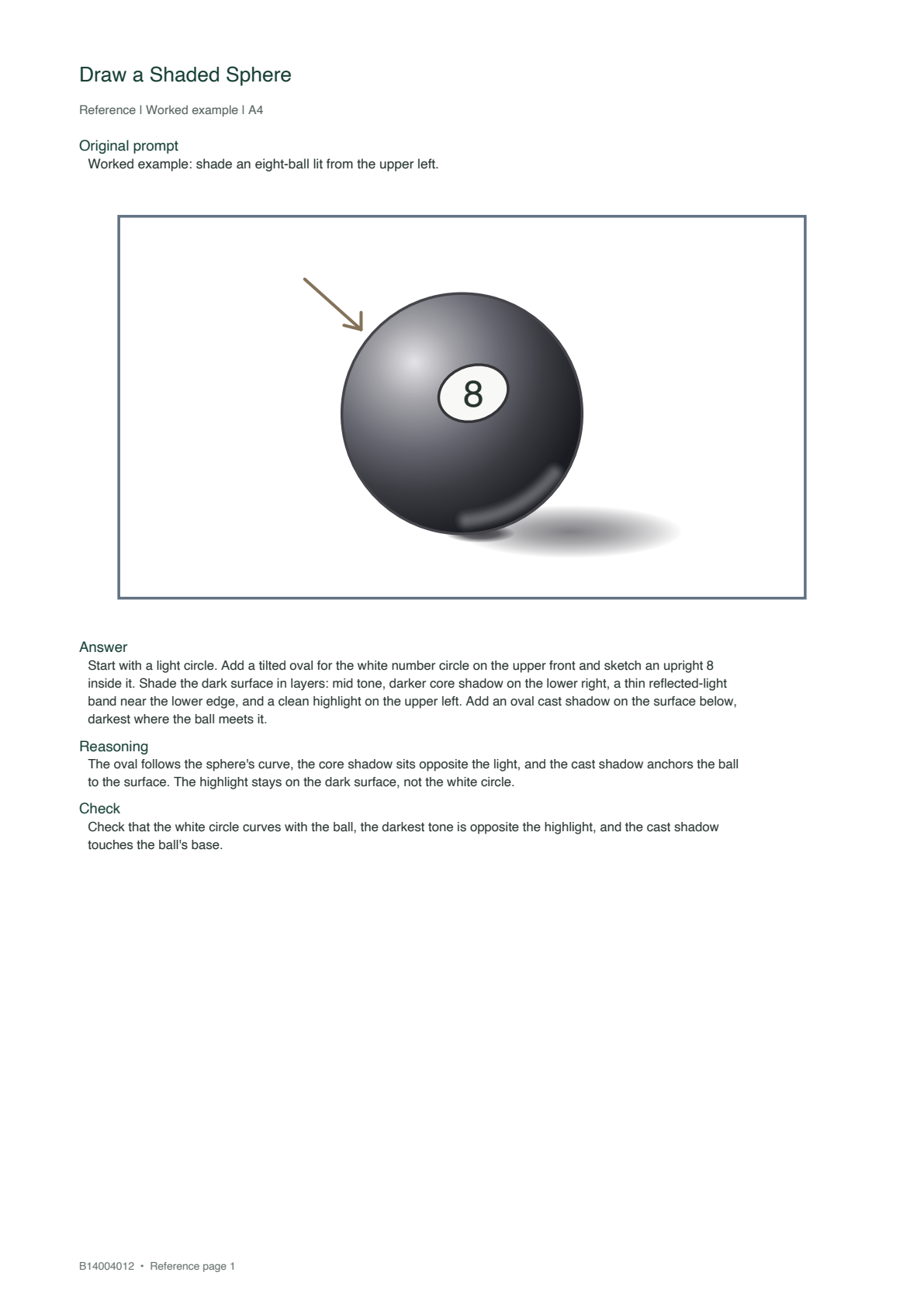
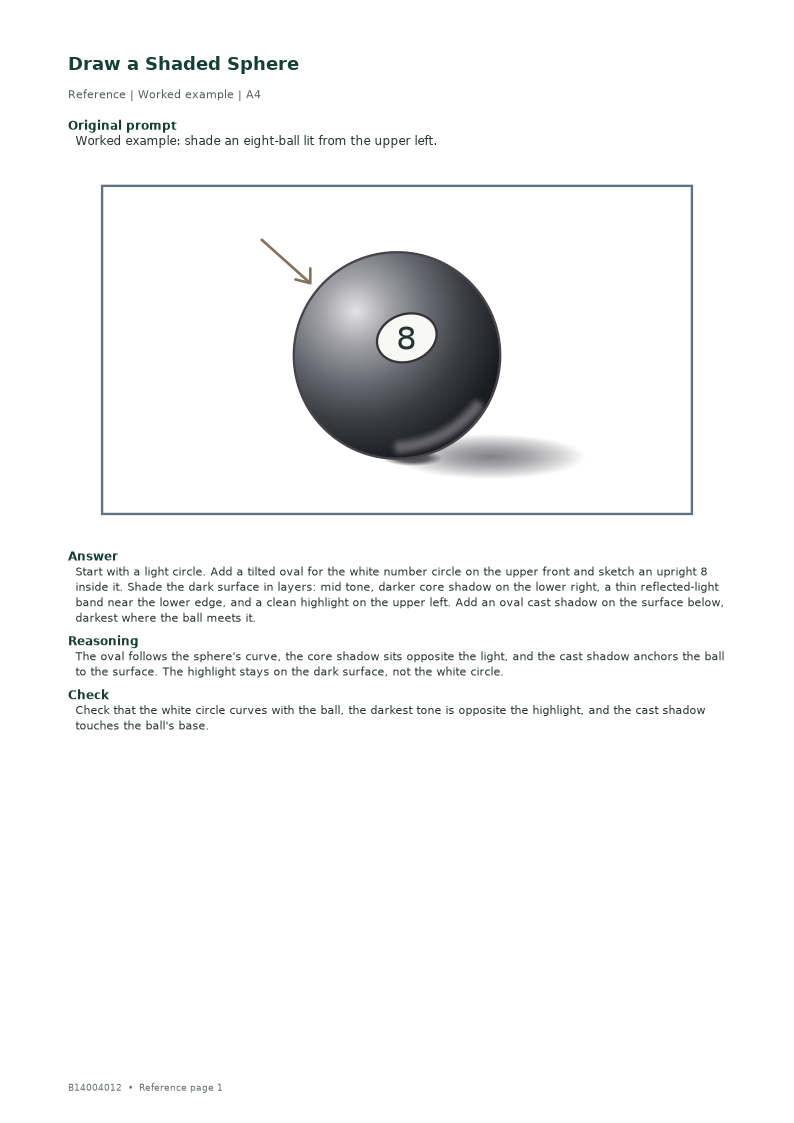
An eight-ball is a dark, glossy sphere with a white circle on its surface containing the number 8. The white circle sits on the curved surface, so it appears slightly distorted and follows the ball's roundness rather than lying flat like a sticker on paper. The ball has a bright highlight, a darker core shadow on the side away from the light, a faint reflected light near the lower edge, and a cast shadow on the surface beneath it.
Step 1: Build the sphere
Draw a clean circle for the ball. Keep the outline light so you can adjust it. Decide where the light comes from; for this pack, choose a light from the upper left. That choice is a classroom convention, not a rule about how balls must be lit. Mark a small oval for the white number circle on the upper front of the ball, tilted to follow the curve.
Step 2: Place the number circle
Draw a tilted oval on the upper front to show the white number marking seen obliquely. Draw the 8 upright and keep the marking readable against the dark shell. Use the same oval position and tilt when you reverse the light in Tasks 2 and 3.
Step 3: Shade the ball
Shade the dark shell around the white marking. Keep a small bright highlight on the upper left of the shell, a deeper core shadow on the lower right, and a faint curved band of reflected light just inside the lower edge, where the drawing shows it. Keep the outer edge of that band soft.
Download the complete resource pack
All individual SVG pages (18)
- A4 reference page 1
- A4 student page 1
- A4 student page 2
- A4 student page 3
- A4 student page 4
- A4 answer page 1
- A4 answer page 2
- A4 answer page 3
- A4 answer page 4
- LETTER reference page 1
- LETTER student page 1
- LETTER student page 2
- LETTER student page 3
- LETTER student page 4
- LETTER answer page 1
- LETTER answer page 2
- LETTER answer page 3
- LETTER answer page 4
Print at 100% / actual size. Use the stated scale on any schematic diagram; physical cutting templates are identified separately. A4 and US Letter are separate files. Free access, no signup; CC BY 4.0.
How to use these pages
- What you are drawing
- Step 1: Build the sphere
- Step 2: Place the number circle
- Step 3: Shade the ball
Worked example
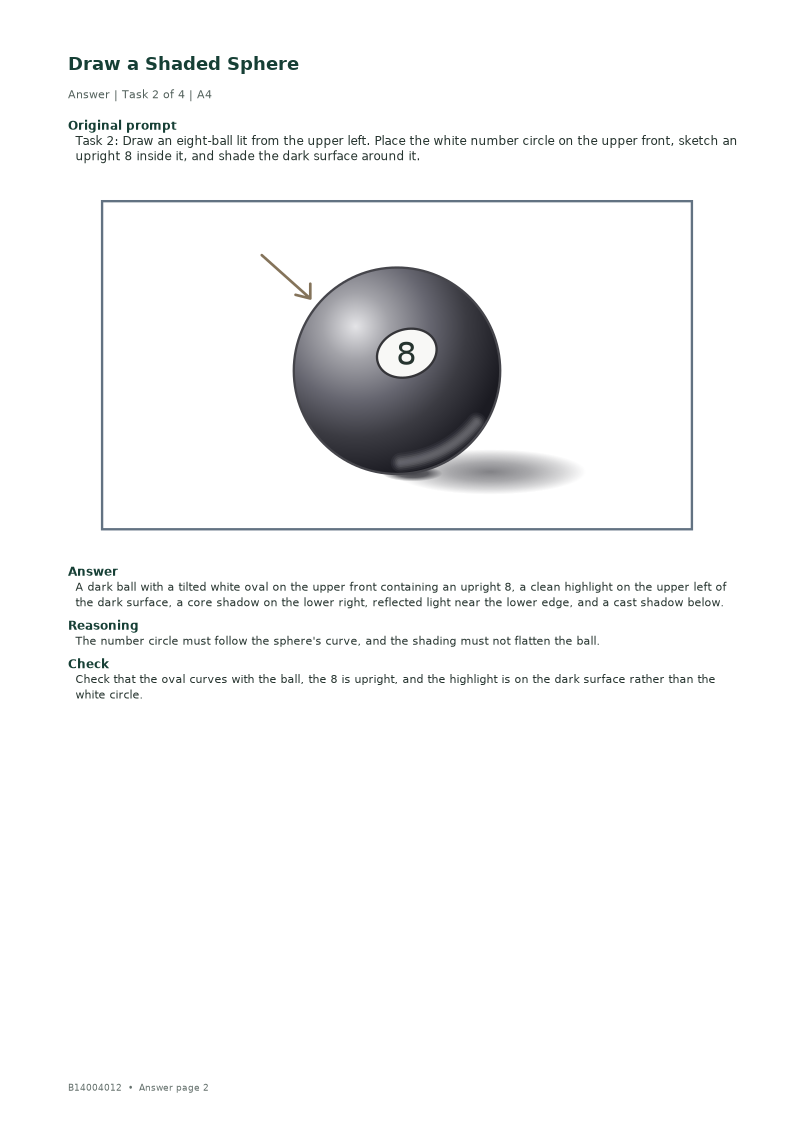
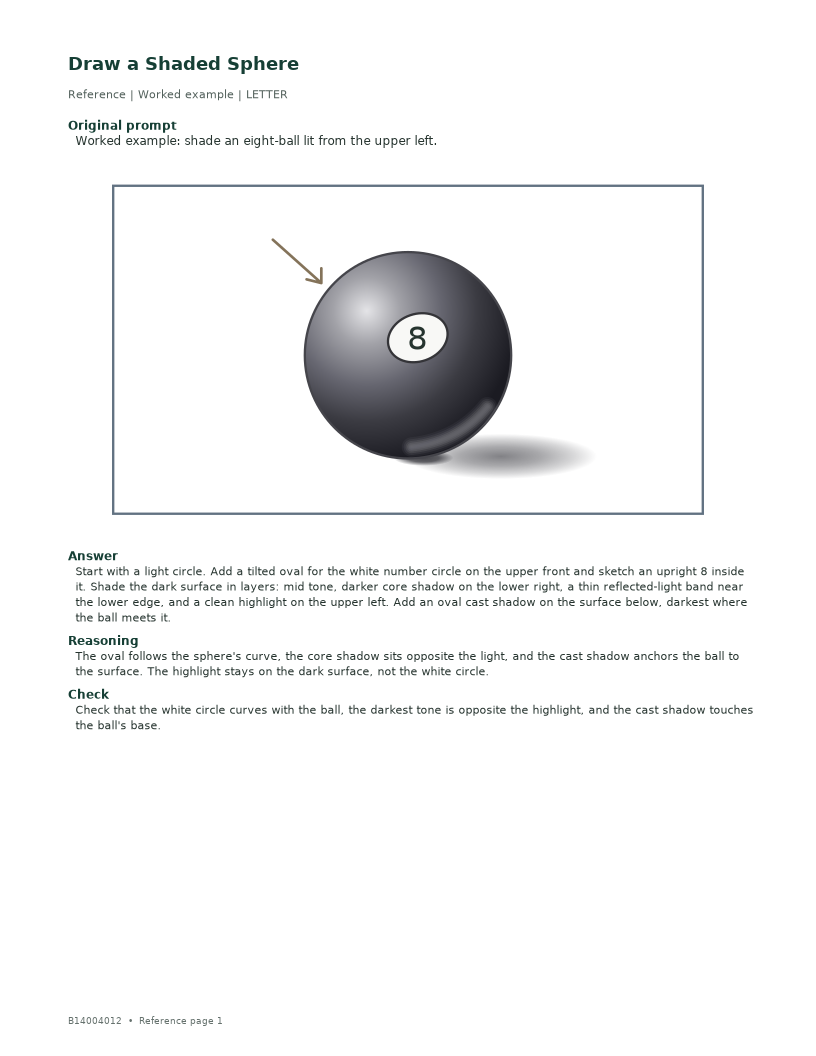
Example: Worked example: shade an eight-ball lit from the upper left.
Answer: Start with a light circle. Add a tilted oval for the white number circle on the upper front and sketch an upright 8 inside it. Shade the dark surface in layers: mid tone, darker core shadow on the lower right, a thin reflected-light band near the lower edge, and a clean highlight on the upper left. Add an oval cast shadow on the surface below, darkest where the ball meets it.
Reasoning: The oval follows the sphere's curve, the core shadow sits opposite the light, and the cast shadow anchors the ball to the surface. The highlight stays on the dark surface, not the white circle.
Check: Check that the white circle curves with the ball, the darkest tone is opposite the highlight, and the cast shadow touches the ball's base.
Four practice tasks and complete answers
Task 1
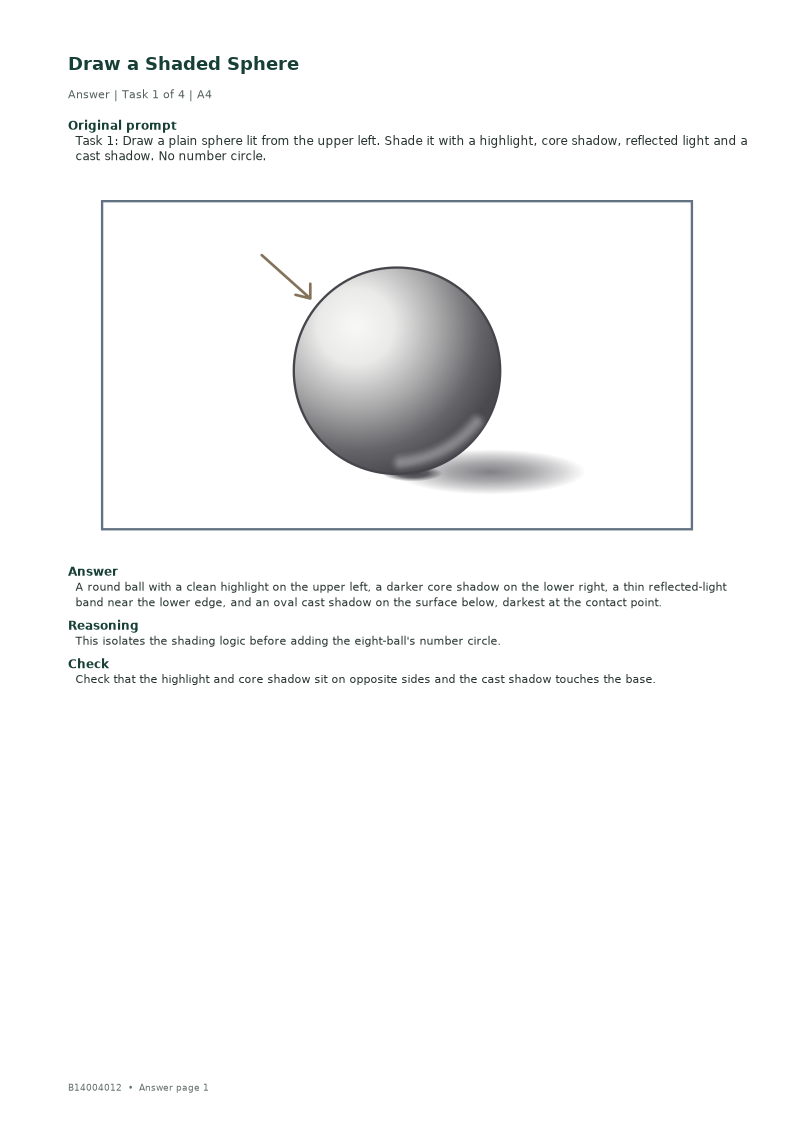
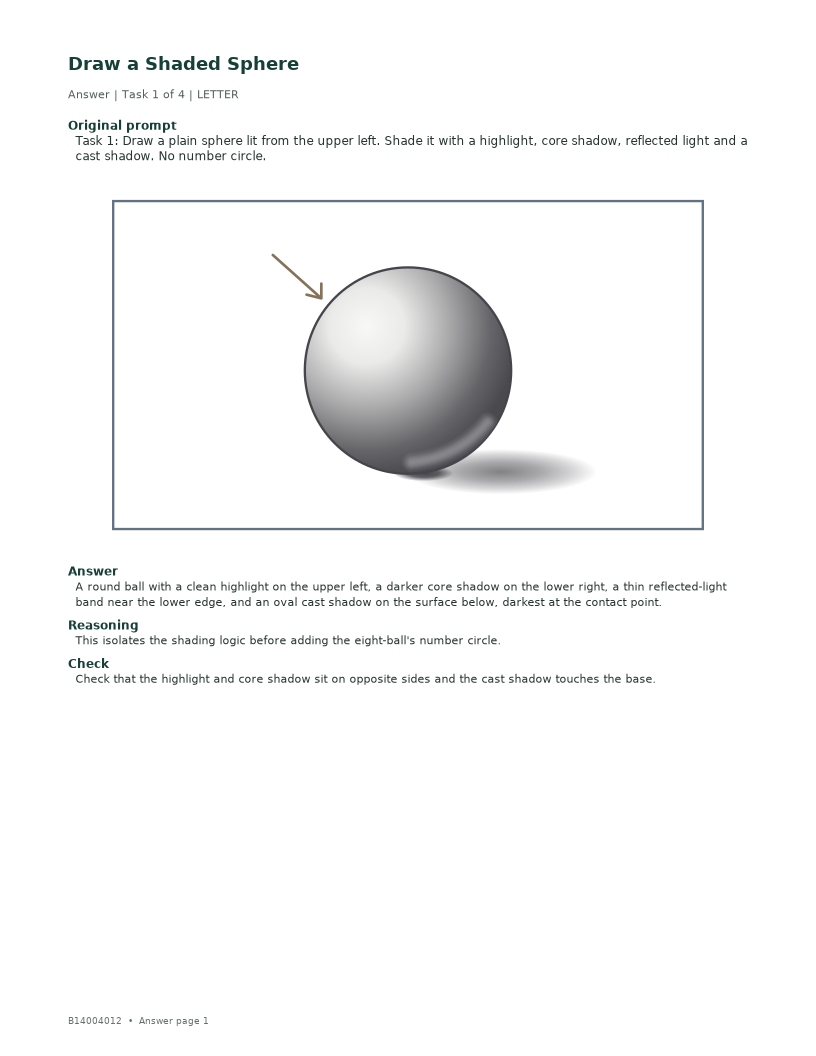
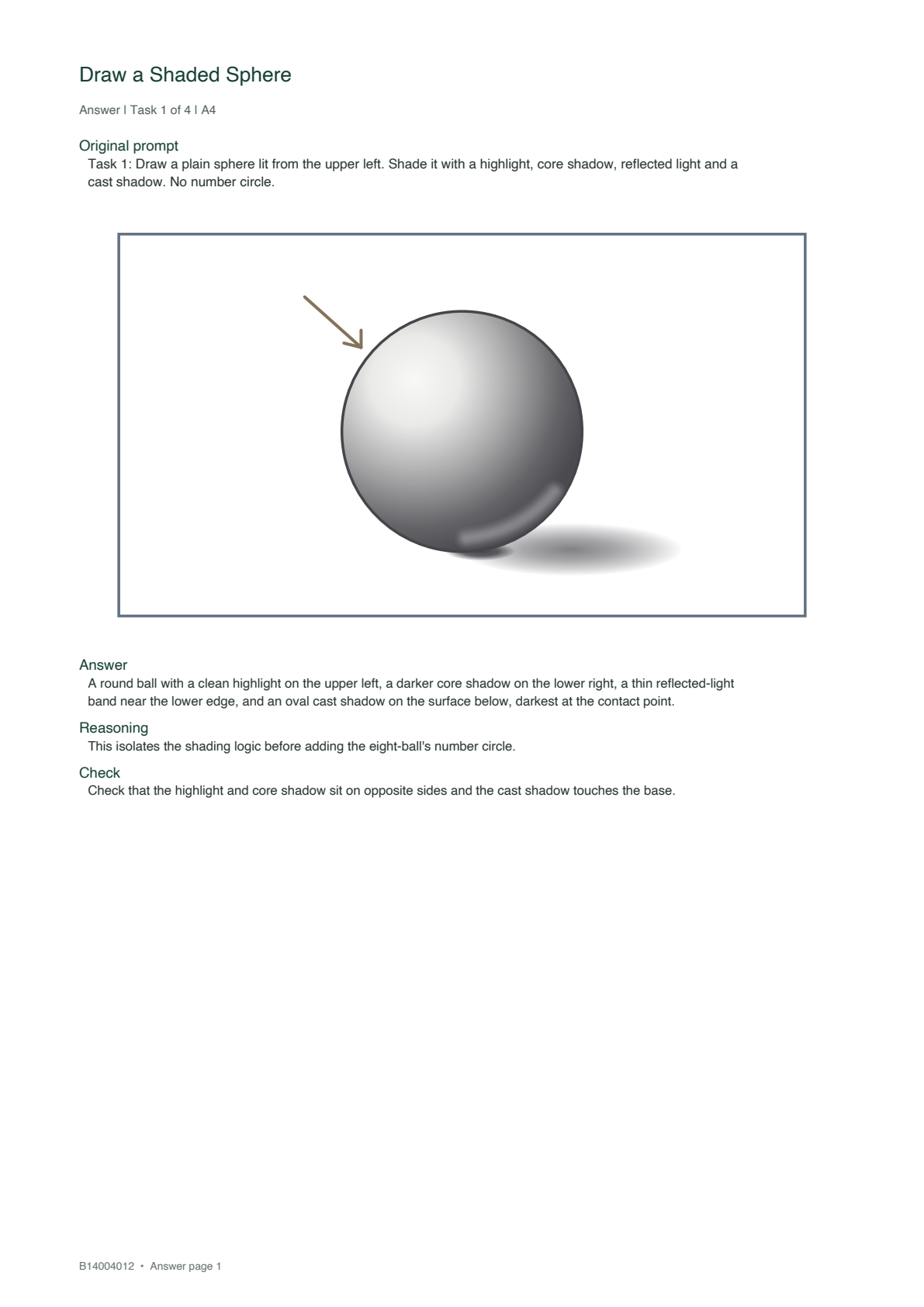
Task 1: Draw a plain sphere lit from the upper left. Shade it with a highlight, core shadow, reflected light and a cast shadow. No number circle.
Show answer 1
A round ball with a clean highlight on the upper left, a darker core shadow on the lower right, a thin reflected-light band near the lower edge, and an oval cast shadow on the surface below, darkest at the contact point.
This isolates the shading logic before adding the eight-ball's number circle.
Check: Check that the highlight and core shadow sit on opposite sides and the cast shadow touches the base.
Task 2
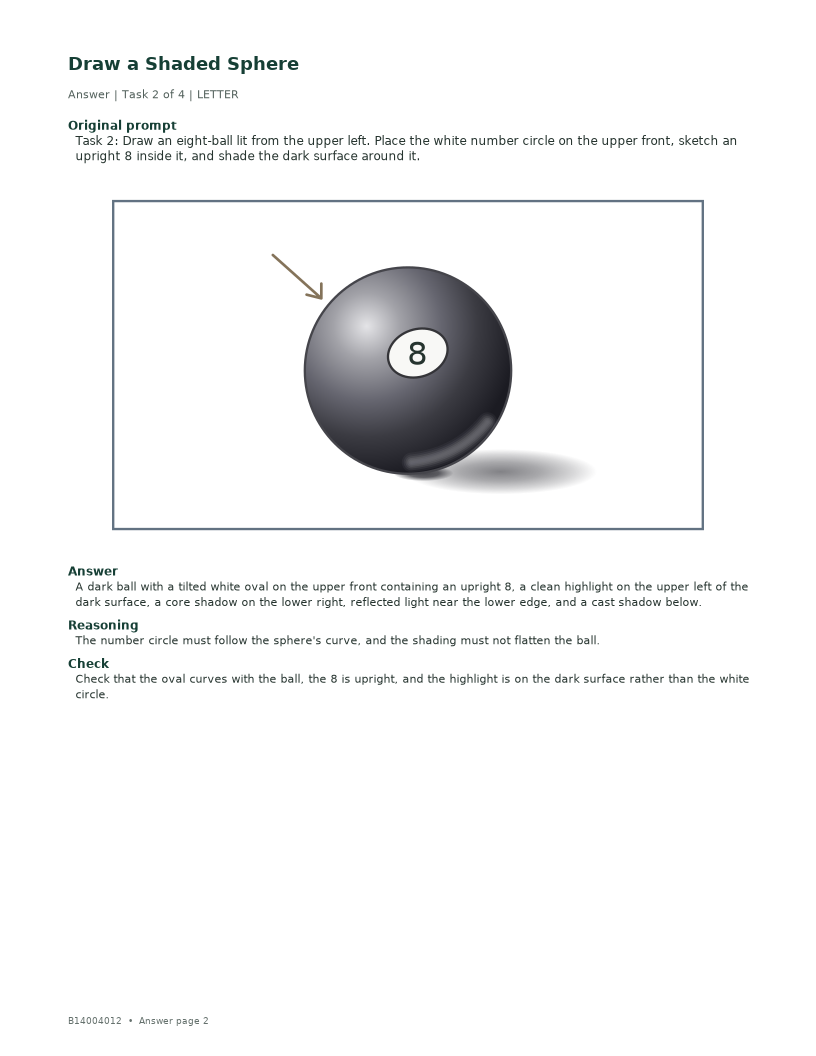
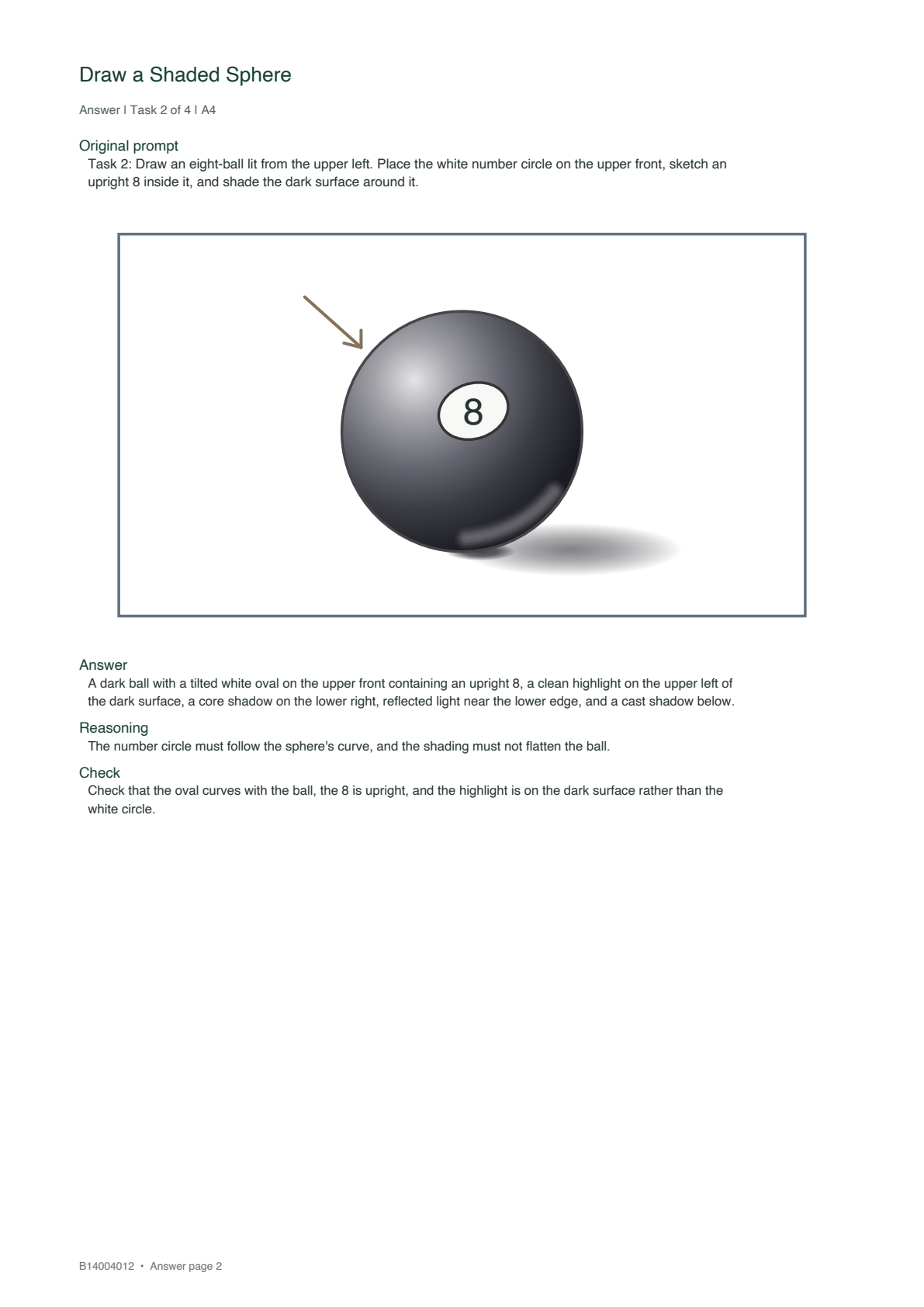
Task 2: Draw an eight-ball lit from the upper left. Place the white number circle on the upper front, sketch an upright 8 inside it, and shade the dark surface around it.
Show answer 2
A dark ball with a tilted white oval on the upper front containing an upright 8, a clean highlight on the upper left of the dark surface, a core shadow on the lower right, reflected light near the lower edge, and a cast shadow below.
The number circle must follow the sphere's curve, and the shading must not flatten the ball.
Check: Check that the oval curves with the ball, the 8 is upright, and the highlight is on the dark surface rather than the white circle.
Task 3
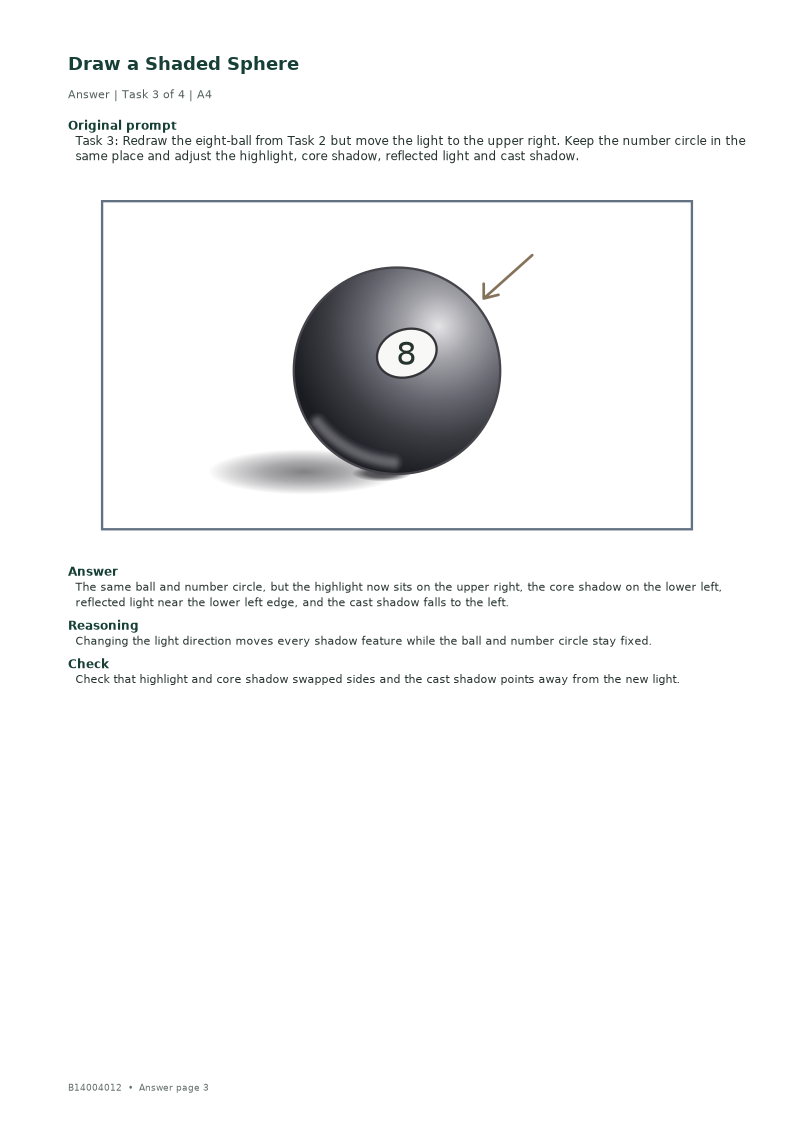
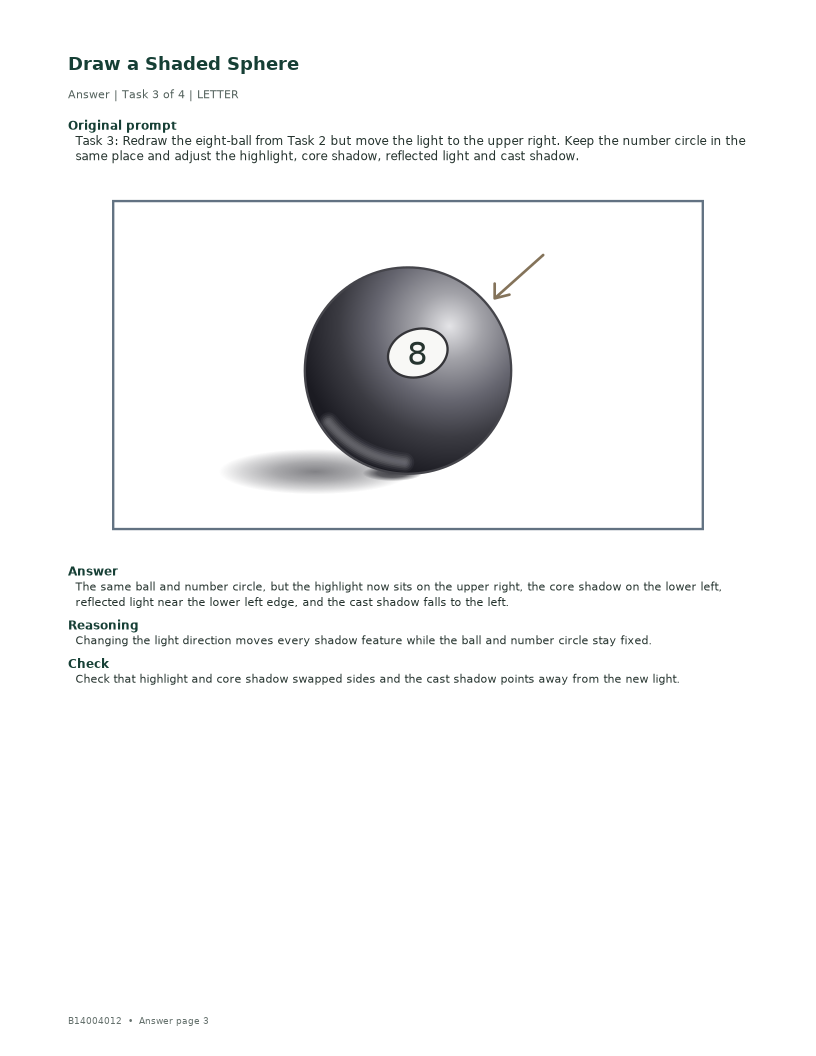
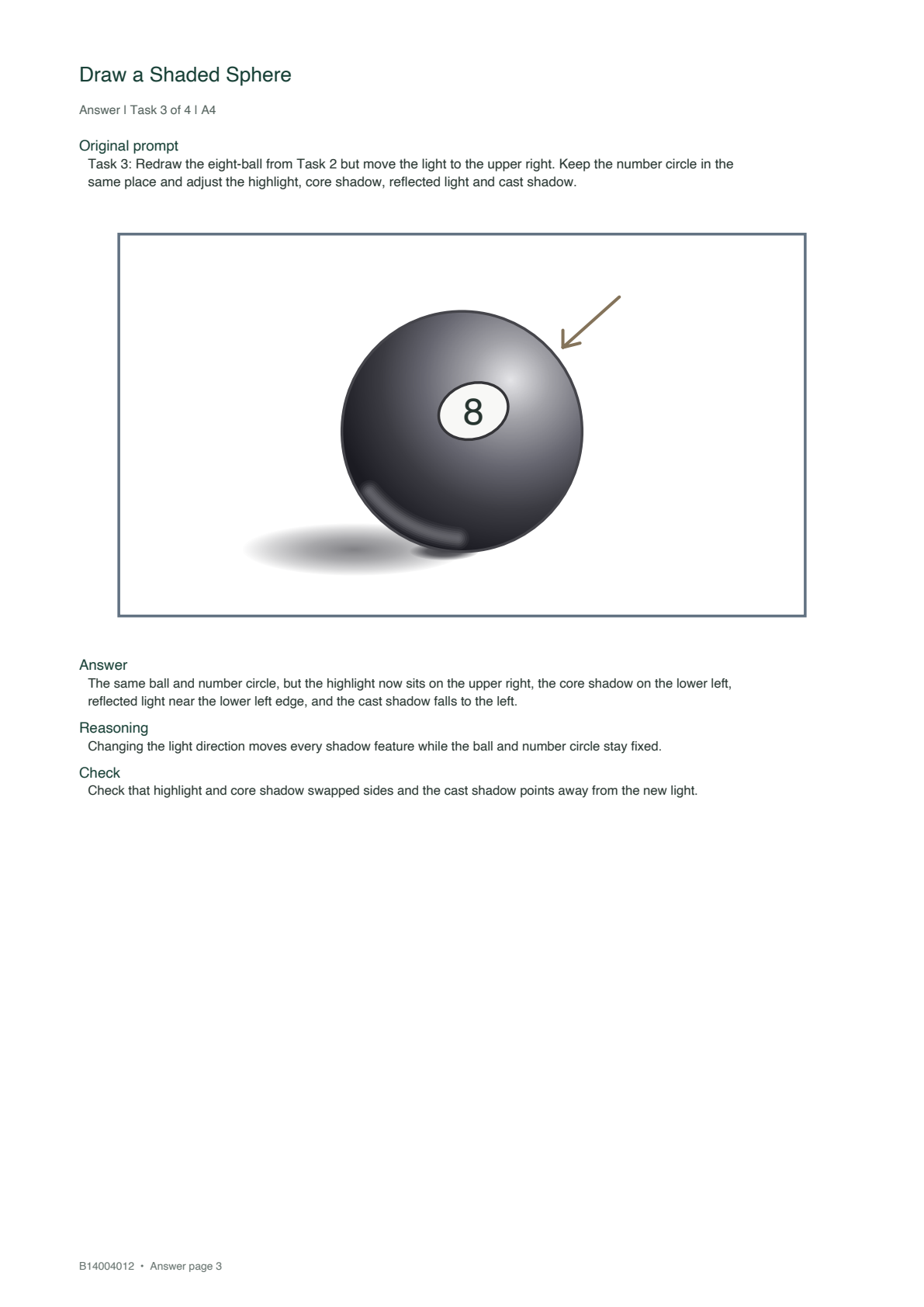
Task 3: Redraw the eight-ball from Task 2 but move the light to the upper right. Keep the number circle in the same place and adjust the highlight, core shadow, reflected light and cast shadow.
Show answer 3
The same ball and number circle, but the highlight now sits on the upper right, the core shadow on the lower left, reflected light near the lower left edge, and the cast shadow falls to the left.
Changing the light direction moves every shadow feature while the ball and number circle stay fixed.
Check: Check that highlight and core shadow swapped sides and the cast shadow points away from the new light.
Task 4
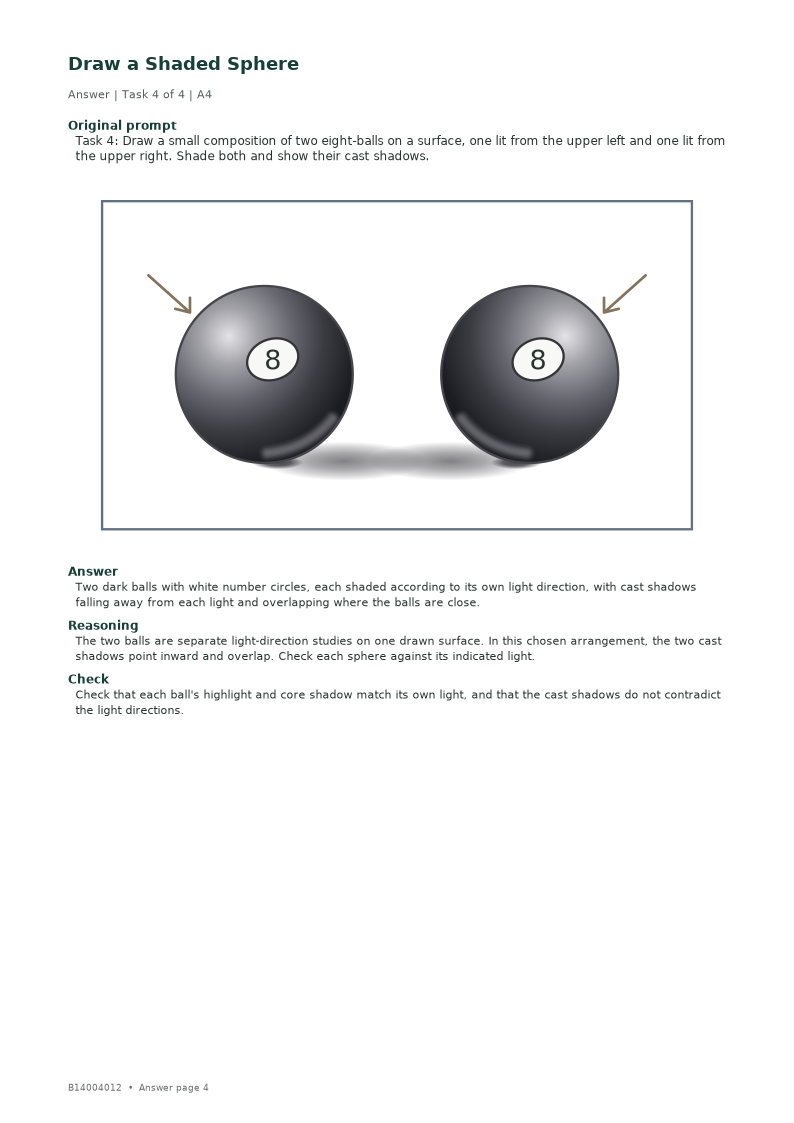
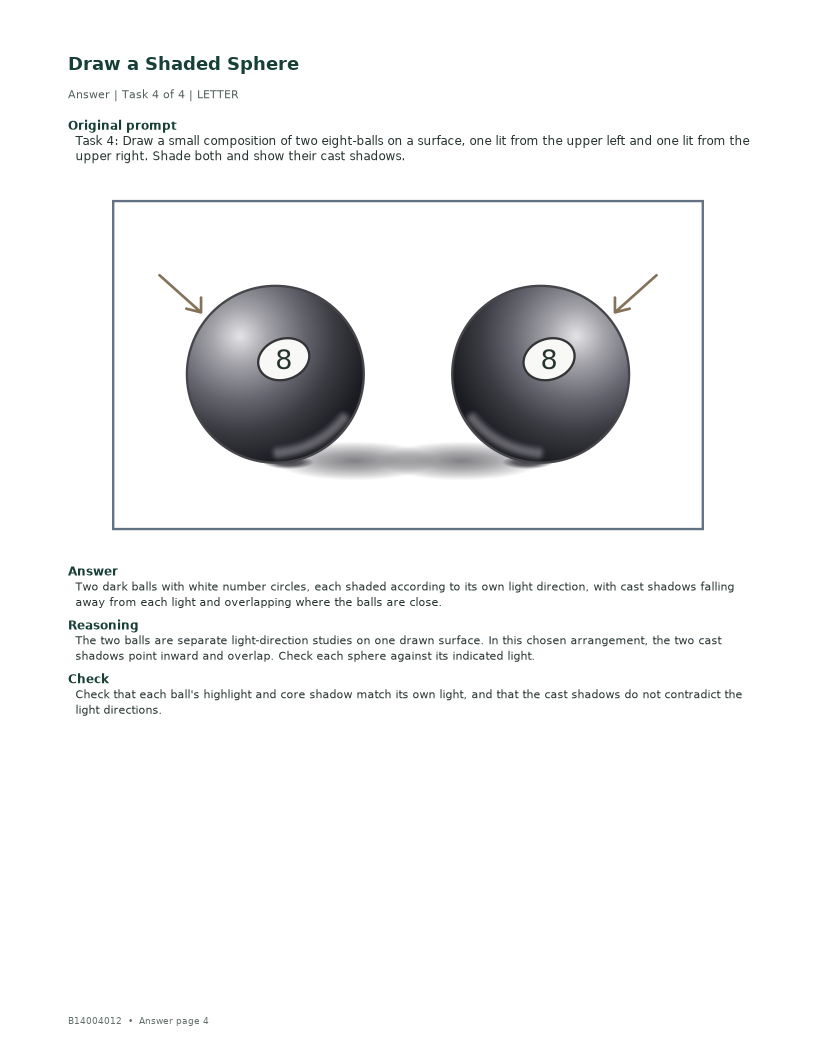
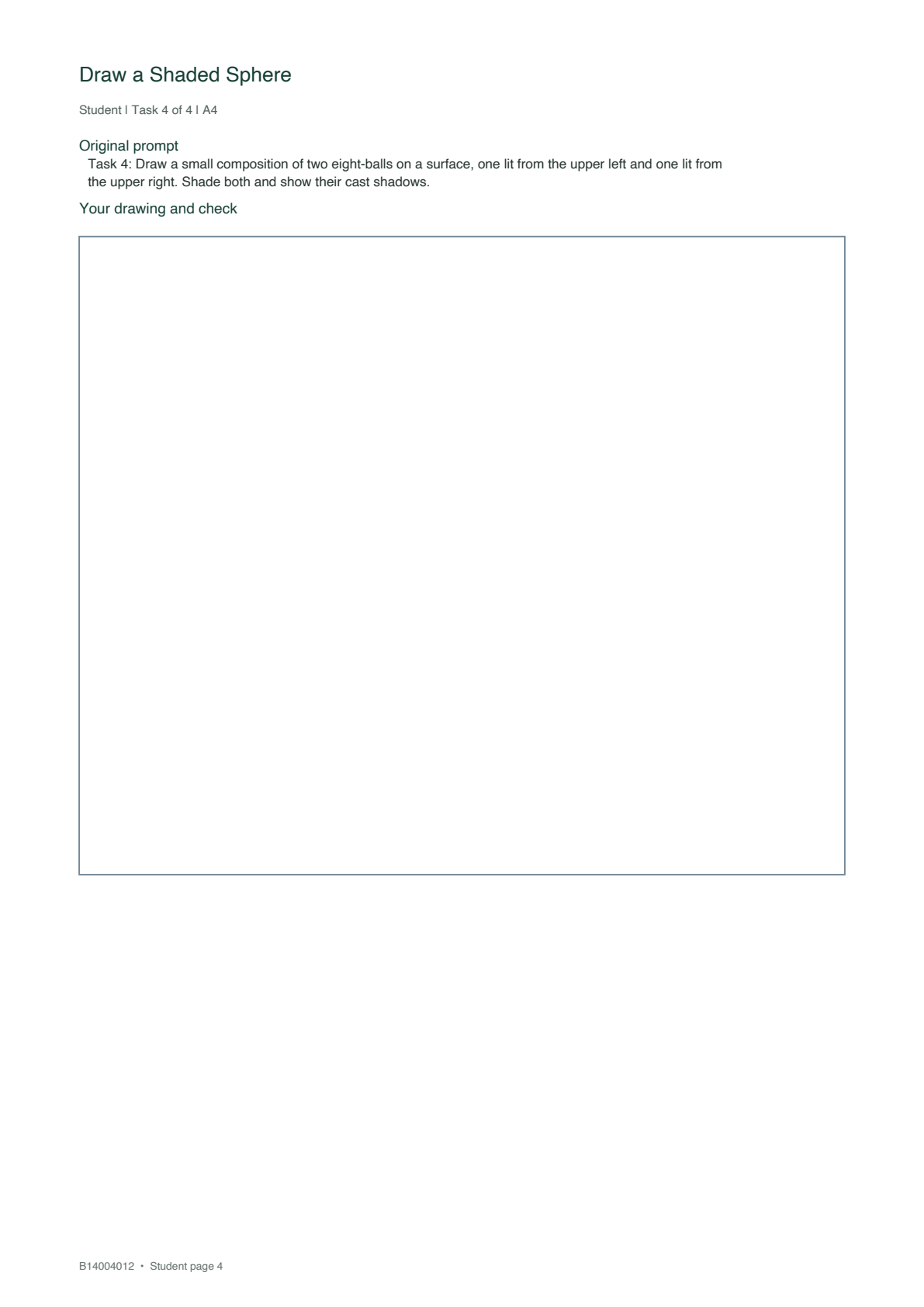
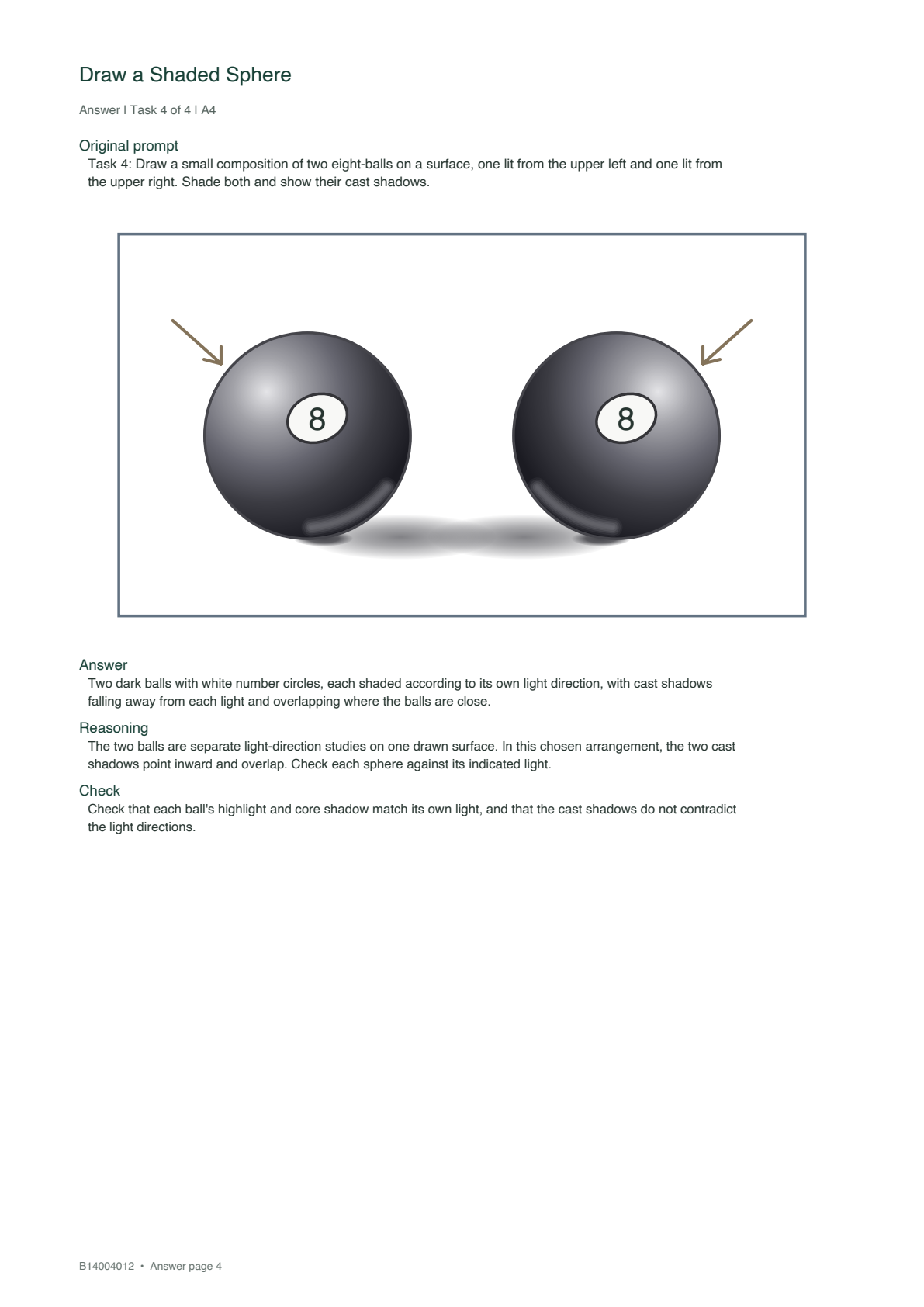
Task 4: Draw a small composition of two eight-balls on a surface, one lit from the upper left and one lit from the upper right. Shade both and show their cast shadows.
Show answer 4
Two dark balls with white number circles, each shaded according to its own light direction, with cast shadows falling away from each light and overlapping where the balls are close.
The two balls are separate light-direction studies on one drawn surface. In this chosen arrangement, the two cast shadows point inward and overlap. Check each sphere against its indicated light.
Check: Check that each ball's highlight and core shadow match its own light, and that the cast shadows do not contradict the light directions.
Useful checks
- Drawing the white number circle as a flat disc. Use a tilted oval to suggest the marking on the curved ball in this view. Keep the number upright.
- Putting the highlight on the white circle. Keep the highlight on the dark surface; the white circle is already light.
- Making the cast shadow float away from the ball. Anchor the cast shadow at the contact point and darken it there.
Questions about this resource
Do I need a real eight-ball to draw this?
No. The lesson uses a chosen light direction and a simple construction; a real ball is useful for observation but not required.
Can I use a plain sphere instead?
Yes. The shading steps are the same; the eight-ball adds the white number circle and a glossier surface.