Free original lessons
Printable Dominoes
A double-six domino set contains every unordered pair of the numbers 0 to 6, including doubles, which gives 28 tiles. Each tile is a rectangle divided into two equal squares, and each square shows pips in the standard pattern for its number. This pack shows how to lay out the full set on a cutout sheet, how to draw the pips, and how to check the sheet before cutting.
Letter & A4
PDF & SVG
What a double-six set contains
A double-six set is built from the numbers 0, 1, 2, 3, 4, 5 and 6. A tile joins two of these numbers, and the order does not matter: a 2-5 tile is the same tile as a 5-2 tile. Doubles such as 4-4 are single tiles.
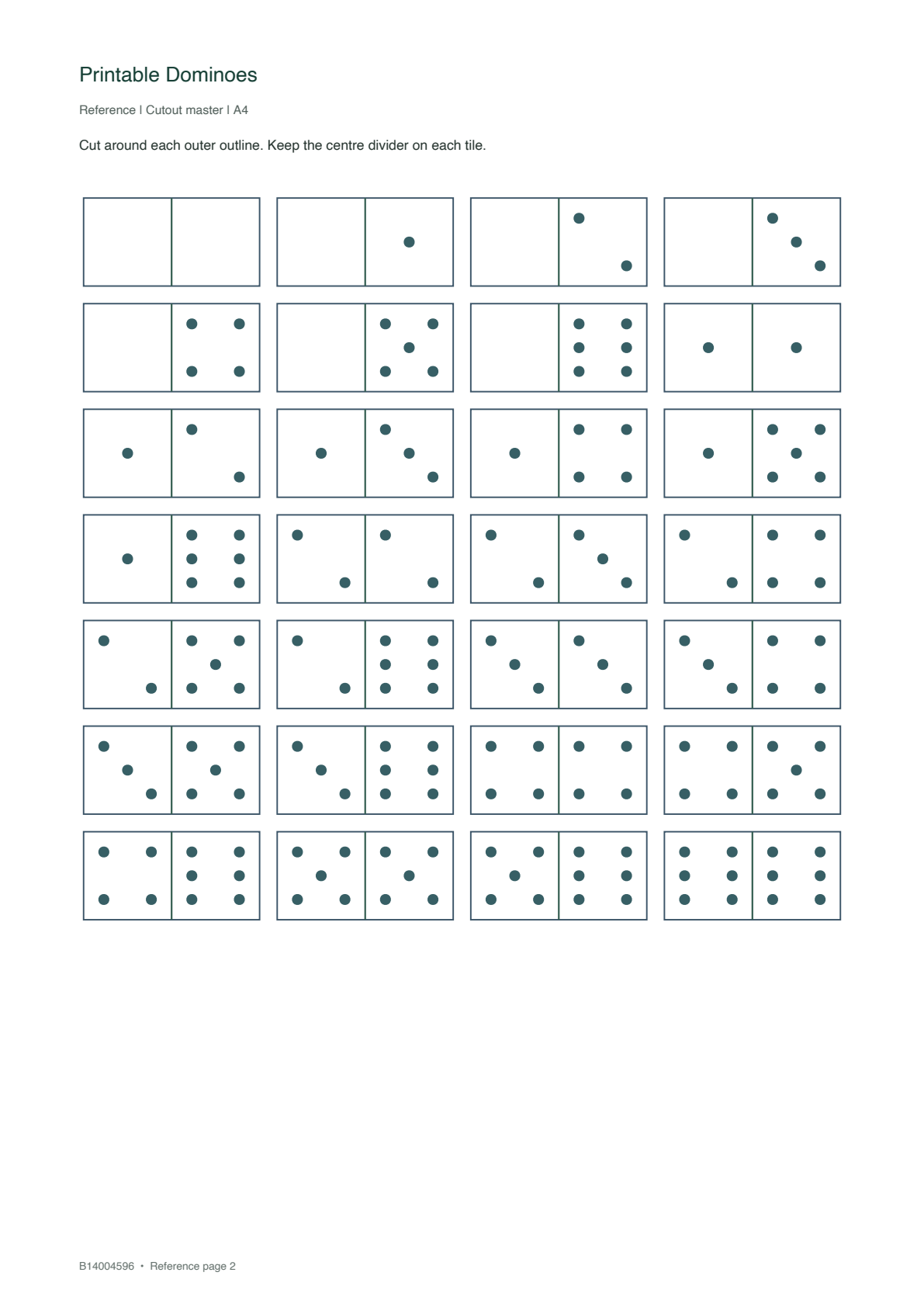
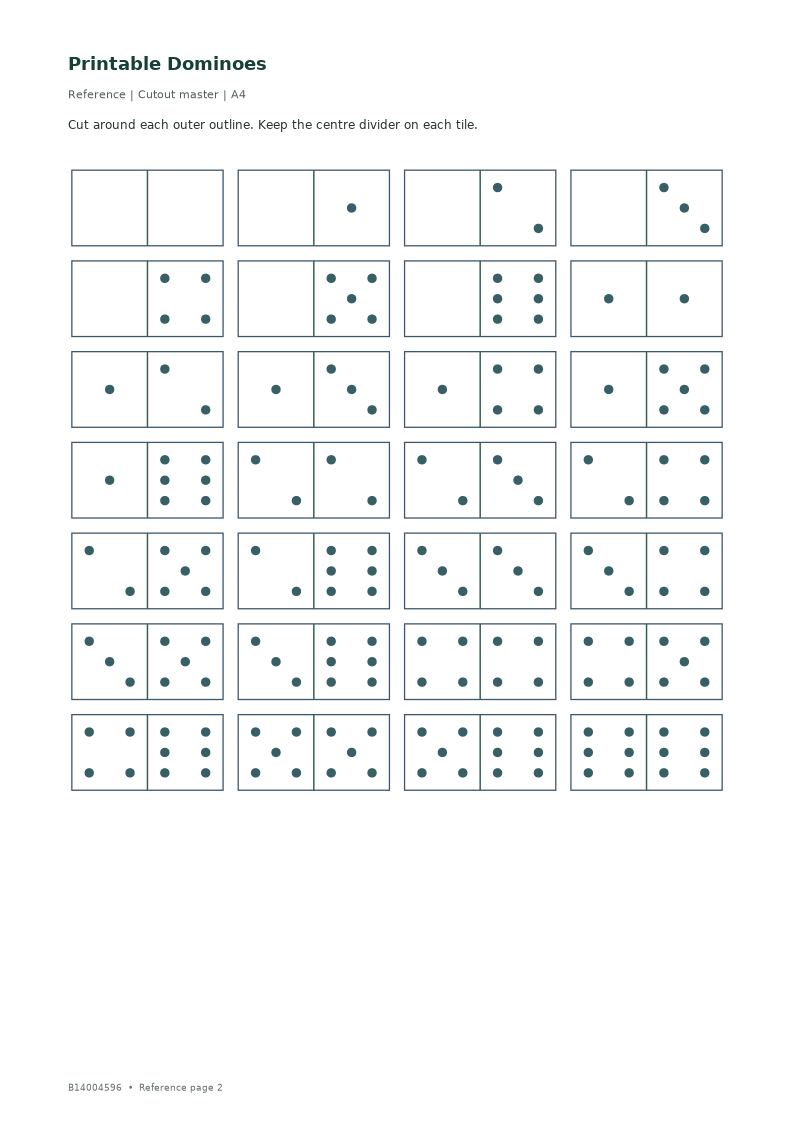
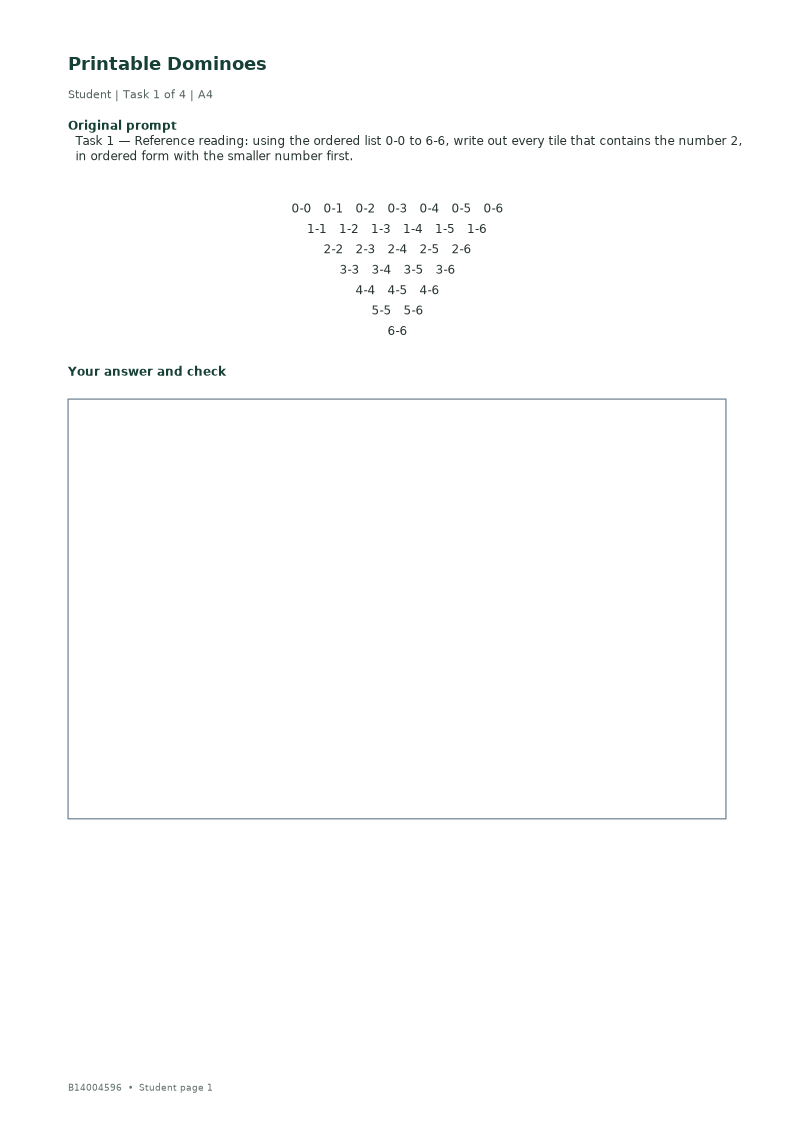
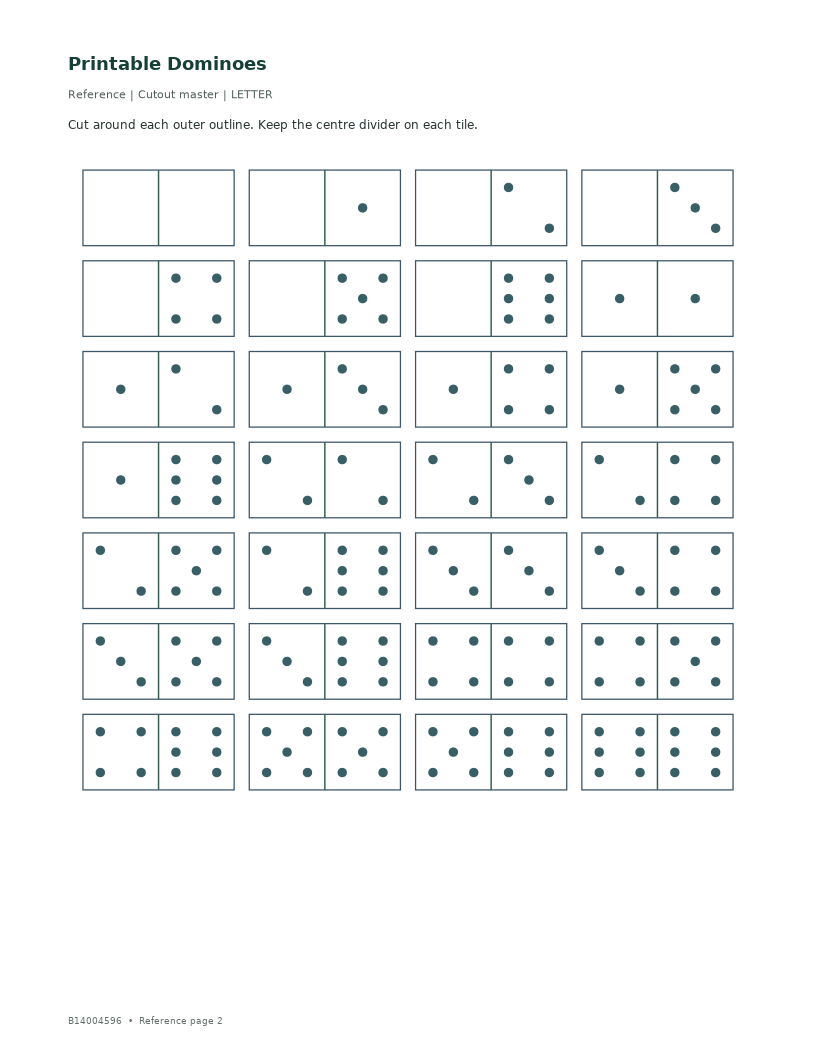
Counting every unordered pair, including doubles, gives 28 tiles. A useful way to list them is to take each first number in turn and pair it only with numbers equal to or greater than itself: 0-0 through 0-6, then 1-1 through 1-6, and so on up to 6-6.
Tile shape and pip patterns
Each tile is a rectangle twice as long as it is wide, divided by a centre line into two equal squares. The centre line runs across the short direction, so the two squares sit end to end.
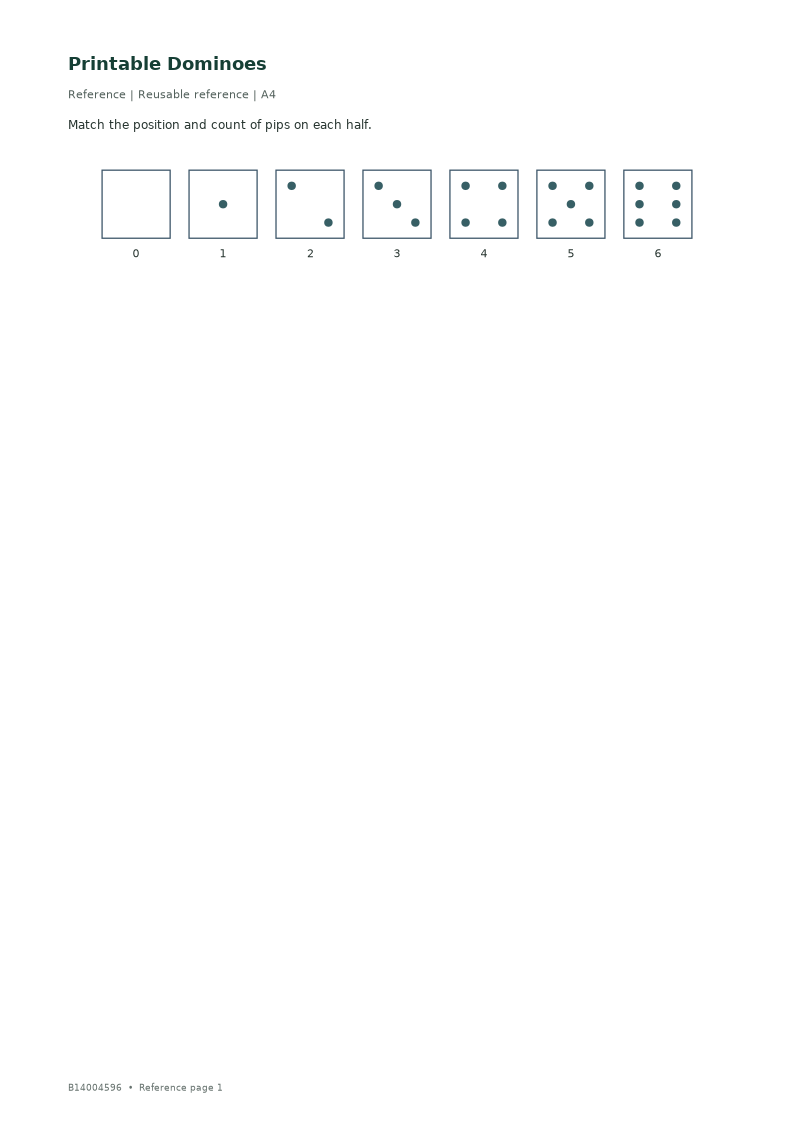
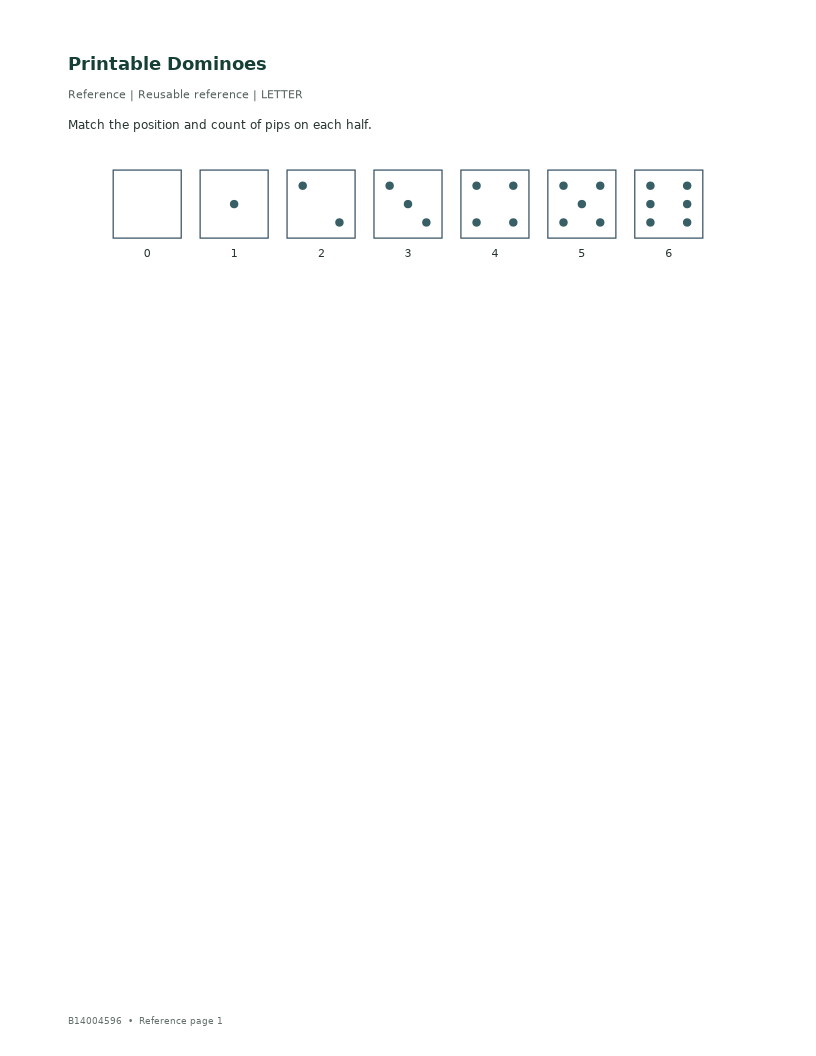
Pips follow the familiar patterns: 0 is empty; 1 is a single centre pip; 2 is two opposite corners; 3 is two opposite corners plus the centre; 4 is the four corners; 5 is the four corners plus the centre; 6 is two columns of three. Keep pip size and spacing consistent so the sheet looks even.
Laying out the cutout sheet
On the portrait cutout master, use seven rows of four tiles. Each printed tile on that sheet is 40 mm by 20 mm at actual size, with 4 mm between tiles. Other layouts can use a different tile size or row count as long as the two halves are equal squares.
Keep a clear margin around the tiles and leave the gutters empty. Cut only along the outside outlines, keeping the centre line as the divider. The larger teaching examples are for comparing pip patterns.
Worked example: the 3-5 tile
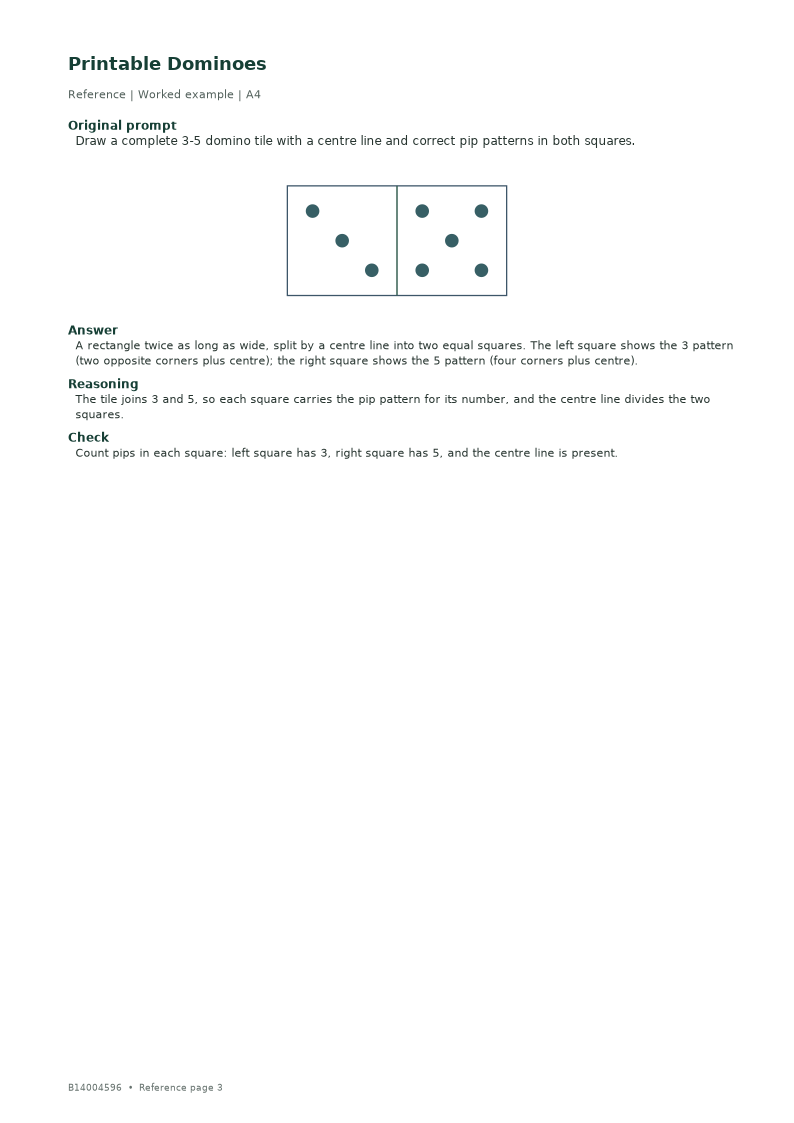
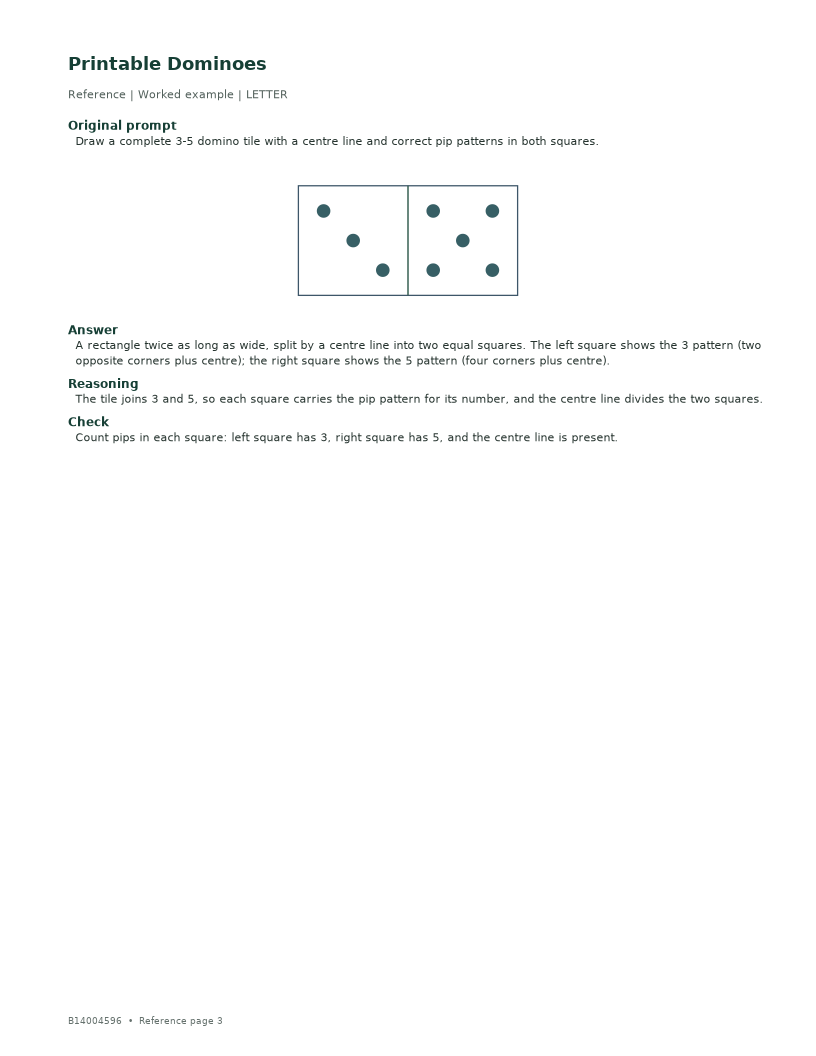
Start with a rectangle twice as long as it is wide. Draw the centre line across the short direction to make two equal squares.
In the left square, place the 3 pattern: two opposite corner pips and one centre pip. In the right square, place the 5 pattern: four corner pips and one centre pip. The result is a finished 3-5 tile ready to cut.
Checking the sheet
Before cutting, count the tiles: there should be 28. Check that every unordered pair from 0-0 to 6-6 appears exactly once and that no pair is repeated in reverse.
Check that each tile has a centre line and that each square's pip count matches its number. A quick visual pass for even spacing and clear outlines saves reprinting later.
Download the complete resource pack
All individual SVG pages (22)
- A4 reference page 1
- A4 reference page 2
- A4 reference page 3
- A4 student page 1
- A4 student page 2
- A4 student page 3
- A4 student page 4
- A4 answer page 1
- A4 answer page 2
- A4 answer page 3
- A4 answer page 4
- LETTER reference page 1
- LETTER reference page 2
- LETTER reference page 3
- LETTER student page 1
- LETTER student page 2
- LETTER student page 3
- LETTER student page 4
- LETTER answer page 1
- LETTER answer page 2
- LETTER answer page 3
- LETTER answer page 4
Print at 100% / actual size. Use the stated scale on any schematic diagram; physical cutting templates are identified separately. A4 and US Letter are separate files. Free access, no signup; CC BY 4.0.
How to use these pages
- What a double-six set contains
- Tile shape and pip patterns
- Laying out the cutout sheet
- Worked example: the 3-5 tile
- Checking the sheet
Worked example
Example: Draw a complete 3-5 domino tile with a centre line and correct pip patterns in both squares.
Answer: A rectangle twice as long as wide, split by a centre line into two equal squares. The left square shows the 3 pattern (two opposite corners plus centre); the right square shows the 5 pattern (four corners plus centre).
Reasoning: The tile joins 3 and 5, so each square carries the pip pattern for its number, and the centre line divides the two squares.
Check: Count pips in each square: left square has 3, right square has 5, and the centre line is present.
Four practice tasks and complete answers
Task 1
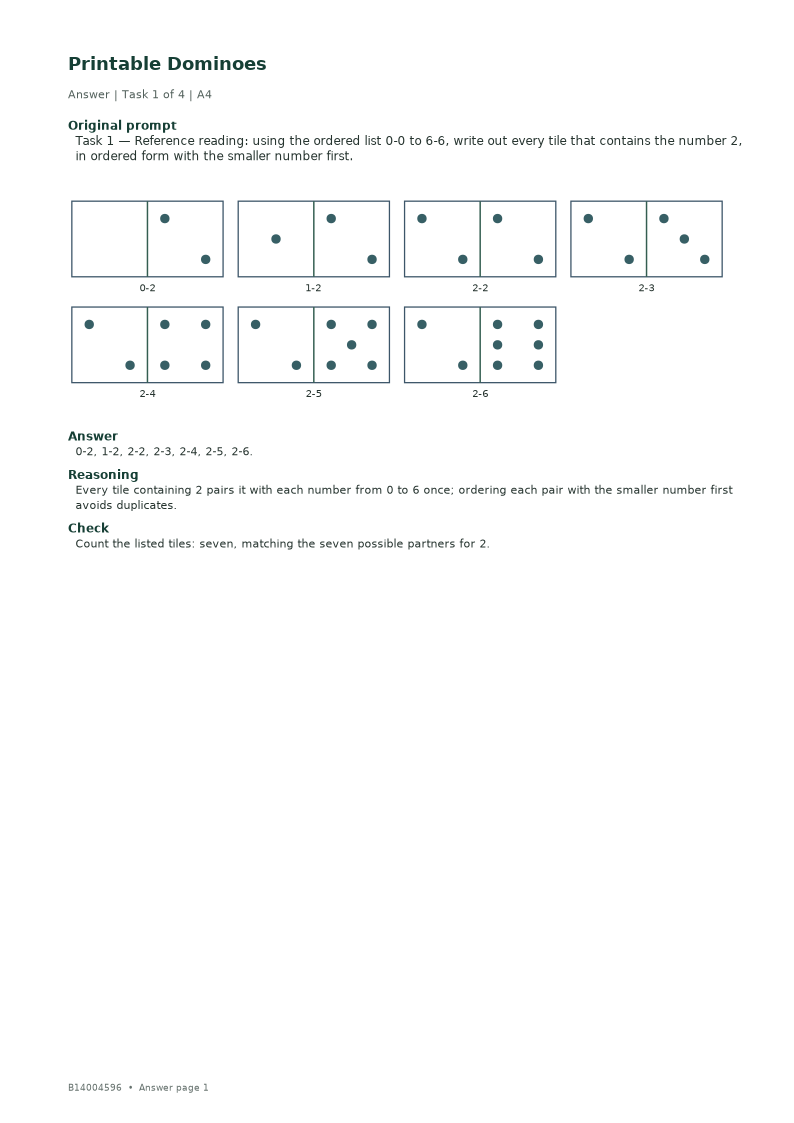
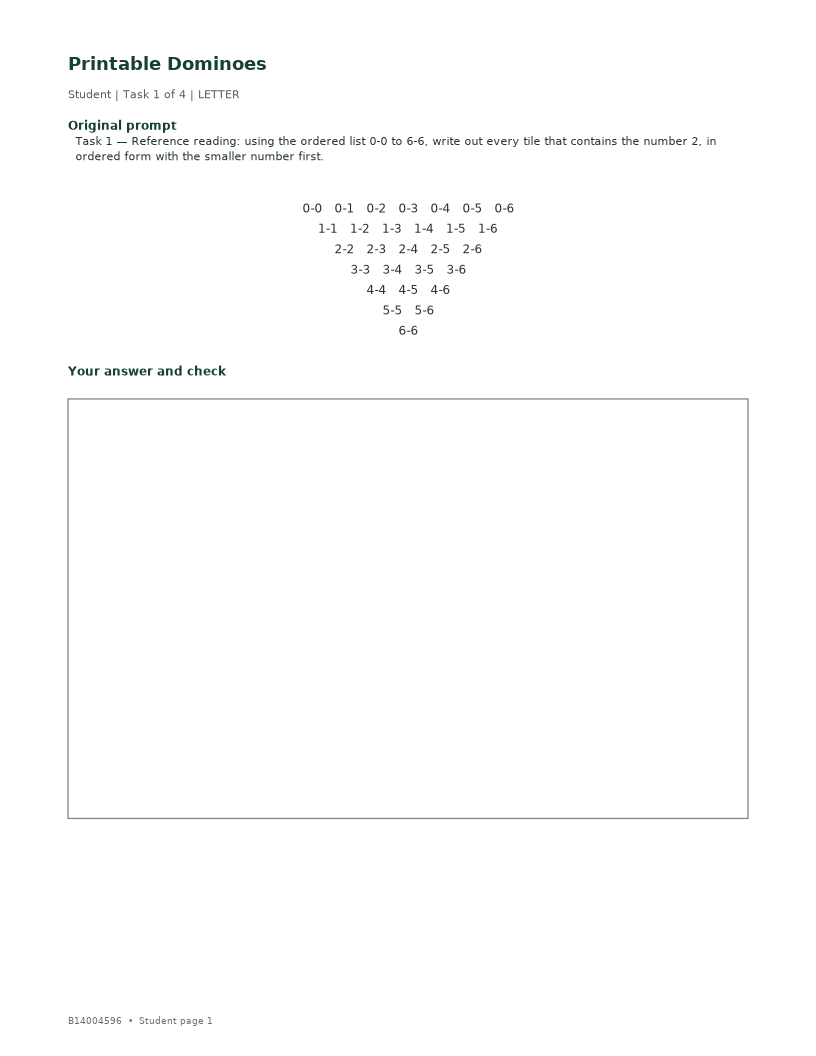
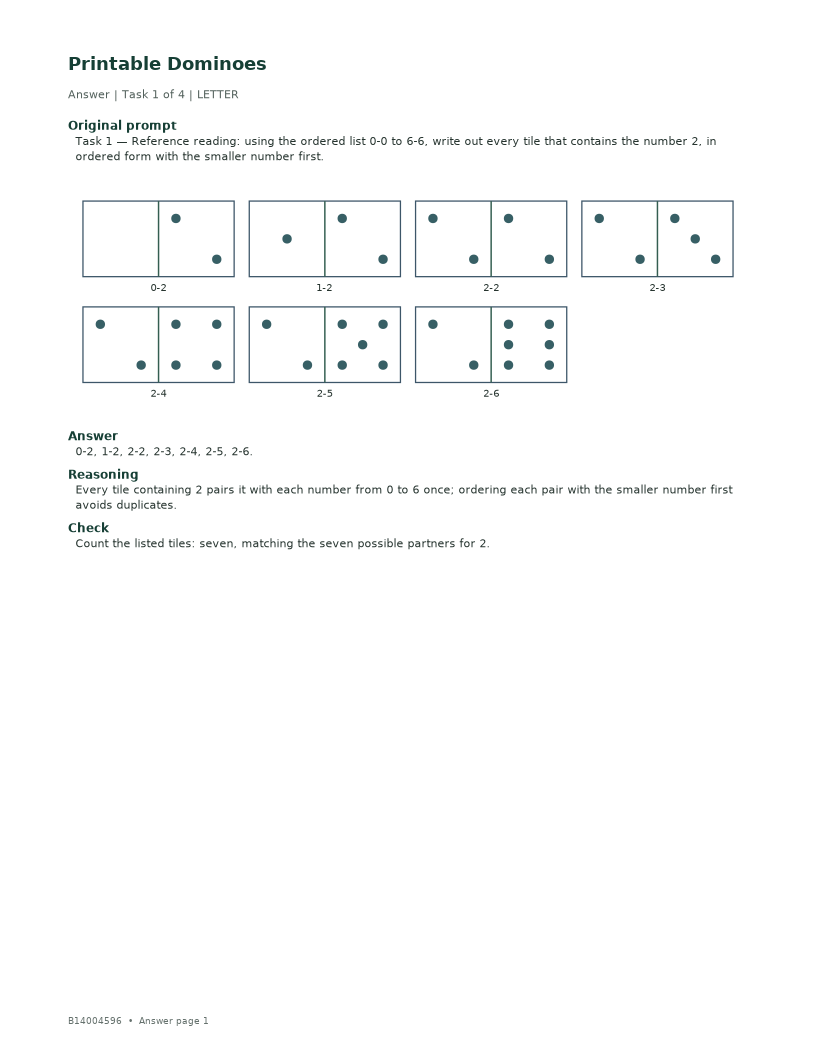
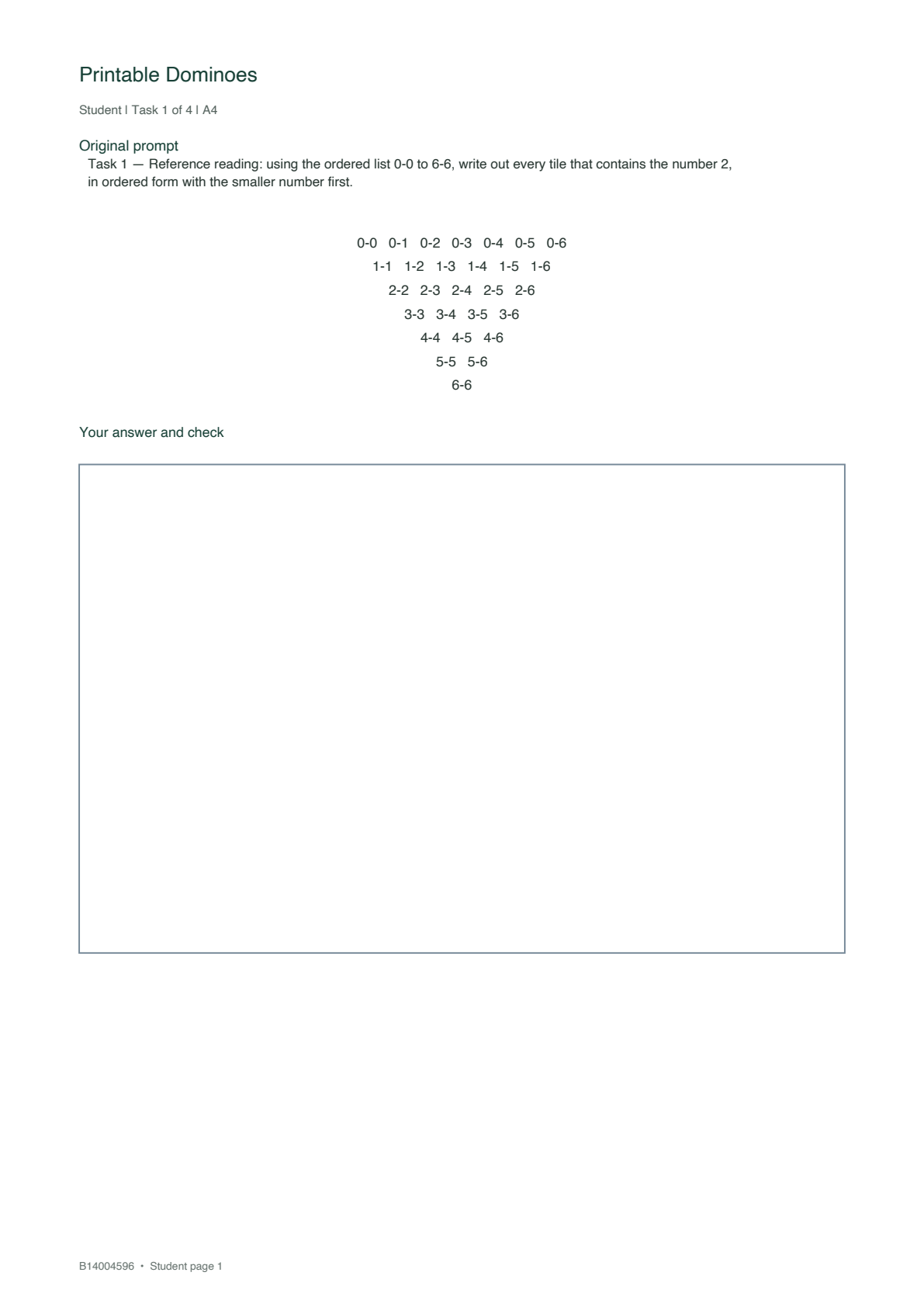
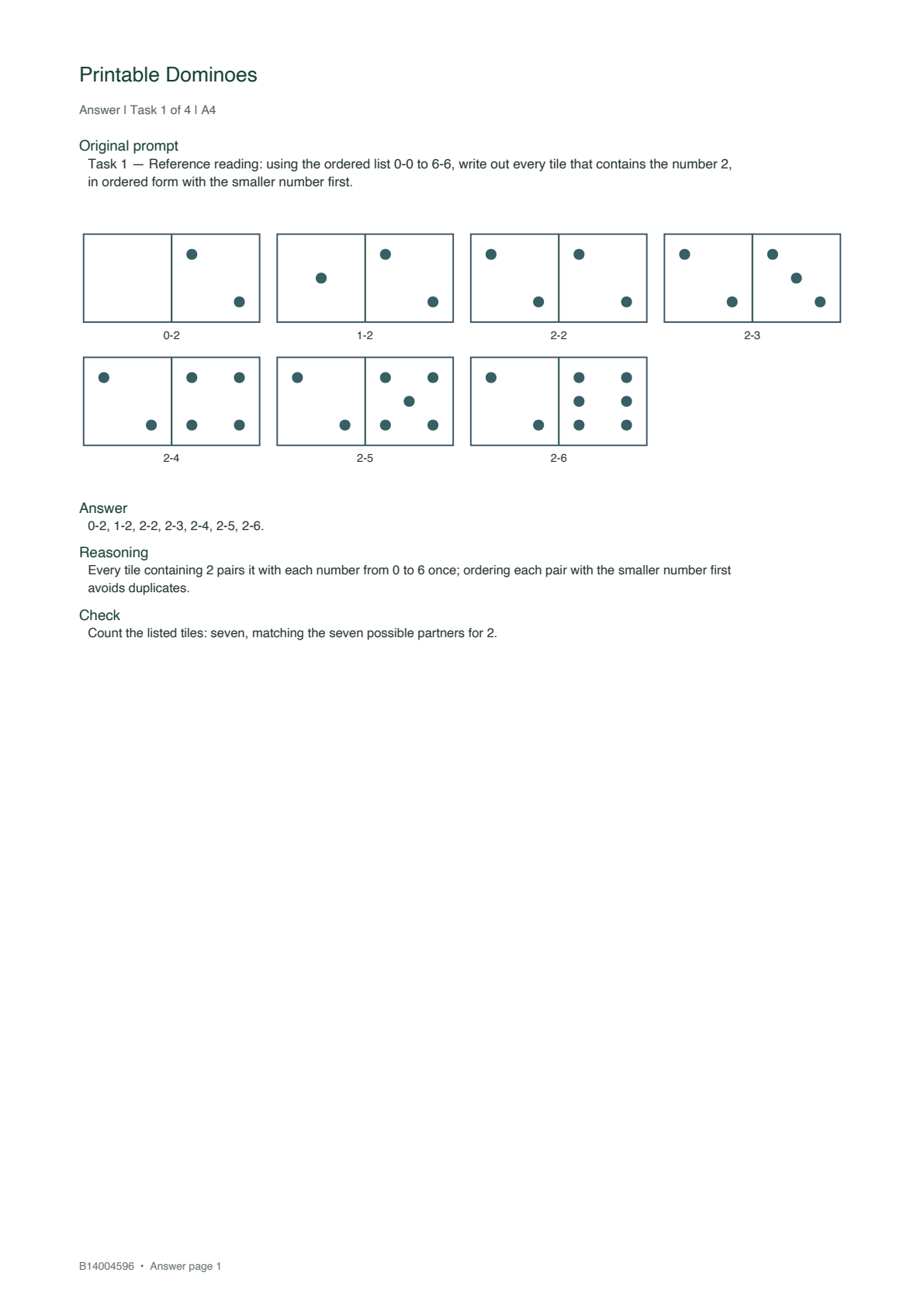
Task 1 — Reference reading: using the ordered list 0-0 to 6-6, write out every tile that contains the number 2, in ordered form with the smaller number first.
Show answer 1
0-2, 1-2, 2-2, 2-3, 2-4, 2-5, 2-6.
Every tile containing 2 pairs it with each number from 0 to 6 once; ordering each pair with the smaller number first avoids duplicates.
Check: Count the listed tiles: seven, matching the seven possible partners for 2.
Task 2
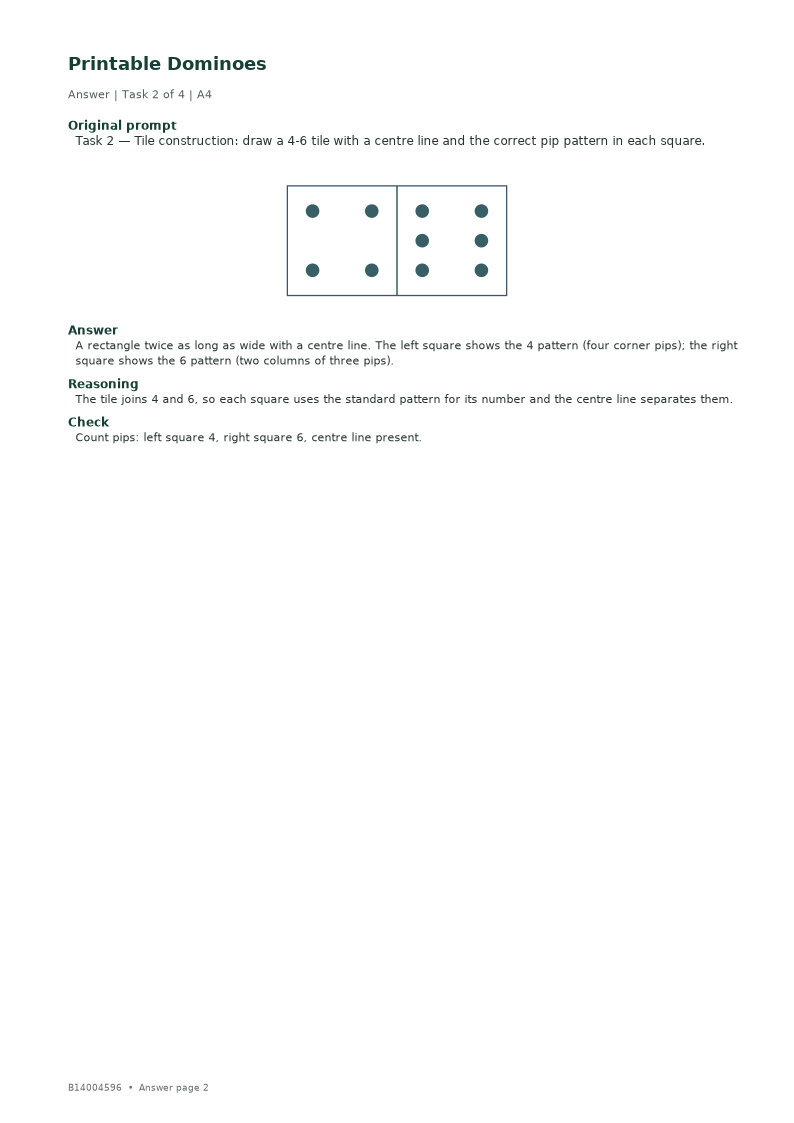
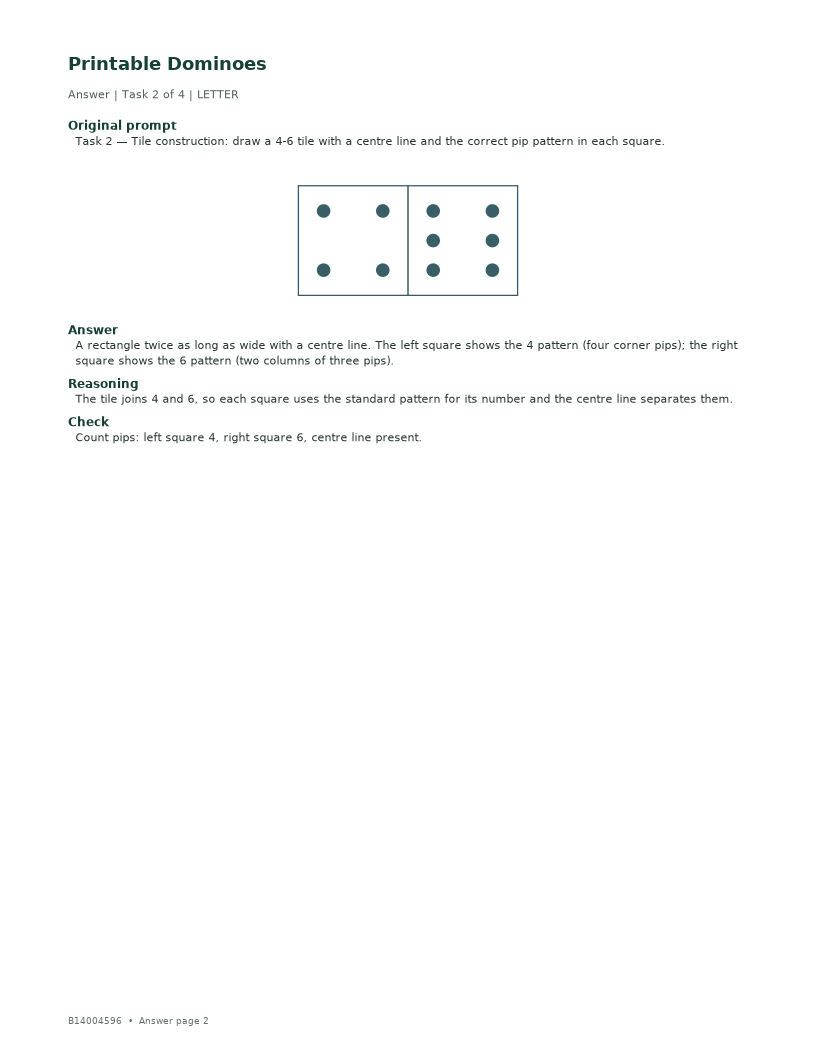
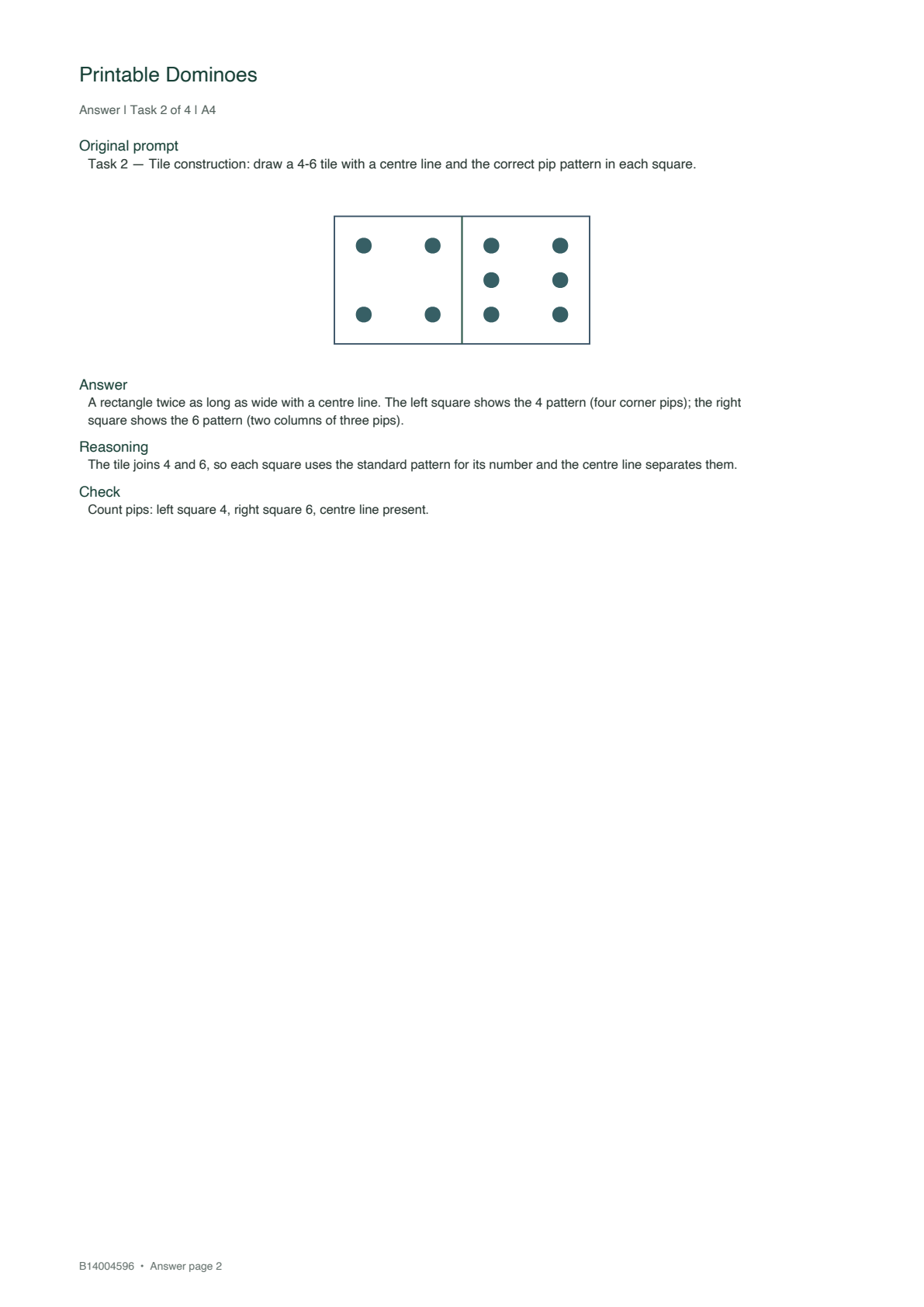
Task 2 — Tile construction: draw a 4-6 tile with a centre line and the correct pip pattern in each square.
Show answer 2
A rectangle twice as long as wide with a centre line. The left square shows the 4 pattern (four corner pips); the right square shows the 6 pattern (two columns of three pips).
The tile joins 4 and 6, so each square uses the standard pattern for its number and the centre line separates them.
Check: Count pips: left square 4, right square 6, centre line present.
Task 3
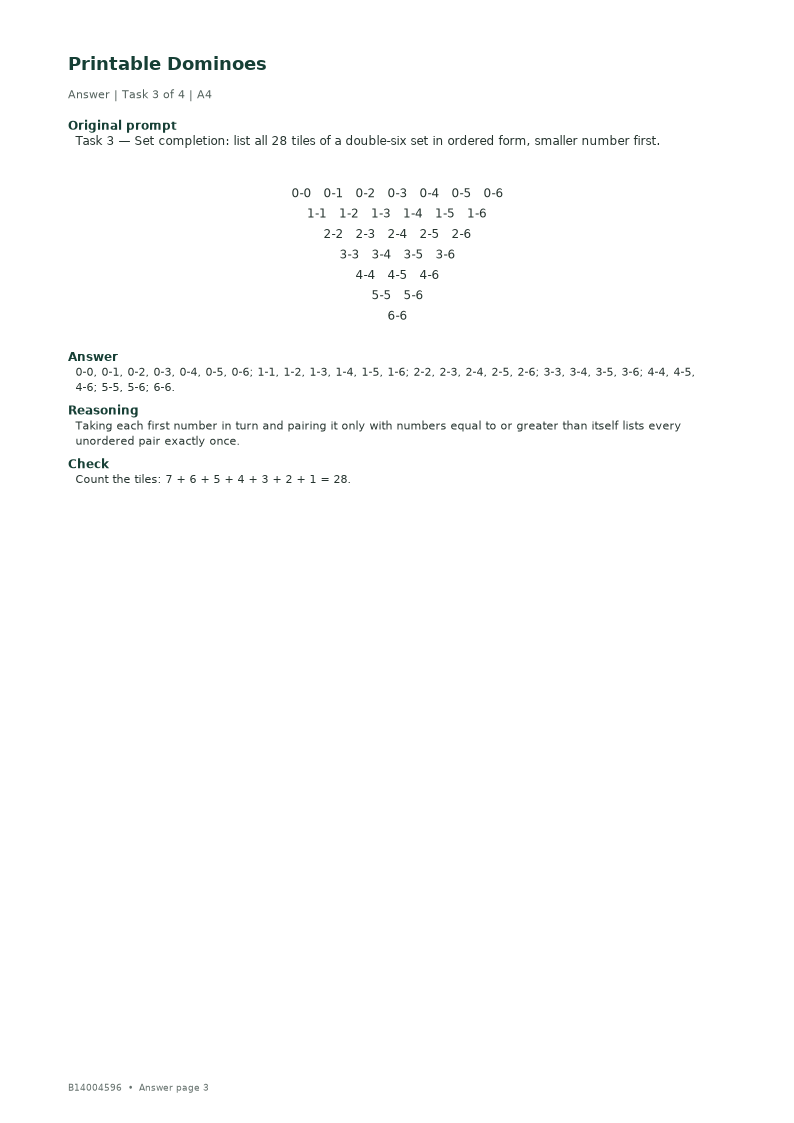
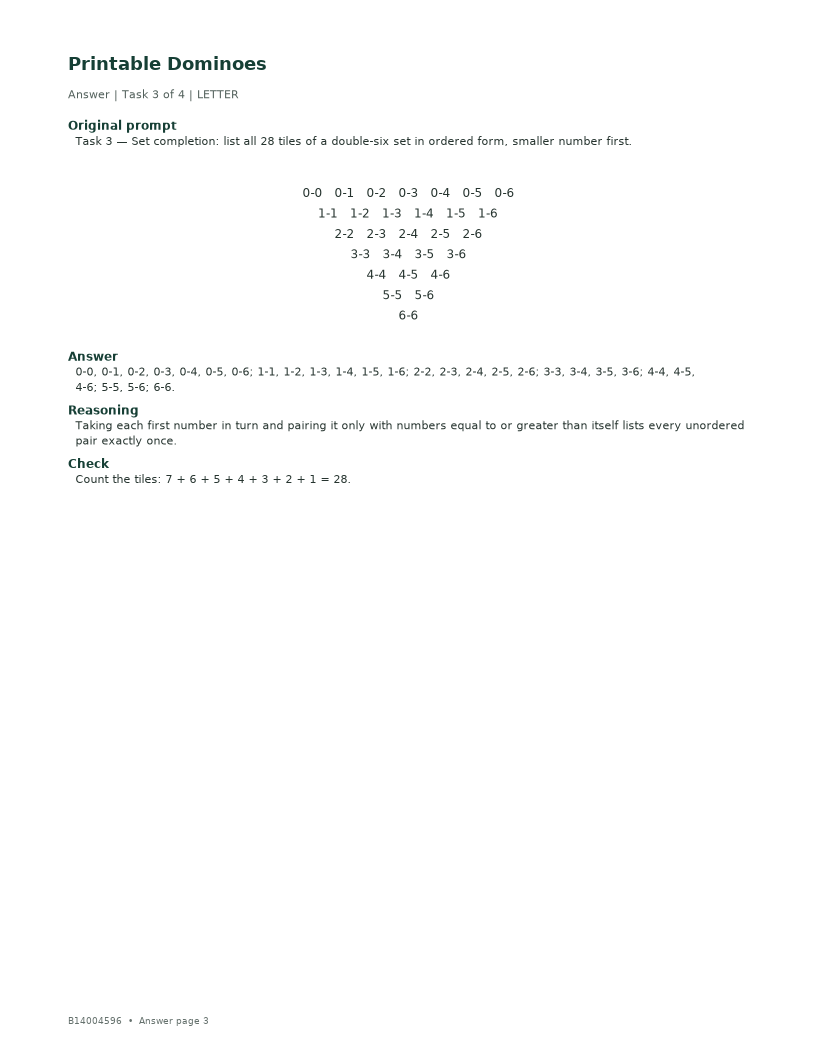
Task 3 — Set completion: list all 28 tiles of a double-six set in ordered form, smaller number first.
Show answer 3
0-0, 0-1, 0-2, 0-3, 0-4, 0-5, 0-6; 1-1, 1-2, 1-3, 1-4, 1-5, 1-6; 2-2, 2-3, 2-4, 2-5, 2-6; 3-3, 3-4, 3-5, 3-6; 4-4, 4-5, 4-6; 5-5, 5-6; 6-6.
Taking each first number in turn and pairing it only with numbers equal to or greater than itself lists every unordered pair exactly once.
Check: Count the tiles: 7 + 6 + 5 + 4 + 3 + 2 + 1 = 28.
Task 4
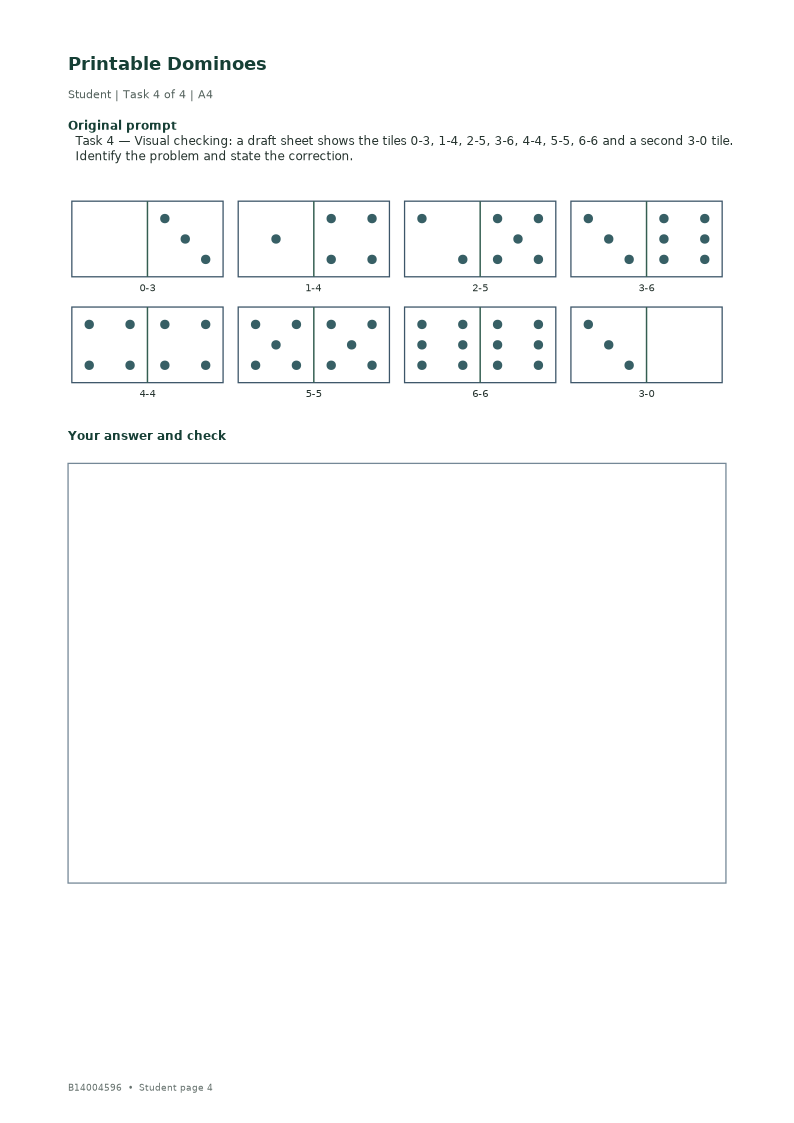
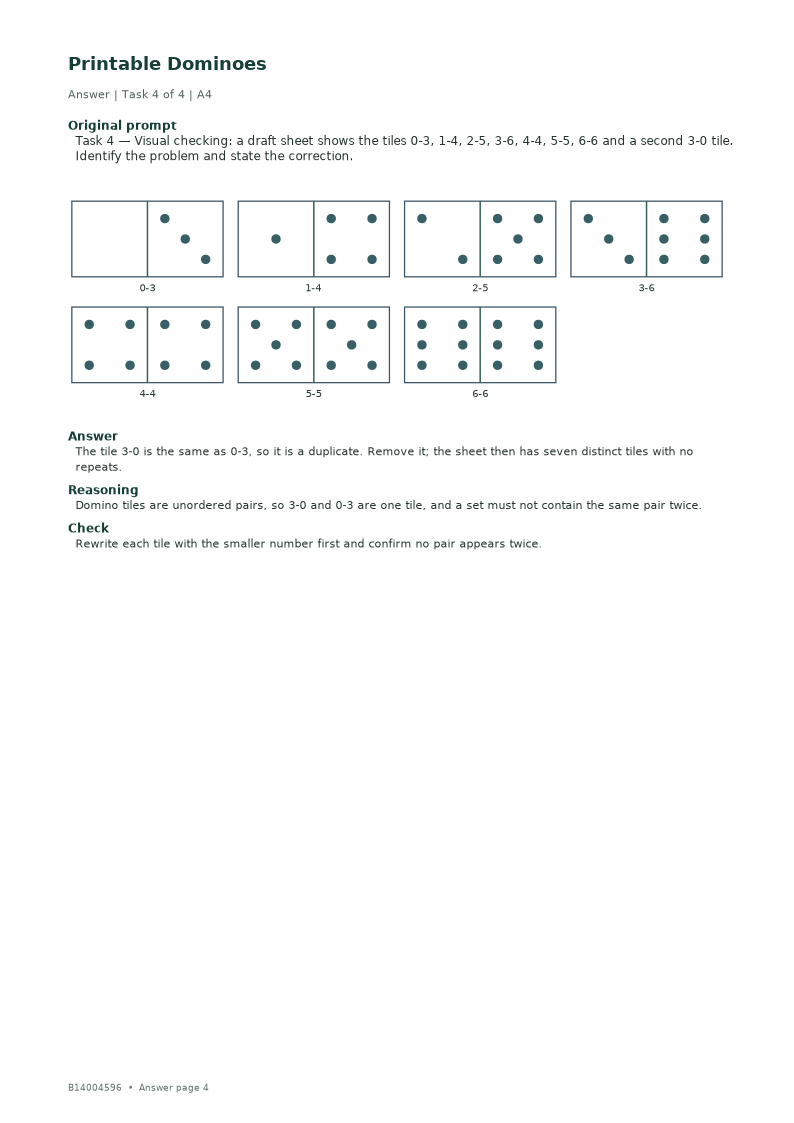
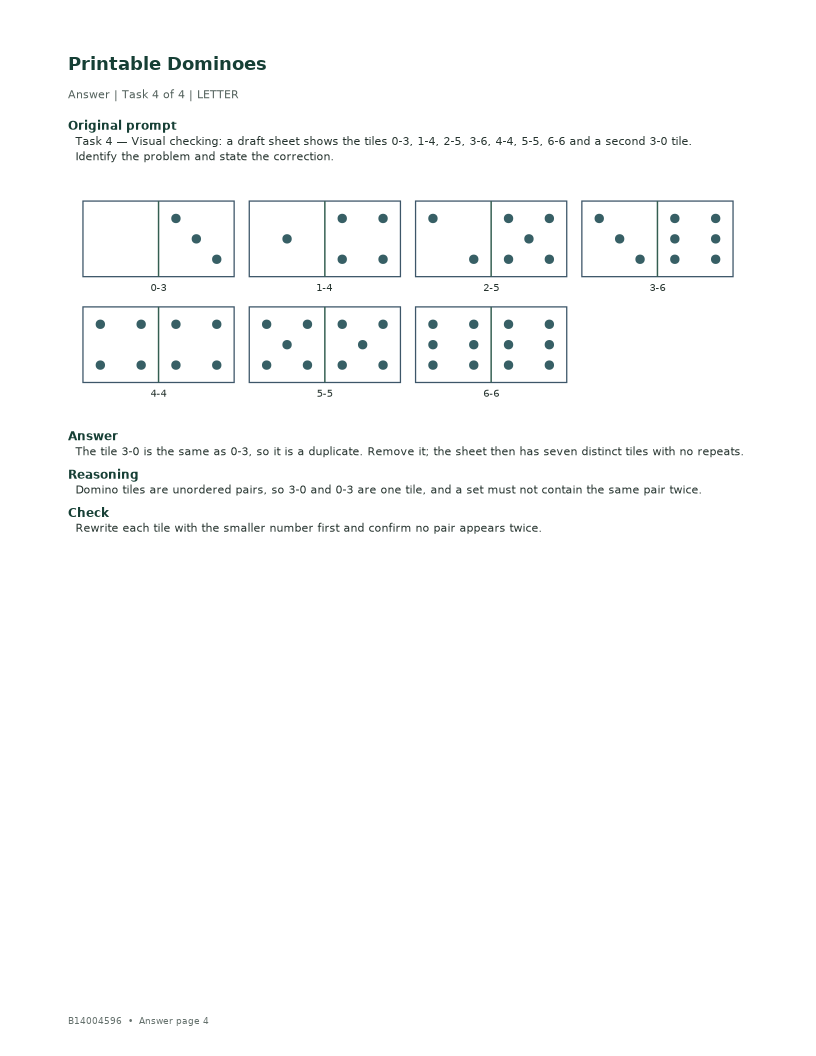
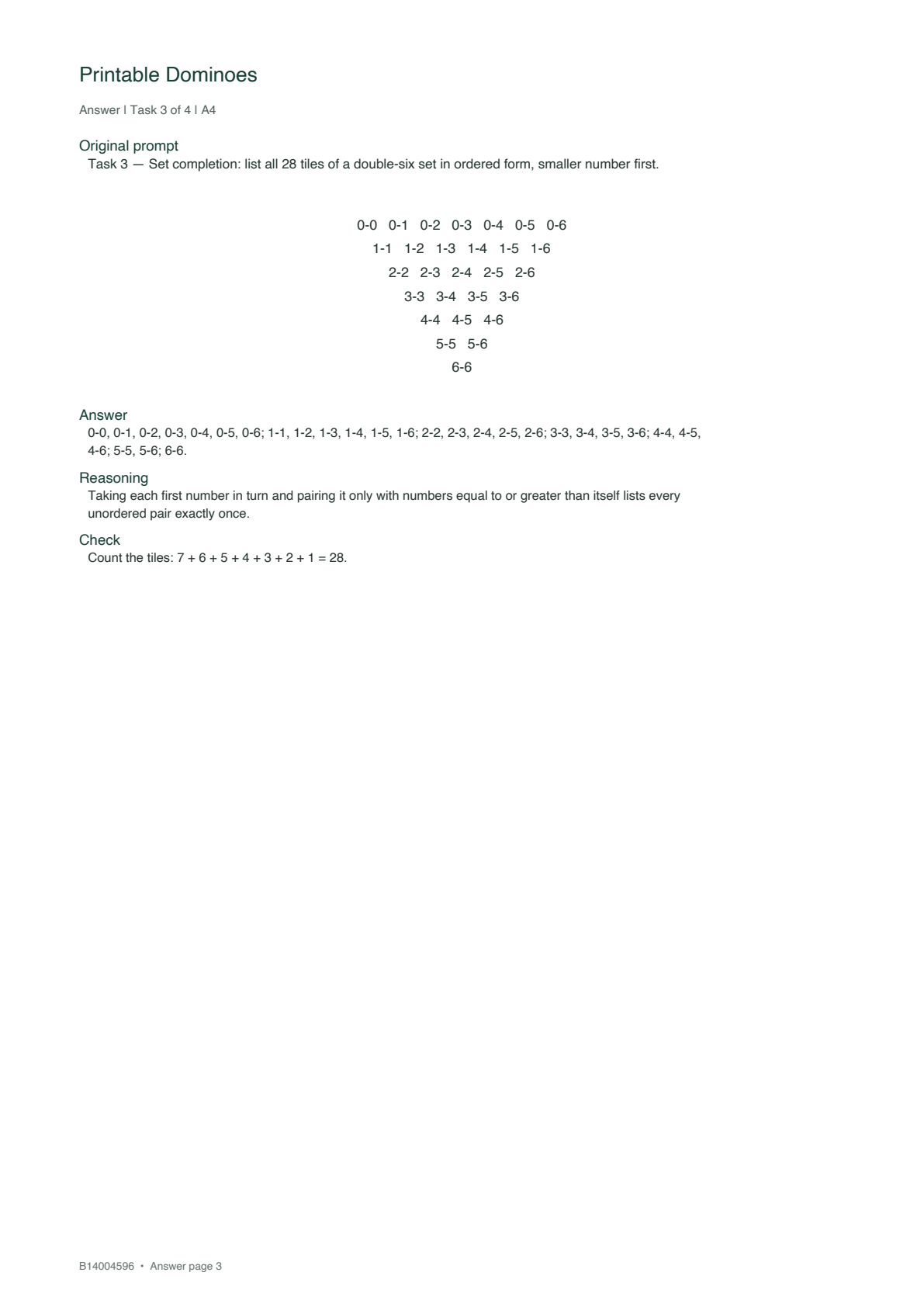
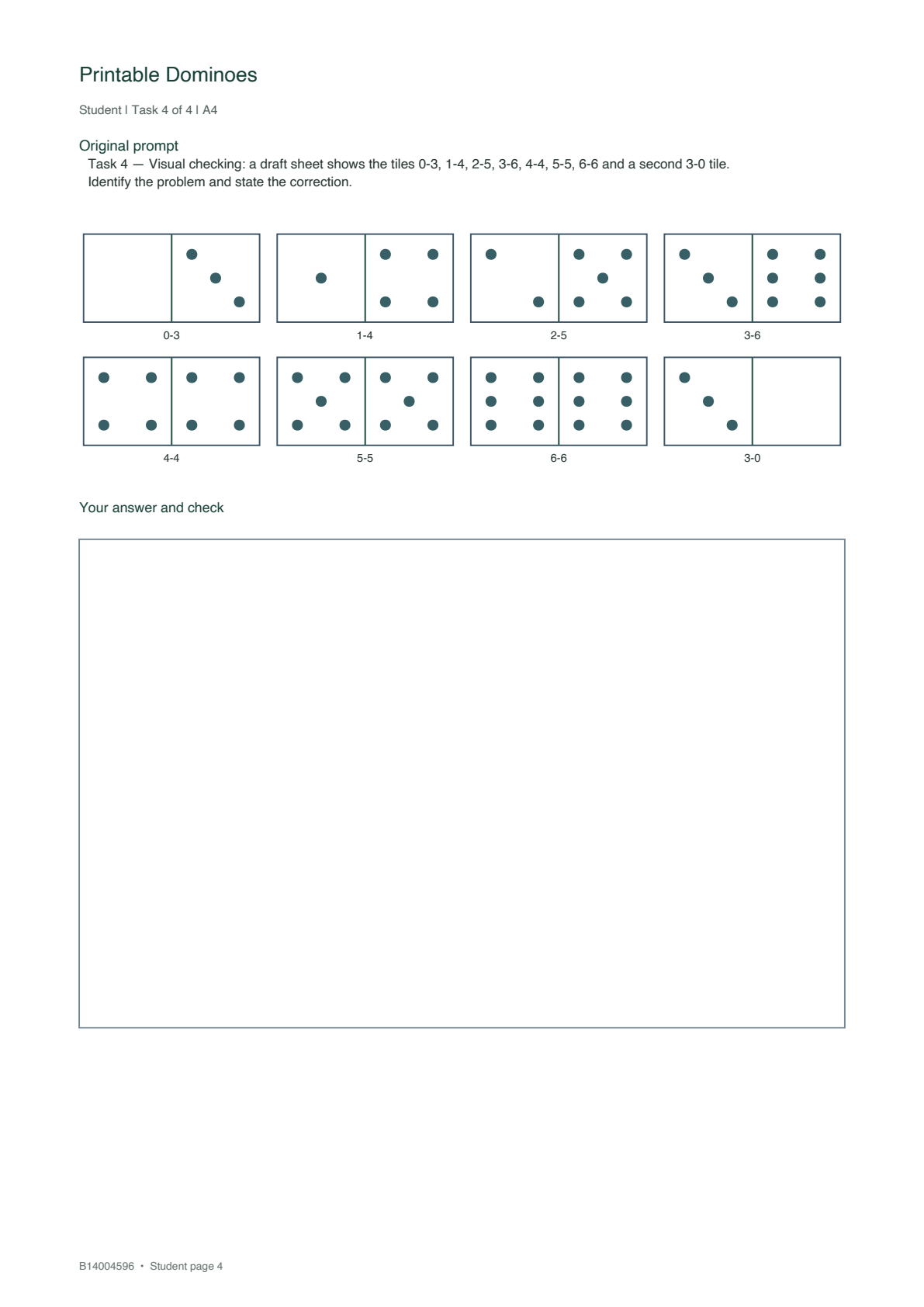
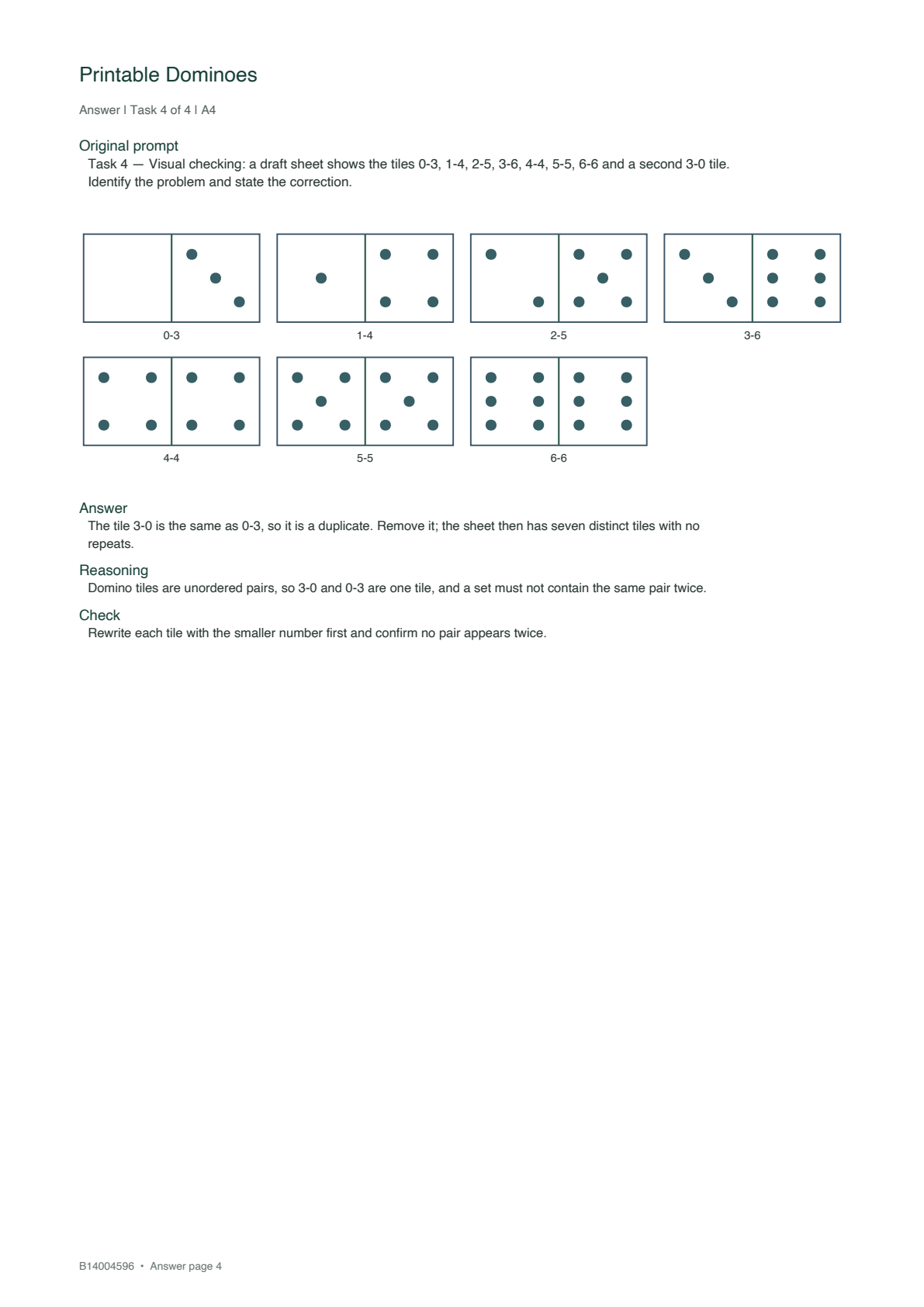
Task 4 — Visual checking: a draft sheet shows the tiles 0-3, 1-4, 2-5, 3-6, 4-4, 5-5, 6-6 and a second 3-0 tile. Identify the problem and state the correction.
Show answer 4
The tile 3-0 is the same as 0-3, so it is a duplicate. Remove it; the sheet then has seven distinct tiles with no repeats.
Domino tiles are unordered pairs, so 3-0 and 0-3 are one tile, and a set must not contain the same pair twice.
Check: Rewrite each tile with the smaller number first and confirm no pair appears twice.
Useful checks
- Treating 3-0 and 0-3 as different tiles. Order every pair with the smaller number first; then duplicates are easy to spot.
- Drawing pips without a centre line. Draw the centre line first so the two squares are equal and the pip patterns sit correctly.
- Cutting along the centre line as well as the outline. Cut only the outer outline; the centre line stays on the tile as the divider.
Questions about this resource
Why 28 tiles?
There are seven numbers, and each unordered pair including doubles counts once, giving 7 + 6 + 5 + 4 + 3 + 2 + 1 = 28.
Does the row layout matter?
No. Four rows of seven is a convenient choice, but any layout with gaps for cutting works.