Free original lessons
Anime Face Emotions: Mix Eyes, Brows, and Mouth on a Fixed Template
Practice drawing anime expressions by swapping eye, brow, and mouth variants on one fixed face template, then combining them into complete, readable emotions.
Free lesson
Four exercises
Worked answers
Object Drawing Lessons
This lesson teaches expression variation on a single anime face template. You will keep head shape, nose, and ear placement fixed while changing only eyes, brows, and mouth. The goal is readable emotion through deliberate part choices, not realistic anatomy or eye-shape-only charts. Work in pencil so you can compare variants before committing. Use a simple convention: the eye's x-height runs from the baseline (lower lid line) to the midline (upper lid line); letter styles and eye shapes vary, so treat these as guides rather than universal rules. Measure your own paper and tools if you set sizes; any numbers below are hypothetical examples.
Practice materials: Printable downloads are not available for this lesson yet. Use the instructions and four exercises below.
Reference illustration
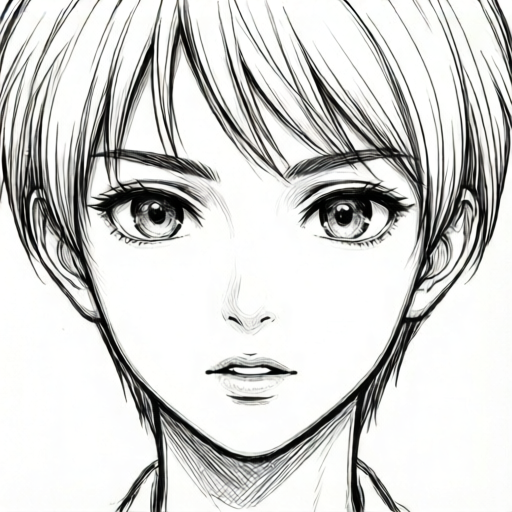
Use the stated measurements and conventions for each exercise.
Set the fixed template and the variation convention
Draw one anime face template: an oval head, a horizontal midline for eye placement, a vertical center line, a small nose mark, and a simple ear at the side. Keep this template identical for every variation so comparisons are fair. The template is the control; only eyes, brows, and mouth change.
Define your eye convention before drawing. Mark a baseline (lower lid) and a midline (upper lid). The x-height is the distance from baseline to midline. Letter styles vary, so an eye can be tall, narrow, round, or angled, but the baseline-to-midline relationship stays consistent within your sheet. This lets you compare expressions without redrawing the whole face.
- Draw the oval head and mark the horizontal midline and vertical center line.
- Add a small nose mark and one simple ear; keep these fixed on every copy.
- Mark the eye baseline and midline lightly so you can erase later.
- Label the template once with 'fixed' so you do not accidentally change head shape.
Build separate eye, brow, and mouth variant strips
Make three strips: eyes, brows, and mouth. On the eye strip, draw four variants that share the same baseline-to-midline x-height but differ in shape: round, narrow, angled, and half-lidded. On the brow strip, draw four variants: flat, raised inner, raised outer, and angled down. On the mouth strip, draw four variants: small smile, wide smile, flat line, and open oval.
Keep each strip separate from the face template at first. This prevents one part from forcing another and lets you mix combinations deliberately. Label each variant with a short name so you can refer to them when combining.
- Draw four eye variants on one strip, all using the same baseline-to-midline x-height.
- Draw four brow variants on a second strip, noting which end is raised.
- Draw four mouth variants on a third strip, noting open versus closed.
- Name each variant in one word so you can mix them by name.
Combine variants into complete expressions
Choose one eye, one brow, and one mouth variant and draw them onto a fresh copy of the fixed template. Read the result aloud as an emotion word. If the combination is ambiguous, change only one part and compare. For example, round eyes with raised inner brows and a small smile reads as surprise; narrow eyes with flat brows and a flat mouth reads as annoyance.
Use the emotion word bank to guide choices, but do not force a single answer. Different combinations can read as the same emotion, and the same parts can read differently depending on context. The rubric rewards deliberate, readable choices and clear part variation, not a single universal correct face.
- Pick one eye, one brow, and one mouth variant by name.
- Draw them on a fresh fixed template without changing head shape.
- Say the emotion word aloud; if unclear, swap one part and compare.
- Record the combination and the emotion word in a final row for reference.
Check readability and refine
Check that the three parts agree. If the brows say anger but the mouth smiles, decide whether the mix is intentional (a smirk) or confusing. Adjust one part at a time and note what changed. Keep the eye x-height consistent so the face does not look distorted.
Use simple arithmetic to check spacing: if your template midline is 6 cm from the top and the eye baseline is 1 cm below the midline, the x-height is 1 cm. If you move the baseline, recalculate so the x-height stays consistent across variants. These numbers are hypothetical examples; measure your own template.
- Compare the three parts for agreement or intentional contrast.
- Change only one part and note the effect on readability.
- Recalculate x-height if you move the baseline.
- Keep the best combination in the final row and label it.
Worked example
On a fixed anime face template with a midline at 6 cm from the top and an eye baseline 1 cm below the midline, combine round eyes, raised inner brows, and a small smile. State the x-height and the emotion word.
Worked answer
The x-height is 1 cm (baseline to midline). Round eyes with raised inner brows and a small smile reads as surprise. The head shape, nose, and ear stay fixed; only the three parts vary.
Four practice exercises
Exercise 1
On a fixed template, combine narrow eyes, flat brows, and a flat mouth. State the emotion word and the x-height if the midline is 5 cm from the top and the baseline is 1.5 cm below it.
Show answer and check
The combination reads as annoyance or boredom. The x-height is 1.5 cm.
Why: Narrow eyes with flat brows and a flat mouth suggest low energy or irritation. The x-height is the baseline-to-midline distance: 1.5 cm.
Check: Say the emotion aloud; if it reads as annoyance or boredom, the combination is clear. Confirm the arithmetic: the midline is 5 cm from the top and the baseline is 1.5 cm below it, so the baseline sits 6.5 cm from the top and the x-height (baseline-to-midline distance) is 1.5 cm.
Exercise 2
Combine round eyes, raised outer brows, and an open oval mouth. Describe the emotion and explain which part you would change to make it read as fear instead.
Show answer and check
The combination reads as surprise or excitement. To make it read as fear, change the brows to raised inner brows and keep the open oval mouth.
Why: Raised outer brows with round eyes and an open mouth suggest surprise. Fear typically uses raised inner brows, so swapping the brow variant shifts the read.
Check: Draw both versions on fresh templates and compare aloud. The surprise version should read clearly with raised outer brows; the fear version should read clearly with raised inner brows. Keep the eye x-height identical in both so only the brow change is being judged.
Exercise 3
Draw two different combinations that both read as happiness. List the parts for each and explain why both are valid.
Show answer and check
Example one: round eyes, flat brows, wide smile. Example two: half-lidded eyes, raised outer brows, small smile. Both are valid because the mouth and brow choices support a positive read even with different eye shapes.
Why: Happiness can be read through a wide smile with neutral brows or a small smile with lifted outer brows. The rubric allows valid alternatives if the combination is deliberate and readable.
Check: Say each emotion aloud; if both read as happiness, they are valid. Check that the eye x-height is consistent within each face and that the head shape, nose, and ear are unchanged between the two combinations.
Exercise 4
Combine angled-down brows, narrow eyes, and a wide smile. State whether the result is confusing or intentional, and give one fix if it is confusing.
Show answer and check
The result can read as a smirk or as confusing. If confusing, change the mouth to a flat line to match the angry brows.
Why: Angled-down brows and narrow eyes suggest anger, while a wide smile suggests happiness. The mix can be intentional (a smirk) but may be unclear. Changing one part resolves the ambiguity.
Check: Say the emotion aloud; if it is unclear, swap the mouth to a flat line and compare. Keep the fixed template and consistent x-height unchanged so only the mouth choice is being tested.
Common mistakes
- Changing the head shape or nose placement between variants. Use the same fixed template copy for every combination; only eyes, brows, and mouth should change.
- Drawing eyes without a consistent baseline-to-midline x-height. Mark the baseline and midline lightly before drawing; keep the x-height equal across eye variants.
- Choosing all three parts from the same emotion without checking readability. Say the emotion word aloud after combining; if it is unclear, swap one part and compare.
- Treating one combination as the only correct answer for an emotion. Accept valid alternatives that read clearly; use the rubric to judge deliberate variation, not a single universal face.
Self-check rubric
- Template is fixed: head shape, nose, and ear placement are identical across combinations.
- Eye variants share a consistent baseline-to-midline x-height.
- Brow and mouth variants are drawn separately before combining.
- At least three complete combinations are drawn on fresh template copies.
- Each combination is labeled with an emotion word and a part list.
- Readability is checked by saying the emotion aloud and swapping one part if unclear.
- Valid alternatives are accepted; no single universal face is required.
Questions and answers
Do I need to draw realistic facial anatomy?
No. This lesson uses a fixed anime template and varies only eyes, brows, and mouth. Realistic anatomy is outside the boundary.
What does x-height mean here?
It is the distance from the eye baseline (lower lid) to the midline (upper lid). Letter styles vary, so eye shapes can differ while the baseline-to-midline relationship stays consistent.
Can two different combinations read as the same emotion?
Yes. The rubric allows valid alternatives as long as the combination is deliberate and readable.
Are the numerical examples required?
No. Any numbers are hypothetical examples. Measure your own paper and tools if you set sizes.