Free original lessons
Contour Drawing of a Panda Head: A Line-Only Study
Learn to draw a panda head using contour lines only. Focus on ear, eye-patch, and muzzle edges with blind and slow contour exercises.
Free lesson
Four exercises
Worked answers
Object Drawing Lessons
Contour drawing captures the outline and edges of a subject without shading or fur texture. This lesson isolates the panda head as a line-only study: you will trace the outer head shape, the rounded ears, the eye patches, and the muzzle edge. The goal is accurate edge observation, not facial proportion construction or fur rendering. Work slowly, keep the pencil moving, and compare each line to the actual edge you see. A simple convention is used throughout: x-height means the distance from the baseline to the midline of a letter, and letter styles may vary, so treat all written labels as approximate guides rather than fixed measurements.
Practice materials: Printable downloads are not available for this lesson yet. Use the instructions and four exercises below.
Reference illustration
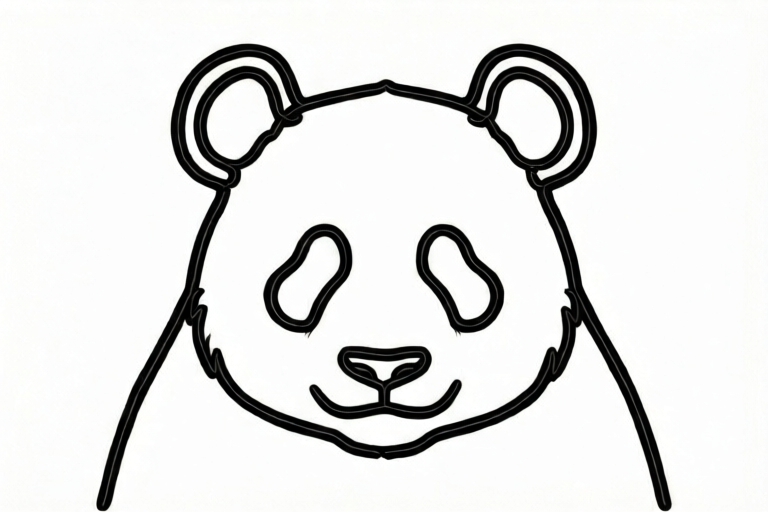
Use the stated measurements and conventions for each exercise.
Seeing Edges Before Drawing Them
Contour drawing begins with careful looking. Before putting pencil to paper, spend one minute tracing the panda head outline with your eyes only. Notice where the head curve meets the ear, where the eye patch edge turns, and how the muzzle line separates from the cheek. These are edges, not textures. Do not draw individual hairs or shading.
A useful convention for this study is to treat every visible boundary as a single continuous line. If an edge disappears behind another shape, stop the line and begin again at the next visible point. This keeps the drawing honest and avoids inventing connections you cannot see.
- Place the reference panda head image where you can see it clearly without turning your head.
- Rest your pencil on the paper and pick one starting edge, such as the top of the left ear.
- Move your eye slowly along that edge while your pencil follows at the same pace.
- When the edge ends or is hidden, lift the pencil and find the next visible edge.
- Complete the outer head outline first, then add the eye patches and muzzle edge as separate contour lines.
Blind Contour: Drawing Without Looking
Blind contour means you look only at the reference, never at your paper, while your pencil records the edges. The result will look distorted, and that is expected. The purpose is to train your hand to follow your eye without correction.
Keep the line continuous where possible. If you must lift the pencil, do so only when the edge is truly hidden. Work for two to three minutes on a single blind contour of the panda head. Afterward, compare the line to the reference and note where your hand slowed or sped up.
- Cover or turn away your paper so you cannot see it.
- Choose one edge, such as the right eye patch, and begin drawing.
- Let your eye move at a steady pace along the edge while your pencil follows.
- Do not lift the pencil unless the edge is interrupted by another shape.
- When finished, look at the drawing and mark one place where the line matched the edge well.
Slow Contour: Refining Edge Accuracy
Slow contour allows you to glance at your paper, but only to place the pencil, not to correct the shape from memory. The pace is deliberately slow: about one minute per major edge. This builds accurate observation without relying on shading or fur texture.
Use the same edge order as the blind contour: outer head, ears, eye patches, muzzle. Keep lines single and clean. If a line goes wrong, leave it and draw the correct edge beside it rather than erasing, so you can see your observation process.
- Draw the outer head outline slowly, glancing at the paper only to start each new line.
- Add each ear as a separate rounded contour, checking where it meets the head.
- Draw the eye patches as closed or nearly closed shapes, following their actual edges.
- Add the muzzle edge as a single line that separates the muzzle from the cheek.
- Review the drawing against the reference and circle one edge you would redraw more slowly.
Using a Simple Convention for Labels
When you label parts of your contour study, use a consistent convention: x-height is the distance from the baseline to the midline of a letter. Letter styles vary, so labels are approximate guides, not measurements. For example, you might label the ear edge with a short note whose x-height is about 3 mm on your paper. This is a hypothetical example, not a standard.
Keep labels outside the contour lines so they do not interfere with the edge study. If you measure anything, measure your actual paper and pencil, and label any chosen numerical value as a hypothetical example.
- Write labels in lowercase letters with a consistent x-height you choose.
- Place each label near the edge it describes but outside the drawn contour.
- Measure your actual paper if you need a reference length, and note it as a hypothetical example.
- Do not use labels to replace drawn edges; they are notes, not contour lines.
Worked example
A student draws a slow contour of a panda head. They start at the top of the left ear, follow the ear edge down to where it meets the head, stop, then begin again at the top of the head and draw the outer head curve to the right ear. They then draw the right eye patch as a closed shape and the muzzle edge as one line. The drawing has one line that crosses the left eye patch by mistake. Describe how to evaluate this contour study using the rubric.
Worked answer
The study meets the edge-focus criterion because it uses single lines for the ear, head, eye patch, and muzzle without shading or fur texture. It meets the hidden-edge criterion because the student stopped at the ear-head junction and restarted at a visible edge. The crossed line on the left eye patch is a slow-contour error; the student should leave it and draw the correct edge beside it. The study does not need facial proportion construction, so missing proportion guides is not a fault. For labeling, any notes should use a consistent x-height convention and be placed outside the contour lines. Overall, the study is a valid contour exercise with one correctable observation error.
Four practice exercises
Exercise 1
Draw a blind contour of a panda head using only the outer head outline and the two ears. Do not look at your paper. Describe the order of edges you followed and one place where your hand slowed down.
Show answer and check
A valid response describes starting at one ear, following its edge to the head, stopping, then drawing the outer head curve to the other ear, and finally drawing the second ear. The student notes one place where the hand slowed, such as the curve between the ear and the head.
Why: Blind contour trains eye-hand coordination without visual correction. The order of edges is flexible as long as each edge is followed continuously until hidden.
Check: Confirm the response names at least three edges (one ear, head outline, second ear) and identifies one slowing point. The drawing itself is not judged for accuracy in blind contour.
Exercise 2
A slow contour drawing of a panda head has the following lines: outer head outline, left ear, right ear, left eye patch, right eye patch, and muzzle edge. The right eye patch line crosses the muzzle edge by 2 mm on the paper. Using the rubric, state whether this is a valid contour study and what the student should do next.
Show answer and check
The study is valid because it includes all major edges and uses single lines without shading. The 2 mm crossing is a slow-contour error. The student should leave the crossing line and draw the correct right eye patch edge beside it, then compare both lines to the reference.
Why: Slow contour allows glancing at the paper but not correcting from memory. Leaving the error shows the observation process, and redrawing beside it improves accuracy.
Check: Check that the response names all six edges, identifies the crossing as an error, and recommends leaving and redrawing rather than erasing.
Exercise 3
You are labeling a contour study. You choose an x-height of 4 mm for your labels on your actual paper. Is this a standard measurement? Explain how to treat this value and where to place the labels.
Show answer and check
No, 4 mm is a hypothetical example chosen for this paper, not a standard. Treat it as an approximate labeling convention. Place labels outside the contour lines so they do not interfere with the edge study.
Why: X-height is baseline to midline and varies with letter style. Any numerical value is a local choice, not a universal standard.
Check: Confirm the response states the value is hypothetical, mentions x-height as baseline to midline, and places labels outside the contour.
Exercise 4
Draw a slow contour of a panda head with the muzzle edge and both eye patches. The reference shows the left eye patch partly hidden behind the muzzle edge. Describe how you handle the hidden part and how you check your drawing against the rubric.
Show answer and check
Stop the left eye patch line where the muzzle edge hides it, then begin again at the next visible point of the eye patch. Check the drawing by confirming that each line follows a visible edge, that the hidden part is not invented, and that no shading or fur texture is used.
Why: Hidden edges must not be invented. Stopping and restarting keeps the contour honest. The rubric checks edge focus and line continuity.
Check: Verify the response stops at the hidden edge, restarts at a visible point, and uses rubric criteria about edge focus and continuity.
Common mistakes
- Drawing fur texture instead of contour edges. Keep the pencil on the edge only. If you see fur, treat the outer boundary of the fur mass as one line, not many hairs.
- Correcting blind contour drawings from memory. Leave the blind contour as drawn. Its purpose is observation training, not a polished result.
- Skipping hidden edges and inventing connections. Stop the line where the edge disappears. Begin again at the next visible edge.
- Using shading to suggest the eye patch. Draw the eye patch as a closed contour line. Do not fill it in.
Self-check rubric
- Edge focus: all lines follow visible edges; no shading, fur texture, or filled areas.
- Line continuity: lines are single and clean; pencil lifts only at hidden edges.
- Blind contour attempt: at least one drawing made without looking at the paper.
- Slow contour accuracy: major edges (head outline, ears, eye patches, muzzle) are present and compared to the reference.
- Label convention: any labels use a consistent x-height convention and sit outside the contour lines.
- Valid alternatives: different line order or starting points are acceptable if edges are followed accurately.
Questions and answers
Do I need to draw the panda's face proportions first?
No. This lesson excludes facial proportion construction. Focus only on visible edges: head outline, ears, eye patches, and muzzle edge.
How long should each contour drawing take?
A blind contour can take two to three minutes. A slow contour can take five to eight minutes. Pace yourself so your eye and pencil move together.
Can I erase mistakes?
For slow contour, leave wrong lines and draw the correct edge beside them. This shows your observation process. For blind contour, do not erase at all.
What does x-height mean here?
X-height is the distance from the baseline to the midline of a letter. Letter styles vary, so use it only as an approximate labeling convention, not a measurement standard.