Free original lessons
Draw a Boat in One-Point Perspective
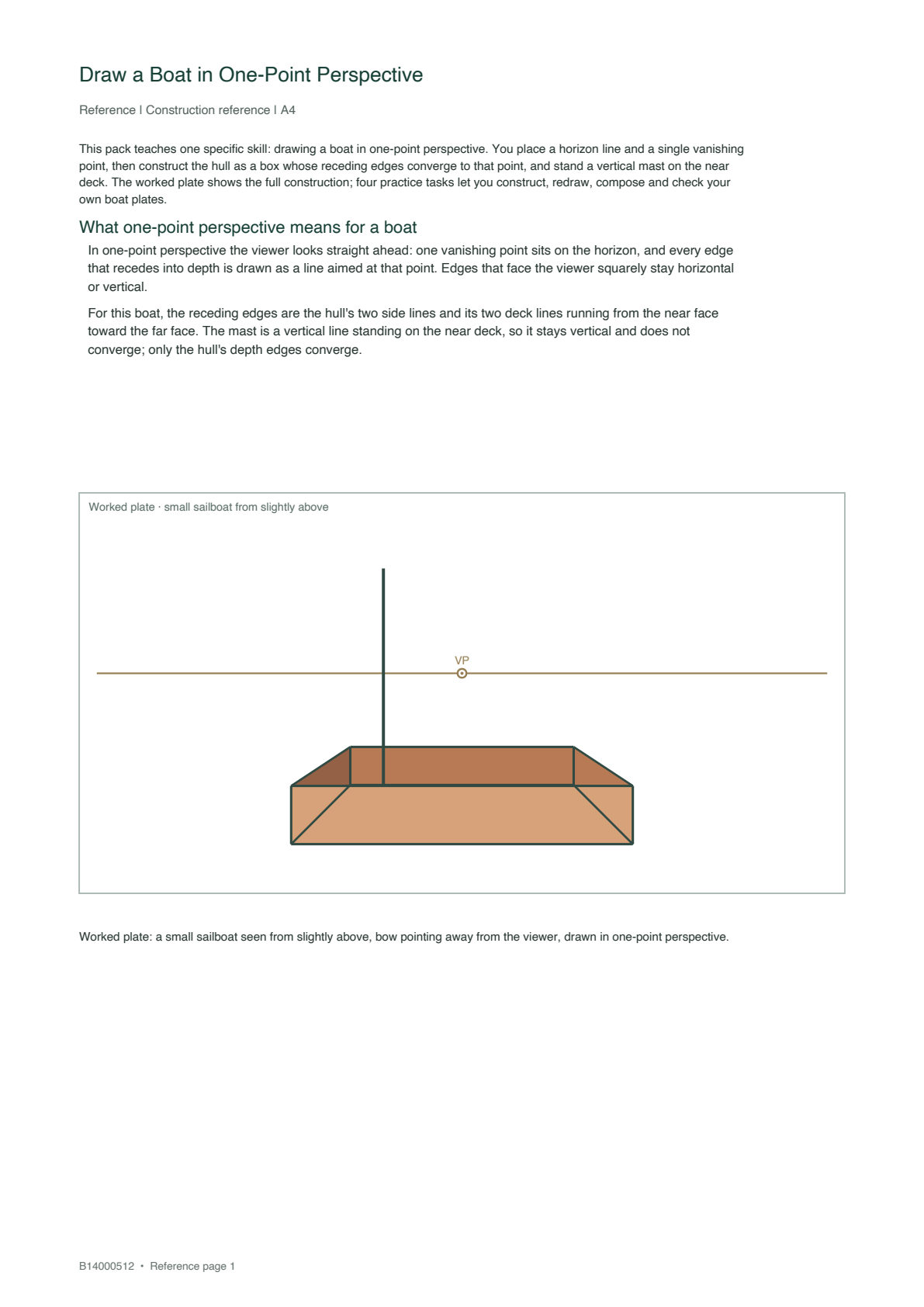
This pack teaches one specific skill: drawing a boat in one-point perspective. You place a horizon line and a single vanishing point, then construct the hull as a box whose receding edges converge to that point, and stand a vertical mast on the near deck. The worked plate shows the full construction; four practice tasks let you construct, redraw, compose and check your own boat plates.
Letter & A4
PDF & SVG
What one-point perspective means for a boat
In one-point perspective the viewer looks straight ahead: one vanishing point sits on the horizon, and every edge that recedes into depth is drawn as a line aimed at that point. Edges that face the viewer squarely stay horizontal or vertical.
For this boat, the receding edges are the hull's two side lines and its two deck lines running from the near face toward the far face. The mast is a vertical line standing on the near deck, so it stays vertical and does not converge; only the hull's depth edges converge.
The construction sequence
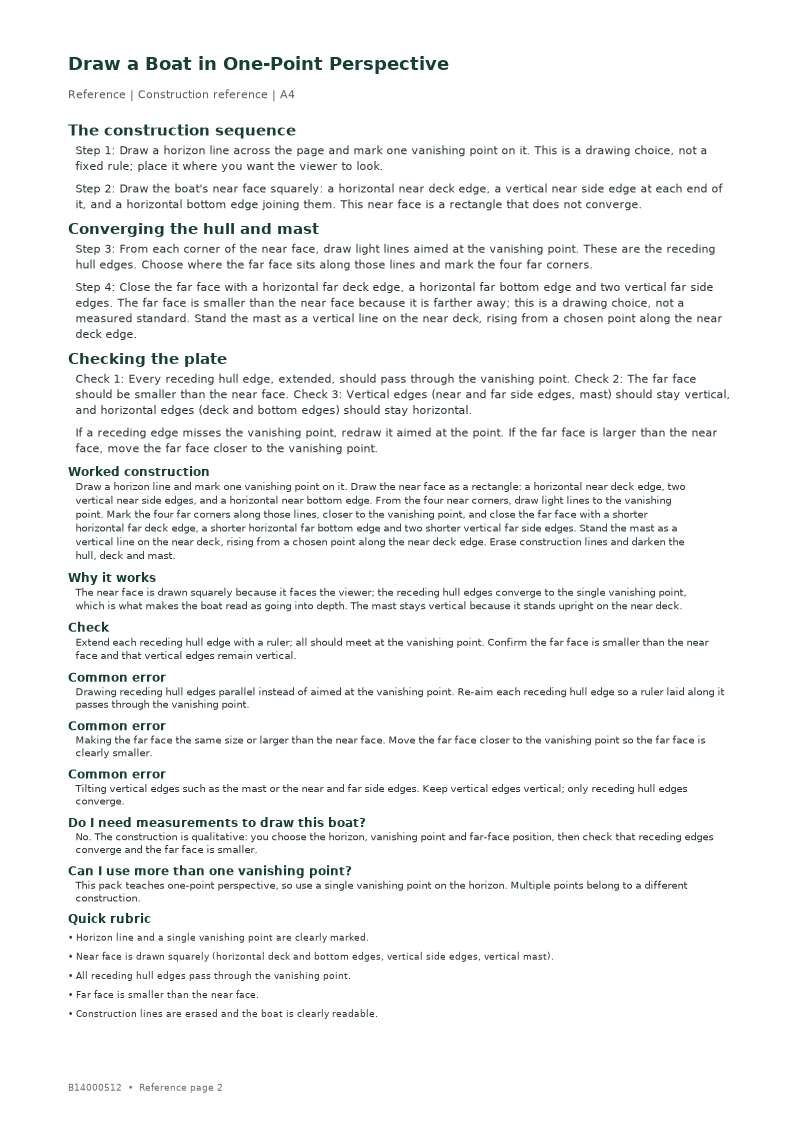
Step 1: Draw a horizon line across the page and mark one vanishing point on it. This is a drawing choice, not a fixed rule; place it where you want the viewer to look.
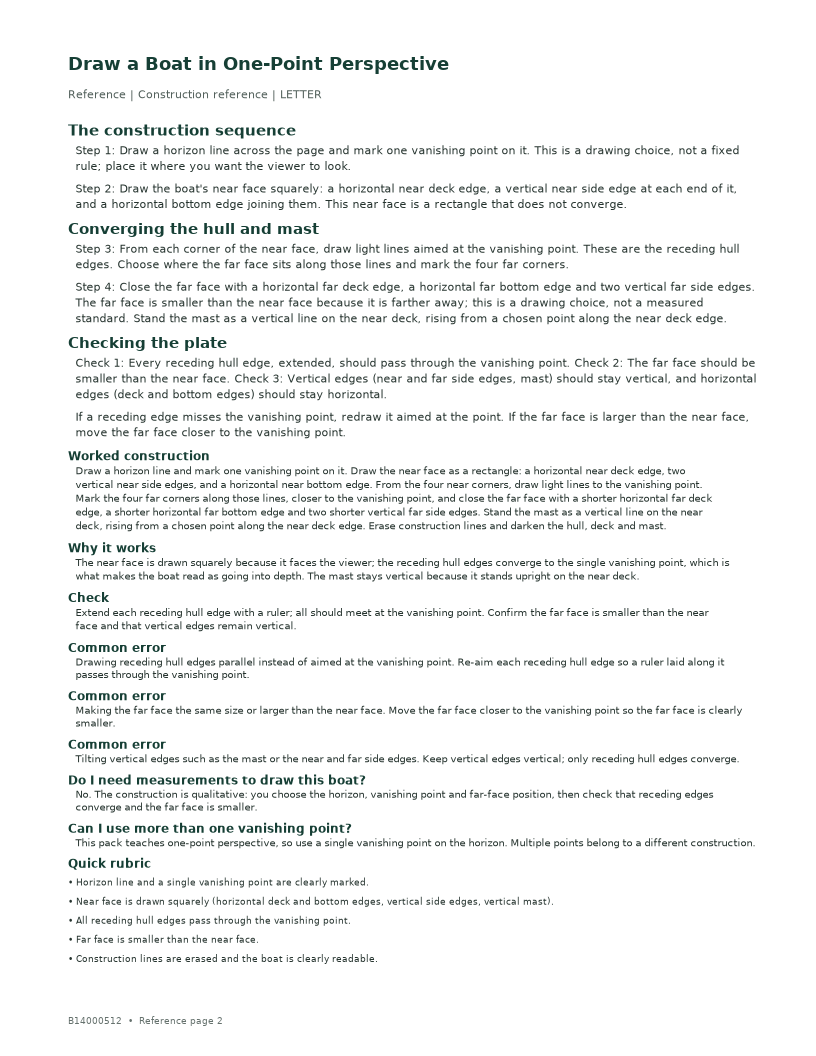
Step 2: Draw the boat's near face squarely: a horizontal near deck edge, a vertical near side edge at each end of it, and a horizontal bottom edge joining them. This near face is a rectangle that does not converge.
Converging the hull and mast
Step 3: From each corner of the near face, draw light lines aimed at the vanishing point. These are the receding hull edges. Choose where the far face sits along those lines and mark the four far corners.
Step 4: Close the far face with a horizontal far deck edge, a horizontal far bottom edge and two vertical far side edges. The far face is smaller than the near face because it is farther away; this is a drawing choice, not a measured standard. Stand the mast as a vertical line on the near deck, rising from a chosen point along the near deck edge.
Checking the plate
Check 1: Every receding hull edge, extended, should pass through the vanishing point. Check 2: The far face should be smaller than the near face. Check 3: Vertical edges (near and far side edges, mast) should stay vertical, and horizontal edges (deck and bottom edges) should stay horizontal.
If a receding edge misses the vanishing point, redraw it aimed at the point. If the far face is larger than the near face, move the far face closer to the vanishing point.
Download the complete resource pack
All individual SVG pages (20)
- A4 reference page 1
- A4 reference page 2
- A4 student page 1
- A4 student page 2
- A4 student page 3
- A4 student page 4
- A4 answer page 1
- A4 answer page 2
- A4 answer page 3
- A4 answer page 4
- LETTER reference page 1
- LETTER reference page 2
- LETTER student page 1
- LETTER student page 2
- LETTER student page 3
- LETTER student page 4
- LETTER answer page 1
- LETTER answer page 2
- LETTER answer page 3
- LETTER answer page 4
Print at 100% / actual size. Use the stated scale on any schematic diagram; physical cutting templates are identified separately. A4 and US Letter are separate files. Free access, no signup; CC BY 4.0.
How to use these pages
- What one-point perspective means for a boat
- The construction sequence
- Converging the hull and mast
- Checking the plate
Worked example
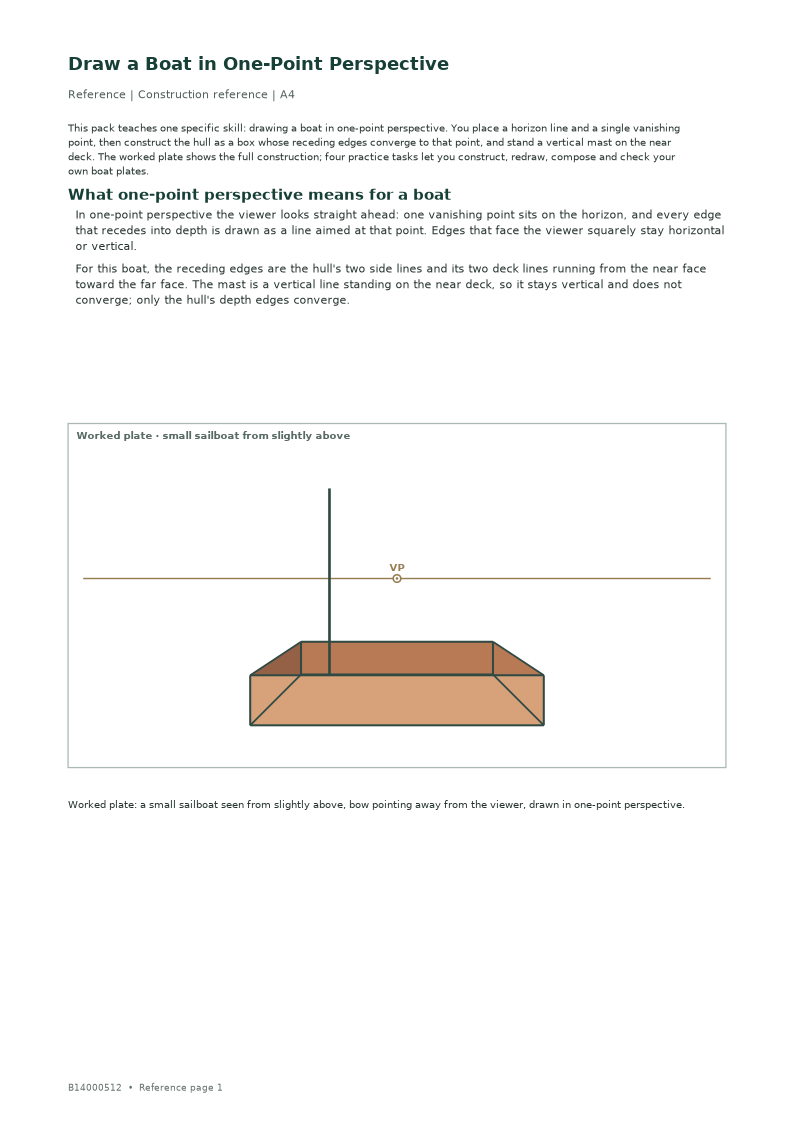
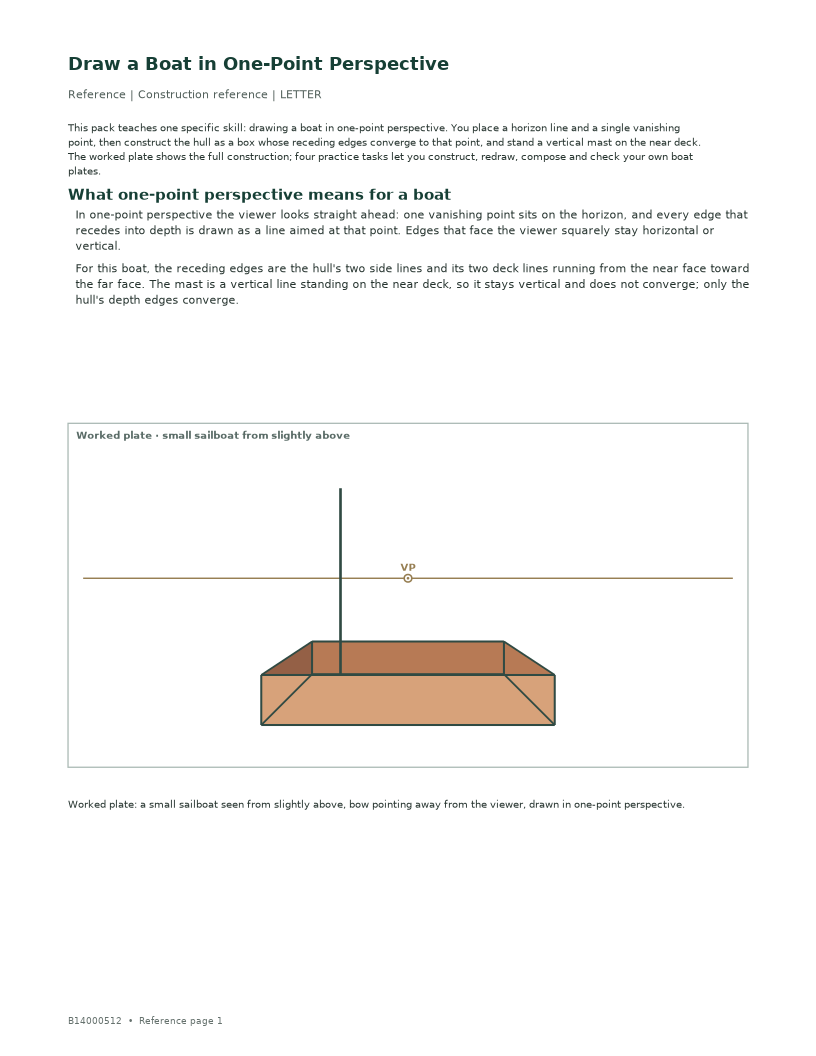
Example: Worked plate: a small sailboat seen from slightly above, bow pointing away from the viewer, drawn in one-point perspective.
Answer: Draw a horizon line and mark one vanishing point on it. Draw the near face as a rectangle: a horizontal near deck edge, two vertical near side edges, and a horizontal near bottom edge. From the four near corners, draw light lines to the vanishing point. Mark the four far corners along those lines, closer to the vanishing point, and close the far face with a shorter horizontal far deck edge, a shorter horizontal far bottom edge and two shorter vertical far side edges. Stand the mast as a vertical line on the near deck, rising from a chosen point along the near deck edge. Erase construction lines and darken the hull, deck and mast.
Reasoning: The near face is drawn squarely because it faces the viewer; the receding hull edges converge to the single vanishing point, which is what makes the boat read as going into depth. The mast stays vertical because it stands upright on the near deck.
Check: Extend each receding hull edge with a ruler; all should meet at the vanishing point. Confirm the far face is smaller than the near face and that vertical edges remain vertical.
Four practice tasks and complete answers
Task 1
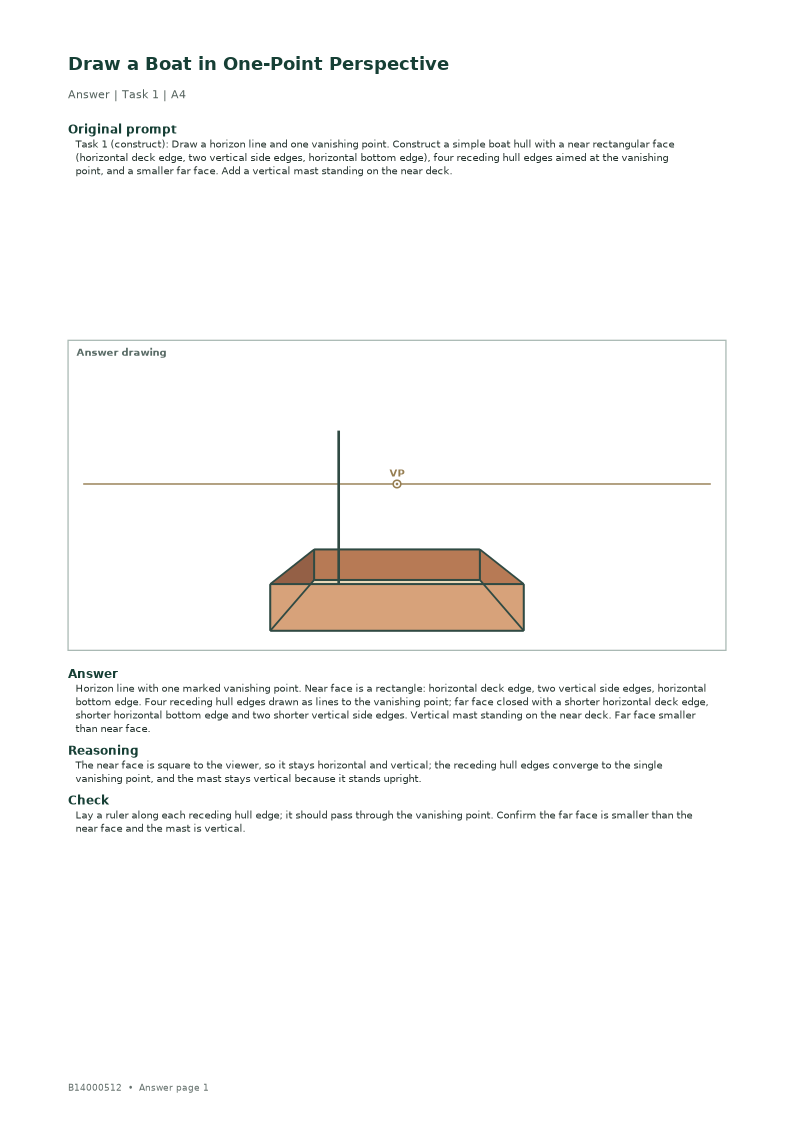
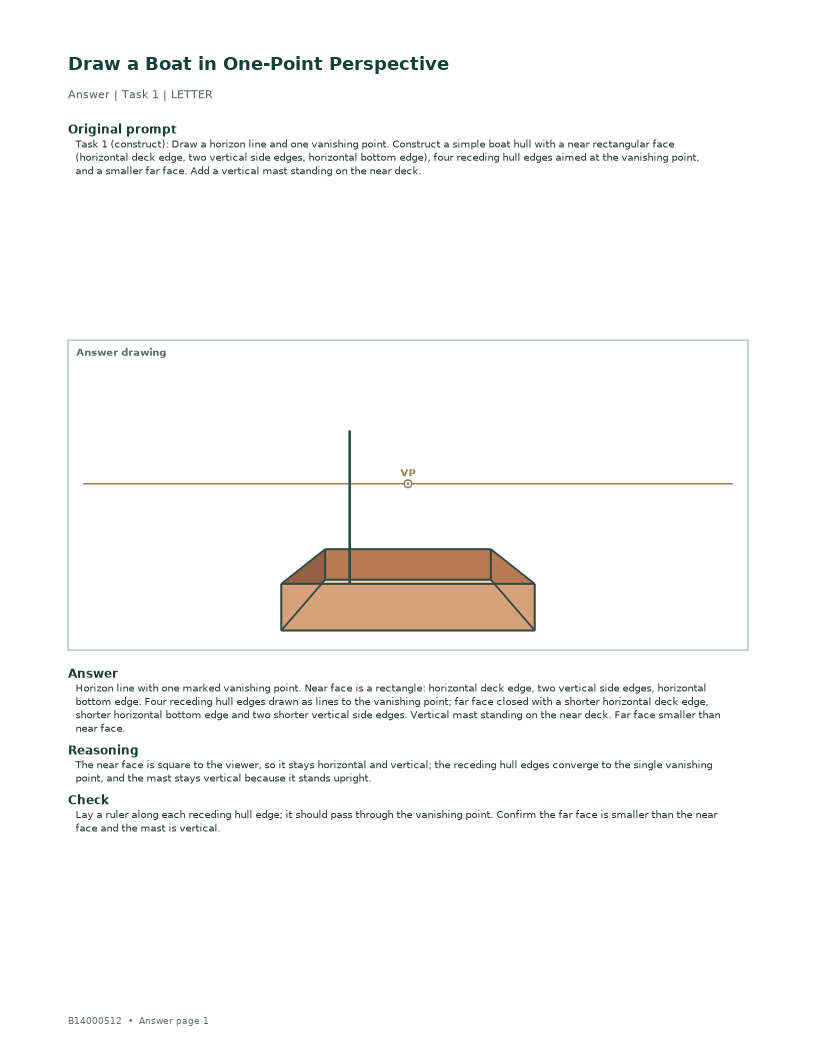
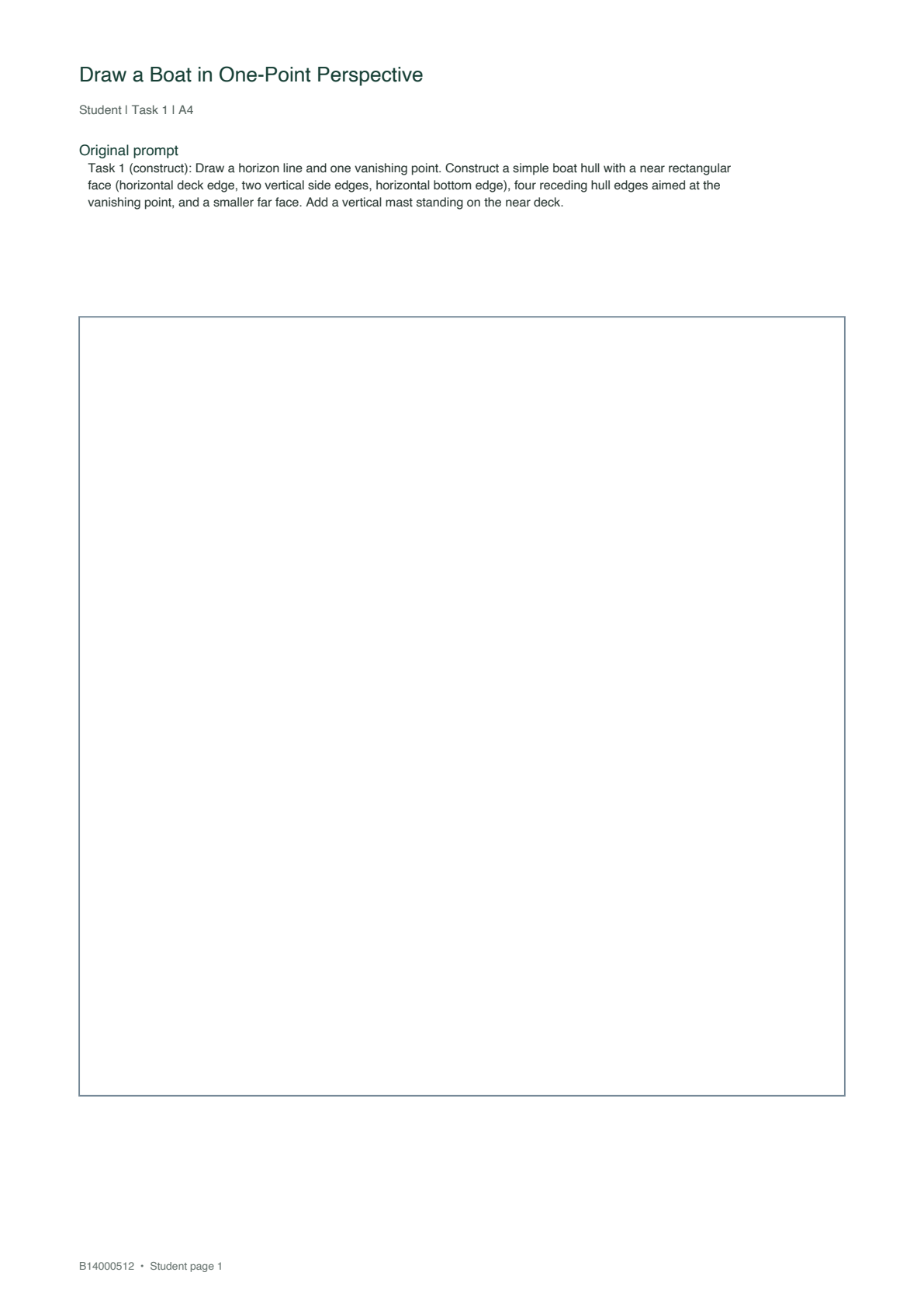
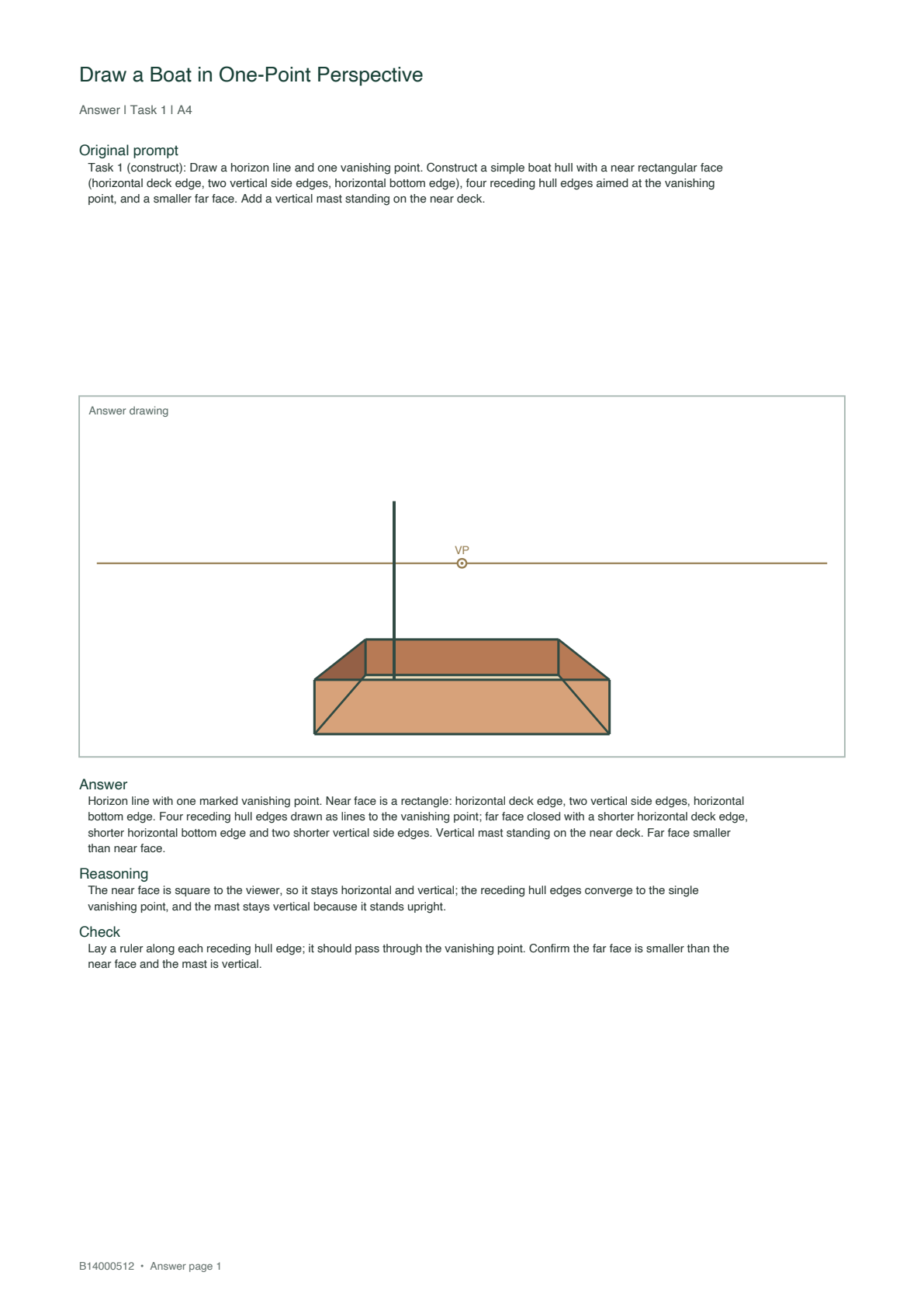
Task 1 (construct): Draw a horizon line and one vanishing point. Construct a simple boat hull with a near rectangular face (horizontal deck edge, two vertical side edges, horizontal bottom edge), four receding hull edges aimed at the vanishing point, and a smaller far face. Add a vertical mast standing on the near deck.
Show answer 1
Horizon line with one marked vanishing point. Near face is a rectangle: horizontal deck edge, two vertical side edges, horizontal bottom edge. Four receding hull edges drawn as lines to the vanishing point; far face closed with a shorter horizontal deck edge, shorter horizontal bottom edge and two shorter vertical side edges. Vertical mast standing on the near deck. Far face smaller than near face.
The near face is square to the viewer, so it stays horizontal and vertical; the receding hull edges converge to the single vanishing point, and the mast stays vertical because it stands upright.
Check: Lay a ruler along each receding hull edge; it should pass through the vanishing point. Confirm the far face is smaller than the near face and the mast is vertical.
Task 2
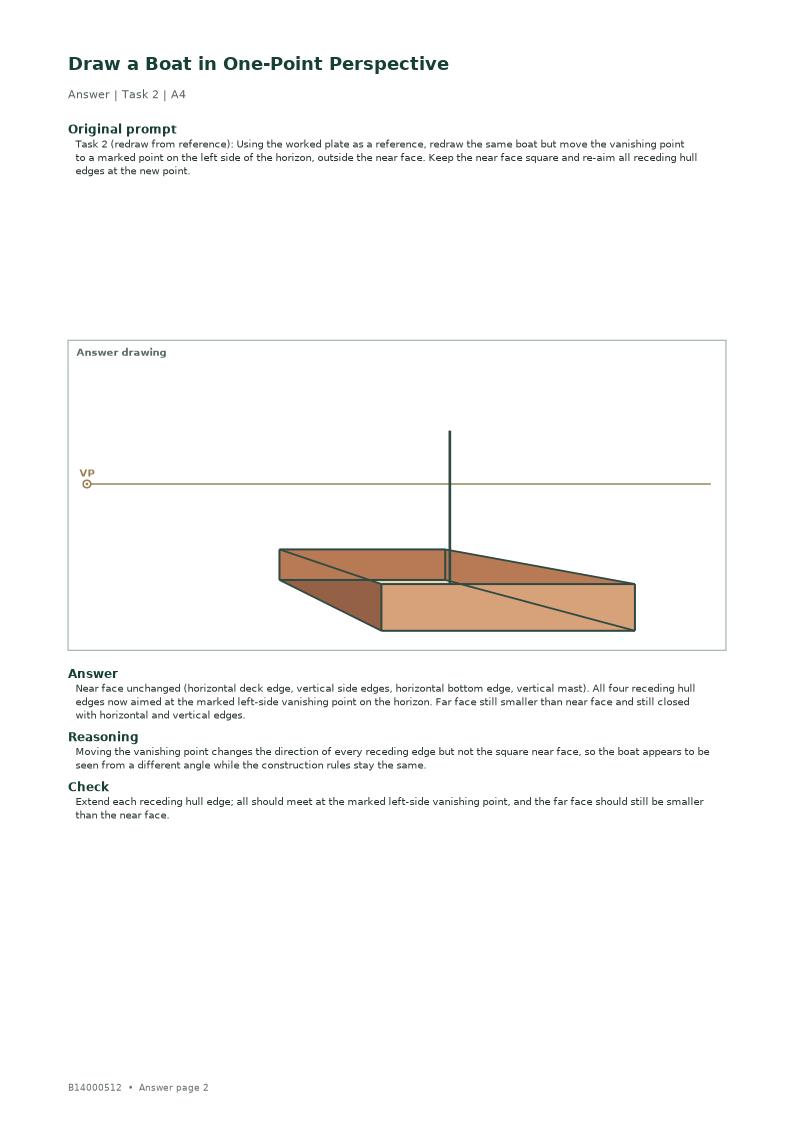
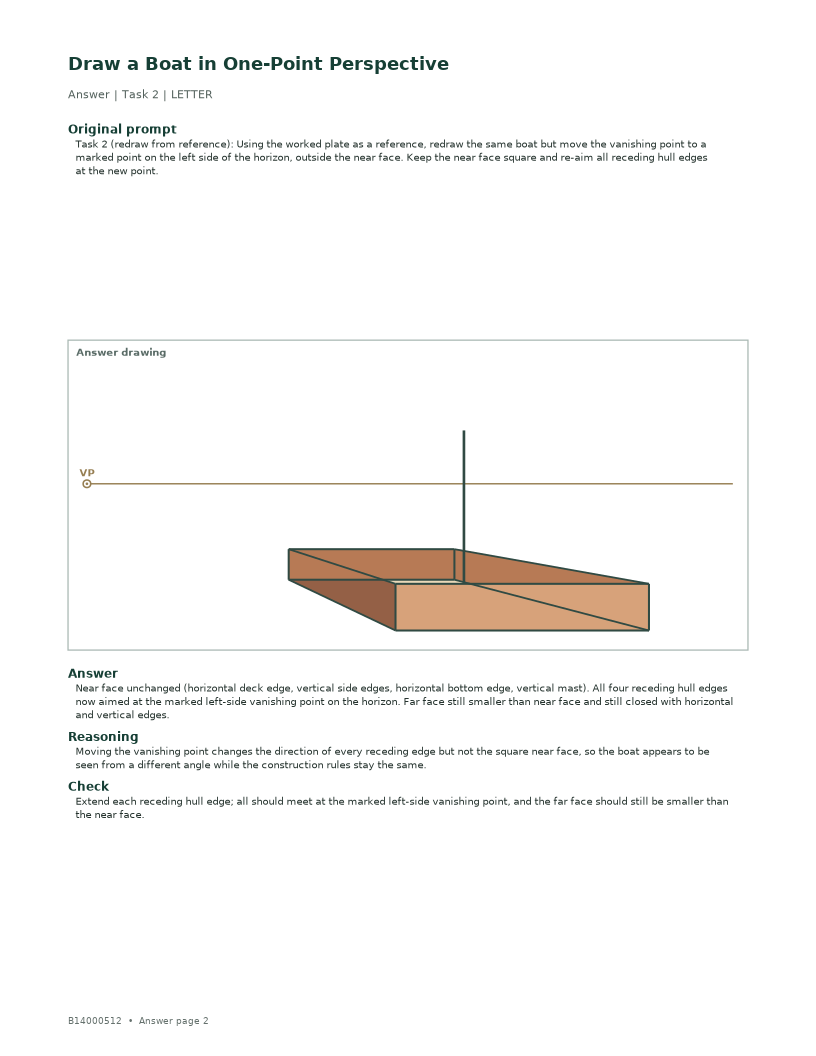
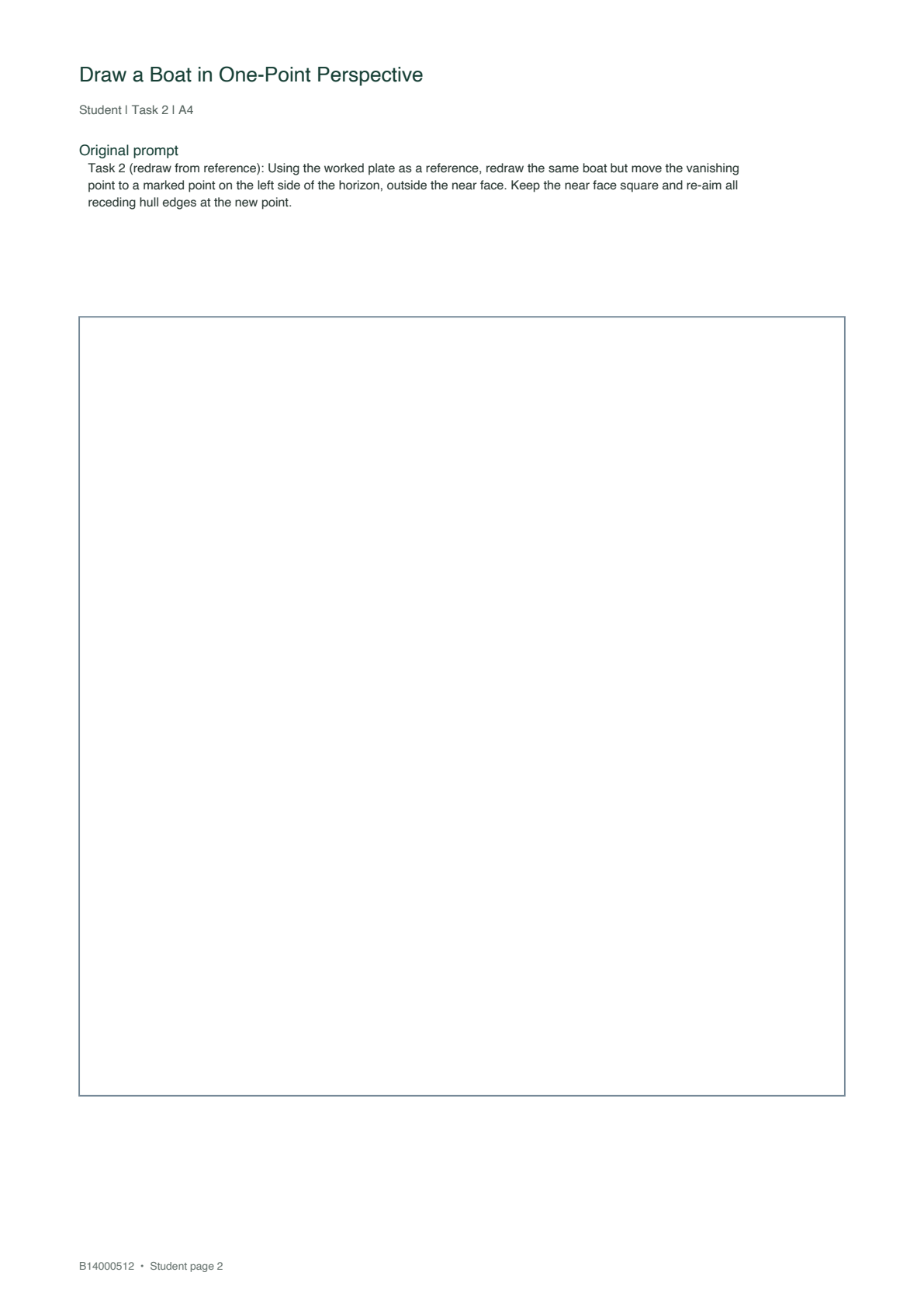
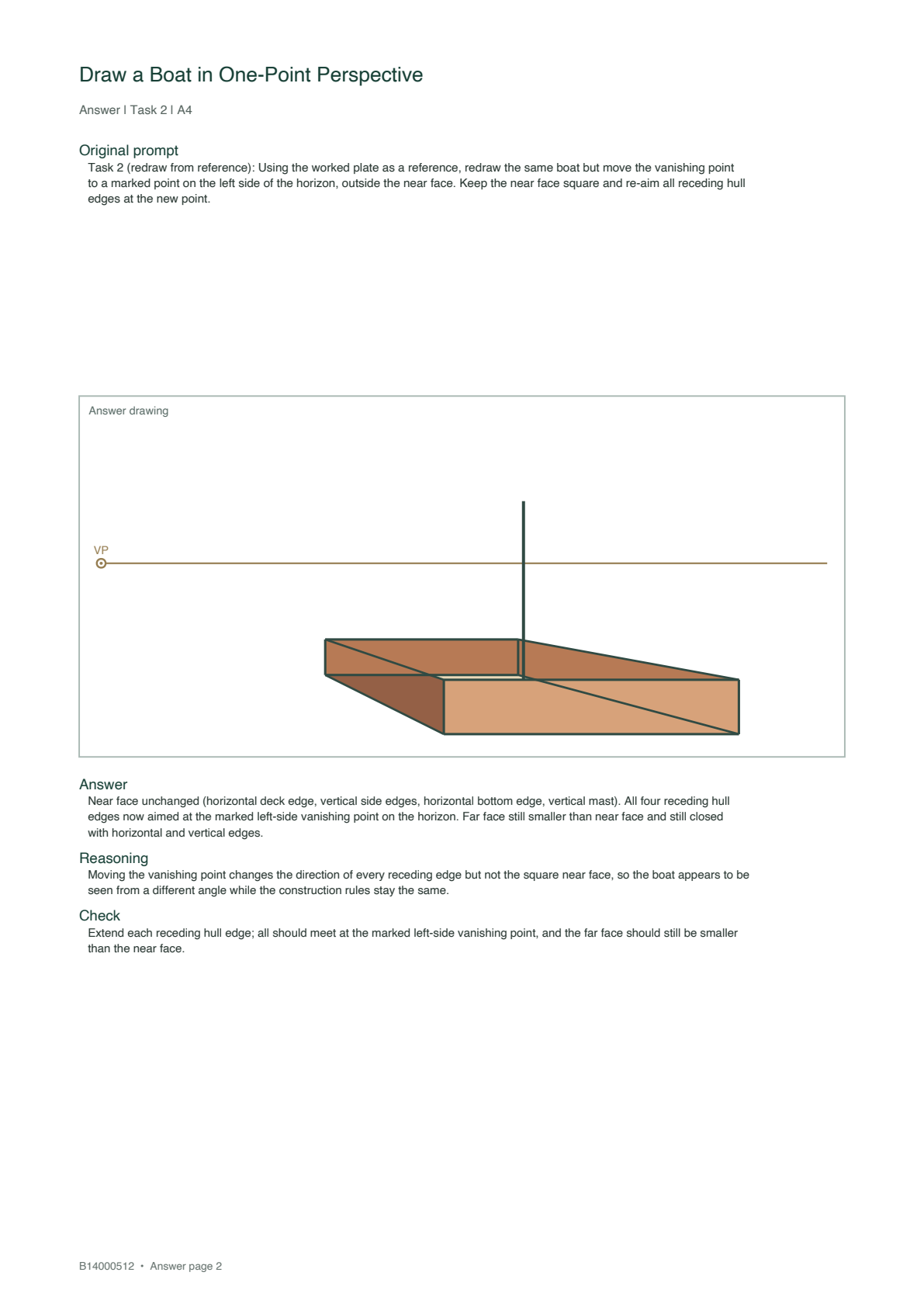
Task 2 (redraw from reference): Using the worked plate as a reference, redraw the same boat but move the vanishing point to a marked point on the left side of the horizon, outside the near face. Keep the near face square and re-aim all receding hull edges at the new point.
Show answer 2
Near face unchanged (horizontal deck edge, vertical side edges, horizontal bottom edge, vertical mast). All four receding hull edges now aimed at the marked left-side vanishing point on the horizon. Far face still smaller than near face and still closed with horizontal and vertical edges.
Moving the vanishing point changes the direction of every receding edge but not the square near face, so the boat appears to be seen from a different angle while the construction rules stay the same.
Check: Extend each receding hull edge; all should meet at the marked left-side vanishing point, and the far face should still be smaller than the near face.
Task 3
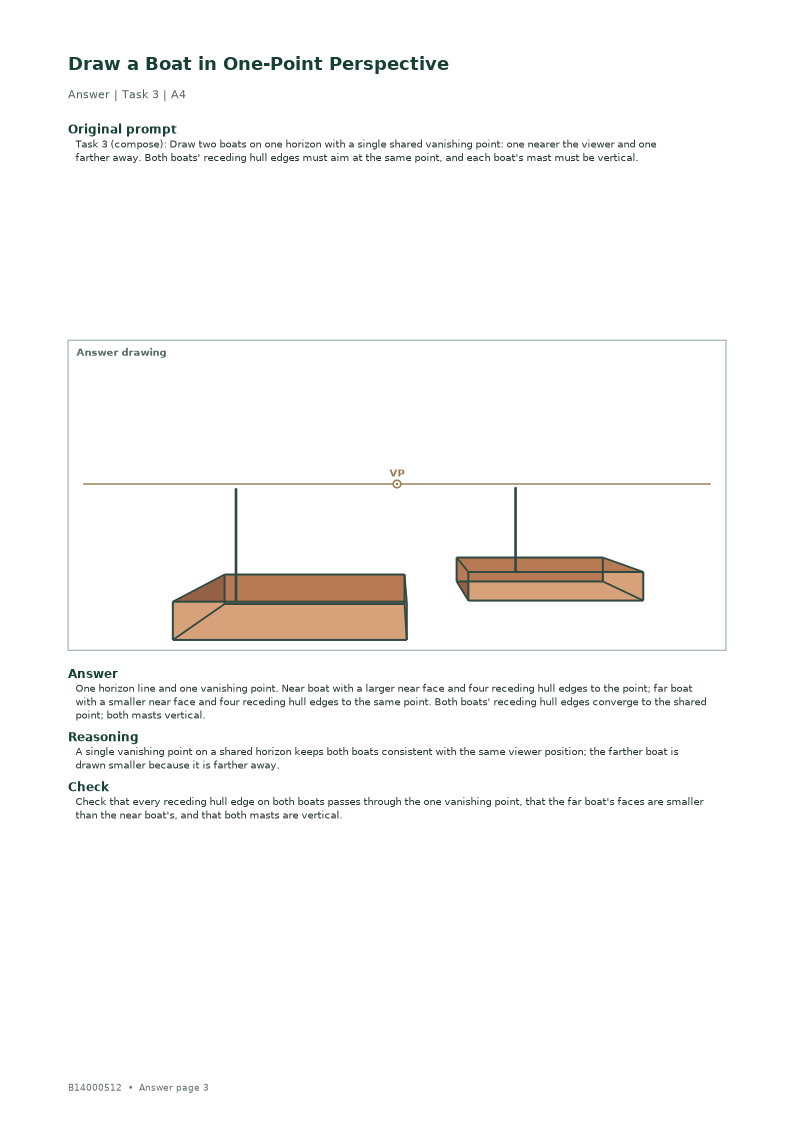
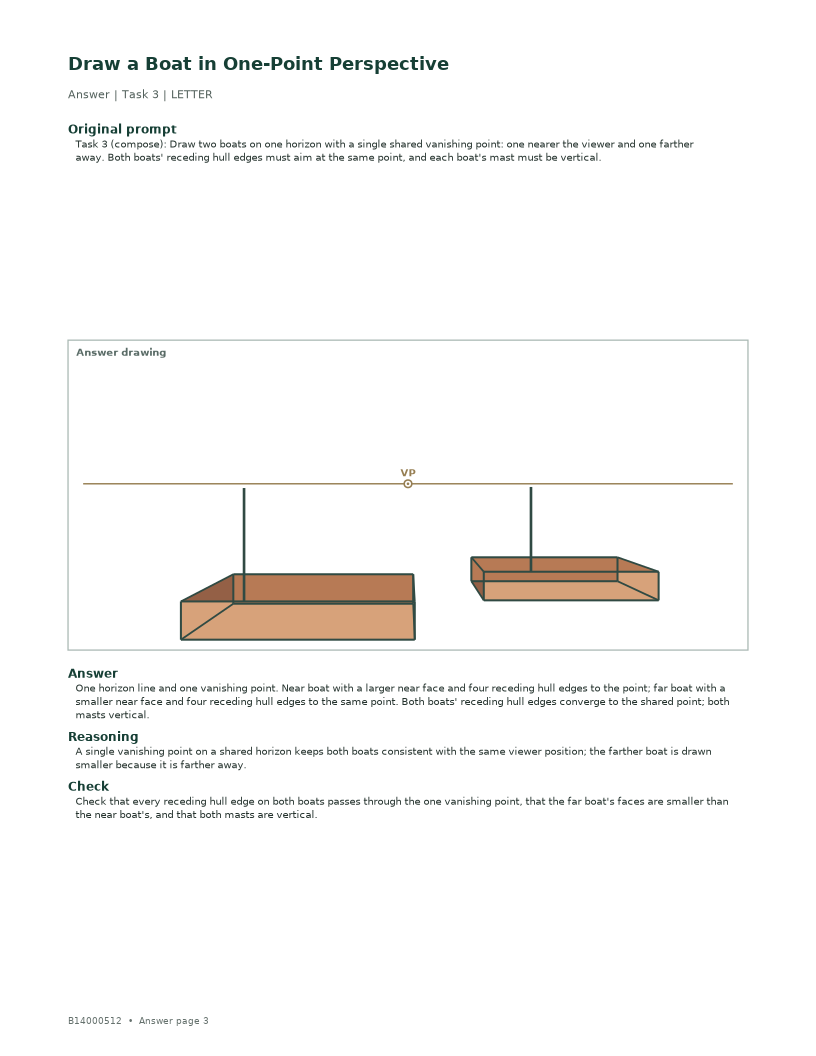
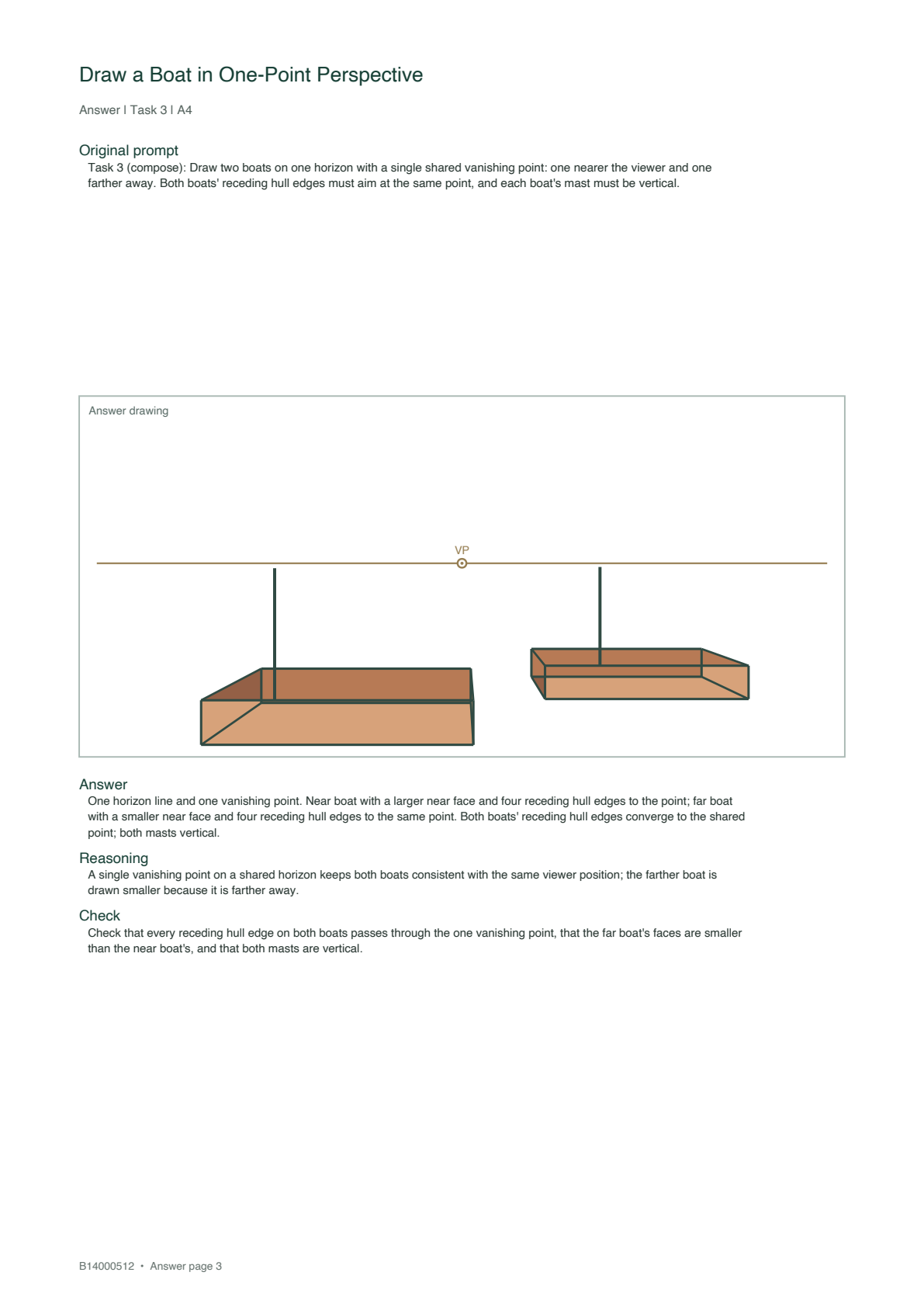
Task 3 (compose): Draw two boats on one horizon with a single shared vanishing point: one nearer the viewer and one farther away. Both boats' receding hull edges must aim at the same point, and each boat's mast must be vertical.
Show answer 3
One horizon line and one vanishing point. Near boat with a larger near face and four receding hull edges to the point; far boat with a smaller near face and four receding hull edges to the same point. Both boats' receding hull edges converge to the shared point; both masts vertical.
A single vanishing point on a shared horizon keeps both boats consistent with the same viewer position; the farther boat is drawn smaller because it is farther away.
Check: Check that every receding hull edge on both boats passes through the one vanishing point, that the far boat's faces are smaller than the near boat's, and that both masts are vertical.
Task 4
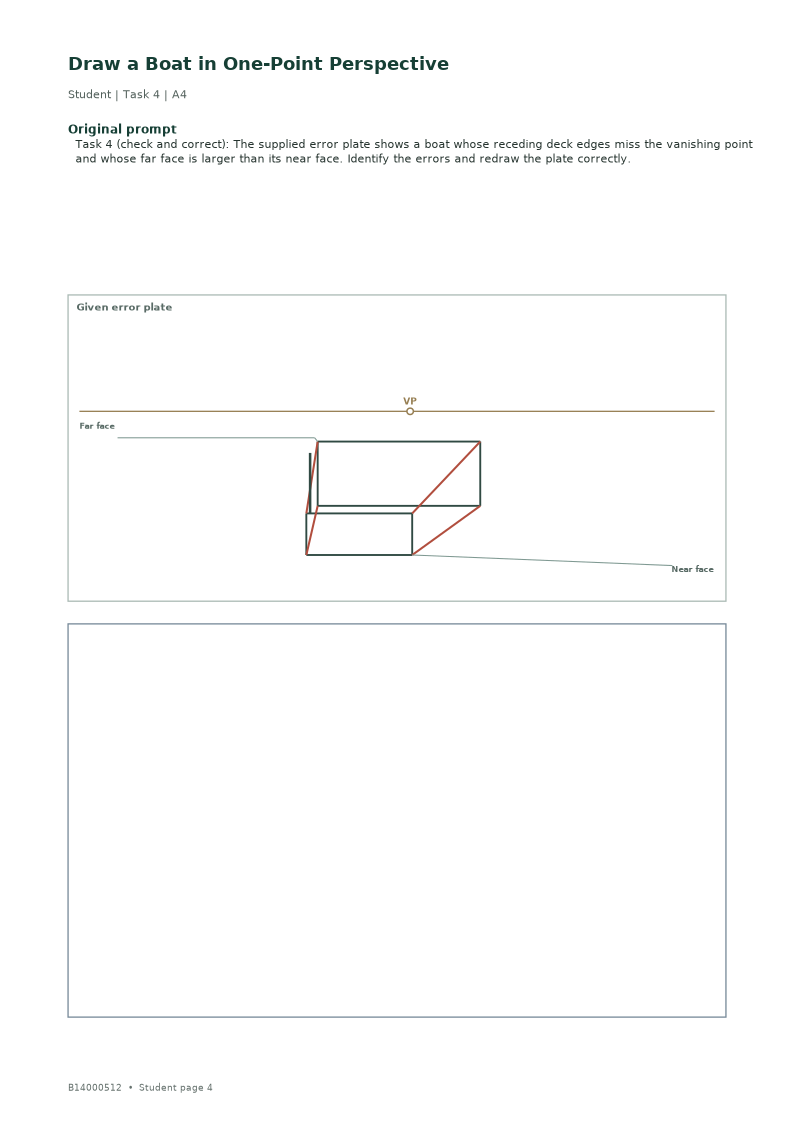
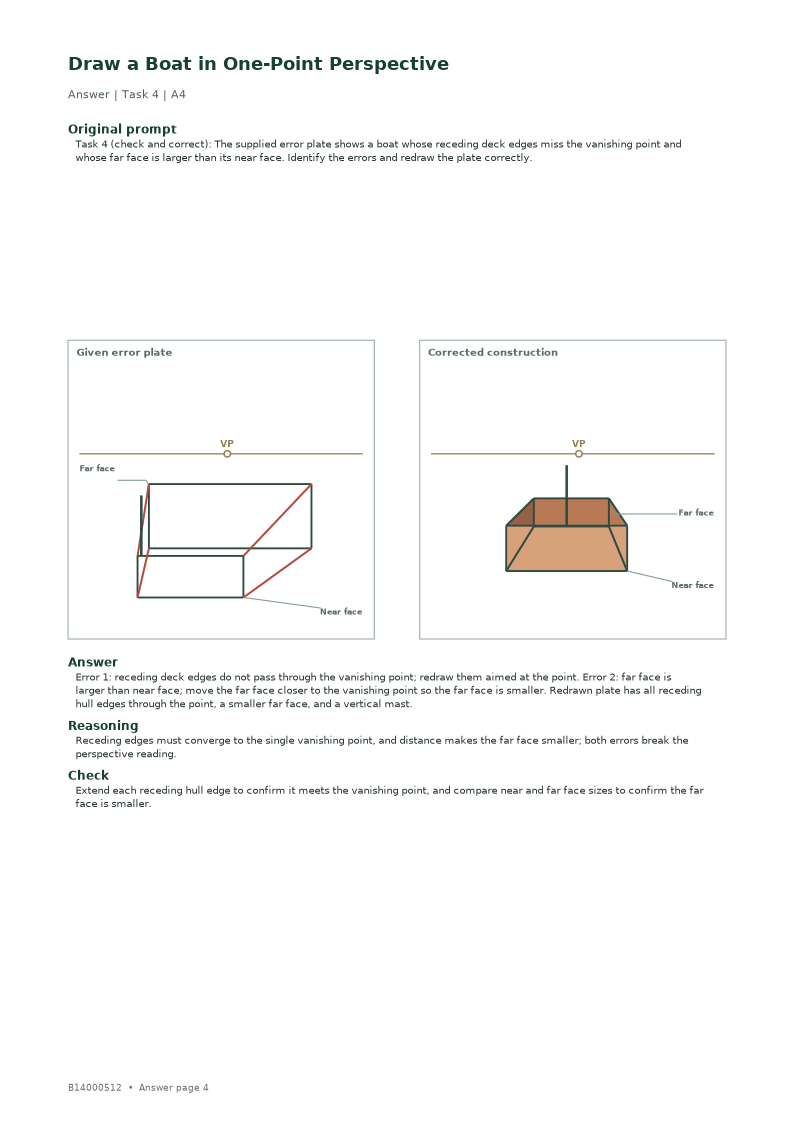
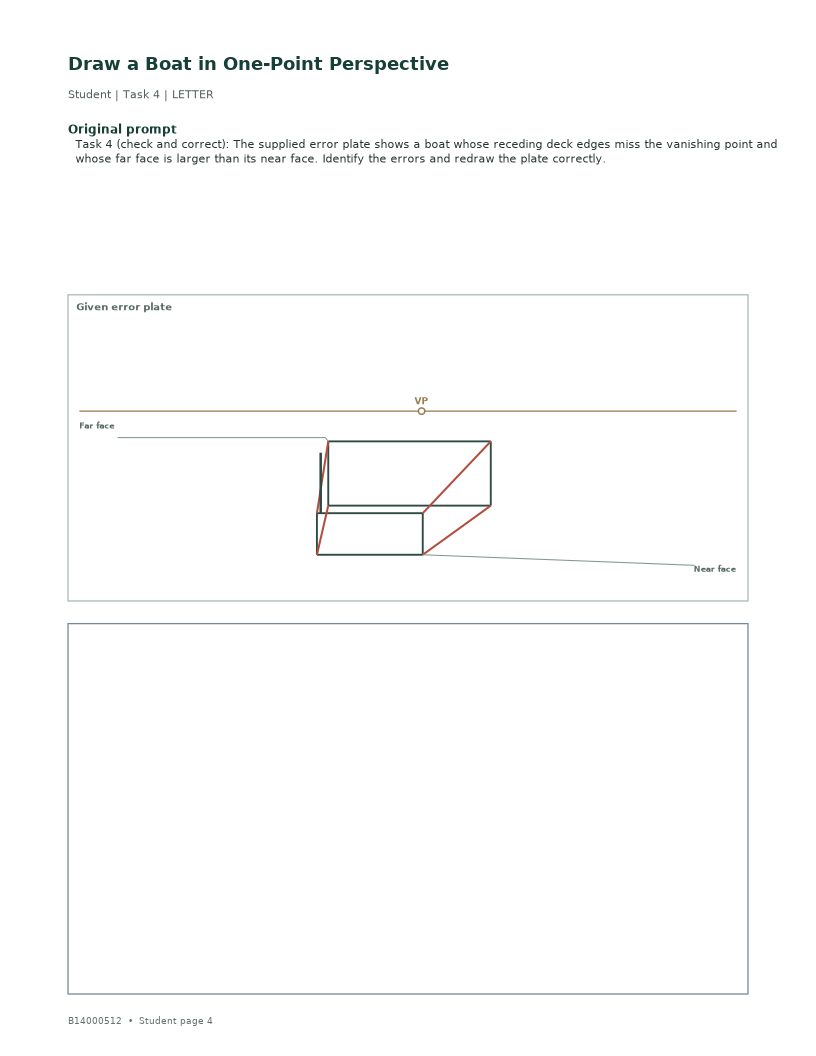
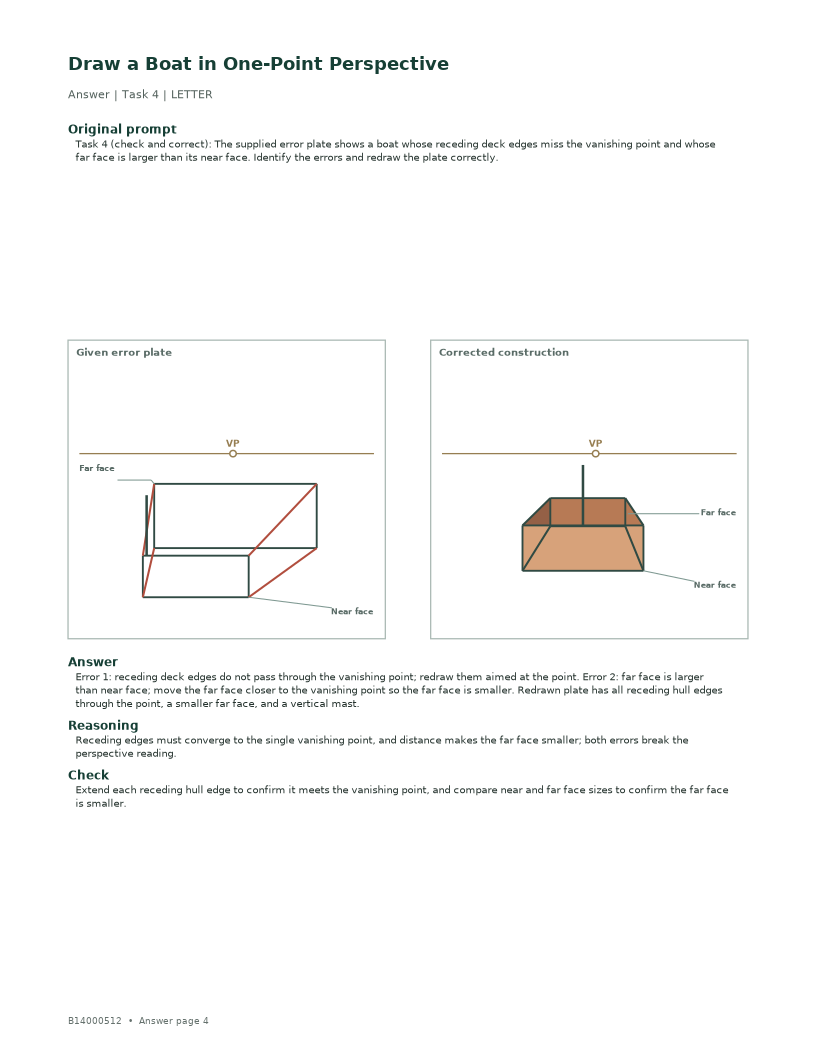
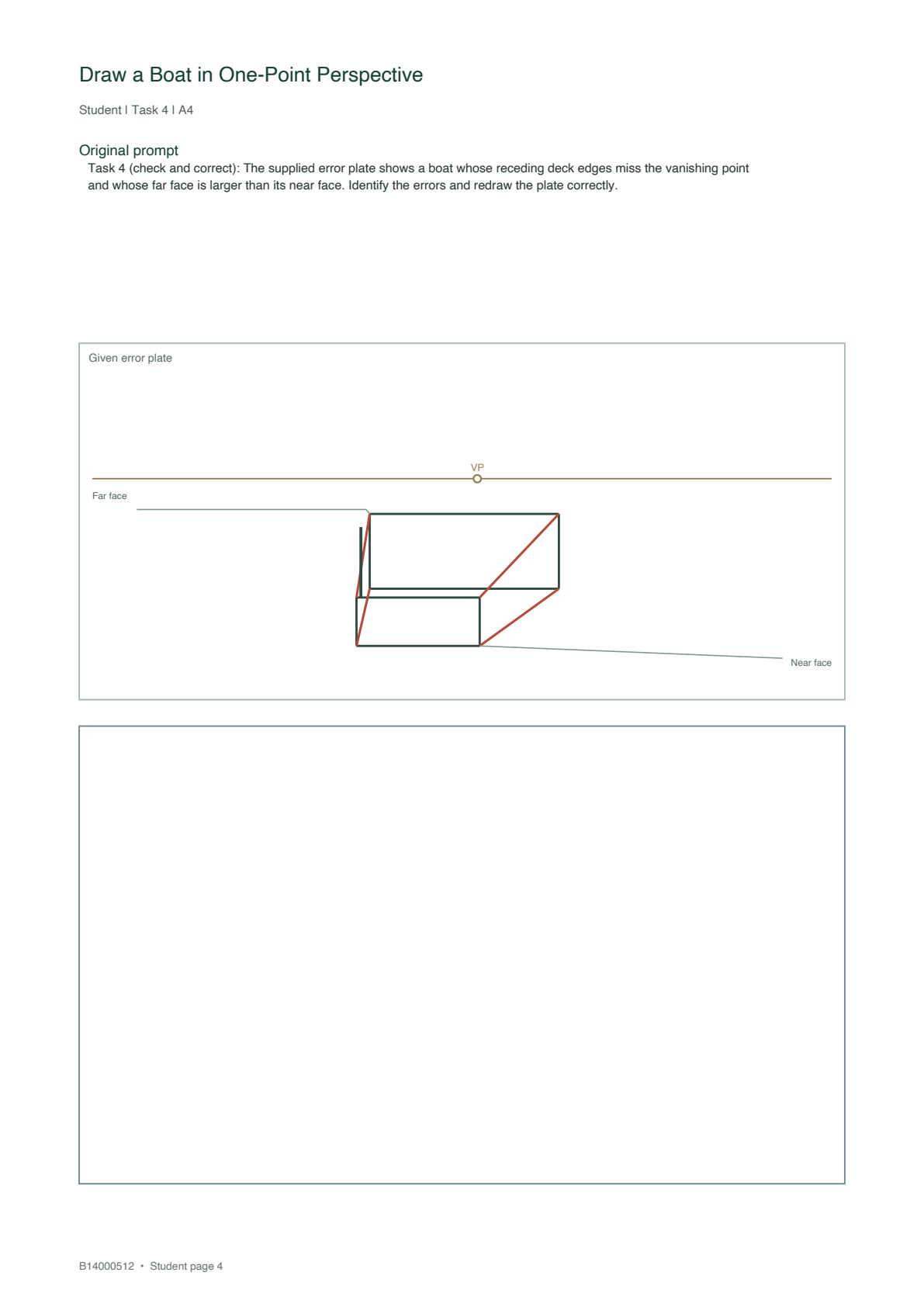
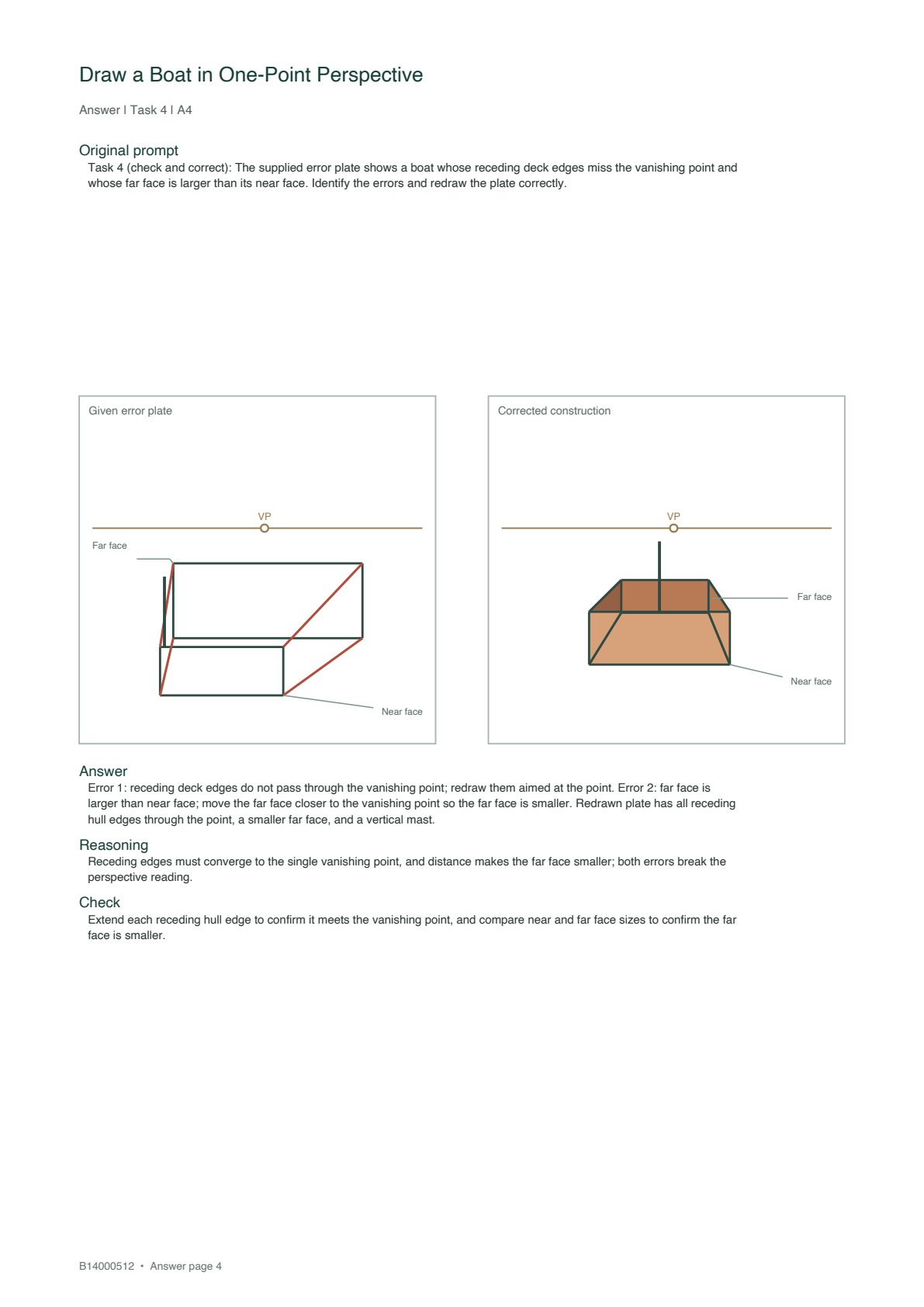
Task 4 (check and correct): The supplied error plate shows a boat whose receding deck edges miss the vanishing point and whose far face is larger than its near face. Identify the errors and redraw the plate correctly.
Show answer 4
Error 1: receding deck edges do not pass through the vanishing point; redraw them aimed at the point. Error 2: far face is larger than near face; move the far face closer to the vanishing point so the far face is smaller. Redrawn plate has all receding hull edges through the point, a smaller far face, and a vertical mast.
Receding edges must converge to the single vanishing point, and distance makes the far face smaller; both errors break the perspective reading.
Check: Extend each receding hull edge to confirm it meets the vanishing point, and compare near and far face sizes to confirm the far face is smaller.
Useful checks
- Drawing receding hull edges parallel instead of aimed at the vanishing point. Re-aim each receding hull edge so a ruler laid along it passes through the vanishing point.
- Making the far face the same size or larger than the near face. Move the far face closer to the vanishing point so the far face is clearly smaller.
- Tilting vertical edges such as the mast or the near and far side edges. Keep vertical edges vertical; only receding hull edges converge.
Questions about this resource
Do I need measurements to draw this boat?
No. The construction is qualitative: you choose the horizon, vanishing point and far-face position, then check that receding edges converge and the far face is smaller.
Can I use more than one vanishing point?
This pack teaches one-point perspective, so use a single vanishing point on the horizon. Multiple points belong to a different construction.