Free original lessons
Avocado Cartoon Drawing: Pit, Peel and Face
Learn to draw a cartoon avocado with a clear pit, peel edge and expressive face using simple shapes, a defined convention and checkable steps.
Free lesson
Four exercises
Worked answers
Object Drawing Lessons
This lesson builds a cartoon avocado from three nested shapes: an outer body, a peel edge and an inner pit. You will place face features on the body above the pit, then vary the expression in an independent drawing. The convention is simple: the avocado body is a rounded pear shape, the pit is a circle or oval inside the lower half, and the peel edge is a narrow band following the body outline. Letter styles and face proportions may vary; the rubric rewards clear construction and readable expression rather than one exact drawing.
Practice materials: Printable downloads are not available for this lesson yet. Use the instructions and four exercises below.
Reference illustration
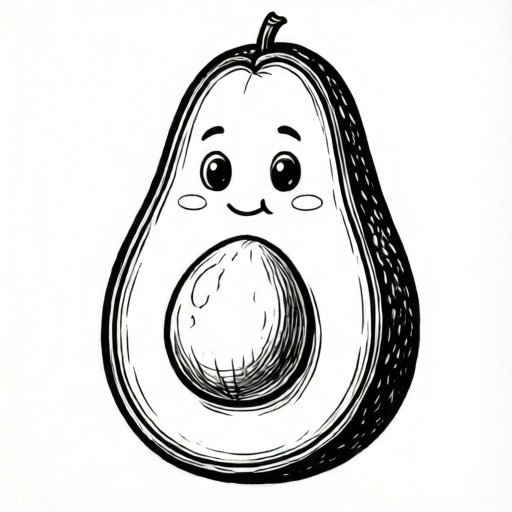
Use the stated measurements and conventions for each exercise.
Build the body and pit
Start with a light pear shape: a narrow top and a wider rounded bottom. Keep the outline smooth and closed. Inside the lower half, draw a circle or oval for the pit. The pit should sit clearly inside the body, not touch the outline. A useful check is that the pit is in the lower half and has space around it on all sides.
Use a pencil lightly so you can adjust. If the pit looks too large, shrink it slightly; if it touches the peel edge, move it inward. The body and pit are the foundation for every later feature.
- Draw a narrow top curve and widen it into a rounded bottom.
- Close the body outline with a smooth curve.
- Draw a circle or oval in the lower half for the pit.
- Check that the pit is fully inside the body with visible space around it.
Add the peel edge
The peel edge is a narrow band just inside the body outline. It shows the avocado skin without realistic shading. Draw it as a second line that follows the body shape, leaving a small gap. The gap can be even or slightly wider at the bottom. Keep the band continuous and avoid crossing the pit.
This convention is deliberately simple: the peel edge is a line, not a shaded surface. Valid alternatives include a wavy peel edge or a peel edge that stops partway down, as long as the body and pit remain readable.
- Trace a second line inside the body outline, leaving a narrow gap.
- Keep the peel band continuous around the body.
- Do not let the peel edge cross the pit.
- Check that the body outline and peel edge are distinct.
Place face features and expression
Place two eyes above the pit, inside the body. Use dots, small circles or short curves. Add a mouth between the eyes and the pit. A simple smile, frown or open mouth changes the expression. Eyebrows are optional but help show mood.
Keep features inside the body; place the eyes above the pit and the mouth between the eyes and the pit so the face reads clearly. The convention allows different eye shapes and mouth styles; the goal is a readable expression, not a single correct face.
- Mark two eye positions above the pit.
- Draw the eyes using dots, circles or short curves.
- Add a mouth between the eyes and the pit.
- Add eyebrows or cheeks if they help the expression.
- Check that all features are inside the body, the eyes are above the pit, and the mouth is between the eyes and the pit without touching the pit.
Independent cartoon avocado with varied expression
In a blank box, draw a new avocado using the same three-part construction: body, pit and peel edge. Choose a different expression, such as surprised, sleepy or happy. You may change the pit shape slightly, but keep it inside the body. The peel edge should still be visible.
This independent drawing tests whether you can apply the convention without copying the practice example. Valid alternatives include a tilted body, a wavy peel edge or different eye shapes, provided the pit and face remain clear.
- Draw a new body shape in the blank box.
- Add a pit inside the lower half.
- Add a peel edge following the body outline.
- Choose a varied expression; place the eyes above the pit and the mouth between the eyes and the pit.
- Check that body, pit, peel edge and face are all readable.
Worked example
Draw a cartoon avocado with a round pit, a narrow peel edge and a happy face. Use a body about 8 cm tall and 6 cm wide as a hypothetical example.
Worked answer
A rounded pear body 8 cm tall and 6 cm wide; a pit circle about 2.5 cm across centered in the lower half with at least 1 cm space from the outline; a peel edge drawn 0.5 cm inside the body outline; two dot eyes above the pit; a curved smile between the eyes and the pit. These sizes are hypothetical examples; measure your own drawing to confirm the gaps.
Why: The body is closed and pear-shaped. The pit is inside the lower half with visible space. The peel edge is a separate line inside the body. The face features are above the pit and inside the body, making the happy expression readable.
Check: Measure the pit diameter and the gap to the outline. Confirm the peel edge is a separate continuous line. Confirm eyes and mouth are above the pit and inside the body.
Four practice exercises
Exercise 1
Draw a cartoon avocado body 7 cm tall and 5 cm wide with a pit 2 cm across. Place the pit in the lower half. Describe where the pit sits and check the gap to the outline.
Show answer and check
A closed pear body 7 cm tall and 5 cm wide; a pit circle 2 cm across with its center placed 2.5 cm above the bottom of the body and centered left-to-right. At the widest part of the body, the pit leaves about 1.5 cm on each side, since (5 − 2) ÷ 2 = 1.5 cm. With the pit center 2.5 cm above the bottom, the gap below is about 1.5 cm, since 2.5 − 1 = 1.5 cm. Because the body is pear-shaped, measure the actual shortest gap to the outline rather than assuming uniform spacing. Note: these sizes are hypothetical examples; measure your own drawing to check the gaps.
Why: The pit is smaller than the body width and placed low, so it stays inside with visible space.
Check: Measure the pit diameter and the shortest gap from the pit to the body outline on each side and below. Confirm the pit does not touch the outline and that the measured gaps match the described placement.
Exercise 2
Add a peel edge to the avocado from the first exercise. Use a narrow band 0.5 cm inside the body outline. State one check that confirms the peel edge is separate from the body outline.
Show answer and check
A second continuous line drawn 0.5 cm inside the body outline, following the pear shape and not crossing the pit. Check: the body outline and peel edge are two distinct lines with a visible gap.
Why: The peel edge is a convention line, not shading. Keeping a gap makes it readable.
Check: Trace the body outline and the peel edge separately. Confirm they do not merge and the gap is visible.
Exercise 3
Draw a surprised avocado face above the pit. Use two round eyes and an open oval mouth. Describe the placement relative to the pit and body.
Show answer and check
Two round eyes placed above the pit and inside the body; an open oval mouth between the eyes and the pit; optional raised eyebrows above the eyes.
Why: Round eyes and an open mouth read as surprise. Keeping features above the pit avoids overlap.
Check: Confirm all features are inside the body, the eyes are above the pit, and the mouth is between the eyes and the pit without touching the pit.
Exercise 4
In a blank box, draw an independent cartoon avocado with a sleepy expression. Use a body, pit and peel edge. State how you checked that the construction is complete.
Show answer and check
A new pear body with a pit inside the lower half, a peel edge following the body, and sleepy features such as half-closed eyes above the pit and a small mouth between the eyes and the pit. Check: body closed, pit inside with space, peel edge separate, eyes above pit, mouth between eyes and pit.
Why: The independent drawing applies the same three-part construction with a different expression.
Check: List the four parts: body, pit, peel edge, face. Confirm each is present and readable, with eyes above the pit and the mouth between the eyes and the pit.
Common mistakes
- The pit touches or crosses the body outline. Redraw the pit smaller or move it inward so there is visible space around it.
- The peel edge is confused with the body outline. Leave a clear narrow gap between the body outline and the peel edge.
- Face features are placed on or below the pit. Move the eyes above the pit and the mouth between the eyes and the pit, inside the body.
- The expression is unclear because features are too small or crowded. Enlarge the eyes and mouth slightly and space them apart.
Self-check rubric
- Body is a closed rounded pear shape.
- Pit is fully inside the lower half with visible space around it.
- Peel edge is a distinct narrow band following the body outline.
- Face features are inside the body; eyes are above the pit and the mouth is between the eyes and the pit.
- Expression is readable and varied in the independent drawing.
- Valid alternatives such as wavy peel edge or oval pit are accepted if construction remains clear.
Questions and answers
Does the pit have to be a perfect circle?
No. A circle or oval is fine. The check is that the pit is fully inside the body with space around it.
Can the peel edge be wavy?
Yes. A wavy peel edge is a valid alternative as long as it follows the body and does not cross the pit.
Where should the face go?
Place the eyes above the pit and the mouth between the eyes and the pit, inside the body. Eyebrows are optional.
Can I change the body shape?
Yes, as long as the body is a rounded pear-like shape and the pit and peel edge remain readable.