Free original lessons
Turtle Color Drawing: Shading Shell Scutes and Skin
Learn to color a turtle with layered shell scute shading and skin tone variation using a clear convention, worked example, and four practice tasks.
Free lesson
Four exercises
Worked answers
Object Drawing Lessons
This lesson teaches a repeatable method for coloring a turtle drawing so the shell scutes read as raised plates and the skin reads as soft, folded tissue. You will use a three-layer convention for each scute (base, mid, highlight) and a two-layer convention for skin (base, shadow). The method works with colored pencils, markers, or crayons. All shading decisions are described in words and simple arithmetic so you can check your work without needing a printed plate. A worked example shows the full sequence on a small shell section, then four self-contained exercises let you apply the same logic to different scute counts and skin areas. Because letter styles and hand pressure vary, the rubric accepts any consistent, checkable shading pattern rather than one universal appearance.
Practice materials: Printable downloads are not available for this lesson yet. Use the instructions and four exercises below.
Reference illustration
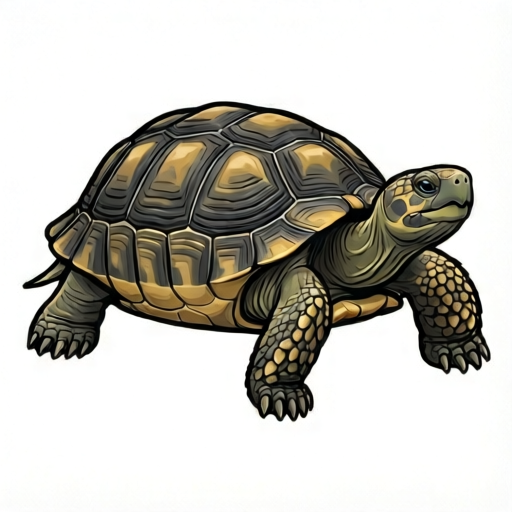
Use the stated measurements and conventions for each exercise.
Shell scute shading convention
Treat each scute as a low dome. Divide it mentally into three bands from the outer seam inward: a base band along the seam, a mid band covering most of the scute, and a highlight band near the center. Apply base first, then mid, then highlight. Keep the highlight smaller than the mid band; a common hypothetical ratio is highlight width about one-third of mid width, but measure your own scute and label any chosen value as a hypothetical example.
Shade in the direction of the scute's growth lines, which run roughly parallel to the seam. Use short strokes and overlap them slightly so no white gaps appear between bands. If your scute is roughly rectangular, count the number of stroke passes across the mid band and keep that count consistent from scute to scute.
- Outline each scute seam lightly so the three bands have a boundary.
- Fill the base band with the darkest shell color, pressing evenly.
- Fill the mid band with a middle shell color, leaving the base band visible.
- Add the highlight band with the lightest shell color near the scute center.
- Blend the boundary between mid and highlight with a light pass, not a heavy scrub.
Skin shading convention
Skin areas on the neck, legs, and tail use two layers: a base tone and a shadow tone placed where the limb meets the shell or where a fold occurs. Keep the shadow band narrow, roughly one-quarter of the visible skin width in a hypothetical example, and measure your own drawing to set the actual width.
Use a slightly warmer or cooler base than the shell so shell and skin separate visually. Do not outline every skin fold; shade only the deepest two or three folds per limb so the skin stays soft.
- Block in the skin base tone across the whole limb or neck area.
- Identify the two or three deepest folds or contact lines.
- Place a narrow shadow band along each fold, following its curve.
- Soften the shadow edge with a light pass of the base tone.
- Check that shell and skin tones differ by at least one visible step in value.
Checking value steps and consistency
Value steps are checkable by counting distinct tones. For shell, you should see three tones per scute: base, mid, highlight. For skin, two tones: base, shadow. If two scutes show four tones or one tone, adjust before continuing.
Consistency is checkable by comparing adjacent scutes: the base band should touch every seam, and the highlight should sit away from the seam. If a highlight touches a seam, move it inward by one stroke width.
- Count tones per scute and record the count.
- Compare adjacent scutes for band placement.
- Check that every seam has a base band on both sides.
- Confirm skin shadows sit only at folds or contact lines.
Worked example
A shell section has four rectangular scutes in a row. Each scute is 3 cm wide and 2 cm tall. Using the three-band convention, describe where each band goes and how many tones you should count after shading. Skin on the near leg is 2 cm wide with two folds.
Worked answer
For each 3 cm scute, use hypothetical example widths measured on the actual drawing: a base band about 0.5 cm wide on each side of the seam (1.0 cm total), a mid band across the middle about 1.5 cm wide, and a highlight near the center about 0.5 cm wide. These sum to 3.0 cm, so the bands fill the scute width with no leftover margin, and the base band remains visible on both sides of the seam while the highlight stays narrower than the mid band. After shading, count three tones per scute, so four scutes give twelve tone regions total. On the 2 cm skin area, place a base tone across the full width and two narrow shadow bands at the folds, each about 0.5 cm wide, giving two skin tones. Check: base bands touch every seam on both sides, highlights sit away from seams, and shell tones differ visibly from skin tones.
Four practice exercises
Exercise 1
Draw a shell section with three square scutes, each 2 cm by 2 cm. Apply the three-band convention and state the tone count after shading.
Show answer and check
Each scute has a base band along its seam, a mid band across the middle, and a highlight near the center. Three scutes give nine tone regions and three tones per scute.
Why: The convention assigns exactly three bands per scute, so the tone count equals three times the number of scutes. Keeping the highlight away from the seam preserves the raised look.
Check: Count tones per scute; confirm each seam has a base band on both sides; measure that the highlight is narrower than the mid band.
Exercise 2
A turtle neck is 4 cm long and 1 cm wide with one deep fold at the midpoint. Shade the skin using the two-layer convention and describe the shadow placement.
Show answer and check
Apply the skin base across the full 4 cm by 1 cm area. Place one narrow shadow band at the midpoint fold, about 0.5 cm wide, then soften its edge with a light base pass. The skin shows two tones.
Why: Only the deepest fold receives shadow, so the neck stays soft rather than striped. The shadow width is a hypothetical example measured on the drawing.
Check: Count two skin tones; confirm the shadow sits only at the fold; check that the shadow edge is softened and not a hard line.
Exercise 3
Draw a shell with five scutes: three in a top row and two in a bottom row. After shading, a classmate counts fourteen tone regions. Is that consistent with the convention? Explain.
Show answer and check
No. Five scutes at three tones each should give fifteen tone regions. Fourteen means one scute is missing a tone or two tones merged. Recheck each scute for a countable base, mid, and highlight.
Why: The convention fixes three tones per scute, so the expected total is three times five. A mismatch signals a shading error, not a valid alternative.
Check: Multiply scute count by three; compare with the counted total; inspect the scute with the missing tone.
Exercise 4
A leg is 3 cm wide with two folds. You shade the base and two shadow bands, each 0.75 cm wide. State the total shadow width and whether the shadows leave enough base tone visible.
Show answer and check
Two shadows at 0.75 cm each total 1.5 cm of shadow. The leg is 3 cm wide, so 1.5 cm of base tone remains visible, which is half the width. That is acceptable because base tone still separates the shadows.
Why: Adding shadow widths and subtracting from total width checks whether shadows dominate. Keeping at least half the width as base tone preserves the soft skin look.
Check: Add shadow widths; subtract from total width; confirm remaining base width is at least equal to total shadow width.
Common mistakes
- Putting the highlight band along the scute seam instead of near the center. Move the highlight inward by one stroke width so the seam stays dark and the scute reads as raised.
- Using the same tone for shell and skin so the two areas merge. Shift the skin base one visible value step warmer or cooler than the shell mid tone.
- Scrubbing the boundary between mid and highlight until the three bands collapse into one. Blend with a single light pass and stop while three distinct tones remain countable.
- Shading every skin fold, making the limb look striped. Limit shadows to the two or three deepest folds per limb and soften each edge.
Self-check rubric
- Each scute shows three countable tones: base, mid, highlight.
- Base bands touch every scute seam on both sides.
- Highlight bands sit away from seams and are narrower than mid bands.
- Skin shows two countable tones with shadows only at folds or contact lines.
- Shell and skin tones differ by at least one visible value step.
- Band widths and stroke direction are consistent across adjacent scutes.
- Any chosen numerical width is labeled as a hypothetical example and measured on the actual drawing.
Questions and answers
Do I need a printed turtle plate to do this lesson?
No. Every exercise describes the scute count and skin areas in words, so you can draw a simple outline yourself and apply the same convention.
What if my colored pencils cannot make three distinct tones?
Use pressure instead of more colors: heavy for base, medium for mid, light for highlight. Count the tones by how dark they appear, not by how many pencils you own.
How wide should the highlight band be?
Measure your own scute and choose a width you can repeat. A hypothetical example is one-third of the mid band width, but any consistent width that stays away from the seam is acceptable.
Can I use markers?
Yes, but markers do not blend by pressure. Instead, choose three marker tones and keep the highlight band narrow so the three tones remain countable.