Free original lessons
Flower Field Drawing: Build Depth with Foreground, Midground, and Horizon
Plan a flower field drawing in three depth bands, simplify flower clusters, and check layering with a clear convention and rubric.
Free lesson
Four exercises
Worked answers
Object Drawing Lessons
A flower field looks deep because near flowers are large and detailed, middle flowers are smaller and grouped, and distant flowers merge into a band at the horizon. This lesson teaches a repeatable layering method: set a horizon line, divide the page into foreground, midground, and horizon bands, then place simplified flower clusters whose size and spacing change with distance. You will use a stated drawing convention so that valid stylistic alternatives are accepted, and you will check your work with simple measurements and visual tests rather than a single universal answer.
Practice materials: Printable downloads are not available for this lesson yet. Use the instructions and four exercises below.
Reference illustration
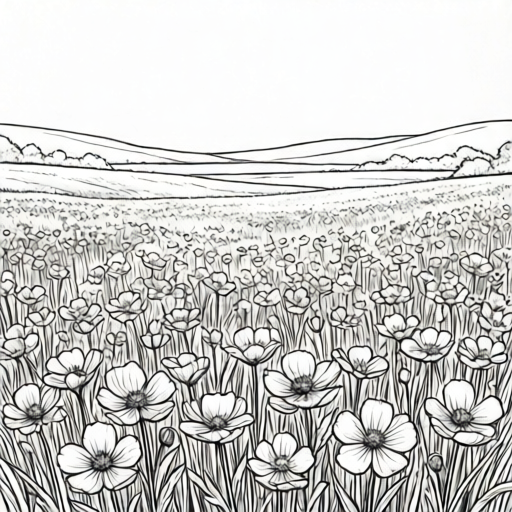
Use the stated measurements and conventions for each exercise.
Set the horizon and the three depth bands
Begin by drawing a light horizontal horizon line across the page. This line separates ground from sky and anchors all depth decisions. Below it, mark two more light lines to create three bands: the foreground band nearest the bottom edge, the midground band in the middle, and the horizon band just below the horizon line. The bands do not need equal heights; a common choice is a taller foreground and a thinner horizon band, but any proportion is valid if it supports the composition.
Label the bands lightly on the page margin, not inside the drawing area. The labels are planning notes and can be erased later. Keep all guide lines light so they do not compete with the final flower shapes.
- Draw a light horizontal horizon line across the upper third of the page.
- Mark a light line below the horizon to close the horizon band.
- Mark a second light line lower down to separate midground from foreground.
- Write F, M, and H in the margin beside each band as planning labels.
Simplify flower clusters by distance
In the foreground, draw individual flowers with visible petals, a center, and a short stem. In the midground, group flowers into clusters of three to six blooms and draw only the outer petal shapes plus a few center dots. In the horizon band, reduce flowers to small marks or short dashes that read as a textured band rather than individual plants.
Use a consistent size rule: foreground flower heads are the largest, midground heads are roughly half that height, and horizon marks are roughly a quarter of that height or smaller. These are hypothetical example ratios, not standards; measure your own drawing and adjust so the size change is clearly visible.
- Draw three to five large foreground flowers with distinct petals and centers.
- Draw two or three midground clusters, each with simplified petal outlines and center dots.
- Fill the horizon band with small dashes or dots spaced closely enough to read as a field.
- Check that flower head width decreases from foreground to horizon.
Use overlap and spacing to reinforce depth
Overlap is the strongest depth cue after size. Let foreground flowers overlap midground clusters, and let midground clusters overlap the horizon band. Avoid overlapping within the horizon band, because distant flowers should merge rather than stack.
Spacing also changes with distance. Foreground flowers can be spaced widely with visible ground between them. Midground clusters sit closer together. Horizon marks are nearly continuous. This progression makes the field feel deeper without adding detail.
- Place foreground flowers so at least one overlaps a midground cluster.
- Place midground clusters so they overlap the horizon band edge.
- Widen gaps between foreground flowers and tighten gaps toward the horizon.
- Step back and confirm the eye moves from large near shapes to a fine distant band.
Apply the drawing convention and rubric
This lesson uses an explicit drawing convention: flower head height is measured vertically from the base of the petals to the top of the center, and different petal styles, such as daisy-like or cup-shaped, are accepted as valid alternatives provided the measured head heights follow the foreground-to-horizon size progression. This convention makes the size check objective without requiring one specific flower species or a single correct arrangement.
The rubric rewards clear band separation, visible size change, overlap, and consistent simplification. It does not require a specific flower species or a single correct arrangement.
- Measure each foreground flower head height from petal base to center top.
- Measure midground cluster head heights the same way and compare.
- Confirm horizon marks are smaller than midground heads.
- Check that at least one overlap occurs between each adjacent pair of bands.
Worked example
A student draws a horizon line at 40 mm from the top of a 200 mm page. They mark a horizon band 20 mm tall below the line, a midground band 60 mm tall, and a foreground band 80 mm tall. Foreground flower heads measure 30 mm tall, midground heads measure 15 mm, and horizon marks measure 6 mm. Check whether the bands and size progression are consistent.
Worked answer
The bands total 20 + 60 + 80 = 160 mm, leaving 40 mm above the horizon for sky, which matches the stated horizon position. The size progression is 30 mm to 15 mm to 6 mm, so each step is roughly half or less of the previous band. This is consistent with the layering rule. The drawing passes the band and size checks.
Why: Add the band heights and compare with the page height minus the sky area. Then compare measured head heights from foreground to horizon to confirm a clear decrease.
Check: Re-measure each band and each flower head with the same ruler, record the numbers, and confirm the totals and ratios match the stated values.
Four practice exercises
Exercise 1
On a 180 mm tall page, a student places the horizon line 50 mm from the top. They plan a horizon band 15 mm tall, a midground band 45 mm tall, and a foreground band 70 mm tall. Do the bands fit below the horizon line, and how much space remains at the bottom?
Show answer and check
The bands total 15 + 45 + 70 = 130 mm. The space below the horizon is 180 - 50 = 130 mm. The bands exactly fill the space below the horizon, leaving 0 mm at the bottom.
Why: Subtract the sky area above the horizon from the page height to find the ground area, then add the three band heights and compare.
Check: Re-add the band heights and subtract from the ground area; both should equal 130 mm.
Exercise 2
A drawing has foreground flower heads 24 mm tall, midground heads 12 mm tall, and horizon marks 5 mm tall. A second drawing has foreground heads 20 mm, midground heads 14 mm, and horizon marks 9 mm. Which drawing shows a clearer size progression, and why?
Show answer and check
The first drawing is clearer. Its sizes halve from 24 to 12 and drop to 5, giving a strong decrease. The second drawing changes only from 20 to 14 to 9, a weaker progression.
Why: Compare the ratios between adjacent bands. A larger relative decrease makes depth easier to read.
Check: Divide each band's head height by the next band's height and compare the ratios; the first drawing has larger ratios.
Exercise 3
A student draws a horizon band with marks spaced 8 mm apart and midground clusters spaced 20 mm apart. Foreground flowers are spaced 40 mm apart. Is the spacing progression correct for depth, and what change would improve it?
Show answer and check
The progression is correct because spacing tightens from foreground to horizon: 40 mm, then 20 mm, then 8 mm. To improve it, the student could tighten the horizon spacing further, for example to 4 mm, so the band reads as continuous.
Why: Depth is reinforced when gaps shrink toward the horizon. The current order is right, but the horizon band can be denser.
Check: Measure three gaps in each band and confirm they decrease from foreground to horizon.
Exercise 4
A student's drawing has foreground flowers overlapping midground clusters, but the midground clusters do not touch the horizon band. The horizon marks are 6 mm tall and midground heads are 18 mm tall. Identify the layering problem and state one fix.
Show answer and check
The missing overlap between midground and horizon weakens the depth transition. One fix is to extend one or two midground clusters downward so they overlap the top edge of the horizon band. The size progression itself is acceptable because 18 mm is larger than 6 mm.
Why: Overlap should occur between each adjacent pair of bands. The size check passes, but the overlap check fails between midground and horizon.
Check: Trace each band edge and confirm at least one shape crosses it; measure head heights to confirm the size order.
Common mistakes
- Drawing horizon flowers as large as foreground flowers. Measure head heights and reduce horizon marks to roughly a quarter of foreground head height or less.
- Leaving wide gaps in the horizon band so it reads as separate plants. Tighten spacing until the horizon band reads as a continuous textured strip.
- Overlapping many flowers inside the horizon band. Keep horizon marks side by side without stacking; reserve overlap for foreground and midground.
- Using heavy guide lines that compete with flower shapes. Draw horizon and band lines lightly and erase or reduce them before finishing.
Self-check rubric
- Horizon line is present and separates ground from sky.
- Three depth bands are distinguishable: foreground, midground, horizon.
- Foreground flower heads are measurably larger than midground heads.
- Midground heads are measurably larger than horizon marks.
- At least one overlap occurs between foreground and midground.
- At least one overlap occurs between midground and horizon band.
- Horizon band reads as a continuous textured strip rather than separate plants.
- Guide lines are light and do not dominate the flower shapes.
- Different flower styles are accepted if measured size progression is consistent.
Questions and answers
Do I need to draw every flower in the field?
No. Use individual flowers in the foreground, clusters in the midground, and marks in the horizon band. Simplification is the point of the layering method.
What if my flower styles differ across the drawing?
Different petal styles are valid alternatives under the convention. What matters is that measured head heights follow the foreground-to-horizon size progression.
How many bands should I use?
Three bands are enough: foreground, midground, and horizon. You can adjust band heights, but keep the size and spacing progression consistent.
Can I change the horizon line position?
Yes. Any horizon position is valid if the three bands remain distinguishable and the size progression is clear.