Free original lessons
Drawing a Lobster: Segmented Body, Claws, and Antennae
Learn to draw a lobster with a segmented tail, paired claws, antennae, and walking legs using a clear body-axis construction and checkable proportions.
Free lesson
Four exercises
Worked answers
Object Drawing Lessons
Drawing a lobster well depends less on artistic flair than on understanding its construction: a cephalothorax, a segmented abdomen, paired claws, antennae, and walking legs. This lesson builds the lobster from a central body axis outward, using simple measured proportions and a repeatable sequence. You will learn a convention for segment marks, a method for checking symmetry, and a rubric that accepts valid stylistic variation. All measurements are hypothetical examples; measure your own paper and tools. The practice tasks are self-contained and solvable from the text.
Practice materials: Printable downloads are not available for this lesson yet. Use the instructions and four exercises below.
Reference illustration
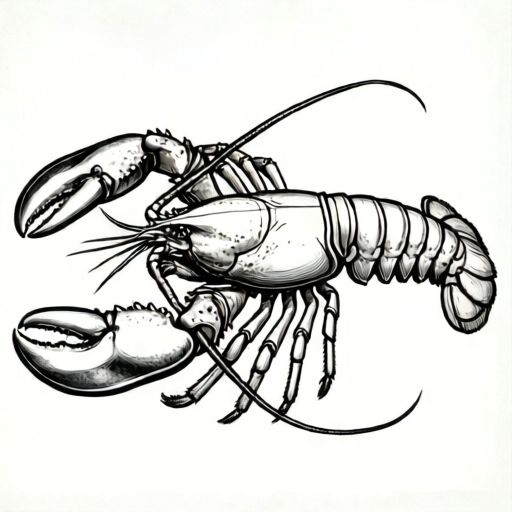
Use the stated measurements and conventions for each exercise.
Establish the body axis and cephalothorax
Begin with a light horizontal axis line across the middle of your page. This axis represents the lobster's overall length from the front of the cephalothorax to the tip of the tail. Mark a start point and an end point. Divide the axis into three unequal zones: the cephalothorax (front body), the abdomen (segmented tail), and the tail fan. A workable hypothetical proportion is 2:3:1, meaning if the whole axis is 12 cm, the cephalothorax occupies 4 cm, the abdomen 6 cm, and the tail fan 2 cm. These numbers are examples only; scale them to your paper.
Draw the cephalothorax as a rounded shield shape centered on the axis. Its width should be roughly half its length in side view, or about two-thirds in top view. Keep the outline light so you can adjust it. Mark the midline of the cephalothorax with a faint dashed line; this helps you place paired appendages symmetrically later.
- Draw a light horizontal axis and mark its start and end.
- Divide the axis into three zones using a 2:3:1 ratio or your own measured ratio.
- Sketch the cephalothorax as a rounded shield centered on the axis.
- Add a faint midline through the cephalothorax for symmetry checks.
Build the segmented abdomen and tail fan
The abdomen is a series of overlapping segments that taper toward the tail. Starting at the rear of the cephalothorax, draw six curved segment lines across the abdomen zone. Each segment should be slightly narrower than the one before it. Use a consistent convention: draw each segment line as a shallow arc that curves toward the tail, and leave a small gap between the arc and the body outline to suggest overlap. This convention is a drawing choice, not a biological standard; letter styles and segment shapes vary, and valid alternatives include straighter segment lines or double-line overlaps.
At the end of the abdomen, draw the tail fan as a set of flat, rounded blades radiating from the axis. A simple version uses five blades: one central and two pairs flanking it. Keep the blades shorter than the last abdomen segment. Check that the fan is centered on the axis and that its total width is roughly equal to the widest part of the abdomen.
- Mark six segment divisions along the abdomen zone, tapering toward the tail.
- Draw each segment line as a shallow arc curving toward the tail.
- Leave small gaps to suggest overlapping segments.
- Add a centered tail fan of about five rounded blades.
- Check that the fan width matches the abdomen's widest point.
Add paired claws, antennae, and walking legs
Place the claws at the front of the cephalothorax. Each claw has two halves: a fixed lower half and a movable upper half. Draw the claw as a rounded wedge with a gap between the halves. Use the midline to mirror the left and right claws. A hypothetical check: the claw length should be about one-third of the cephalothorax length. If your cephalothorax is 4 cm, each claw is about 1.3 cm. Adjust to your own scale.
Antennae attach near the front of the cephalothorax. Draw two long, thin curves sweeping forward and outward. Keep them longer than the claws but shorter than the full body axis. Walking legs attach along the lower sides of the cephalothorax. Draw four pairs as short, jointed lines angled downward and slightly backward. Use the same segment-gap convention for leg joints. Finally, check symmetry by folding the paper along the midline or by measuring distances from the axis to each paired appendage.
- Draw two claw wedges at the front, each with a gap between halves.
- Mirror the claws using the cephalothorax midline.
- Add two long antennae sweeping forward and outward.
- Draw four pairs of short jointed walking legs along the lower cephalothorax.
- Check paired appendages for equal distance from the midline.
Worked example
A learner draws a lobster on a 12 cm body axis using the 2:3:1 ratio. The cephalothorax is 4 cm, the abdomen is 6 cm, and the tail fan is 2 cm. The learner draws a claw 1.5 cm long. Is the claw close to the suggested one-third cephalothorax length?
Worked answer
One-third of 4 cm is about 1.33 cm. A 1.5 cm claw is slightly long but within a reasonable adjustment range. The learner can shorten it to about 1.3 cm or keep it if the overall proportion still reads clearly.
Four practice exercises
Exercise 1
On a 10 cm body axis, use a 2:3:1 ratio. Calculate the length of each zone.
Show answer and check
Cephalothorax about 3.33 cm, abdomen 5 cm, tail fan about 1.67 cm.
Why: The ratio parts sum to 6. Divide 10 cm by 6 to get about 1.67 cm per part. Multiply: 2 parts is about 3.33 cm, 3 parts is 5 cm, and 1 part is about 1.67 cm. These three lengths add to 10 cm. If you prefer whole numbers, use a 12 cm axis instead, which gives exact 4 cm, 6 cm, and 2 cm zones.
Check: Add the three zone lengths and confirm they equal the chosen axis length within your rounding rule.
Exercise 2
A cephalothorax is 6 cm long. Using the one-third rule, what claw length should you aim for?
Show answer and check
About 2 cm.
Why: One-third of 6 cm is 2 cm. This is a hypothetical proportion for checking, not a biological standard.
Check: Multiply your chosen claw length by 3 and compare it to the cephalothorax length.
Exercise 3
You draw six abdomen segments on a 6 cm abdomen zone. If each segment is equal in length, how long is each segment?
Show answer and check
1 cm per segment.
Why: Divide the 6 cm abdomen zone by 6 segments. Equal division is a simplification; tapering is added by narrowing the segment widths, not necessarily changing their lengths.
Check: Add the six segment lengths and confirm the total equals the abdomen zone length.
Exercise 4
A tail fan is drawn 5 cm wide. The abdomen's widest point is 4 cm. Is the fan within the suggested check?
Show answer and check
No. The fan is wider than the abdomen's widest point by 1 cm.
Why: The suggested check is that the fan's total width is roughly equal to the abdomen's widest point. A 5 cm fan against a 4 cm abdomen exceeds that check.
Check: Compare the fan width and abdomen width directly; if the fan is wider, narrow the blades or widen the abdomen.
Common mistakes
- Drawing the abdomen as one smooth tube without segment divisions. Mark six tapering segment arcs before adding detail, and keep the gaps consistent.
- Making the claws identical in size to the walking legs. Use a measured ratio such as claw length about one-third of cephalothorax length, and keep walking legs shorter.
- Placing antennae and legs without a midline reference, causing asymmetry. Draw a faint midline first and measure each paired appendage's distance from it.
- Letting the tail fan extend wider than the abdomen. Check that the fan's total width is roughly equal to the abdomen's widest point.
Self-check rubric
- Body axis is present and divided into three zones with a stated ratio.
- Cephalothorax is centered on the axis and has a midline reference.
- Abdomen shows six tapering segment divisions using a consistent convention.
- Tail fan is centered and no wider than the abdomen's widest point.
- Two claws are present, each with two halves and a visible gap.
- Two antennae sweep forward and outward, longer than the claws.
- Four pairs of walking legs are placed along the lower cephalothorax.
- Paired appendages are checked for symmetry using the midline.
- Valid stylistic alternatives are accepted if segment and appendage construction remains clear.
Questions and answers
Do I need to draw the lobster in a specific pose?
No. The construction works for side or top views. Choose one pose and keep the body axis consistent.
How many abdomen segments should I draw?
Six is a practical convention for this lesson. Other counts can be valid if the taper and overlap remain clear.
Can I use straight segment lines instead of arcs?
Yes. The arc is a convention, not a rule. Straight or double-line overlaps are valid alternatives if they read as segments.
What if my paper is a different size?
Scale the hypothetical ratios to your paper. Measure your own axis and divide it using the same proportions.