Free original lessons
Draw a Lynx: Ear Tufts, Facial Disk, and Body Proportions
Learn lynx-specific construction: tufted ears, facial disk, cheek ruff, short tail, and body proportion. Includes steps, rubric, and four practice tasks.
Free lesson
Four exercises
Worked answers
Object Drawing Lessons
This guide teaches a repeatable construction for a lynx, focusing on the features that separate it from other cats: prominent ear tufts, a broad facial disk with cheek ruff, a short tail, and a compact body with long legs. Work lightly in pencil, build from large shapes to small details, and measure proportions against your own drawing rather than assuming a fixed size. The convention for line placement is simple: the x-height of any lettering or label sits between the baseline and the midline of the writing line; letter styles vary, so use your normal handwriting. All numerical examples are hypothetical and should be checked against your actual paper and tools.
Practice materials: Printable downloads are not available for this lesson yet. Use the instructions and four exercises below.
Reference illustration
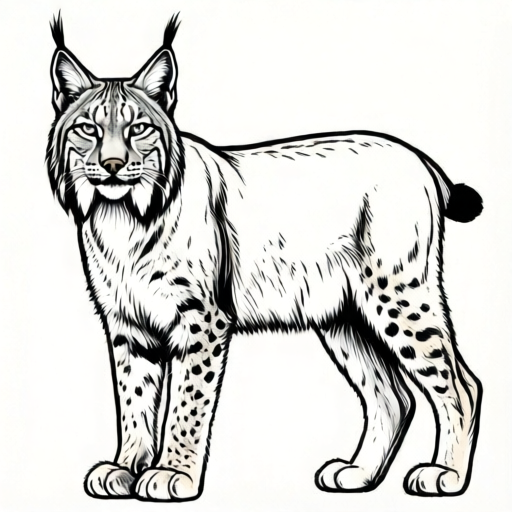
Use the stated measurements and conventions for each exercise.
Head: Facial Disk and Ear Tufts
Start with a circle for the cranium and a smaller oval for the muzzle. The facial disk is a broad, slightly flattened area around the eyes and nose, framed by a cheek ruff that flares outward. Draw two curved lines from the top of the head outward to suggest the ruff, then place the eyes on a horizontal midline through the circle. Ear tufts are not the ears themselves; they are tufts of hair rising from the ear tips. Draw the ear triangles first, then add a short, tapered tuft on each tip, angled slightly outward and back. Keep tufts asymmetrical if you wish; natural variation is acceptable.
- Draw a circle for the cranium and a smaller oval for the muzzle, overlapping them slightly.
- Mark a horizontal midline through the cranium for the eyes and a vertical midline for symmetry.
- Draw the facial disk as a soft, rounded shape around the eyes and nose, then add cheek ruff curves flaring outward.
- Draw two ear triangles on top of the cranium, then add a tapered tuft on each tip, angled outward and back.
- Place the eyes, nose, and mouth, checking that the facial disk frames them rather than covering them.
Body Proportions and Short Tail
Use a shoulder-to-hip ratio to keep the body compact. As a hypothetical example, if the shoulder-to-hip length is 6 units, the leg length from shoulder to ground might be 4 units, giving a ratio of 3:2. Measure your own drawing with a ruler or by marking units on scrap paper. The tail is short: roughly one-quarter to one-third of the body length, ending in a rounded tip. Draw the body as a rounded rectangle or oval, add long legs with slight bends at the joints, and attach the short tail low on the hip. Check that the tail does not extend past the hip line by more than the chosen fraction.
- Draw a rounded oval for the torso, then mark shoulder and hip points.
- Measure shoulder-to-hip length and leg length; record the ratio you are using.
- Draw the front and back legs with simple bends, keeping leg length consistent with your ratio.
- Attach a short tail at the hip, using one-quarter to one-third of the body length as a guide.
- Check the tail length against the hip line and adjust before adding details.
Checking and Refining the Construction
Before adding fur or shading, check the construction against the brief. The ear tufts should be visible and distinct from the ear triangles. The facial disk should read as a broad area around the eyes, with the cheek ruff flaring outward. The tail should be short and the body compact with long legs. Use a simple checklist: tufts present, disk present, ruff present, tail short, leg-to-body ratio recorded. If a feature is missing, adjust the underlying shapes rather than drawing over them. Keep line weight light so corrections are easy.
- Compare your drawing to the checklist: tufts, disk, ruff, short tail, recorded ratio.
- Measure the tail and leg lengths again with your chosen units.
- Adjust any shape that does not match the checklist, then redraw the affected lines.
- Only after the construction passes, add optional details such as whiskers or ear interior lines.
Worked example
Construct a lynx head and body using a 3:2 shoulder-to-hip to leg ratio, with a tail one-third of body length. Use hypothetical units: shoulder-to-hip 6 units, leg 4 units, tail 2 units.
Worked answer
Draw a cranium circle and muzzle oval. Add a broad facial disk with cheek ruff curves, then ear triangles with tapered tufts. For the body, draw a rounded oval 6 units long from shoulder to hip and legs 4 units long, giving a 3:2 ratio. Attach a tail 2 units long at the hip, which is one-third of 6. Check that the eyes sit inside the disk, the tufts are separate from the ears, and the tail does not exceed 2 units.
Four practice exercises
Exercise 1
Draw a lynx head only. Use a cranium circle and muzzle oval, add a facial disk with cheek ruff, and place two ear triangles with tapered tufts. Label the tuft length as one-third of ear height.
Show answer and check
A head drawing with a broad disk around the eyes, outward ruff curves, and separate tufts on the ear tips. Tuft length is about one-third of ear height.
Why: The task isolates the lynx-specific head features: disk, ruff, and tufts. Drawing the ear triangles before the tufts prevents confusing tufts with ears.
Check: Check that eyes sit inside the disk, ruff curves flare outward, and each tuft is a separate tapered shape on the ear tip. Measure tuft length against ear height.
Exercise 2
Draw a lynx body using a 4:3 shoulder-to-hip to leg ratio. Use hypothetical units: shoulder-to-hip 8 units, leg 6 units. Add a short tail of 2 units. State the tail fraction of body length.
Show answer and check
A compact body 8 units long with legs 6 units long, ratio 4:3, and a tail 2 units long, which is one-quarter of body length.
Why: The ratio keeps the body compact and legs long. The tail fraction is calculated as 2 divided by 8, giving one-quarter.
Check: Measure shoulder-to-hip and leg lengths in the same units and confirm 8:6 reduces to 4:3. Measure the tail and confirm it is 2 units, one-quarter of 8.
Exercise 3
Draw a full lynx in a standing pose. Use a 3:2 ratio with shoulder-to-hip 6 units and leg 4 units. Add a tail of 2 units. Include ear tufts and a facial disk. List three checklist items you verified.
Show answer and check
A standing lynx with tufts, disk, 6-unit body, 4-unit legs, and 2-unit tail. Checklist items might be: tufts separate from ears, eyes inside disk, tail one-third of body length.
Why: Combining head and body features tests whether the construction holds together. The checklist makes the verification explicit.
Check: Re-measure the body and leg lengths, confirm the tail fraction, and check that the disk frames the eyes and the tufts are distinct.
Exercise 4
Draw a lynx head and body, then deliberately vary the tuft angle and disk outline. Record your chosen ratio and tail fraction. Explain why your variation is still valid.
Show answer and check
A lynx drawing with altered tuft angles and disk outline, a recorded ratio such as 5:3, and a tail fraction such as one-third. The variation is valid because the checklist features remain present.
Why: The brief allows valid alternatives. Varying tuft angle and disk outline while keeping the required features demonstrates flexible construction.
Check: Confirm the checklist: tufts present and separate, disk broad and framing eyes, ruff flaring, ratio recorded, tail within one-quarter to one-third of body length.
Common mistakes
- Drawing the ear tufts as the ears themselves. Draw the ear triangles first, then add separate tapered tufts on the tips.
- Making the facial disk too small or omitting the cheek ruff. Draw a broad disk around the eyes and add outward-flaring ruff curves before placing features.
- Using a long tail or a stretched body. Set a shoulder-to-hip to leg ratio, measure it, and keep the tail to one-quarter to one-third of body length.
- Placing eyes outside the facial disk. Mark the eye midline first, then draw the disk around that midline so the eyes sit inside it.
Self-check rubric
- Ear tufts are present and distinct from the ear triangles.
- Facial disk is broad and frames the eyes; cheek ruff flares outward.
- Body shows a recorded shoulder-to-hip to leg ratio, measured in consistent units.
- Tail is short, between one-quarter and one-third of body length.
- Construction lines are light and corrections are visible rather than hidden.
- Valid alternatives are accepted: tuft angle, disk outline, and exact ratio may vary if the checklist is met.
Questions and answers
How long should the ear tufts be?
There is no single correct length. A practical guide is to make each tuft about one-third of the ear triangle height, angled outward and back. Adjust to suit your drawing and check that the tuft reads as separate from the ear.
What ratio should I use for body and legs?
Use any simple ratio you can measure, such as 3:2 for shoulder-to-hip length to leg length. Record your chosen units and check the drawing against them. The numbers are hypothetical examples, not standards.
How short is the tail?
A short tail is roughly one-quarter to one-third of the body length. Measure from the hip and mark the tip before drawing the final outline.
Can I vary the facial disk shape?
Yes. The disk should be broad and frame the eyes, but its exact outline can vary. Use the checklist: disk present, ruff flaring, eyes inside the disk.