Free original lessons
Mini Car Drawing: Compact Proportions and Wheel Placement
Learn to draw a mini car with compact body proportions and accurate wheel placement using simple guides, side and three-quarter views, and a self-check rubric.
Free lesson
Four exercises
Worked answers
Object Drawing Lessons
This lesson teaches a reliable method for drawing a mini car with compact proportions. You will establish a short wheelbase, place wheels before body details, and use a defined proportion convention to keep the car looking small and stable. The approach works for side and three-quarter views and allows valid stylistic variation. All measurements are hypothetical examples; measure your own paper and tools. A printable plate and practice panel are planned but not yet built, so work from the text descriptions here.
Practice materials: Printable downloads are not available for this lesson yet. Use the instructions and four exercises below.
Reference illustration
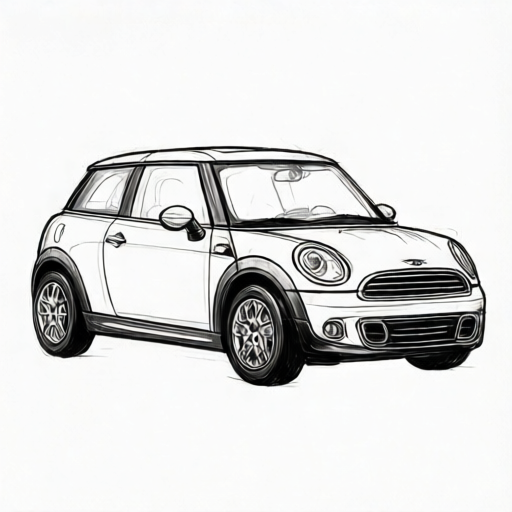
Use the stated measurements and conventions for each exercise.
Set the compact proportion convention
A mini car reads as compact when its overall length is short relative to its height and when the wheels sit close to the body ends. Use a simple unit system: let one wheel diameter equal one unit. For a compact look, the wheelbase (centre of front wheel to centre of rear wheel) is about two wheel diameters, and the total body length is about three wheel diameters. These are hypothetical example values; adjust them to your chosen style while keeping the wheelbase short.
Define your drawing convention before starting. For this lesson, x-height means the distance from the baseline to the midline of lowercase letters in your normal handwriting; use it only as a familiar reference for small spacing decisions, not as a universal standard. Letter styles vary, so treat x-height as a personal guide. Mark a baseline for the ground and a midline for the car body centre. Keep all units consistent, for example centimetres or grid squares.
- Draw a horizontal ground baseline.
- Mark a body midline above the baseline at a height equal to about one and a half wheel diameters.
- Mark two wheel centres on the baseline, separated by about two wheel diameters.
- Draw two circles of equal diameter at those centres to represent the wheels.
- Check that the gap from each wheel edge to the nearest body end is about half a wheel diameter.
Build the compact body outline
With wheels placed, sketch the body as a simple rounded box that sits between the wheel tops. The roof line should be low and the body should not extend far beyond the wheels. A compact body often has a short bonnet and a near-vertical rear. Keep the body height about one and a half wheel diameters above the baseline. Use light lines so you can adjust before committing.
Place the wheel arches after the body outline. Each arch is a curve that follows the top of its wheel with a small clearance, for example one tenth of a wheel diameter. Avoid making the arches wider than the wheels; compact cars have tight arches. Check symmetry by measuring from each wheel centre to the body edge.
- Sketch a rounded rectangle from the front body end to the rear body end, sitting on the baseline.
- Set the roof height at about one and a half wheel diameters above the baseline.
- Draw a short bonnet line from the front body end to the front wheel arch.
- Draw a near-vertical rear line from the roof to the rear body end.
- Add wheel arches as curves with a small, consistent clearance above each wheel.
Draw side and three-quarter views
For the side view, use the steps above directly. For a three-quarter view, keep the same wheel diameter and wheelbase but shift the far wheels slightly up and to the side to suggest depth. A simple rule is to offset the far wheel centres by about half a wheel diameter horizontally and a quarter vertically. These are hypothetical example values; choose offsets that look consistent with your perspective.
In three-quarter view, the near wheels remain full circles, while the far wheels may be partially hidden by the body. Draw the body outline first, then place the near wheels, then the far wheels. Check that the near and far wheel pairs share the same diameter and that the wheelbase remains short. Add simple details such as a window line and a door line only after proportions are correct.
- Draw the ground baseline and mark the near front and near rear wheel centres using the side-view spacing.
- Offset the far wheel centres by a chosen horizontal and vertical amount, keeping the same diameter.
- Sketch the body outline around all four wheel positions, keeping the roof low.
- Draw the near wheels as full circles and the far wheels as partial circles where hidden.
- Add a window line and one door line, then check all wheel diameters and the wheelbase.
Refine and self-check
Refinement should not change the compact proportion. Use a consistent line weight for the body and a slightly heavier line for the wheels if you wish. Erase construction lines only after checking the rubric. A valid alternative style may use a taller roof or a more rounded body, provided the wheelbase stays short and the wheels remain close to the body ends.
Measure your drawing with a ruler or grid. Record the wheel diameter, wheelbase, total length, and body height. Compare ratios rather than absolute sizes. If the wheelbase is longer than about two and a half wheel diameters, the car will look less compact. If the body extends more than one wheel diameter beyond a wheel centre, shorten it.
- Measure each wheel diameter and confirm they are equal within your chosen tolerance.
- Measure the wheelbase and divide by the wheel diameter; aim for about two.
- Measure total body length and divide by the wheel diameter; aim for about three.
- Check that each wheel arch clearance is small and consistent.
- Adjust only the body outline or wheel positions, not the chosen convention, until the ratios match your target.
Worked example
A side-view mini car uses a wheel diameter of 2 cm. The wheelbase is 4 cm, total body length is 6 cm, and body height above the baseline is 3 cm. Check whether the proportions match the compact targets of about two wheel diameters for wheelbase and about three for total length.
Worked answer
Wheelbase ratio = 4 cm ÷ 2 cm = 2, which matches the target. Total length ratio = 6 cm ÷ 2 cm = 3, which matches the target. Body height ratio = 3 cm ÷ 2 cm = 1.5, which matches the suggested height. The proportions are consistent with the compact convention.
Four practice exercises
Exercise 1
Side view: wheel diameter 3 cm, wheelbase 6 cm, total body length 9 cm, body height 4.5 cm. State whether the wheelbase and total length ratios match the compact targets of about two and about three wheel diameters.
Show answer and check
Wheelbase ratio = 6 ÷ 3 = 2, matching the target. Total length ratio = 9 ÷ 3 = 3, matching the target. Body height ratio = 4.5 ÷ 3 = 1.5, matching the suggested height.
Why: Divide each measurement by the wheel diameter to compare with the target ratios. The values are hypothetical examples and are consistent with the compact convention.
Check: Recompute each division and confirm the units cancel: cm ÷ cm gives a pure ratio.
Exercise 2
Side view: wheel diameter 2.5 cm, wheelbase 7.5 cm, total body length 10 cm. Identify which ratio is too long for the compact target and suggest one adjustment.
Show answer and check
Wheelbase ratio = 7.5 ÷ 2.5 = 3, which is longer than the target of about 2. Total length ratio = 10 ÷ 2.5 = 4, also longer than about 3. Shorten the wheelbase to about 5 cm and the total length to about 7.5 cm, or record a different compact target.
Why: A wheelbase of three wheel diameters makes the car look long. Reducing the wheelbase and total length restores the compact look while keeping the same wheel diameter.
Check: After adjustment, divide the new measurements by 2.5 cm and confirm the ratios are close to 2 and 3.
Exercise 3
Three-quarter view: near wheel diameter 2 cm, far wheel diameter 2 cm, near wheelbase 4 cm, far wheelbase 4 cm, horizontal offset 1 cm, vertical offset 0.5 cm. Check whether the wheel sizes and wheelbase are consistent.
Show answer and check
Near and far wheel diameters are equal at 2 cm. Near and far wheelbases are equal at 4 cm, which is two wheel diameters. The offsets are hypothetical example values and are consistent with a simple three-quarter convention.
Why: Consistency requires equal diameters and equal wheelbases between near and far pairs. The offsets only suggest depth and do not change the compact proportion.
Check: Compare each near measurement with its far counterpart and confirm the differences are zero for diameter and wheelbase.
Exercise 4
A drawing has wheel diameter 2 cm, wheelbase 5 cm, total body length 8 cm, and body height 4 cm. Calculate the three ratios and state whether the drawing meets the compact targets of about 2, about 3, and about 1.5.
Show answer and check
Wheelbase ratio = 5 ÷ 2 = 2.5, which is above the target of about 2. Total length ratio = 8 ÷ 2 = 4, above the target of about 3. Body height ratio = 4 ÷ 2 = 2, above the suggested 1.5. The drawing is not compact by these targets; shorten the wheelbase, total length, and body height.
Why: All three ratios exceed the hypothetical targets, so the car will look larger and less compact. Adjusting the measurements while keeping the wheel diameter fixed brings the ratios closer to the targets.
Check: Recalculate each ratio after adjustment and confirm each is close to its target within your chosen tolerance.
Common mistakes
- Drawing a long wheelbase that makes the car look like a full-size sedan. Shorten the distance between wheel centres to about two wheel diameters and move the body ends closer to the wheels.
- Making the wheels different sizes or placing them at different heights. Use one wheel diameter for all wheels and keep all wheel centres on the same baseline in side view.
- Letting the body extend far beyond the wheels, which weakens the compact look. Keep the overhang at each end to about half a wheel diameter and recheck total length against the three-diameter target.
- Drawing wheel arches much wider than the wheels. Tighten each arch to a small, consistent clearance, for example one tenth of a wheel diameter, and measure both sides.
Self-check rubric
- Wheel diameters are equal within the chosen tolerance.
- Wheelbase is about two wheel diameters, or another short value you have recorded.
- Total body length is about three wheel diameters, or another compact value you have recorded.
- Body height above the baseline is about one and a half wheel diameters.
- Wheel arches have small, consistent clearance and are not wider than the wheels.
- In three-quarter view, near and far wheels share the same diameter and the offset is consistent.
- Construction lines are light and final lines are clear.
- Valid alternative styles are accepted if the compact proportion and wheel placement rules are met.
Questions and answers
Do I need a printed plate to complete this lesson?
No. The plate and practice panel are planned resources, not yet built. The text steps and your own paper are sufficient.
What does x-height mean here?
It is the distance from the baseline to the midline of lowercase letters in your normal handwriting. It is a personal spacing reference, not a universal standard, because letter styles vary.
Can I use different proportions and still draw a mini car?
Yes. The ratios given are hypothetical examples. Keep the wheelbase short and the wheels close to the body ends, and record your own chosen values.
How do I check a three-quarter view?
Confirm that near and far wheels share the same diameter, that the wheelbase remains short, and that the far wheels are offset consistently.