Free original lessons
Pitbull Proportions: Head Width, Chest Depth, and Stance
Learn to draw a pitbull with accurate head width, chest depth, and stance using simple measured guides and a repeatable proportion method.
Free lesson
Four exercises
Worked answers
Object Drawing Lessons
This lesson teaches a measured approach to drawing a pitbull's head, chest, and stance proportions. You will use a defined convention: x-height is measured from the baseline to the midline of a letter, and letter styles vary, so treat all numerical values as hypothetical examples you can adjust to your own drawing scale. The goal is a believable pitbull silhouette, not a single universal answer. You will set head width relative to chest depth and stance width, then check your work with simple arithmetic and visual comparisons.
Practice materials: Printable downloads are not available for this lesson yet. Use the instructions and four exercises below.
Reference illustration
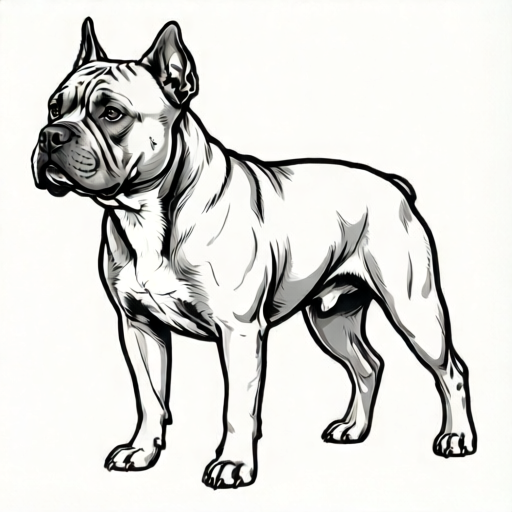
Use the stated measurements and conventions for each exercise.
Setting Up a Proportion Convention
Before drawing, choose a unit. For this lesson, let one unit equal the x-height of a lowercase letter in your normal handwriting, measured from baseline to midline. Because letter styles vary, your unit is personal; the ratios matter more than the absolute size. Label your unit on scrap paper so every measurement uses the same scale.
Draw a vertical center line and a horizontal ground line. Mark the top of the head and the bottom of the chest along the center line. These two marks define the head-to-chest span. Use a ruler or marked strip of paper to transfer distances; do not rely on memory.
- Write a lowercase letter and measure baseline to midline; record this as one unit.
- Draw a vertical center line and a horizontal ground line.
- Mark the top of the head and the lowest point of the chest on the center line.
- Measure the head-to-chest span in your units and write it beside the line.
Head Width and Chest Depth
Pitbull head width is substantial relative to the body. As a hypothetical example, set head width at about 1.2 times the head-to-chest span. Chest depth, measured from the top of the shoulder to the lowest chest point, can be about 0.8 times the head-to-chest span. These are starting ratios, not standards; adjust them after comparing your drawing to a clear reference photo you have permission to use.
Draw the head as a rounded block: mark the widest point at the cheeks, then taper slightly toward the muzzle. For the chest, draw a deep, broad curve from shoulder to shoulder, with the lowest point near the center line. Keep the chest depth visibly greater than the head height to avoid a narrow, terrier-like silhouette.
- Mark head width on a horizontal line through the cheeks.
- Draw the head outline: rounded top, wide cheeks, slight taper to muzzle.
- Mark chest depth from shoulder top to lowest chest point.
- Draw the chest curve broad and deep, centered on the center line.
Stance Width and Leg Placement
Stance width is the distance between the outside edges of the front paws. A stable pitbull stance is often slightly wider than the chest. As a hypothetical example, set stance width at about 1.1 times chest width at its widest point. Place front legs under the shoulders, not under the head, so the chest reads as deep and the stance as planted.
Draw the front legs as slightly angled columns from shoulder to paw. Keep paw width modest; wide paws can make the stance look clumsy. Check that the space between the front paws is roughly equal to one paw width, and that the outside edges align with your stance-width marks.
- Mark chest width at its widest point.
- Set stance-width marks slightly wider than chest width.
- Draw front legs from shoulders to paws, angled slightly outward.
- Check the gap between paws and adjust leg placement if needed.
Checking and Refining the Silhouette
Step back and compare your drawing to your recorded ratios. Measure head width, chest depth, and stance width again with the same unit. If a measurement is off by more than about ten percent, adjust the outline rather than redrawing everything. Use simple arithmetic: divide the measured value by the target value to see how close you are.
Refine the neck and shoulder transition last. The neck should be thick and short, connecting the wide head to the deep chest without a pinched gap. Erase construction lines only after the silhouette reads clearly as a pitbull from a distance.
- Re-measure head width, chest depth, and stance width in your units.
- Calculate each measured value divided by its target value.
- Adjust any outline that differs by more than ten percent.
- Refine neck and shoulder transition, then erase construction lines.
Worked example
A learner sets one unit as 1 cm for convenience. The head-to-chest span measures 10 cm. Using the hypothetical ratios, find head width (1.2 times span), chest depth (0.8 times span), and stance width (1.1 times chest width).
Worked answer
Head width = 1.2 × 10 = 12 cm. Chest depth = 0.8 × 10 = 8 cm. Chest width is not given, so stance width cannot be calculated without it; if chest width were 9 cm, stance width = 1.1 × 9 = 9.9 cm. The learner should measure chest width first, then compute stance width.
Four practice exercises
Exercise 1
A learner uses a unit of 2 cm. The head-to-chest span is 8 units. Calculate head width at 1.2 times the span and chest depth at 0.8 times the span. State both answers in units and in centimeters.
Show answer and check
Head width = 1.2 × 8 = 9.6 units = 19.2 cm. Chest depth = 0.8 × 8 = 6.4 units = 12.8 cm.
Why: Multiply the span by each ratio, then multiply by the unit size to convert to centimeters. Keep units consistent throughout.
Check: Divide each centimeter answer by 2 to return to units; confirm 19.2 ÷ 2 = 9.6 and 12.8 ÷ 2 = 6.4.
Exercise 2
Chest width is 7 units. Stance width is set at 1.1 times chest width. The learner draws a stance width of 8.4 units. Is the drawing within ten percent of the target? Show the arithmetic.
Show answer and check
Target stance width = 1.1 × 7 = 7.7 units. Measured ÷ target = 8.4 ÷ 7.7 ≈ 1.09, which is about nine percent above target, so it is within ten percent.
Why: Compute the target first, then divide the measured value by the target. A result between 0.9 and 1.1 is within ten percent.
Check: Multiply the target by 1.1 to get the upper limit: 7.7 × 1.1 = 8.47. Since 8.4 is below 8.47, the drawing is within the limit.
Exercise 3
A drawing has head width 10 units and head-to-chest span 9 units. The learner intended head width to be 1.2 times the span. By how many units is the head width off, and what percentage of the target is that?
Show answer and check
Target head width = 1.2 × 9 = 10.8 units. The drawing is 10.8 − 10 = 0.8 units too narrow. As a percentage of target: 0.8 ÷ 10.8 ≈ 0.074, or about 7.4 percent.
Why: Subtract the measured value from the target to find the difference, then divide the difference by the target to express it as a percentage.
Check: Add the difference back to the measured value: 10 + 0.8 = 10.8, which matches the target.
Exercise 4
A learner measures chest depth as 6 units and head-to-chest span as 10 units. The intended chest-depth ratio is 0.8 times the span. Is the chest too shallow or too deep, and by what percentage of the target?
Show answer and check
Target chest depth = 0.8 × 10 = 8 units. The drawing is 8 − 6 = 2 units too shallow. As a percentage of target: 2 ÷ 8 = 0.25, or 25 percent too shallow.
Why: Compare the measured depth to the target. A measured value below target means the chest is too shallow; divide the difference by the target for the percentage.
Check: Multiply the target by 0.75 to confirm the measured value: 8 × 0.75 = 6, which matches the drawing.
Common mistakes
- Making the head too narrow relative to the chest. Re-measure head width at the cheeks and compare it to the head-to-chest span; widen the cheeks if the ratio is below your target.
- Drawing the chest shallow, like a terrier. Mark chest depth from shoulder top to lowest chest point and increase the curve until it is visibly deeper than the head height.
- Placing front legs under the head instead of the shoulders. Move the leg columns back so they align with the shoulder marks, then re-check stance width.
- Using inconsistent units between measurements. Record your unit once and use the same marked strip or ruler for every measurement.
Self-check rubric
- Head width is measured at the cheeks and recorded in consistent units.
- Chest depth is visibly greater than head height and measured from shoulder top to lowest chest point.
- Stance width is slightly wider than chest width and front legs align under the shoulders.
- All measurements use the same unit, and any adjustment is justified by a simple ratio check.
- The final silhouette reads as a pitbull from a distance, with a thick neck and broad chest.
Questions and answers
Do I need a reference photo?
A clear photo helps, but the lesson works with the measured ratios alone. If you use a photo, choose one you have permission to use and compare proportions rather than copying details.
Are the numerical ratios fixed standards?
No. They are hypothetical examples for practice. Adjust them to your drawing scale and to the individual dog you are drawing.
How do I know my unit is consistent?
Write your unit on scrap paper and use the same marked strip or ruler for every measurement. If you change units, re-measure all values.
Can I use a different letter style for the x-height?
Yes. The convention allows any letter style as long as you measure baseline to midline consistently. Letter styles vary, so your unit may differ from someone else's.