Free original lessons
Puma Drawing Easy: Head, Paw and Body Proportion Guide
Learn to draw a puma with clear head shape, paw pad layout and body proportion checks. Includes worked example, practice tasks and a simple rubric.
Free lesson
Four exercises
Worked answers
Object Drawing Lessons
This guide teaches a repeatable way to draw a puma by controlling three things: head shape, paw structure and body proportion. You will use simple measured comparisons rather than copying a single picture. The convention is that all lengths are measured in the same unit, and any numerical values are hypothetical examples you can replace with measurements from your own reference. X-height means the distance from baseline to midline in lettering; here it is used only as a handwriting convention for labels, not as a drawing measurement. Letter styles vary, so labels may be printed or joined as long as they are legible. Work on plain paper with a pencil, eraser and ruler. Keep your first lines light so proportion errors are easy to correct.
Practice materials: Printable downloads are not available for this lesson yet. Use the instructions and four exercises below.
Reference illustration
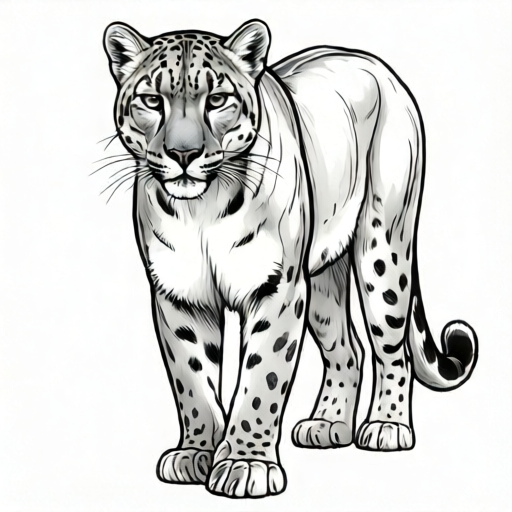
Use the stated measurements and conventions for each exercise.
Head shape and proportion
A puma head is rounded with a short muzzle and small rounded ears set wide. Begin with a circle for the cranium, then add a smaller rounded rectangle for the muzzle. The muzzle should be about one third of the cranium width. Place the eyes on a midline across the cranium, roughly halfway between the top of the head and the chin. Ears sit above the eye line and are about one quarter of the cranium diameter (about 1 cm when the cranium is 4 cm across).
Use a light construction circle and a cross axis. The vertical axis runs from between the ears to the chin. The horizontal axis passes through the eyes. Check that the distance from the eye line to the chin is about equal to the distance from the eye line to the top of the cranium. Adjust the muzzle so it does not extend beyond the cranium circle by more than one third of its width.
- Draw a light circle about 4 cm across as the cranium.
- Add a vertical axis and a horizontal eye line through the centre.
- Draw a rounded muzzle below the eye line, about 1.3 cm wide.
- Place two small ears above the eye line, each about 1 cm tall.
- Mark the eyes on the horizontal axis and the nose at the muzzle tip.
- Erase construction lines only after the outline is confident.
Paw structure
A puma paw has four visible toes and a main pad. Draw the paw as a rounded trapezoid, wider at the front than the back. The main pad is a three-lobed shape near the centre. Each toe pad is a small oval arranged in an arc across the front. Claw marks are not usually shown in a simple standing drawing because puma claws are retracted.
Use a simple convention: the paw width is about equal to the muzzle width from the head section. This keeps the drawing consistent. The main pad should occupy about one third of the paw width. Toe pads sit in a shallow arc, with the middle two slightly forward. Check that no toe pad overlaps the main pad.
- Draw a rounded trapezoid about 2 cm wide and 1.5 cm long.
- Sketch a three-lobed main pad in the lower centre.
- Add four small oval toe pads in an arc across the top.
- Check spacing: gaps between toe pads should be roughly equal.
- Lightly indicate the wrist or ankle line behind the paw.
Body proportion and pose
For a standing puma, the body length from chest to rump is about twice the head height. The leg length from shoulder to paw is about equal to the body length. Use a simple box for the torso and a smaller box for the hips. The neck connects the head to the chest at a slight downward angle. The tail is long and thick, roughly equal to the body length.
For a crouched pose, lower the torso box and bend the legs. Keep the head size the same. Check that the paw width still matches the muzzle width. The body length may appear shorter due to foreshortening, but the head and paw proportions should remain consistent. Use light guide lines to compare distances before adding detail.
- Draw a torso box about 8 cm long and 4 cm tall.
- Add a hip box about 4 cm wide behind the torso.
- Attach the head circle at the front with a short neck.
- Draw four legs as simple tubes, each about 8 cm long.
- Add paws at the ends using the paw convention.
- For a crouched pose, lower the torso and bend the leg tubes.
- Check body length against head height before finalising.
Worked example
Draw a standing puma using a head circle 4 cm across. The body length should be twice the head height, and the paw width should equal the muzzle width. Label the eye line and main pad.
Worked answer
Draw a 4 cm cranium circle. Add an eye line halfway down. Draw a muzzle about 1.3 cm wide. Make the torso box 8 cm long, which is twice the 4 cm head height. Draw legs about 8 cm long. Draw paws 1.3 cm wide to match the muzzle. Place four toe pads in an arc and a three-lobed main pad. Label the eye line and main pad legibly.
Four practice exercises
Exercise 1
A head circle is 5 cm across. The body length should be twice the head height. What body length should you draw?
Show answer and check
10 cm.
Why: Twice the head height means 5 cm multiplied by 2, which equals 10 cm. Use the same unit for both measurements.
Check: Measure the head circle and the torso box with a ruler. Confirm the torso is 10 cm long.
Exercise 2
The muzzle width is 1.5 cm. The paw width should equal the muzzle width. The main pad should be one third of the paw width. What main pad width should you draw?
Show answer and check
0.5 cm.
Why: One third of 1.5 cm is 0.5 cm. Keep the paw width at 1.5 cm and place the main pad in the lower centre.
Check: Measure the paw width and the main pad width. Confirm the main pad is about 0.5 cm and does not overlap the toe pads.
Exercise 3
A standing puma drawing has a head height of 4 cm and a body length of 6 cm. Is the body proportion correct according to the guide? If not, what should the body length be?
Show answer and check
No. The body length should be 8 cm.
Why: The guide says body length is about twice the head height. Twice 4 cm is 8 cm, so 6 cm is too short.
Check: Multiply head height by 2 and compare with the measured body length. Adjust the torso box if needed.
Exercise 4
A paw is drawn 2 cm wide with four toe pads and a main pad. The toe pads are placed in a straight line and one toe pad overlaps the main pad. Name one mistake and one fix.
Show answer and check
Mistake: toe pads are in a straight line and one overlaps the main pad. Fix: arrange the four toe pads in a shallow arc and move them so none overlaps the main pad.
Why: The paw convention requires an arc of four toe pads and a separate main pad. Overlap and a straight line break the structure.
Check: Check that the toe pads form an arc and that there is a visible gap between every toe pad and the main pad.
Common mistakes
- Making the head too large relative to the body. Measure head height and compare it to body length. The body should be about twice the head height in a standing pose.
- Drawing paws with five visible toes. Use four toe pads and one main pad. Keep the toe pads in an arc and do not overlap the main pad.
- Placing the eyes too high or too low on the cranium. Put the eye line halfway between the top of the cranium and the chin, then adjust the muzzle below it.
- Using different units for head and body measurements. Choose one unit, such as centimetres on your paper, and use it for every comparison.
Self-check rubric
- Head: cranium and muzzle are distinct, eye line is roughly halfway between top and chin, ears are above the eye line.
- Paw: four toe pads and one main pad are visible, toe pads form an arc, no toe pad overlaps the main pad.
- Body: body length is about twice the head height in a standing pose, leg length is consistent with body length.
- Proportion check: muzzle width and paw width are compared using the same unit.
- Labels: any labels are legible; x-height convention is baseline to midline, and letter styles may vary.
- Alternatives: valid alternative head or paw shapes are accepted if the proportion checks are met.
Questions and answers
Do I need to draw fur texture?
No. This guide focuses on head shape, paw structure and body proportion. Keep the outline simple and add fur only if you want to.
Can I use a different head shape?
Yes, as long as the proportions are checked. The rubric allows valid alternatives when the head, paw and body relationships are consistent.
How do I check my drawing without a reference image?
Use the arithmetic checks in the exercises: compare head height to body length, muzzle width to paw width, and eye line position.
What does x-height mean here?
X-height is the distance from baseline to midline in lettering. It is used only for label handwriting, not for the puma drawing.