Free original lessons
Draw a Cougar: Body Proportions, Head and Paw Construction
Learn to draw a cougar using measured body ovals, a structured head, and clear paw construction. Includes a worked example, four practice tasks, and a marking rubric.
Free lesson
Four exercises
Worked answers
Object Drawing Lessons
This lesson teaches a repeatable method for drawing a cougar from the side, focusing on body proportions, head structure, and paw construction. You will use simple ovals and guide lines, then refine them into a believable cougar. The convention for all line work is: a light construction line is any line you intend to erase or leave faint; a final line is darker and defines the silhouette or a feature. X-height is not used here because this is not lettering; instead, proportion is checked by comparing lengths along the same axis. All numerical values are hypothetical examples for practice, not standards. Measure your own paper and tools if you scale the drawing.
Practice materials: Printable downloads are not available for this lesson yet. Use the instructions and four exercises below.
Reference illustration
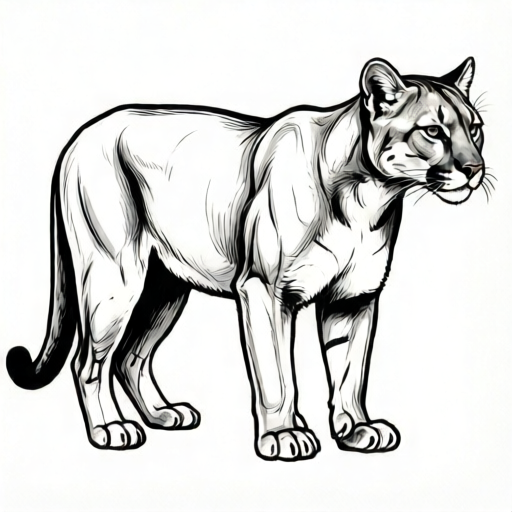
Use the stated measurements and conventions for each exercise.
Body Proportions: Ovals and Axis Lines
Begin with a horizontal body axis. Mark a shoulder point and a hip point. As a hypothetical example, place them 12 cm apart on A4 paper. Draw a large oval for the ribcage centered slightly forward of the midpoint, and a smaller oval for the hips. A cougar has a long, lean body with a deep chest and a tucked waist. Connect the ovals with a gentle curve along the back and a flatter curve along the belly.
Add the neck as a short, thick cylinder from the shoulder toward the head. The head is roughly one-fifth of the body length in side view. Use a vertical guide through the head to keep the eye, nose, and jaw aligned. The tail is long and thick, about two-thirds of the body length, and should curve naturally rather than hang stiffly.
- Draw a horizontal axis and mark shoulder and hip points 12 cm apart (hypothetical example).
- Draw a ribcage oval and a hip oval, then connect them with back and belly curves.
- Add a neck cylinder and a head-length guide equal to about one-fifth of the body length.
- Sketch the tail as a curved taper from the hip, about two-thirds of the body length.
Head Construction: Structure Before Detail
Build the head from a rounded rectangle or oval, then add a cross guide: one vertical line for symmetry and one horizontal line at eye level. Cougar heads are broad with a short muzzle. Place the eyes slightly above the horizontal midline, the nose at the lower third, and the ears high on the skull. Keep the muzzle short and wide, not pointed like a domestic cat.
The ears are rounded and medium-sized. The cheek line should suggest a subtle ruff, not a lion's mane. Draw the jaw as a shallow curve under the muzzle. Check that the distance from the eye line to the nose is about half the distance from the eye line to the top of the skull. This is a proportion check, not a fixed rule.
- Draw a head oval and a vertical symmetry guide.
- Add a horizontal eye-level guide slightly above the middle.
- Place the nose at the lower third and the ears high on the skull.
- Refine the muzzle as short and wide, then add the jaw curve.
Paw Construction: Pads, Toes and Weight
A cougar paw is broad and rounded. Start with a flattened oval for the paw pad, then add four toe ovals in an arc above it. The central two toes are slightly forward. Connect the toes to the pad with short curves. For the front paw, show the wrist as a slight bend above the paw; for the hind paw, the ankle is higher and the paw sits flatter.
Use the paw width to check body proportion: a front paw is roughly as wide as the muzzle is long. Draw claws only if the pose requires them; otherwise keep the toes rounded. Shade under the paw to suggest weight, but keep construction lines light so they can be erased.
- Draw a flattened oval for the main pad.
- Add four toe ovals in an arc, with the middle two slightly forward.
- Connect toes to pad with short curves and add wrist or ankle bends.
- Check paw width against muzzle length, then darken final lines.
Refining and Checking the Whole Cougar
Once the construction is complete, compare the head length to the body length, the tail length to the body, and the paw width to the muzzle. Adjust any oval that makes the cougar look too stocky or too slender. Cougars are muscular but lean, with long legs and a small head relative to the body.
Erase or lighten construction lines, then darken the final silhouette. Add only the details that support the pose: eye shape, nose shape, ear interior, and tail tip. Keep the drawing consistent in scale and check that all units are the same (for example, all in centimeters).
- Compare head, tail, and paw proportions to the body.
- Adjust ovals for a lean, muscular silhouette.
- Lighten construction lines and darken final lines.
- Add minimal details and verify consistent units.
Worked example
A side-view cougar on A4 paper: shoulder and hip points 12 cm apart, head length 2.4 cm, tail length 8 cm, front paw width 2.4 cm. Describe the construction order and one proportion check.
Worked answer
Draw the 12 cm body axis, then a ribcage oval and hip oval connected by back and belly curves. Add a neck cylinder and a head oval 2.4 cm long. Add a tail curve 8 cm long from the hip. Draw the front paw as a pad oval 2.4 cm wide with four toe ovals. Check: head length (2.4 cm) equals paw width (2.4 cm), and tail length (8 cm) is about two-thirds of body length (12 cm).
Four practice exercises
Exercise 1
Draw a side-view cougar with a body axis of 10 cm (hypothetical). Set head length to 2 cm and tail length to 6.5 cm. Describe your oval placement and one check.
Show answer and check
Place shoulder and hip points 10 cm apart. Draw a ribcage oval forward of midpoint and a hip oval at the rear. Add a head oval 2 cm long and a tail curve 6.5 cm long. Check: head length is about one-fifth of body length (2 cm vs 10 cm).
Why: The body axis sets scale; head and tail are fractions of that axis. The check confirms proportion.
Check: Measure head length and body axis with the same ruler; compare ratio.
Exercise 2
Construct a cougar head with a vertical symmetry guide and an eye-level guide. Place the nose at the lower third and ears high. State how you check muzzle length.
Show answer and check
Draw a head oval, add a vertical guide and a horizontal eye-level guide slightly above middle. Place nose at lower third and ears high. Check muzzle length by comparing eye-to-nose distance to eye-to-skull-top distance; eye-to-nose should be about half.
Why: Guides keep features aligned; the ratio check prevents a long domestic-cat muzzle.
Check: Measure eye-to-nose and eye-to-top distances; compare ratio.
Exercise 3
Draw a front paw using a pad oval and four toe ovals. Make the paw width equal to a 2 cm muzzle length. Describe the toe arrangement and one weight cue.
Show answer and check
Draw a pad oval 2 cm wide, add four toe ovals in an arc with the middle two slightly forward, and connect with short curves. Add a slight wrist bend above. Shade under the paw for weight.
Why: The pad-and-toe structure gives a broad cougar paw; the width check ties paw to head proportion.
Check: Measure paw width and muzzle length; they should match in this exercise.
Exercise 4
Draw a complete side-view cougar on a blank frame using a 14 cm body axis (hypothetical). Set head length to 2.8 cm, tail to 9 cm, and paw width to 2.8 cm. List two proportion checks you would perform.
Show answer and check
Draw the 14 cm axis, ribcage and hip ovals, neck, head oval 2.8 cm, tail 9 cm, and front paw 2.8 cm wide. Checks: head length vs body axis (about one-fifth) and tail length vs body axis (about two-thirds).
Why: A complete drawing combines body, head, and paw construction; checks catch proportion errors.
Check: Measure each stated length with the same ruler and compare ratios.
Common mistakes
- Making the head too large relative to the body. Re-measure head length against body length; aim for about one-fifth in side view.
- Drawing pointed, domestic-cat ears. Round the ear tips and place them high on the skull.
- Making the tail short or stiff. Extend the tail to about two-thirds of body length and curve it naturally.
- Drawing paws as small circles. Use a broad pad oval with four toe ovals in an arc, then check width against muzzle length.
Self-check rubric
- Body proportions: head about one-fifth of body length; tail about two-thirds; legs long and lean.
- Head construction: broad skull, short wide muzzle, rounded ears high on skull, eye line slightly above middle.
- Paw construction: broad pad oval with four toe ovals in an arc; wrist or ankle bend shown.
- Line quality: light construction lines and darker final lines; construction lines erased or faint.
- Consistency: all measurements use the same unit; proportion checks are stated.
Questions and answers
Do I need to use centimeters?
No. Use any consistent unit. The centimeter values are hypothetical examples for practice.
Can I draw a cougar facing forward?
Yes, but this lesson uses a side view for proportion checks. A forward view needs a different symmetry guide.
How dark should construction lines be?
Light enough to erase or leave faint. Final lines are darker and define the silhouette.
What if my cougar looks too stocky?
Narrow the ribcage oval slightly and lengthen the legs, then re-check head and tail proportions.