Free original lessons
Rat Simple Drawing: Body Shape, Ear, Snout and Tail Construction
Learn to draw a rat with a clear body-shape sequence, ear and snout placement, and a curved tail. Includes practice tasks, a rubric, and a worked example.
Free lesson
Four exercises
Worked answers
Object Drawing Lessons
This lesson teaches a simple rat drawing using a repeatable construction order: body mass, head and snout, ear, limbs, then tail. The goal is not a single perfect outline but a recognizable rat whose parts relate correctly. Work lightly at first, then darken the lines you keep. Use the same unit for every measurement in this lesson; centimetres are used in examples, but any consistent unit works. A useful convention for judging size is x-height: the distance from baseline to midline in your own handwriting. Letter styles vary, so treat x-height as a personal reference, not a universal standard. Measure your actual paper and pencil if you need exact values; any numbers here are hypothetical examples.
Practice materials: Printable downloads are not available for this lesson yet. Use the instructions and four exercises below.
Reference illustration
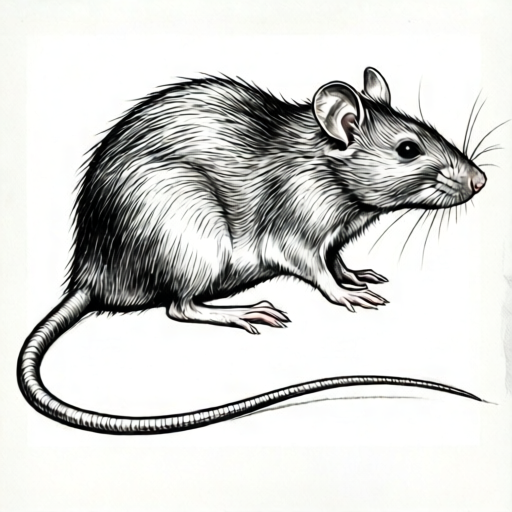
Use the stated measurements and conventions for each exercise.
Build the body as a tapered mass
Start with the body rather than the face. A rat body reads as an egg shape that is wider at the hips and narrower at the shoulders. Draw a light oval about two x-heights long and one and a half x-heights tall. Add a smaller circle for the head at the narrow end, overlapping the body by roughly one third of the head width. This overlap prevents a pinched neck.
Check the silhouette before adding detail: the back should curve gently, the belly should be slightly fuller, and the head should sit lower than the highest point of the back. If the head looks like a ball stuck on, increase the overlap.
- Draw a light oval for the body, wider at the rear.
- Add an overlapping circle for the head at the front.
- Check that the head centre is slightly below the back line.
- Adjust the overlap until the neck transition looks smooth.
Place the snout and ear
The snout is a short wedge extending from the head circle. Draw a line from the head centre toward the nose tip, then taper the wedge to a rounded point. The nose sits at the tip, slightly below the eye line. Keep the snout length about half the head width; a longer snout starts to read as a different animal.
The ear is a rounded triangle or soft cup placed on the upper rear quarter of the head circle. Its base should touch the head outline, and its height should be roughly one third of the head height. Draw the ear before the eye so you can judge the head balance. The eye is a small dark oval set about one third of the head width back from the nose.
- Draw a short tapered wedge for the snout from the head circle.
- Mark the nose at the tip, slightly below the eye line.
- Place a rounded ear on the upper rear quarter of the head.
- Add a small eye between the ear and the snout.
Add limbs and the curved tail
Rats have short limbs that tuck under the body. Draw the front leg as a small bent line from the shoulder area, ending in a simple foot. The rear leg is slightly larger and pushes back from the hip. Keep both legs short; long legs make the rat look like a different rodent.
The tail is the strongest identifying feature. Start at the rear of the body, curve it away in a smooth S or C shape, and taper it to a point. The tail length can be roughly equal to the body length, but a shorter tail is acceptable if the curve is clear. Draw the tail last so it does not compete with the body construction.
- Add a short bent front leg under the shoulder.
- Add a slightly larger rear leg at the hip.
- Draw the tail from the rear, curving smoothly and tapering to a point.
- Darken the final outline and erase construction lines.
Worked example
Draw a side-view rat using the construction order. Use a body oval two x-heights long and one and a half x-heights tall, a head circle overlapping by one third, a snout half the head width, an ear one third of the head height on the upper rear quarter, short tucked legs, and a tail equal to body length curving in a C shape.
Worked answer
The finished drawing shows a tapered body wider at the hips, a head circle overlapping the front by one third of its width, a short rounded snout with the nose slightly below the eye line, a rounded ear on the upper rear quarter, two short legs tucked under the body, and a tapering C-shaped tail starting at the rear. Construction lines are erased and the final outline is darkened.
Four practice exercises
Exercise 1
Draw a side-view rat with a body oval three x-heights long and two x-heights tall. Place the head circle overlapping the front by one third of its width. Add a snout half the head width, an ear one third of the head height on the upper rear quarter, and a tail equal to body length curving in a C shape.
Show answer and check
A side-view rat with a tapered body, overlapping head, short rounded snout, ear on the upper rear quarter, and a tapering C-shaped tail.
Why: The measurements set the proportions before detail. Overlapping the head prevents a pinched neck, and the short snout keeps the rat from reading as another animal. The C-shaped tail provides a clear identifying curve.
Check: Measure the body oval against your x-height: three long and two tall. Check the head overlap is about one third of the head width. Confirm the snout is about half the head width and the ear sits on the upper rear quarter. Trace the tail to confirm it tapers and curves.
Exercise 2
Draw a three-quarter-view rat. Keep the body oval two x-heights long and one and a half x-heights tall. Show the near ear fully and the far ear partly hidden behind the head. Add a short snout and a tail curving behind the body in an S shape.
Show answer and check
A three-quarter-view rat with a tapered body, one full ear and one partly hidden ear, a short snout, and an S-shaped tail behind the body.
Why: In a three-quarter view the head turns, so the far ear is partly occluded. Keeping the body proportions the same preserves the rat silhouette. The S-shaped tail behind the body separates it from the legs.
Check: Check that the body still tapers and the head overlaps. Confirm the near ear is fully visible and the far ear is partly hidden. Verify the snout is short and the tail curves in an S without crossing the legs.
Exercise 3
Draw a rat with a body oval two x-heights long and one and a half x-heights tall, but make the tail shorter than the body, about one and a half x-heights long. Curve it in a smooth C and taper it to a point. Keep the snout half the head width and the ear on the upper rear quarter.
Show answer and check
A rat with correct body, head, snout, and ear proportions, and a shorter C-shaped tapering tail.
Why: Tail length can vary, but the curve and taper are what make it read as a rat tail. A shorter tail tests whether the student relies on shape rather than a fixed length.
Check: Measure the tail against the body: about one and a half x-heights. Confirm the tail curves smoothly and tapers. Check the snout and ear placements against the head circle.
Exercise 4
Draw two small rats side by side on one page. Rat A is a side view with a C-shaped tail. Rat B is a three-quarter view with an S-shaped tail. Use the same body proportions for both: two x-heights long and one and a half x-heights tall. Label each drawing with the pose and tail shape.
Show answer and check
Two labelled rat drawings: a side view with a C-shaped tail and a three-quarter view with an S-shaped tail, both using the same body proportions.
Why: Drawing two poses tests whether the construction order transfers. The labels make the pose and tail shape explicit so the check is objective.
Check: Compare both bodies to the stated proportions. Confirm Rat A is a side view with a C tail and Rat B is a three-quarter view with an S tail. Check that both have overlapping heads, short snouts, and ears on the upper rear quarter.
Common mistakes
- Making the head a separate circle with no overlap. Overlap the head circle into the body by about one third of its width so the neck reads smoothly.
- Drawing the snout too long and pointed. Keep the snout about half the head width and round the tip; check that the nose sits slightly below the eye line.
- Placing the ear too low or too far forward. Move the ear to the upper rear quarter of the head, with its base touching the head outline.
- Making the tail straight or too thick. Curve the tail in a smooth S or C and taper it gradually to a point.
Self-check rubric
- Body tapers from wider hips to narrower shoulders.
- Head circle overlaps the body by roughly one third of its width.
- Snout is short, rounded, and about half the head width.
- Nose sits at the snout tip, slightly below the eye line.
- Ear is on the upper rear quarter of the head and touches the outline.
- Legs are short and tucked under the body.
- Tail starts at the rear, curves smoothly, and tapers to a point.
- Final outline is clear and construction lines are removed or faint.
Questions and answers
How long should the tail be?
A tail roughly equal to the body length is a safe starting point, but a shorter tail is acceptable if the curve and taper are clear. Judge the whole silhouette rather than a single measurement.
Can I draw the rat in a different pose?
Yes. The construction order stays the same: body mass, head and snout, ear, limbs, tail. In a side pose the tail curves behind; in a three-quarter pose the far ear may be partly hidden.
What if my lines are not smooth?
Work lightly first, then darken only the lines you keep. Smoothness improves with repeated practice; the rubric rewards correct relationships between parts, not perfect line quality.
How do I know the drawing is finished?
Check that the body tapers, the head overlaps the body, the snout is short, the ear sits on the upper rear quarter, and the tail curves and tapers. If all five are present, the construction is complete.