Free original lessons
Capybara Drawing: Body Proportion, Snout, Ear and Leg Practice
Learn to draw a capybara by building body proportion, then adding a blunt snout, small rounded ear and sturdy legs with clear checkable steps.
Free lesson
Four exercises
Worked answers
Object Drawing Lessons
Capybaras look simple but go wrong quickly when the body is too tall, the snout too pointed or the legs too thin. This lesson treats the capybara as a construction problem: first a low, long body block, then a blunt snout, a small rounded ear and four sturdy legs. You will use a defined drawing convention so that your result can be checked fairly even if your line style differs from someone else's. All measurements below are hypothetical examples chosen for practice; measure your own paper and tools rather than assuming any standard. Work lightly at first, then firm up the lines you keep.
Practice materials: Printable downloads are not available for this lesson yet. Use the instructions and four exercises below.
Reference illustration
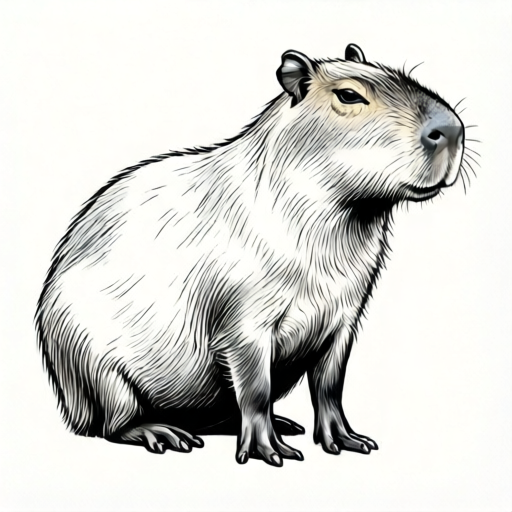
Use the stated measurements and conventions for each exercise.
Set a convention and block the body
Use this convention throughout: the body's top line is the back line, the bottom line is the belly line, and the midline is an imaginary horizontal line halfway between them. X-height means the distance from the baseline to the midline, not a letter size. Your capybara may be drawn larger or smaller, but keep the proportions consistent within your own drawing.
A capybara body is long and low. As a hypothetical example, make the body length about 3 units and the body height about 1.5 units, so the length is roughly twice the height. Draw a soft rectangle or oval for the body, then mark the midline. The back should be gently curved, not domed like a hamster.
- Draw a light horizontal baseline for the feet and a parallel back line above it.
- Mark the body length as three equal units along the baseline.
- Set the body height at about half the length and draw a low oval between the lines.
- Add a midline halfway up the body; keep the belly close to the baseline.
- Check that the body reads as long and low before adding any features.
Build the blunt snout and small ear
The snout is the feature most often drawn too pointed. A capybara's head is blocky with a broad, blunt muzzle. Place the head at one end of the body, slightly above the midline. The muzzle should be wider than a pencil tip and squared off rather than tapering to a point.
The ear is small and rounded, set high and slightly back on the head. Avoid large triangular ears, which make the drawing read as a different rodent. Draw the ear as a short rounded loop, then add a smaller inner curve if you want detail.
- Draw a rounded head block at one end of the body, about one unit wide.
- Add a blunt muzzle: a short, wide shape with a flat or softly squared front.
- Place a small rounded ear high on the head, slightly behind the eye area.
- Add a simple eye as a small dark oval near the top of the head, not on the muzzle.
- Check that the muzzle is blunt and the ear is small and round.
Place four sturdy legs
Capybara legs are short and thick relative to the body. Draw them as sturdy columns, not thin sticks. Place the front legs under the chest and the back legs under the rear, with a small gap between each pair so the legs read separately.
Use the baseline as the foot line. As a hypothetical example, make each leg about 0.7 units tall and 0.4 units wide. Keep all four feet touching or just above the baseline so the animal looks grounded.
- Mark two front leg positions under the chest and two back leg positions under the rear.
- Draw each leg as a short, thick column from belly to baseline.
- Keep the feet flat and close to the baseline.
- Check that the legs are thick enough to support the low body.
- Erase construction lines only after the final shapes look correct.
Refine and self-check
Refinement means adjusting proportion, not adding habitat scenery. Compare your drawing against the convention: is the body about twice as long as it is tall? Is the snout blunt? Is the ear small and rounded? Are the legs thick and grounded?
Valid alternatives are allowed. A slightly rounder body, a softer muzzle or a different ear curve can still be correct if the proportion and feature relationships hold. The rubric rewards checkable relationships, not a single universal outline.
- Compare body length to body height using your own unit marks.
- Trace the snout outline to confirm it is blunt, not pointed.
- Confirm the ear is small and rounded.
- Confirm four thick legs reach the baseline.
- Make one adjustment, then re-check the same four points.
Worked example
A learner draws a capybara with body length 3 units, body height 1.5 units, a blunt muzzle, a small rounded ear and four legs each 0.7 units tall and 0.4 units wide, with all feet on the baseline. Check it against the convention.
Worked answer
The body length-to-height ratio is 3 to 1.5, or 2 to 1, which matches the low, long body target. The muzzle is blunt and the ear is small and rounded, so the head features pass. Four legs of 0.7 by 0.4 units are short and thick, and all feet touch the baseline, so the leg check passes. The drawing meets the convention; any remaining variation in line style is acceptable.
Four practice exercises
Exercise 1
A drawing shows a capybara body 4 units long and 2 units tall, a pointed snout, a large triangular ear and two thin legs. Identify two proportion or feature errors and state one fix for each.
Show answer and check
The snout is pointed and should be blunt or squared; the ear is large and triangular and should be small and rounded. The body ratio 4 to 2 is acceptable, but the leg count and thickness are also wrong: there should be four thick legs.
Why: The body ratio is 2 to 1, which matches the low body target. The errors are in feature shape and leg construction, not body proportion.
Check: Re-read the convention: blunt muzzle, small rounded ear, four thick legs. Compare each feature to those words.
Exercise 2
Using a hypothetical unit, a learner marks body length 3 units and body height 1 unit. Is the body too tall, too low or acceptable under the twice-as-long guideline? Show the arithmetic.
Show answer and check
The ratio is 3 to 1, which is three times as long as tall, so the body is too low or too long for the guideline. It should be closer to 3 to 1.5.
Why: The guideline compares length to height as roughly 2 to 1. Dividing 3 by 1 gives 3, which is greater than 2.
Check: Divide length by height and compare the result to 2.
Exercise 3
A learner draws four legs each 0.5 units tall and 0.2 units wide on a body 1.5 units tall. Are the legs proportionate as sturdy columns? Explain using the hypothetical example of 0.7 tall and 0.4 wide.
Show answer and check
The legs are too thin. At 0.2 units wide they are half the example width of 0.4, while the height 0.5 is shorter than the example 0.7. They read as sticks rather than sturdy columns.
Why: The example gives a width-to-height relationship of about 0.4 to 0.7. The learner's 0.2 to 0.5 is narrower relative to height.
Check: Compare each leg's width to the example width and confirm the leg looks thick enough to support the body.
Exercise 4
A learner's capybara has a blunt muzzle, a small rounded ear, a body 3 units long and 1.5 units tall, but only three legs touching the baseline. State the remaining error and one check method to catch it.
Show answer and check
The remaining error is the leg count: a capybara drawing under this convention needs four legs touching or near the baseline. Check by counting the feet at the baseline.
Why: Body proportion and head features pass, but the leg construction is incomplete.
Check: Count the feet on the baseline and confirm there are four separate thick legs.
Common mistakes
- Drawing the body too tall, like a guinea pig or hamster. Re-measure body length and height; aim for length about twice the height.
- Making the snout pointed. Square off the muzzle front and widen it slightly.
- Drawing large triangular ears. Replace with a small rounded loop set high and slightly back.
- Using thin stick legs. Redraw legs as short thick columns and keep feet on the baseline.
Self-check rubric
- Body length is about twice the body height, using the learner's own unit marks.
- The back is gently curved and the belly stays low near the baseline.
- The muzzle is blunt or softly squared, not pointed.
- The ear is small and rounded, set high and slightly back.
- Four legs are drawn as short thick columns with feet at or near the baseline.
- Valid alternatives in line style, body roundness or ear curve are accepted if the proportion and feature relationships hold.
Questions and answers
Do I need to use the hypothetical unit measurements?
No. They are examples for practice. Keep the relationships consistent in your own drawing and measure your actual paper.
Can my capybara face the other direction?
Yes. Mirror the construction; the proportion and feature checks still apply.
How detailed should the ear be?
A small rounded outer shape is enough. An inner curve is optional and should stay small.
What if my lines are messy?
Work lightly first, then firm up kept lines. The rubric checks proportion and feature placement, not perfect line quality.