Free original lessons
Draw a Realistic Axolotl: Body Shape and Gill Branches
Learn axolotl-specific body proportions, three external gill branches per side, and skin texture with a clear convention and checkable steps.
Free lesson
Four exercises
Worked answers
Object Drawing Lessons
This lesson teaches a realistic axolotl drawing by focusing on two features that separate it from other amphibians: a broad, flattened head with a wide mouth, and three feathery external gill branches on each side of the head. You will use a simple body-outline convention, place limbs and gills by measured proportions, and add skin texture without turning the animal into a cartoon. All measurements are relative to the head width you choose, so the drawing scales to any paper size. Work lightly at first, then darken only the lines you keep.
Practice materials: Printable downloads are not available for this lesson yet. Use the instructions and four exercises below.
Reference illustration
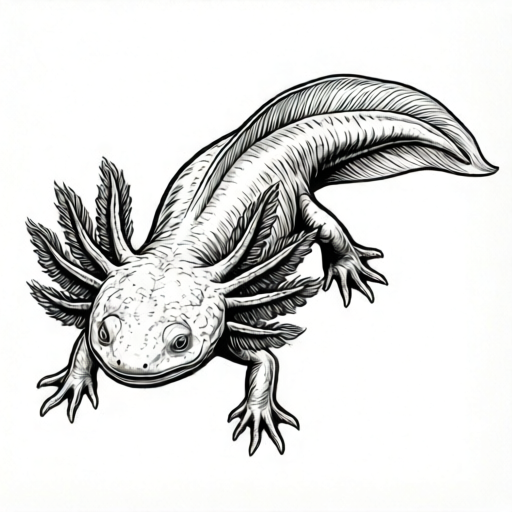
Use the stated measurements and conventions for each exercise.
Set a body-outline convention
Define the head width as one unit (1U). Draw a horizontal midline for the body and a vertical midline through the head. The axolotl body is widest at the head, narrows through the shoulders, and tapers to a flattened tail. Use these proportions: head length 1.2U, head width 1U, shoulder width 0.8U, tail length 2.5U, and total body length about 4.5U from snout to tail tip.
The mouth is a wide, shallow curve across the front third of the head. Eyes sit small and dark, roughly 0.25U apart, above the mouth line. Keep the head outline smooth and rounded, not pointed.
- Draw the horizontal midline and mark a snout point.
- Measure 1.2U back from the snout for the head length and draw a rounded head outline 1U wide.
- Mark the shoulder at 1.6U from the snout and set width 0.8U.
- Taper the body to a tail tip at 4.5U from the snout, keeping the tail flattened and slightly curved.
Place limbs and gill branches
Axolotls have four short limbs. Front limbs attach just behind the head at about 1.7U from the snout; hind limbs attach at about 3.0U. Each limb is about 0.6U long with four toes on the front feet and five on the hind feet in this convention. Draw limbs as simple tapered tubes before adding toes.
External gills are the key feature. Place three gill branches on each side of the head, emerging from the upper rear quarter of the head outline. Branch one points forward-up, branch two points outward, and branch three points back-down. Each branch is a curved stem about 0.7U long with short feathery side filaments. Keep the three branches separated so they read as distinct structures.
- Mark front limb attachment at 1.7U and hind limb at 3.0U on the midline.
- Draw four tapered limbs, then add toes: four front, five hind.
- On each side of the head, mark three gill attachment points in the upper rear quarter.
- Draw three curved stems per side with short side filaments, keeping branch directions forward-up, outward, and back-down.
Add skin texture and finish
Axolotl skin is smooth with subtle mottling. Use small, sparse dots and short soft strokes rather than heavy crosshatching. Keep texture density low on the head and slightly higher along the back and tail. Darken the eye, the mouth line, and the gill stems last so the body outline stays readable.
Check that the gills do not overlap the eye or mouth, that limbs attach at the marked points, and that the tail remains flattened rather than round. A valid drawing may vary branch curvature and filament count as long as three distinct branches per side remain visible.
- Add sparse dots and short strokes along the back and tail.
- Darken the eye, mouth, and gill stems.
- Erase construction midlines and compare proportions to the 1U convention.
Worked example
Using U = 4 cm head width, calculate the head length, shoulder width, tail length, and total body length in centimeters.
Worked answer
Head length = 1.2 × 4 = 4.8 cm. Shoulder width = 0.8 × 4 = 3.2 cm. Tail length = 2.5 × 4 = 10 cm. Total body length = 4.5 × 4 = 18 cm.
Four practice exercises
Exercise 1
A drawing uses U = 5 cm. Find the head length, shoulder width, and total body length in centimeters.
Show answer and check
Head length 6 cm, shoulder width 4 cm, total body length 22.5 cm.
Why: Multiply each proportion by U: 1.2 × 5 = 6; 0.8 × 5 = 4; 4.5 × 5 = 22.5.
Check: Recheck each multiplication and confirm units are centimeters.
Exercise 2
A sketch shows two gill branches on the left side and three on the right. State the fix and the check you would use.
Show answer and check
Add a third distinct branch on the left side in the upper rear quarter, then check that each side shows three separated branches clear of the eye and mouth.
Why: The convention requires three branches per side; the missing branch breaks symmetry of structure, not necessarily of curvature.
Check: Count branches per side and confirm none overlap the eye or mouth.
Exercise 3
A tail is drawn 3.0U long and as wide as the shoulder. Identify two problems and give corrected values.
Show answer and check
The tail is too long and too wide. Correct to about 2.5U long and narrower than 0.8U shoulder width.
Why: The convention sets tail length at 2.5U and requires the tail to taper narrower than the shoulder.
Check: Compare tail length to 2.5 head widths and tail width to shoulder width by eye.
Exercise 4
A front limb is placed at 2.4U from the snout. State the correct attachment and the difference in U.
Show answer and check
Correct attachment is about 1.7U; the drawn limb is 0.7U too far back.
Why: Subtract 1.7 from 2.4 to get 0.7U.
Check: Re-subtract and confirm the limb sits just behind the head.
Common mistakes
- Drawing a pointed snout like a salamander. Keep the head outline rounded and wide, with the mouth as a shallow curve across the front third.
- Placing gills on top of the head or too close to the eyes. Attach all three branches in the upper rear quarter of the head outline, clear of the eye and mouth.
- Making the tail round and thick like a fish body. Taper the tail to a flattened tip and keep its width less than the shoulder width.
- Adding heavy crosshatching that hides the body outline. Use sparse dots and short soft strokes, keeping texture light on the head.
Self-check rubric
- Head is rounded and wide, with a shallow mouth curve across the front third.
- Three distinct gill branches per side attach in the upper rear quarter of the head.
- Four limbs attach near 1.7U and 3.0U, with four front toes and five hind toes.
- Tail tapers to a flattened tip and is narrower than the shoulder width.
- Texture is sparse and does not obscure the body outline.
- Valid alternatives: branch curvature, filament count, and mottling pattern may vary if the three-branch structure and proportions remain clear.
Questions and answers
How many gill branches should I draw?
Three distinct branches on each side of the head, attached in the upper rear quarter. Branch curvature and filament count may vary.
What is the unit U?
U is the head width you choose. All other measurements are multiples of U, so the drawing scales to your paper.
Can I change the toe count?
This convention uses four front toes and five hind toes. If you change it, keep the count consistent and note it in your rubric check.
How do I check proportions without a ruler?
Compare distances by eye against the head width: head length about 1.2 head widths, tail about 2.5 head widths, total about 4.5 head widths.