Free original lessons
Drawing Realistic Mouths: Lip Planes, Highlights, and Shadow Placement
Learn to draw realistic mouths by mapping lip planes, placing highlights, and shading shadows with a clear convention and checkable steps.
Free lesson
Four exercises
Worked answers
Object Drawing Lessons
A realistic mouth is not a single outline but a set of overlapping planes: the upper lip's two columns, the lower lip's central bulge, the corners, and the shadow under the lower lip. This lesson teaches a repeatable convention for drawing those planes and placing highlights and shadows so the mouth reads as three-dimensional. You will use simple shapes, consistent light direction, and arithmetic checks. All practice tasks are self-contained; where a diagram would help, the text describes it precisely. The convention is explicit, but valid stylistic alternatives are allowed and judged by the rubric.
Practice materials: Printable downloads are not available for this lesson yet. Use the instructions and four exercises below.
Reference illustration
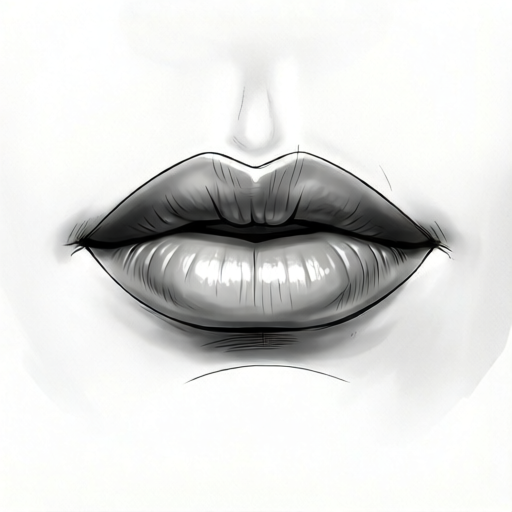
Use the stated measurements and conventions for each exercise.
Mapping the lip planes
Begin with a horizontal midline and a vertical centerline. The mouth's width is about two-thirds of the distance between the nose base and the chin in a typical adult face, but treat that as a hypothetical proportion to verify against your own reference. Mark the corners on the midline. The upper lip has two columns separated by a central dip (the cupid's bow); each column is a plane that tilts slightly outward. The lower lip is a single central bulge with two side planes that recede toward the corners.
Define light direction before shading. For this lesson, light comes from the upper left at about 45 degrees. That means the upper-left column of the upper lip catches light, the lower-left side of the lower lip catches light, and shadows fall under the lower lip and at the right corner. Keep this direction consistent across all practice.
- Draw a horizontal midline and a vertical centerline crossing at the mouth center.
- Mark two corner points on the midline; connect them with a shallow curve for the lip seam.
- Draw the upper lip as two rounded columns meeting at a central dip; keep the left column slightly higher if light is upper-left.
- Draw the lower lip as one central bulge with two side planes angling back toward the corners.
- Add a thin shadow plane under the lower lip and a small shadow at the right corner.
Highlight and shadow placement
Highlights are not outlines; they are small, soft shapes on the planes that face the light. Place one highlight on the upper-left column near its top edge and one on the lower lip's central bulge slightly left of center. Shadows go where planes turn away: under the lower lip, along the right side of the lower lip, and in the central dip of the upper lip. The lip seam itself is a dark line, but it should vary in thickness.
Use a simple five-step value scale: 1 is paper white, 3 is mid-tone, 5 is darkest. Assign the lower-lip underside a 4, the right corner a 3, the lip seam a 4, and highlights a 1 or 2. These numbers are hypothetical examples; measure your own pencil values against a scale you draw.
- Draw a five-step value scale from 1 to 5 and label it.
- Block the shadow under the lower lip at value 4, then darken its center to 5.
- Add the right-corner shadow at value 3, blending toward the corner.
- Place the upper-left highlight as a soft oval at value 1, then soften its edge.
- Add the lower-lip highlight slightly left of center; keep the corners in shadow to match the receding corner planes.
Checking proportion and consistency
Measure the mouth width and the distance from the bottom of the lip seam to the bottom of the lower lip. In this convention, upper-lip height is measured from the top of the upper lip to the bottom of the seam, and lower-lip visible height is measured from the bottom of the seam to the bottom of the lower lip. The lower-lip visible height equals half the upper-lip height; the seam thickness is counted separately and is not part of either measurement. This makes the lower lip shorter than the upper lip. Also check that highlights sit on the light-facing side: if light is upper-left, the left side of the lower lip should be lighter than the right.
Use a simple arithmetic check: count the number of distinct planes you drew. A complete mouth in this convention has five: upper-left column, upper-right column, lower central bulge, lower-left side plane, lower-right side plane. If you count fewer, add the missing plane before shading.
- Measure mouth width and lower-lip height with a ruler; record both in the same unit.
- Confirm the lower-lip visible height equals upper-lip height divided by 2, where upper-lip height runs from the top of the upper lip to the bottom of the seam and lower-lip visible height runs from the bottom of the seam to the bottom of the lower lip, with seam thickness counted separately.
- Count five planes and label them lightly in pencil.
- Check that every highlight sits on a light-facing plane and every shadow on a receding plane.
Worked example
Draw a mouth with upper-left light. The mouth width is 6 cm. The upper lip height is 1.2 cm and the seam thickness is 0.2 cm. Place five planes, one highlight on the upper-left column, one on the lower lip, and shadows under the lower lip and at the right corner. Use a five-step value scale.
Worked answer
Midline and centerline cross at the mouth center. Corners are 3 cm left and right of center. The seam is a shallow curve. Upper lip: two columns, left slightly higher; upper-lip height is 1.2 cm measured from the top of the upper lip to the bottom of the seam. Lower lip: central bulge with side planes; visible height about 0.6 cm (half of 1.2 cm) measured from the bottom of the seam to the bottom of the lower lip, with the 0.2 cm seam counted separately. Five planes labeled. Value scale 1 to 5. Upper-left highlight at 1; lower-lip highlight slightly left of center at 1; shadow under lower lip at 4 with center at 5; right-corner shadow at 3; seam at 4 with thicker corners. Check: five planes counted; lower lip shorter than upper lip; highlights on light-facing planes only.
Four practice exercises
Exercise 1
A mouth is 8 cm wide. The upper lip is 1.6 cm tall and the seam is 0.2 cm thick. Calculate the expected lower-lip visible height using the lesson convention, then describe where the upper-left highlight and the right-corner shadow go.
Show answer and check
Expected lower-lip visible height is 0.8 cm (half of 1.6 cm), measured from the bottom of the seam to the bottom of the lower lip; upper-lip height is measured from the top of the upper lip to the bottom of the seam, and the 0.2 cm seam is counted separately. The upper-left highlight goes on the upper-left column near its top edge. The right-corner shadow goes at the right corner, blending inward.
Why: The convention sets lower-lip visible height as half the upper-lip height: 1.6 / 2 = 0.8 cm, with upper-lip height measured from the top of the upper lip to the bottom of the seam and seam thickness counted separately. With upper-left light, the left column faces the light and the right corner turns away.
Check: Measure the drawn lower lip from the bottom of the seam to its bottom edge; it should be about 0.8 cm. Confirm the highlight is on the left column and the shadow is at the right corner, not the left.
Exercise 2
You draw a mouth with light from the upper right. List which lower-lip side plane should be lighter and which should be darker, and state one highlight and one shadow location. Then give a value-scale check using values 1 to 5.
Show answer and check
The lower-right side plane is lighter and the lower-left side plane is darker (the side planes flip with light direction). The central bulge highlight shifts slightly right of center because the bulge faces the light source. One shadow goes under the lower lip and one at the left corner. On a 1-to-5 scale, the highlight is 1 or 2, the underside shadow is 4, and the left-corner shadow is 3.
Why: Mirroring the light direction swaps which side planes are light and dark. The central bulge still catches light, but the highlight shifts toward the light side. Shadows fall opposite the light.
Check: Verify that the lighter side plane is on the same side as the light source. Check that the highlight value is lower (lighter) than the shadow values on your drawn scale.
Exercise 3
A learner draws a mouth with three planes and a uniform dark seam. Identify two mistakes and describe the corrected drawing in words, including where to add two missing planes.
Show answer and check
Mistake one: too few planes. Mistake two: uniform seam. Corrected drawing: add the upper-right column and the lower-left side plane so five planes exist. Vary the seam thickness, making it thicker at the corners and central dip and thinner where lips meet lightly. Keep the existing light direction consistent.
Why: The convention requires five planes for complete shading. A uniform seam flattens the mouth and ignores the varying contact between lips.
Check: Count the planes in the corrected description; there should be five. Check that the seam description includes at least two different thicknesses.
Exercise 4
Design a quick self-check for a mouth drawing with upper-left light. Include one arithmetic check, one plane-count check, and one light-consistency check. State what result would fail each check.
Show answer and check
Arithmetic check: lower-lip visible height should be about half the upper-lip height, where upper-lip height runs from the top of the upper lip to the bottom of the seam and lower-lip visible height runs from the bottom of the seam to the bottom of the lower lip, with seam thickness counted separately; failing means the lower lip is taller than expected. Plane-count check: count five planes; failing means fewer than five are present. Light-consistency check: highlights should be on the upper-left column and the lower-lip left side, shadows on the right corner and under the lip; failing means a highlight appears on the right side or a shadow on the left.
Why: Each check targets a different failure mode: proportion, completeness, and coherent lighting. Simple counts and comparisons make the checks repeatable.
Check: Apply each check to a sample drawing and record pass or fail. A drawing passes only if all three checks pass.
Common mistakes
- Drawing the mouth as a single outline with no internal planes. Break the outline into five labeled planes before shading; shade each plane separately.
- Placing highlights on both sides of the lower lip. Choose one light direction and place highlights only on light-facing planes; keep the opposite side in shadow.
- Making the lower lip taller than the upper lip. Re-measure using the defined heights: upper-lip height from the top of the upper lip to the bottom of the seam, and lower-lip visible height from the bottom of the seam to the bottom of the lower lip. Reduce the lower-lip visible height to about half the upper-lip height, counting seam thickness separately.
- Using a uniform dark line for the lip seam. Vary seam thickness: thicker at the corners and central dip, thinner where the lips meet lightly.
Self-check rubric
- Five distinct lip planes are visible and labeled or clearly implied.
- Light direction is stated and consistent across highlights and shadows.
- Highlights sit only on light-facing planes; shadows sit on receding planes.
- Lower-lip visible height is about half the upper-lip height, where upper-lip height runs from the top of the upper lip to the bottom of the seam and lower-lip visible height runs from the bottom of the seam to the bottom of the lower lip, with seam thickness counted separately, within a reasonable margin.
- Lip seam varies in thickness and is not a uniform outline.
- Value scale is drawn and used to justify at least three shading choices.
- Valid stylistic alternatives are accepted if planes, light direction, and proportions remain coherent.
Questions and answers
Do I need a reference photo?
No. The lesson describes a convention and gives measurable checks. A reference helps, but every practice task is solvable from the text alone.
Can I use a different light direction?
Yes. The convention fixes upper-left light for teaching, but you may mirror it. Keep highlights and shadows consistent with your chosen direction and state it in your notes.
How do I know my values are correct?
Draw a five-step value scale and compare. The numbers in the lesson are hypothetical examples; your scale is the authority.
Is there a single correct mouth shape?
No. Lip styles vary. The rubric rewards consistent planes, coherent light direction, and checkable proportions, not one universal shape.