Free original lessons
Salt Marsh Drawing: Creek Channels, Grass Clumps, and Tide Line
Learn to draw a salt marsh scene with branching creek channels, clustered grass clumps, and a clear tide line using simple depth cues and a defined line convention.
Free lesson
Four exercises
Worked answers
Object Drawing Lessons
A salt marsh drawing reads clearly when three features work together: creek channels that branch and narrow, grass clumps that cluster at different scales, and a tide line that marks where water has recently reached. This lesson uses a simple convention: the tide line is a continuous dashed line, creek channels are drawn with smooth paired edges, and grass clumps are built from short angled strokes grouped in tufts. You will practice composing these features with depth cues such as overlap, size change, and placement on the page. All measurements are hypothetical examples; measure your own paper and tools before drawing.
Practice materials: Printable downloads are not available for this lesson yet. Use the instructions and four exercises below.
Reference illustration
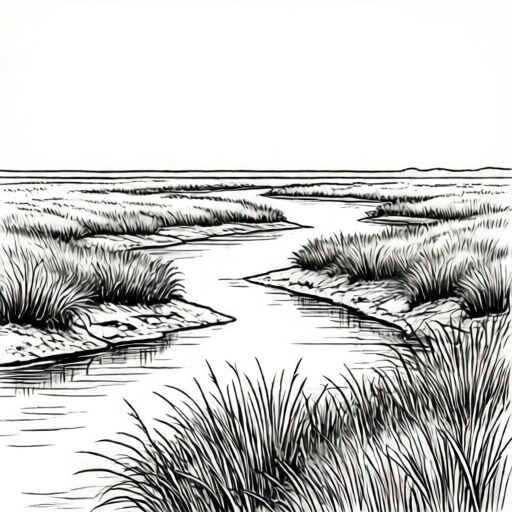
Use the stated measurements and conventions for each exercise.
Setting up the page and the line convention
Choose a drawing surface and mark a light horizon line about one third from the top. This separates distant marsh from foreground. Decide on a simple convention before drawing: creek channels use paired smooth lines that taper as they recede; grass clumps use groups of three to seven short strokes fanning from a base point; the tide line is a dashed line that follows the ground contour and crosses creek channels without closing them.
Keep the convention consistent so a viewer can tell features apart. For example, if creek edges are smooth, avoid jagged strokes on those lines. If grass strokes are short and angled, do not switch to long vertical strokes in the same clump. Label any numerical values you choose as hypothetical; for instance, you might decide a foreground grass clump spans about 3 cm on your paper, but measure your actual paper first.
- Mark a light horizon line one third from the top of your paper.
- Draw a small test box and practice three creek-channel pairs that taper from wide to narrow.
- Practice five grass clumps using three to seven short angled strokes each.
- Draw a dashed tide line across the test box, letting it cross a creek channel without closing the channel.
Drawing creek channels with branching and taper
Start with one main channel entering from the bottom edge and curving toward the horizon. Draw its two edges as smooth lines that gradually come closer together as they recede. Add one or two branches that split from the main channel at a shallow angle. Branches should be narrower than the parent channel at the split and should taper faster.
Use overlap to show depth: a grass clump drawn later can cover part of a creek edge, which tells the viewer the grass is closer. Keep channel edges unbroken where they meet the tide line; the dashed tide line should cross the channel, not stop at it. If you use a numerical example, say a main channel is about 2 cm wide at the bottom edge and narrows to about 0.5 cm near the horizon; these are hypothetical values, so measure your own drawing and adjust.
- Draw the main channel from the bottom edge toward the horizon with paired smooth edges.
- Add one branch splitting at a shallow angle and taper it faster than the main channel.
- Check that each branch is narrower than its parent at the split.
- Draw a grass clump overlapping one creek edge to create a depth cue.
Building grass clumps and placing the tide line
Grass clumps should vary in size and spacing. Draw larger clumps in the foreground and smaller clumps near the horizon. Each clump begins with a base point; from that point, draw three to seven short strokes fanning outward. Leave small gaps between clumps so the marsh does not look like a solid wall. Group two or three clumps together, then leave a gap, then group again.
The tide line is a dashed line that follows the ground contour. It should cross creek channels and pass behind foreground grass clumps. Draw it after the channels and before the foreground clumps so the clumps can overlap it. Use a consistent dash length, such as a hypothetical 0.5 cm dash with a 0.3 cm gap, but measure your own paper and choose values that fit. The tide line does not need to be perfectly straight; it can curve with the land.
- Place three large grass clumps in the foreground with gaps between them.
- Add smaller clumps near the horizon, keeping them sparse.
- Draw the dashed tide line across the middle ground, crossing creek channels.
- Draw foreground grass clumps over the tide line to show overlap.
Checking depth cues and consistency
Review your drawing for three depth cues: overlap, size change, and placement. Foreground clumps should be larger and may overlap creek edges or the tide line. Distant clumps should be smaller and placed closer to the horizon. Creek channels should taper as they recede. The tide line should remain a continuous dashed line even where it crosses channels.
Check that your convention is consistent: creek edges smooth, grass strokes short and angled, tide line dashed. If a feature breaks the convention, redraw that part rather than adding more marks. A simple check is to trace each creek channel from bottom to horizon and confirm it narrows; then trace the tide line and confirm it crosses at least one channel without closing it.
- Trace each creek channel and confirm it narrows toward the horizon.
- Confirm at least one foreground grass clump overlaps a creek edge or the tide line.
- Check that the tide line crosses at least one creek channel without closing it.
- Confirm grass clumps vary in size from foreground to horizon.
Worked example
Draw a small salt marsh scene on a 10 cm by 15 cm area. Include one main creek channel that tapers from about 2 cm wide at the bottom edge to about 0.5 cm near the horizon, one branch, three foreground grass clumps, four distant grass clumps, and a dashed tide line crossing the main channel. These measurements are hypothetical; measure your own paper first.
Worked answer
The finished drawing shows a main channel entering from the bottom edge and curving toward the horizon, narrowing from about 2 cm to about 0.5 cm. One branch splits at a shallow angle and tapers faster. Three large grass clumps sit in the foreground with gaps between them; four smaller clumps sit near the horizon. A dashed tide line crosses the main channel and passes behind the foreground clumps. At least one foreground clump overlaps a creek edge.
Why: The taper shows depth along the channel. The branch being narrower than the parent at the split reinforces the branching structure. Larger foreground clumps and smaller distant clumps use size change as a depth cue. Overlap between a foreground clump and a creek edge adds a second depth cue. The dashed tide line crossing the channel keeps the convention consistent and shows the tide line is continuous.
Check: Trace the main channel and confirm it narrows from bottom to horizon. Confirm the branch is narrower than the main channel at the split. Count three foreground clumps and four distant clumps, and confirm the foreground clumps are larger. Trace the tide line and confirm it crosses the main channel without closing it. Confirm at least one foreground clump overlaps a creek edge.
Four practice exercises
Exercise 1
On a 12 cm by 18 cm area, draw one main creek channel that tapers from about 3 cm wide at the bottom edge to about 0.8 cm near the horizon. Add one branch that splits at a shallow angle and is narrower than the main channel at the split. These measurements are hypothetical; measure your own paper first.
Show answer and check
A main channel with smooth paired edges narrowing from about 3 cm to about 0.8 cm, plus one branch that is narrower than the main channel where it splits.
Why: The taper shows depth along the channel. The branch being narrower at the split reinforces the branching structure and keeps the channel hierarchy clear.
Check: Trace the main channel and confirm it narrows from bottom to horizon. Measure the branch at the split and confirm it is narrower than the main channel at that point.
Exercise 2
Draw five grass clumps in a row with gaps between them. Make the first two clumps larger than the last three. Use three to seven short angled strokes per clump. Do not draw creek channels or a tide line.
Show answer and check
Five grass clumps with gaps, the first two larger than the last three, each built from three to seven short angled strokes fanning from a base point.
Why: Size change is a depth cue: larger clumps read as closer. Gaps prevent the marsh from looking like a solid wall. The stroke count keeps the convention consistent.
Check: Count the clumps and confirm there are five with gaps. Compare the first two clumps to the last three and confirm the first two are larger. Count the strokes in each clump and confirm each has three to seven short angled strokes.
Exercise 3
Draw a dashed tide line across a 10 cm wide area. Draw one creek channel crossing the tide line. The tide line must cross the channel without closing it. Use a consistent dash length and gap. These measurements are hypothetical; measure your own paper first.
Show answer and check
A dashed tide line crossing a creek channel, with the channel edges still visible through the dashes and the dash length and gap consistent.
Why: The tide line follows the ground contour and crosses channels rather than stopping at them. Keeping the channel edges visible preserves the channel structure. Consistent dashes maintain the convention.
Check: Trace the tide line and confirm it crosses the channel. Confirm the channel edges are visible on both sides of the tide line. Check that the dash length and gap are consistent across the tide line.
Exercise 4
Compose a small salt marsh scene on a 10 cm by 15 cm area with one main creek channel, one branch, three foreground grass clumps, three distant grass clumps, and a dashed tide line. Include at least one overlap between a foreground grass clump and a creek edge. These measurements are hypothetical; measure your own paper first.
Show answer and check
A composed scene with a tapering main channel, a narrower branch, three larger foreground clumps, three smaller distant clumps, a dashed tide line crossing the channel, and at least one foreground clump overlapping a creek edge.
Why: The composition combines taper, branching, size change, and overlap to create depth. The tide line crossing the channel keeps the convention consistent. Foreground clumps overlapping a creek edge adds a clear depth cue.
Check: Confirm the main channel tapers and the branch is narrower at the split. Count three foreground clumps and three distant clumps, and confirm the foreground clumps are larger. Trace the tide line and confirm it crosses the channel without closing it. Confirm at least one foreground clump overlaps a creek edge.
Common mistakes
- Drawing creek channels with parallel edges that never taper. Redraw each channel so its two edges gradually come closer together as they recede toward the horizon.
- Making grass clumps all the same size and spacing. Vary clump size from large in the foreground to small near the horizon, and leave gaps between groups.
- Stopping the tide line at a creek channel instead of crossing it. Continue the dashed tide line across the channel, keeping the dashes consistent.
- Using long vertical strokes for grass after establishing short angled strokes. Return to the defined convention: three to seven short angled strokes fanning from a base point.
Self-check rubric
- Creek channels have paired smooth edges that taper toward the horizon.
- At least one branch splits from a main channel and is narrower than the parent at the split.
- Grass clumps use three to seven short angled strokes fanning from a base point.
- Grass clumps vary in size, with larger clumps in the foreground and smaller clumps near the horizon.
- The tide line is a continuous dashed line that crosses at least one creek channel without closing it.
- At least one depth cue is present: overlap, size change, or placement.
- The line convention is consistent throughout the drawing.
Questions and answers
Do I need to measure my paper before drawing?
Yes. Measure your actual paper and tools first. Any numerical values in this lesson are hypothetical examples, not standards.
Can the tide line be curved?
Yes. The tide line should follow the ground contour, so curves are valid as long as the dashed convention stays consistent.
How many grass strokes should each clump have?
Use three to seven short angled strokes per clump. The exact number can vary, but keep the stroke style consistent.
What if my creek channel crosses the tide line?
That is expected. The tide line should cross creek channels without closing them; keep the channel edges visible through the dashes.