Free original lessons
Side-On Face Drawing: Profile Contour and Feature Alignment
Learn to draw a side face by mapping the profile contour and aligning eye, nose, mouth, and ear using simple proportional checks and a defined convention.
Free lesson
Four exercises
Worked answers
Object Drawing Lessons
Drawing a side-on face is mostly a problem of contour and alignment. The profile line runs from forehead to chin, and each feature sits at a predictable height relative to that line. This lesson defines a clear convention: the eye sits on a horizontal midline, the ear spans roughly from eye level to nose base, and the mouth falls between nose base and chin. You will use checkable proportions, not guesswork, and a rubric that accepts valid stylistic variation. All measurements are hypothetical examples; measure your own reference or drawing to confirm.
Practice materials: Printable downloads are not available for this lesson yet. Use the instructions and four exercises below.
Reference illustration
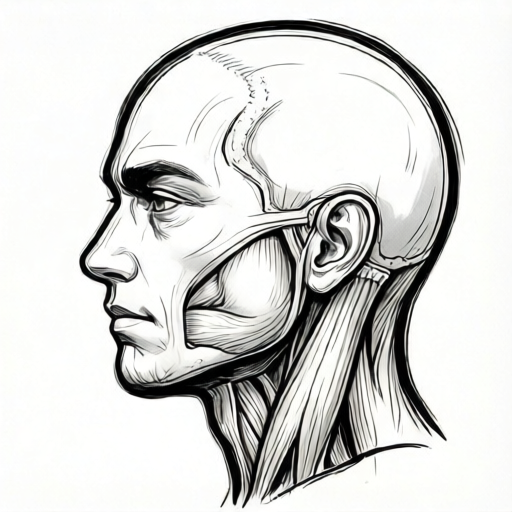
Use the stated measurements and conventions for each exercise.
Establish the profile contour
Begin with a single continuous line that describes the side edge of the face: forehead curve, brow dip, nose bridge, nose tip, upper lip, lower lip, and chin. Keep the line light so you can adjust it. The contour is not a straight vertical; it steps forward at the nose and recedes at the eye socket and under the chin.
Use a baseline and a midline to anchor the drawing. The baseline is the bottom of the chin; the midline is a horizontal line through the eye. Mark the top of the head and the chin to set overall height. Then place the nose base and mouth line as fractions of that height. For example, if head height is 18 units, a hypothetical nose base might sit 10 units above the baseline and the eye midline 12 units above it. These numbers are examples only; measure your own drawing.
- Draw a light vertical guide for the back of the head and a horizontal baseline at the chin.
- Sketch the profile contour from forehead to chin in one pass, then refine the nose and lips.
- Mark the eye midline horizontally across the face at about two-thirds of head height above the baseline.
- Mark the nose base and mouth line, then check that the mouth sits between nose base and chin.
Align eye, nose, mouth, and ear
Feature alignment means each feature has a height and a depth relative to the contour. The eye sits on the midline and its front corner is close to the profile line at the brow. The nose tip projects forward; the nose base is a horizontal mark. The mouth line is between nose base and chin, often closer to the nose base. The ear sits behind the eye line, with its top near the eye midline and its bottom near the nose base.
Check alignment by drawing horizontal dashed lines across the face at eye, nose base, mouth, and ear top and bottom. If a line misses its target, adjust the feature rather than the whole contour. Keep the back of the head rounded and the jaw line connecting ear base to chin. Use a convention: the midline is the horizontal eye line, and the baseline is the bottom of the chin.
- Draw a horizontal eye midline and place the eye so its front corner nearly touches the profile at the brow.
- Mark the nose base and draw the nose tip forward of the contour by a small, consistent amount.
- Place the mouth line between nose base and chin, then draw lips that meet the profile contour.
- Place the ear between eye midline and nose base, behind the eye, and connect the jaw to the chin.
Refine proportions and check
Proportion checks catch common drift. Measure head height from chin baseline to top of head. The eye midline should be roughly halfway between top of head and chin, or slightly lower depending on style. The nose base is often about one-third of head height above the chin. The ear height is roughly the distance from eye midline to nose base. These are hypothetical examples; confirm with your own reference.
Use a simple arithmetic check: if head height is 18 units and the eye midline is 12 units above the baseline, then the top of the head is 6 units above the eye line. If the nose base is 10 units above the baseline, the ear spans from 10 to 12 units, a 2-unit height. Adjust until the numbers match your intended style. The rubric accepts valid alternatives, so record your chosen proportions and keep them consistent.
- Measure head height and eye midline height; record both in the same units.
- Check nose base height and mouth line height as fractions of head height.
- Verify ear top and bottom align with eye midline and nose base.
- Erase guides, darken the contour and features, and label your chosen proportions lightly.
Worked example
A side-face study uses a head height of 18 units from chin baseline to top of head. The eye midline is 12 units above the baseline, the nose base is 10 units above the baseline, and the mouth line is 8 units above the baseline. Describe where the ear top and bottom should sit and check the mouth placement.
Worked answer
Ear top aligns with the eye midline at 12 units; ear bottom aligns with the nose base at 10 units, so the ear spans 2 units. The mouth line at 8 units sits between nose base (10) and chin (0), closer to the nose base, which is consistent with the convention. Head height check: top of head is 18, eye midline 12, so the eye is 6 units below the top and 12 above the chin; this is a valid stylistic choice if kept consistent.
Four practice exercises
Exercise 1
A side-face drawing has head height 20 units, eye midline 13 units above the chin baseline, nose base 11 units above the baseline, and mouth line 9 units above the baseline. Where should the ear top and bottom align, and is the mouth placement valid?
Show answer and check
Ear top aligns with the eye midline at 13 units; ear bottom aligns with the nose base at 11 units, so the ear spans 2 units. The mouth at 9 units is between nose base (11) and chin (0), closer to the nose base, so it is valid under the convention.
Why: The convention ties ear top to eye midline and ear bottom to nose base. The mouth must fall between nose base and chin; 9 is between 11 and 0 and closer to 11, which matches the stated tendency.
Check: Subtract heights: 13 minus 11 equals 2 units for ear height; 11 minus 9 equals 2 units from nose base to mouth; 9 minus 0 equals 9 units from mouth to chin. Confirm all values are in the same units.
Exercise 2
A profile contour is drawn with the nose tip 3 units forward of the brow line and the eye placed on a midline 14 units above the chin baseline. Head height is 21 units. Check whether the eye midline is plausible and state one adjustment if the nose tip is too far forward.
Show answer and check
The eye midline at 14 units is two-thirds of 21, which is a plausible hypothetical choice. If the nose tip is too far forward, reduce its forward projection by 1 unit and keep the eye midline unchanged, then recheck that the nose base and mouth line still align.
Why: Two-thirds of head height is a common starting proportion, but it is not universal. The nose projection is a style choice; adjusting it should not disturb the horizontal feature alignments.
Check: Compute 21 divided by 3 equals 7; 7 times 2 equals 14. Confirm the nose tip change is measured in the same units and that eye, nose base, mouth, and ear lines remain horizontal.
Exercise 3
In a side-face study, the ear top is at 15 units and the ear bottom is at 12 units above the baseline. The eye midline is at 15 units and the nose base is at 12 units. The mouth line is at 10 units. State whether the ear alignment is correct and whether the mouth is valid.
Show answer and check
The ear alignment is correct: top matches eye midline at 15 and bottom matches nose base at 12. The mouth at 10 is between nose base (12) and chin (0), closer to the nose base, so it is valid.
Why: The ear spans exactly from eye midline to nose base, which satisfies the alignment rule. The mouth line falls in the required interval and is closer to the nose base.
Check: Verify 15 minus 12 equals 3 units for ear height; 12 minus 10 equals 2 units from nose base to mouth; 10 minus 0 equals 10 units from mouth to chin. All units are consistent.
Exercise 4
A drawing uses head height 16 units and eye midline 10 units above the baseline. The nose base is 8 units above the baseline and the mouth line is 6 units. Describe the ear placement and check whether the eye is above or below the halfway point of head height.
Show answer and check
Ear top aligns with eye midline at 10 units; ear bottom aligns with nose base at 8 units, so the ear spans 2 units. Half of head height is 8 units; the eye midline at 10 is above the halfway point by 2 units, which is a valid stylistic choice if recorded and kept consistent.
Why: Ear placement follows the same alignment rule. The eye midline can vary; the check is arithmetic and consistency, not a single universal value.
Check: Compute 16 divided by 2 equals 8; 10 minus 8 equals 2 units above halfway. Confirm ear height 10 minus 8 equals 2 units and mouth 6 is between 8 and 0.
Common mistakes
- Making the profile contour a straight vertical line. Step the contour forward at the nose and recede at the eye socket and under the chin; keep the forehead and jaw curves.
- Placing the eye too high or too low relative to the midline. Draw a horizontal eye midline first and place the eye on it; check that the top of the head and chin are balanced around it.
- Putting the ear too far forward or at the wrong height. Place the ear behind the eye line, with its top near the eye midline and its bottom near the nose base.
- Letting the mouth float between nose and chin without a line. Mark a mouth line between nose base and chin, often closer to the nose base, and draw lips that meet the profile.
Self-check rubric
- Profile contour is continuous from forehead to chin and shows a forward nose and receding eye socket.
- Eye sits on a drawn horizontal midline and its front corner is near the profile at the brow.
- Nose base and mouth line are marked; mouth sits between nose base and chin.
- Ear sits behind the eye line with top near eye midline and bottom near nose base.
- Proportions are recorded in consistent units and checked with simple arithmetic.
- Valid stylistic alternatives are allowed if alignment and recorded proportions remain consistent.
Questions and answers
Do I need to draw a front portrait first?
No. This lesson focuses on the side profile contour and feature alignment only; front portraits and full-body figures are outside the boundary.
Are the proportions fixed for every face?
No. The numbers here are hypothetical examples. Use them as starting checks, then measure your own reference or drawing and keep your chosen proportions consistent.
How do I know the ear is in the right place?
Check that the ear sits behind the eye line, with its top near the eye midline and its bottom near the nose base. Adjust until those horizontal alignments hold.
What if my style changes the eye height?
The rubric allows valid alternatives. Record your chosen eye midline height and keep the nose base, mouth, and ear aligned to it.