Free original lessons
Space Marine Drawing: Armor Proportions and Pose Construction
Learn to draw a space marine with believable armor proportions and dynamic pose using a step-by-step construction method and a clear measurement convention.
Free lesson
Four exercises
Worked answers
Object Drawing Lessons
This lesson teaches a repeatable method for drawing a space marine figure. You will use a simple proportion convention based on head units, break the armor into distinct pieces, and build a pose from a gesture line before adding detail. The focus is on believable armor proportions and a clear, readable stance. All measurements are relative to your own drawing, so you can scale the figure to any size. A worked example and four practice tasks let you apply the method immediately. The convention for judging proportions is defined below, and the rubric allows valid stylistic alternatives.
Practice materials: Printable downloads are not available for this lesson yet. Use the instructions and four exercises below.
Reference illustration
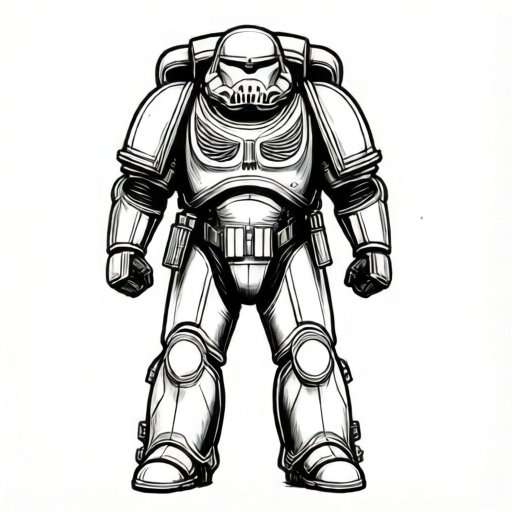
Use the stated measurements and conventions for each exercise.
Armor Piece Breakdown
A space marine figure reads clearly when the armor is divided into recognizable masses: helmet, torso (chest and abdomen), shoulder pauldrons, arms (upper and forearm), gauntlets, pelvis, thighs, greaves, and boots. Treat each mass as a simple 3D shape before adding surface detail. The helmet is roughly egg-shaped with a flat visor plane. The chest is a broad wedge that tapers to the waist. Pauldrons are large rounded caps that sit above the shoulder joint and extend outward. The backpack is a rectangular block behind the torso, slightly wider than the chest.
Proportion convention: one head unit (HU) equals the vertical height of the helmet, measured from crown to chin. The helmet midline sits 0.5 HU below the top of the head, so for an 8 HU figure the helmet midline is at 7.5 HU from the baseline. For a heroic armored figure, a total height of 7.5 to 8 HU is typical. Use 8 HU as a working example. The helmet occupies 1 HU, from 7 HU to 8 HU above the baseline. The shoulder line sits 1 HU below the helmet midline, at 6.5 HU, which is 0.5 HU below the chin. The torso from shoulder line to hip line is about 2.5 HU, placing the hip line at 4 HU. The legs from hip line to baseline are about 4 HU. These values are hypothetical examples; measure your own drawing to keep consistency.
- Draw a vertical center line and mark the total height as 8 equal HU segments.
- Place the helmet in the top segment, centered on the line.
- Mark the shoulder line 1 HU below the helmet midline (0.5 HU below the chin) and the hip line 2.5 HU below the shoulder line.
- Block the chest as a wedge from shoulder line to a point 1.5 HU down, then the abdomen as a narrower box to the hip line.
- Add pauldrons as rounded caps centered on each shoulder point, extending 0.5 HU outward.
- Block upper arms and forearms as tapered cylinders, then gauntlets as boxes.
- Block the pelvis, thighs, greaves, and boots, keeping the leg length about 4 HU from hip to baseline.
Pose Construction from Gesture to Armor
Start with a gesture line that captures the action: a single curved line from the head through the spine to the supporting foot. For a ready stance, the gesture line leans slightly forward. Mark the supporting foot and the free foot placement before drawing any armor. Use simple joint circles at shoulders, elbows, hips, and knees to test the pose. Only after the skeleton reads clearly should you wrap the armor masses around it.
When posing armored figures, remember that rigid plates limit extreme bends. Keep elbow and knee angles moderate unless the pose demands otherwise. The pauldrons should follow the shoulder line, not float above it. The backpack stays aligned with the torso. Check that the figure's weight is over the supporting foot; a vertical line from the center of the chest should fall near the supporting ankle.
- Draw the gesture line and mark the head, chest center, hip center, and supporting foot.
- Place joint circles for shoulders, elbows, hips, and knees.
- Test the pose by checking balance: chest center over supporting ankle.
- Wrap the torso wedge around the spine, then add pelvis and legs.
- Add arms and pauldrons last, keeping them attached to the shoulder joints.
- Refine armor edges and add simple surface lines only after proportions read correctly.
Checking Proportions and Balance
Use a simple arithmetic check to keep proportions consistent. If your total height is 8 HU and each HU is 3 cm on your paper, then the total height is 24 cm, the helmet midline is at 22.5 cm from the baseline, the shoulder line at 19.5 cm, and the hip line at 12 cm. Measure these marks with a ruler and adjust before adding detail. For balance, draw a vertical line from the chest center; it should pass within 0.5 HU of the supporting ankle. These numerical values are hypothetical examples; measure your actual drawing and keep units consistent.
The rubric below allows valid alternatives. Armor can be bulky or sleek, and poses can be symmetrical or dynamic, as long as the proportion convention is applied consistently and the figure reads clearly.
- Measure total height and divide by 8 to find your HU in centimeters.
- Mark helmet midline, shoulder line, and hip line using the HU values.
- Check that leg length from hip to baseline is about 4 HU.
- Draw the balance line from chest center and compare to supporting ankle.
- Adjust joint circles and armor masses before refining details.
Worked example
Draw a space marine standing in a ready stance, total height 8 HU, with the right foot forward and the left foot back. Use a HU of 3 cm on your paper. Show the helmet, torso, pauldrons, arms, legs, and backpack.
Worked answer
Mark the baseline and a vertical center line. Measure 24 cm total height and divide into 8 segments of 3 cm. Place the helmet in the top segment, centered, so its midline is at 7.5 HU = 22.5 cm from the baseline. Mark the shoulder line 1 HU below the helmet midline at 6.5 HU = 19.5 cm, and the hip line 2.5 HU below the shoulder line at 4 HU = 12 cm. Block the chest as a wedge from 19.5 cm to 15 cm, then the abdomen to 12 cm. Add pauldrons centered on shoulder points at 19.5 cm, extending 1.5 cm outward. Draw the right leg forward with the knee at about 7.5 cm and the foot at baseline; draw the left leg back with the knee at about 9 cm and the foot at baseline. Add the backpack as a block behind the torso, slightly wider than the chest. Check balance: a vertical line from chest center falls near the right ankle. Refine armor edges and add simple surface lines.
Four practice exercises
Exercise 1
A space marine drawing has a total height of 8 HU and each HU is 4 cm. Where should the shoulder line and hip line be marked from the baseline?
Show answer and check
Shoulder line at 26 cm and hip line at 16 cm from the baseline.
Why: Helmet midline is at 8 HU minus 0.5 HU = 7.5 HU from baseline, which is 30 cm. Shoulder line is 1 HU below helmet midline: 30 cm minus 4 cm = 26 cm. Hip line is 2.5 HU below shoulder line: 26 cm minus 10 cm = 16 cm.
Check: Measure total height, divide by 8 to confirm HU, then subtract the HU values in order. Verify that leg length from hip to baseline is about 4 HU (16 cm).
Exercise 2
A figure is 7.5 HU tall with HU = 2 cm. The chest center is 9 cm from the left edge and the supporting ankle is 11 cm from the left edge. Is the pose balanced within 0.5 HU?
Show answer and check
No, the pose is not balanced. The difference is 2 cm, which exceeds 0.5 HU (1 cm).
Why: 0.5 HU equals 1 cm. The horizontal difference between chest center and supporting ankle is 11 cm minus 9 cm = 2 cm. Since 2 cm is greater than 1 cm, the balance check fails.
Check: Compute 0.5 HU in centimeters, then compare the horizontal distance between chest center and supporting ankle. If the distance is greater, adjust the pose.
Exercise 3
A space marine is drawn with a helmet of 1.2 HU and total height of 8 HU. The legs measure 3.5 HU from hip to baseline. Identify two proportion errors and state a fix for each.
Show answer and check
Error 1: helmet is too large (1.2 HU instead of about 1 HU). Fix: reduce helmet to 1 HU. Error 2: legs are too short (3.5 HU instead of about 4 HU). Fix: move hip line up or lengthen legs to about 4 HU.
Why: The convention sets helmet at about 1 HU and leg length at about 4 HU. Deviations of 0.2 HU and 0.5 HU are noticeable and should be corrected before adding detail.
Check: Measure helmet height and leg length in HU. Compare to the convention values and adjust the construction marks.
Exercise 4
Describe how to place pauldrons on a figure whose shoulder joints are 6 cm apart horizontally, with the left shoulder joint at 0 cm and the right shoulder joint at 6 cm from a left reference. The pauldrons should extend 0.5 HU outward, with HU = 3 cm. Give the horizontal positions of the outer edges relative to the same left reference.
Show answer and check
Each pauldron extends 1.5 cm outward from its shoulder joint. The left pauldron outer edge is at 0 cm minus 1.5 cm = -1.5 cm from the left reference, and the right pauldron outer edge is at 6 cm plus 1.5 cm = 7.5 cm from the same reference.
Why: 0.5 HU equals 1.5 cm. Pauldrons are centered on shoulder joints and extend outward by that amount. The outer edges are therefore 1.5 cm beyond each joint: 1.5 cm to the left of the left joint and 1.5 cm to the right of the right joint.
Check: Measure the horizontal distance from each shoulder joint to the pauldron outer edge and confirm it equals 0.5 HU in centimeters. Check that pauldrons overlap the upper arm mass slightly.
Common mistakes
- Making the helmet too large relative to the body. Keep the helmet within 1 HU and measure the total height first. If the helmet exceeds 1 HU, reduce it before drawing armor.
- Floating pauldrons that do not connect to the shoulder joint. Center each pauldron on the shoulder joint circle and overlap it slightly with the upper arm mass.
- Legs that are too short, making the figure look squat. Mark the hip line at 2.5 HU below the shoulder line and keep the leg length about 4 HU from hip to baseline.
- Pose that is off balance, with the chest center far from the supporting foot. Draw a vertical balance line from chest center and adjust the supporting foot or hip position until the line falls near the ankle.
Self-check rubric
- Total height is 7.5 to 8 HU and the helmet is about 1 HU.
- Shoulder line is about 1 HU below helmet midline and hip line about 2.5 HU below shoulder line.
- Leg length from hip to baseline is about 4 HU.
- Pauldrons are centered on shoulder joints and connect to the upper arms.
- Pose is balanced: chest center within 0.5 HU of supporting ankle.
- Armor masses are distinct and readable; surface detail does not obscure proportions.
- Valid alternatives: bulky or sleek armor, symmetrical or dynamic pose, as long as the convention is applied consistently.
Questions and answers
How many head units tall should a space marine be?
A heroic armored figure is typically 7.5 to 8 HU tall. Use 8 HU as a working example and measure your own drawing to keep consistency.
Do I need to draw the skeleton first?
Yes. A gesture line and joint circles help you test the pose and balance before wrapping armor masses around the figure.
Can I change the armor style?
Yes. The rubric allows bulky or sleek armor as long as the proportion convention is applied consistently and the figure reads clearly.
How do I check balance?
Draw a vertical line from the chest center. It should pass within 0.5 HU of the supporting ankle. Adjust the pose if it does not.