Free original lessons
Draw a Treehouse in Two-Point Perspective
This pack teaches you to draw a treehouse in two-point perspective. You will place two vanishing points on a horizon line, build the platform as a flat slab whose two edge families run to those points, and align the support posts vertically beneath the platform corners. The reference plate shows the finished construction; the worked example walks through the same steps; four practice tasks let you build, redraw, compose, and check your own plate.
Letter & A4
PDF & SVG
What two-point perspective means here
In two-point perspective, vertical edges stay vertical on the page, while the two horizontal edge families of a box-like form each converge to one of two vanishing points on a single horizon line. For a treehouse, the platform is the main box-like form: its long edges run to one vanishing point and its short edges run to the other.
The support posts are vertical members. Their top ends meet the platform underside at the platform corners, and their bottom ends sit lower on the page, still vertical. Because the posts are vertical, they do not converge to either vanishing point; they stay parallel to the page's vertical direction.
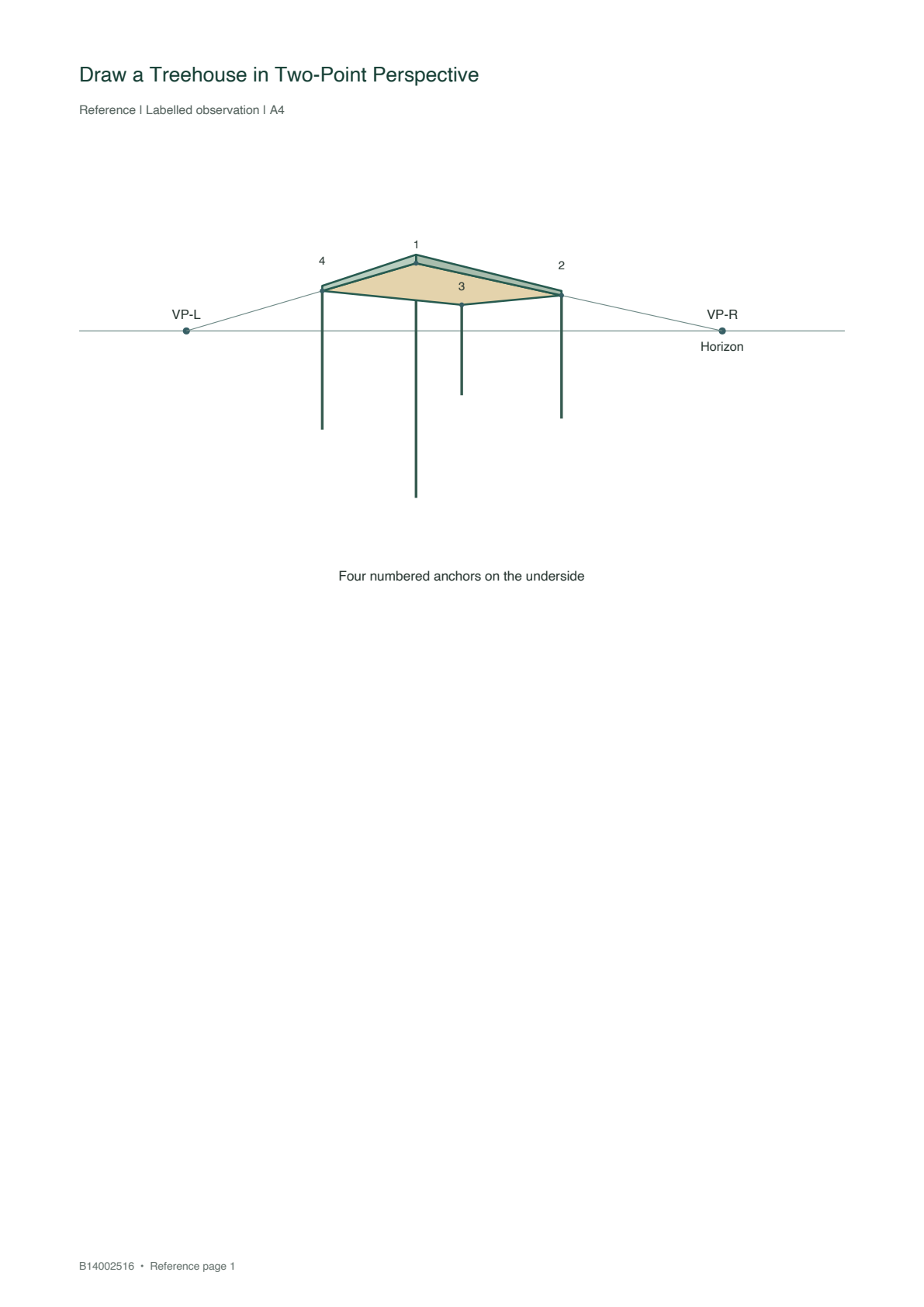
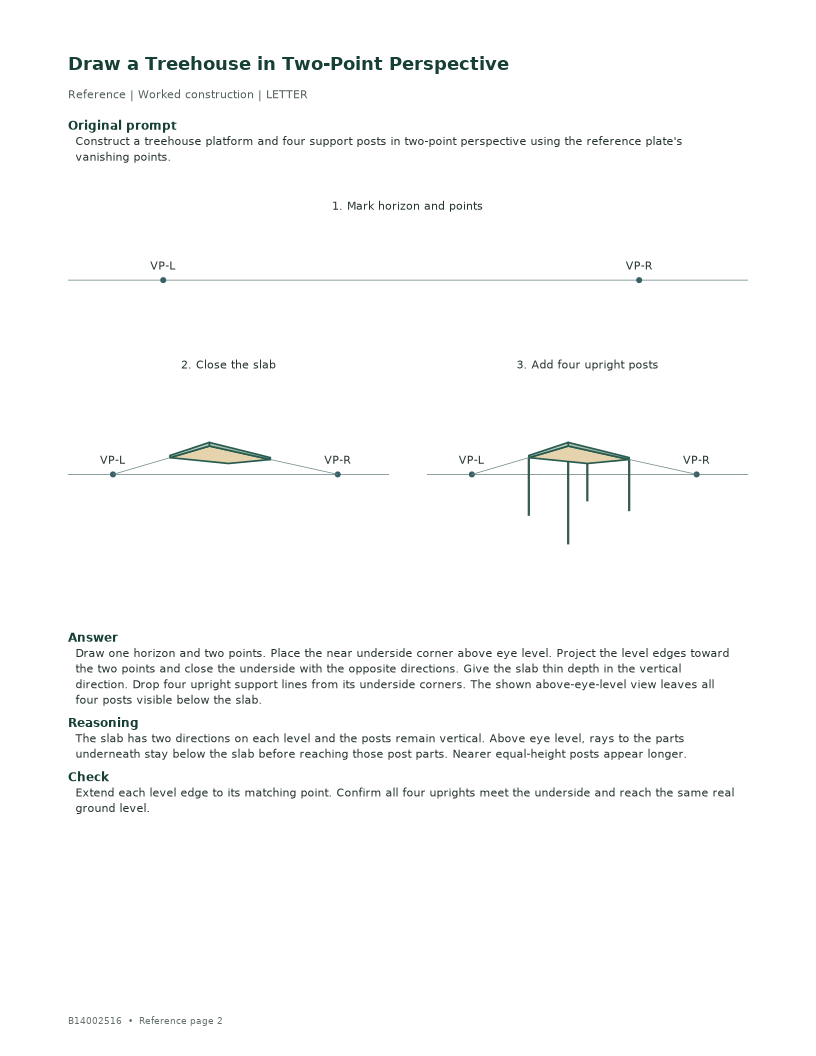
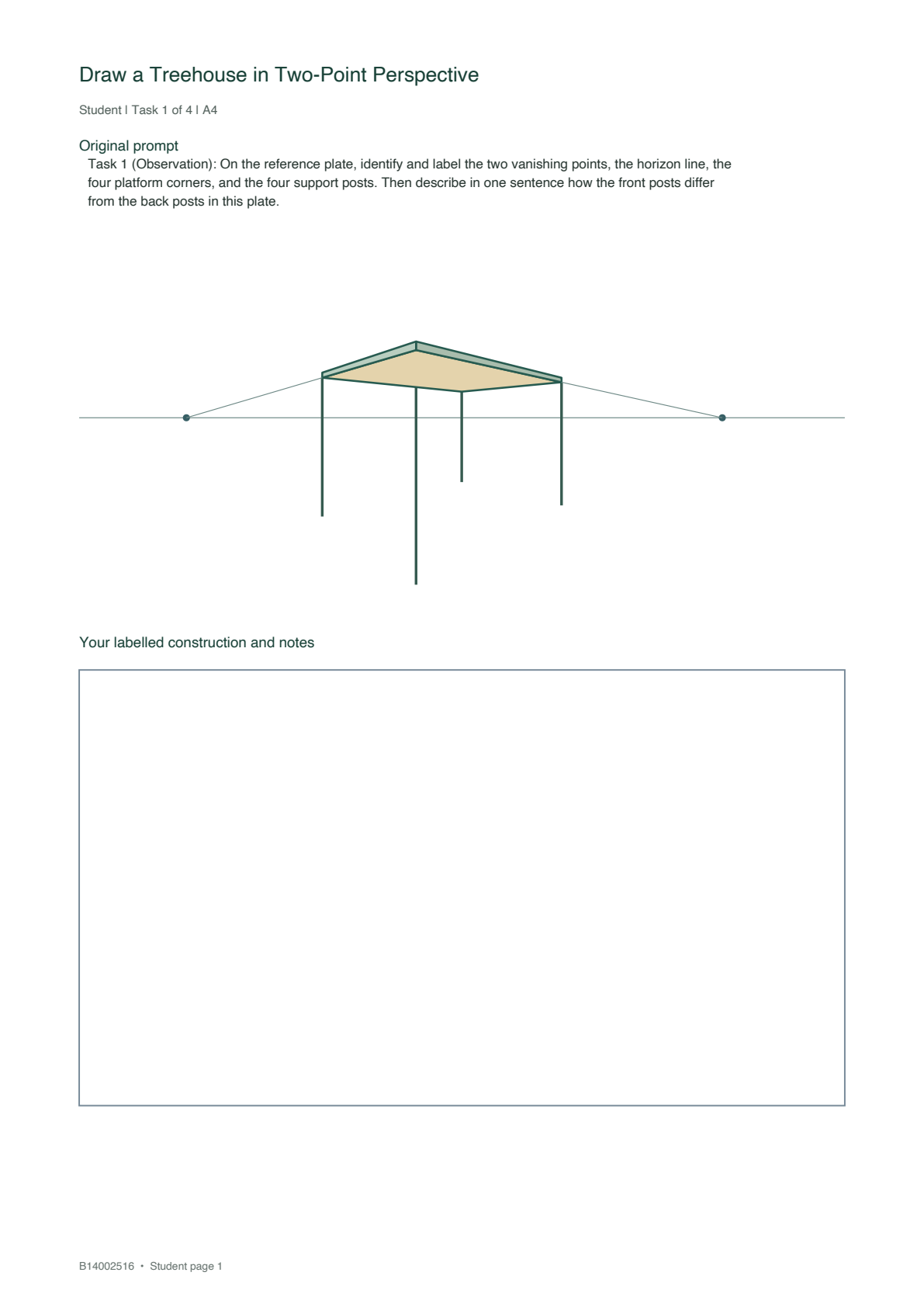
Reference plate: platform edges and post alignment
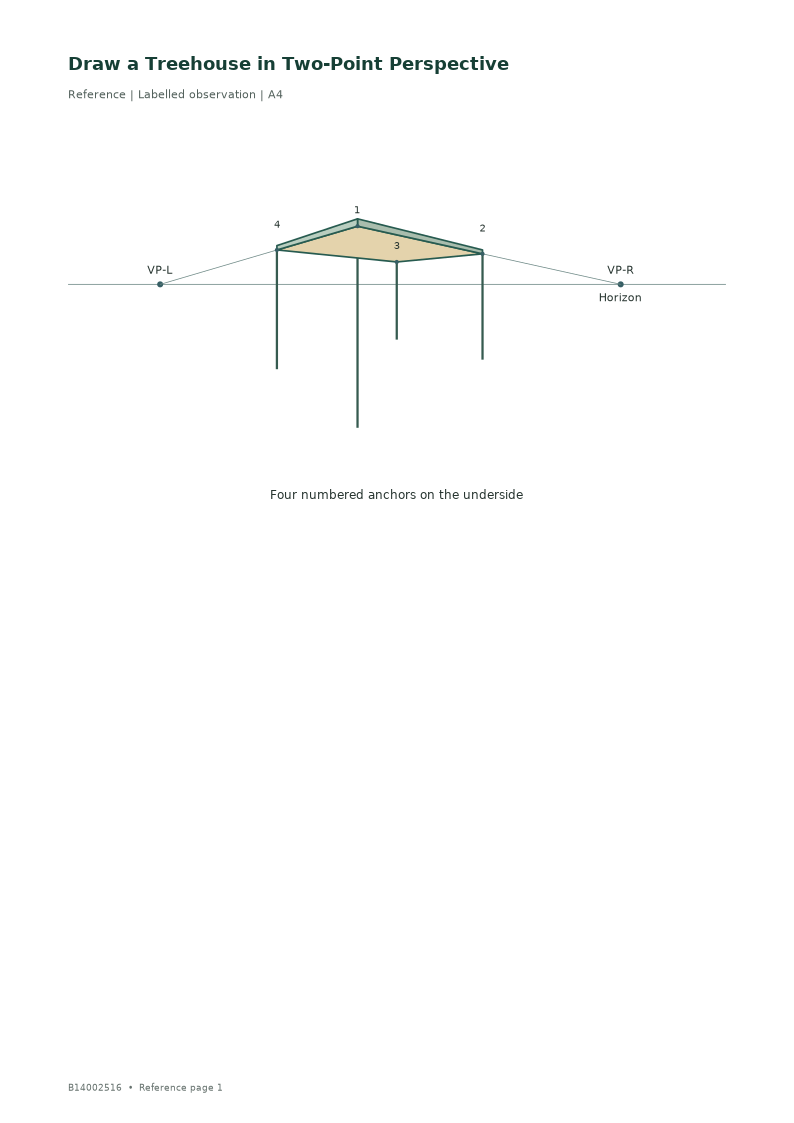
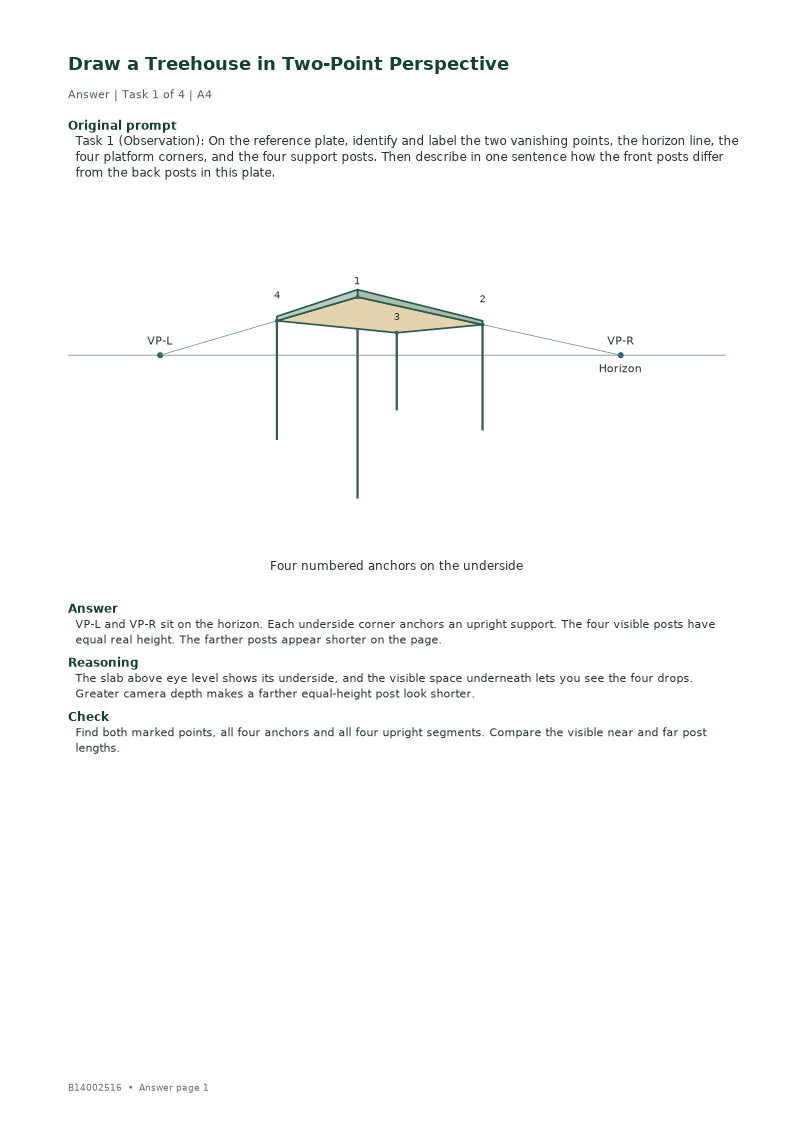
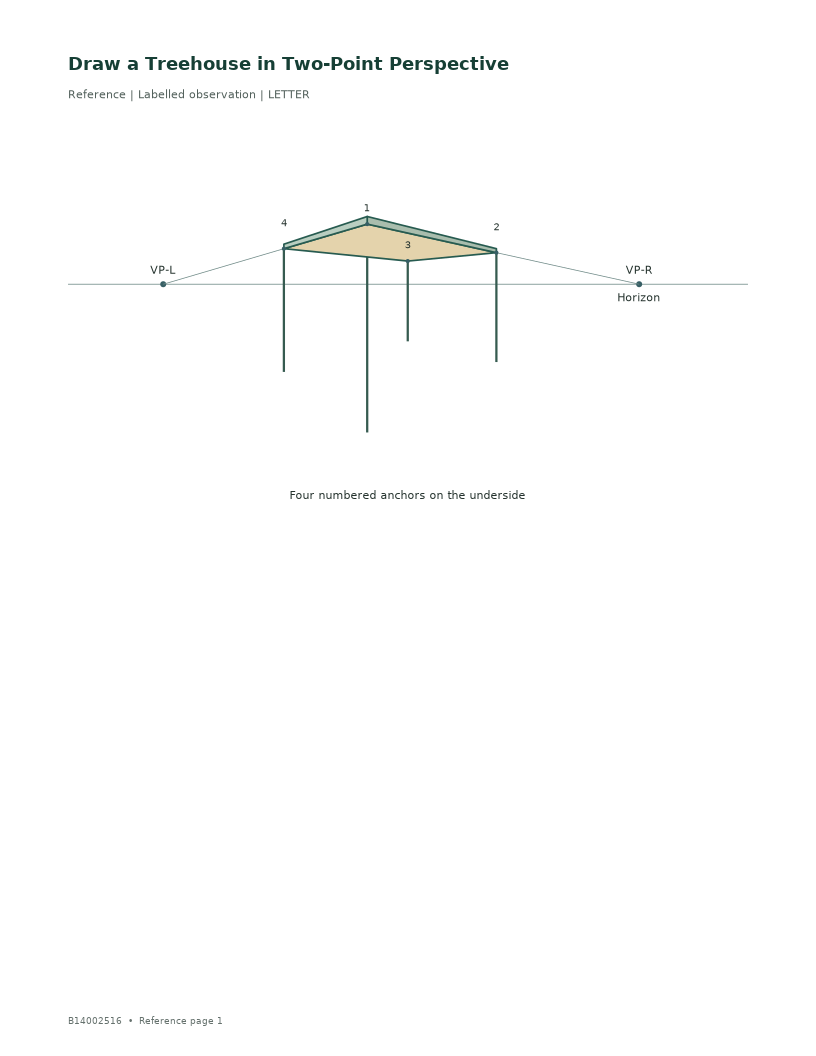
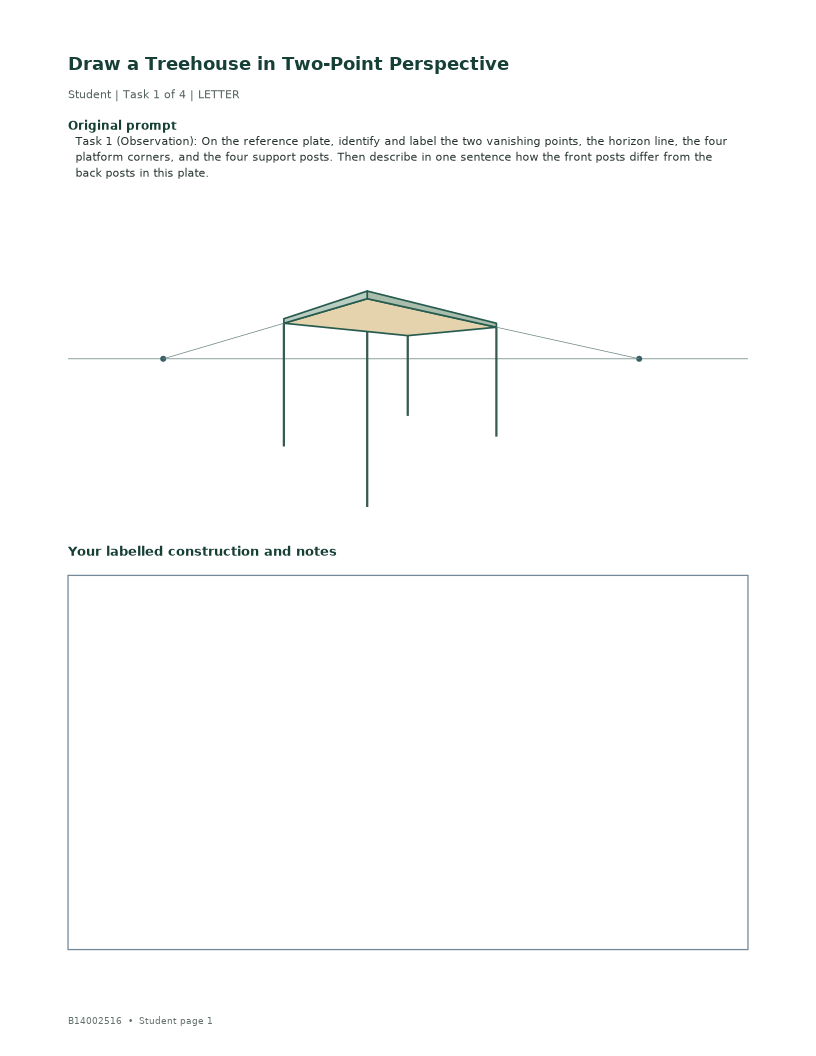
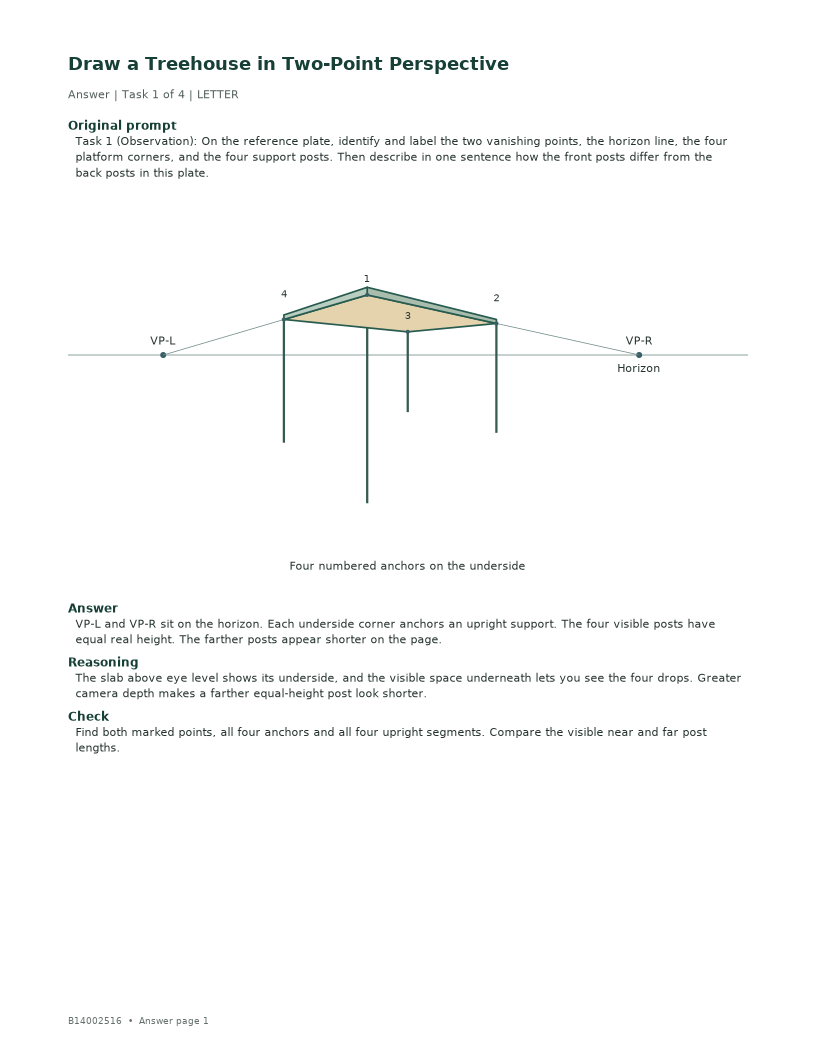
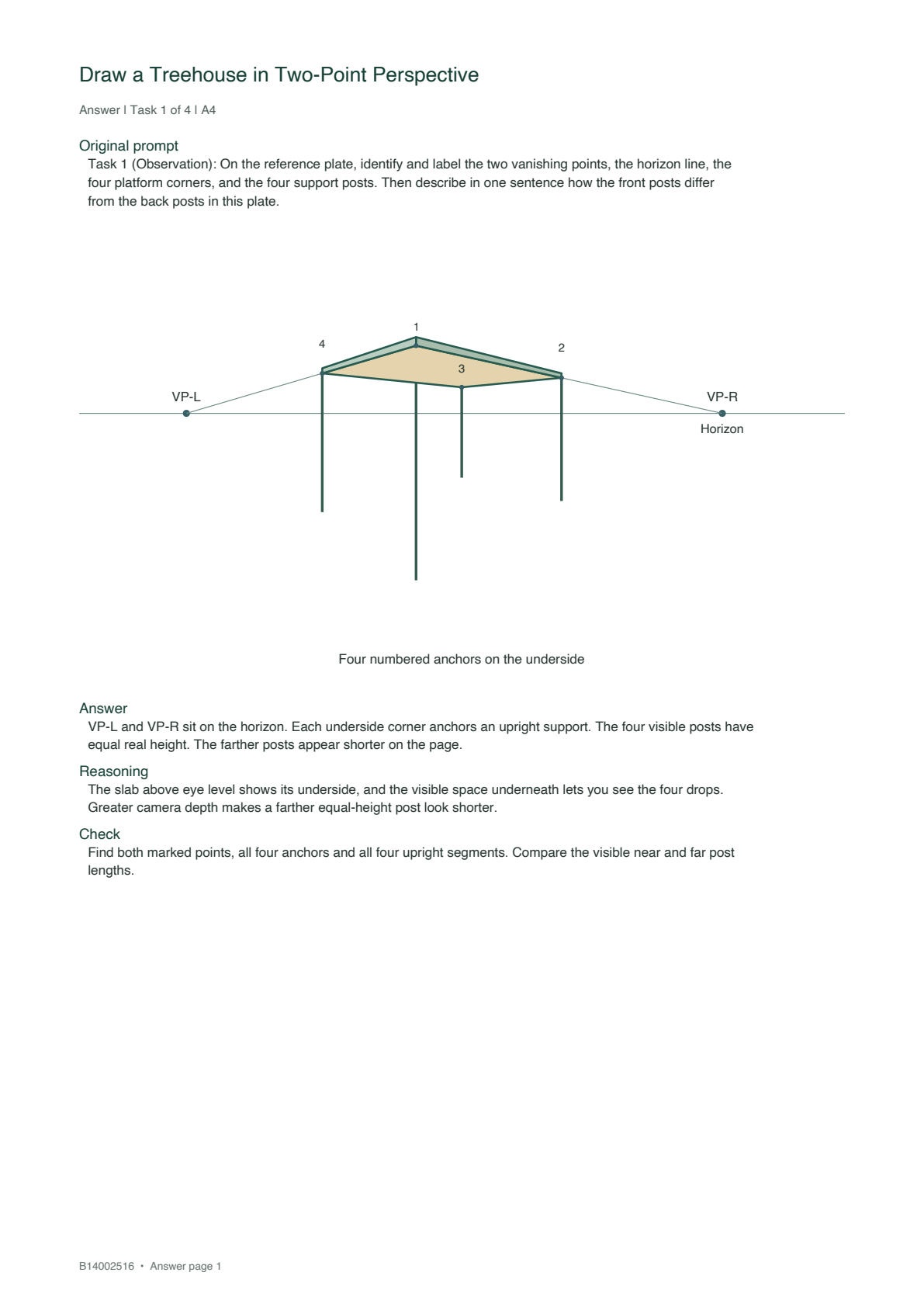
The reference marks VP-L and VP-R on one horizon. The slab's level edges form two pairs of directions. The four projected underside corners are the tops of the four upright posts.
The reference slab is above eye level, so its underside is visible. Each post starts under a corner and extends downward. This viewpoint leaves all four posts visible beneath the slab. The farther posts look shorter than the nearer ones even when their real heights match.
Worked example
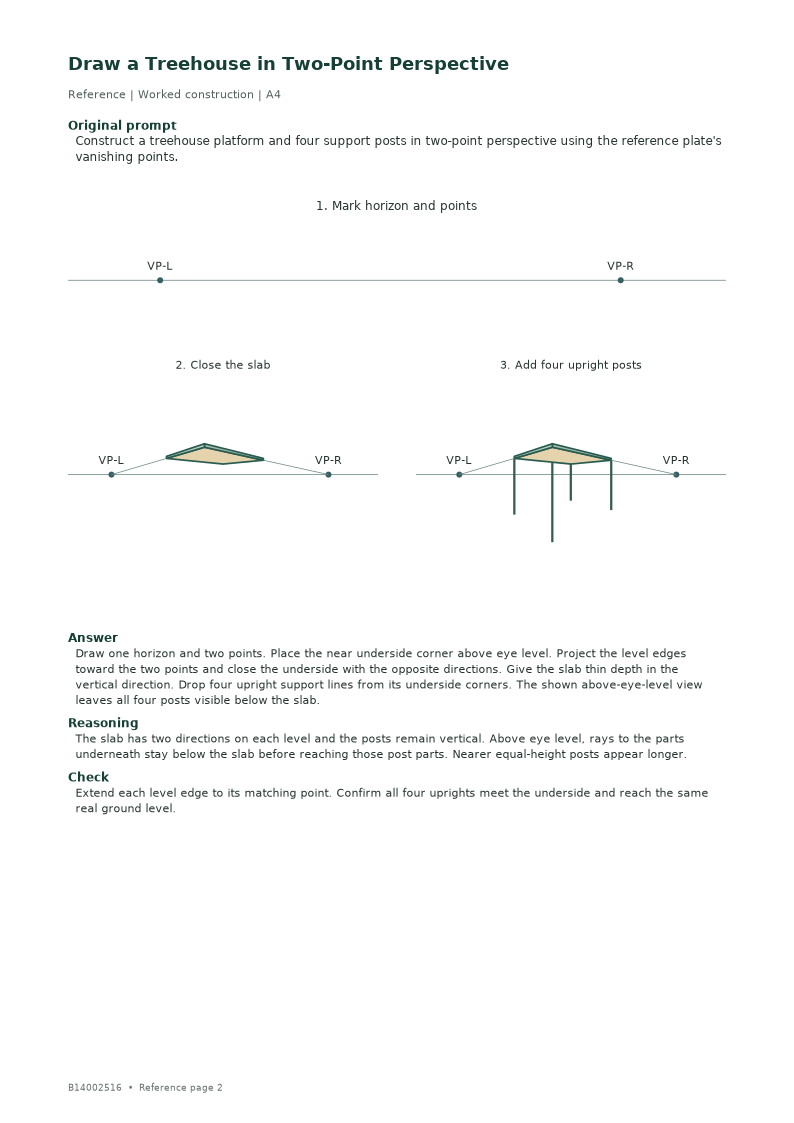
Step 1: Draw a horizontal horizon line across the middle of the page. Mark VP-L near the left edge and VP-R near the right edge. These are choices for this example, not a standard.
Step 2: Choose a platform front corner above the horizon. From that corner, draw one edge toward VP-L and one edge toward VP-R. These are the two front platform edges. Mark a chosen platform depth along each edge and close the back edges by drawing lines back to the opposite vanishing point. The result is a flat quadrilateral slab seen from below, because the platform sits above the horizon and we see its underside. This placement is a choice, not a rule about treehouses. The slab is the platform; its four corners are the post anchors. The two edge families are the platform edges that run to the two vanishing points. The platform corners are where those edges meet. The support posts are the vertical members under the platform. The post alignment is the vertical drop from each platform corner to the post bottom.
Download the complete resource pack
All individual SVG pages (20)
- A4 reference page 1
- A4 reference page 2
- A4 student page 1
- A4 student page 2
- A4 student page 3
- A4 student page 4
- A4 answer page 1
- A4 answer page 2
- A4 answer page 3
- A4 answer page 4
- LETTER reference page 1
- LETTER reference page 2
- LETTER student page 1
- LETTER student page 2
- LETTER student page 3
- LETTER student page 4
- LETTER answer page 1
- LETTER answer page 2
- LETTER answer page 3
- LETTER answer page 4
Print at 100% / actual size. Use the stated scale on any schematic diagram; physical cutting templates are identified separately. A4 and US Letter are separate files. Free access, no signup; CC BY 4.0.
How to use these pages
- What two-point perspective means here
- Reference plate: platform edges and post alignment
- Worked example
Worked example
Example: Construct a treehouse platform and four support posts in two-point perspective using the reference plate's vanishing points.
Answer: Draw one horizon and two points. Place the near underside corner above eye level. Project the level edges toward the two points and close the underside with the opposite directions. Give the slab thin depth in the vertical direction. Drop four upright support lines from its underside corners. The shown above-eye-level view leaves all four posts visible below the slab.
Reasoning: The slab has two directions on each level and the posts remain vertical. Above eye level, rays to the parts underneath stay below the slab before reaching those post parts. Nearer equal-height posts appear longer.
Check: Extend each level edge to its matching point. Confirm all four uprights meet the underside and reach the same real ground level.
Four practice tasks and complete answers
Task 1
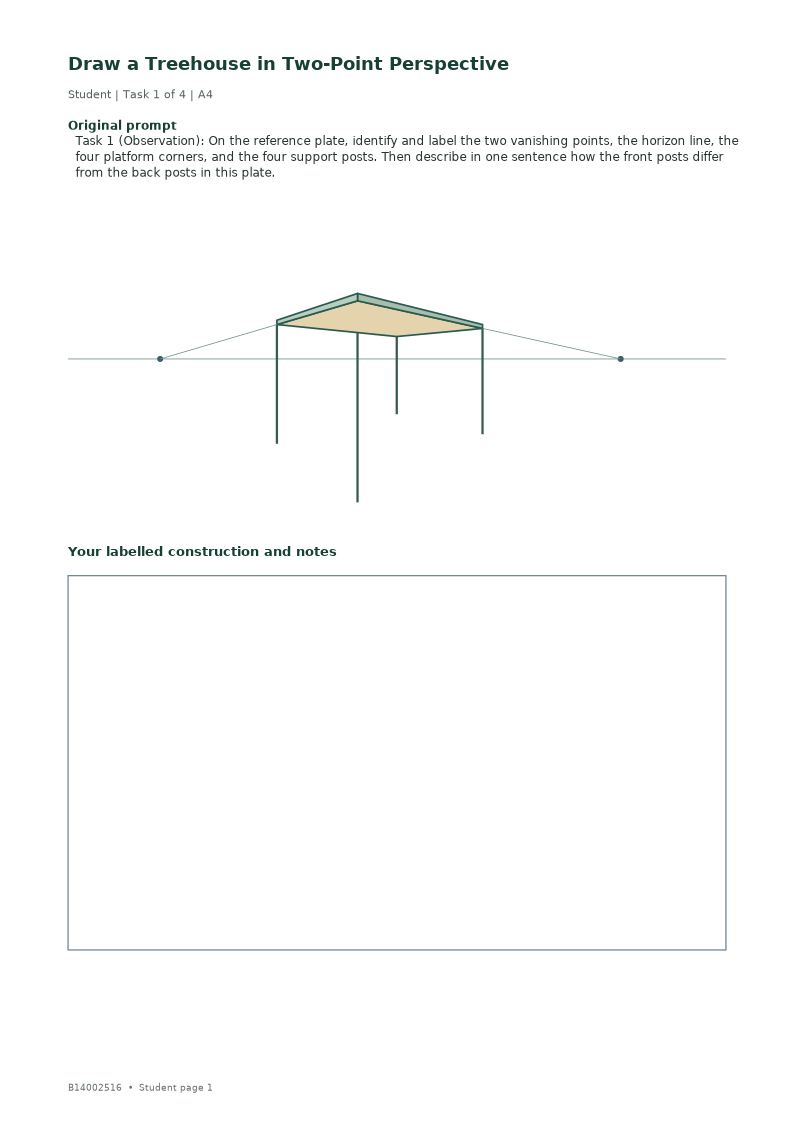
Task 1 (Observation): On the reference plate, identify and label the two vanishing points, the horizon line, the four platform corners, and the four support posts. Then describe in one sentence how the front posts differ from the back posts in this plate.
Show answer 1
VP-L and VP-R sit on the horizon. Each underside corner anchors an upright support. The four visible posts have equal real height. The farther posts appear shorter on the page.
The slab above eye level shows its underside, and the visible space underneath lets you see the four drops. Greater camera depth makes a farther equal-height post look shorter.
Check: Find both marked points, all four anchors and all four upright segments. Compare the visible near and far post lengths.
Task 2
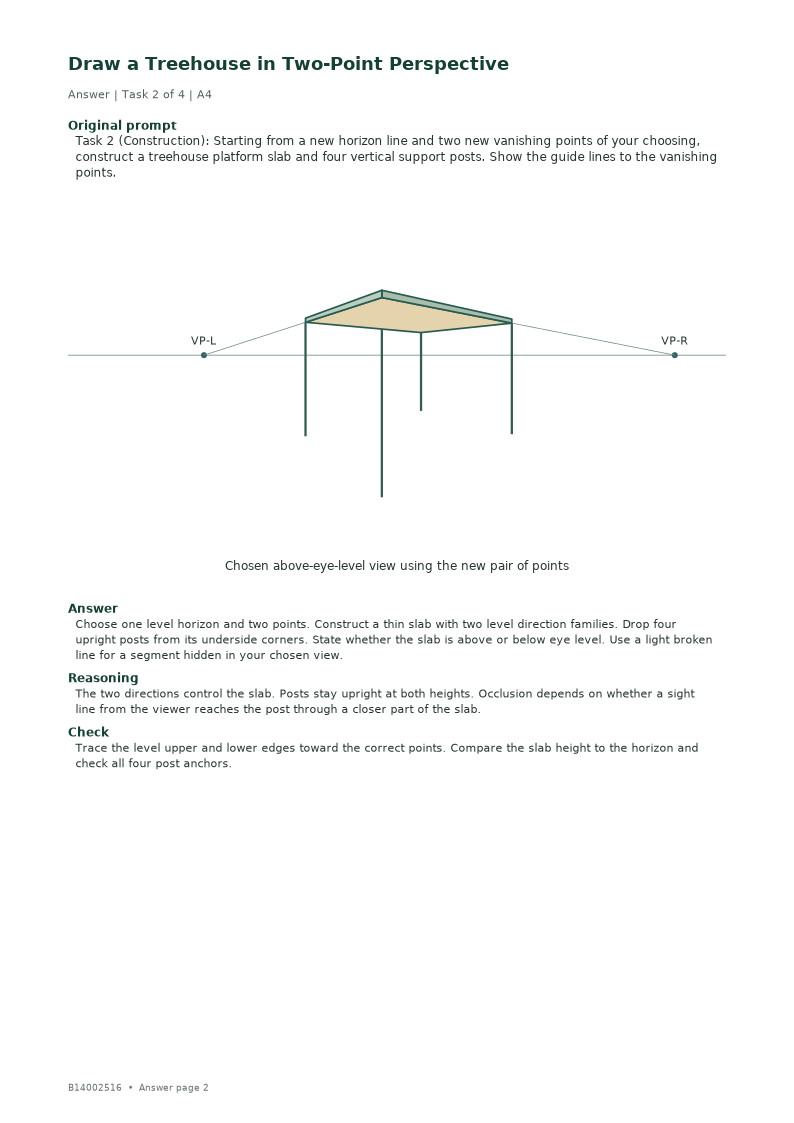
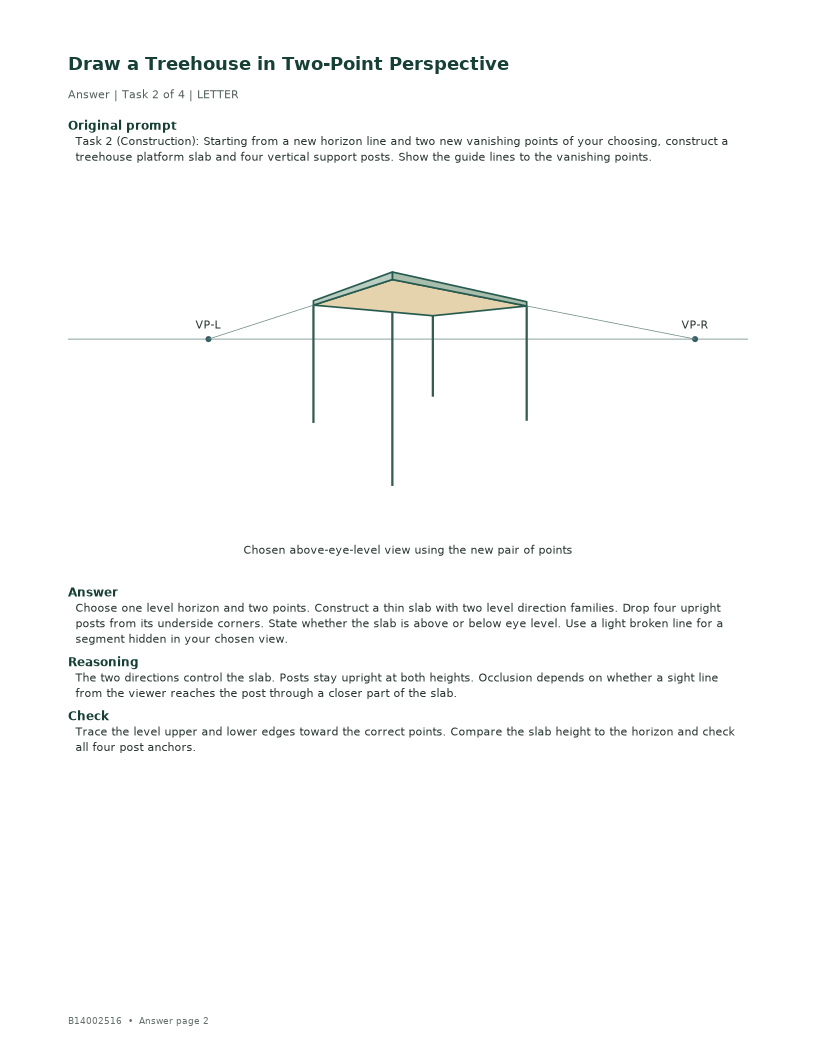
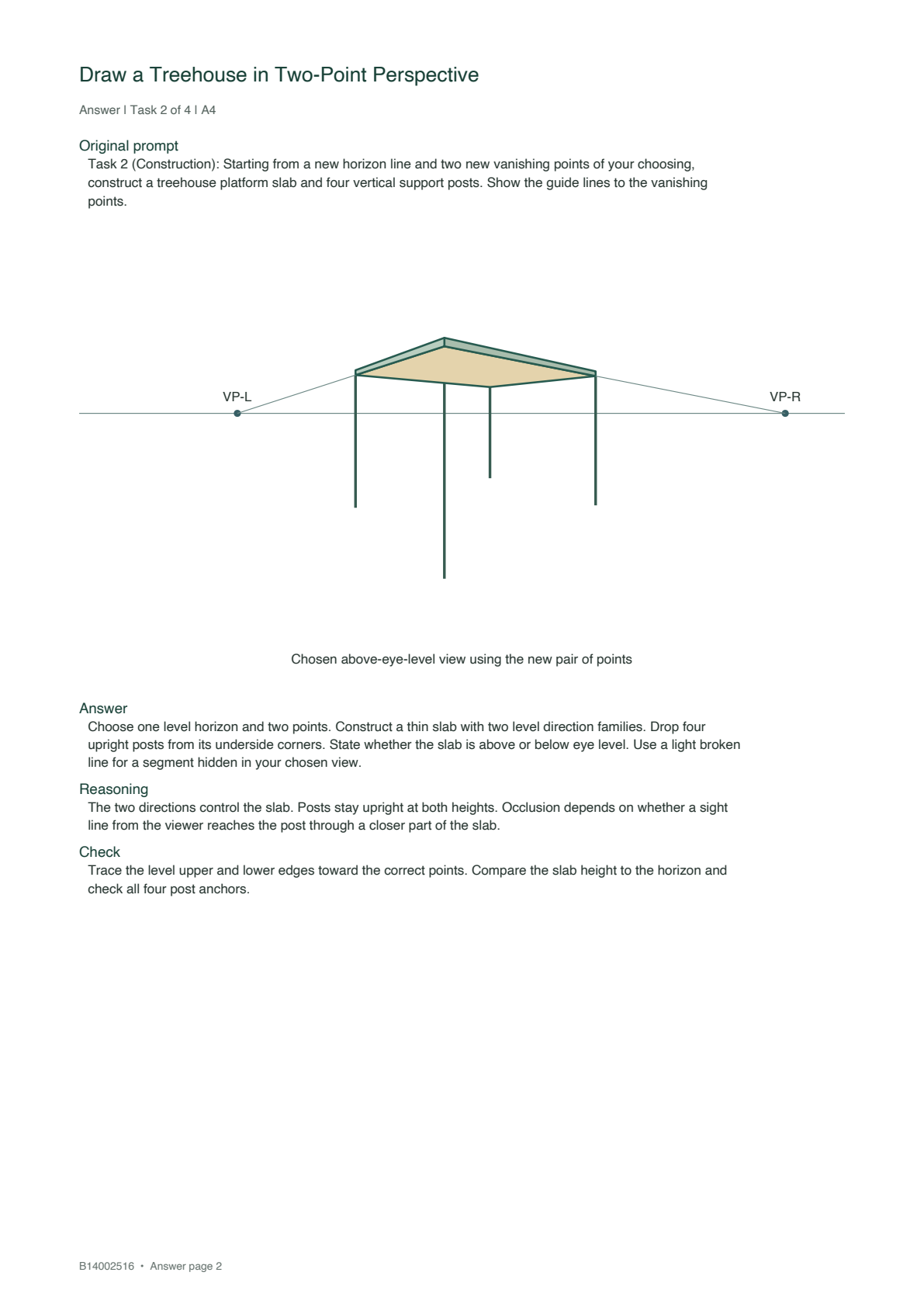
Task 2 (Construction): Starting from a new horizon line and two new vanishing points of your choosing, construct a treehouse platform slab and four vertical support posts. Show the guide lines to the vanishing points.
Show answer 2
Choose one level horizon and two points. Construct a thin slab with two level direction families. Drop four upright posts from its underside corners. State whether the slab is above or below eye level. Use a light broken line for a segment hidden in your chosen view.
The two directions control the slab. Posts stay upright at both heights. Occlusion depends on whether a sight line from the viewer reaches the post through a closer part of the slab.
Check: Trace the level upper and lower edges toward the correct points. Compare the slab height to the horizon and check all four post anchors.
Task 3
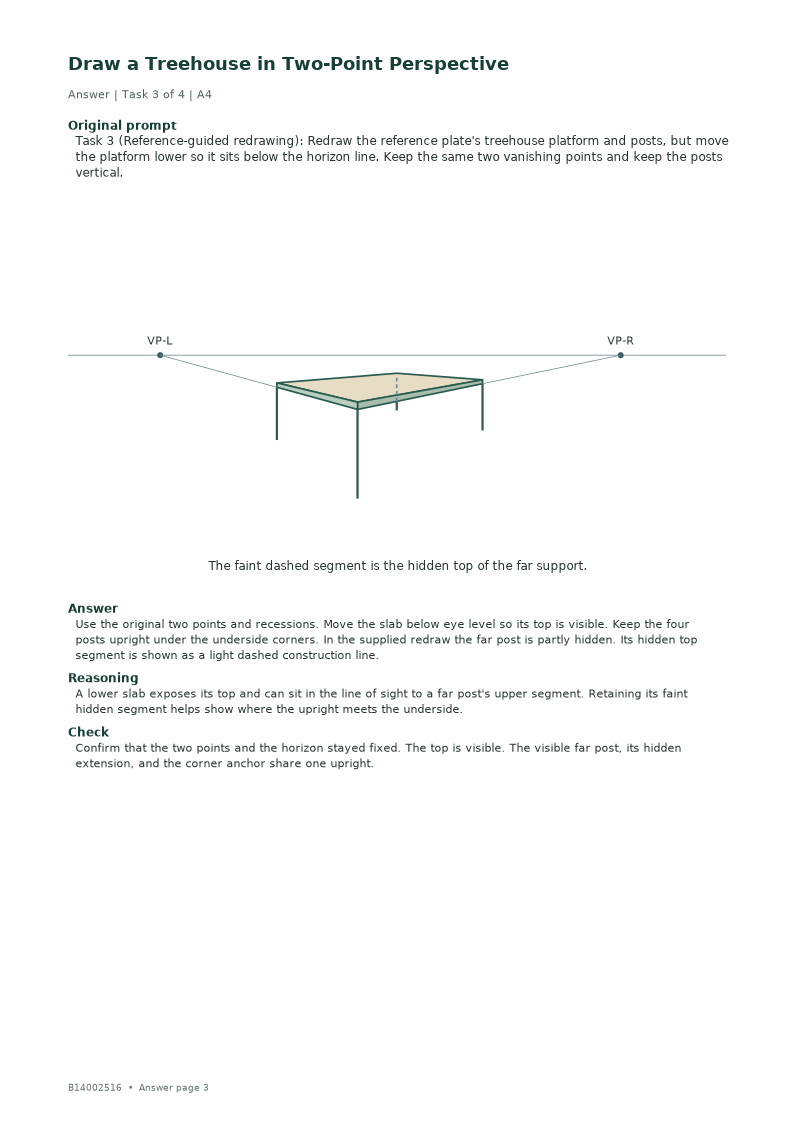
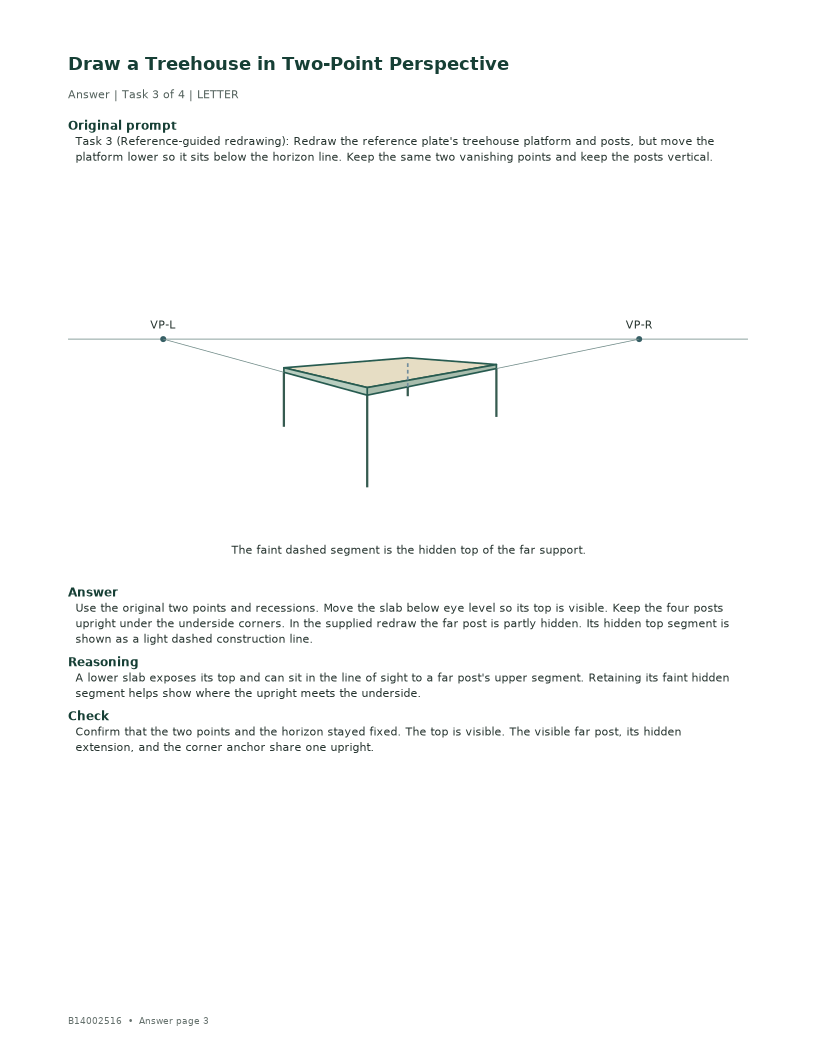
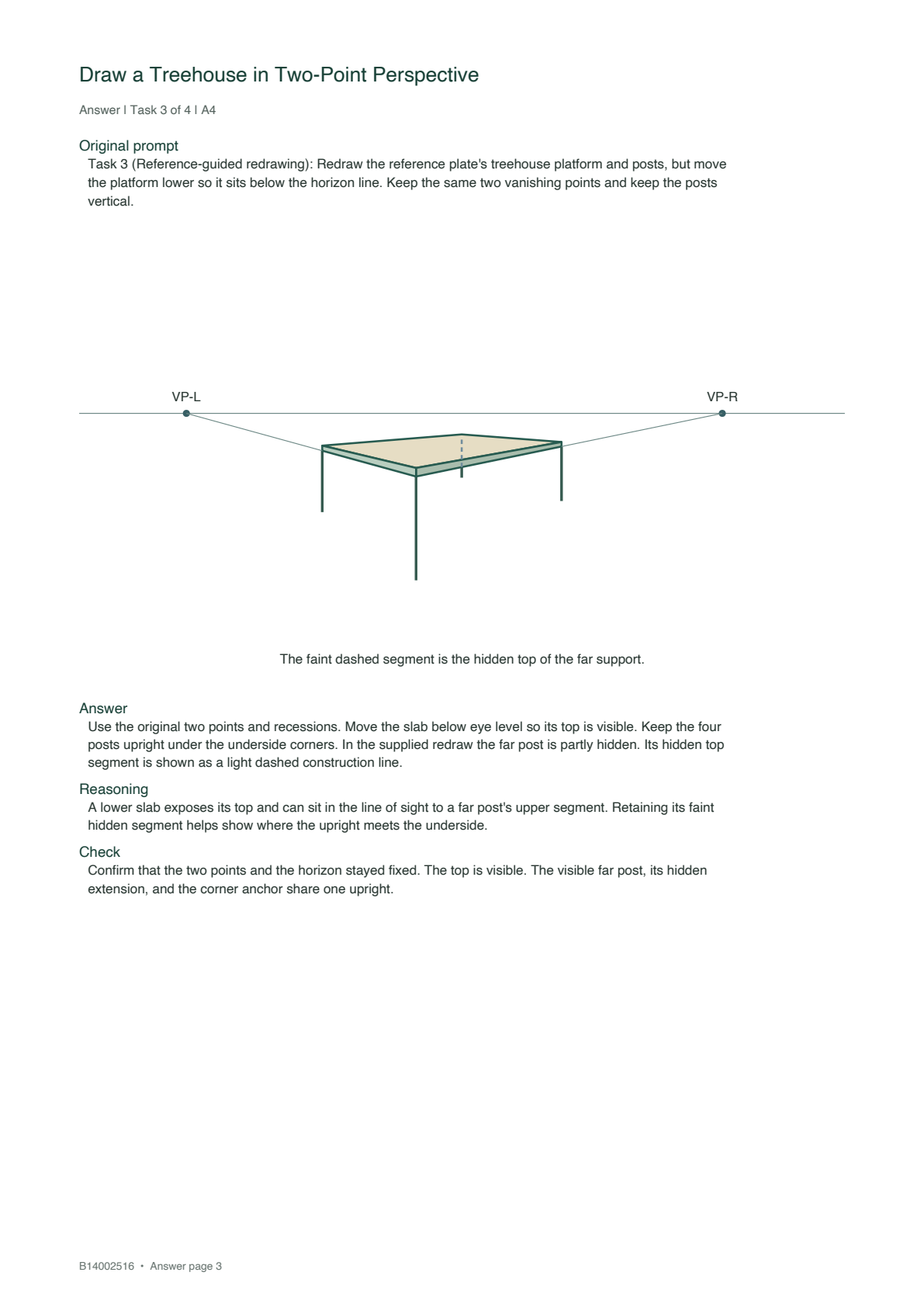
Task 3 (Reference-guided redrawing): Redraw the reference plate's treehouse platform and posts, but move the platform lower so it sits below the horizon line. Keep the same two vanishing points and keep the posts vertical.
Show answer 3
Use the original two points and recessions. Move the slab below eye level so its top is visible. Keep the four posts upright under the underside corners. In the supplied redraw the far post is partly hidden. Its hidden top segment is shown as a light dashed construction line.
A lower slab exposes its top and can sit in the line of sight to a far post's upper segment. Retaining its faint hidden segment helps show where the upright meets the underside.
Check: Confirm that the two points and the horizon stayed fixed. The top is visible. The visible far post, its hidden extension, and the corner anchor share one upright.
Task 4
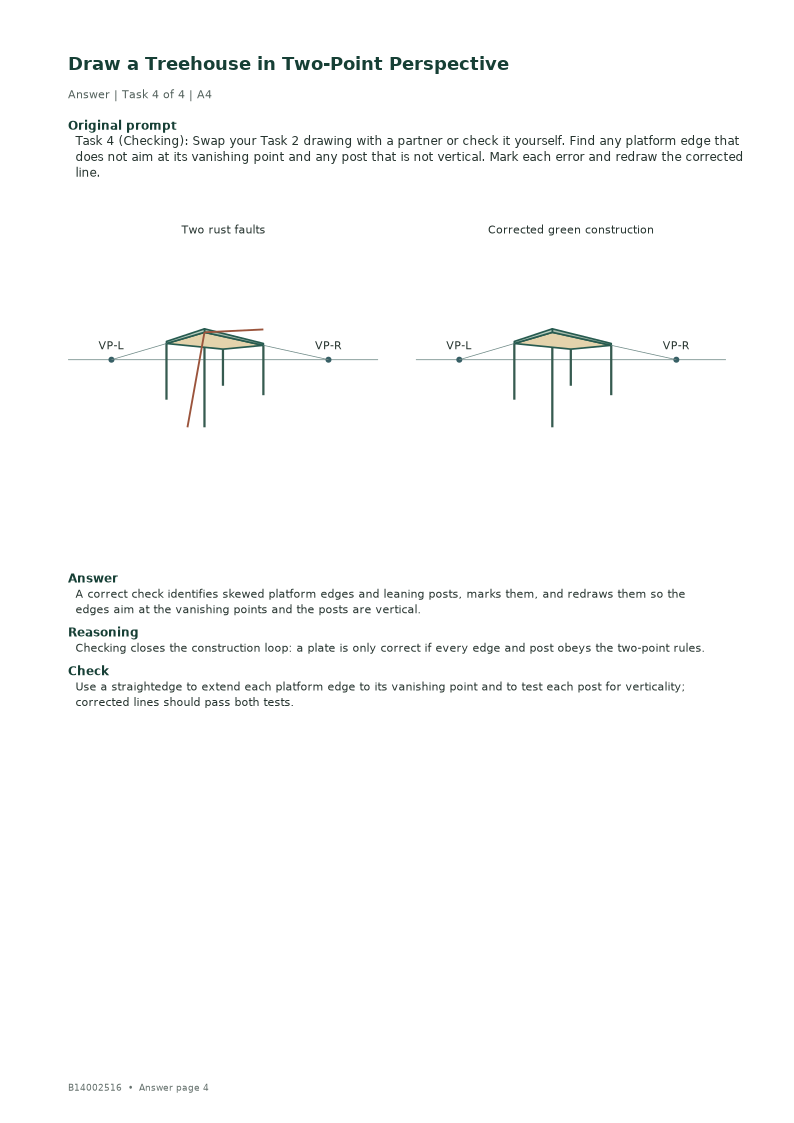
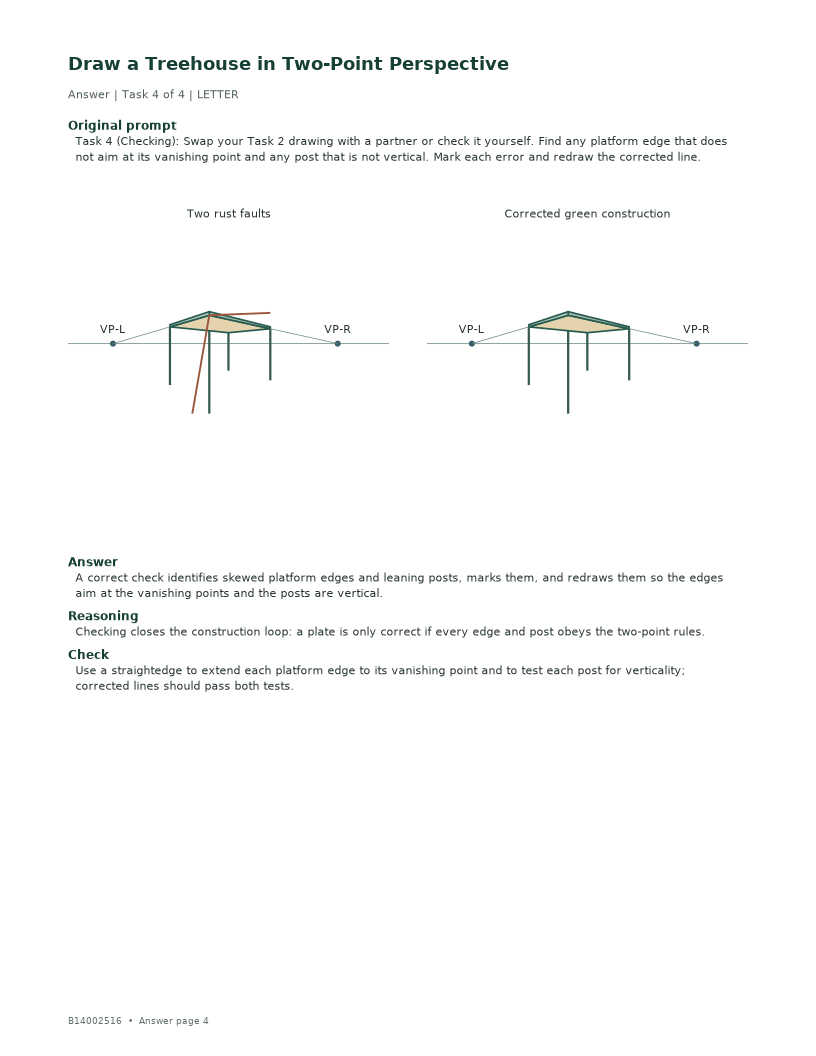
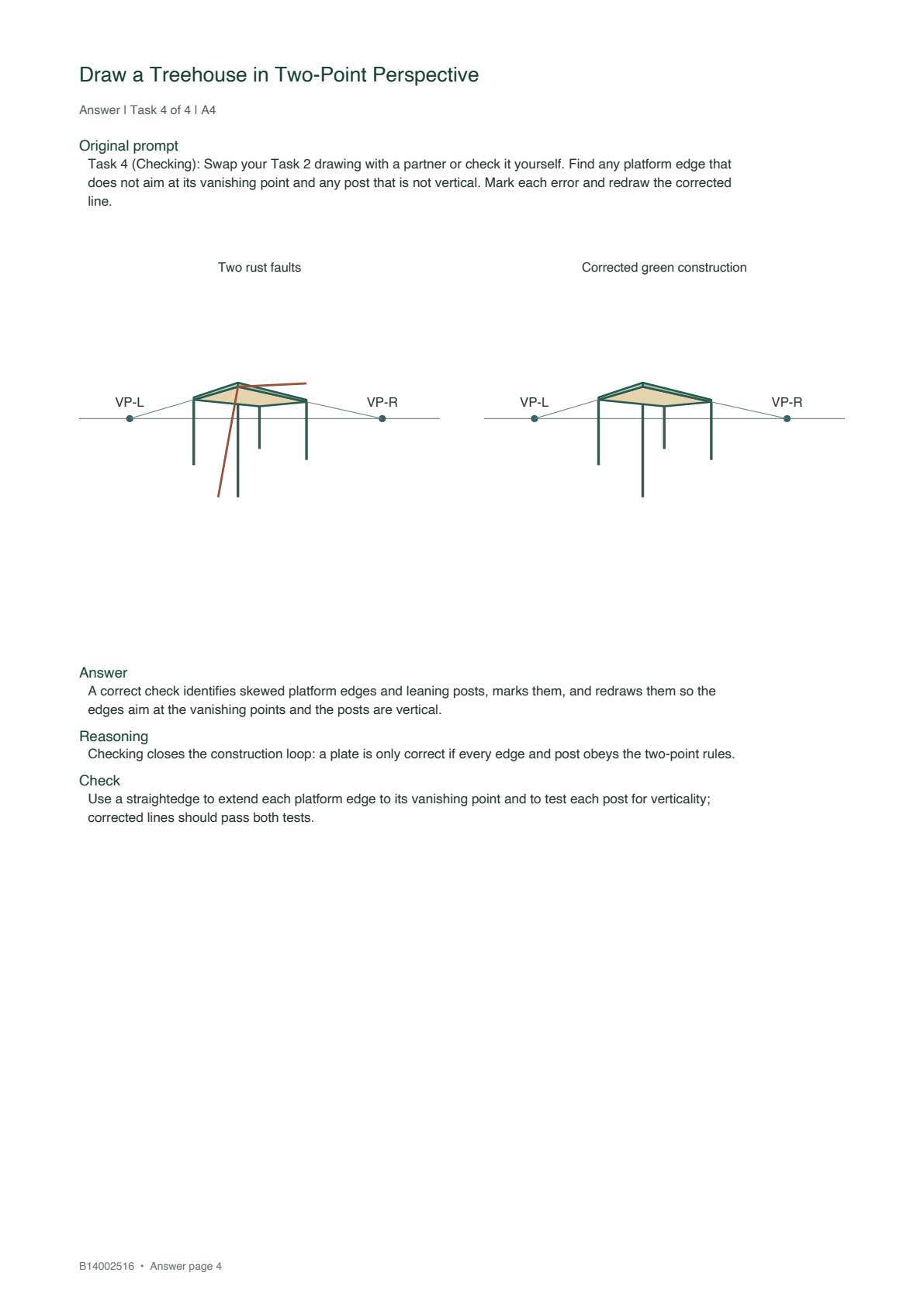
Task 4 (Checking): Swap your Task 2 drawing with a partner or check it yourself. Find any platform edge that does not aim at its vanishing point and any post that is not vertical. Mark each error and redraw the corrected line.
Show answer 4
A correct check identifies skewed platform edges and leaning posts, marks them, and redraws them so the edges aim at the vanishing points and the posts are vertical.
Checking closes the construction loop: a plate is only correct if every edge and post obeys the two-point rules.
Check: Use a straightedge to extend each platform edge to its vanishing point and to test each post for verticality; corrected lines should pass both tests.
Useful checks
- Drawing platform edges parallel on the page instead of converging to the vanishing points. Extend each edge with a straightedge until it meets its vanishing point; adjust the edge until it does.
- Drawing support posts that lean toward a vanishing point. Posts are vertical members; hold a vertical straightedge against each post and redraw it straight up and down.
- Anchoring posts away from the platform corners. Each post must start at a platform corner; move the post top to the corner before dropping the vertical line.
Questions about this resource
Do the support posts converge to a vanishing point?
No. In two-point perspective the posts are vertical, so they stay vertical on the page and do not converge to either vanishing point.
Can I choose where the vanishing points go?
Yes. The placement of the horizon line and the two vanishing points is a drawing choice; the construction rules then apply to whatever points you choose.