Free original lessons
Westie Drawing: Head Proportions, Erect Ears, and Wiry Coat Texture
Learn to draw a West Highland White Terrier with breed-specific head proportions, erect ear placement, and wiry coat texture using simple guides and checkable steps.
Free lesson
Four exercises
Worked answers
Object Drawing Lessons
This lesson focuses on the Westie's distinctive head and coat rather than generic dog anatomy. You will use a defined convention for x-height (baseline to midline) to judge head proportions, place erect ears relative to the skull, and build wiry texture with short, broken strokes. All measurements are relative to your own drawing, so the method works at any size. The practice tasks are self-contained and use simple arithmetic with consistent units. A worked example shows the full process before you try the four exercises.
Practice materials: Printable downloads are not available for this lesson yet. Use the instructions and four exercises below.
Reference illustration
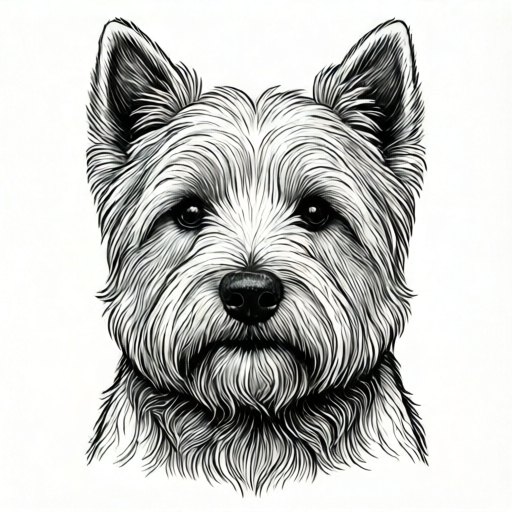
Use the stated measurements and conventions for each exercise.
Head Proportions Using X-Height
Define x-height as the distance from the baseline of the head (the bottom of the muzzle when viewed from the front) to the midline (an imaginary horizontal line through the middle of the skull). This is a drawing convention, not a breed standard. Letter styles vary, so treat x-height as a flexible unit: you can set it to any convenient length, such as 4 cm in a hypothetical example.
For a Westie head, the skull width is roughly one x-height (the baseline-to-midline distance), while the top of the skull sits above the midline. The muzzle projects forward from the lower half of the face. Use the x-height to check that the ears sit above the midline and that the eyes fall near the midline. Because the convention is relative, a head drawn with x-height 3 cm or 6 cm can both be valid if the internal ratios hold.
- Draw a light baseline and a midline separated by your chosen x-height.
- Sketch an oval skull whose width is about one x-height and whose top sits above the midline.
- Add a muzzle from the lower half of the oval, keeping its length about half an x-height.
- Mark eye positions just below the midline and check they are level.
Placing Erect Ears
Westie ears are small, erect, and set wide on the skull. Use the midline as a reference: the base of each ear should sit at or slightly above the midline, and the tips should rise above the top of the skull. The ears are triangular with rounded tips, not sharp points.
A common error is placing ears too close together or too low. Check by drawing a vertical line from each ear base down to the eye on the same side; the line should pass near the outer edge of the eye. This keeps the ears wide and balanced.
- Mark two ear-base points on the skull, each about one-quarter of the skull width from the outer edge.
- Draw a triangle from each base, angling the outer edge slightly outward.
- Round the tip and keep the inner edge shorter than the outer edge.
- Check that the ear tips are higher than the top of the skull oval.
Building Wiry Coat Texture
The Westie coat is double and wiry, so avoid smooth, continuous shading. Use short, broken strokes that change direction slightly. Work in layers: first a light base of strokes following the body contour, then a second layer at a different angle to suggest roughness.
Keep stroke length consistent within a region, for example 1 cm strokes on the head and 2 cm strokes on the body in a hypothetical example. Vary pressure rather than length to create depth. The face has shorter, tighter strokes around the muzzle and ears, while the body uses slightly longer strokes.
- Draw contour lines lightly to guide stroke direction.
- Add a first layer of short strokes following the contour.
- Add a second layer at a slight angle to the first.
- Leave small gaps so the coat looks broken rather than solid.
Profile Outline and Final Checks
A profile outline helps you check the head-to-body relationship. Draw a simple profile: forehead, stop (the dip between forehead and muzzle), muzzle, and neck. The stop should be slight, not deep. The neck is short and thick relative to the head.
Before finishing, check three things: the ears are erect and wide, the muzzle is about half an x-height, and the coat strokes are broken rather than smooth. If any check fails, adjust lightly rather than erasing heavily.
- Sketch the profile line from forehead to muzzle.
- Add the neck as a short, thick curve.
- Compare the profile to your front view for consistency.
- Run the three final checks and adjust.
Worked example
Draw a front-facing Westie head using x-height 4 cm (hypothetical). Show the baseline, midline, skull oval, muzzle, eyes, and erect ears. Then add a light layer of wiry coat strokes.
Worked answer
Set baseline at 0 cm and midline at 4 cm. Draw a skull oval about 4 cm wide with its top at 6 cm. Add a muzzle from 0 cm to 2 cm below the midline, length about 2 cm. Mark eyes just below the midline at 3.5 cm, level with each other. Place ear bases at 4.5 cm, each about 1 cm from the outer skull edge, and draw rounded triangles rising to 7 cm. Add short 1 cm strokes in two layers across the head, leaving gaps. Check: ears above midline, muzzle half x-height, eyes level, strokes broken.
Four practice exercises
Exercise 1
Using x-height 5 cm (hypothetical), calculate the recommended skull width and muzzle length, then state where the ear bases should sit relative to the midline.
Show answer and check
Skull width about 5 cm; muzzle length about 2.5 cm; ear bases at or slightly above the midline.
Why: Skull width equals one x-height (5 cm). Muzzle length is half an x-height (2.5 cm). Ear bases sit at or above the midline by convention.
Check: Verify each value against the definitions: width = x-height, muzzle = half x-height, ear base ≥ midline.
Exercise 2
A drawing has baseline at 0 cm and midline at 6 cm. The muzzle is drawn 4 cm long. Is this within the recommended proportion? Show the arithmetic.
Show answer and check
No. Recommended muzzle length is half of 6 cm, which is 3 cm. The drawn 4 cm is 1 cm too long.
Why: X-height is 6 cm. Half x-height is 3 cm. Compare 4 cm to 3 cm: difference is 1 cm.
Check: Subtract recommended from actual: 4 − 3 = 1 cm. If the difference is zero or near zero, the proportion is acceptable.
Exercise 3
Describe how to place two erect ears on a front-facing Westie head with skull width 8 cm (hypothetical). Give ear-base positions and a check.
Show answer and check
Place each ear base about 2 cm from the outer skull edge, at or above the midline. Draw rounded triangles rising above the skull. Check by dropping a vertical line from each base to the outer eye edge.
Why: One-quarter of skull width is 2 cm, which keeps ears wide-set. The vertical check ensures the ears are not too close together.
Check: Measure 2 cm from each outer edge and confirm the vertical line passes near the outer eye edge on the same side.
Exercise 4
You have drawn a coat with smooth continuous shading. List two changes to make it wiry and explain how to check the result.
Show answer and check
Replace smooth shading with short broken strokes, then add a second layer at a different angle with small gaps. Check by looking for visible breaks and varied stroke direction.
Why: Wiry texture depends on broken strokes and layering, not continuous tone. Two layers at different angles create roughness.
Check: Scan the coat for continuous lines; if found, break them. Confirm at least two stroke directions are visible.
Common mistakes
- Drawing ears too low or too close together. Place ear bases at or above the midline and check with a vertical line to the outer eye edge.
- Making the muzzle too long. Keep muzzle length about half an x-height and re-measure from baseline to midline.
- Using smooth, continuous shading for the coat. Switch to short, broken strokes in two layers at different angles.
- Treating x-height as a fixed universal measurement. Remember x-height is a relative convention; choose any convenient length and keep internal ratios consistent.
Self-check rubric
- Head width is approximately one x-height and the midline is clearly marked.
- Muzzle length is about half an x-height and projects from the lower half of the face.
- Ears are erect, wide-set, triangular with rounded tips, and rise above the skull.
- Eyes are level and sit near the midline.
- Coat texture uses short, broken strokes in at least two layers.
- Profile outline is consistent with the front view.
- Valid alternatives are accepted if internal ratios and checks hold, even when x-height differs.
Questions and answers
Do I need to use centimetres?
No. Any consistent unit works. The hypothetical centimetre values are examples only; the ratios matter more than the absolute numbers.
Can I draw the Westie facing sideways?
Yes. The same x-height convention applies: measure baseline to midline on the profile and keep the muzzle about half an x-height.
How do I know my coat texture is wiry enough?
Check that strokes are short, broken, and layered at different angles. If the shading looks smooth, add a second layer with gaps.
What if my ears look too sharp?
Round the tips slightly. Westie ears are triangular with rounded ends, not needle points.