Free original lessons
Pencil Drawing of a German Shepherd: Breed-Specific Head, Coat, and Stance
Learn to draw a German Shepherd with correct erect ears, sloped back, and coat direction using pencil proportion guides and stroke practice.
Free lesson
Four exercises
Worked answers
Object Drawing Lessons
German Shepherds have a distinctive silhouette: erect triangular ears, a long wedge-shaped head, a sloping backline from withers to croup, and a dense double coat that follows specific directional flows. This lesson breaks the breed into measurable parts so you can build a convincing pencil drawing from simple guides. You will use a consistent convention: x-height is measured from baseline to midline of lowercase letters, and all proportions are relative to the dog's own body, not to a universal standard. Letter styles vary, so treat written labels as flexible. Measure your actual paper and pencil, and label any numerical values as hypothetical examples. The goal is a breed-specific study, not a generic dog.
Practice materials: Printable downloads are not available for this lesson yet. Use the instructions and four exercises below.
Reference illustration
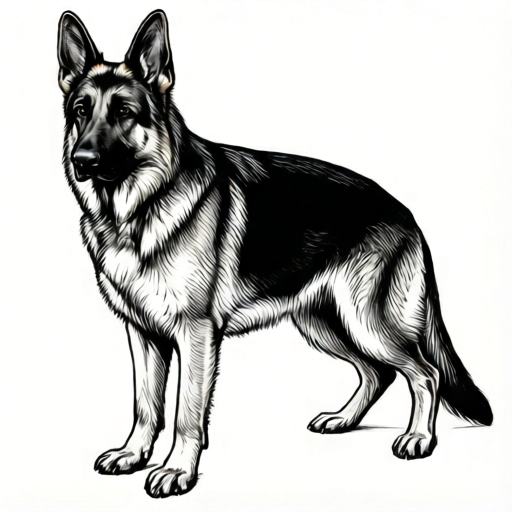
Use the stated measurements and conventions for each exercise.
Head and Ear Construction
Begin with a wedge: the muzzle is roughly half the length of the entire head from nose to occiput. The stop is moderate, not steep. Erect ears sit high on the skull, triangular with slightly rounded tips, and their inner edges are nearly parallel when viewed from the front. Use a light construction line from the nose through the stop to the crown, then place ear bases at about one ear-width apart.
The eye is almond-shaped and set obliquely. The nose leather is broad and black. Keep the cheek plane flat rather than bulging. For pencil work, establish the head as a box in perspective, then carve the wedge and ear triangles. Check that the ear height equals about one-third of the head length. If you draw a head length of 9 cm, one-third is 3 cm, so label a 3 cm ear height as a hypothetical example and adjust to your reference.
- Draw a horizontal line for the muzzle top and a shorter line for the skull top.
- Mark the nose tip, stop, and occiput; verify muzzle is about half the head length.
- Place two ear triangles with bases one ear-width apart; tips angle slightly outward.
- Refine the eye almond and nose leather, then erase construction lines lightly.
Body Stance and Sloped Back
The German Shepherd's backline slopes downward from the withers to the croup. This is a breed characteristic, not a sign of weakness. The chest is deep, reaching to the elbow. The front legs are straight and vertical when viewed from the side; the rear legs are angulated with a hock that sits well below the tail base. The tail is bushy and reaches the hock.
Use a side-view rectangle as a body box: length from chest to rump is about 1.2 times the height at the withers. Mark withers, croup, and tail base. The slope from withers to croup should be gentle, roughly one unit drop for every four units of horizontal run, where the run is measured only from the withers to the croup, not the full chest-to-rump length. Label these as hypothetical proportions and adjust to your reference. Note that the croup sits lower than the withers by about one-quarter of the withers height; this is a separate vertical measurement from the slope ratio, so keep the two checks distinct.
- Draw a body box and mark withers height and body length.
- Place croup lower than withers by about one-quarter of the withers height.
- Add front leg verticals from elbow to ground; add rear leg angles with hock below tail base.
- Sketch the tail curve reaching the hock, then check the slope line.
Coat Direction and Pencil Strokes
The double coat has a harsh outer layer and soft undercoat. Pencil strokes should follow hair flow: short strokes on the face and ears, longer directional strokes on the neck ruff, back, and tail. On the back, strokes run from withers toward the tail; on the chest, downward and slightly outward; on the legs, downward. Avoid cross-hatching that contradicts flow.
Use a sharp pencil for fine ear hair and a duller point for body mass. Build tone in layers: light pressure for undercoat, firmer strokes for guard hairs. The convention for x-height is baseline to midline; use this only for labeling your practice plate, not for the dog's anatomy. Letter styles vary, so treat written labels as flexible.
- Map flow arrows on the body: neck to chest, withers to tail, leg downward.
- Practice 20 short strokes per zone on scrap paper before the final plate.
- Layer light undercoat tone first, then add guard-hair strokes.
- Check that no stroke crosses the flow direction by more than 30 degrees.
Pencil Practice Plate
Create a practice plate with four zones: head wedge, ear triangles, back slope, and coat flow. In each zone, draw three quick studies at different sizes. Use the same convention for labels: x-height from baseline to midline. Keep the plate free of finished rendering; it is a construction drill.
Measure your paper and pencil first. If you choose a 2 cm ear height, label it as a hypothetical example. Compare your plate to the breed traits: erect ears, sloped back, correct coat direction. Valid alternatives include slightly different ear tip roundness or tail curve, as long as the breed silhouette remains. For example, a head length of 6 cm gives a suggested ear height of about 2 cm, which is a hypothetical example you can scale to your paper.
- Divide the plate into four labeled zones.
- Draw three head wedges with ear triangles in zone one.
- Draw three back-slope lines with withers and croup marks in zone two.
- Add flow arrows and ten practice strokes per zone in zones three and four.
Worked example
A side-view German Shepherd sketch has withers height 10 cm and a horizontal distance from withers to croup of 8 cm. The croup is 2 cm lower than the withers. The head length is 6 cm. What is the muzzle length, and is the back slope within the suggested range? Also check the croup drop against the one-quarter-of-withers-height guide.
Worked answer
Muzzle length is about 3 cm (half of 6 cm). The slope drop is 2 cm over a withers-to-croup run of 8 cm, which is one unit drop per 4 units run. This matches the suggested one-per-four range, so the slope is a valid gentle breed slope. The one-quarter guide gives 10 divided by 4, which is 2.5 cm; the 2 cm drop is slightly less than that, so it is a gentle slope within a reasonable range.
Four practice exercises
Exercise 1
A head study has total head length 8 cm. The muzzle is drawn 5 cm long. Is this within the breed proportion guide? Give the corrected muzzle length.
Show answer and check
No. The muzzle should be about half the head length, so 4 cm. The drawn 5 cm is too long by 1 cm.
Why: The guide states muzzle is roughly half of nose-to-occiput length. Half of 8 cm is 4 cm. Compare 5 cm to 4 cm.
Check: Measure the muzzle line and the full head line on your drawing; divide head length by two and compare.
Exercise 2
A side-view body box has a horizontal distance from withers to croup of 12 cm. The croup is marked 3 cm below the withers. Calculate the slope drop per horizontal unit and state whether it is steeper than one unit per four units. Separately, if the withers height is 12 cm, is the croup drop consistent with the one-quarter-of-withers-height guide?
Show answer and check
Drop per unit is 3 divided by 12, which is 0.25 units per unit, or one per four. This equals the suggested ratio, so it is not steeper than one per four. The one-quarter guide gives 12 divided by 4, which is 3 cm, so the 3 cm croup drop also matches that check.
Why: Slope ratio is vertical drop divided by the withers-to-croup horizontal run. 3/12 equals 0.25. One per four is also 0.25, so the slope matches the guide. The croup-drop guide is withers height divided by four: 12/4 equals 3 cm, matching the marked drop.
Check: Measure the drop from withers to croup and the horizontal distance from withers to croup (not the full body length); divide drop by run and compare to 0.25. Then measure withers height, divide by four, and compare to the croup drop.
Exercise 3
You draw ten coat strokes on the back. Six run from withers toward tail, three run sideways, and one runs upward. Using the 30-degree flow rule, how many strokes violate the rule?
Show answer and check
Four strokes violate the rule: the three sideways and one upward. Only the six withers-to-tail strokes follow the back flow.
Why: Back flow runs from withers toward tail. Sideways and upward strokes exceed 30 degrees from that direction.
Check: Draw a flow arrow on the back; for each stroke, estimate its angle to the arrow and count those over 30 degrees.
Exercise 4
An ear triangle has height 2 cm and base 1.5 cm. The head length is 7 cm. Is the ear height within the one-third guide? What is the suggested ear height range if you allow plus or minus 0.5 cm? Also state whether the 1.5 cm base is consistent with the one-ear-width spacing guide when the ear height is about 2 cm.
Show answer and check
One-third of 7 cm is about 2.3 cm. The 2 cm ear is within 0.3 cm of that, so it is acceptable. With plus or minus 0.5 cm, the range is about 1.8 to 2.8 cm. The base of 1.5 cm is close to the ear height of 2 cm, so it is consistent with the one-ear-width spacing guide within a reasonable range.
Why: Divide head length by three: 7/3 is about 2.33. Compare 2 cm to 2.33 cm. Add and subtract 0.5 cm for the range. The base spacing guide says bases are about one ear-width apart; with an ear height near 2 cm, a 1.5 cm base is close enough to be a valid alternative.
Check: Measure ear height and head length; compute head length divided by three; check the difference is within 0.5 cm. Then compare the ear base width to the ear height and confirm they are close, allowing for valid variation.
Common mistakes
- Drawing upright, vertical ears that are too round or too small. Use triangular ears with slightly rounded tips, height about one-third of head length, bases one ear-width apart.
- Making the back flat or sloping upward toward the croup. Mark withers higher than croup; use a gentle downward slope of about one unit drop per four units run.
- Using cross-hatching that ignores coat flow. Map flow arrows first; keep strokes within 30 degrees of the flow direction.
- Treating the muzzle as equal to the skull length. Check that muzzle is about half the total head length from nose to occiput.
Self-check rubric
- Ears are erect, triangular, with slightly rounded tips and bases about one ear-width apart.
- Muzzle length is approximately half the total head length.
- Backline slopes gently downward from withers to croup; croup is lower than withers.
- Coat strokes follow mapped flow directions within 30 degrees.
- Practice plate includes four labeled zones and three studies per zone.
- Labels use the defined x-height convention; valid alternatives in ear tip roundness, tail curve, and ear base width are accepted.
Questions and answers
Is the sloped back a health problem?
The slope is a breed characteristic. Draw it as a gentle line from withers to croup, not an extreme curve. Consult breed references for variation.
How do I know my ear proportions are correct?
Measure ear height against head length. If ear height is about one-third of head length and bases are one ear-width apart, the construction is within a valid range.
Can I use a different pencil grade?
Yes. Use what you have. A sharp point helps fine ear hair; a duller point helps body mass. Adjust pressure rather than switching tools.
What does x-height mean here?
X-height is the distance from baseline to midline of lowercase letters. Use it only for labeling your practice plate; letter styles vary, so labels are flexible.