Free original lessons
Animal Paw Drawing: Compare Pad Shapes and Claw Placement
Learn to draw animal paws by comparing pad shapes and claw placement across paw types, with a convention-based rubric and four self-contained practice tasks.
Free lesson
Four exercises
Worked answers
Object Drawing Lessons
Drawing an animal paw well depends less on memorizing one perfect outline and more on noticing how pad shapes and claw placement change between paw types. This lesson teaches a comparison method: you will define a simple drawing convention, sketch pad outlines for two or three paw types side by side, mark where claws sit relative to each pad, and then redraw each paw in blank comparison boxes. The goal is not a single universal answer. Paw anatomy varies by species, breed, age, and posture, and lettering or handwriting style varies too. Instead, you will use an explicitly stated convention and a rubric that rewards accurate comparison, clear placement marks, and consistent scale. All measurements are simple and checkable, and any numerical values are hypothetical examples you can replace with measurements of your own paper and tools.
Practice materials: Printable downloads are not available for this lesson yet. Use the instructions and four exercises below.
Reference illustration
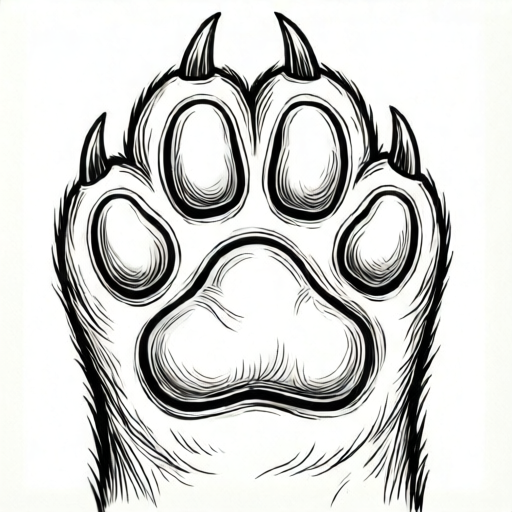
Use the stated measurements and conventions for each exercise.
Set a comparison convention before drawing
A comparison drawing only works if every paw is drawn under the same rules. Write a short convention at the top of your page: one unit equals one small grid square, each paw is drawn at the same overall width, and claws are marked as short lines extending from the pad edge rather than as full detailed claws. State that pad shapes are simplified to closed outlines and that fur is omitted. This keeps the comparison about pad shape and claw placement, not about shading or texture.
Choose two or three paw types that are clearly different in pad arrangement and claw visibility. Good comparison sets include a rounded four-toe pad with visible claws, a longer narrower pad with less visible claws, and a broad pad with widely spaced toes. You do not need to name a species if you are unsure; label them Paw A, Paw B, and Paw C and describe the visible features. The convention should also state how you will show claw placement: for example, a small dot at the pad edge plus a short line pointing outward, with the line length equal to half a grid square.
- Write the convention in three lines: scale, pad outline style, and claw mark style.
- Draw a light baseline and a midline for each paw so all paws share the same height reference.
- Label each paw type with a letter and one descriptive phrase, such as broad pad or narrow pad.
- Keep all claw marks the same length and direction rule so placement is comparable.
Compare pad shapes side by side
Draw each paw inside an equal-sized box. Start with the large central pad, then add the toe pads around it. Compare three things: the width-to-height ratio of the central pad, the number and spacing of toe pads, and the gap between the central pad and the toe pads. Use simple arithmetic to check consistency. If your box is 12 grid squares wide and the central pad is 6 squares wide, the pad occupies half the box width. If another paw's central pad is 4 squares wide in the same box, it occupies one third. These fractions make the comparison checkable without claiming any standard.
Pad shapes are often described as round, oval, triangular, or bean-shaped, but these are drawing labels, not biological rules. A valid alternative is to describe the pad as having a flat front edge and a curved back edge. The rubric accepts any clear outline that matches your stated convention and is consistently applied. Avoid inventing precise anatomical standards. If you measure your own printed reference or your own drawing, record the actual measurement and label any chosen number as a hypothetical example.
- Draw the central pad first and record its width and height in grid squares.
- Add toe pads one at a time, keeping spacing even within each paw.
- Write the width-to-height ratio beside each pad, using the same units.
- Check that every paw uses the same box size and baseline.
Mark claw placement relative to each pad
Claw placement is easier to compare when you mark it before drawing detailed claws. Use a small dot at the outer edge of each toe pad and a short line pointing away from the pad center. State whether claws are visible, partly visible, or hidden in your convention. For a paw with visible claws, place one mark per toe pad. For a paw with hidden claws, use a dashed mark or a small circle to show where a claw would sit if extended. This keeps the comparison honest without pretending to know exact anatomy.
Check placement with simple counting and spacing. If a paw has four toe pads and you place four claw marks, the count matches. If the marks are spaced evenly, the distance between neighboring marks should be roughly equal in grid squares. Record those distances. A useful check is to compare the total span of claw marks to the width of the central pad. For example, if the claw marks span 8 squares and the central pad is 4 squares wide, the span is twice the pad width. Label such numbers as hypothetical examples and replace them with your own measurements.
- Mark one claw position per toe pad, or use a dashed mark for hidden claws.
- Keep the mark length and direction rule identical across all paws.
- Count the marks and compare the count to the number of toe pads.
- Measure the span of marks and the central pad width in the same units.
Redraw each paw in blank comparison boxes
After the first comparison, use blank boxes to redraw each paw from memory or from your notes. The redraw should keep the same convention: same box size, same baseline, same claw mark style. This step tests whether your comparison is clear enough to reproduce. If a redraw changes the pad ratio or claw count, adjust the original notes rather than hiding the difference. The rubric rewards consistent, checkable comparison, not perfect realism.
Finish by writing a short comparison note under each box: one sentence about pad shape and one about claw placement. For example, Paw A has a round central pad occupying half the box width, with four visible claw marks spaced evenly. Paw B has a narrower oval pad occupying one third of the box width, with dashed marks for hidden claws. These sentences make your drawing easy to review and give the rubric concrete evidence.
- Redraw each paw in a blank box using the same convention.
- Compare the redraw to the first drawing and note any differences.
- Write one pad-shape sentence and one claw-placement sentence per paw.
- Check that all units, counts, and ratios are stated consistently.
Worked example
A learner draws two paws in equal 12-square-wide boxes. Paw A has a central pad 6 squares wide and 4 squares high, with four toe pads and four solid claw marks. Paw B has a central pad 4 squares wide and 5 squares high, with four toe pads and four dashed claw marks. Compare the pad width fractions and claw mark counts, and state one check.
Worked answer
Paw A's central pad occupies 6 out of 12 squares, or one half of the box width. Paw B's central pad occupies 4 out of 12 squares, or one third of the box width. Both paws have four toe pads and four claw marks, so the counts match. Paw A uses solid marks for visible claws and Paw B uses dashed marks for hidden claws, following the stated convention. Check: 6 divided by 12 equals 0.5, and 4 divided by 12 equals about 0.33, so Paw A's pad is wider relative to the box than Paw B's pad.
Four practice exercises
Exercise 1
Draw two paws in equal 10-square-wide boxes. Paw A has a central pad 5 squares wide and 3 squares high. Paw B has a central pad 4 squares wide and 4 squares high. Both have four toe pads. State the width fraction of each central pad and one check.
Show answer and check
Paw A's central pad occupies 5 out of 10 squares, or one half. Paw B's central pad occupies 4 out of 10 squares, or two fifths. Check: 5 divided by 10 equals 0.5, and 4 divided by 10 equals 0.4, so Paw A's pad is wider relative to the box.
Why: The width fraction compares pad width to box width using the same unit. Dividing each width by the box width gives a checkable decimal or fraction.
Check: Recount the grid squares for each pad and box, then divide pad width by box width and compare the two results.
Exercise 2
A paw has four toe pads. You place three solid claw marks and one dashed mark. Using the convention that solid means visible and dashed means hidden, how many visible and hidden claw positions are shown, and what count check applies?
Show answer and check
Three visible claw positions and one hidden claw position are shown. The total number of claw marks is four, which matches the four toe pads.
Why: Each toe pad should have one claw position under the stated convention. Solid and dashed marks distinguish visible from hidden without changing the count.
Check: Count the toe pads, count the solid marks, count the dashed marks, and confirm that solid plus dashed equals the toe pad count.
Exercise 3
Paw A's claw marks span 8 grid squares and its central pad is 4 squares wide. Paw B's claw marks span 6 grid squares and its central pad is 3 squares wide. Compare the span-to-pad-width ratio for each paw and state one check.
Show answer and check
Paw A has a ratio of 8 to 4, or 2 to 1. Paw B has a ratio of 6 to 3, or 2 to 1. Both ratios are equal. Check: 8 divided by 4 equals 2, and 6 divided by 3 equals 2.
Why: The ratio compares claw mark span to central pad width in the same unit. Equal ratios mean the claw span is twice the pad width in both paws.
Check: Measure both spans and both pad widths in grid squares, divide each span by its pad width, and compare the results.
Exercise 4
You draw three paws in equal 12-square-wide boxes. Paw A's central pad is 6 squares wide, Paw B's is 4 squares wide, and Paw C's is 3 squares wide. List the width fractions in order from largest to smallest and state one check.
Show answer and check
Paw A is 6 out of 12, or one half. Paw B is 4 out of 12, or one third. Paw C is 3 out of 12, or one quarter. Order: Paw A, Paw B, Paw C. Check: 0.5 is greater than about 0.33, which is greater than 0.25.
Why: Each fraction compares the same kind of pad width to the same box width, so the fractions can be ordered directly. Converting to decimals makes the order checkable.
Check: Divide each pad width by 12, write the decimals, and confirm the order from largest to smallest.
Common mistakes
- Drawing each paw at a different size, which makes pad shapes and claw spacing impossible to compare. Use equal-sized boxes and a shared baseline, and record pad width and height in the same grid-square units for every paw.
- Treating one paw type as the correct standard and marking others as wrong. State a drawing convention instead of a universal standard, and describe differences as comparisons rather than errors.
- Placing claw marks without a rule, so some marks are long and some are short. Define one claw mark length and direction rule before drawing, and apply it to every paw, including dashed marks for hidden claws.
- Inventing precise measurements or tolerances that were not measured. Measure your own paper or drawing, label chosen numbers as hypothetical examples, and keep arithmetic simple and checkable.
Self-check rubric
- Convention is stated clearly in three lines: scale, pad outline style, and claw mark style.
- Two or three paw types are drawn in equal-sized boxes with a shared baseline.
- Pad shapes are compared using at least one checkable ratio or measurement in consistent units.
- Claw placement marks follow one rule and the count matches the number of toe pads or stated hidden-claw marks.
- Comparison notes include one sentence on pad shape and one on claw placement per paw.
- Valid alternatives are accepted when they follow the stated convention and are applied consistently.
Questions and answers
Do I need to identify the exact animal for each paw?
No. You can label paws as Paw A, Paw B, and Paw C and describe visible features such as broad pad, narrow pad, visible claws, or hidden claws. The comparison method works without species identification.
What if my paw drawing does not look realistic?
The rubric rewards a clear convention, consistent scale, accurate comparison notes, and checkable claw placement. Realism is optional; a simplified outline that follows your stated rules can score well.
How do I show claws that are hidden?
Use a dashed mark or a small circle at the pad edge to show where a claw would sit if extended. State this rule in your convention so hidden and visible claws are compared fairly.
Can I use different units for different paws?
No. Use the same unit, such as one grid square, for every paw. If you measure in centimeters, convert all measurements to centimeters before comparing ratios.