Free original lessons
Angel Island Drawing: Shoreline, Hills and Bay Composition
Plan a clear Angel Island landscape drawing with shoreline, layered hills and bay. Use depth cues, a simple map guide and a checkable rubric.
Free lesson
Four exercises
Worked answers
Object Drawing Lessons
This lesson helps you draw a specific Angel Island scene: its shoreline, hills and bay. You will use a simple outline map and a layered composition guide to place land and water, then add depth cues so the island reads clearly. The drawing convention is explicitly defined: depth is shown by overlap, smaller distant hills, and lighter distant lines. All measurements are checkable and use consistent units. The printable resources are planned but not yet built; this text gives you everything needed to draw and check your work now.
Practice materials: Printable downloads are not available for this lesson yet. Use the instructions and four exercises below.
Reference illustration
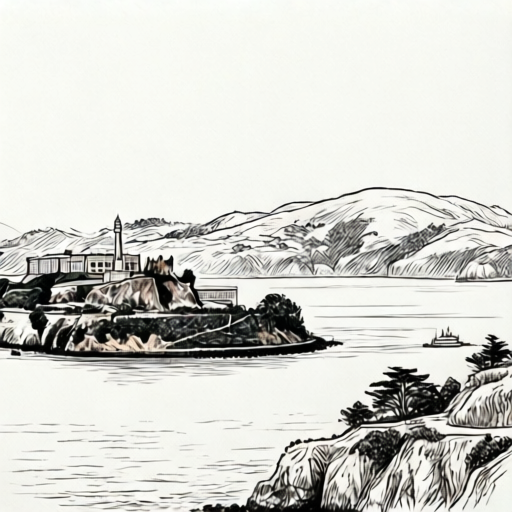
Use the stated measurements and conventions for each exercise.
Map the island and bay
Start with a light outline map of Angel Island. Mark the shoreline as a closed curve and the bay as the area outside it. Choose a view direction and note where the hills sit relative to the water. Keep the map simple: one island shape, one bay area, and a few hill ridges.
Use a consistent unit, such as centimetres, for any measurements you take from your own equipment. If you choose numerical values for spacing, label them as hypothetical examples. Measure your actual paper and pencil before relying on any number.
- Draw a light rectangle for the panel and label the top as the far distance.
- Sketch the island shoreline as a closed curve inside the panel, leaving bay space around it.
- Mark two or three hill ridges inside the island outline.
- Check that the shoreline does not touch the panel edge unless you intend a close crop.
Layer hills and bay for depth
Depth comes from overlap, size change and placement. Put the bay in the lower foreground, the shoreline in the middle, and the hills behind. Hills farther away should be smaller and higher in the panel. Use lighter lines for distant ridges and stronger lines for near shoreline.
Keep the horizon level consistent. A simple check is to draw a faint horizontal line and place the far hilltops near it, while near shoreline sits lower. This makes the bay read as foreground water.
- Draw the bay first as a broad area in the lower half.
- Add the shoreline as a clear boundary between bay and land.
- Place hill ridges behind the shoreline, overlapping slightly.
- Lighten distant hill lines and strengthen near shoreline lines.
Add shoreline detail and check composition
Add a few shoreline details such as small rocks or a gentle curve, but keep them simple. Avoid filling every space; leave calm bay areas. Check that the island shape is recognisable and that hills, shoreline and bay are all visible.
Use the rubric to review your drawing. Valid alternatives are allowed: hill shapes, shoreline curves and detail density may vary as long as the three elements read clearly and depth cues are present.
- Add two or three small shoreline marks.
- Leave at least one calm bay area without detail.
- Check overlap: hills behind shoreline, shoreline behind bay.
- Review against the rubric and adjust line strength if needed.
Worked example
A student draws a panel 20 cm wide and 15 cm high. They place the bay in the lower 6 cm, the shoreline at 7 cm from the bottom, and two hill ridges above that. Check whether the composition shows depth.
Worked answer
Yes. The bay is foreground, shoreline is middle, and hills are behind. The hills are higher in the panel and can be drawn smaller and lighter. The shoreline is a clear boundary. This meets the depth cues.
Four practice exercises
Exercise 1
Draw a 15 cm by 10 cm panel. Place the bay in the lower 4 cm, the shoreline at 5 cm from the bottom, and one hill ridge above. Describe where each element sits.
Show answer and check
Bay occupies the bottom 4 cm. Shoreline sits at 5 cm from the bottom as a boundary. Hill ridge is above the shoreline, higher in the panel.
Why: This uses simple vertical placement to separate foreground bay, middle shoreline and background hill.
Check: Measure from the bottom edge with a ruler. Confirm bay is lowest, shoreline next, hill highest.
Exercise 2
A drawing shows two hills of equal size, one at the top and one at the bottom. Which should be smaller to show distance, and why?
Show answer and check
The hill at the top should be smaller because it is farther away.
Why: Distant objects appear smaller and higher in the panel in this convention.
Check: Compare hill heights with a ruler; the top hill should measure less than the bottom hill.
Exercise 3
You have a shoreline line of strength 3 and a distant hill line of strength 1 on a 1 to 3 scale. Which should be lighter, and what does that show?
Show answer and check
The distant hill line at strength 1 is lighter. This shows distance.
Why: Lighter lines for far objects are a depth cue.
Check: Compare line darkness visually and confirm the hill line is lighter than the shoreline.
Exercise 4
Draw a simple island outline with one bay area and two hill ridges. Check that the shoreline does not touch the panel edge. State one valid alternative you could use.
Show answer and check
The shoreline is a closed curve inside the panel, bay outside it, two ridges inside. A valid alternative is a different shoreline curve shape.
Why: The brief allows valid alternatives as long as the three elements read clearly.
Check: Trace the shoreline with a finger to confirm it is closed and inside the panel; check hills are behind shoreline.
Common mistakes
- Drawing the island as a generic blob without a clear shoreline. Redraw the shoreline as a closed curve and keep the bay area outside it distinct.
- Making distant hills larger than near shoreline. Shrink far hills and raise them slightly in the panel to show distance.
- Using the same line strength everywhere. Lighten distant ridges and strengthen near shoreline lines.
- Filling the bay with too much detail. Leave calm water areas and add only a few shoreline marks.
Self-check rubric
- Island shoreline is a clear closed curve.
- Bay area is distinct from land.
- At least two hill ridges are visible behind the shoreline.
- Depth cues include overlap, size change or line strength change.
- Composition leaves some calm bay space.
- Shoreline is a closed curve inside the panel and does not unintentionally touch the edge.
Questions and answers
Do I need the printable map to start?
No. The map is planned but not yet built. You can sketch a simple island outline and bay area directly from this text.
How do I show depth in this drawing?
Use overlap (hills behind the shoreline, shoreline behind the bay), make distant hills smaller and higher in the panel, and use lighter lines for distant ridges and stronger lines for the near shoreline.
Can I use different hill shapes?
Yes. Valid alternatives are allowed as long as hills, shoreline and bay read clearly and depth cues are present.
How do I check depth?
Look for overlap, smaller distant hills and lighter distant lines. Near shoreline should sit lower and stronger.