Free original lessons
Draw an Aircraft Planform: Wing Sweep, Fuselage Axis, and Tail Layout
Learn top-down planform drawing: set a fuselage centerline, measure wing sweep from a reference line, and lay out tail span with a simple grid.
Free lesson
Four exercises
Worked answers
Object Drawing Lessons
A planform is the top-down outline of an aircraft. This lesson teaches a repeatable method: establish a fuselage centerline, mark wing root and tip stations, measure sweep as an angle from a lateral reference, and place the horizontal tail using span and chord. You will use a grid and a simple convention for line weight and labeling. The goal is a clear, checkable drawing, not a perfect replica. All measurements are hypothetical examples; measure your own paper and tools if you adapt the numbers.
Practice materials: Printable downloads are not available for this lesson yet. Use the instructions and four exercises below.
Reference illustration
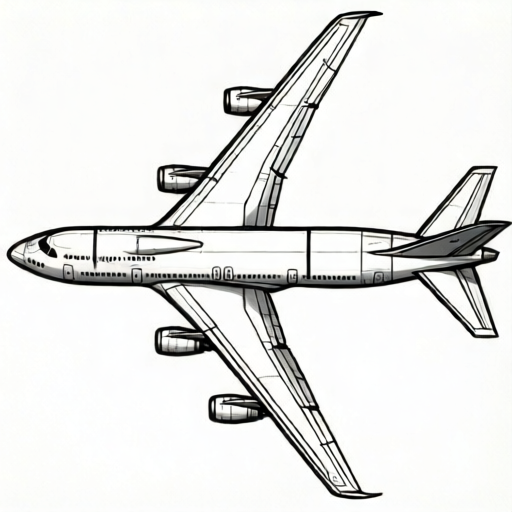
Use the stated measurements and conventions for each exercise.
Set the fuselage axis and station grid
Begin with a rectangular grid. Draw a horizontal fuselage centerline through the middle. Label the nose end station 0 and mark equal station intervals along the centerline. These stations are reference points, not aircraft dimensions.
Use a light construction line for the centerline and a slightly heavier final line for the fuselage outline. Keep all labels horizontal so they remain readable when the planform is rotated.
- Draw a horizontal centerline across the grid and label it fuselage axis.
- Mark station 0 at the nose and add equal intervals toward the tail.
- Sketch the fuselage outline symmetrically about the centerline using the grid squares as a guide.
- Label the nose, wing root station, wing tip station, and tail station.
Measure wing sweep from a lateral reference
Sweep is the angle between the wing leading edge and a lateral line perpendicular to the fuselage axis. Draw a lateral reference line at the wing root station. Then draw the wing leading edge from the root to the tip. Measure the angle at the root between the lateral reference and the leading edge.
A positive sweep angles the tip aft; a negative sweep angles it forward. Record the angle in degrees and note whether it is measured to the leading edge or a different reference. Consistency matters more than the exact value.
- Draw a lateral reference line perpendicular to the fuselage axis at the wing root station.
- Mark the wing tip station on the grid and draw the leading edge from root to tip.
- Measure the angle between the lateral reference and the leading edge at the root.
- Label the angle as sweep and state the reference used.
Lay out the tail span and chord
The horizontal tail is placed aft of the wing. Mark a tail station on the centerline. Draw a lateral tail reference line and mark half-span distances on both sides. Connect the tail root to the tail tips to form the tail planform.
Label tail span as the total tip-to-tip distance and tail chord as the root length along the fuselage axis. Keep units consistent, for example grid squares or millimeters.
- Mark the tail station aft of the wing and draw a lateral tail reference line.
- Measure equal half-span distances left and right of the centerline.
- Draw the tail leading and trailing edges to the tips.
- Label tail span and tail chord with units.
Apply a line and label convention
Use one convention throughout: light lines for construction references, medium lines for final outlines, and short leader lines for labels. Write labels in block letters or a consistent handwriting style. The convention is yours to define, but it must be stated on the drawing.
Valid alternatives include measuring sweep to the trailing edge instead of the leading edge, or using a different grid scale, provided the reference is labeled and the arithmetic is consistent.
- Write a short key stating line weights and label style.
- Label the fuselage axis, wing sweep angle with reference, tail span, and tail chord.
- Check that every angle and distance has a stated reference or unit.
Worked example
On a grid, draw a fuselage centerline 12 squares long. Place the wing root at station 4 and the wing tip at station 7, with the tip 5 squares above the centerline. Draw a lateral reference at station 4 and measure the sweep angle to the leading edge. Then place the tail at station 10 with a half-span of 3 squares. Label the fuselage axis, sweep angle, tail span, and tail chord.
Worked answer
The lateral reference is horizontal at station 4. The leading edge rises 5 squares over a horizontal run of 3 squares (stations 4 to 7). The sweep angle is arctan(5/3) ≈ 59 degrees from the lateral reference. Tail span is 6 squares total (3 squares each side), and tail chord is the distance along the centerline from station 10 to the tail trailing edge, for example 2 squares. Labels state the reference and units.
Four practice exercises
Exercise 1
A grid shows a fuselage centerline. The wing root is at station 3 and the tip at station 6. The tip is 4 squares above the centerline. Draw the lateral reference at station 3 and calculate the sweep angle to the leading edge. State the reference.
Show answer and check
Horizontal run is 3 squares, vertical rise is 4 squares. Sweep angle = arctan(4/3) ≈ 53 degrees from the lateral reference to the leading edge.
Why: The lateral reference is perpendicular to the centerline. The leading edge forms a right triangle with run 3 and rise 4, so the angle from the lateral line is arctan(rise/run).
Check: Verify the triangle sides on the grid and confirm the angle is measured from the lateral line, not the centerline.
Exercise 2
A planform has a tail station at 9 and a tail trailing edge at station 11 along the centerline. The tail half-span is 2.5 squares each side. State the tail span and tail chord in grid squares.
Show answer and check
Tail span = 5 squares total. Tail chord = 2 squares.
Why: Span is twice the half-span: 2 × 2.5 = 5. Chord is the distance along the centerline from station 9 to station 11: 11 − 9 = 2.
Check: Confirm both sides of the tail are equal distance from the centerline and that chord is measured along the fuselage axis.
Exercise 3
A learner measures sweep as 40 degrees from the fuselage centerline. Explain the error and give the corrected reference line to use.
Show answer and check
Sweep should be measured from a lateral line perpendicular to the fuselage centerline, not from the centerline itself. Draw a lateral reference at the wing root and measure the angle to the leading edge from that line.
Why: The centerline runs nose to tail; sweep is defined relative to a lateral direction. Using the centerline changes the reference and produces a different angle.
Check: Check that the reference line is perpendicular to the centerline and that the angle is labeled with its reference.
Exercise 4
On a grid, place the wing root at station 2 and the tip at station 5. The tip is 3 squares above the centerline. Draw the lateral reference and calculate the sweep angle to the leading edge. Then place a tail at station 8 with half-span 2 squares and chord 1.5 squares. List the labels you would include.
Show answer and check
Sweep angle = arctan(3/3) = 45 degrees from the lateral reference to the leading edge. Tail span = 4 squares total; tail chord = 1.5 squares. Labels: fuselage axis, lateral reference at station 2, sweep 45 degrees to leading edge, tail span 4 squares, tail chord 1.5 squares.
Why: Run is 3 squares and rise is 3 squares, giving a 45-degree angle. Tail span is twice the half-span, and chord is the stated length along the centerline.
Check: Verify the 45-degree angle by checking equal run and rise, confirm tail symmetry, and ensure every label states a reference or unit.
Common mistakes
- Measuring sweep from the fuselage centerline instead of a lateral reference. Draw a lateral line perpendicular to the centerline at the wing root and measure from that line.
- Using different units for span and chord. Choose one unit, such as grid squares, and label every measurement with it.
- Drawing the tail span asymmetrically about the centerline. Mark equal half-span distances left and right from the centerline before drawing the tail edges.
- Leaving the sweep reference unlabeled. State whether the angle is measured to the leading edge or trailing edge and show the reference line.
Self-check rubric
- Fuselage centerline is drawn and labeled as the fuselage axis.
- Wing root and tip stations are marked and connected by a leading edge.
- A lateral reference line is drawn at the wing root and the sweep angle is measured from it.
- The sweep reference (leading edge or trailing edge) is stated.
- Tail span is symmetric about the centerline and labeled with units.
- Tail chord is labeled with units.
- A line and label convention is stated and followed.
- Valid alternative references or scales are accepted if labeled and arithmetically consistent.
Questions and answers
What is a planform?
A planform is the top-down outline of an aircraft, showing the fuselage, wings, and tail as seen from above.
How do I measure wing sweep?
Draw a lateral line perpendicular to the fuselage axis at the wing root, then measure the angle between that line and the wing leading edge.
Can I use a different sweep reference?
Yes, provided you label the reference clearly and keep the measurement consistent. Leading edge and trailing edge references are both valid if stated.
Do I need exact aircraft dimensions?
No. Use hypothetical example values or grid squares. The method and labeling are the learning goals.