Free original lessons
Contour Drawing of Deadpool: Outline-Only vs Detail Pass
Learn to draw a Deadpool contour in two passes: a clean outline-only pass, then a detail pass that adds mask seams, eye shapes, and belt lines without shading.
Free lesson
Four exercises
Worked answers
Object Drawing Lessons
Contour drawing asks you to describe an edge with a single confident line. This lesson uses a Deadpool figure to compare two passes: an outline-only pass that captures the silhouette and major shape breaks, and a detail pass that adds internal contour lines such as mask seams, eye rims, and belt edges. You will work from a simple reference you construct yourself, so no printed image is required. The goal is not a perfect replica but a clear, checkable contour that a classmate can compare against your reference. Keep all lines as contours: no shading, no cross-hatching, no comic layout. Use a pencil and paper, and measure your actual paper and drawing space before starting. Any numerical sizes below are hypothetical examples, not standards.
Practice materials: Printable downloads are not available for this lesson yet. Use the instructions and four exercises below.
Reference illustration
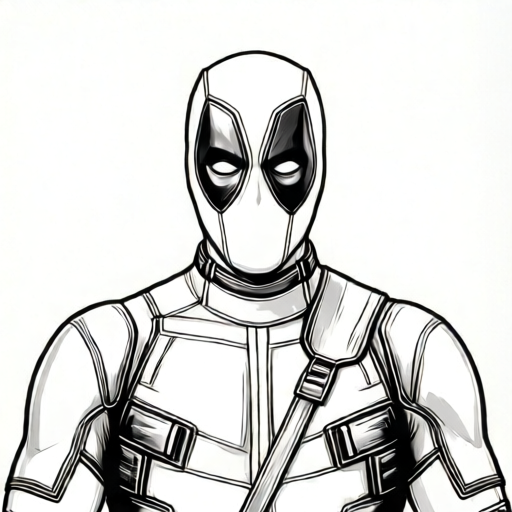
Use the stated measurements and conventions for each exercise.
Set up a simple Deadpool reference
Build a reference from basic shapes: a rounded rectangle for the head, a narrower rectangle for the torso, two bent tubes for arms, and two straight tubes for legs. Place the head above the torso with a small gap for the neck. Add a horizontal belt line across the lower torso and two oval eye shapes on the mask. This reference is yours to adjust; the lesson checks contour clarity, not exact proportions.
Measure your paper first. For example, if your paper is 20 cm by 28 cm, reserve a 9 cm by 12 cm box for the outline-only pass and a second 9 cm by 12 cm box for the detail pass. Label the boxes A and B. These numbers are hypothetical examples; use your actual measurements.
- Measure the paper and draw two equal boxes side by side; label them A and B.
- In box A, sketch the reference silhouette lightly using the basic shapes.
- In box B, sketch the same silhouette at the same size so the two passes can be compared.
- Check that both silhouettes fit inside their boxes with at least 1 cm margin.
Pass one: outline-only contour
The outline-only pass records the outer boundary and major shape breaks. Use one continuous line where possible. Do not add internal seams, eye details, or belt lines yet. If the line must stop, stop at a clear corner such as the shoulder or the top of the head.
A useful convention: treat the mask as a single closed contour in pass one. The eyes and seams belong to pass two. This keeps the comparison honest: pass one shows silhouette, pass two shows internal structure.
- Start at the top of the head and draw clockwise around the head, neck, shoulders, arms, torso, legs, and feet.
- At each major change of direction, slow down but keep the pencil moving.
- Close the contour at the starting point without lifting the pencil if possible.
- Label box A 'Outline-only pass' and note the date.
Pass two: detail contour overlay
The detail pass adds internal contour lines that describe form without shading. Add the eye ovals, the vertical mask seam, the belt line, and simple glove and boot cuffs. Keep every added line a contour: it should separate two visible regions, not suggest light and shadow.
Compare pass two to pass one. The outer silhouette should remain recognizable. If a detail line crosses the silhouette, redraw it so it stays inside the figure. Use the same line weight for both passes so the comparison is fair.
- Trace the pass-one silhouette lightly in box B as a guide.
- Add two eye ovals on the mask, keeping them inside the head contour.
- Add one vertical seam from the top of the head to the neck.
- Add a horizontal belt line across the lower torso and short cuff lines at wrists and ankles.
- Check that no detail line extends outside the silhouette.
Compare and self-check
Place boxes A and B side by side. Ask three questions: Is the silhouette in B still recognizable as the same figure? Are all detail lines inside the silhouette? Does either pass rely on shading instead of contour? A valid answer may differ from the reference in proportion; the rubric rewards clear, continuous contours and a visible difference between the two passes.
Record one improvement for each pass. For example, 'Pass one: shoulder corner too rounded' or 'Pass two: belt line crosses the torso edge.' This written note is part of the check.
- Compare silhouettes and circle one difference that is intentional.
- Confirm no shading marks appear in either box.
- Write one improvement note for pass one and one for pass two.
- Initial and date both boxes.
Worked example
A student measures paper at 20 cm by 28 cm and draws two 9 cm by 12 cm boxes. In box A they draw a closed silhouette with no internal lines. In box B they trace the silhouette and add two eye ovals, one vertical seam, and one belt line. All added lines stay inside the silhouette. Is this a valid comparison?
Worked answer
Yes. Pass one is outline-only, pass two adds internal contours, both passes use equal boxes, and no detail line crosses the silhouette. The student should add one improvement note per pass to complete the check.
Four practice exercises
Exercise 1
On a 15 cm by 20 cm paper, draw two 6 cm by 8 cm boxes. In box A, draw an outline-only Deadpool silhouette using the basic-shape reference. In box B, trace the silhouette and add exactly two eye ovals and one belt line. Keep all detail lines inside the silhouette.
Show answer and check
Box A shows a closed outer contour with no internal lines. Box B shows the same silhouette plus two eye ovals and one belt line, all inside the outer contour.
Why: The task separates silhouette from internal structure. Equal boxes make the comparison fair, and the detail count is fixed so the check is simple.
Check: Measure both boxes to confirm 6 cm by 8 cm. Confirm box A has no internal lines. Confirm box B has exactly two eye ovals and one belt line, and that no detail line crosses the silhouette.
Exercise 2
A student draws pass one with a closed silhouette and pass two with the same silhouette plus a vertical seam that extends 1 cm above the head. Identify the error and state the fix.
Show answer and check
The seam crosses outside the silhouette. The fix is to redraw the seam so both ends stop inside the head contour.
Why: Detail lines describe internal form; they must not alter the outer silhouette established in pass one.
Check: Trace the outer contour in pass two and confirm every detail line has both endpoints inside it.
Exercise 3
You have a 10 cm by 14 cm drawing space. You want two equal boxes with a 1 cm gap between them and 1 cm margins on all sides. Using hypothetical values, calculate a possible box width and height, then state whether the boxes fit.
Show answer and check
A possible size is 3.5 cm wide by 12 cm high: width = (10 - 1 - 1 - 1) / 2 = 3.5 cm; height = 14 - 1 - 1 = 12 cm. The boxes fit.
Why: Subtract the two side margins and the gap from the total width, then divide by two. Subtract the top and bottom margins from the height. These numbers are hypothetical examples.
Check: Recompute: 1 + 3.5 + 1 + 3.5 + 1 = 10 cm across and 1 + 12 + 1 = 14 cm down. Confirm both sums match the drawing space.
Exercise 4
Compare two passes: pass one has a rounded head and straight torso; pass two has the same silhouette but adds a belt line that stops 0.5 cm short of the torso edge on both sides. Is pass two valid? Explain.
Show answer and check
Yes, pass two is valid. The belt line is an internal contour and stays inside the silhouette; stopping short of the edge is acceptable because the line still separates regions without crossing the outer contour.
Why: The rubric requires detail lines to stay inside the silhouette, not to touch the edge. A short internal line is a valid contour choice.
Check: Confirm the belt line has two endpoints inside the torso contour and that the outer silhouette matches pass one.
Common mistakes
- Adding eye details during the outline-only pass. Keep pass one to the outer silhouette only; move all internal lines to pass two.
- Using shading to suggest the mask or belt. Replace shaded areas with single contour lines that separate regions.
- Letting detail lines cross outside the silhouette. Redraw each detail line so both ends stop inside the outer contour.
- Drawing the two passes at different sizes. Measure both boxes before starting and keep the same reference size in each.
Self-check rubric
- Pass one contains only the outer silhouette and major shape breaks; no internal details.
- Pass two adds at least three internal contour lines (for example, two eye ovals and one seam) that stay inside the silhouette.
- Neither pass uses shading, cross-hatching, or comic layout.
- Both passes fit inside equal measured boxes with visible margins.
- A written improvement note appears for each pass.
- Valid alternatives are accepted: different proportions, poses, or line styles are allowed if the two-pass comparison remains clear and checkable.
Questions and answers
Do I need a printed Deadpool reference?
No. Build a simple reference from basic shapes as described in section one. The lesson checks contour clarity, not likeness to a published image.
Can I use a different pose?
Yes, as long as the pose stays inside the two equal boxes and the outline-only pass contains no internal details.
How much detail belongs in pass two?
Add eye ovals, one mask seam, a belt line, and simple cuffs. More detail is allowed if every added line is a contour and stays inside the silhouette.
What if my lines are not perfectly smooth?
Smoothness is not the main criterion. The rubric rewards continuous, checkable contours and a clear difference between the two passes.