Free original lessons
Contour Drawing of Scissors: Slow vs Quick Line Passes
Compare slow and quick contour line passes of scissors. Learn to capture shape, proportion, and line quality with a clear convention and self-check rubric.
Free lesson
Four exercises
Worked answers
Object Drawing Lessons
Contour drawing records the visible edge of an object without shading. This lesson uses a pair of scissors to compare two timed passes: a slow pass that prioritizes careful edge tracking, and a quick pass that prioritizes overall gesture and proportion. For this exercise, treat each scissors handle loop as a letter-like shape: measure its x-height from the loop's baseline (lowest point) to its midline (the horizontal line through the loop's vertical center). Loop shapes may vary. All numerical values below are hypothetical examples for practice, not manufacturing standards. Measure your own paper and tool before drawing.
Practice materials: Printable downloads are not available for this lesson yet. Use the instructions and four exercises below.
Reference illustration
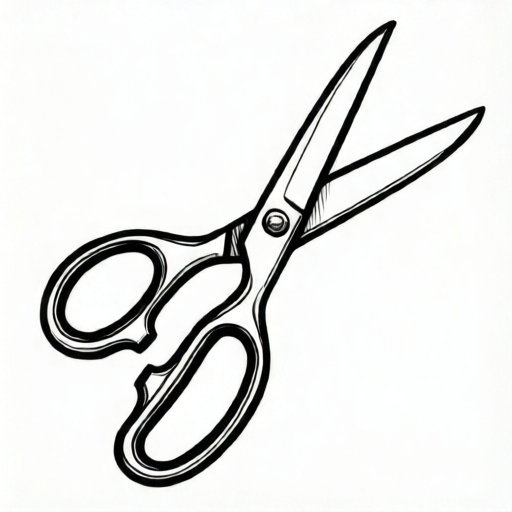
Use the stated measurements and conventions for each exercise.
Set Up the Reference and Two Boxes
Place the scissors flat on a plain surface so the handles and blades form a clear silhouette. Draw two boxes of equal size on your paper, side by side. Label the left box Slow and the right box Quick. The boxes are your only frames; do not add shading or tool-function labels.
Choose a drawing tool that makes a visible but not heavy line. Before starting, measure the longest dimension of the scissors with a ruler and note it in the same unit you will use for the boxes. For example, if the scissors measure 18 cm from handle tip to blade tip, make each box at least 20 cm wide so the drawing fits with margin.
- Measure the scissors length and the width of each box in centimeters.
- Mark the midpoint of each box edge to help center the drawing.
- Place the scissors so the pivot is roughly centered in your view.
- Label the boxes Slow and Quick with small letters; keep labels outside the drawing area.
Slow Contour Pass: Track Every Visible Edge
In the slow pass, move your eye along the edge of the scissors and let your pencil follow at the same pace. Do not lift the pencil unless the edge breaks completely. The goal is accurate edge tracking, not speed. Keep your hand relaxed and accept small wobbles; a contour line is a record of attention, not a perfect vector.
Use the x-height convention to check handle loops: treat each loop as a letter-like shape and measure from its baseline (the lowest point of the loop) to its midline (the horizontal line through the loop's vertical center). Letter styles vary, so a loop may be round, oval, or angular; the convention only fixes the measurement points, not the shape.
- Start at the tip of one blade and trace its outer edge toward the pivot.
- Continue around the handle loop without lifting the pencil.
- Record the inner edge of the same handle loop as a separate contour line.
- Repeat for the second blade and handle, then compare the two handle loops for relative size.
Quick Contour Pass: Capture Gesture and Proportion
In the quick pass, draw the same scissors in the right box in one continuous line if possible, working faster than in the slow pass. Prioritize the overall angle of the blades, the distance between handle loops, and the position of the pivot. Accept that some edges will be simplified; the quick pass is a summary, not a detailed trace.
After both passes, compare line quality. Slow lines tend to be more even and closely spaced to the edge; quick lines tend to be more angular and may overshoot. Neither is automatically better. Use the comparison note below each box to record one observable difference, such as 'slow line follows the blade curve more closely' or 'quick line captures the blade angle with fewer breaks'.
- Draw the pivot first as a small mark, then draw the blade angle as a single line.
- Add each handle loop as one continuous curve, keeping the pencil moving.
- Check the distance between the two handle loops against the slow pass.
- Write one line-quality comparison note under each box.
Comparison Note and Self-Check
A useful comparison note names a specific feature and a specific difference. For example: 'Slow pass: handle loop x-height is 3 cm; quick pass: handle loop x-height is 2.5 cm.' Or: 'Slow pass: blade edge has 4 direction changes; quick pass: blade edge has 2 direction changes.' Keep units consistent and measure only what you can see on your paper.
Check your work by measuring the longest dimension in each box and comparing it to your reference measurement. A difference of 1 cm or less is a reasonable hypothetical tolerance for this exercise; adjust the number to match your own paper size and tool. Then read your comparison notes aloud to confirm they describe observable line quality rather than guesses about the object's function.
- Measure the longest dimension in the slow box and record it.
- Measure the longest dimension in the quick box and record it.
- Compare each to the reference measurement and note the difference.
- Confirm each box has one comparison note and no shading.
Worked example
A student measures the scissors as 18 cm long. The slow box drawing measures 17 cm; the quick box drawing measures 16 cm. The slow pass note says 'handle loop x-height 3 cm'; the quick pass note says 'handle loop x-height 2.5 cm.' Are the drawings within a hypothetical 1 cm tolerance for the longest dimension, and what does the x-height difference suggest?
Worked answer
The slow drawing differs from the reference by 1 cm (18 - 17 = 1), so it is within the hypothetical tolerance. The quick drawing differs by 2 cm (18 - 16 = 2), so it is outside that tolerance. The x-height difference is 0.5 cm (3 - 2.5 = 0.5), suggesting the quick pass simplified the handle loop. To correct the quick pass, re-measure the overall handle-tip-to-blade-tip span in the quick box and adjust the drawn overall span (for example, extend the blade tip or handle tip along the measured axis) so the longest dimension comes within 1 cm of 18 cm.
Four practice exercises
Exercise 1
A scissors reference measures 15 cm. The slow box drawing measures 14.5 cm and the quick box drawing measures 13 cm. Using a hypothetical 1 cm tolerance, state which drawing is within tolerance and by how much each differs.
Show answer and check
The slow drawing is within tolerance: 15 - 14.5 = 0.5 cm difference. The quick drawing is outside tolerance: 15 - 13 = 2 cm difference.
Why: Subtract each drawing measurement from the reference measurement in the same unit. Compare each difference to the stated 1 cm tolerance.
Check: Re-measure the longest dimension in each box with the same ruler and confirm the subtraction: 15 - 14.5 = 0.5 and 15 - 13 = 2.
Exercise 2
In a slow pass, a handle loop has a baseline at 4 cm from the bottom of the box and a midline at 7 cm from the bottom. In the quick pass, the same loop has a baseline at 4 cm and a midline at 6 cm. Calculate each x-height and the difference.
Show answer and check
Slow x-height = 7 - 4 = 3 cm. Quick x-height = 6 - 4 = 2 cm. Difference = 3 - 2 = 1 cm.
Why: X-height is midline minus baseline. Apply the convention to each pass and subtract the smaller x-height from the larger.
Check: Confirm the baseline is the same in both passes, then re-subtract: 7 - 4 = 3 and 6 - 4 = 2; 3 - 2 = 1.
Exercise 3
A quick pass drawing has a blade angle line that starts at the pivot and ends 8 cm to the right and 6 cm up from the pivot. A slow pass drawing has the same start but ends 7 cm to the right and 5 cm up. Which pass has the longer blade line, and by how much? Use whole-centimeter arithmetic and state the unit.
Show answer and check
The quick pass blade line is longer. Quick length is the hypotenuse of 8 cm and 6 cm, which is 10 cm; slow length is the hypotenuse of 7 cm and 5 cm, which is about 8.6 cm. The difference is about 1.4 cm.
Why: Treat each blade line as the hypotenuse of a right triangle with the horizontal and vertical offsets as legs. Compute each length and subtract.
Check: Recompute 8 squared plus 6 squared equals 100, so the quick length is 10 cm. Recompute 7 squared plus 5 squared equals 74, so the slow length is about 8.6 cm. Subtract: 10 - 8.6 = 1.4 cm.
Exercise 4
A student writes two comparison notes: 'Slow pass: blade edge has 4 direction changes; quick pass: blade edge has 2 direction changes.' The reference scissors blade is straight. Is the note a valid line-quality comparison, and what should the student check next?
Show answer and check
Yes, the note is valid because it names a specific feature (blade edge) and a countable difference (4 versus 2 direction changes) without guessing about function. The student should next check whether the quick pass still shows a readable blade angle and pivot position, and whether the longest dimension is within the chosen tolerance.
Why: A valid comparison note describes observable line quality with consistent counting. Direction changes are countable on the drawing. The next check confirms the quick pass remains readable and proportional.
Check: Count the direction changes on each drawn blade edge again and confirm the numbers 4 and 2. Then measure the longest dimension in each box and compare to the reference.
Common mistakes
- Lifting the pencil repeatedly in the slow pass, turning the contour into a series of separate marks. Slow down further and keep the pencil on the paper unless the edge truly breaks; accept small wobbles as part of the record.
- Rushing the quick pass so the two handle loops merge or the blade angle is lost. Mark the pivot and blade angle first, then add each handle loop as one continuous curve; check the gap between loops.
- Adding shading or functional labels inside the boxes. Keep the boxes for contour lines only; place any labels outside the drawing area and use the comparison note for line quality.
- Using different units for the reference measurement and the box measurements. Choose centimeters or millimeters at the start and write the unit next to every measurement.
Self-check rubric
- Both boxes are labeled Slow and Quick, and each contains one contour drawing of the scissors with no shading.
- The slow pass shows continuous edge tracking with few pencil lifts and records at least one inner and one outer handle edge.
- The quick pass shows a readable pivot, blade angle, and gap between handle loops in a faster, simplified line.
- Each box has one comparison note naming a specific line-quality difference with consistent units.
- Measurements of the longest dimension in each box are recorded and compared to the reference measurement.
- Handle loop x-height is measured from baseline to midline using the stated convention; loop shape may vary.
Questions and answers
Do I need to draw the scissors exactly as they look?
No. Contour drawing records visible edges with your own line quality. The convention fixes measurement points for handle loops, but letter styles and loop shapes may vary. Valid alternatives include round, oval, or angular loops as long as the baseline-to-midline measurement is consistent.
How long should each pass take?
Use a hypothetical example: 5 minutes for the slow pass and 1 minute for the quick pass. Adjust to your paper size and tool. The important difference is attention to edge tracking versus overall gesture, not the exact clock time.
What if my quick pass looks messy?
A quick contour can be angular and simplified. Check that the pivot position, blade angle, and gap between handle loops are readable. If they are not, redraw the quick pass with fewer breaks rather than adding detail.
Can I use a ruler to draw the contour lines?
Use a ruler only for measuring the reference and the boxes. Draw contour lines freehand so the line quality comparison remains meaningful.