Free original lessons
Draw and Compare Five Face Shapes with Proportion Guides
Learn to outline oval, square, heart, round, and oblong faces, then place eyes, nose, and jaw guides using a simple proportion checklist.
Free downloads
Letter & A4
PDF & SVG
Object Drawing Lessons
Face-shape comparison is a drawing skill, not a personality test. This lesson teaches you to outline five common face shapes and place a consistent set of feature guides on each. You will use a centerline, an eye-line, and a jaw-width check so that differences come from the outline, not from random feature placement. Work on plain paper with a pencil and eraser. All measurements are relative to the face height you choose, so the same rules work at any size. The goal is controlled comparison: draw each shape at the same height, then observe how eye spacing, nose length, and jaw width change the read of the face. Keep your lines light until the final pass, and label each outline so you can compare them side by side.
Practice materials: Download the free reference pages, practice sheets and separate answer keys below, in A4 and US Letter PDF and SVG formats.
Set up a shared proportion frame
Choose a face height H, for example 12 cm, and use it for all five outlines. Mark a vertical centerline and a horizontal eye-line halfway down H. Mark a nose-line about one third of the way from the eye-line to the chin. These guides stay in the same relative positions on every shape, which makes comparison fair.
Define your own convention for x-height: the distance from the baseline to the midline of lowercase letters. Use it only when labeling or writing notes, not as a facial proportion. Letter styles vary, so do not treat x-height as a universal facial measure.
- Draw a vertical centerline of length H.
- Mark the eye-line at H divided by 2.
- Mark the nose-line at the eye-line plus one third of the remaining distance to the chin.
- Lightly mark the jaw-width line at about two thirds of H from the top.
Outline the five shapes
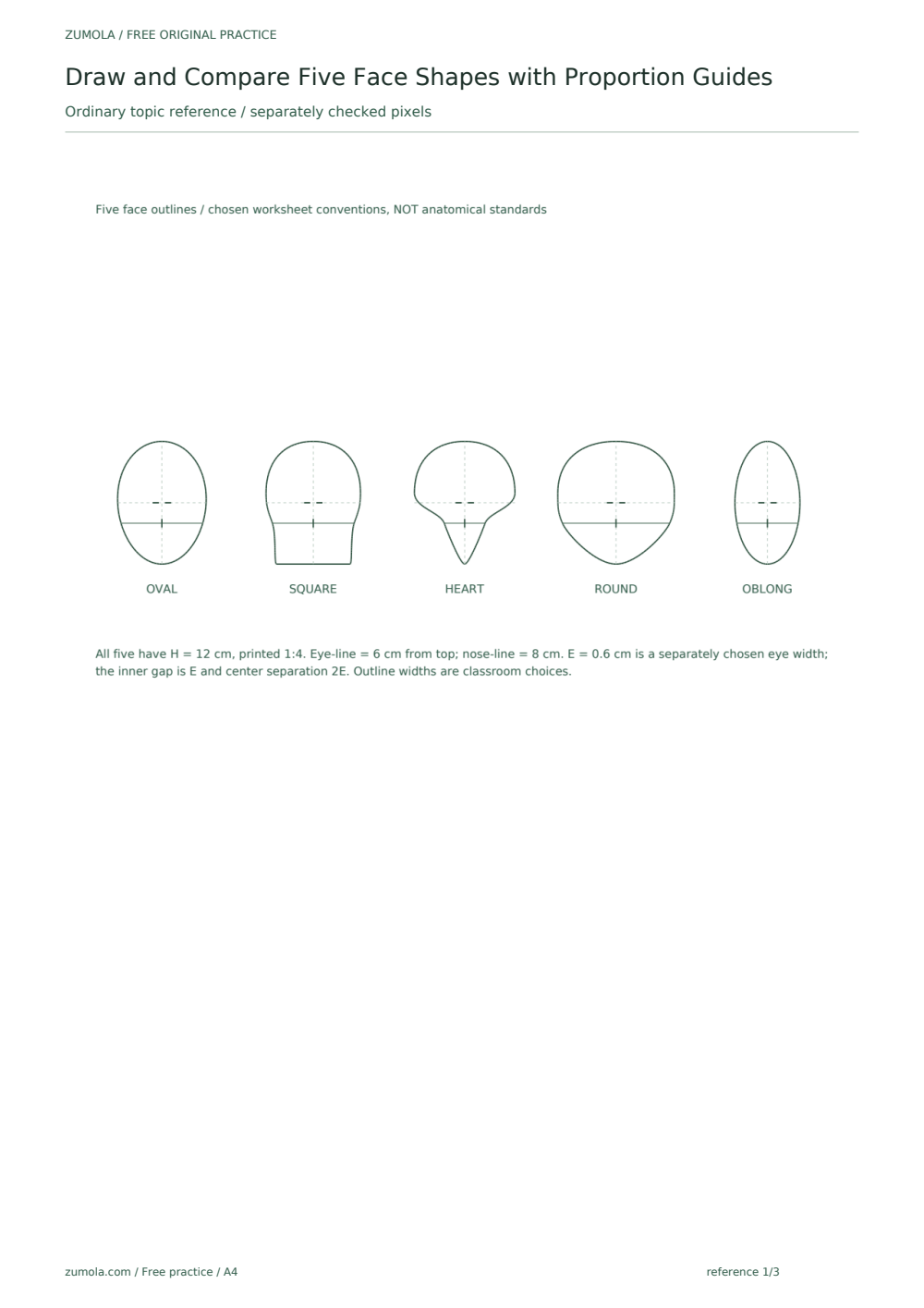
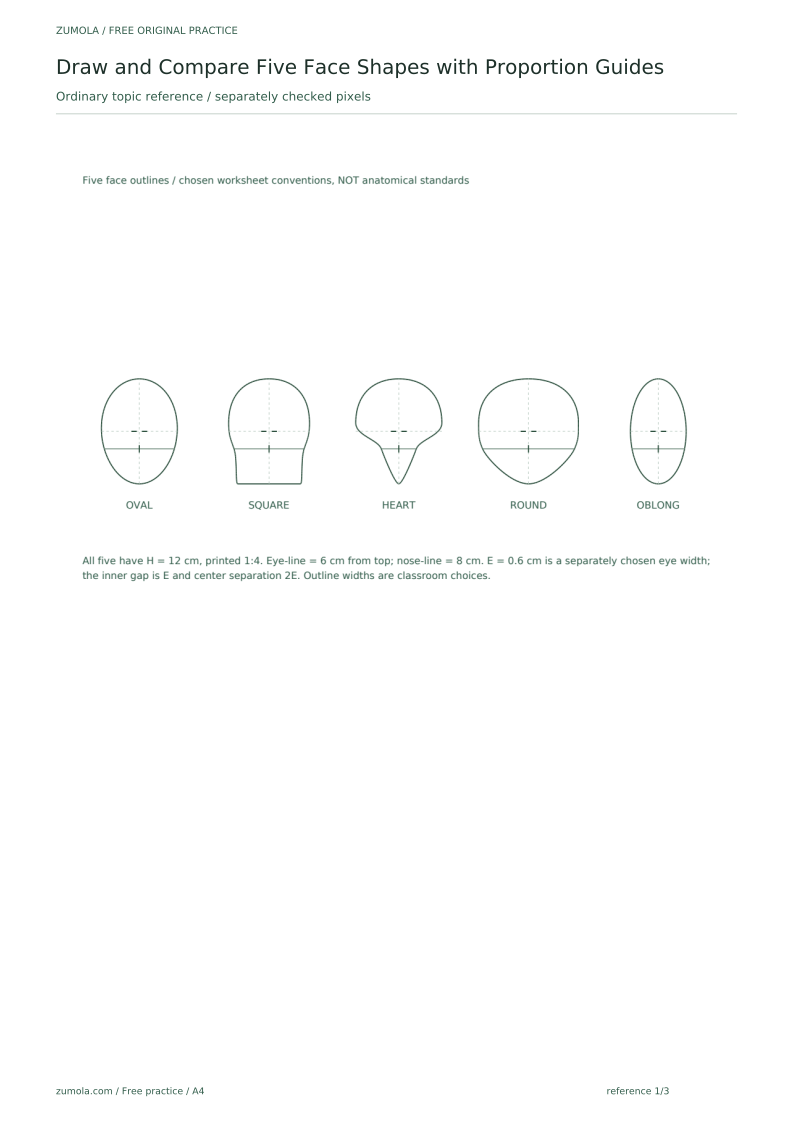
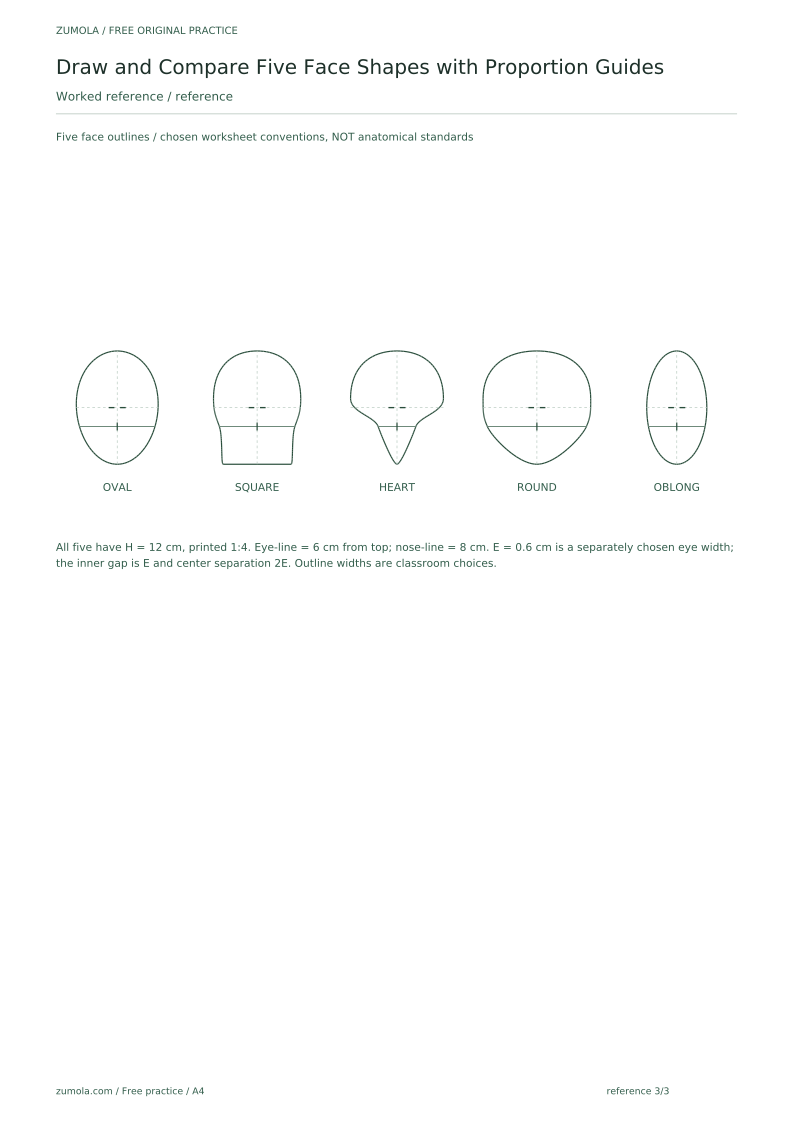
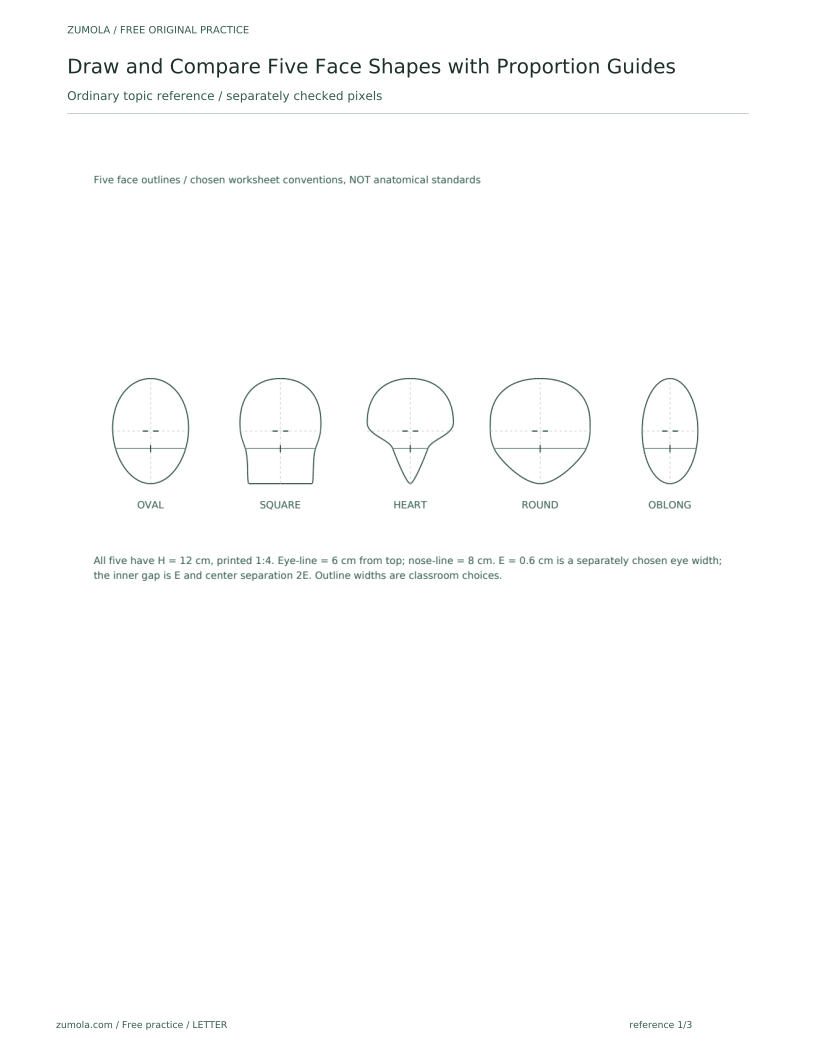
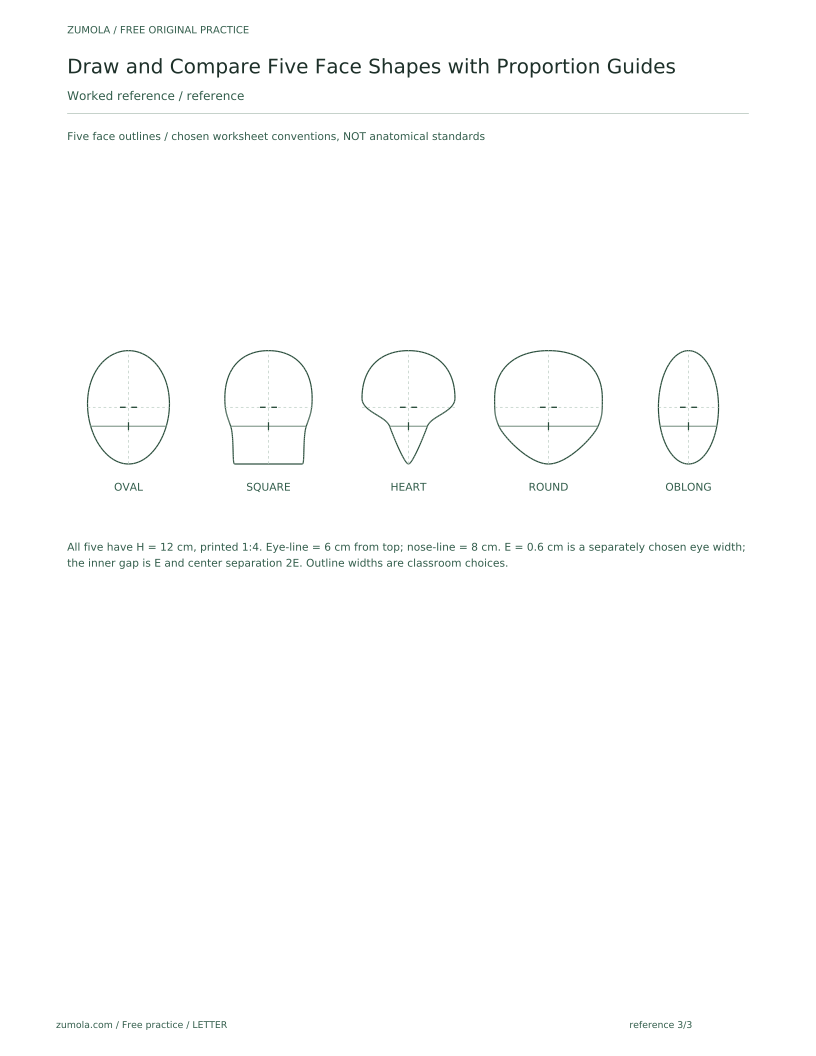
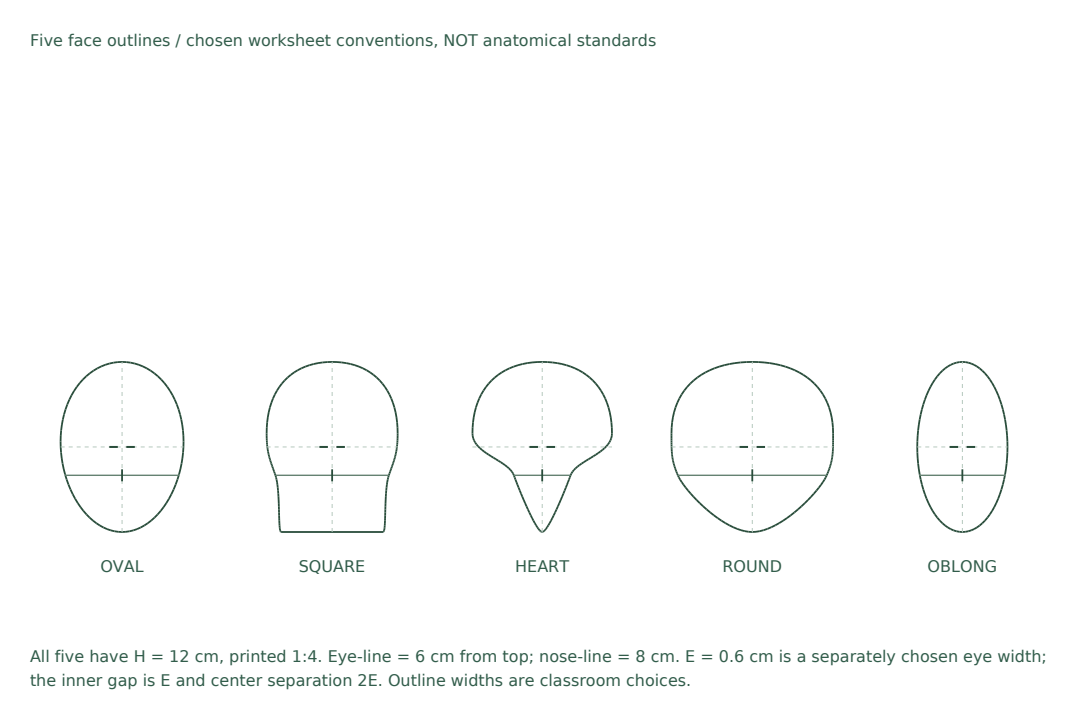
Oval: a smooth egg outline, slightly narrower at the chin than at the temples. Square: a broad forehead and a jaw with a flat bottom edge, corners rounded. Heart: wide at the temples, tapering to a narrow chin, with a gently pointed lower edge. Round: nearly circular, with soft cheeks and a short chin. Oblong: longer than the oval, with fairly straight sides and a chin that is not sharply tapered.
Keep all five at the same H. If a shape looks too wide, check the jaw-width line before changing the height.
- Draw the oval first as your reference.
- Draw the square with a flat jaw edge and rounded corners.
- Draw the heart with a narrow chin and wide temples.
- Draw the round shape with a soft, short chin.
- Draw the oblong with straighter sides and a longer read.
Place features with the checklist
Eye spacing: choose and record an eye width E, draw two eyes of that width, and use an inner-edge gap of E under this selected worksheet rule. The eye-center separation is then 2E; distinguish that from the gap. Nose marks stay centered on the stated nose-line. For jaw comparison record a horizontal eye-span or eye-width benchmark explicitly; the vertical eye-line height is not a horizontal eye width. Use the named outline differences as drawing conventions, not anatomical standards.
Use the same feature set on every shape: two eye marks, one nose mark, and one jaw-width mark. Do not add hair, shading, or expression.
- Mark two eye centers symmetrically on the eye-line, 2E apart when each eye is E wide and the inner gap is E.
- Place the nose mark on the nose-line, centered.
- Mark jaw width at the jaw-width line.
- Compare each shape against the checklist and note one difference.
Compare and correct
Lay the five outlines side by side. Check that every eye-line is at the same height and every nose-line is at the same relative position. If one shape drifts, erase the feature marks and re-place them from the centerline. The comparison grid is not included as a separate printable in this standard pack; you can recreate it by drawing five boxes of equal height and labeling them oval, square, heart, round, and oblong.
- Check eye-line height on all five shapes.
- Check nose-line position on all five shapes.
- Compare jaw widths against the recorded horizontal benchmark, not the vertical eye-line height.
- Write one sentence describing how the outline changes the feature read.
Worked example
A learner draws an oval face with H = 12 cm. Where should the eye-line and nose-line go if the nose-line is one third of the way from the eye-line to the chin?
Worked answer
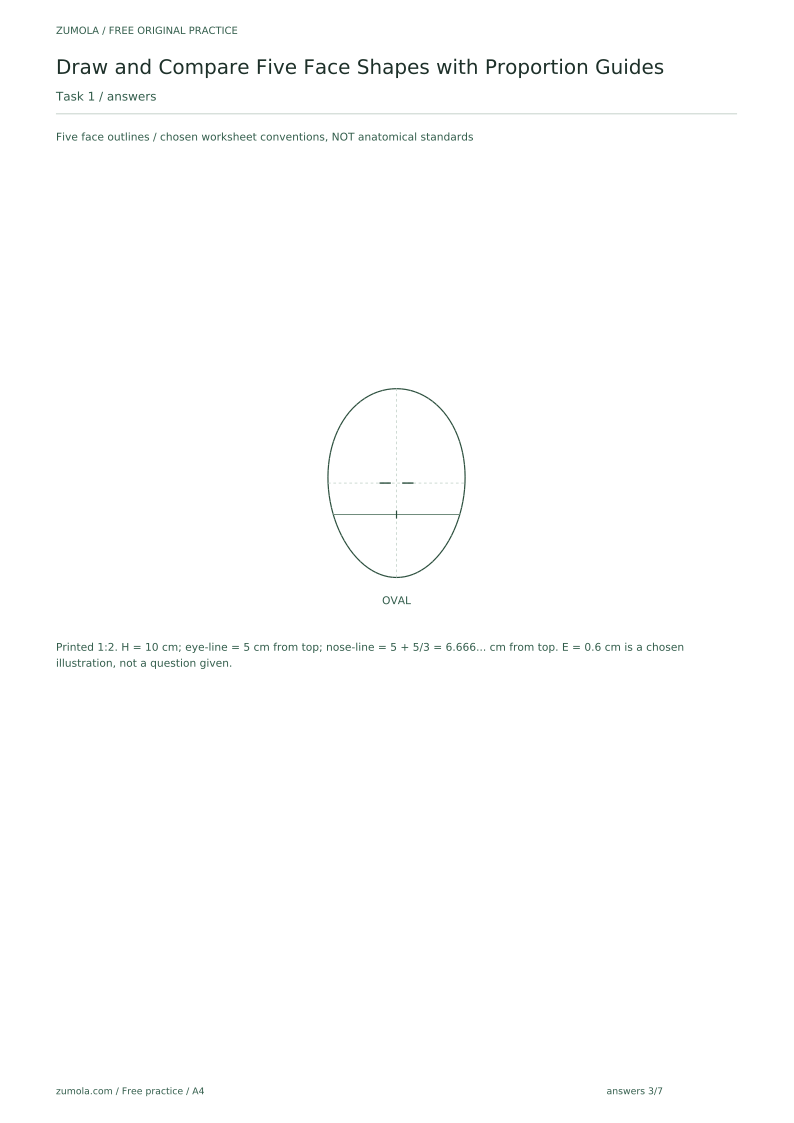
Eye-line at 6 cm from the top. The remaining distance to the chin is 6 cm, so one third is 2 cm. Nose-line at 6 + 2 = 8 cm from the top.
Four practice exercises
Exercise 1
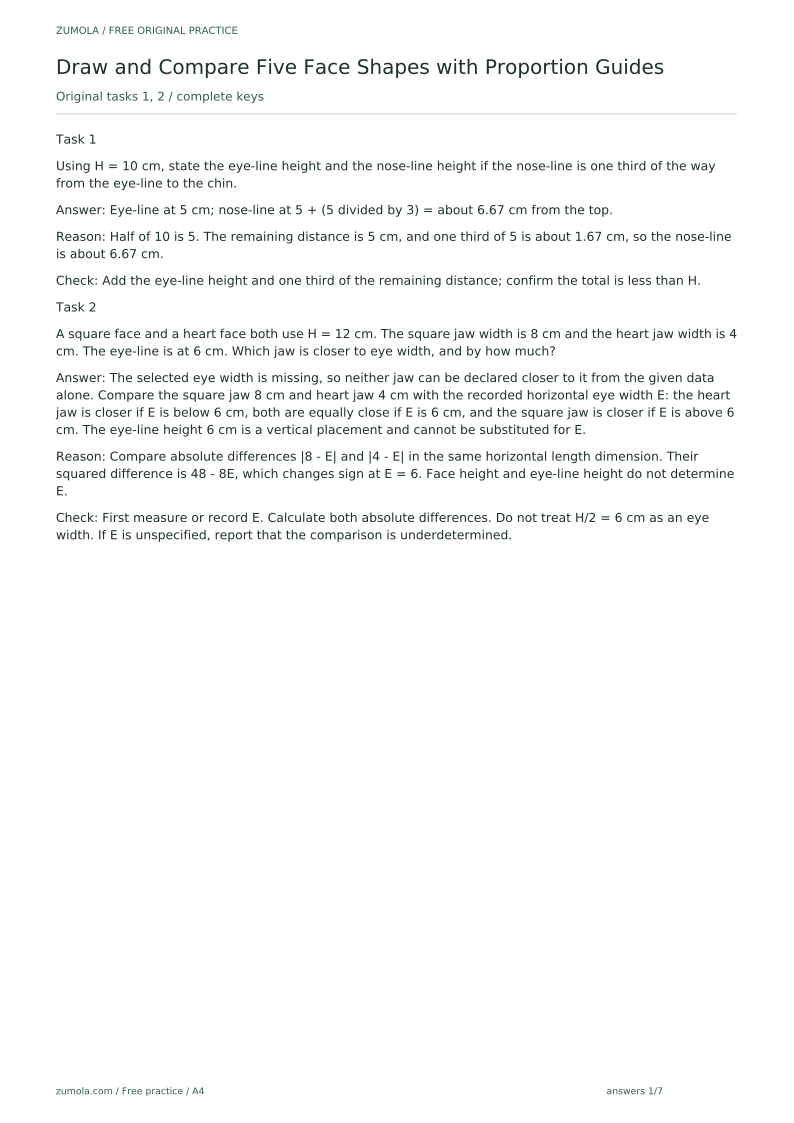
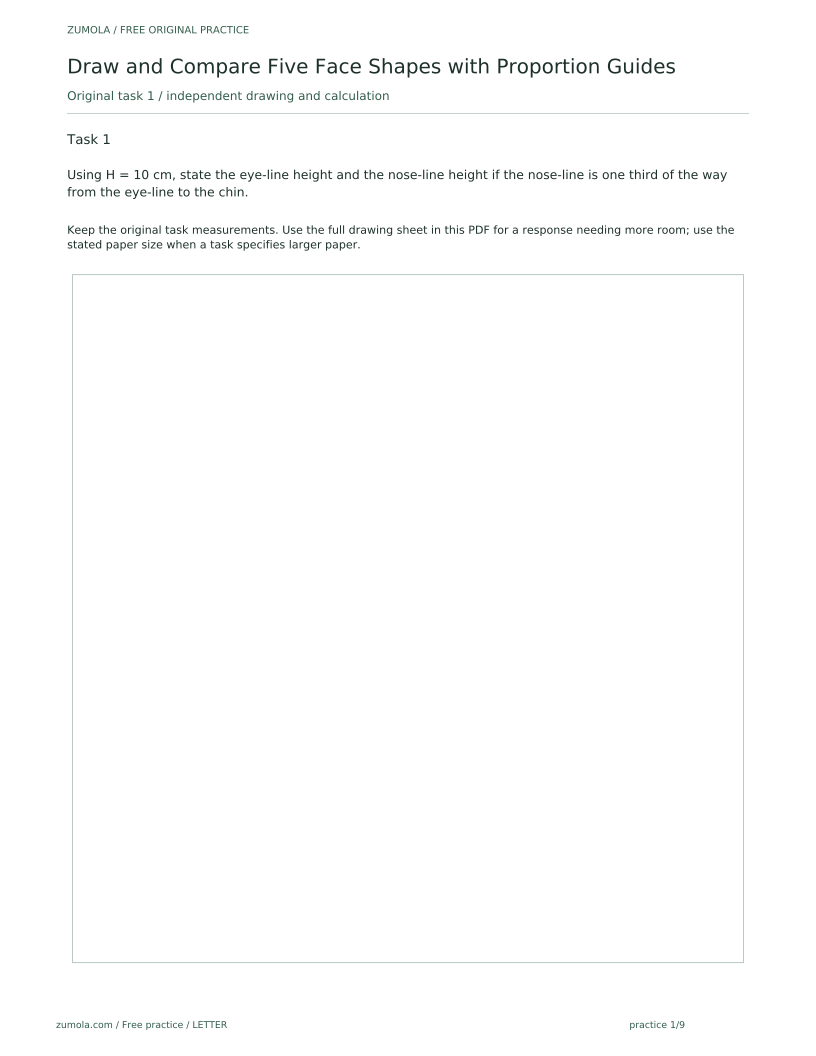
Using H = 10 cm, state the eye-line height and the nose-line height if the nose-line is one third of the way from the eye-line to the chin.
Show answer and check
Eye-line at 5 cm; nose-line at 5 + (5 divided by 3) = about 6.67 cm from the top.
Why: Half of 10 is 5. The remaining distance is 5 cm, and one third of 5 is about 1.67 cm, so the nose-line is about 6.67 cm.
Check: Add the eye-line height and one third of the remaining distance; confirm the total is less than H.
Exercise 2
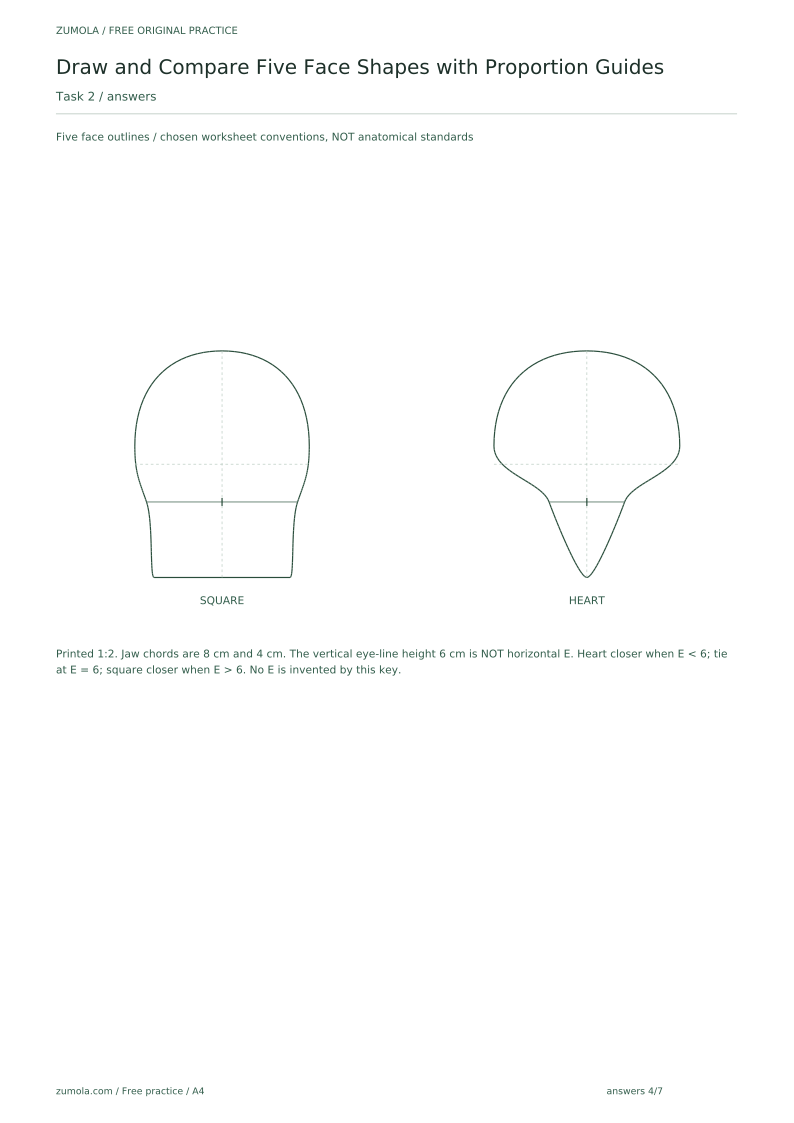
A square face and a heart face both use H = 12 cm. The square jaw width is 8 cm and the heart jaw width is 4 cm. The eye-line is at 6 cm. Which jaw is closer to eye width, and by how much?
Show answer and check
The selected eye width is missing, so neither jaw can be declared closer to it from the given data alone. Compare the square jaw 8 cm and heart jaw 4 cm with the recorded horizontal eye width E: the heart jaw is closer if E is below 6 cm, both are equally close if E is 6 cm, and the square jaw is closer if E is above 6 cm. The eye-line height 6 cm is a vertical placement and cannot be substituted for E.
Why: Compare absolute differences |8 - E| and |4 - E| in the same horizontal length dimension. Their squared difference is 48 - 8E, which changes sign at E = 6. Face height and eye-line height do not determine E.
Check: First measure or record E. Calculate both absolute differences. Do not treat H/2 = 6 cm as an eye width. If E is unspecified, report that the comparison is underdetermined.
Exercise 3
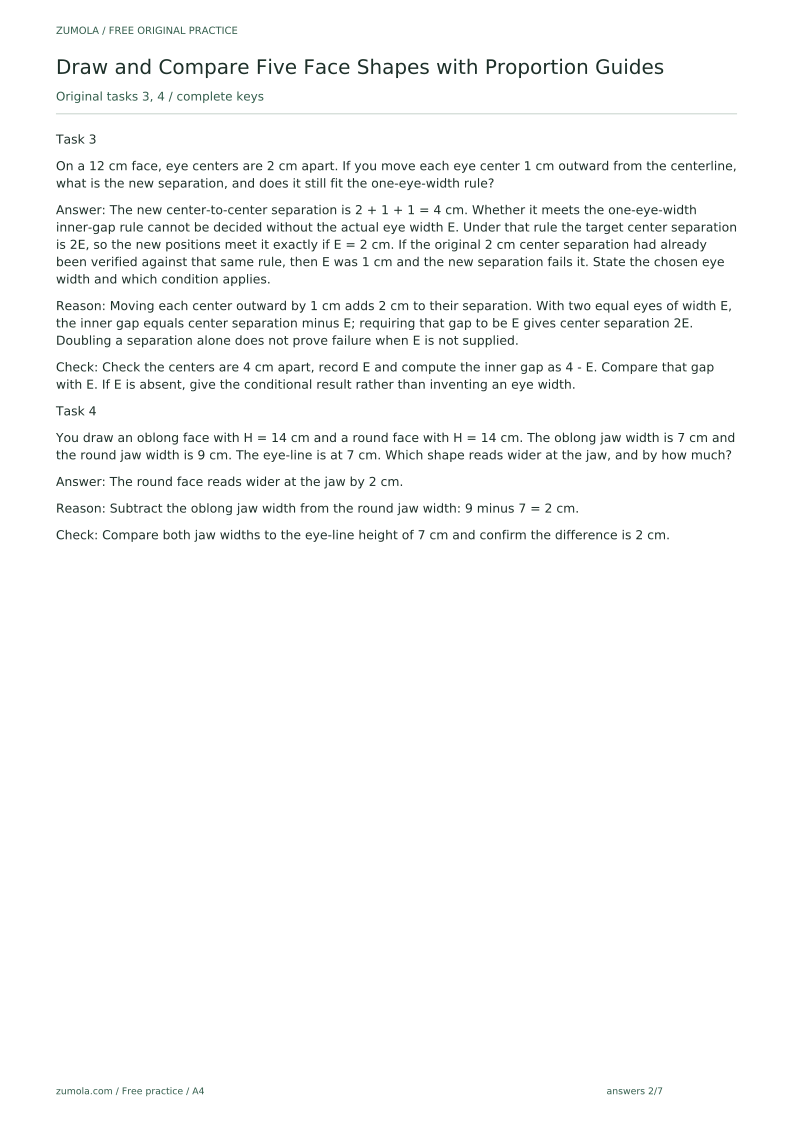
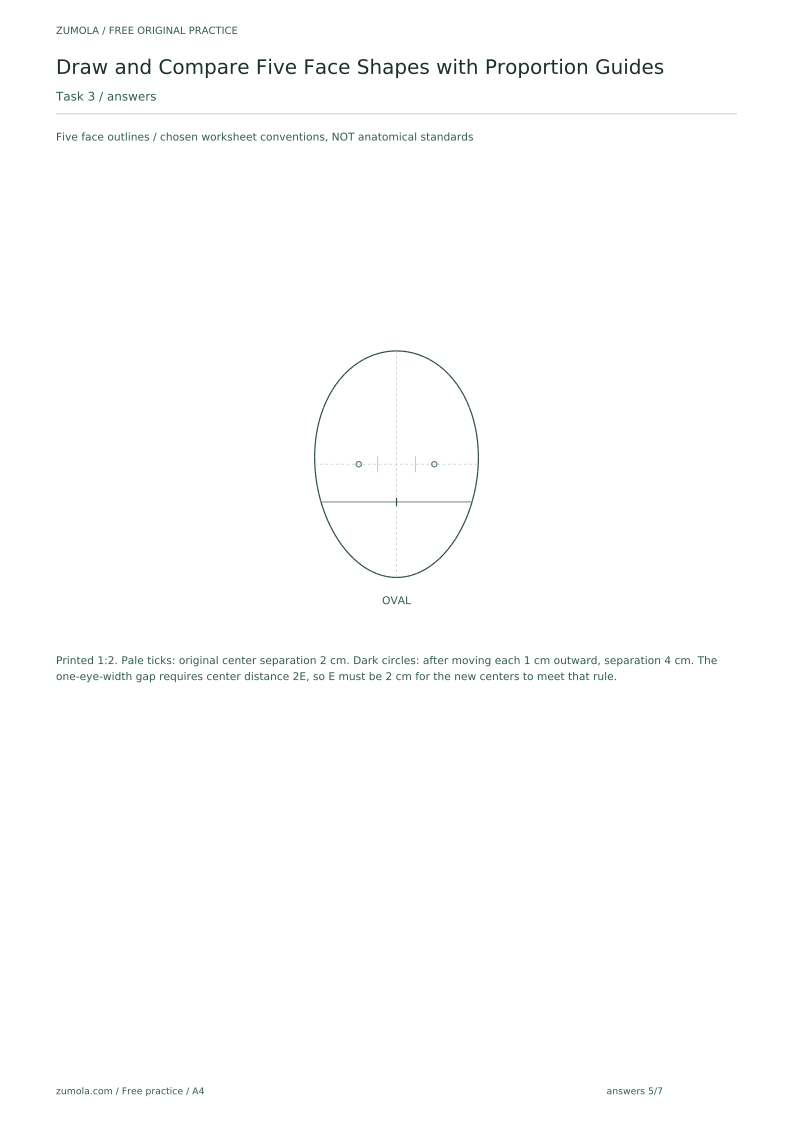
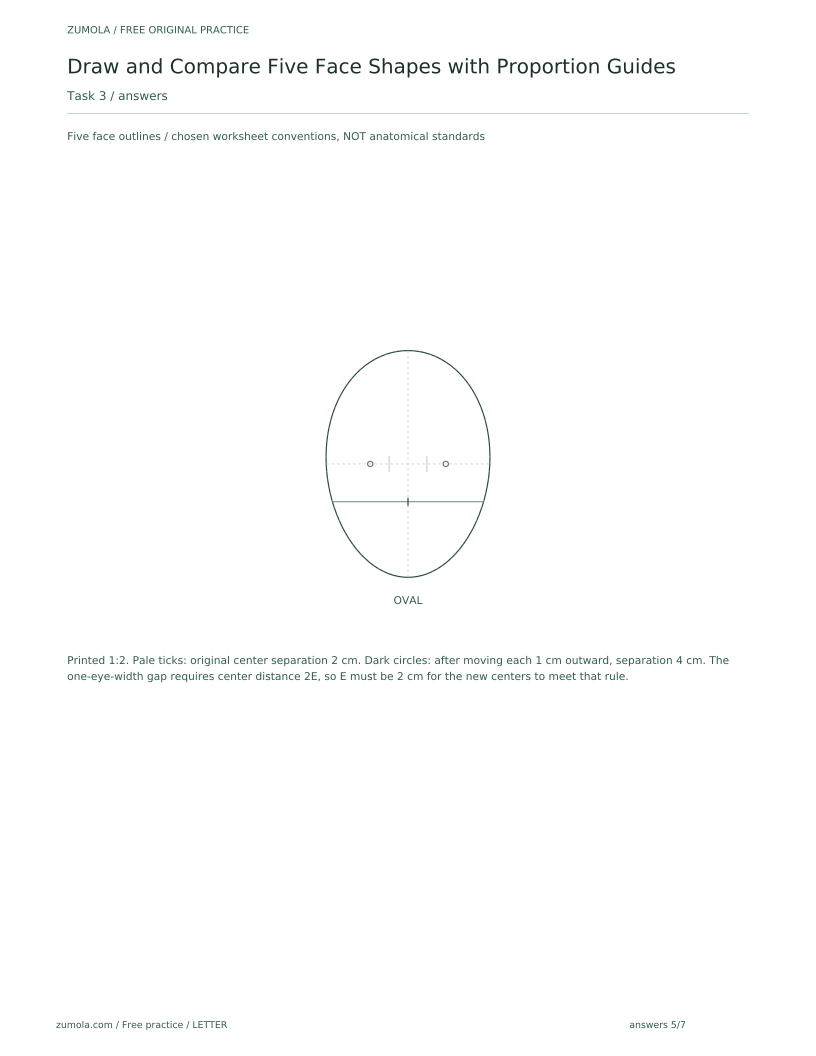
On a 12 cm face, eye centers are 2 cm apart. If you move each eye center 1 cm outward from the centerline, what is the new separation, and does it still fit the one-eye-width rule?
Show answer and check
The new center-to-center separation is 2 + 1 + 1 = 4 cm. Whether it meets the one-eye-width inner-gap rule cannot be decided without the actual eye width E. Under that rule the target center separation is 2E, so the new positions meet it exactly if E = 2 cm. If the original 2 cm center separation had already been verified against that same rule, then E was 1 cm and the new separation fails it. State the chosen eye width and which condition applies.
Why: Moving each center outward by 1 cm adds 2 cm to their separation. With two equal eyes of width E, the inner gap equals center separation minus E; requiring that gap to be E gives center separation 2E. Doubling a separation alone does not prove failure when E is not supplied.
Check: Check the centers are 4 cm apart, record E and compute the inner gap as 4 - E. Compare that gap with E. If E is absent, give the conditional result rather than inventing an eye width.
Exercise 4
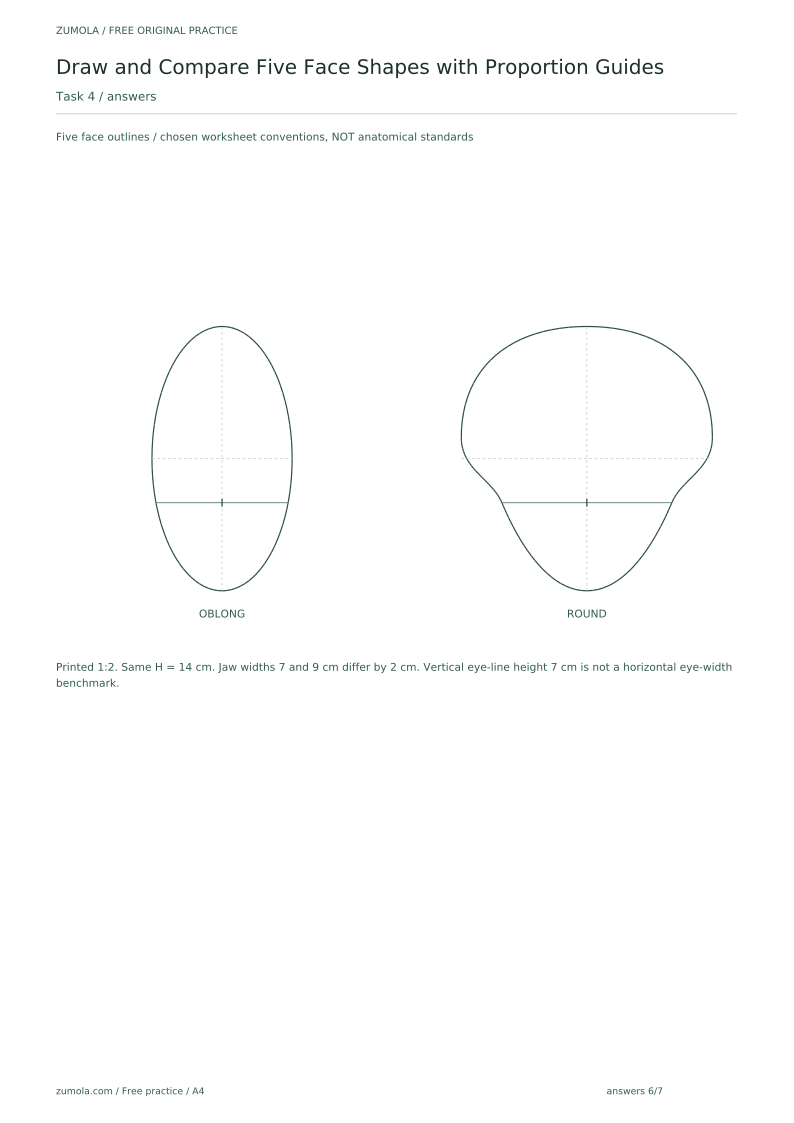
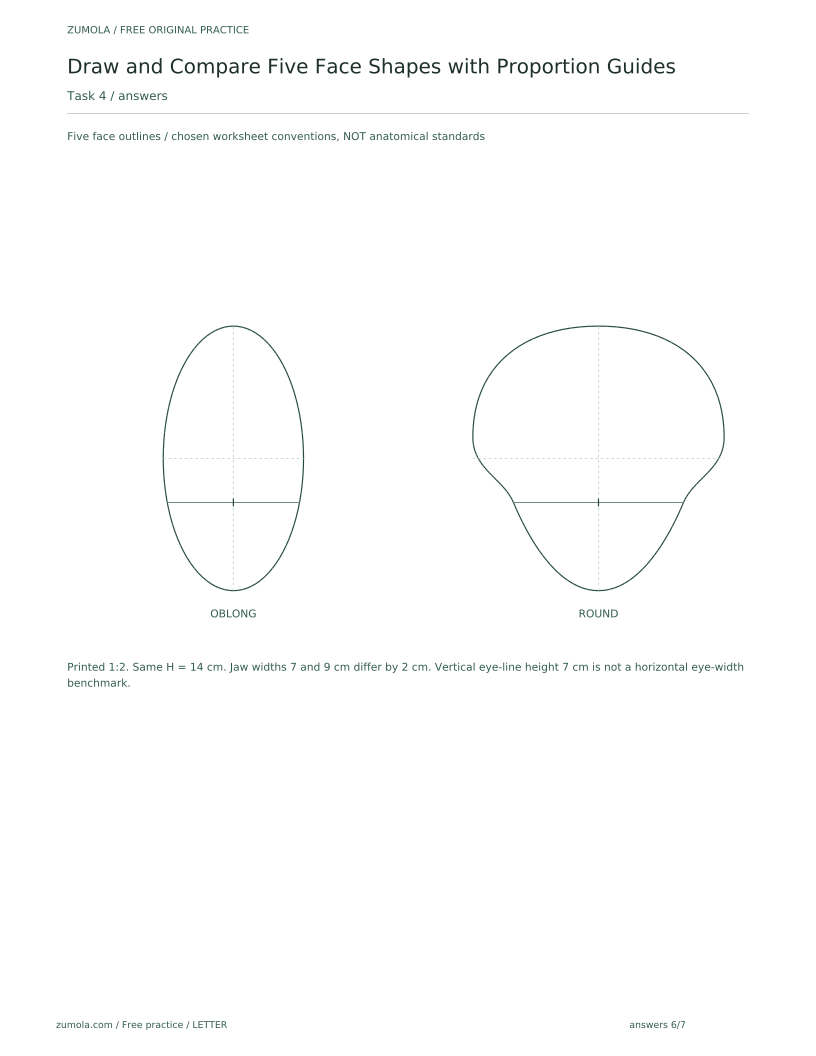
You draw an oblong face with H = 14 cm and a round face with H = 14 cm. The oblong jaw width is 7 cm and the round jaw width is 9 cm. The eye-line is at 7 cm. Which shape reads wider at the jaw, and by how much?
Show answer and check
The round face reads wider at the jaw by 2 cm.
Why: Subtract the oblong jaw width from the round jaw width: 9 minus 7 = 2 cm.
Check: Compare both jaw widths to the eye-line height of 7 cm and confirm the difference is 2 cm.
Common mistakes
- Changing face height between shapes. Use one H for all five outlines and mark it before drawing.
- Placing eyes by guesswork instead of the eye-line. Mark the eye-line at H divided by 2 and place eye centers on it.
- Making the heart chin as wide as the square jaw. Narrow the heart chin clearly and keep the square jaw close to eye width.
- Adding hair or shading before the guides are correct. Finish the feature marks and checklist first; leave hair and shading out.
Self-check rubric
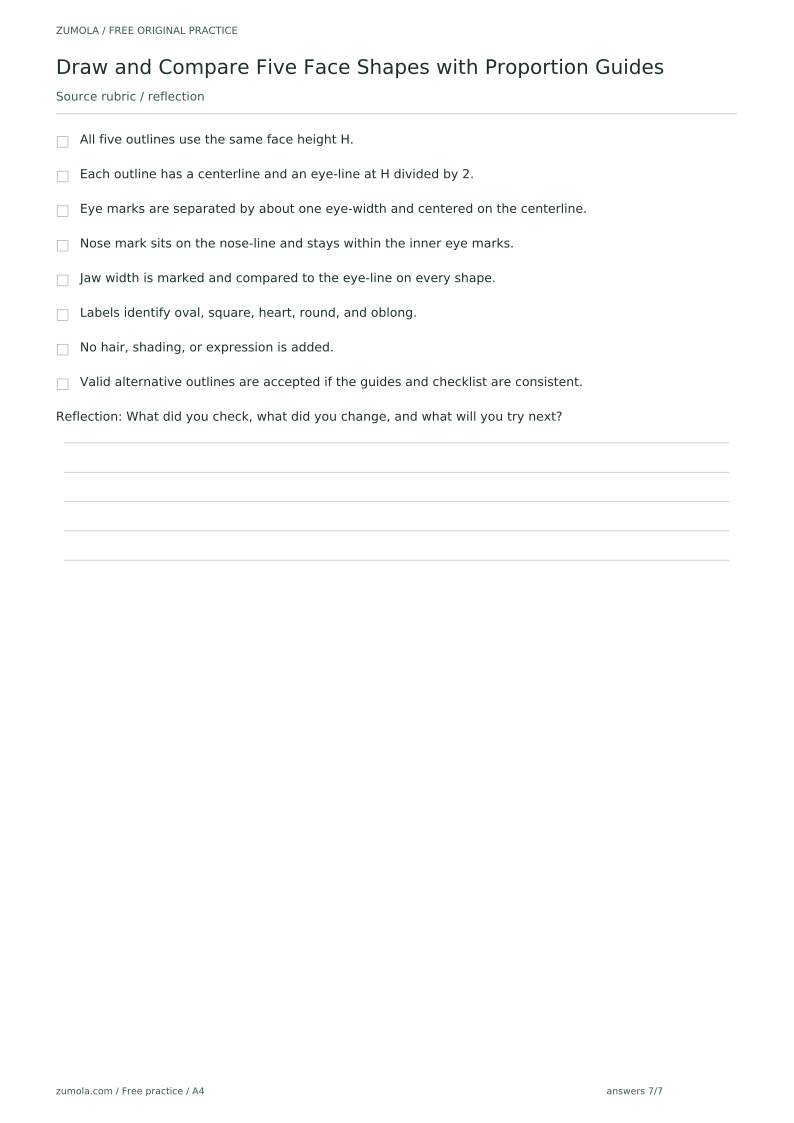
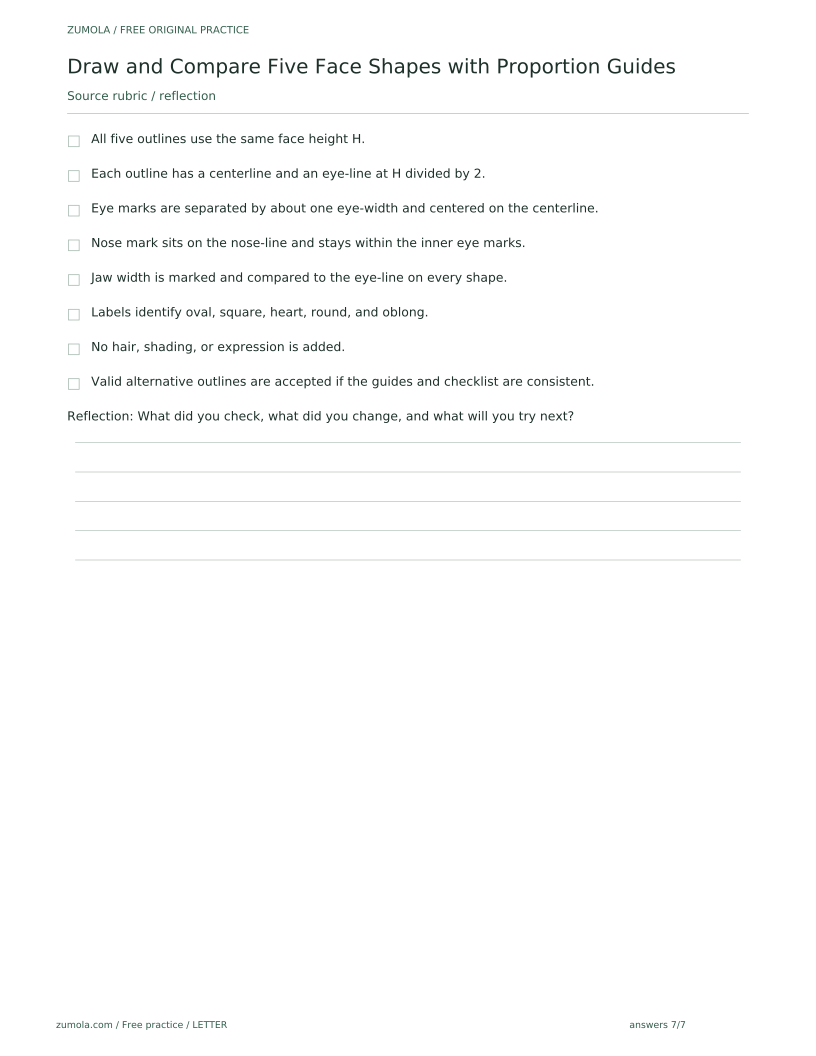
- All five outlines use the same face height H.
- Each outline has a centerline and an eye-line at H divided by 2.
- Eye marks are separated by about one eye-width and centered on the centerline.
- Nose mark sits on the nose-line and stays within the inner eye marks.
- Jaw width is marked and compared to the eye-line on every shape.
- Labels identify oval, square, heart, round, and oblong.
- No hair, shading, or expression is added.
- Valid alternative outlines are accepted if the guides and checklist are consistent.
Questions and answers
Do I need special paper?
No. Plain paper and a pencil work. A ruler helps mark equal heights.
Is there one correct face shape?
No. The five outlines are comparison tools, and valid alternatives exist within each category.
How wide is one eye-width?
Choose a width, such as 2 cm on a 12 cm face, and keep it consistent across all five shapes.
Can I use x-height for facial proportions?
No. X-height is a lettering convention from baseline to midline; letter styles vary, so it is not a facial measure.
Reference illustration
Free printable downloads
Choose a paper size. Practice sheets and answer keys are separate. Download every file free, without registration.
This standard pack covers the four original exercises, blank work areas, complete keys and necessary figures. Additional extension sets described in the lesson are outside this download.
PDF bundles
Individual SVG pages
Reference-page preview