Free original lessons
Portrait Drawing: Place Features with Proportion Guides
Learn to place eyes, nose, and mouth on a head using simple guide lines and checkable proportions. Practice with a convention that allows valid style differences.
Free lesson
Four exercises
Worked answers
Object Drawing Lessons
Portrait drawing becomes manageable when you separate placement from rendering. This lesson teaches a guide-line convention: a vertical midline, an eye line, a nose line, and a mouth line placed by simple fractions of head height. You will measure, mark, and check feature positions before adding detail. The convention is a tool, not a rule about beauty; letter styles and feature shapes vary, so treat each line as a starting checkpoint you can adjust after comparing distances. All measurements use the same unit, and any numerical values are hypothetical examples you can replace with your own measured head height.
Practice materials: Printable downloads are not available for this lesson yet. Use the instructions and four exercises below.
Reference illustration
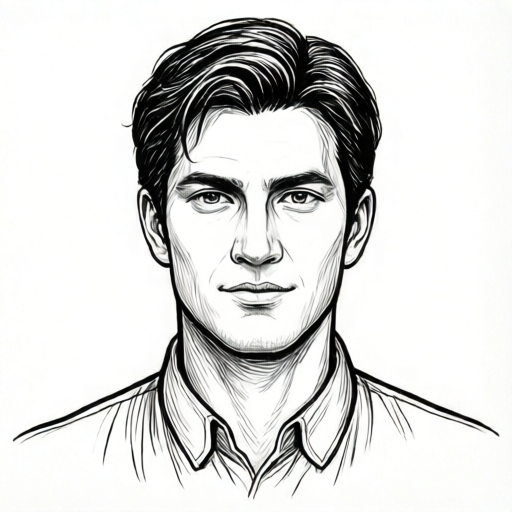
Use the stated measurements and conventions for each exercise.
Set up the head box and midline
Begin with a light rectangle that represents the head's height and width. Measure the actual height of your rectangle in millimeters or centimeters and record it as H. Draw a vertical midline from top to bottom. This line is a placement aid, not a facial feature.
Mark the top and bottom of the head box. The eye line, nose line, and mouth line will be positioned as fractions of H measured from the top. Keep your pencil light so you can erase and adjust.
- Draw a rectangle and label its height H in one unit.
- Draw a vertical midline through the rectangle.
- Mark the top edge as 0 and the bottom edge as H.
- Measure and lightly mark the halfway point, H divided by 2.
Place the eye, nose, and mouth lines
Using the convention, place the eye line at about half of H from the top. Place the nose line at about three-quarters of H from the top. Place the mouth line about one-third of the way from the nose line to the bottom of the head box. These are starting positions; compare the gaps after marking and adjust if your head shape calls for it.
The eye line is a horizontal guide. Eyes sit on or near this line, but their width and spacing vary by style. The nose line marks where the base of the nose begins, not the tip of every nose shape. The mouth line marks the lip line area, not a single universal mouth.
- Mark the eye line at H divided by 2 from the top.
- Mark the nose line at three times H divided by 4 from the top.
- Mark the mouth line one-third of the distance from the nose line to the bottom.
- Check that the gaps between lines are consistent with your recorded measurements.
Place features and check distances
On the eye line, mark two eye positions with a gap between them. A common convention is to leave one eye-width between the eyes, but this is a style choice. Measure the gap and the eye widths with the same unit and record them. On the nose line, mark the nose base width. On the mouth line, mark the mouth width. Compare the widths to the head width and to each other.
Use simple arithmetic checks: the distance from the top to the eye line plus the distance from the eye line to the bottom should equal H. The nose line should sit between the eye line and the mouth line. If a check fails, adjust the light guide lines before adding detail.
- Mark eye positions on the eye line and measure the gap.
- Mark nose base width on the nose line.
- Mark mouth width on the mouth line.
- Add the top-to-eye distance and eye-to-bottom distance; confirm the sum equals H.
- Confirm the nose line is between the eye line and the mouth line.
Refine without losing the placement
Once the guide lines pass your checks, add simple feature shapes. Keep the guide lines visible until the shapes are stable. If you change a feature, re-measure the gap it affects and repeat the arithmetic check. The convention supports many valid outcomes: eyes may be wider or narrower, the nose base may be higher or lower, and the mouth may be fuller or thinner, as long as your recorded measurements and checks remain consistent.
For a final check, compare the vertical order: top, eye line, nose line, mouth line, bottom. Then compare the horizontal spacing on each line. A portrait that passes these checks has defensible feature placement even if the style differs from another drawing.
- Add simple eye, nose, and mouth shapes on the guide lines.
- Re-measure any changed gap and repeat the sum check.
- Confirm vertical order and horizontal spacing.
- Erase guide lines only after the checks pass.
Worked example
A head box is 120 mm tall. Using the convention, find the eye line, nose line, and mouth line positions from the top. Then check that the top-to-eye distance plus the eye-to-bottom distance equals the head height.
Worked answer
Eye line: 120 divided by 2 = 60 mm from the top. Nose line: three times 120 divided by 4 = 90 mm from the top. Mouth line: one-third of the distance from the nose line to the bottom. The nose-to-bottom distance is 120 minus 90 = 30 mm. One-third of 30 mm is 10 mm, so the mouth line is 90 plus 10 = 100 mm from the top. Check: top-to-eye is 60 mm, eye-to-bottom is 120 minus 60 = 60 mm, and 60 plus 60 equals 120 mm, which matches H.
Four practice exercises
Exercise 1
A head box is 80 mm tall. Using the convention, calculate the eye line and nose line positions from the top. Then state the nose-to-bottom distance.
Show answer and check
Eye line: 80 divided by 2 = 40 mm from the top. Nose line: three times 80 divided by 4 = 60 mm from the top. Nose-to-bottom distance: 80 minus 60 = 20 mm.
Why: The eye line is half of H. The nose line is three-quarters of H. Subtract the nose line position from H to find the remaining distance to the bottom.
Check: Add the eye line position and the eye-to-bottom distance: 40 mm plus 40 mm equals 80 mm, which matches H. Confirm the nose line is between the eye line and the bottom.
Exercise 2
A head box is 100 mm tall. The nose line is at 75 mm from the top. Calculate the mouth line using one-third of the nose-to-bottom distance. Then check that the mouth line is below the nose line and above the bottom.
Show answer and check
Nose-to-bottom distance: 100 minus 75 = 25 mm. One-third of 25 mm is about 8.33 mm. Mouth line: 75 plus 8.33 = 83.33 mm from the top. The mouth line is below 75 mm and above 100 mm.
Why: Find the remaining distance from the nose line to the bottom, take one-third of it, and add that to the nose line position.
Check: Confirm 75 is less than 83.33 and 83.33 is less than 100. Recalculate one-third of 25 mm and compare with the recorded mouth line value.
Exercise 3
A head box is 90 mm tall. The eye line is at 45 mm. A student marks the nose line at 70 mm and the mouth line at 60 mm. Identify the vertical order error and give a corrected mouth line position using one-third of the nose-to-bottom distance.
Show answer and check
The mouth line at 60 mm is above the nose line at 70 mm, so the vertical order is wrong. Corrected nose-to-bottom distance: 90 minus 70 = 20 mm. One-third of 20 mm is about 6.67 mm. Corrected mouth line: 70 plus 6.67 = 76.67 mm from the top.
Why: The mouth line must be below the nose line. Recalculate the mouth line from the nose line position and the remaining distance to the bottom.
Check: Confirm the corrected order: 45 mm eye, 70 mm nose, 76.67 mm mouth, 90 mm bottom. Check that 70 is less than 76.67 and 76.67 is less than 90.
Exercise 4
A head box is 140 mm tall and 100 mm wide. The eye line is at 70 mm. On the eye line, two eye positions are marked with a 20 mm gap between them, and each eye width is 15 mm. Calculate the total horizontal space used by the two eyes and the gap. Then state whether this fits within the 100 mm head width.
Show answer and check
Total horizontal space: 15 mm plus 20 mm plus 15 mm = 50 mm. This fits within the 100 mm head width, leaving 50 mm for the remaining side spaces.
Why: Add the two eye widths and the gap. Compare the sum with the head width using the same unit.
Check: Subtract the total used space from the head width: 100 minus 50 = 50 mm. Confirm the result is not negative and that the eye line position plus the eye-to-bottom distance equals 140 mm.
Common mistakes
- Placing the eye line at one-third of the head height without measuring. Measure H, divide by 2, and mark the eye line at that distance from the top. Record the value.
- Using different units for the head height and the feature gaps. Choose one unit, such as centimeters, and convert all measurements before comparing.
- Treating the nose line as the tip of every nose shape. Use the nose line as the base-of-nose guide, then adjust the nose shape while keeping the line as a checkpoint.
- Erasing guide lines before checking the vertical order. Keep light guide lines until top, eye, nose, mouth, and bottom are confirmed in order.
Self-check rubric
- The head box height H is measured and recorded in one consistent unit.
- A vertical midline is present and used as a placement aid.
- The eye line, nose line, and mouth line are marked as fractions of H and labeled.
- The vertical order is top, eye line, nose line, mouth line, bottom.
- The sum of top-to-eye and eye-to-bottom distances equals H within the recorded measurement.
- Feature widths and gaps are measured with the same unit and recorded.
- Valid style alternatives are accepted when the recorded measurements and checks remain consistent.
Questions and answers
Do I have to use exactly half for the eye line?
No. Half is a starting convention. Measure your own head box and adjust, then record the new fraction and check that the vertical distances still sum to H.
What if my style makes the eyes wider than one eye-width apart?
That can be valid. Measure the gap and eye widths, record them, and confirm the total horizontal layout fits within the head width.
Can I use inches instead of centimeters?
Yes, as long as every measurement in the drawing uses the same unit. Convert any mixed values before comparing.
How do I know the placement is correct?
Use the arithmetic checks: top-to-eye plus eye-to-bottom equals H, the nose line lies between the eye and mouth lines, and the vertical order is top, eye, nose, mouth, bottom.