Free original lessons
Draw a Dragon from Front, Side, and Three-Quarter Views
Learn to construct a dragon consistently across three viewpoints using simple shapes, alignment guides, and a clear convention for proportions.
Free lesson
Four exercises
Worked answers
Object Drawing Lessons
Drawing the same dragon from different angles is easier when you build it from a few repeatable shapes instead of copying outlines. This lesson teaches a construction method for front, side, and three-quarter views. You will use a simple convention: the dragon's body is a rounded box, the neck is a tapered cylinder, and the head is a wedge with a snout. All measurements are relative to the dragon's own body, so you can scale the drawing freely. Work on plain paper with a pencil and eraser. Keep your lines light until the final pass. The goal is consistency: the same dragon should feel like one creature, not three unrelated sketches.
Practice materials: Printable downloads are not available for this lesson yet. Use the instructions and four exercises below.
Reference illustration
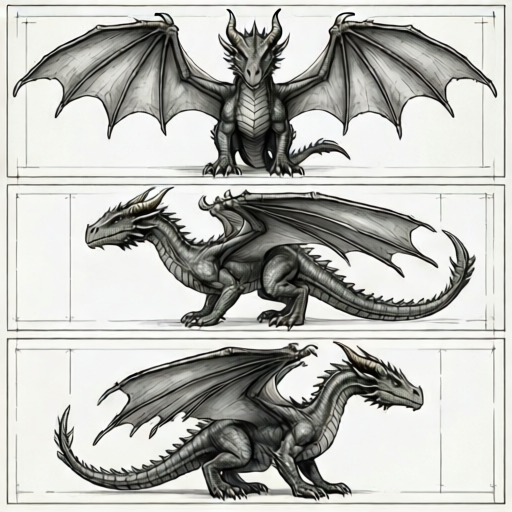
Use the stated measurements and conventions for each exercise.
Set a shared proportion convention
Before drawing any view, decide on one body length unit. Call it L. In the front view, the body width is about 0.6L and the body height is about 0.5L. In the side view, the body length is L and the height is 0.5L. In the three-quarter view, the visible body length is about 0.8L and the width is about 0.5L. These are hypothetical example values; adjust them to your design, but keep them consistent across all three views.
Use the same head size in every view: head length about 0.35L, head width about 0.25L. The neck connects the head to the body with a taper. Legs are about 0.4L long from body to ground. Wings attach at the upper back, roughly one-third of the body length from the front. Mark these anchor points lightly before adding detail.
- Draw a horizontal baseline and mark a scale bar of length L.
- Lightly mark body, head, neck, leg, and wing anchor points using the proportions above.
- Check that the same anchor points appear in all three views before drawing outlines.
Front view construction
Start with a vertical center line. Draw the body as a rounded rectangle centered on the line, width 0.6L and height 0.5L. Place the head above the body, centered, with the snout pointing toward the viewer. The neck is a short tapered shape connecting head and body. Because the dragon faces you, the legs appear as two pairs: front legs slightly inside the body width, rear legs slightly outside. Wings spread symmetrically left and right from the upper back.
Keep the front view symmetrical unless your design intentionally has asymmetry. Use the center line to check that eyes, nostrils, and horns mirror each other. The tail is mostly hidden behind the body in this view; show only a small tip if desired.
- Draw the vertical center line and the body rounded rectangle.
- Add the head wedge and neck taper on the center line.
- Place legs and wings symmetrically, then erase construction lines lightly.
Side view construction
Draw a horizontal ground line. The body is a rounded rectangle of length L and height 0.5L, resting above the ground by the leg length. Place the head at the front, with the snout pointing forward. The neck curves slightly upward from body to head. In side view, you see one front leg and one rear leg clearly; the far legs can be hinted with lighter lines. The wing folds along the back, so show its top edge and a few fold lines rather than a full spread.
Use the same head length and body height as the front view. The tail extends behind the body, roughly 0.5L long, tapering to a point. Check that the eye is on the side of the head and the nostril is near the snout tip.
- Draw the ground line and body rectangle of length L.
- Attach the neck and head at the front, snout forward.
- Add near legs, tail, and folded wing, then compare head size with the front view.
Three-quarter view construction
The three-quarter view combines front and side information. Draw a body shape that is about 0.8L long and 0.5L high, angled so one side is more visible. Place the head slightly off-center toward the viewer's left or right, with the snout turned partway toward the viewer. The neck connects at an angle. One front leg is more visible than the other; the far legs are partially hidden. Wings attach at the upper back, with one wing more foreshortened.
Use the same head size and leg length as the other views. The tail curves away behind the body. Check consistency by comparing the head-to-body ratio and the leg length with your front and side drawings. The three-quarter view should look like the same dragon rotated, not a new design.
- Draw an angled body shape using 0.8L visible length.
- Place the head off-center and turn the snout partway toward the viewer.
- Add near and far legs, wings, and tail, then compare proportions with the other views.
Worked example
A dragon has body length L = 10 cm on paper. Using the lesson proportions, find the body height, head length, and leg length, then state where the wing anchor sits in the side view.
Worked answer
Body height = 0.5L = 5 cm. Head length = 0.35L = 3.5 cm. Leg length = 0.4L = 4 cm. The wing anchor is one-third of body length from the front, so 10 cm divided by 3 is about 3.3 cm from the front edge of the body.
Why: Each proportion is a multiplier of L. Multiply 10 cm by 0.5, 0.35, and 0.4. For the wing anchor, divide L by 3.
Check: Add the leg length to the body height: 4 cm + 5 cm = 9 cm total height above ground. Re-measure the head against the scale bar to confirm 3.5 cm.
Four practice exercises
Exercise 1
Using L = 8 cm, calculate body height, head length, and leg length with the lesson proportions. Then state the wing anchor distance from the front in the side view.
Show answer and check
Body height = 4 cm; head length = 2.8 cm; leg length = 3.2 cm; wing anchor = about 2.7 cm from the front.
Why: Multiply 8 cm by 0.5, 0.35, and 0.4. Divide 8 cm by 3 for the wing anchor.
Check: Add leg length and body height: 3.2 cm + 4 cm = 7.2 cm total height. Confirm head length is less than body height.
Exercise 2
A front-view drawing shows a body width of 6 cm. If the convention says body width is 0.6L, what is L? Then find the side-view body length.
Show answer and check
L = 10 cm; side-view body length = 10 cm.
Why: Divide 6 cm by 0.6 to get L. The side-view body length equals L.
Check: Multiply L by 0.6 to return to 6 cm. Confirm side-view length matches the scale bar.
Exercise 3
In a three-quarter view, the visible body length is 0.8L. If L = 12 cm, what visible length should you draw? If the head length is 0.35L, what is it?
Show answer and check
Visible body length = 9.6 cm; head length = 4.2 cm.
Why: Multiply 12 cm by 0.8 and by 0.35.
Check: Add the two results: 9.6 cm + 4.2 cm = 13.8 cm. Re-measure each against the scale bar of 12 cm.
Exercise 4
A side-view dragon has leg length 5 cm and body height 6 cm. What is the total height above the ground line? If the head length is 4 cm, is the head longer or shorter than the body height?
Show answer and check
Total height = 11 cm; the head is shorter than the body height.
Why: Add leg length and body height for total height. Compare 4 cm head length with 6 cm body height.
Check: Subtract leg length from total height to return to 6 cm. Confirm 4 cm is less than 6 cm.
Common mistakes
- Changing head size between views. Measure head length against the scale bar L in every view and keep it about 0.35L.
- Drawing the three-quarter view as a side view with a turned head only. Angle the body shape and show one side more than the other; foreshorten the far wing and far legs.
- Making legs different lengths in front and side views. Use the same leg length, about 0.4L, and check against the ground line.
- Placing wings at different heights across views. Mark the wing anchor at one-third of body length from the front in all three views before drawing wing shapes.
Self-check rubric
- All three views use the same scale bar L and the same head length.
- Body height is consistent across front, side, and three-quarter views.
- Leg length matches in all views and rests on the ground line.
- Wing anchor appears at the same relative position in every view.
- Three-quarter view shows foreshortening: one side of the body is more visible, and far legs or wing are partially hidden.
- Construction lines are light and final outlines are clear.
- Valid alternative proportions are accepted if they are recorded and used consistently.
Questions and answers
Do I have to use the exact proportions given?
No. The numbers are hypothetical examples. Choose your own consistent proportions and record them on a scale bar so all three views match.
How do I know the three-quarter view is correct?
Compare head size, body height, and leg length with the front and side views. If those match, the rotation is consistent.
Can I add spikes or horns?
Yes, but place them using the same anchor points in every view so they do not shift position.
What if my dragon has a longer neck?
Decide the neck length as a multiple of L, write it down, and use that same multiple in all three views.