Free original lessons
Ink Flower Drawing: Petal and Leaf Stroke Practice
Learn ink pen flower strokes with guided petal and leaf direction, step-by-step construction, and self-checked practice panels.
Free lesson
Four exercises
Worked answers
Object Drawing Lessons
This lesson teaches ink pen flowers through controlled stroke direction for petals and leaves. You will practice single strokes, build a simple flower from a center outward, and check your work with a clear convention: x-height is measured from baseline to midline, and letter styles vary. All exercises are self-contained; any diagram is described in text. Use a pen that makes a consistent line, and measure your actual paper and pen before labeling any numerical values as hypothetical examples.
Practice materials: Printable downloads are not available for this lesson yet. Use the instructions and four exercises below.
Reference illustration
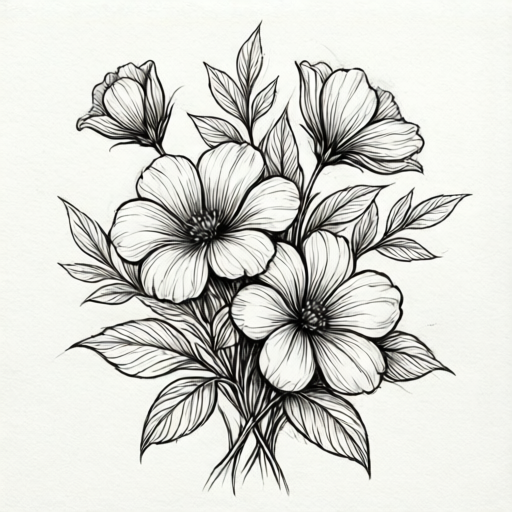
Use the stated measurements and conventions for each exercise.
Stroke Direction and Pressure Basics
Ink flowers depend on repeatable strokes. A petal stroke starts at the flower center, moves outward with light pressure, and lifts at the tip. A leaf stroke starts at the stem, moves toward the tip, and may taper by lifting the pen. Keep your hand relaxed and rotate the paper rather than forcing an awkward wrist angle.
Define a simple convention before drawing: the baseline is the lowest line of your practice panel, and the midline is halfway up that panel. X-height is the distance from baseline to midline. Letter styles vary, so do not treat x-height as a universal flower size; use it only as a local reference for stroke length and spacing.
- Draw two horizontal guide lines on scrap paper: baseline and midline, with midline halfway between baseline and the top of the panel.
- Practice ten petal strokes from a center point outward, lifting at the tip.
- Practice ten leaf strokes from a stem line toward a tip, tapering by lifting the pen.
- Compare stroke lengths to your x-height reference and adjust spacing, not pressure, first.
Building a Simple Ink Flower
A reliable flower starts with a small center mark, then a ring of petals drawn in alternating directions. Alternate directions so the flower does not lean. Overlap petal bases slightly at the center, but keep tips separate. Add leaves after the petals so you can judge balance.
Use a hypothetical example for spacing: if your x-height is 10 mm on your actual paper, try petal lengths of about 15 mm and leaf lengths of about 20 mm. These numbers are examples only; measure your own equipment and adjust.
- Mark a center point and draw five petal strokes outward, alternating clockwise and counterclockwise.
- Draw a second layer of five shorter petals between the first-layer gaps.
- Add a stem line downward from the center, then draw two leaves from the stem toward their tips.
- Check that petal tips do not cross and that leaf bases meet the stem cleanly.
Practice Panels and Self-Check
Divide a page into four blank panels. In panel one, practice petal strokes only. In panel two, practice leaf strokes only. In panel three, draw one complete flower. In panel four, draw a small cluster of two flowers and three leaves. Label each panel with the date and pen used.
Self-check with a convention, not a single universal answer. Valid alternatives include narrower petals, wider leaves, or a different petal count, provided the stroke direction and taper are intentional. Measure x-height on your actual panel and note whether stroke lengths are consistent with your chosen reference.
- Draw four panels and label them petal, leaf, flower, and cluster.
- Complete each panel with at least five strokes or one full form.
- Circle any stroke where the taper is unclear or the tip crosses another line.
- Redraw one circled stroke three times, changing only direction or lift point.
Worked example
On a panel with baseline at 0 mm and midline at 10 mm, draw one flower with five petals and two leaves. Use petal length 15 mm and leaf length 20 mm as hypothetical examples. Describe the stroke order and one check.
Worked answer
Mark a center point 30 mm above the baseline. Draw five petal strokes outward, alternating clockwise and counterclockwise, each about 15 mm long, lifting at the tip. Draw a stem downward to the baseline. Draw two leaf strokes from the stem toward their tips, each about 20 mm long, tapering by lifting. Check that petal tips do not cross and that leaf bases meet the stem cleanly.
Four practice exercises
Exercise 1
Draw a practice panel with baseline at 0 mm and midline at 8 mm. Draw six petal strokes from one center point, alternating directions, each about 12 mm long as a hypothetical example. Check that no tips cross.
Show answer and check
A panel with six outward strokes from one center, alternating clockwise and counterclockwise, tips separate.
Why: Alternating directions prevents leaning; lifting at the tip keeps the taper clean.
Check: Measure x-height on the actual panel, confirm six strokes, and circle any crossing tips.
Exercise 2
Draw four leaf strokes from a vertical stem line. Start each at the stem and taper toward the tip. Use leaf length 18 mm as a hypothetical example. Check that each base meets the stem.
Show answer and check
Four tapered strokes beginning at the stem line and ending at separate tips.
Why: Starting at the stem controls the taper and keeps leaf bases attached.
Check: Confirm each stroke begins on the stem line and that tips do not overlap.
Exercise 3
Build one flower with a center, five outer petals, and three inner petals. Add one stem and two leaves. Use petal length 14 mm and leaf length 19 mm as hypothetical examples. Check balance by comparing left and right petal counts.
Show answer and check
A flower with eight petals total, one stem, and two leaves, with left and right sides roughly balanced.
Why: Layering shorter inner petals fills gaps; counting left and right checks lean.
Check: Count petals on each side of the center and confirm stem and leaf bases meet.
Exercise 4
Draw a cluster of two flowers and three leaves in one panel. Use different petal counts for each flower, such as five and seven, as a style choice. Check that stems do not cross and that x-height is measured on the actual panel.
Show answer and check
Two flowers with different petal counts and three leaves, stems separate, x-height noted locally.
Why: Different petal counts are valid alternatives if stroke direction and taper remain intentional.
Check: Trace each stem to its flower, confirm no stem crossings, and record the measured x-height.
Common mistakes
- Pressing hard at the petal tip, causing a blob. Lift the pen gradually before the tip and keep pressure light at the end.
- Drawing all petals in the same direction, making the flower lean. Alternate clockwise and counterclockwise strokes around the center.
- Starting leaf strokes at the tip instead of the stem. Begin at the stem line and move toward the tip so the taper is controlled.
- Using x-height as a fixed flower size for every letter style. Treat x-height as a local reference only; letter styles vary, so adjust spacing to your panel.
Self-check rubric
- Petal strokes start near the center and lift at the tip.
- Leaf strokes start at the stem and taper toward the tip.
- Stroke directions alternate or are intentionally varied.
- X-height reference is measured on the actual panel and labeled as local.
- Valid alternatives are accepted if stroke direction and taper are intentional.
- Self-check circles unclear tapers or crossings and redraws one stroke.
Questions and answers
Do I need special ink pens?
No. Use any pen that makes a consistent line. Measure your actual pen and paper before choosing stroke lengths.
How many petals should a flower have?
Five to ten petals is a practical range. The exact count is a style choice; keep stroke direction and taper intentional.
What does x-height mean here?
X-height is the distance from baseline to midline on your practice panel. It is a local reference, not a universal flower size.
Can I use the hypothetical 10 mm example?
Only as an example. Measure your own paper and pen, then label any chosen values as hypothetical.