Free original lessons
Petunia Drawings: Trumpet Petal Construction and Bloom Clusters
Learn to draw petunias by building trumpet-shaped petals from throat to ruffled edge, then arrange blooms in natural clusters with overlap shading.
Free lesson
Four exercises
Worked answers
Object Drawing Lessons
Petunias are recognizable by their trumpet form: a narrow throat that flares into a wide, often ruffled rim. This lesson breaks that shape into measurable stages, then shows how to cluster several blooms so they read as one plant. You will use a simple convention: the flower's face is a circle or oval, the throat is a smaller concentric shape, and the flare connects them with curved lines. All measurements are hypothetical examples; measure your own paper and tools. The goal is a clear, checkable construction, not a single correct style.
Practice materials: Printable downloads are not available for this lesson yet. Use the instructions and four exercises below.
Reference illustration
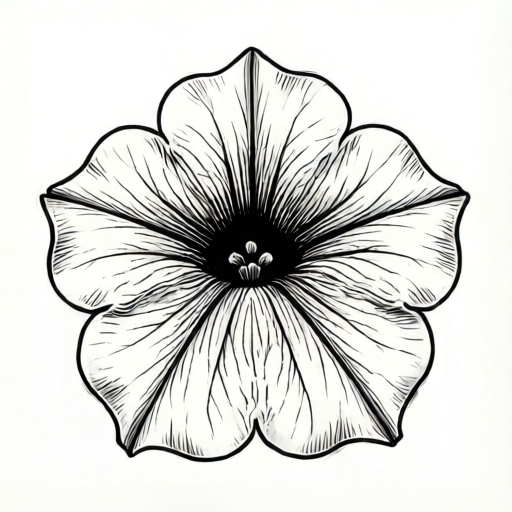
Use the stated measurements and conventions for each exercise.
Building the trumpet from throat to rim
Start with the flower face as an oval. Mark its center and draw a smaller oval inside for the throat opening. The space between the two ovals is the flare. Draw four to six curved lines from the throat oval outward to the rim oval, spacing them evenly. These lines are the petal seams. The rim is not a perfect circle: add gentle scallops between seams to suggest ruffling. Keep the throat darker and the rim lighter to show depth.
Use a consistent unit, such as centimeters, for your example. If the face oval is 6 cm wide and 5 cm tall, make the throat oval 2 cm wide and 1.5 cm tall, centered. The flare lines then travel about 2 cm from throat edge to rim. These numbers are hypothetical; adjust to your paper size. Check that every seam reaches the rim and that scallops sit between seams, not on them.
- Draw a light face oval and mark its center.
- Draw a smaller centered throat oval inside it.
- Add four to six evenly spaced curved seam lines from throat to rim.
- Scallop the rim between seams to suggest ruffling.
- Shade the throat darkest, the flare medium, and the rim lightest.
Arranging blooms in a cluster
A petunia cluster reads best when blooms overlap slightly and face different directions. Place three to five face ovals first, varying size by about 20 percent. Let each new bloom overlap the previous one by roughly one-third of its width. Draw the front bloom completely, then draw the back blooms only up to the overlap line. This creates depth without erasing.
Add stems last. Each stem should meet its bloom at the throat, not the rim. Keep stem curves gentle and avoid crossing stems at sharp angles. A simple check: trace each stem from bloom to cluster base without lifting your pencil; if the path is blocked by another bloom, redraw that stem behind it.
- Place three to five face ovals with varied sizes.
- Overlap each new bloom by about one-third of its width.
- Draw front blooms fully and back blooms only to the overlap line.
- Attach stems at the throat and keep curves gentle.
- Check that no stem crosses another at a sharp angle.
Shading overlap and vein lines
Shade overlap zones with short parallel strokes that follow the petal curve. Where one bloom sits in front, darken the back bloom's edge just inside the overlap. Vein lines should start at the throat and fan outward, thinning as they reach the rim. Draw no more than three veins per petal seam gap; too many veins flatten the trumpet.
Use a simple value scale: throat darkest, overlap shadow medium-dark, flare medium, rim light. Check by squinting: the trumpet should still read as a funnel. If the rim looks as dark as the throat, lighten the rim. If the overlap disappears, darken the back bloom's edge slightly.
- Shade overlap zones with curved parallel strokes.
- Darken the back bloom's edge inside each overlap.
- Draw veins from throat outward, thinning toward the rim.
- Limit veins to three per seam gap.
- Squint-check that the funnel shape still reads.
Worked example
Draw one petunia bloom with a 6 cm by 5 cm face oval, a centered 2 cm by 1.5 cm throat oval, five seam lines, and scalloped rim. Shade throat darkest and rim lightest.
Worked answer
A completed bloom shows a light face oval, a smaller centered throat oval, five curved seams reaching the rim, scallops between seams, and a value gradient from dark throat to light rim. The trumpet reads as a funnel when squinting.
Four practice exercises
Exercise 1
Draw a single bloom with a 5 cm wide face oval and a throat oval one-third that width. Add four seam lines and scallops between them.
Show answer and check
A bloom with a 5 cm face oval, a throat oval about 1.7 cm wide, four seams reaching the rim, and scallops between seams.
Why: The throat width follows the three-to-one rule, and four seams are within the allowed range. Scallops between seams create the ruffled rim.
Check: Measure the throat width; it should be about 1.7 cm. Count seams (four) and confirm each reaches the rim. Confirm scallops sit between seams.
Exercise 2
Arrange three blooms in a cluster. Make the second bloom overlap the first by about one-third of its width, and the third overlap the second similarly. Draw stems to the throats.
Show answer and check
Three overlapping blooms with varied sizes, front blooms drawn fully, back blooms drawn only to overlap lines, and stems meeting throats.
Why: Overlapping by one-third creates depth. Drawing back blooms only to the overlap line avoids erasing and keeps the front bloom clear.
Check: Trace each stem from bloom to cluster base without lifting the pencil. Confirm no stem meets a rim and that each overlap is about one-third of the front bloom's width.
Exercise 3
Add vein lines to one bloom: no more than three veins per seam gap, starting at the throat and thinning toward the rim. Shade the throat darkest and the rim lightest.
Show answer and check
A bloom with up to three veins per gap, a dark throat, medium flare, and light rim.
Why: Limiting veins keeps the trumpet readable. The value order reinforces the funnel shape.
Check: Count veins per gap (maximum three). Squint: the throat should be darkest and the rim lightest. If the rim matches the throat, lighten the rim.
Exercise 4
Draw two overlapping blooms and shade only the back bloom's edge inside the overlap. Then check that the overlap shadow is darker than the flare but lighter than the throat.
Show answer and check
Two blooms with a medium-dark overlap shadow on the back bloom's edge, a medium flare, and a dark throat.
Why: Shading only the back bloom's edge inside the overlap creates separation without muddying the front bloom. The value order keeps depth clear.
Check: Compare values: throat darkest, overlap shadow medium-dark, flare medium, rim light. Confirm the front bloom's surface is not darkened inside the overlap.
Common mistakes
- Drawing the rim as a perfect circle with no scallops. Add gentle scallops between seam lines so the rim suggests ruffling.
- Making the throat oval too large, so the trumpet looks flat. Keep the throat roughly one-third the width of the face oval.
- Letting stems meet the rim instead of the throat. Redraw each stem so it ends at the throat opening.
- Shading the rim as dark as the throat. Lighten the rim and keep the darkest value in the throat and overlap shadows.
Self-check rubric
- Face oval and throat oval are concentric and proportioned about three to one in width.
- Four to six seam lines reach the rim and are evenly spaced.
- Scallops sit between seams, not on them.
- Stems meet the throat, not the rim.
- Overlap shading darkens only the back bloom's edge inside the overlap.
- Value order is throat darkest, rim lightest.
- Valid alternatives: any seam count from four to six, any scallop depth that stays gentle, and any vein count up to three per gap.
Questions and answers
How many seam lines should a petunia bloom have?
Four to six evenly spaced curved lines work well. Fewer looks simple; more can crowd the flare.
Can I vary the bloom size in a cluster?
Yes. Vary sizes by about 20 percent so the cluster looks natural rather than stamped.
Where should vein lines start and end?
Start at the throat and fan outward, thinning before the rim. Limit to three veins per seam gap.
What if my overlap shading looks muddy?
Use fewer, cleaner strokes and darken only the back bloom's edge inside the overlap.