Free original lessons
Draw a Bouquet: Bloom Clusters, Wrap, Ribbon, and Stems
Learn to compose a bouquet drawing with grouped blooms, a shaped wrap, a ribbon bow, and tidy stem lines using simple, checkable steps.
Free lesson
Four exercises
Worked answers
Object Drawing Lessons
This lesson teaches bouquet composition rather than flower identification or color rendering. You will arrange bloom clusters, shape a wrap, draw a ribbon bow, and group stems so the drawing reads clearly. Use pencil and paper. All measurements are hypothetical examples; measure your own paper and tools. The convention for size is x-height: the distance from baseline to midline of a lowercase x in your normal handwriting. Letter styles vary, so treat x-height as a personal unit, not a universal standard.
Practice materials: Printable downloads are not available for this lesson yet. Use the instructions and four exercises below.
Reference illustration
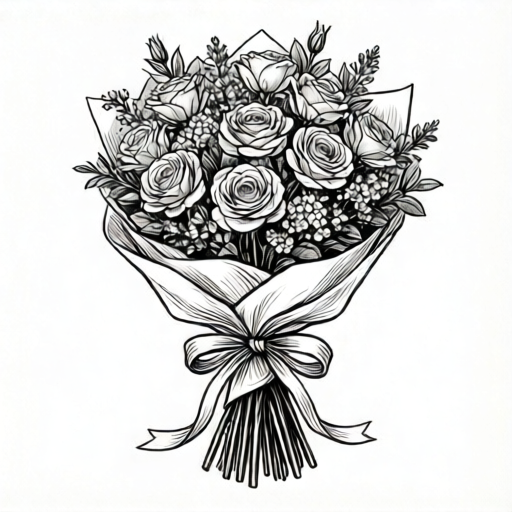
Use the stated measurements and conventions for each exercise.
Plan the bloom cluster layout
Start with a composition box on your paper. A hypothetical box is 18 cm wide and 24 cm tall; adjust to your paper. Mark a center vertical line and a horizontal midline. Decide three bloom clusters: a large focal cluster near the center, a medium cluster above and slightly left, and a small cluster to the right. Each cluster is a group of overlapping circles or ovals, not individual species.
Use x-height to size blooms. If your x-height is 5 mm, make the focal cluster about 4 x-heights across, the medium about 3, and the small about 2. Keep gaps between clusters at least 1 x-height so groups stay distinct. Overlap blooms inside a cluster by about one-third of a bloom width to show grouping.
- Draw the composition box and mark center and midline.
- Place three cluster centers: focal at center, medium above-left, small right.
- Draw overlapping circles or ovals for each cluster using the x-height sizes.
- Check that cluster gaps are at least 1 x-height and overlaps are about one-third.
Shape the wrap and group the stems
The wrap is a simple cone or folded shape below the blooms. Draw two outer wrap lines from the lower bloom cluster edges down to a narrow point, then add one or two fold lines inside. The wrap should cover the lower third of the bloom area and narrow toward the stem bundle. Keep the wrap outline smooth and symmetrical enough to read as a holder.
Group stems into a single bundle below the wrap point. Draw three to five stem lines that converge, then continue as parallel lines for a short distance. Use a hypothetical stem length of 6 x-heights below the wrap point. Space stem lines about half an x-height apart so the bundle reads as grouped, not scattered.
- Draw two outer wrap lines from bloom edges to a narrow point.
- Add one or two interior fold lines inside the wrap.
- Draw three to five stem lines converging at the wrap point.
- Continue stems as parallel lines for about 6 x-heights and check spacing.
Draw the ribbon bow
Place the bow at the wrap point or slightly above it. Draw a small center knot as a circle about 1 x-height across. Add two loops as rounded triangles or ovals on either side, each about 2 x-heights wide. Add two tails below the knot, each about 3 x-heights long, with a gentle curve. Keep loops and tails balanced but not identical; valid alternatives include different loop shapes and tail curves.
Check the bow by counting parts: one knot, two loops, two tails. Ensure the bow overlaps the wrap and stems slightly so it reads as tied on. Use the rubric to accept any bow that has these parts, clear overlap, and balanced placement.
- Draw the center knot at the wrap point.
- Add two loops, one on each side, about 2 x-heights wide.
- Add two curved tails below the knot, about 3 x-heights long.
- Check for one knot, two loops, two tails, and slight overlap with wrap and stems.
Refine and self-check the composition
Refine line clarity by darkening the final bloom cluster outlines, wrap outline, stem bundle, and bow. Erase construction marks lightly. Check that the focal cluster is largest, the wrap covers the lower blooms, stems converge, and the bow sits at the wrap point. Use the rubric to score each part from 0 to 2 and revise the lowest score first.
Remember that letter styles vary, so x-height is your own unit. If your x-height is 4 mm, all hypothetical sizes scale down; if 6 mm, they scale up. Measure your actual paper and pencil before drawing, and label any chosen numbers as examples.
- Darken final outlines for blooms, wrap, stems, and bow.
- Erase construction marks lightly.
- Score each rubric part from 0 to 2.
- Revise the part with the lowest score and recheck.
Worked example
A student has an x-height of 5 mm and a composition box 18 cm by 24 cm. They draw a focal cluster 4 x-heights across, a medium cluster 3 x-heights across, and a small cluster 2 x-heights across. They place the focal cluster at center, the medium above-left, and the small right. They draw a wrap from lower bloom edges to a narrow point, three stem lines converging and continuing 6 x-heights below, and a bow with one knot, two loops, and two tails. Check the sizes and spacing.
Worked answer
Focal cluster = 4 x 5 mm = 20 mm across. Medium = 3 x 5 mm = 15 mm. Small = 2 x 5 mm = 10 mm. Cluster gaps should be at least 1 x-height = 5 mm. Stem length below wrap = 6 x 5 mm = 30 mm. Stem spacing about half an x-height = 2.5 mm. The bow has the required one knot, two loops, and two tails. The composition meets the size and spacing checks.
Four practice exercises
Exercise 1
Using an x-height of 4 mm, calculate the across-size of a focal cluster that is 4 x-heights, a medium cluster that is 3 x-heights, and a small cluster that is 2 x-heights. State the minimum gap between clusters.
Show answer and check
Focal = 16 mm, medium = 12 mm, small = 8 mm. Minimum gap = 1 x-height = 4 mm.
Why: Multiply each x-height count by 4 mm. The gap rule is at least 1 x-height, so 4 mm.
Check: Recompute 4 x 4 = 16, 3 x 4 = 12, 2 x 4 = 8, and confirm the gap is 4 mm.
Exercise 2
A wrap point is 30 mm below the lowest bloom. If stem lines continue 6 x-heights below the wrap point and x-height is 5 mm, how long is the stem section below the wrap? If three stems are spaced half an x-height apart, what is the total spacing between the first and third stem line?
Show answer and check
Stem section = 30 mm. Spacing between first and third stem line = 5 mm.
Why: 6 x 5 mm = 30 mm. Half an x-height = 2.5 mm. Two gaps between three lines = 2 x 2.5 mm = 5 mm.
Check: Confirm 6 x 5 = 30 and 2 x 2.5 = 5.
Exercise 3
Describe a bow that meets the rubric: list the parts and their hypothetical sizes using an x-height of 6 mm. Include knot, loops, and tails.
Show answer and check
Knot about 1 x-height = 6 mm across; two loops each about 2 x-heights = 12 mm wide; two tails each about 3 x-heights = 18 mm long. The bow overlaps the wrap and stems slightly.
Why: Use the lesson proportions: knot 1 x-height, loops 2 x-heights, tails 3 x-heights. Multiply by 6 mm.
Check: Count one knot, two loops, two tails; verify 1 x 6 = 6, 2 x 6 = 12, 3 x 6 = 18, and check overlap.
Exercise 4
A student draws three bloom clusters with gaps of 3 mm, 5 mm, and 7 mm using an x-height of 5 mm. Which gaps meet the minimum gap rule? If the focal cluster is 18 mm across, how many x-heights is that?
Show answer and check
The 5 mm and 7 mm gaps meet the rule; 3 mm does not. The focal cluster is 18 / 5 = 3.6 x-heights.
Why: Minimum gap is 1 x-height = 5 mm. Compare each gap. Divide 18 mm by 5 mm for x-height count.
Check: Check 3 < 5, 5 = 5, 7 > 5, and compute 18 / 5 = 3.6.
Common mistakes
- Drawing blooms as separate scattered circles instead of clusters. Group blooms with about one-third overlap inside each cluster and keep at least 1 x-height gap between clusters.
- Making the wrap too wide or too short so it does not read as a holder. Draw the wrap from lower bloom edges to a narrow point and cover about the lower third of the bloom area.
- Scattering stem lines instead of grouping them. Converge three to five stem lines at the wrap point, then continue them as parallel lines spaced about half an x-height apart.
- Drawing a bow with missing parts or no overlap. Include one knot, two loops, and two tails, and overlap the bow slightly with the wrap and stems.
Self-check rubric
- Bloom clusters: 0 = scattered or missing groups; 1 = three clusters present but gaps or overlaps unclear; 2 = three distinct clusters with about one-third overlap and at least 1 x-height gaps.
- Wrap shape: 0 = missing or not a holder shape; 1 = present but too wide, too short, or unclear; 2 = smooth wrap from lower blooms to a narrow point covering about the lower third.
- Stem grouping: 0 = scattered or missing; 1 = some convergence but spacing uneven; 2 = three to five stems converge at the wrap point and continue as parallel lines spaced about half an x-height.
- Ribbon bow: 0 = missing parts or no overlap; 1 = one knot, two loops, two tails but unbalanced or no overlap; 2 = all parts present, slight overlap with wrap and stems, balanced placement.
- Line clarity: 0 = construction marks obscure final lines; 1 = final lines visible but messy; 2 = final outlines darkened and construction marks lightly erased.
Questions and answers
Do I need to identify flower species?
No. Use generic bloom clusters of overlapping circles or ovals. The lesson focuses on composition, not species identification.
What is x-height and why use it?
X-height is the distance from baseline to midline of a lowercase x in your normal handwriting. It is a personal unit because letter styles vary. Measure your own x-height and scale the hypothetical sizes accordingly.
Can I change the number of blooms or stems?
Yes. Keep three bloom clusters and three to five stem lines as a guide, but valid alternatives include different cluster shapes and stem counts as long as grouping and convergence remain clear.
How do I know the drawing is finished?
Use the rubric: score bloom clusters, wrap shape, stem grouping, and ribbon bow from 0 to 2. Revise the lowest score until each part is at least 1 and the overall composition reads clearly.