Free original lessons
Draw Serpent Scale Rows: Overlap Practice
Learn to build serpent scale rows with clear overlap, using a simple row template, consistent spacing, and shading that shows which scale sits on top.
Free lesson
Four exercises
Worked answers
Object Drawing Lessons
Serpent scales read as believable when rows overlap in a consistent direction and the shading agrees with that overlap. This lesson isolates that construction problem: you will draw a curved body band, lay out scale rows with a repeating template, and shade each overlap so the nearer scale edge is clear. The convention used here is that each scale is a rounded wedge whose exposed edge points toward the tail; the row nearer the tail overlaps the row nearer the head. You may reverse this direction if you state it, but keep it consistent. All measurements are hypothetical examples; measure your own paper and tools before drawing.
Practice materials: Printable downloads are not available for this lesson yet. Use the instructions and four exercises below.
Reference illustration
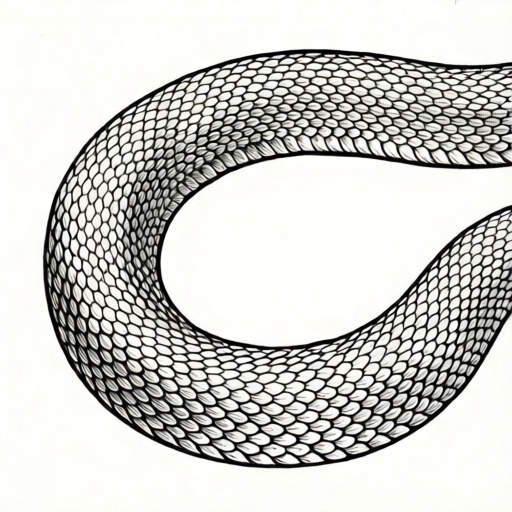
Use the stated measurements and conventions for each exercise.
Set the body band and row direction
Begin with a smooth curved band about 4 cm wide and 12 cm long on ordinary drawing paper. Mark a centerline along the band. Decide the overlap direction once: in this lesson, scales point toward the tail, and the row nearer the tail overlaps the row nearer the head (the row behind it). Write that direction as a small arrow beside the band.
Divide the centerline into equal row intervals. A hypothetical example is 1 cm between row centers, giving twelve rows along a 12 cm band. Measure your actual band and choose an interval that gives at least eight rows; record the number.
- Draw the curved band and centerline lightly.
- Mark row centers at equal intervals along the centerline.
- Draw a direction arrow for the overlap and keep it visible.
- Check that the interval is uniform by measuring between marks.
Build the row-by-row scale template
A scale template is a single rounded wedge shape you repeat. Draw one wedge about 1.5 cm wide and 1 cm tall, with a rounded exposed edge and a narrower base. Trace or copy it along each row, alternating offset by half a scale width so rows interlock.
Keep scale width consistent within a row. A hypothetical example uses three scales per row across a 4.5 cm band at 1.5 cm width with slight overlap; adjust to your band. Count scales per row and note any row where the count changes.
- Draw and cut a paper template of one wedge.
- Place scales along the first row, offsetting alternate rows by half a width.
- Trace each scale lightly, keeping the exposed edge toward the tail.
- Number the rows and count scales in each.
Shade the overlap so the nearer edge reads
Shade only the covered part of each scale, leaving the exposed rounded edge light. Use a consistent light source, for example from the upper left. The scale that overlaps casts a narrow shadow on the scale beneath it along the covered edge.
Check overlap by asking which edge is visible. If two adjacent scales both look fully exposed, the overlap is unclear; redraw the covered edge slightly darker or shorten the lower scale.
- Choose one light direction and mark it.
- Shade the covered portion of each scale, not the exposed rim.
- Add a thin shadow line where one scale crosses another.
- Review three random rows for consistent overlap direction.
Worked example
A band is 10 cm long with row centers every 1.25 cm. How many row intervals fit, and if each row has 5 scales, how many scales are drawn?
Worked answer
Eight row intervals fit (10 divided by 1.25 equals 8), and 8 rows times 5 scales equals 40 scales.
Four practice exercises
Exercise 1
A band is 9 cm long with row centers every 1.5 cm. Each row has 4 scales. Find the number of rows and total scales.
Show answer and check
Six rows and 24 scales.
Why: 9 divided by 1.5 equals 6 rows; 6 times 4 equals 24 scales.
Check: Multiply rows by scales per row and confirm the product is 24.
Exercise 2
A row is 6 cm wide and each scale is 1.5 cm wide with a 0.25 cm overlap between neighbors. Estimate how many scales fit.
Show answer and check
About 5 scales.
Why: Each additional scale adds 1.25 cm after the first 1.5 cm; 1.5 plus four times 1.25 equals 6.5 cm, so five scales fit within 6 cm with slight trimming.
Check: Add 1.5 and four 1.25 cm steps and compare with 6 cm.
Exercise 3
You draw 7 rows with 5 scales each, but one row has 6 scales. What is the total scale count?
Show answer and check
36 scales.
Why: Six rows of 5 give 30; adding the 6-scale row gives 36.
Check: Recount row by row and sum to 36.
Exercise 4
A band has 8 rows spaced 1.2 cm apart. What length does the row span cover from first to last row center?
Show answer and check
8.4 cm.
Why: Seven intervals between eight rows times 1.2 cm equals 8.4 cm.
Check: Count intervals as rows minus one, then multiply by spacing.
Common mistakes
- Alternating overlap direction between rows. Keep one direction arrow visible and check each row against it before shading.
- Scales touching edge-to-edge with no overlap. Offset alternate rows by half a scale width and let each scale cross the one beneath by a small measured amount.
- Shading the exposed rim instead of the covered area. Shade only where the nearer scale covers the farther one, leaving the rounded exposed edge light.
- Row spacing drifting along the curve. Measure row centers from the centerline and re-mark any interval that differs from your chosen value.
Self-check rubric
- Body band is smooth and a centerline is present.
- Row centers are evenly spaced and counted.
- Overlap direction is stated and consistent across all rows.
- Alternate rows are offset by about half a scale width.
- Shading marks covered areas, not exposed rims.
- Scale counts per row are recorded and match the drawing.
Questions and answers
Must every scale be the same size?
No. Keep width consistent within a row, but you may vary size slightly between rows if the overlap direction stays clear.
Can I reverse the overlap direction?
Yes, if you state the direction and apply it consistently. The rubric checks consistency, not one universal direction.
How many rows should I draw?
At least eight rows on a 12 cm band is a workable target; measure your band and choose an interval that gives a countable number.
What if my band is wider?
Increase scales per row or scale width, then recount. Record the chosen values as your own measurements.