Free original lessons
Draw a Realistic Snake: Scale Rows, Fangs, and Head Construction
Learn to build a realistic snake head and body with clear scale-row guides, fang placement, and a checkable drawing convention for self-review.
Free lesson
Four exercises
Worked answers
Object Drawing Lessons
This lesson teaches a repeatable method for drawing a realistic snake with visible scale rows, correctly placed fangs, and a constructed head. You will use a simple convention: the snake's body is divided into dorsal, lateral, and ventral scale bands, and the head is built from three overlapping ovals before features are added. All measurements are hypothetical examples; measure your own paper and reference. The goal is structural accuracy and believable scale flow, not a single universal style. Work lightly, check proportions before committing to dark lines, and use the rubric to judge your own result.
Practice materials: Printable downloads are not available for this lesson yet. Use the instructions and four exercises below.
Reference illustration
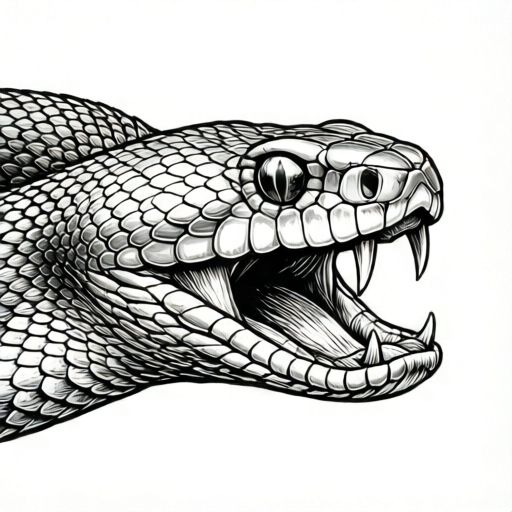
Use the stated measurements and conventions for each exercise.
Set the scale-row convention
Define three scale bands on the body: dorsal rows run along the top ridge, lateral rows wrap around the sides, and ventral rows form wide belly plates. Draw a faint centerline along the body length, then mark row spacing as a consistent baseline unit, for example 4 mm on a 20 cm drawing. Hold that baseline spacing along most of the body; only near the tail may you narrow it very gradually. Do not widen spacing behind the head.
Scale rows are not perfect grids. Offset each row by half a scale so seams stagger, which reads as natural overlap. Keep row direction following the body curve; rows bend around bends rather than cutting straight across.
- Draw the body centerline and a second line for the belly edge.
- Mark dorsal row positions at equal intervals along the centerline.
- Offset lateral rows by half an interval and curve them around the body form.
- Add ventral plates as wider, flatter shapes along the belly edge.
Construct the head in three ovals
Build the head from a large cranial oval, a smaller snout oval, and a jaw oval. Overlap them so the snout oval sits forward and slightly lower, and the jaw oval sits beneath the cranial oval. This gives a wedge-shaped head common to many snakes without forcing one species.
Place the eye at the boundary between the cranial and snout ovals, roughly one-third back from the snout tip. The eye should sit above the jaw line. Add a nostril near the snout tip and a subtle mouth line that follows the jaw oval.
- Draw the cranial oval and mark its center.
- Add the snout oval forward and slightly lower, overlapping by about one-third.
- Add the jaw oval beneath, overlapping the cranial oval.
- Place the eye, nostril, and mouth line using the oval boundaries as guides.
Place fangs and finish the mouth
Fangs sit on the upper jaw, forward of the eye and near the snout tip. Draw two small curved triangles pointing down and slightly back, with the front fang slightly longer. Keep fangs proportional: on a 10 cm head, a hypothetical fang length of 6 mm is reasonable. Do not attach fangs to the lower jaw.
Add a thin mouth line that passes behind the fangs and curves up slightly at the back. Shade the mouth interior lightly and keep the fang bases connected to the jaw edge so they do not float.
- Mark two fang positions on the upper jaw near the snout tip.
- Draw each fang as a curved triangle with a connected base.
- Draw the mouth line behind the fangs and curve it toward the jaw hinge.
- Check that fangs point downward and slightly backward.
Integrate body and head
Connect the neck to the cranial oval with a smooth taper. Scale rows should begin behind the jaw and flow onto the neck without abrupt changes in spacing. Check that the widest part of the head aligns with the jaw oval and that the body centerline meets the head center.
Use the rubric to review proportion, row consistency, fang placement, and clarity. Valid alternatives include different head shapes, scale sizes, and shading styles, provided the structural checks pass.
- Taper the neck into the cranial oval.
- Continue dorsal and lateral rows onto the neck with consistent spacing.
- Compare head width to body width and adjust lightly.
- Apply the rubric and revise one weak area.
Worked example
On a 15 cm body drawing, mark dorsal row spacing at 3 mm, offset lateral rows by 1.5 mm, and place two upper-jaw fangs on a 6 cm head with the front fang 4 mm long and the rear fang 3 mm long. Describe the check.
Worked answer
Draw the centerline, mark dorsal rows every 3 mm, and place lateral rows offset by 1.5 mm, curving them around the body. On the head, mark fang bases near the snout tip on the upper jaw, draw the front fang 4 mm and the rear 3 mm, both pointing down and slightly back. Check that row spacing is consistent, fangs connect to the jaw, and the eye sits above the jaw line.
Four practice exercises
Exercise 1
A 12 cm body drawing uses dorsal row spacing of 2 mm. How many dorsal row intervals fit along the centerline, and what offset should lateral rows use?
Show answer and check
6 intervals; lateral offset 1 mm.
Why: 12 cm divided by 2 mm equals 6 intervals. Half of 2 mm is 1 mm, so lateral rows offset by 1 mm.
Check: Multiply intervals by spacing to recover 12 cm, and confirm the offset is half the spacing.
Exercise 2
On an 8 cm head, the front fang is 5 mm and the rear fang is 4 mm. Are the fangs proportional if the head length is treated as 80 mm? State the ratio of front fang to head length.
Show answer and check
Yes, they are proportional; front fang ratio is 5:80 or 1:16.
Why: Convert 8 cm to 80 mm. The front fang is 5 mm, giving 5/80, which simplifies to 1/16. The rear fang is 4/80 or 1/20, slightly shorter as intended.
Check: Divide fang length by head length in the same units and confirm the front fang is longer but both remain small fractions.
Exercise 3
A head is drawn with the eye placed at the jaw line and the fangs on the lower jaw. Identify two structural errors and state the fixes.
Show answer and check
Error 1: eye at the jaw line; fix by moving it above the jaw line. Error 2: fangs on the lower jaw; fix by attaching them to the upper jaw near the snout tip.
Why: The eye should sit above the jaw line on the cranial oval, and fangs belong on the upper jaw forward of the eye.
Check: Trace the jaw line and confirm the eye center is above it; trace each fang base to the upper jaw edge.
Exercise 4
A body drawing has dorsal rows at 3 mm spacing but lateral rows at 5 mm spacing. State whether the rows are consistent and give a corrected lateral spacing using the half-offset rule.
Show answer and check
They are inconsistent. Corrected lateral spacing is 3 mm with a 1.5 mm offset.
Why: Row spacing should match across bands for a coherent scale flow. The half-offset rule uses half the dorsal spacing, so 1.5 mm.
Check: Compare spacing values directly and verify the offset equals half the chosen spacing.
Common mistakes
- Drawing scale rows as straight parallel lines across a curved body. Curve each row around the body form and offset rows by half a scale.
- Placing fangs on the lower jaw or letting them float. Attach fang bases to the upper jaw edge near the snout tip and point them down and slightly back.
- Making the head a single oval with no snout or jaw structure. Build the head from three overlapping ovals before adding features.
- Using inconsistent row spacing that jumps abruptly. Mark row intervals first and narrow spacing gradually toward the tail.
Self-check rubric
- Head is built from three overlapping ovals with a clear snout and jaw.
- Eye sits above the jaw line and roughly one-third back from the snout tip.
- Two fangs attach to the upper jaw near the snout tip and point down and slightly back.
- Scale rows follow body curves, stagger by half a scale, and narrow gradually toward the tail.
- Body centerline meets the head center and the neck tapers smoothly.
- Valid alternatives in head shape, scale size, and shading are accepted if structural checks pass.
Questions and answers
Do I need a specific snake species reference?
No. The method works for many species. Use a reference if you want species-specific scale counts, but the structural checks apply broadly.
How many scale rows should I draw?
Choose a count that fits your drawing size and keep it consistent. For example, a hypothetical 12 dorsal rows on a 20 cm drawing is workable; measure your own spacing.
Can fangs be different lengths?
Yes. A slightly longer front fang is common in many snakes. Keep both connected to the upper jaw and proportional to the head.
What if my head shape differs from the example?
That is valid. The rubric checks structure, not a single outline. Ensure the snout, jaw, eye, and fang placements remain coherent.