Free original lessons
Draw Zeus: Beard, Drapery, and Thunderbolt Construction
Learn to construct a mythological Zeus figure with a shaped beard, draped garment masses, and a thunderbolt prop using simple, checkable drawing steps.
Free lesson
Four exercises
Worked answers
Object Drawing Lessons
This lesson teaches a construction approach to drawing a mythological Zeus figure. You will build the pose from simple masses, shape the beard and drapery, and place a thunderbolt prop. The method uses a defined convention: x-height is measured from baseline to midline, and letter styles vary, so valid alternatives exist. All measurements are hypothetical examples; measure your own paper and tools. No downloads or files are currently available; the resource plan describes proposed materials.
Practice materials: Printable downloads are not available for this lesson yet. Use the instructions and four exercises below.
Reference illustration
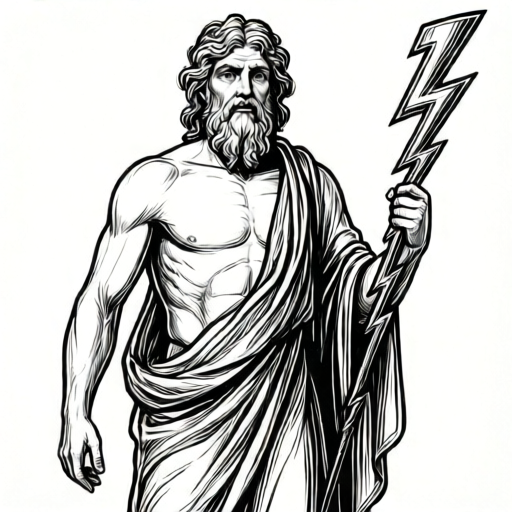
Use the stated measurements and conventions for each exercise.
Pose and Proportion Masses
Begin with a vertical midline and a baseline. Mark a hypothetical total figure height of 18 cm on your paper. Divide it into three equal bands of 6 cm: head and beard zone, torso and drapery zone, and lower drapery and feet zone. These values are examples only; adjust to your paper size.
Use light construction lines. Draw an oval for the head in the top band, a trapezoid for the torso in the middle band, and a wider trapezoid for the lower drapery. Keep the shoulders wider than the hips. The beard will occupy the lower half of the head oval and extend slightly into the torso band.
- Draw a vertical midline and a baseline; mark three equal bands.
- Place a head oval in the top band and a torso trapezoid in the middle band.
- Add a wider lower drapery trapezoid and simple arm lines.
- Check that the shoulders are wider than the hips and the midline stays centered.
Beard Shape and Feature Panel
Shape the beard as a rounded wedge below the chin. Use a center part line and two side curves that taper toward the chest. The beard should read as a mass, not individual hairs. Add a moustache curve above the beard and simple eye and nose marks within the head oval.
An annotated feature panel can show three beard variants: short rounded, medium pointed, and long forked. All are valid if the beard mass stays below the chin and above the chest line. Label the chin line, beard base, and center part.
- Mark the chin line inside the head oval.
- Draw a rounded wedge for the beard with a center part.
- Add a moustache curve and simple facial marks.
- Compare your beard to the three valid variants and adjust the mass.
Drapery Masses and Thunderbolt Prop
Build drapery from two or three overlapping masses: a shoulder drape, a torso wrap, and a lower skirt. Use curved fold lines that follow the body direction. Keep folds simple and spaced. The thunderbolt is a zigzag prop held in one hand; draw it as a short double zigzag with a handle grip.
Place the thunderbolt so it does not cross the face. A hypothetical thunderbolt length of 5 cm works on an 18 cm figure; measure your own hand and paper to choose a length. The prop should read as a separate object with a clear grip.
- Draw a shoulder drape mass over the torso trapezoid.
- Add a torso wrap and a lower skirt with curved fold lines.
- Draw a double zigzag thunderbolt with a handle grip in one hand.
- Check that the prop does not cross the face and the folds follow the body.
Worked example
On an 18 cm figure divided into three 6 cm bands, place a head oval in the top band, a torso trapezoid in the middle band, and a wider lower drapery trapezoid. Add a rounded beard wedge below the chin and a 5 cm double zigzag thunderbolt in the right hand, not crossing the face.
Worked answer
The figure has three equal bands. The head oval sits in the top band, the torso trapezoid in the middle, and the lower drapery is wider than the torso. The beard is a rounded wedge below the chin with a center part. The thunderbolt is a double zigzag with a grip in the right hand, placed to the side so it does not cross the face. Shoulders are wider than hips and the midline is centered.
Four practice exercises
Exercise 1
Draw a Zeus figure on a 15 cm total height divided into three equal bands. Place a head oval, torso trapezoid, and wider lower drapery. Add a short rounded beard and a thunderbolt in the left hand that does not cross the face.
Show answer and check
Three bands of 5 cm each. Head oval in top band, torso trapezoid in middle, lower drapery wider than torso. Short rounded beard below chin. Thunderbolt double zigzag with grip in left hand, placed to the side.
Why: Equal bands keep proportions checkable. A short rounded beard is a valid variant if it stays below the chin. Placing the prop to the side keeps the face clear.
Check: Measure the three bands are equal; confirm shoulders wider than hips; confirm beard mass below chin; confirm prop does not cross the face.
Exercise 2
Draw a Zeus figure with a medium pointed beard and two drapery masses: a shoulder drape and a lower skirt. Use a hypothetical thunderbolt length of 4 cm on a 16 cm figure. Describe where the prop is placed.
Show answer and check
Figure height 16 cm. Medium pointed beard below chin with center part. Shoulder drape over torso and lower skirt wider than torso. Thunderbolt 4 cm double zigzag with grip held at the side, not crossing the face.
Why: Two drapery masses are enough to read as draped garment. A medium pointed beard is valid. The prop length is an example; the key is a clear grip and no face crossing.
Check: Confirm two drapery masses overlap; confirm beard is pointed and below chin; measure prop is about 4 cm; confirm prop is at the side.
Exercise 3
Draw a Zeus figure with a long forked beard and three drapery masses. Add a thunderbolt in the right hand. Check that the beard does not cover the entire torso and the prop has a clear handle grip.
Show answer and check
Long forked beard below chin, ending above the chest line. Three drapery masses: shoulder drape, torso wrap, lower skirt. Thunderbolt double zigzag with handle grip in right hand, placed to the side.
Why: A long forked beard is valid if it does not cover the entire torso. Three masses build layered drapery. A handle grip makes the prop read clearly.
Check: Confirm beard ends above chest line; count three drapery masses; confirm handle grip is visible; confirm prop does not cross the face.
Exercise 4
Draw a Zeus figure on a 20 cm total height divided into three equal bands. Use a rounded beard and a thunderbolt held across the body but below the chin. Check that the thunderbolt does not touch the beard.
Show answer and check
Three bands of about 6.7 cm each. Rounded beard below chin. Thunderbolt double zigzag with grip held across the body below the chin, not touching the beard. Shoulders wider than hips.
Why: Equal bands keep proportions checkable. A rounded beard is valid. Holding the prop across the body is acceptable if it stays below the chin and does not touch the beard.
Check: Measure bands are equal; confirm beard is rounded and below chin; confirm prop is below chin and not touching beard; confirm shoulders wider than hips.
Common mistakes
- Drawing the beard as individual hairs before the mass is clear. Shape the beard as a rounded wedge first, then add a few simple hair lines.
- Making the thunderbolt cross the face or beard. Move the prop to the side or lower it so the face remains clear.
- Using equal-width trapezoids for torso and lower drapery. Widen the lower drapery and keep shoulders wider than hips.
- Adding many fold lines that hide the body structure. Limit folds to two or three curved lines per drapery mass.
Self-check rubric
- Figure is built from three equal bands with a centered midline.
- Shoulders are wider than hips and lower drapery is wider than torso.
- Beard is a clear mass below the chin with a center part or valid variant.
- Drapery uses two or three overlapping masses with simple curved folds.
- Thunderbolt is a clear double zigzag with a grip and does not cross the face.
- Valid alternatives in beard style and prop length are accepted if the mass and grip read clearly.
Questions and answers
Do I need to draw a realistic face?
No. Simple eye and nose marks are enough; the lesson focuses on beard, drapery, and thunderbolt construction.
Can the beard be short instead of long?
Yes. Short rounded, medium pointed, and long forked beards are all valid if the beard mass stays below the chin and above the chest line.
What if my thunderbolt is a different length?
Any clear double zigzag with a grip is valid. Measure your own paper and hand; the 5 cm example is hypothetical.
How do I check my proportions?
Use the three equal bands and confirm shoulders are wider than hips and the midline stays centered.