Free original lessons
Easy Asparagus Drawing: Tip Scales and Stalk Taper
Learn to draw an asparagus spear with clear tip scales and a tapered stalk using simple guides, a worked example, and four practice tasks.
Free lesson
Four exercises
Worked answers
Object Drawing Lessons
This lesson teaches a reliable way to draw a single asparagus spear. You will build the spear from a center line, add a tapered stalk, then place overlapping tip scales in a defined convention. The convention is a drawing choice, not a botanical rule: scales are drawn as rounded triangles that overlap from the tip downward, and the stalk narrows gradually from base to tip. Letter styles and scale shapes vary, so the rubric accepts valid alternatives. All measurements are hypothetical examples; measure your own paper and tools before drawing.
Practice materials: Printable downloads are not available for this lesson yet. Use the instructions and four exercises below.
Reference illustration
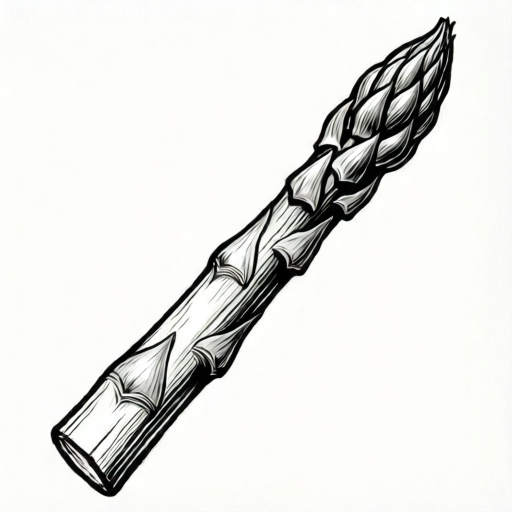
Use the stated measurements and conventions for each exercise.
Set Up the Spear Skeleton
Start with a light vertical center line. Mark a top point for the tip and a bottom point for the cut base. The distance between them is the spear length. For a practice spear, choose a length that fits your paper with room for scales. A hypothetical example is 12 cm, but use your actual paper size.
Decide the stalk width at the base and at the tip. The tip is narrower. A simple taper guide is two gentle curves that start wider at the base and converge toward the tip. Keep the curves smooth; avoid sudden bulges. The center line helps you check symmetry by comparing left and right widths at several heights.
- Draw a light vertical center line and mark top and base points.
- Mark the base width on both sides of the center line.
- Mark a narrower tip width near the top point.
- Connect the base marks to the tip marks with gentle curves to form the stalk outline.
Draw the Tip Scales in a Defined Convention
The tip scales are the small overlapping shapes near the top. Use this convention: each scale is a rounded triangle whose point faces upward, and each lower scale overlaps the one above it. Draw scales in rows from the tip downward. The topmost scale is smallest; lower scales become slightly wider and taller. This is a drawing convention, not a claim about every asparagus spear.
Keep scale edges inside the stalk outline. Leave a small gap between scale rows so the overlap is visible. If a scale looks too large, redraw it smaller rather than erasing the whole tip. Valid alternatives include sharper scale points or more rounded scales, as long as the overlap direction is consistent and the scales stay within the stalk.
- Mark three to five scale rows below the tip point.
- Draw the top scale as a small rounded triangle pointing up.
- Draw the next scale below it, slightly wider, overlapping the top scale.
- Continue downward, keeping each scale inside the stalk outline.
- Check that every scale points upward and overlaps the one above.
Finish the Stalk and Check Proportions
Complete the stalk outline from the lowest scale to the base. The stalk should taper smoothly. A useful check is to compare widths at three heights: near the base, at the middle, and just below the scales. Each higher width should be smaller than the one below it. If a width increases, adjust the curve.
Add a simple cut line at the base. The cut line can be straight or slightly curved; both are valid. Do not add shading or background elements in this lesson. The goal is a clear spear with readable tip scales and a tapered stalk.
- Draw the lower stalk outline from the last scale to the base marks.
- Compare widths at base, middle, and below the scales.
- Adjust any curve that does not taper smoothly.
- Add a simple base cut line and erase the center line if desired.
Worked example
Draw a spear 10 cm long with a base width of 2 cm and a tip width of 0.6 cm. Add four scale rows. Describe the result and check the taper.
Worked answer
Draw a 10 cm center line. Mark 1 cm on each side at the base and 0.3 cm on each side near the tip. Connect with gentle curves. Draw four upward-pointing rounded triangles from the tip downward, each slightly wider than the one above and inside the stalk. Check widths at 2 cm, 5 cm, and 8 cm from the base: each should be smaller than the one below. The base cut is a simple straight line.
Four practice exercises
Exercise 1
Draw a spear 8 cm long with base width 1.6 cm and tip width 0.5 cm. Add three scale rows. State the widths you used at base, middle, and below the scales.
Show answer and check
A valid answer shows a tapered stalk with base half-width 0.8 cm, tip half-width 0.25 cm, and three upward-overlapping scales inside the stalk. Example middle half-width: 0.5 cm.
Why: The taper is checked by comparing widths: base 1.6 cm, middle about 1.0 cm, below scales about 0.7 cm, tip 0.5 cm. Each higher width is smaller.
Check: Measure the drawn widths at the three heights. Confirm each higher width is smaller and scales stay inside the outline.
Exercise 2
Draw a spear 12 cm long with base width 2.4 cm and tip width 0.6 cm. Use four scale rows. Describe how each scale overlaps the one above.
Show answer and check
A valid answer shows four upward-pointing scales, each lower scale slightly wider and overlapping the scale above, all inside the stalk. Base half-width 1.2 cm; tip half-width 0.3 cm.
Why: The overlap direction is consistent from tip downward. Scale widths increase slightly: for example 0.4 cm, 0.5 cm, 0.6 cm, 0.7 cm, all less than the local stalk width.
Check: Trace each scale edge. Confirm it points upward and covers part of the scale above without crossing the stalk outline.
Exercise 3
Draw a spear 9 cm long with base width 1.8 cm and tip width 0.45 cm. Add five scale rows. Check taper at 1 cm, 4.5 cm, and 8 cm from the base.
Show answer and check
A valid answer shows a smooth taper with five upward-overlapping scales. Hypothetical widths: at 1 cm about 1.7 cm; at 4.5 cm about 1.1 cm; at 8 cm about 0.7 cm; tip 0.45 cm.
Why: The three measured widths decrease with height. The scales remain inside the stalk and increase slightly in size downward.
Check: Measure the three widths with a ruler. Confirm the sequence decreases and no scale crosses the stalk edge.
Exercise 4
Draw two spear variants: one with sharper scale points and one with rounder scale points. Both must be 10 cm long with base width 2 cm and tip width 0.5 cm, and both must use four scale rows.
Show answer and check
A valid answer shows two spears with the same taper and four upward-overlapping scales, differing only in scale point style. Both keep scales inside the stalk.
Why: The convention allows valid alternatives in scale shape. The taper and overlap direction remain consistent, so both drawings meet the rubric.
Check: Compare both spears: confirm equal length and base/tip widths, four scale rows each, upward overlap, and scales inside the outline.
Common mistakes
- Drawing the stalk with parallel sides. Mark a narrower tip width and connect base to tip with gentle curves.
- Making tip scales point downward. Use the convention that each scale points upward and overlaps the scale above.
- Letting scales spill outside the stalk outline. Keep scale edges inside the stalk; redraw oversized scales smaller.
- Changing scale size randomly. Make scales slightly wider and taller as you move down from the tip.
Self-check rubric
- Spear has a visible center-line-based symmetry within reasonable hand-drawing variation.
- Stalk tapers smoothly from base to tip; widths decrease at higher points.
- Tip scales point upward and overlap the scale above in a consistent convention.
- Scales remain inside the stalk outline.
- Scale size increases slightly from tip downward.
- Base cut is present and simple.
- No shading or background elements are required for this task.
Questions and answers
Do I need to measure exact centimeters?
No. Measurements are hypothetical examples. Use your paper and a ruler to choose a length that fits, then keep units consistent.
Can the scales be sharper or more rounded?
Yes. The convention requires upward-pointing overlapping scales inside the stalk. Sharpness and roundness are valid style choices.
How many scale rows should I draw?
Three to five rows is enough for a clear tip. More rows can work if they stay inside the stalk and overlap consistently.
Should the base cut be straight or curved?
Either is valid. Choose one and keep it simple; the lesson does not require a specific cut shape.