Free original lessons
Linework Drawing Practice
Linework drawing is the skill of making deliberate marks with a drawing tool: a straight stroke that holds its direction, a curved stroke that keeps a smooth arc, and hatching strokes that sit in an even, controlled set. This pack teaches those three stroke families on a practice plate, then gives four tasks with complete answers and a visual check for each.
Letter & A4
PDF & SVG
What linework drawing practice covers
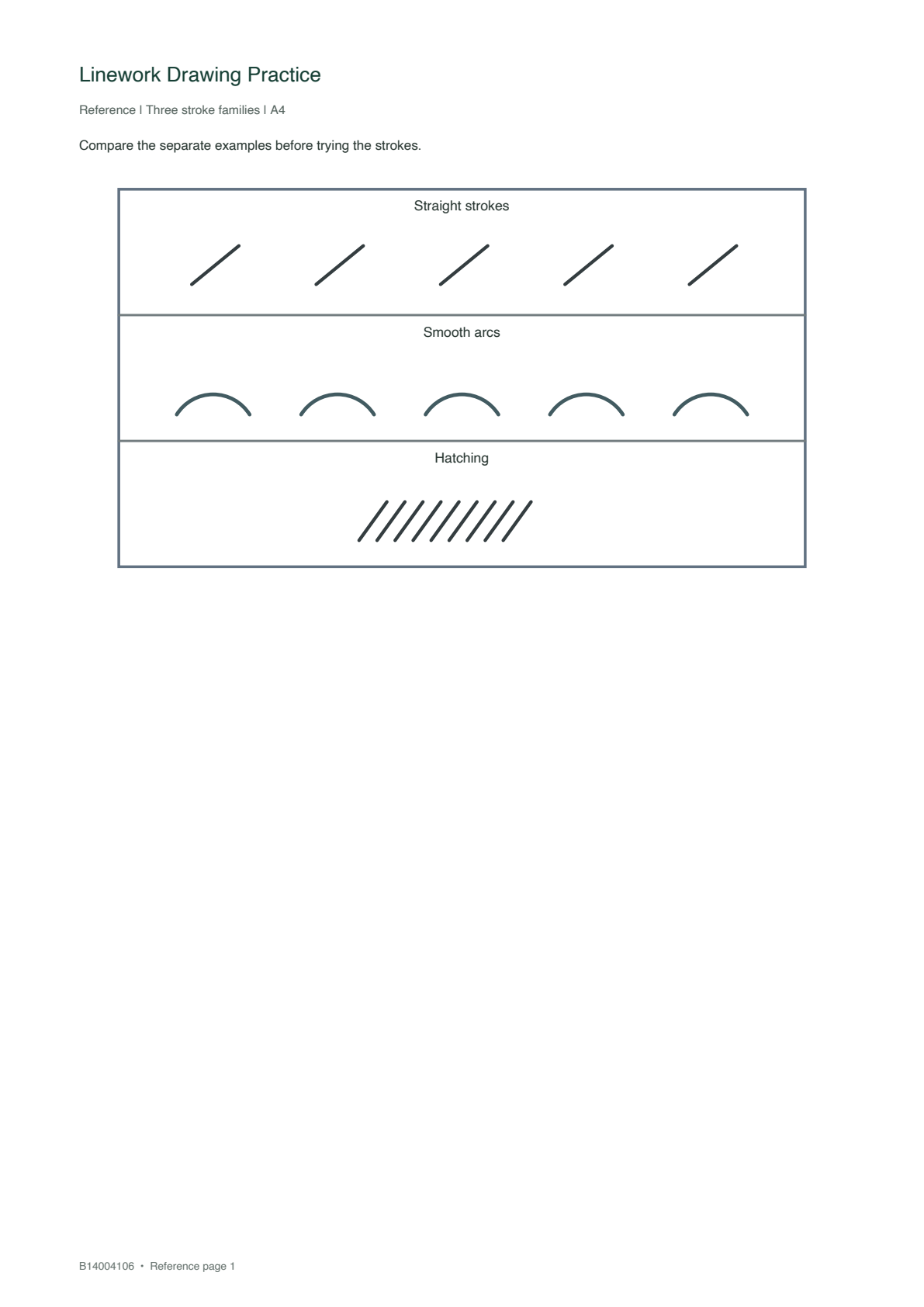
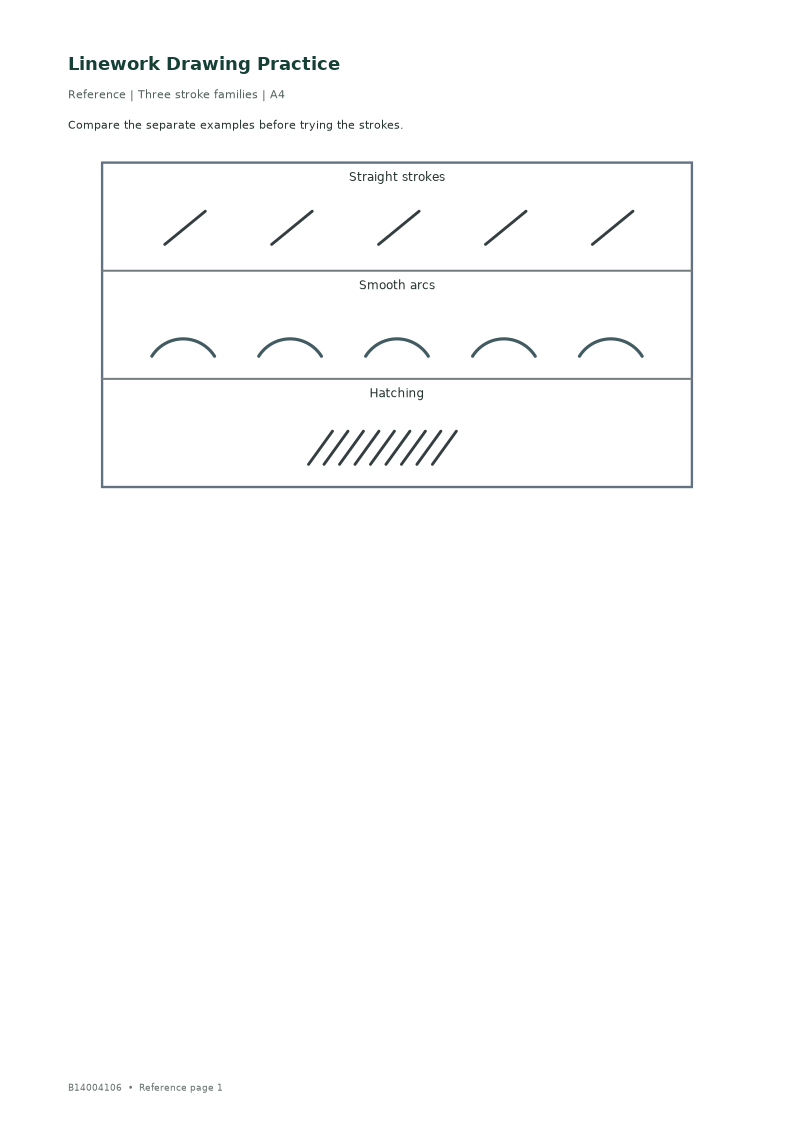
A linework practice plate is a sheet where you repeat one stroke family at a time so your hand learns the motion before you combine strokes into a drawing. The three families here are straight strokes, curved strokes and hatching strokes; each is practised on its own before being checked against a reference.
How to set up and use the plate
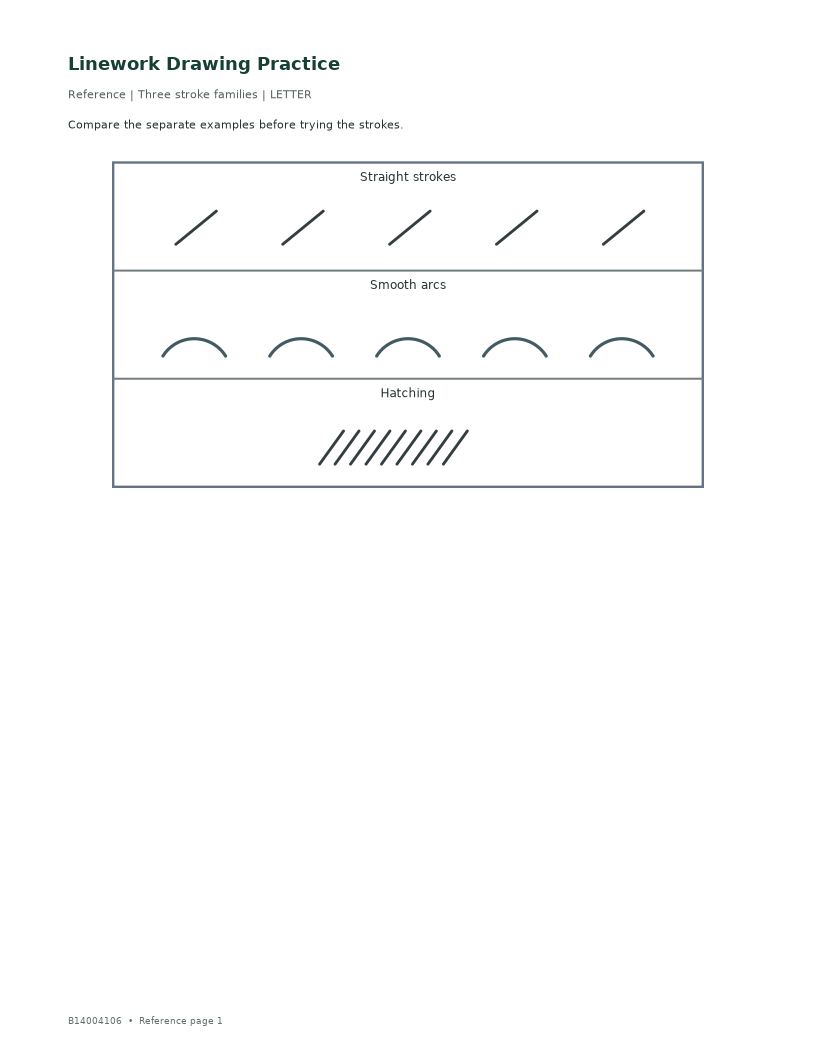
Work on a plain sheet with a pencil or pen you can control. Draw a light border to mark the plate area, then divide the area into three bands: one for straight strokes, one for curved strokes and one for hatching. Keep each band separate so a check can compare like with like.
Straight strokes
A straight stroke is drawn in one steady movement from a clear start to a clear end. Look at where the stroke should finish before the tool touches the paper, and let the arm move rather than only the fingers. A good straight stroke has a consistent direction, an even weight and a clean start and end.
Curved strokes
A curved stroke is a single smooth arc with no flat spots or kinks. Choose the curve's direction first, then draw the whole arc in one movement. A good curved stroke keeps the same curvature along its length and returns cleanly to its intended end point.
Download the complete resource pack
All individual SVG pages (20)
- A4 reference page 1
- A4 reference page 2
- A4 student page 1
- A4 student page 2
- A4 student page 3
- A4 student page 4
- A4 answer page 1
- A4 answer page 2
- A4 answer page 3
- A4 answer page 4
- LETTER reference page 1
- LETTER reference page 2
- LETTER student page 1
- LETTER student page 2
- LETTER student page 3
- LETTER student page 4
- LETTER answer page 1
- LETTER answer page 2
- LETTER answer page 3
- LETTER answer page 4
Print at 100% / actual size. Use the stated scale on any schematic diagram; physical cutting templates are identified separately. A4 and US Letter are separate files. Free access, no signup; CC BY 4.0.
How to use these pages
- What linework drawing practice covers
- How to set up and use the plate
- Straight strokes
- Curved strokes
Worked example
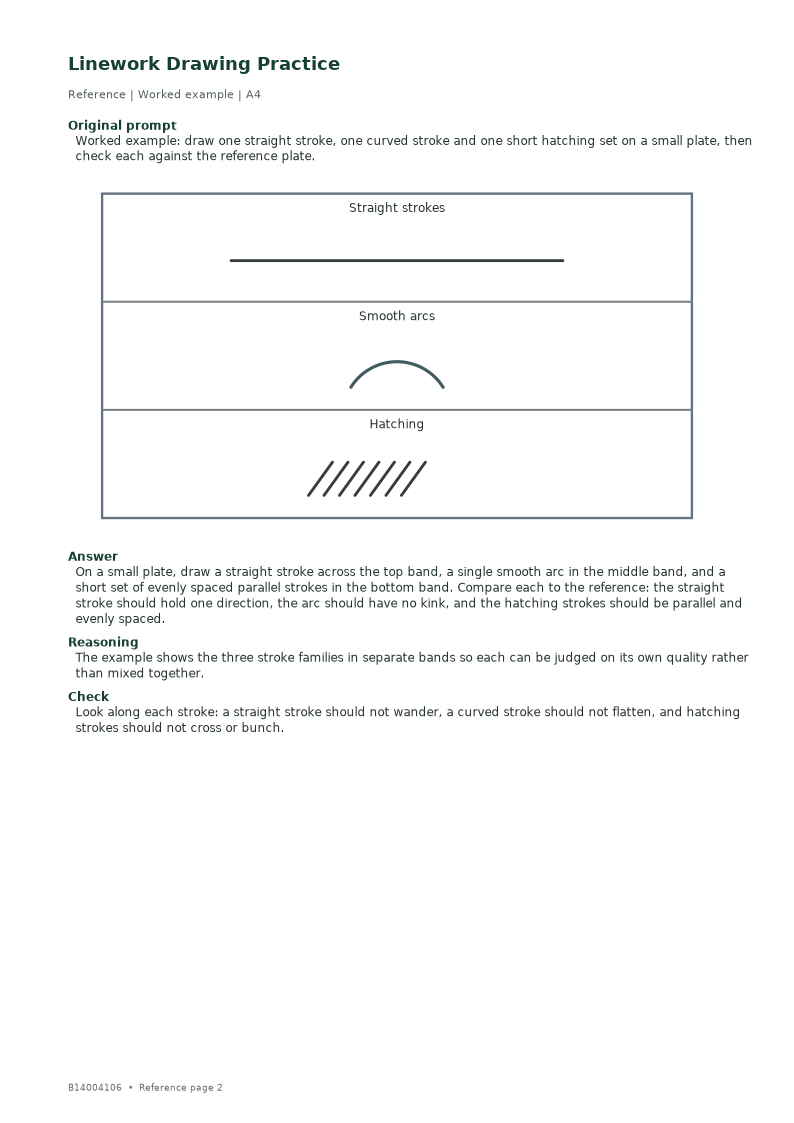
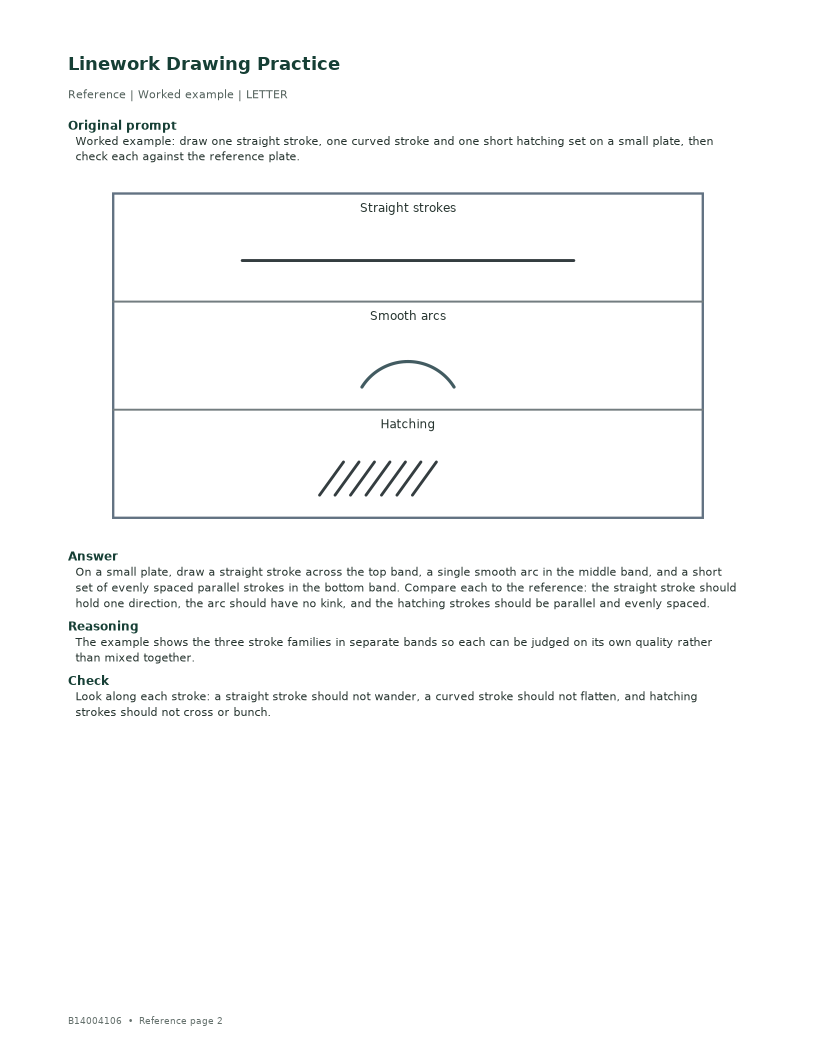
Example: Worked example: draw one straight stroke, one curved stroke and one short hatching set on a small plate, then check each against the reference plate.
Answer: On a small plate, draw a straight stroke across the top band, a single smooth arc in the middle band, and a short set of evenly spaced parallel strokes in the bottom band. Compare each to the reference: the straight stroke should hold one direction, the arc should have no kink, and the hatching strokes should be parallel and evenly spaced.
Reasoning: The example shows the three stroke families in separate bands so each can be judged on its own quality rather than mixed together.
Check: Look along each stroke: a straight stroke should not wander, a curved stroke should not flatten, and hatching strokes should not cross or bunch.
Four practice tasks and complete answers
Task 1
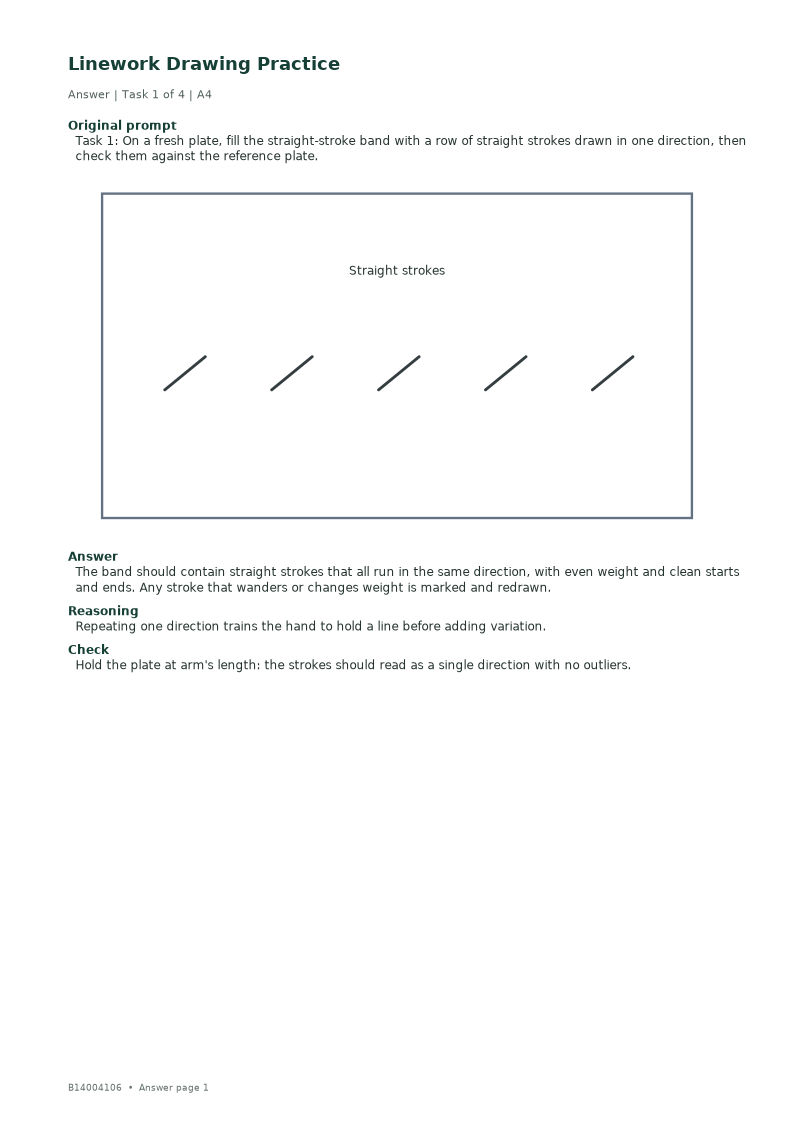
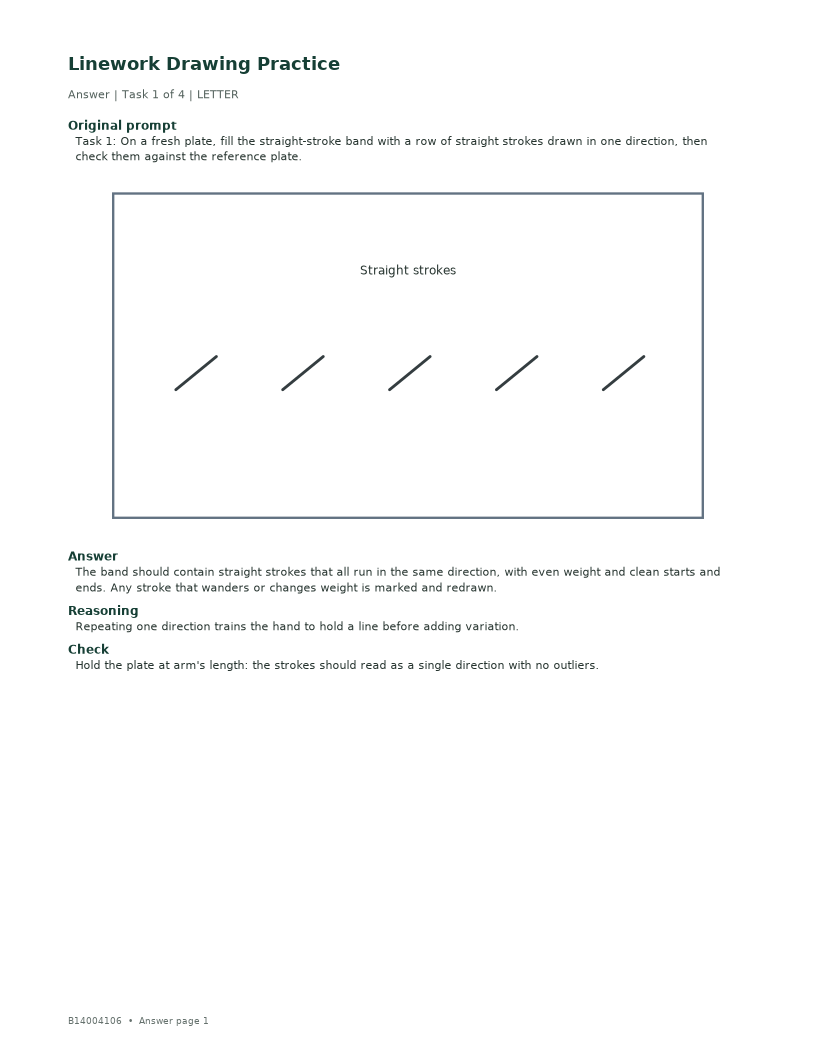
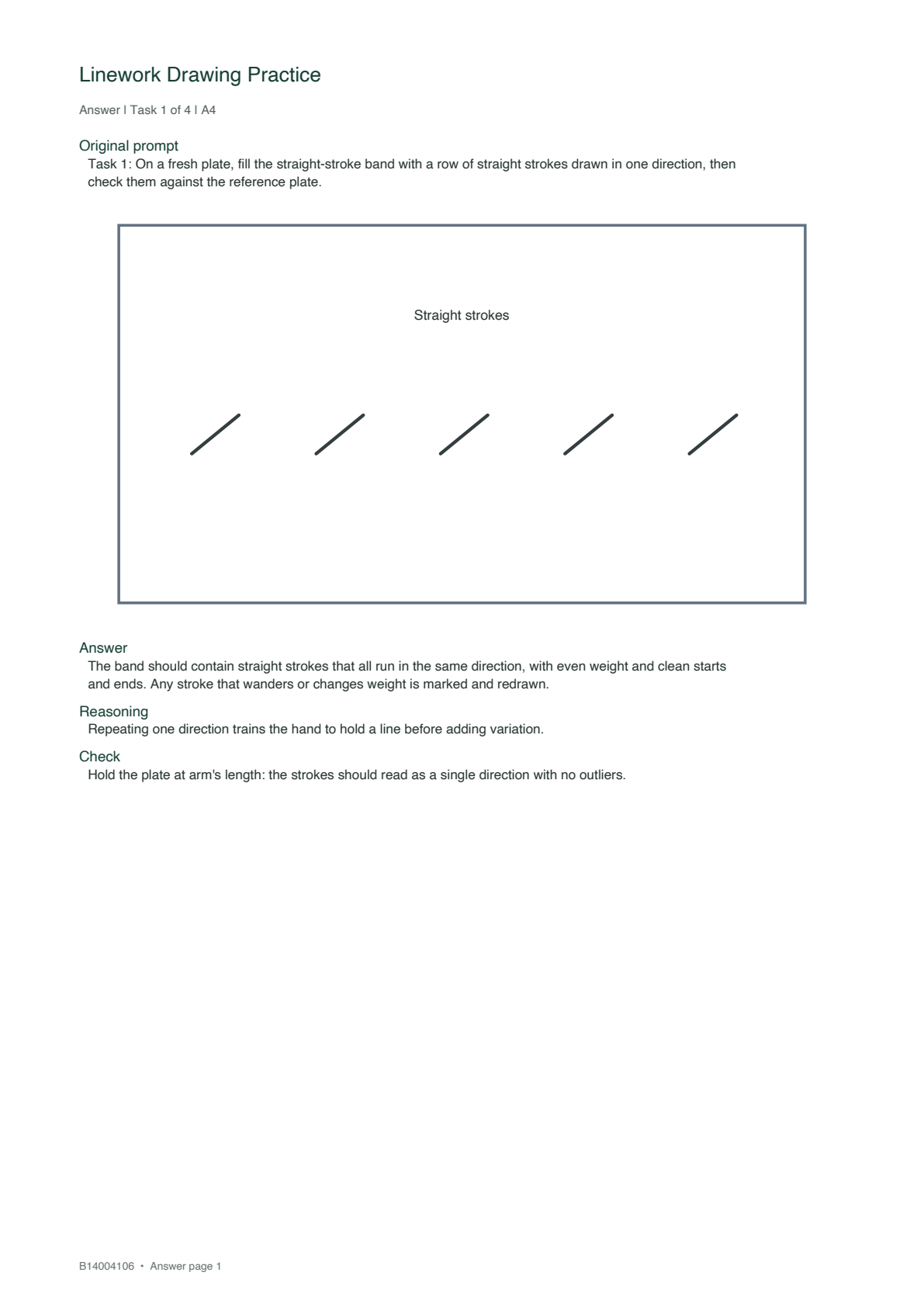
Task 1: On a fresh plate, fill the straight-stroke band with a row of straight strokes drawn in one direction, then check them against the reference plate.
Show answer 1
The band should contain straight strokes that all run in the same direction, with even weight and clean starts and ends. Any stroke that wanders or changes weight is marked and redrawn.
Repeating one direction trains the hand to hold a line before adding variation.
Check: Hold the plate at arm's length: the strokes should read as a single direction with no outliers.
Task 2
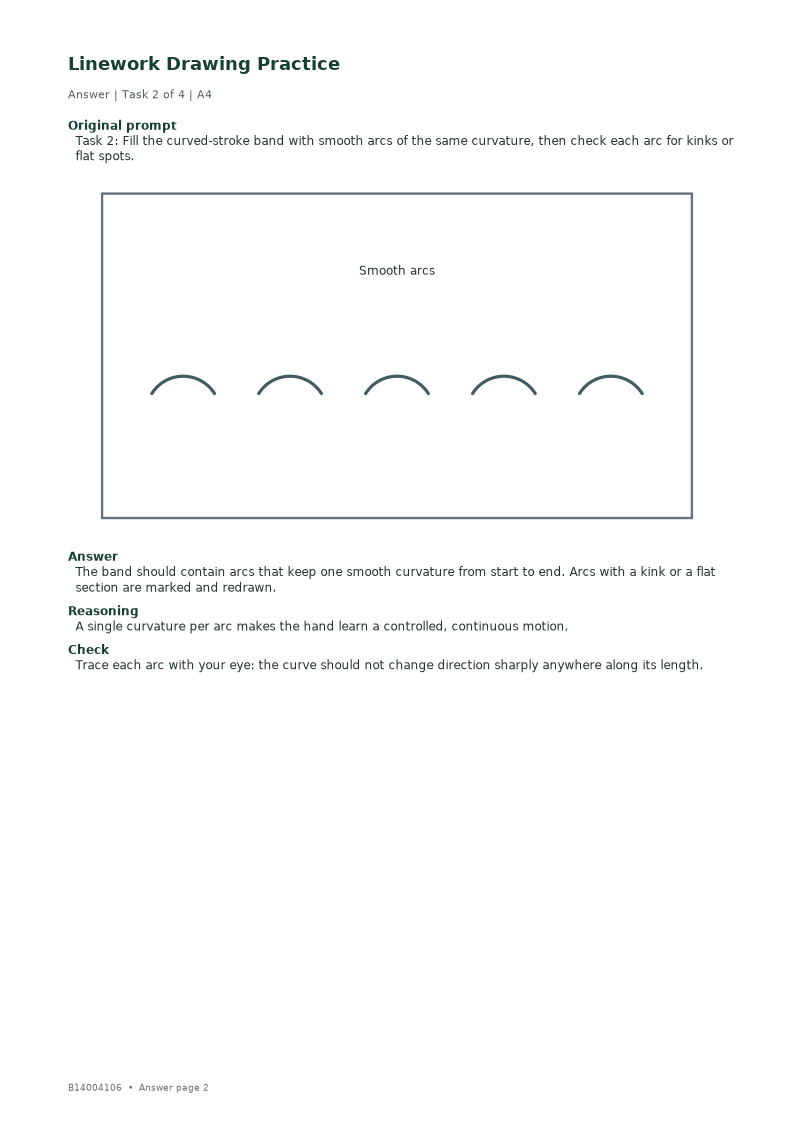
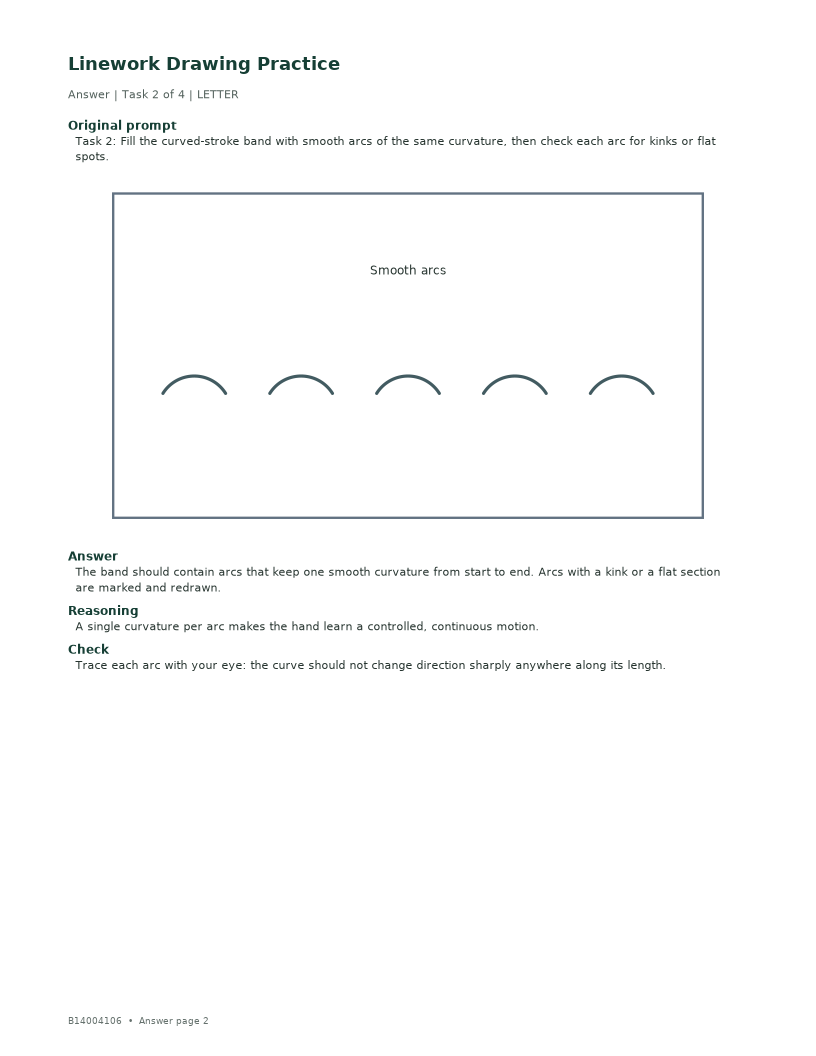
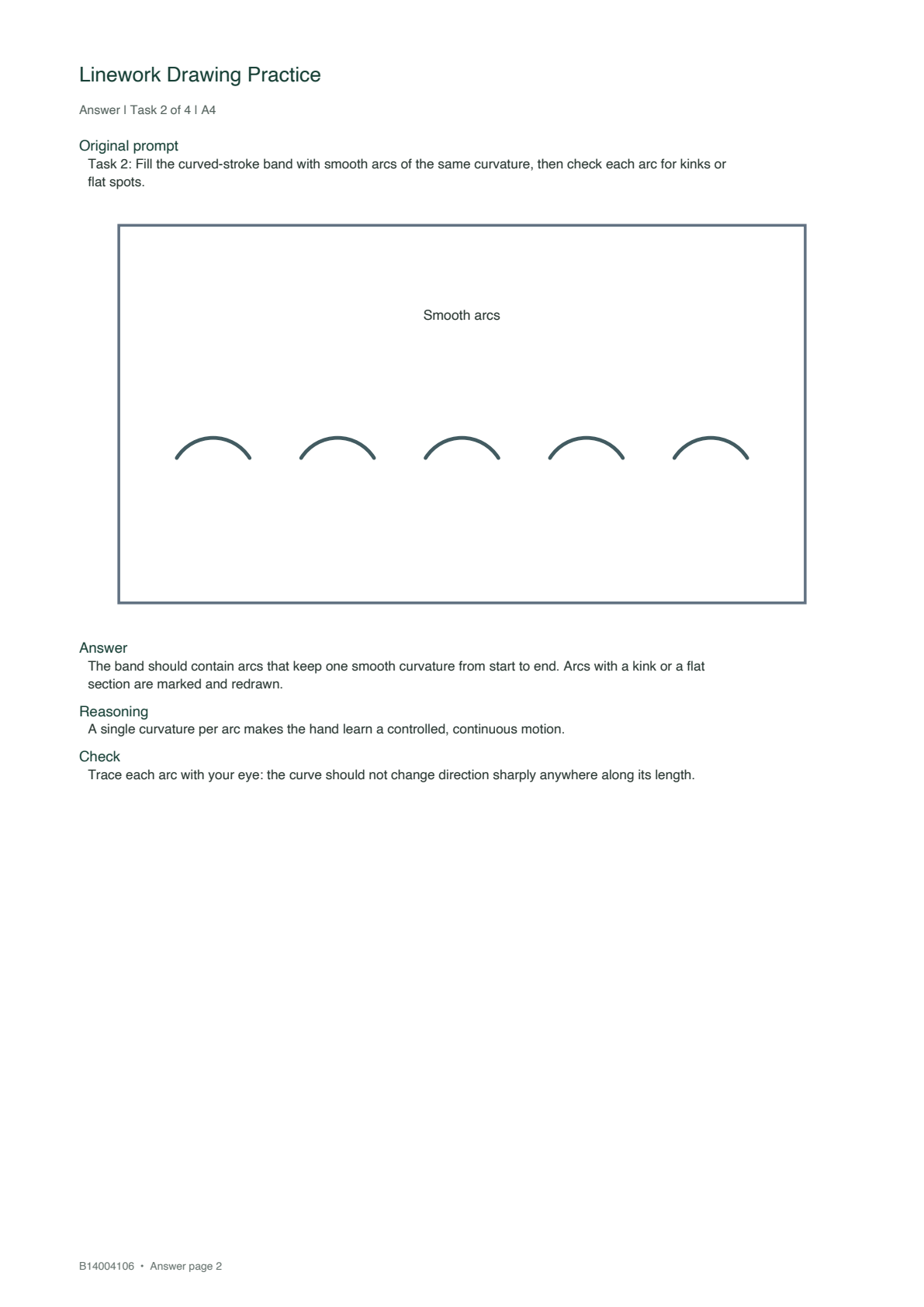
Task 2: Fill the curved-stroke band with smooth arcs of the same curvature, then check each arc for kinks or flat spots.
Show answer 2
The band should contain arcs that keep one smooth curvature from start to end. Arcs with a kink or a flat section are marked and redrawn.
A single curvature per arc makes the hand learn a controlled, continuous motion.
Check: Trace each arc with your eye: the curve should not change direction sharply anywhere along its length.
Task 3
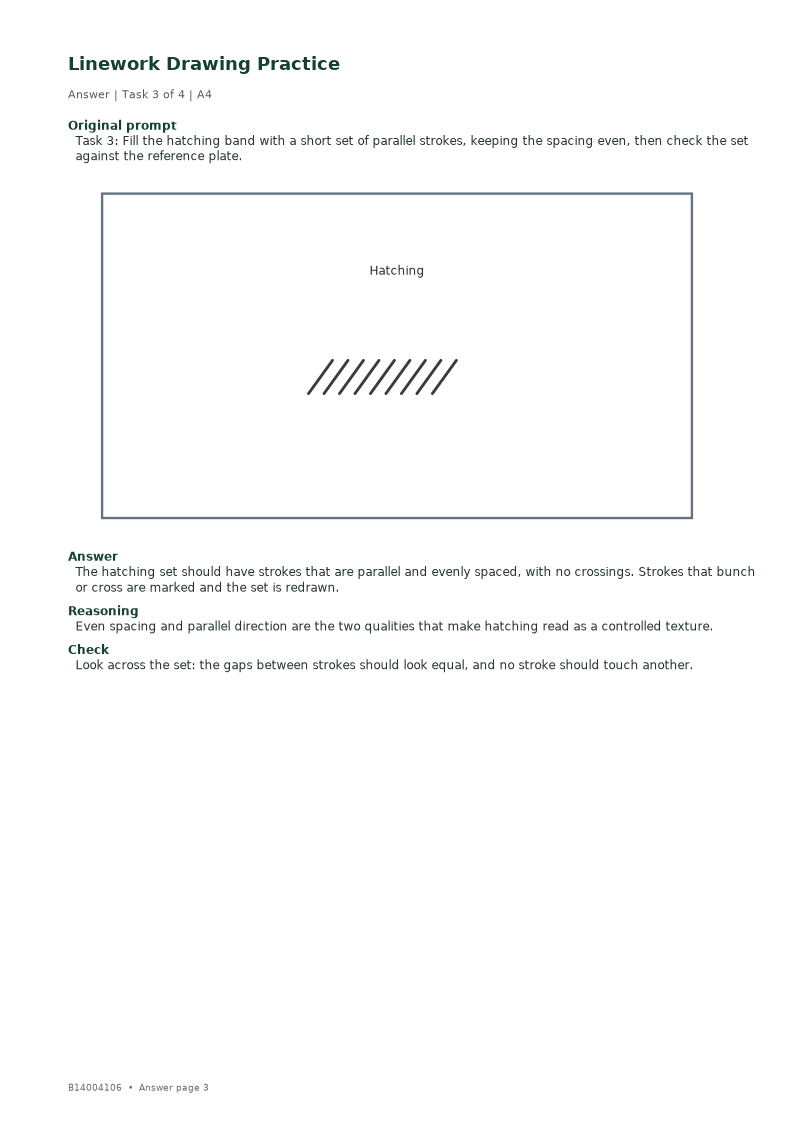
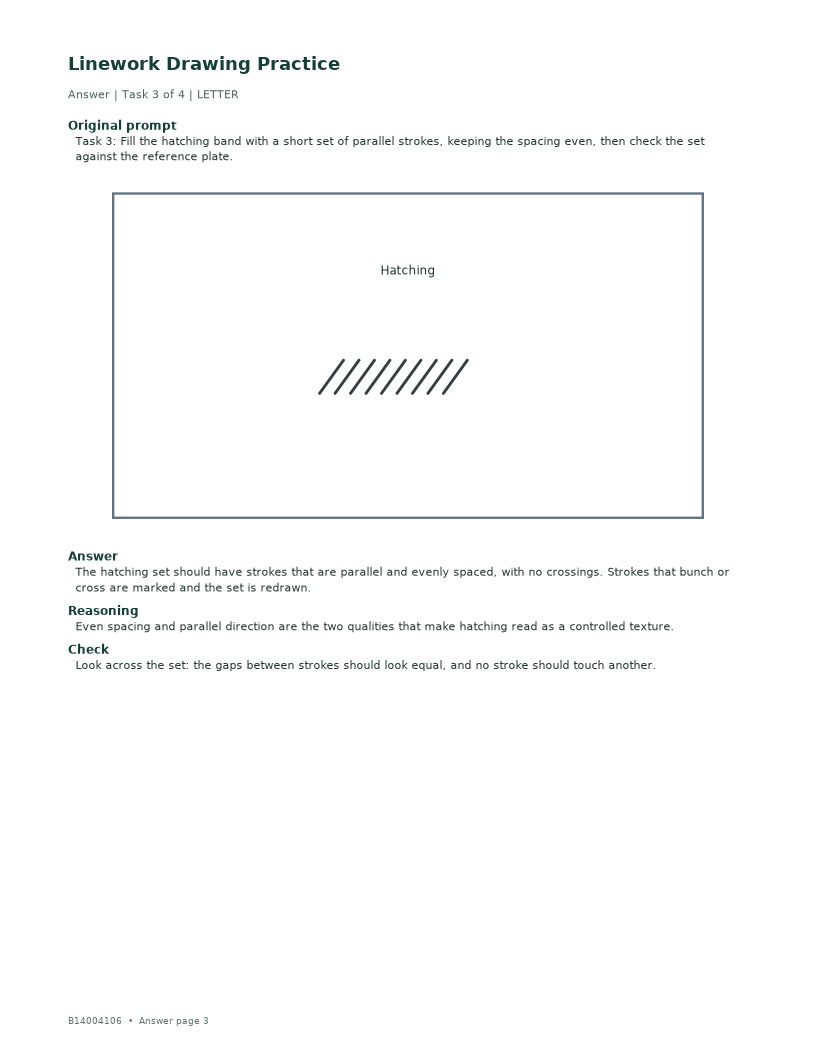
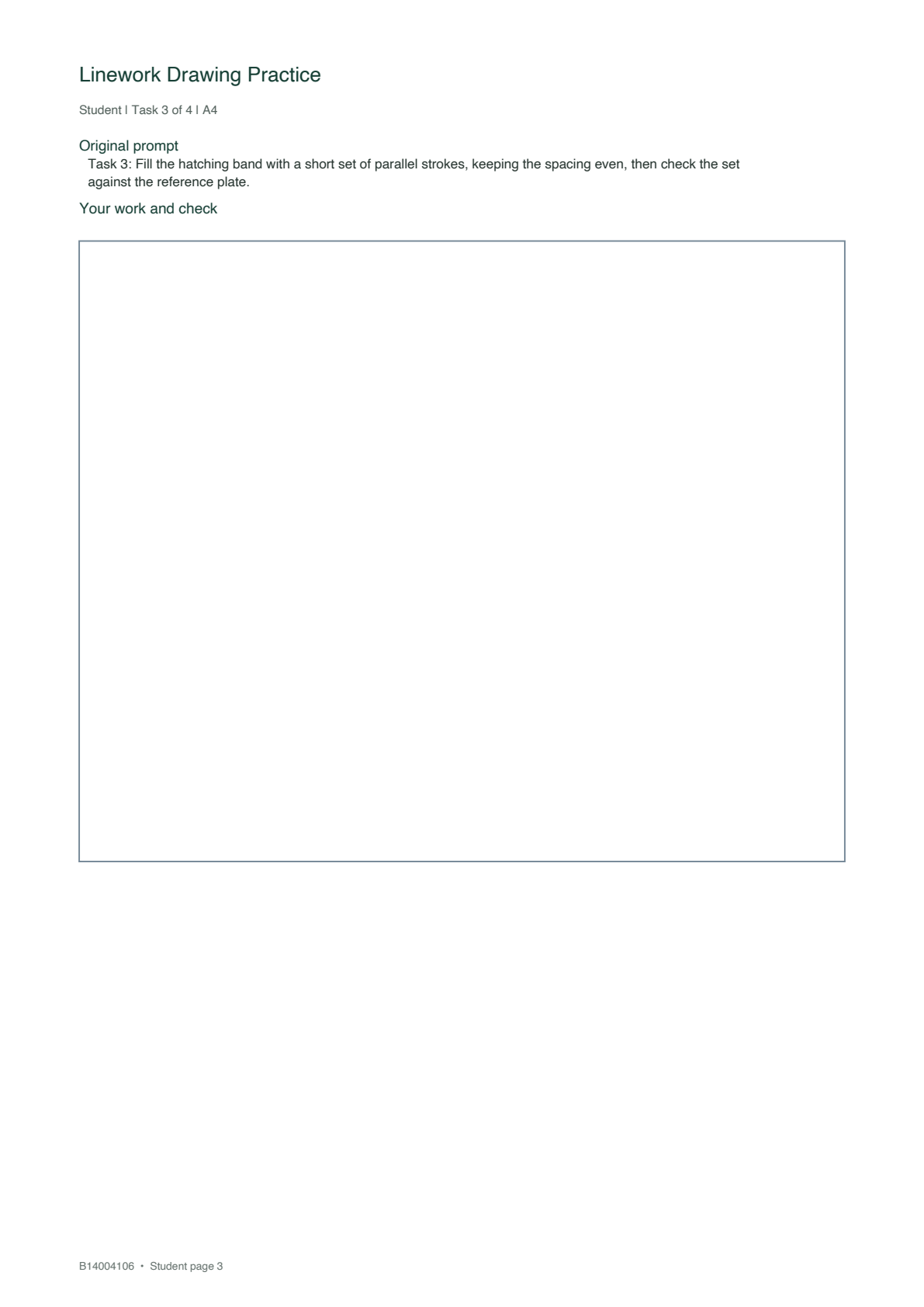
Task 3: Fill the hatching band with a short set of parallel strokes, keeping the spacing even, then check the set against the reference plate.
Show answer 3
The hatching set should have strokes that are parallel and evenly spaced, with no crossings. Strokes that bunch or cross are marked and the set is redrawn.
Even spacing and parallel direction are the two qualities that make hatching read as a controlled texture.
Check: Look across the set: the gaps between strokes should look equal, and no stroke should touch another.
Task 4
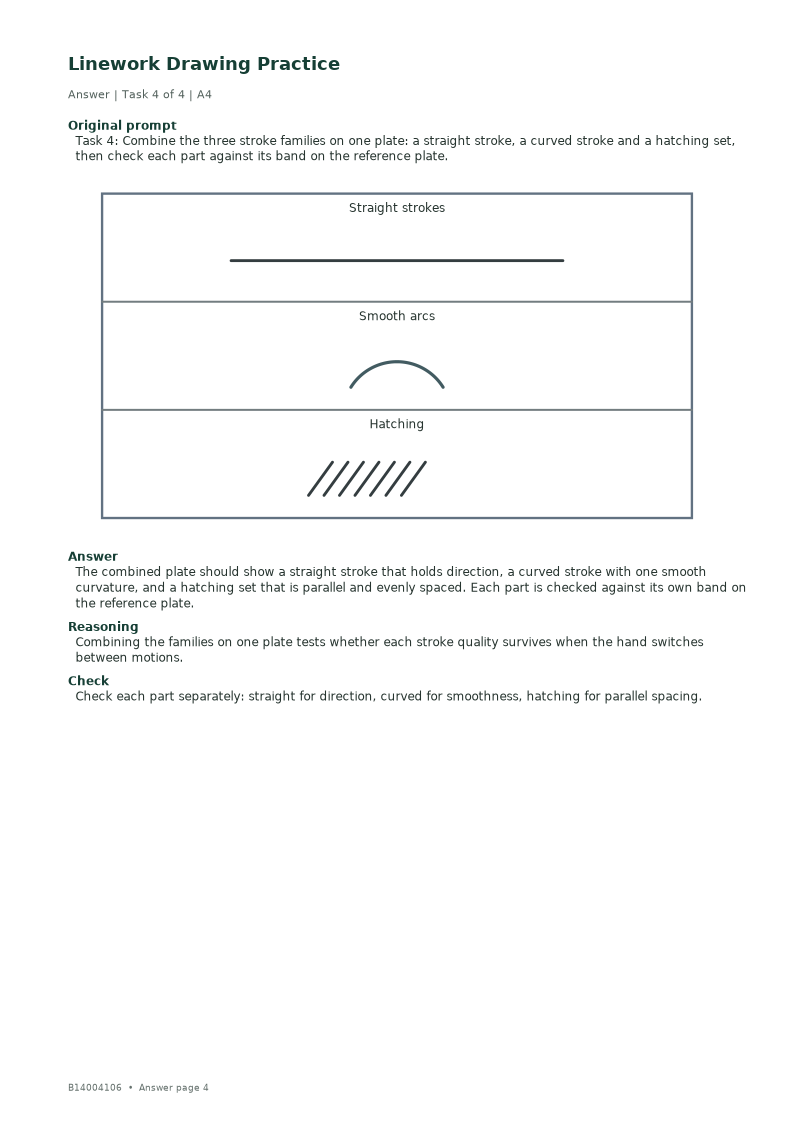
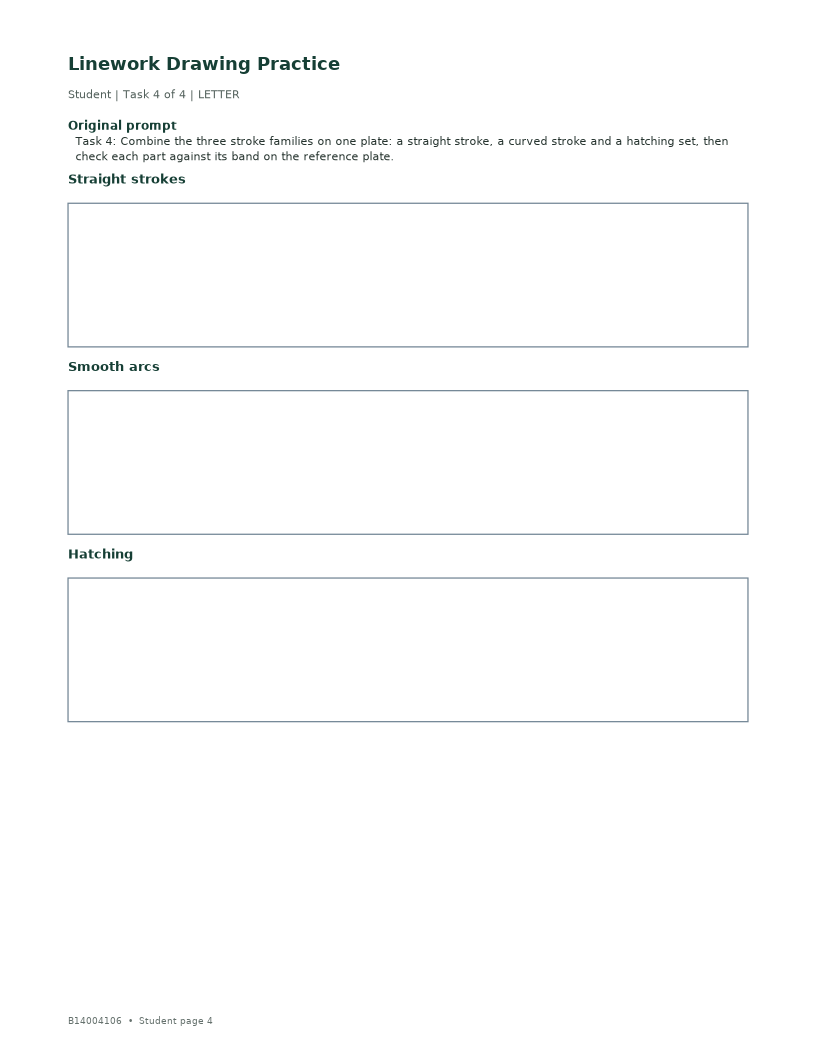
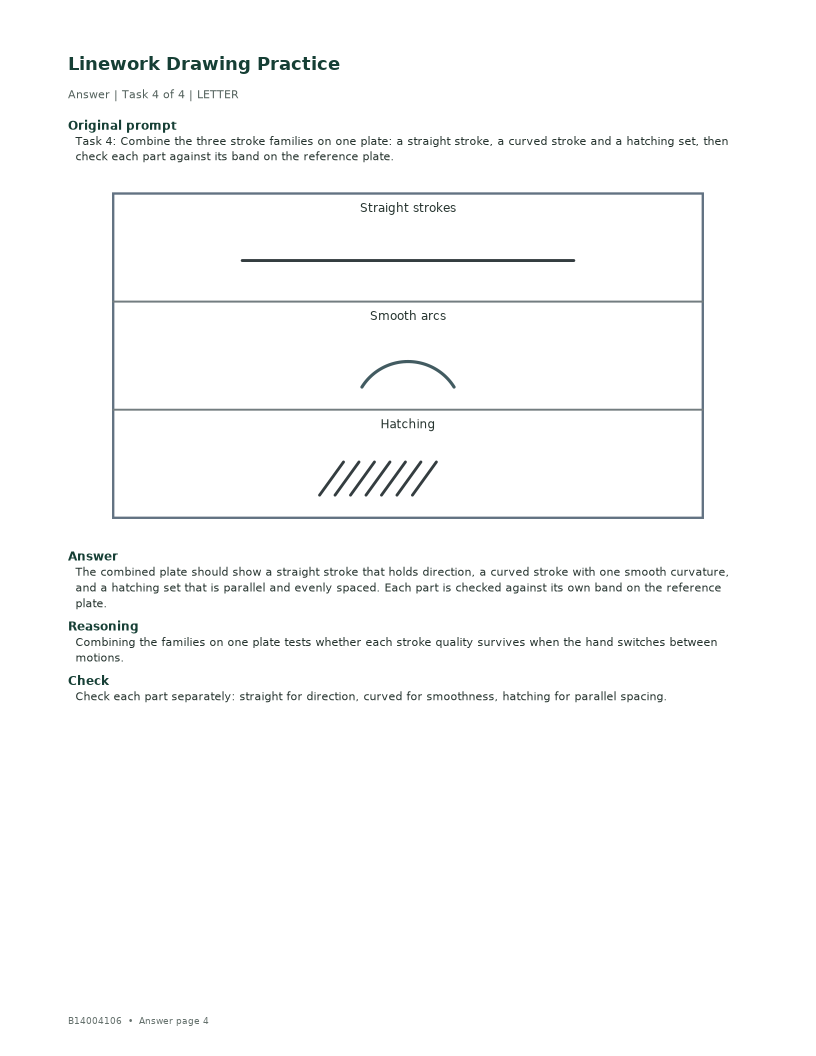
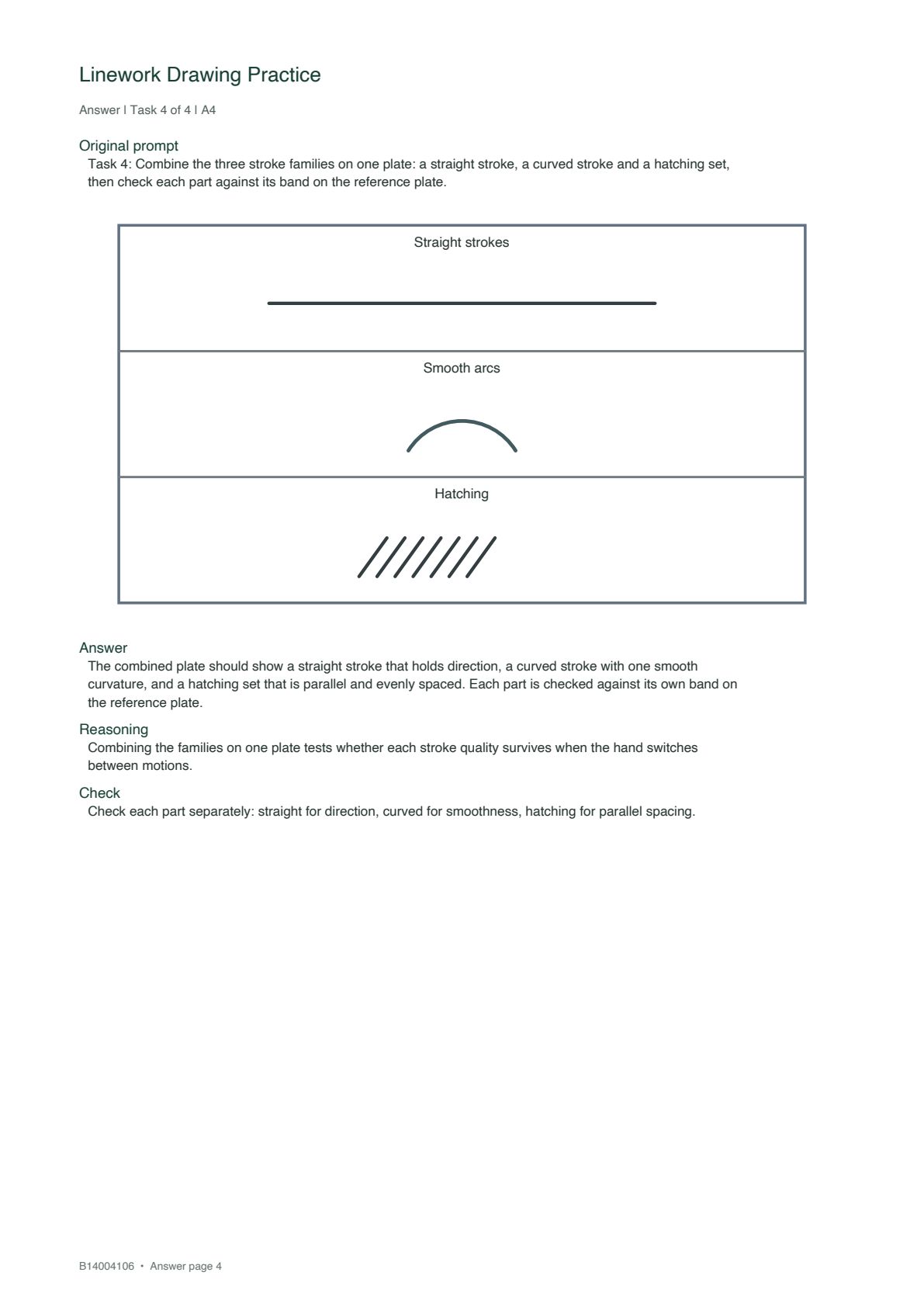
Task 4: Combine the three stroke families on one plate: a straight stroke, a curved stroke and a hatching set, then check each part against its band on the reference plate.
Show answer 4
The combined plate should show a straight stroke that holds direction, a curved stroke with one smooth curvature, and a hatching set that is parallel and evenly spaced. Each part is checked against its own band on the reference plate.
Combining the families on one plate tests whether each stroke quality survives when the hand switches between motions.
Check: Check each part separately: straight for direction, curved for smoothness, hatching for parallel spacing.
Useful checks
- Drawing a straight stroke with only the fingers, so it curves at the end. Move the whole arm and look at the stroke's end point before starting.
- Drawing a curved stroke in short segments, which creates kinks. Draw the whole arc in one movement and keep one curvature.
- Letting hatching strokes bunch or cross. Space the strokes evenly and keep them parallel to the first stroke.
Questions about this resource
Do I need special tools for linework drawing practice?
No. A pencil or pen you can control and a plain sheet are enough; the plate is about stroke control, not materials.
How do I know a stroke is good?
Check it against its family: straight strokes hold direction, curved strokes keep one smooth curvature, and hatching strokes stay parallel and evenly spaced.