Free original lessons
Brick Pattern Paper
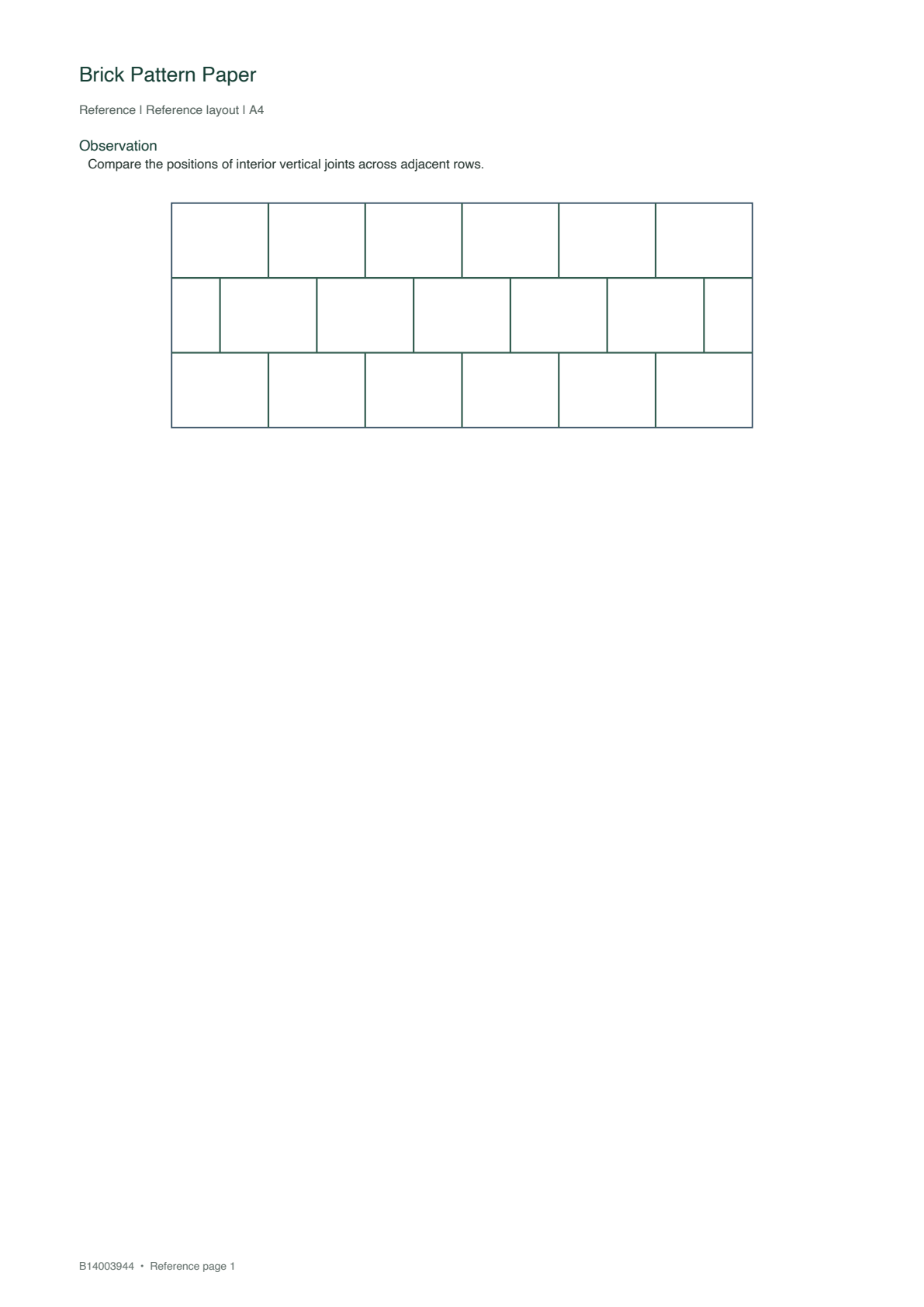
Draw equal rectangular full bricks in horizontal rows. In the main exercises the joints shift sideways by a fraction of a brick from one row to the next. At the edges, use partial bricks where the pattern reaches the sheet boundary. Compare that stagger with the aligned joints in the zero-offset example.
Letter & A4
PDF & SVG
What brick pattern paper is
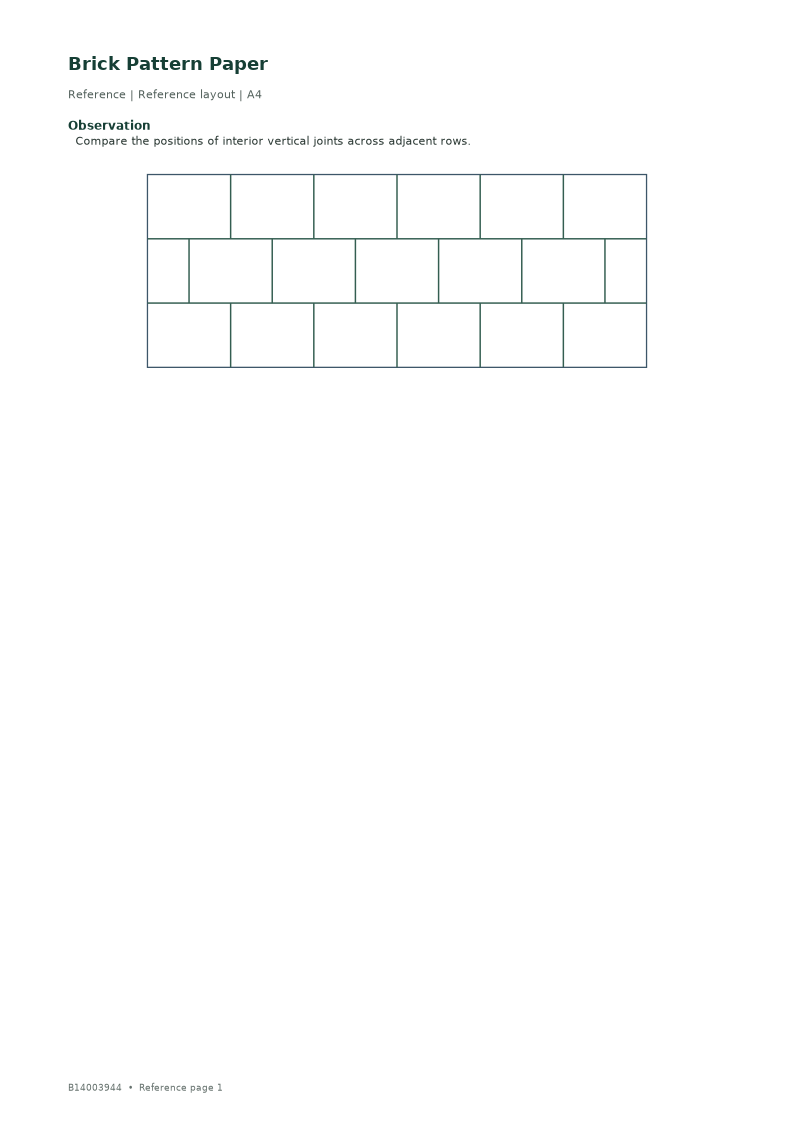
This drawing sheet shows rows of equal-size full bricks and occasional partial bricks at the sheet edges. In a staggered layout each row shifts sideways from the previous row, so its inside joints fall between the previous row's joints.
The offset is the layout control. A half-brick offset (each row shifted by half a brick width) is the common running-bond look; a quarter-brick offset gives a tighter stagger. The offset is a design choice for the sheet, not a fixed standard.
Reading the stagger
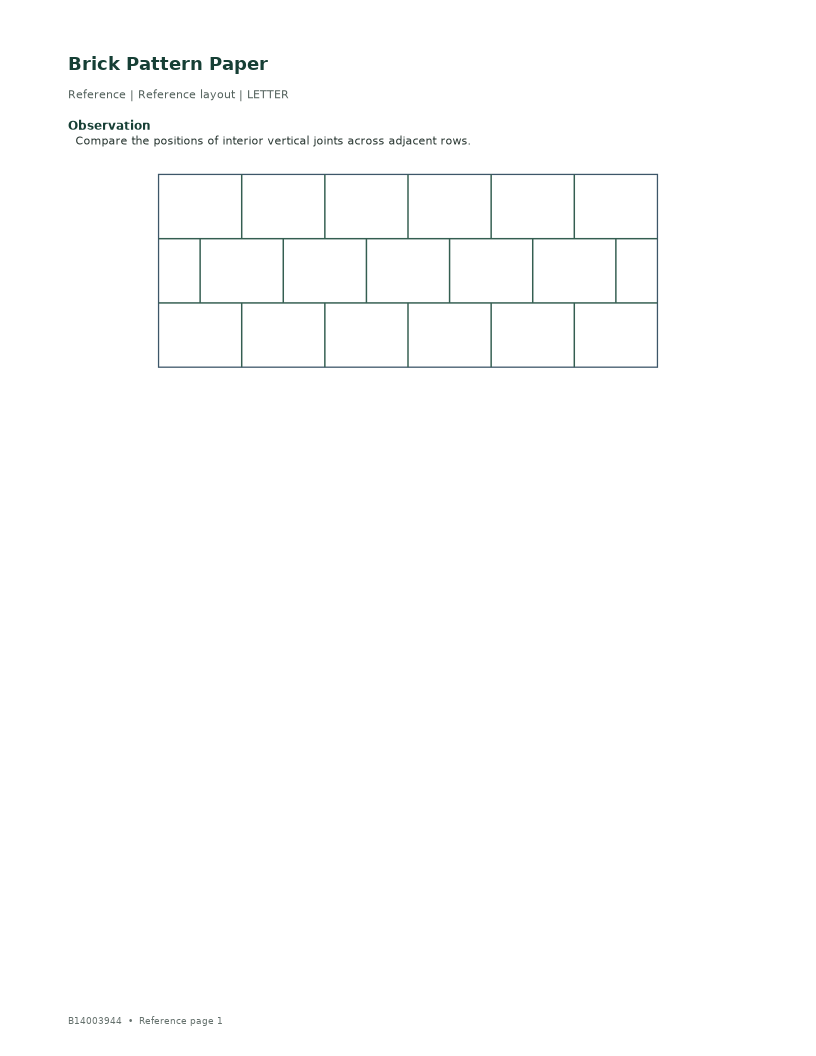
Compare the first interior joints of two neighboring rows. Their measured separation gives the half-brick example. For a full repeating cycle, follow one joint across rows and track the shift modulo a whole brick width.
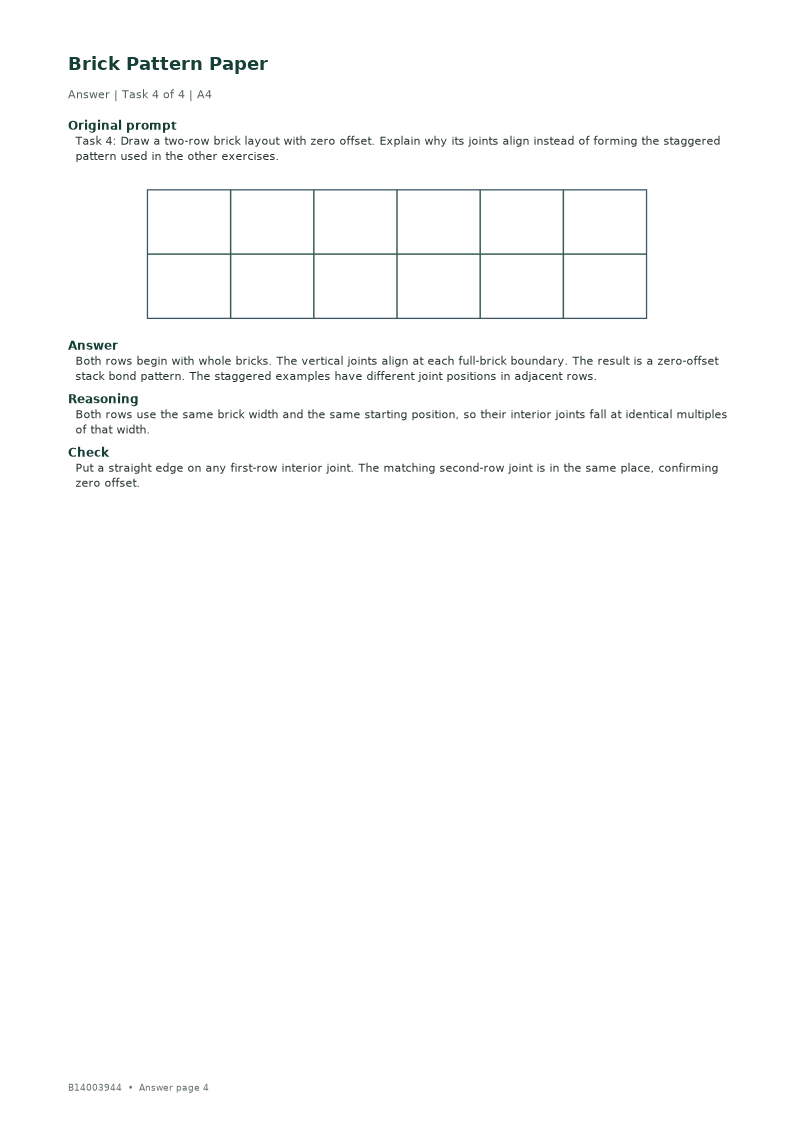
If corresponding joints line up, the offset is zero. This produces a stack bond pattern. The other exercises require a nonzero stagger between neighboring rows.
Constructing a staggered row by hand
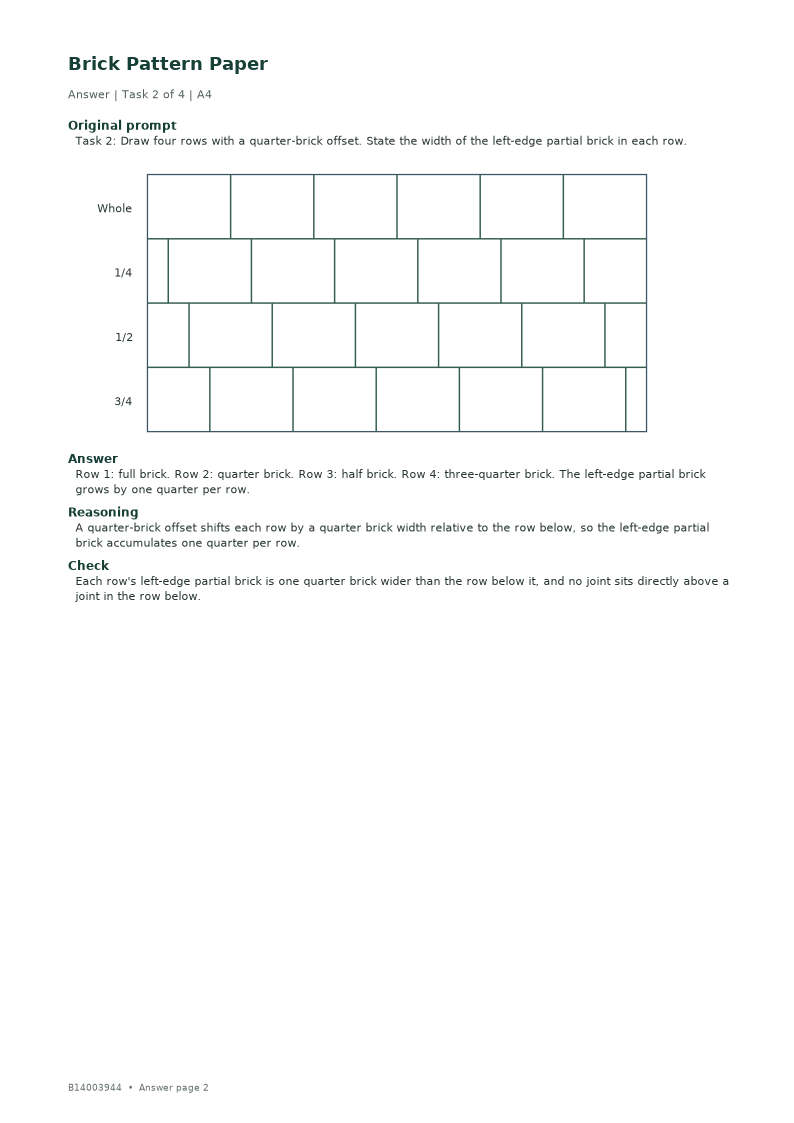
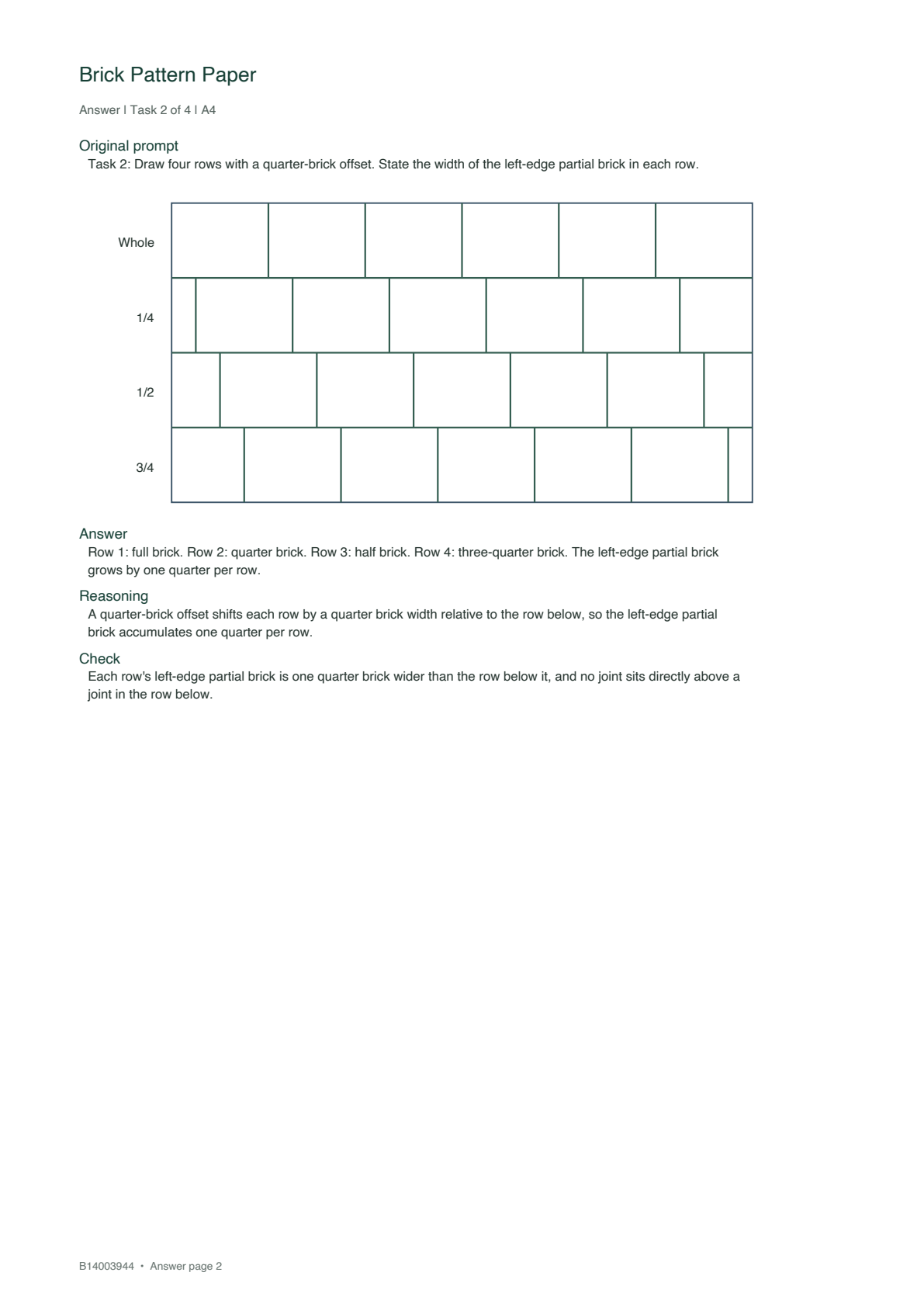
Draw the first row with whole bricks from the left edge. Shift the interior joints of the next row by the chosen fraction. In the quarter-brick example, the left edge starts with a whole, a quarter, a half and three quarters as you move down the four rows.
Step 4: at the sheet edges, the shifted row will end in a partial brick. Draw that partial brick honestly rather than stretching the last brick to fill the space.
Worked example
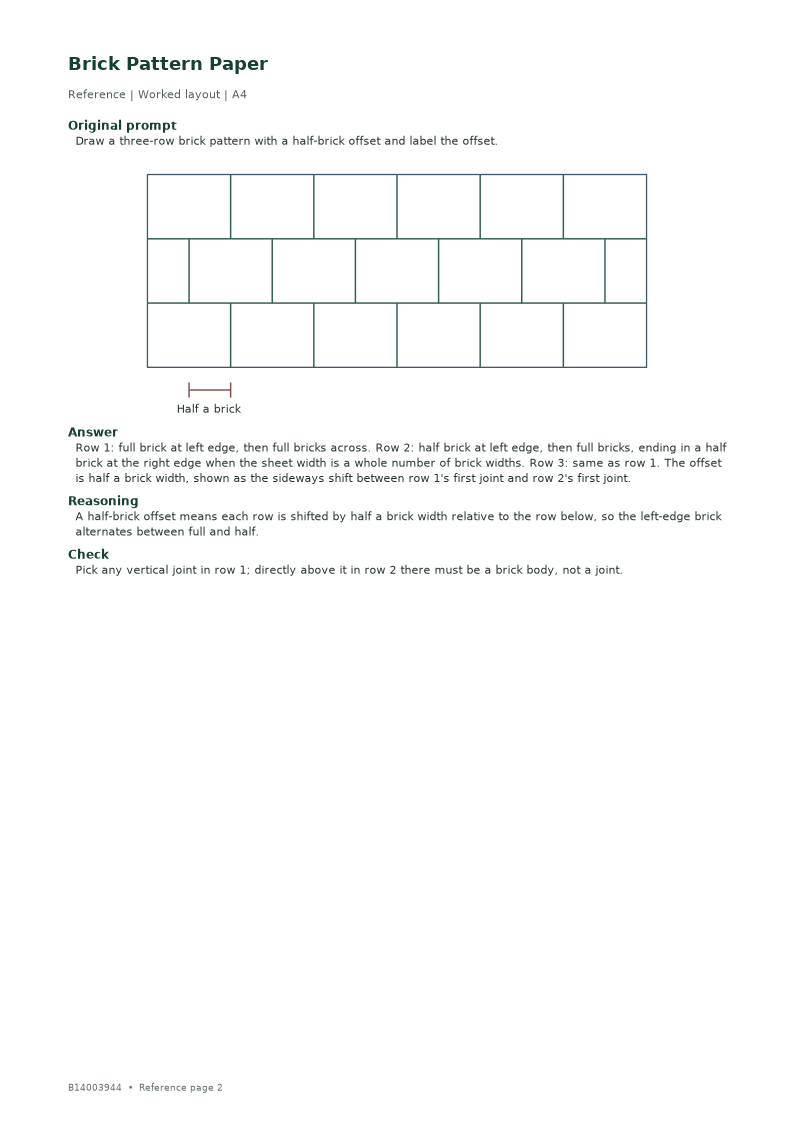
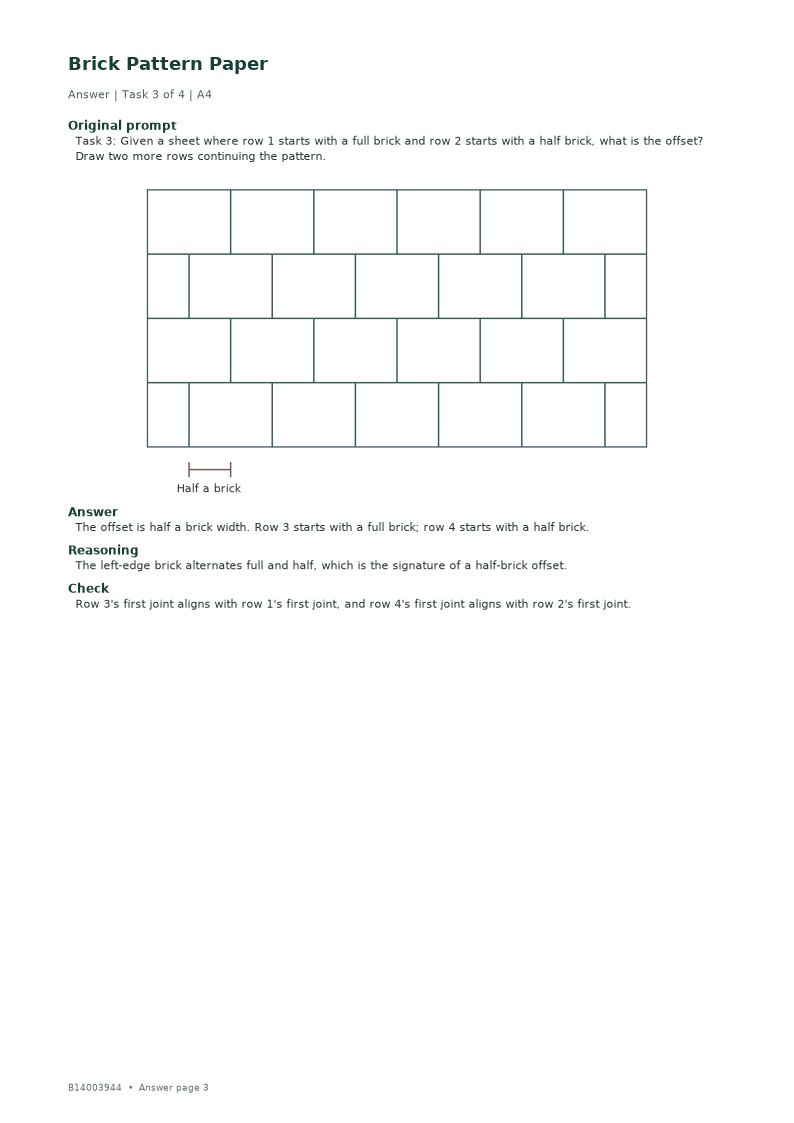
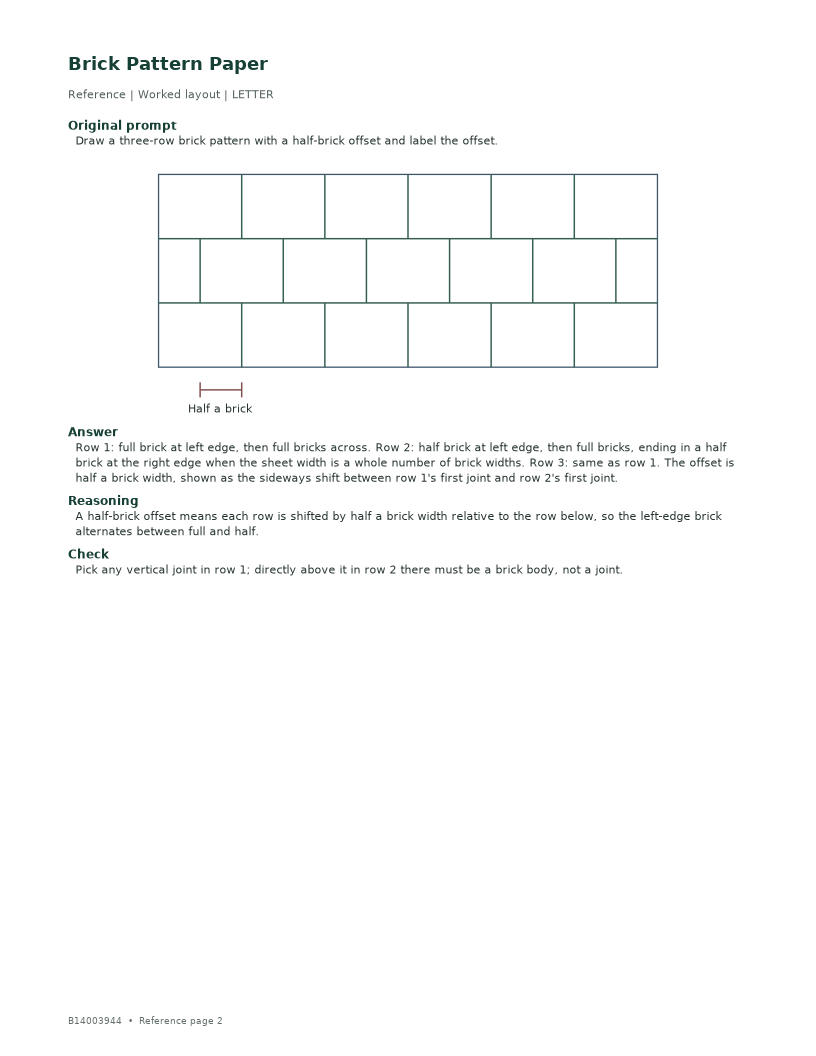
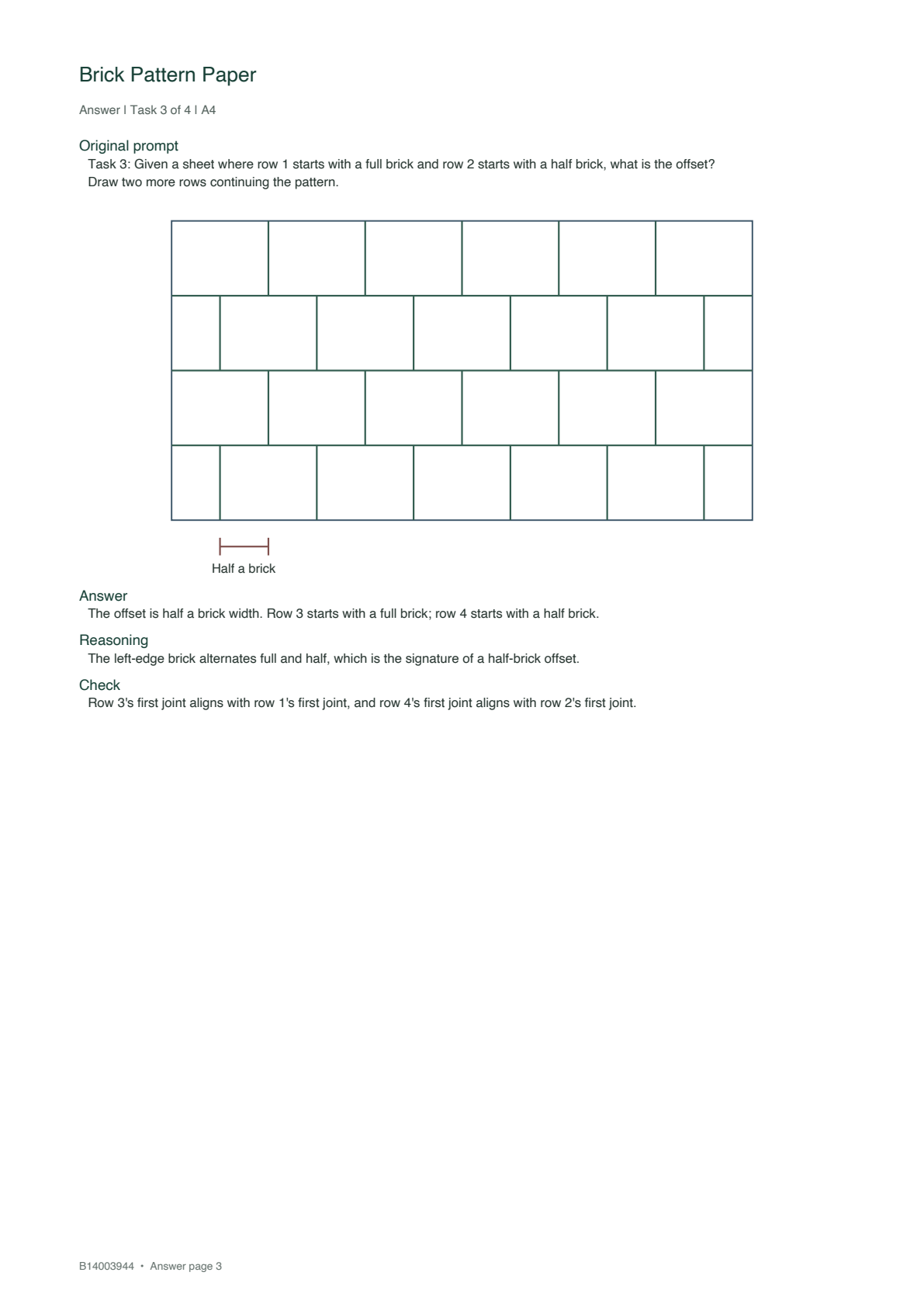
The first row starts with a whole brick at the left edge. The second starts with a half brick. The first interior joints are separated by half a brick width. The third starts with a whole brick after the two half steps complete a full-width cycle.
Check adjacent rows: a joint in the first row should align with the interior of a brick in the second row. Repeat the check for rows two and three.
Practice tasks
Task 1: On a blank sheet, draw three rows of equal bricks with a half-brick offset. Answer: row 1 begins with a full brick; row 2 begins with a half brick; row 3 begins with a full brick. Check: no vertical joint in row 2 sits directly above a joint in row 1.
Task 2: Draw four rows with a quarter-brick offset. Read downward: whole, quarter, half and three quarters at the left edge. In each successive row the repeating joints shift by one quarter of a brick width, measured modulo one brick width.
Download the complete resource pack
All individual SVG pages (20)
- A4 reference page 1
- A4 reference page 2
- A4 student page 1
- A4 student page 2
- A4 student page 3
- A4 student page 4
- A4 answer page 1
- A4 answer page 2
- A4 answer page 3
- A4 answer page 4
- LETTER reference page 1
- LETTER reference page 2
- LETTER student page 1
- LETTER student page 2
- LETTER student page 3
- LETTER student page 4
- LETTER answer page 1
- LETTER answer page 2
- LETTER answer page 3
- LETTER answer page 4
Print at 100% / actual size. Use the stated scale on any schematic diagram; physical cutting templates are identified separately. A4 and US Letter are separate files. Free access, no signup; CC BY 4.0.
How to use these pages
- What brick pattern paper is
- Reading the stagger
- Constructing a staggered row by hand
- Worked example
- Practice tasks
Worked example
Example: Draw a three-row brick pattern with a half-brick offset and label the offset.
Answer: Row 1: full brick at left edge, then full bricks across. Row 2: half brick at left edge, then full bricks, ending in a half brick at the right edge when the sheet width is a whole number of brick widths. Row 3: same as row 1. The offset is half a brick width, shown as the sideways shift between row 1's first joint and row 2's first joint.
Reasoning: A half-brick offset means each row is shifted by half a brick width relative to the row below, so the left-edge brick alternates between full and half.
Check: Pick any vertical joint in row 1; directly above it in row 2 there must be a brick body, not a joint.
Four practice tasks and complete answers
Task 1
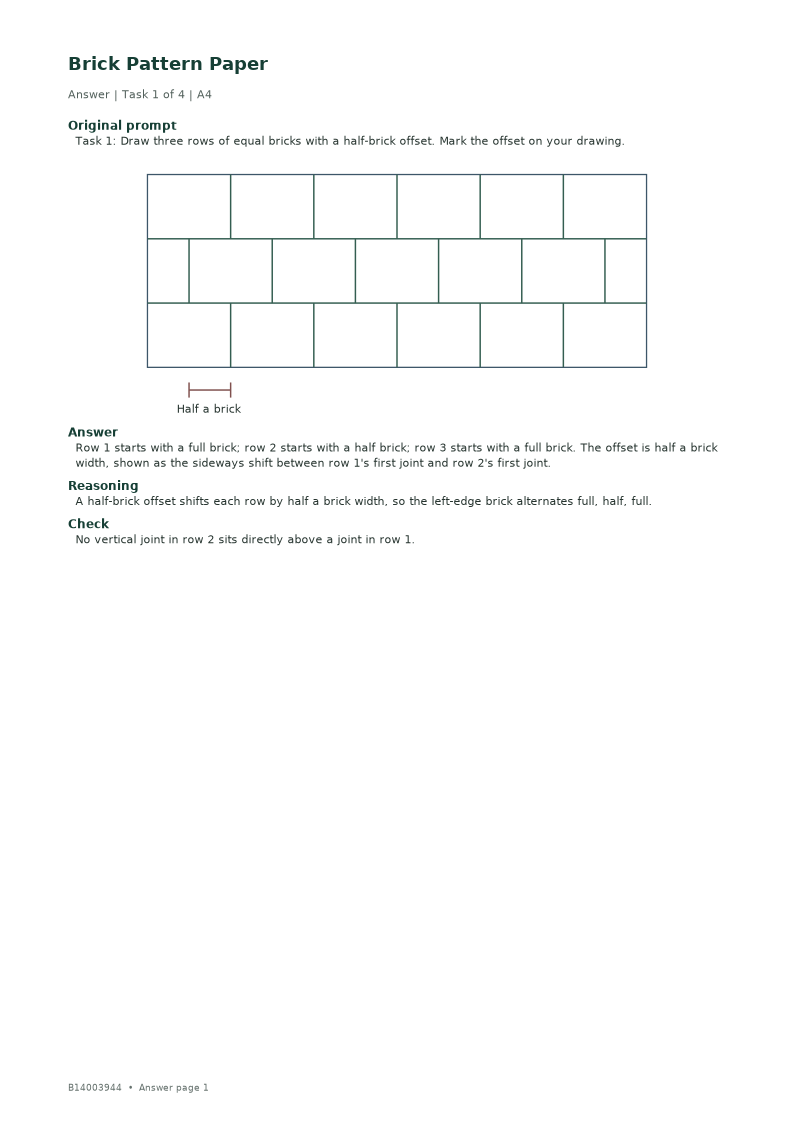
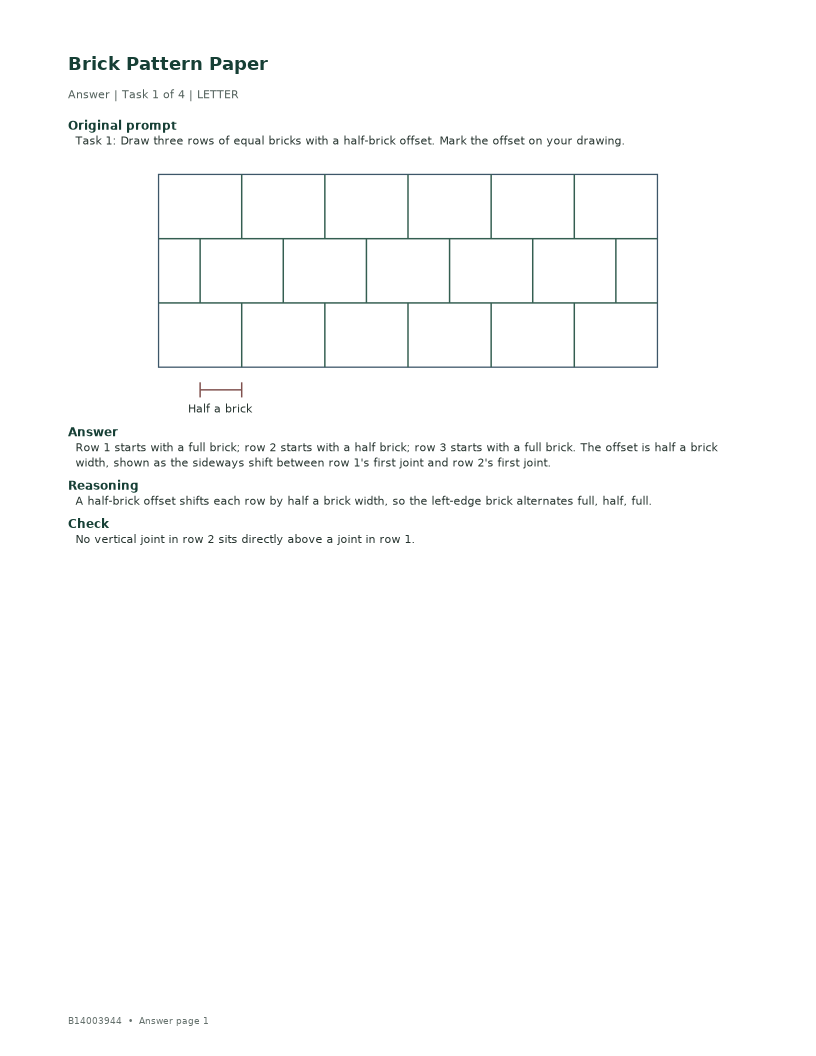
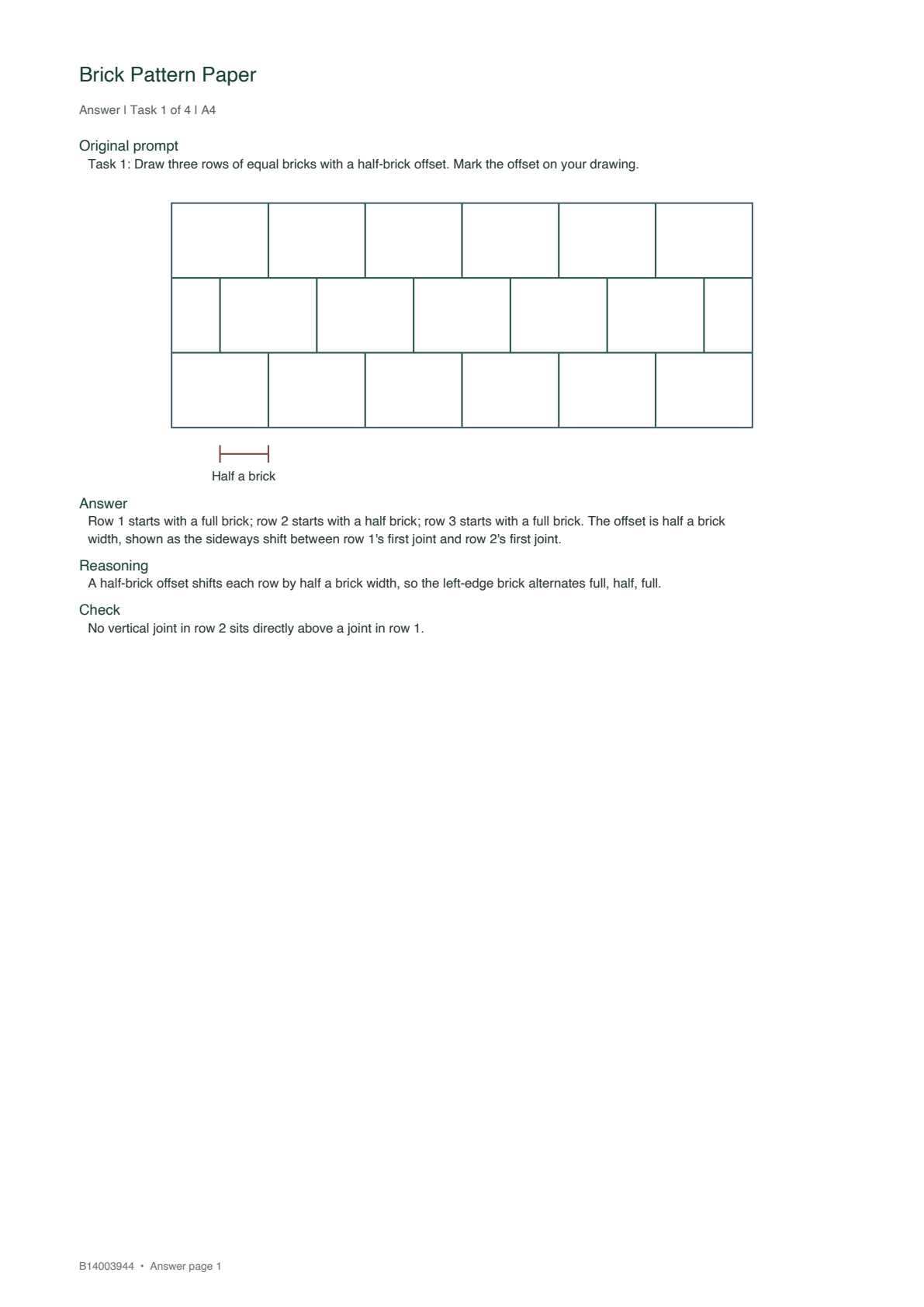
Task 1: Draw three rows of equal bricks with a half-brick offset. Mark the offset on your drawing.
Show answer 1
Row 1 starts with a full brick; row 2 starts with a half brick; row 3 starts with a full brick. The offset is half a brick width, shown as the sideways shift between row 1's first joint and row 2's first joint.
A half-brick offset shifts each row by half a brick width, so the left-edge brick alternates full, half, full.
Check: No vertical joint in row 2 sits directly above a joint in row 1.
Task 2
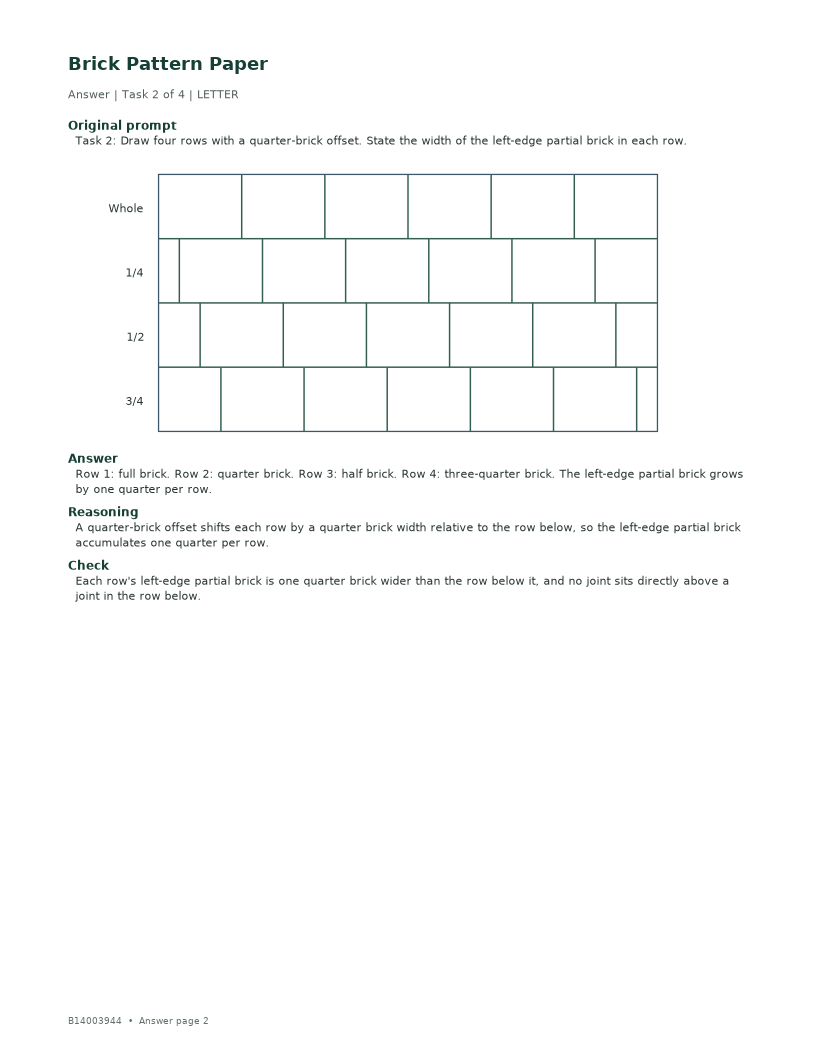
Task 2: Draw four rows with a quarter-brick offset. State the width of the left-edge partial brick in each row.
Show answer 2
Row 1: full brick. Row 2: quarter brick. Row 3: half brick. Row 4: three-quarter brick. The left-edge partial brick grows by one quarter per row.
A quarter-brick offset shifts each row by a quarter brick width relative to the row below, so the left-edge partial brick accumulates one quarter per row.
Check: Each row's left-edge partial brick is one quarter brick wider than the row below it, and no joint sits directly above a joint in the row below.
Task 3
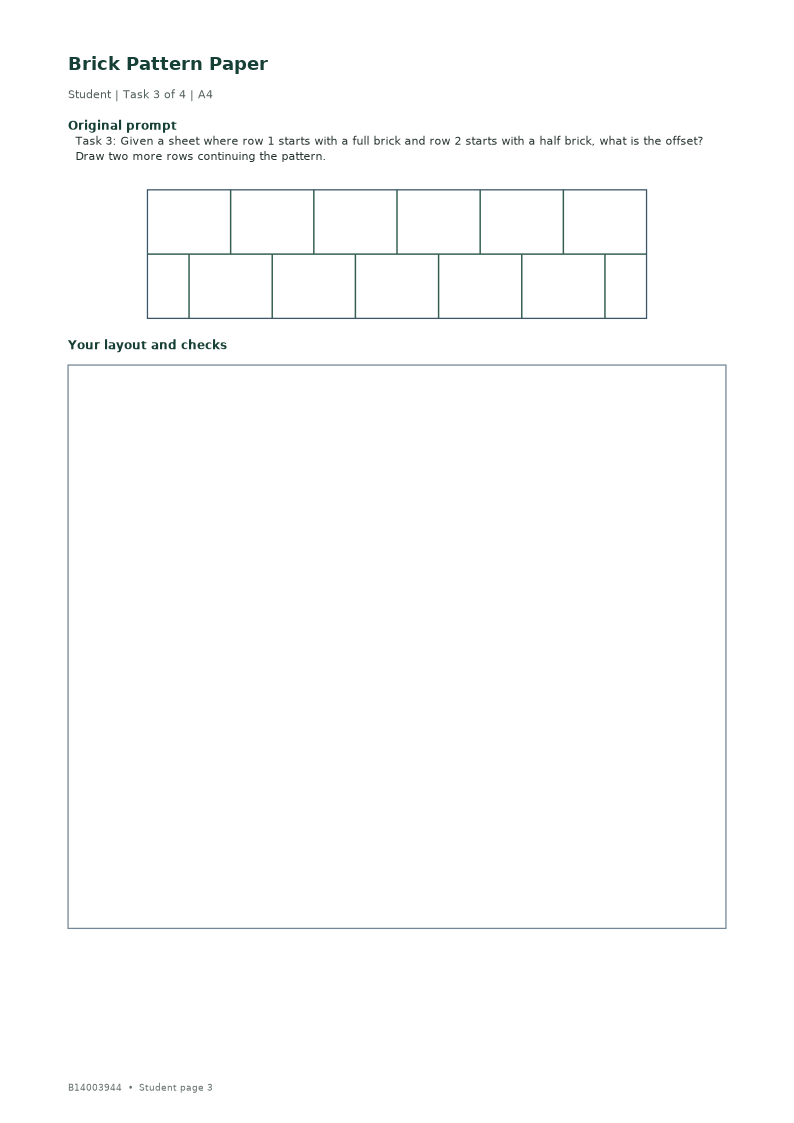
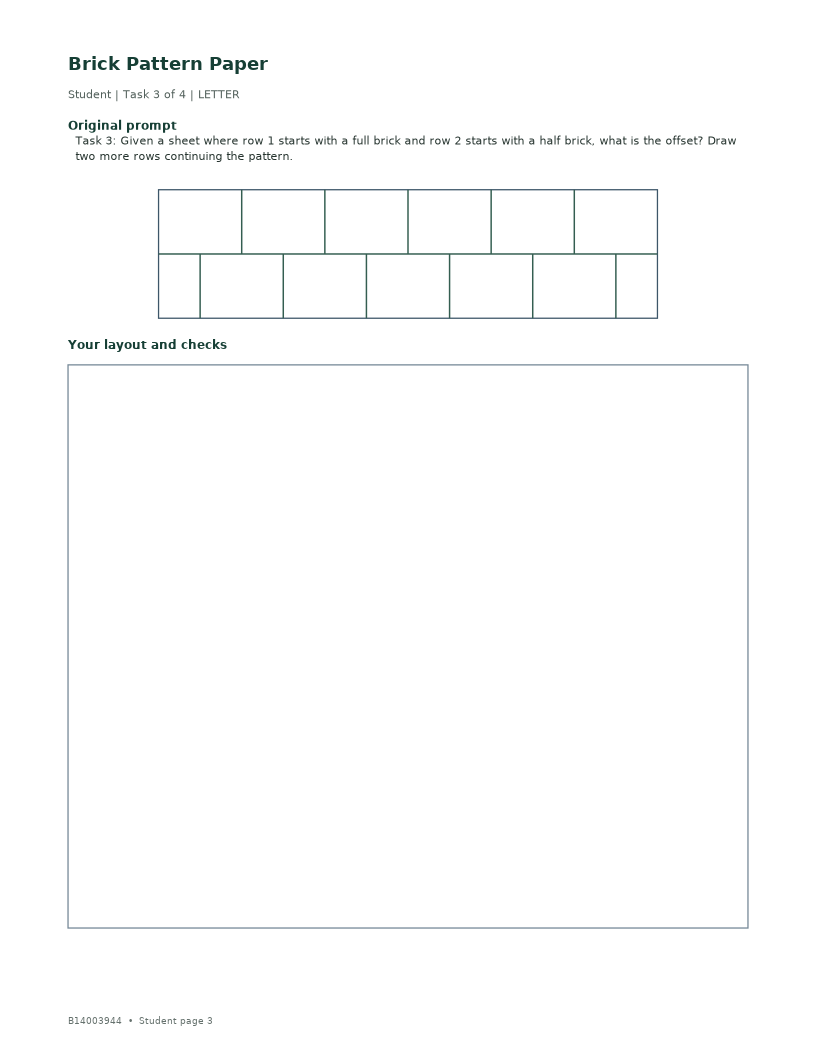
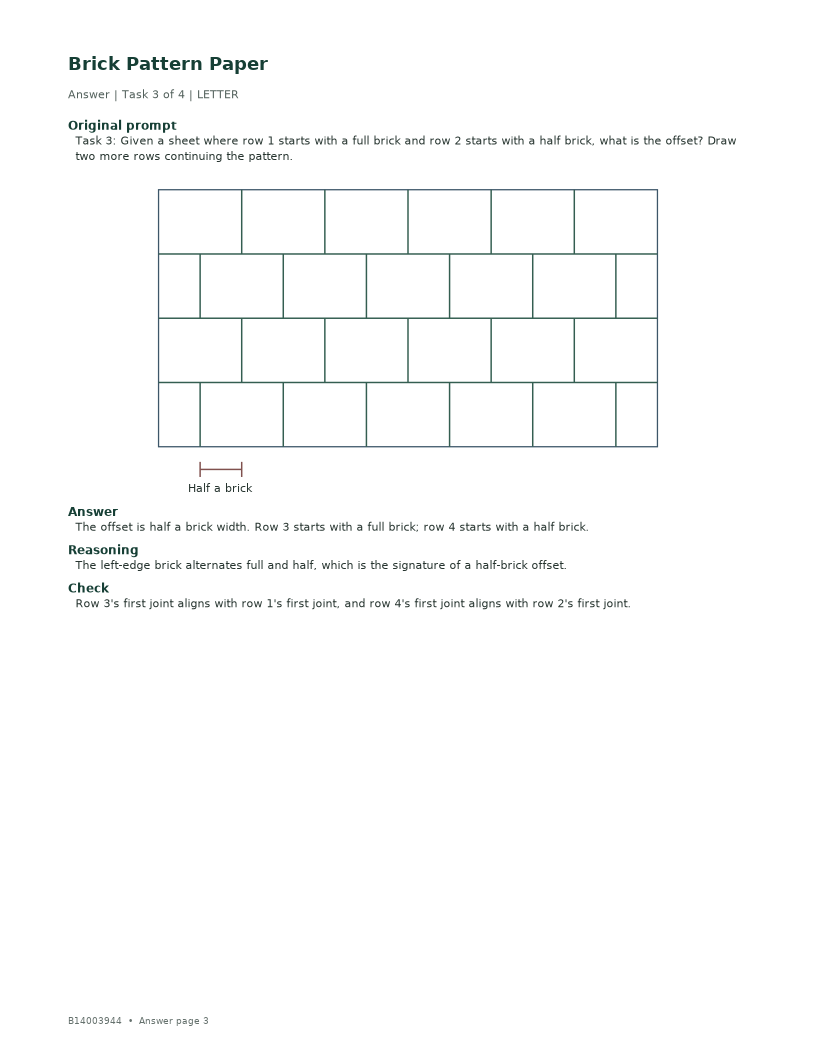
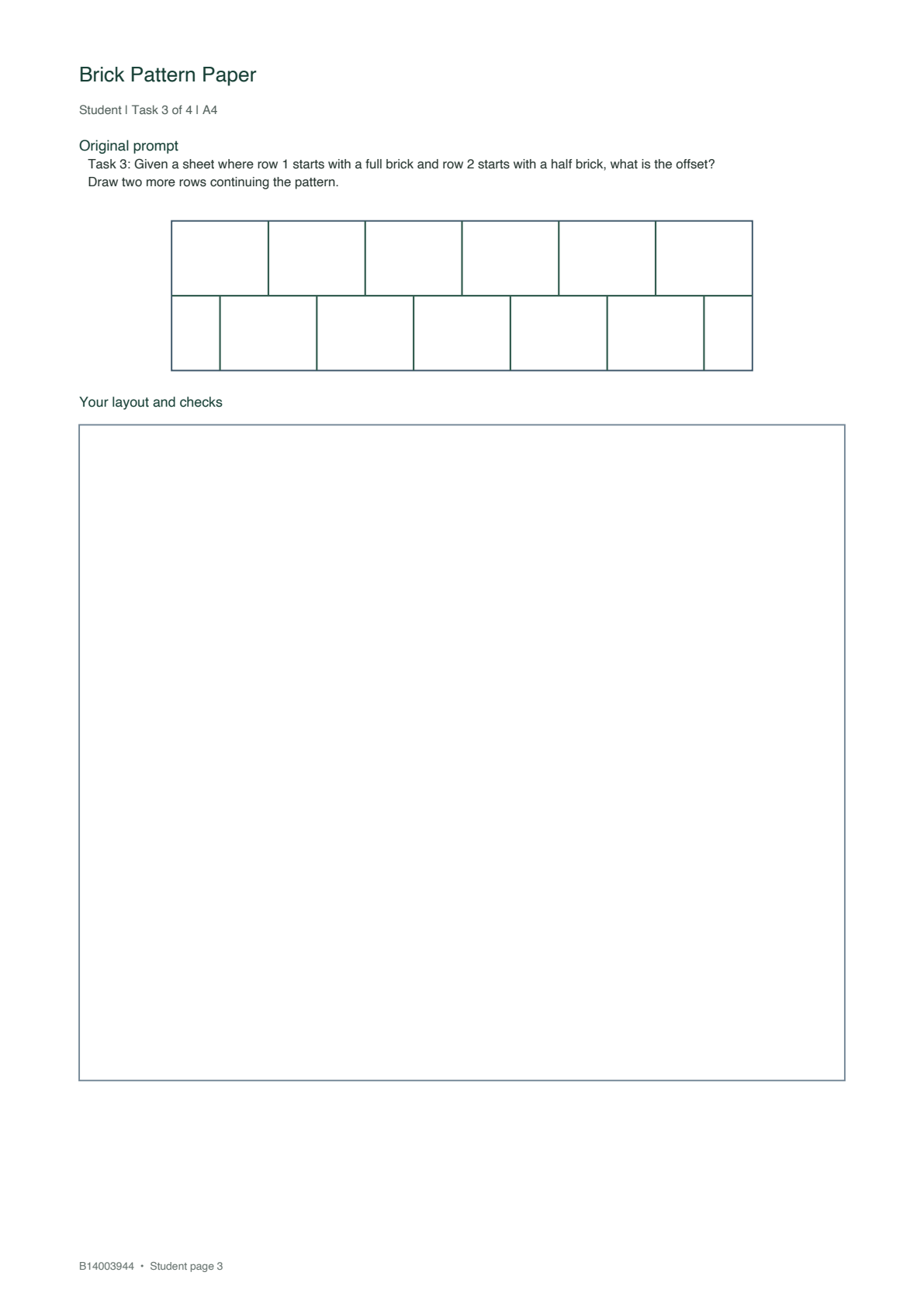
Task 3: Given a sheet where row 1 starts with a full brick and row 2 starts with a half brick, what is the offset? Draw two more rows continuing the pattern.
Show answer 3
The offset is half a brick width. Row 3 starts with a full brick; row 4 starts with a half brick.
The left-edge brick alternates full and half, which is the signature of a half-brick offset.
Check: Row 3's first joint aligns with row 1's first joint, and row 4's first joint aligns with row 2's first joint.
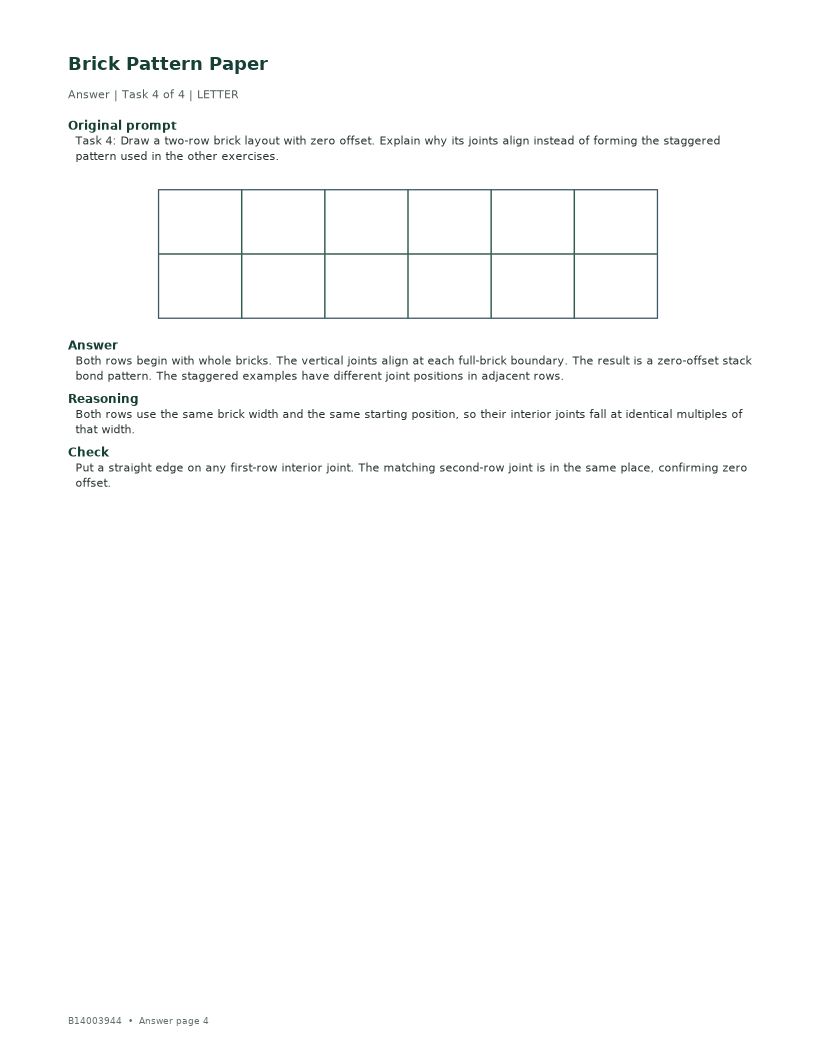
Task 4
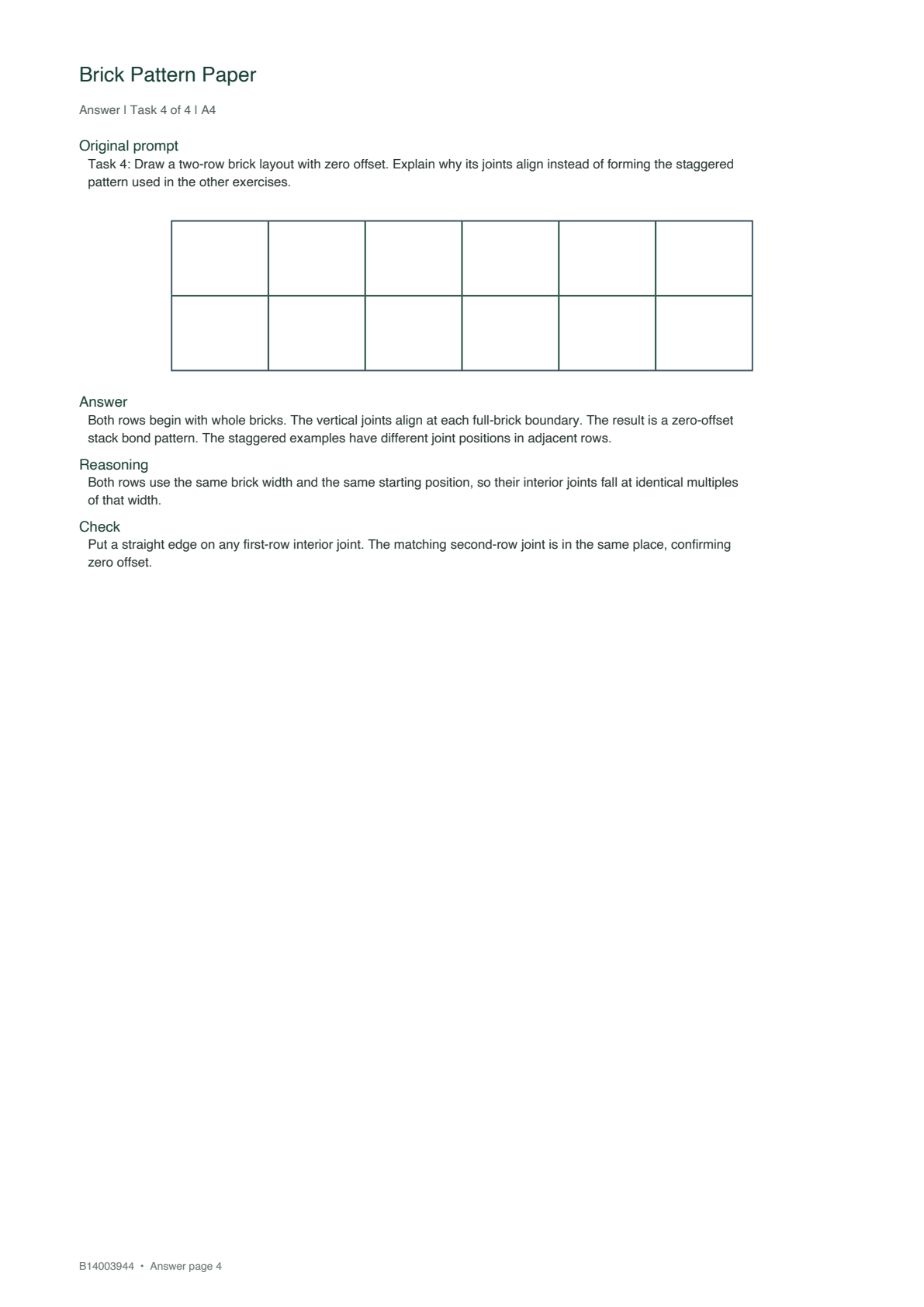
Task 4: Draw a two-row brick layout with zero offset. Explain why its joints align instead of forming the staggered pattern used in the other exercises.
Show answer 4
Both rows begin with whole bricks. The vertical joints align at each full-brick boundary. The result is a zero-offset stack bond pattern. The staggered examples have different joint positions in adjacent rows.
Both rows use the same brick width and the same starting position, so their interior joints fall at identical multiples of that width.
Check: Put a straight edge on any first-row interior joint. The matching second-row joint is in the same place, confirming zero offset.
Useful checks
- Stretching the last brick in a shifted row to fill the sheet edge. Keep full bricks equal. Draw any partial edge piece at its actual width when the sheet ends between full-width joints.
- Applying the offset in alternating directions each row for a simple running bond. For a simple running bond, shift the same way each row; alternating directions gives a different pattern.
Questions about this resource
Is a half-brick offset a standard?
No; it is a common design choice. The offset is a layout control you choose, not a fixed standard.
Can I use brick pattern paper for mosaic planning?
Yes; the staggered grid helps plan tile placement, but the offset is your choice.