Free original lessons
Bunco Score Sheet Template
A Bunco round score sheet records each player's points for a round using tally marks in a column. This pack teaches the sheet's layout, how to tally points, and how to check a completed sheet. The layout below is an original classroom choice, not an official Bunco or printer standard.
Letter & A4
PDF & SVG
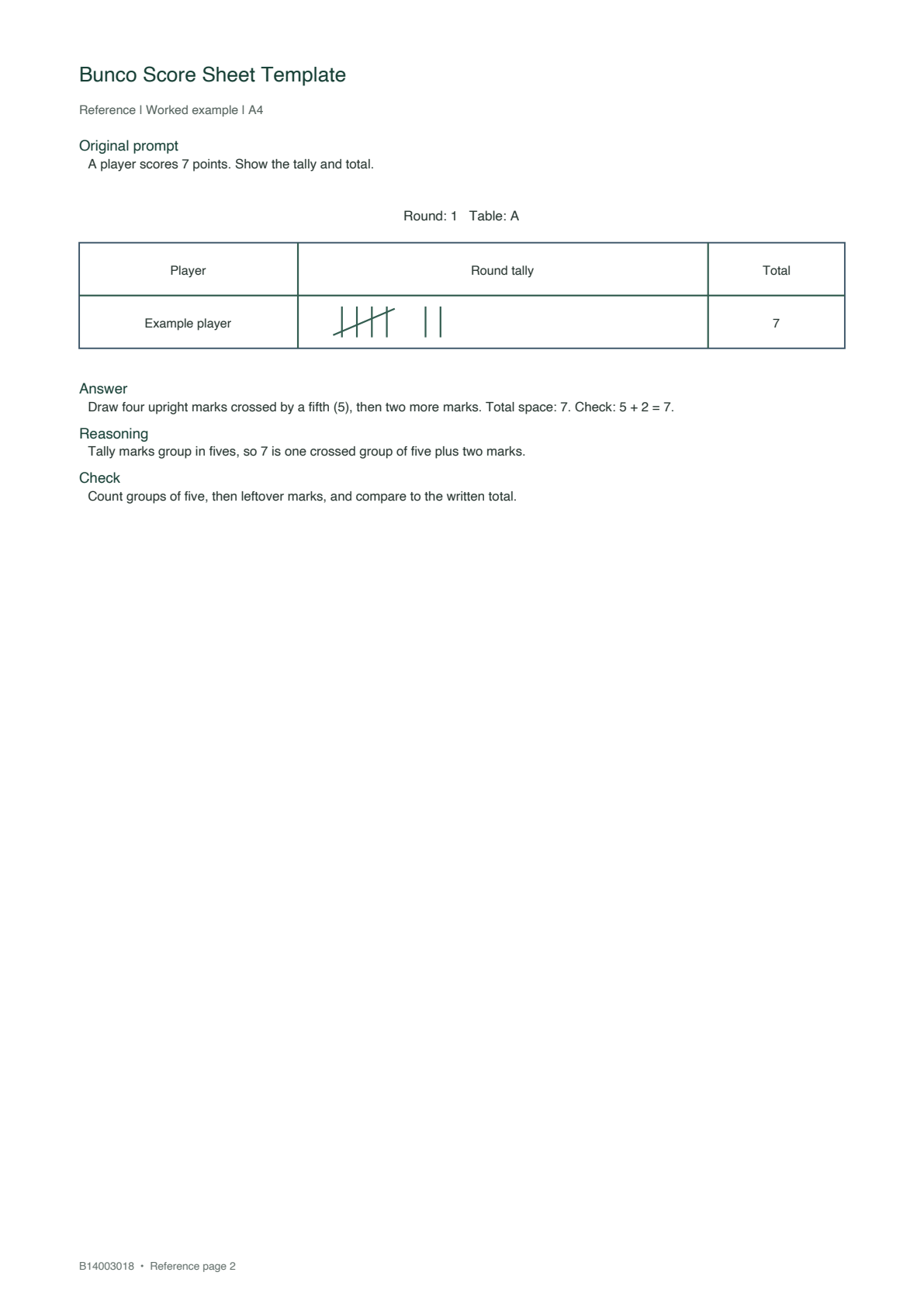
The sheet layout
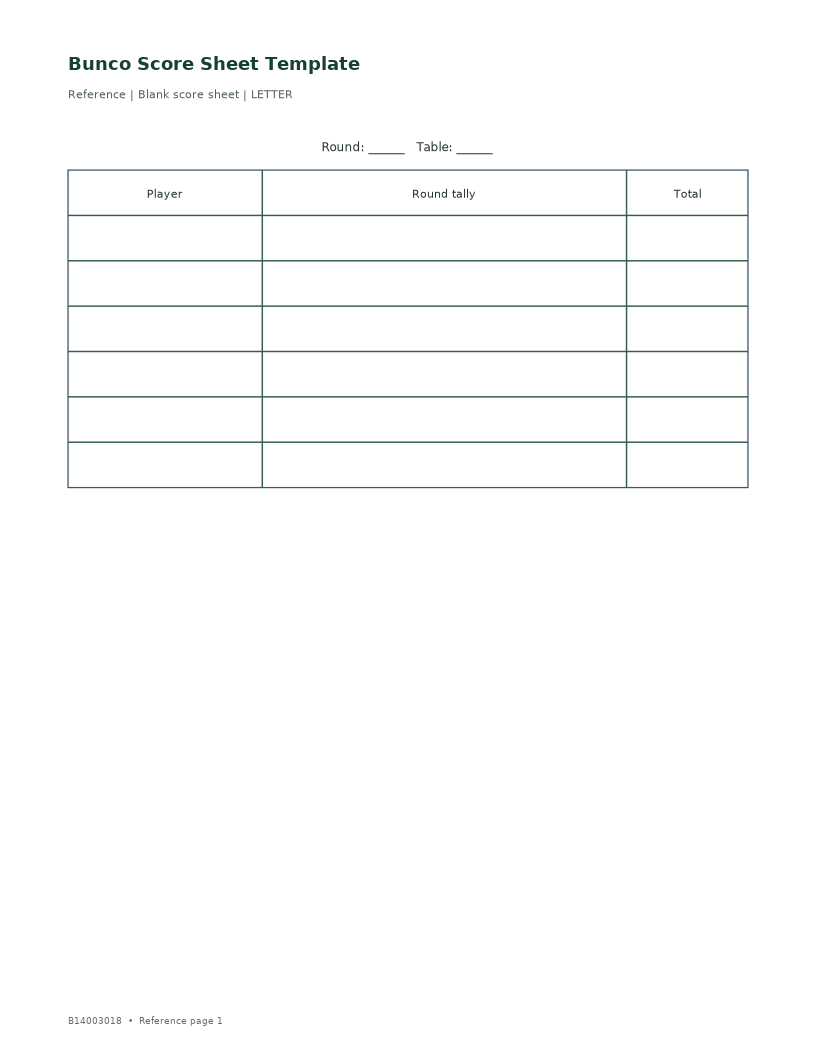
The sheet has a header for the round number and table, then one row per player. Each player row has a name space and a tally column for points scored in that round.
Points are recorded as tally marks: one mark per point, grouped in fives (four upright marks crossed by a fifth) so totals are easy to read. A round total is written in the total space at the end of the row.
Worked example
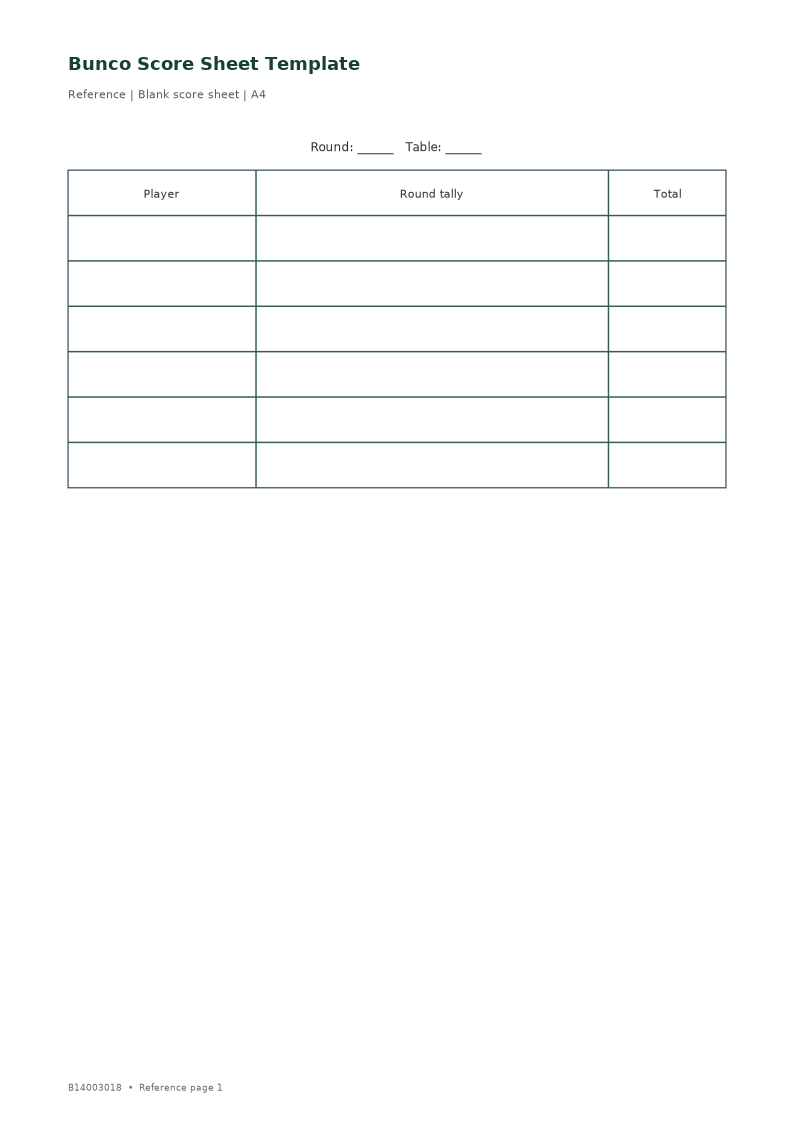
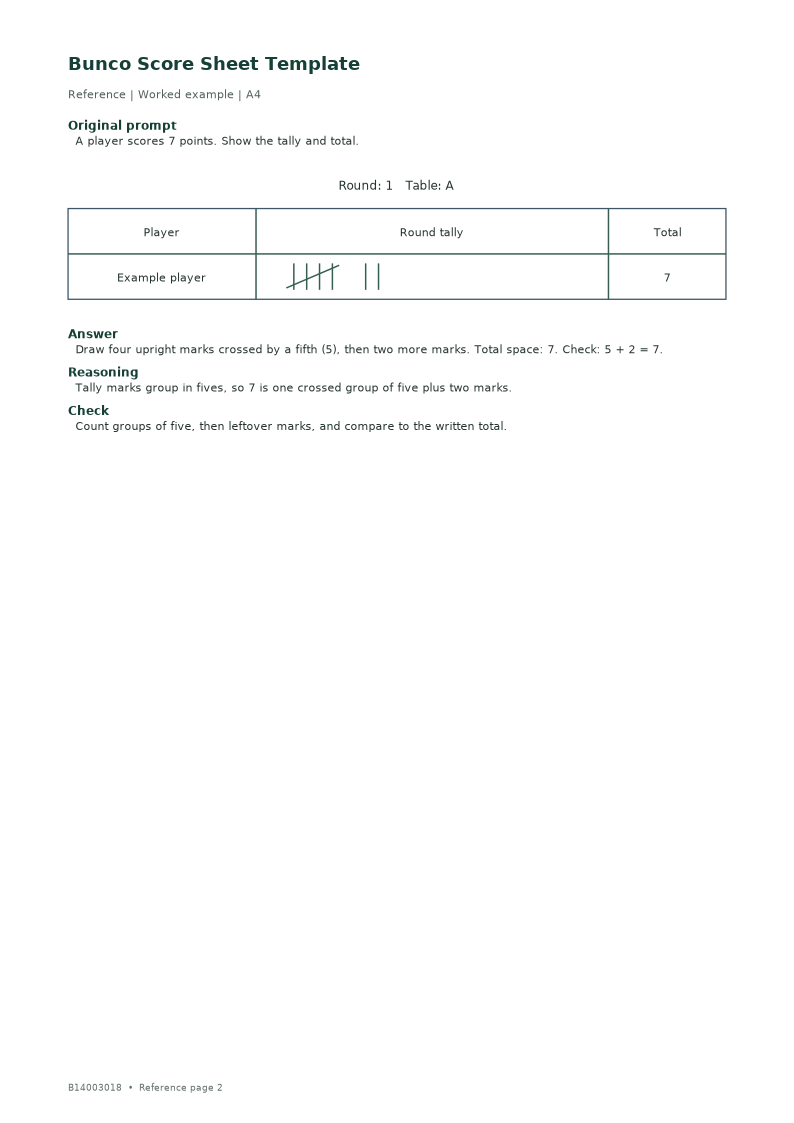
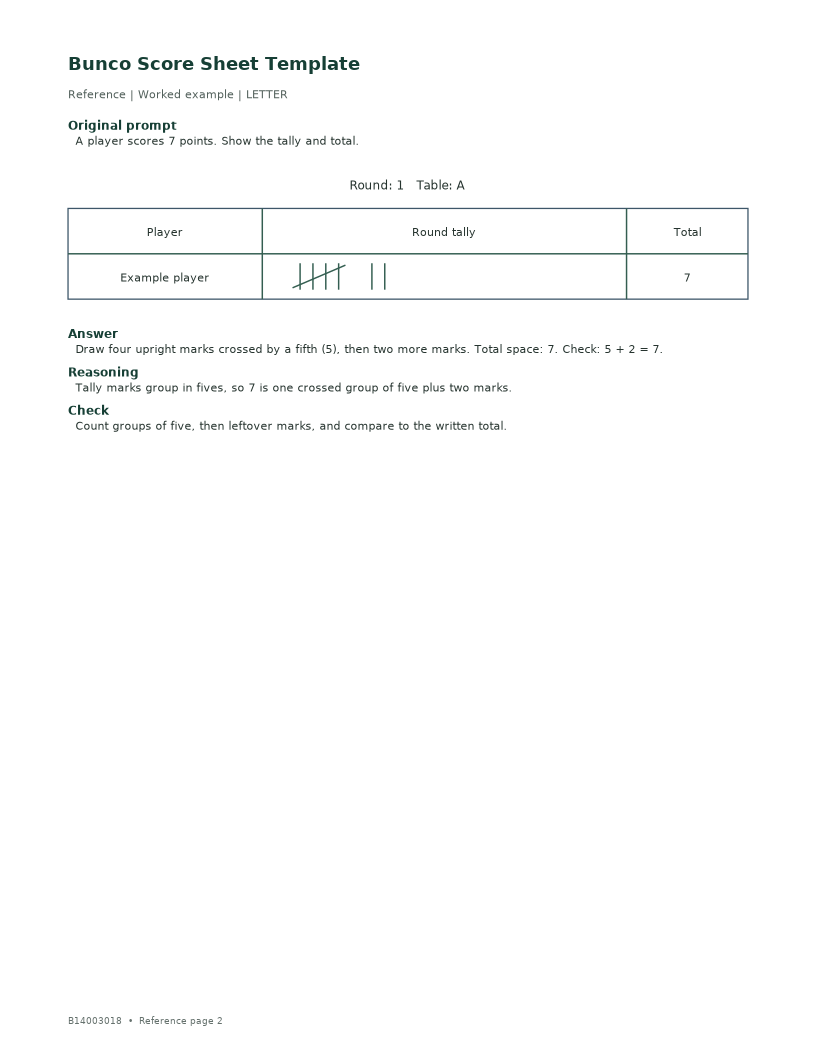
Suppose a player scores 7 points in a round. Write four upright marks, cross them with a fifth to show 5, then add two more marks. The tally reads 5 + 2, and the total space shows 7.
Check: count the groups of five first (one group = 5), then count the leftover marks (2). 5 + 2 = 7, matching the written total.
Practice tasks
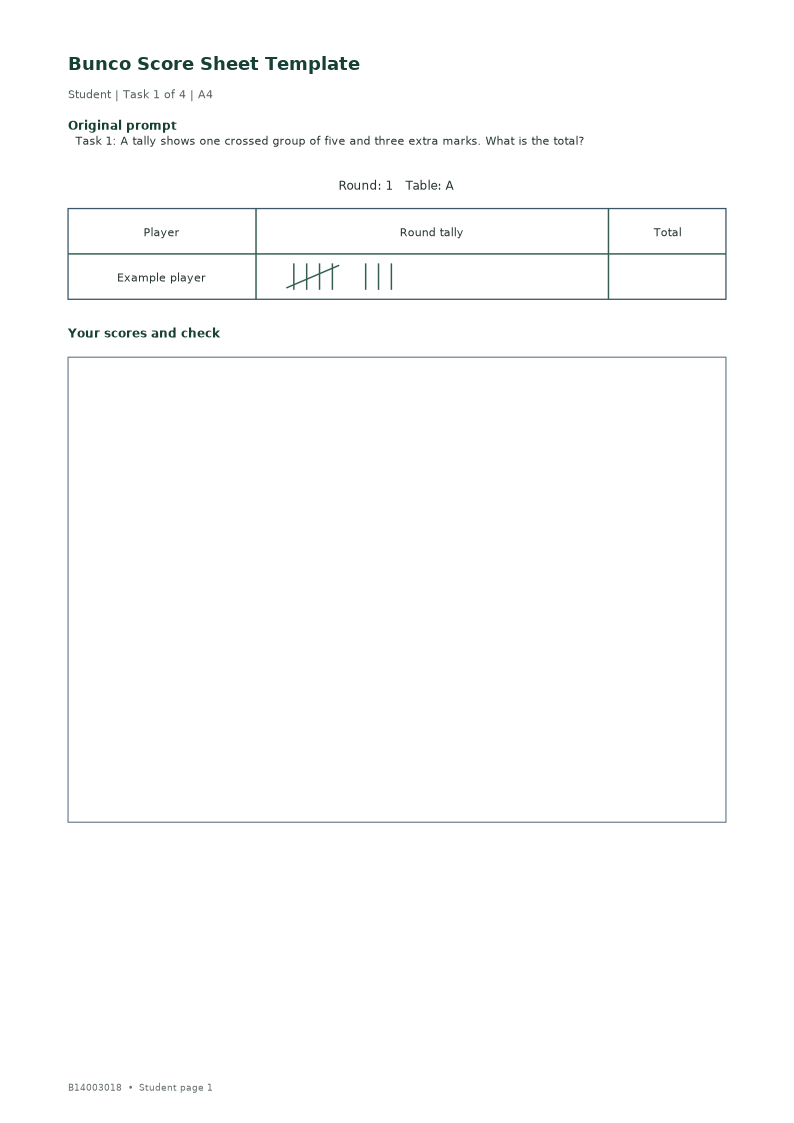
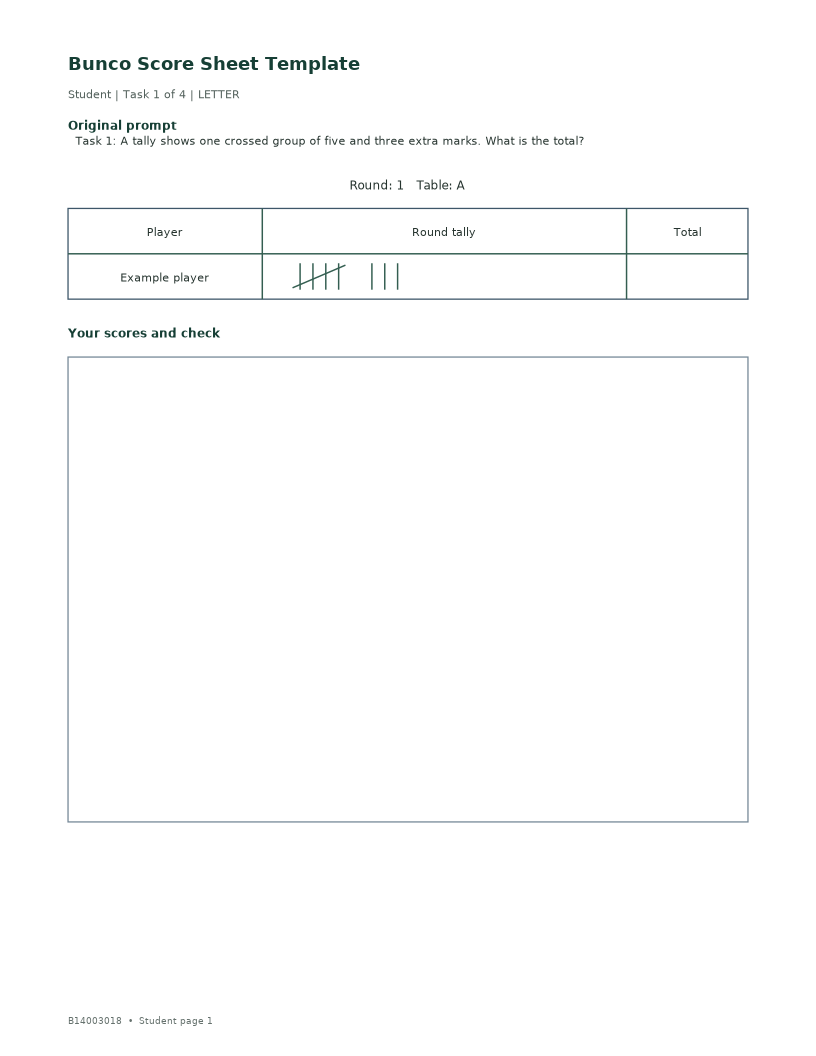
Task 1: Read a tally. A player's tally shows one crossed group of five and three extra marks. Write the total.
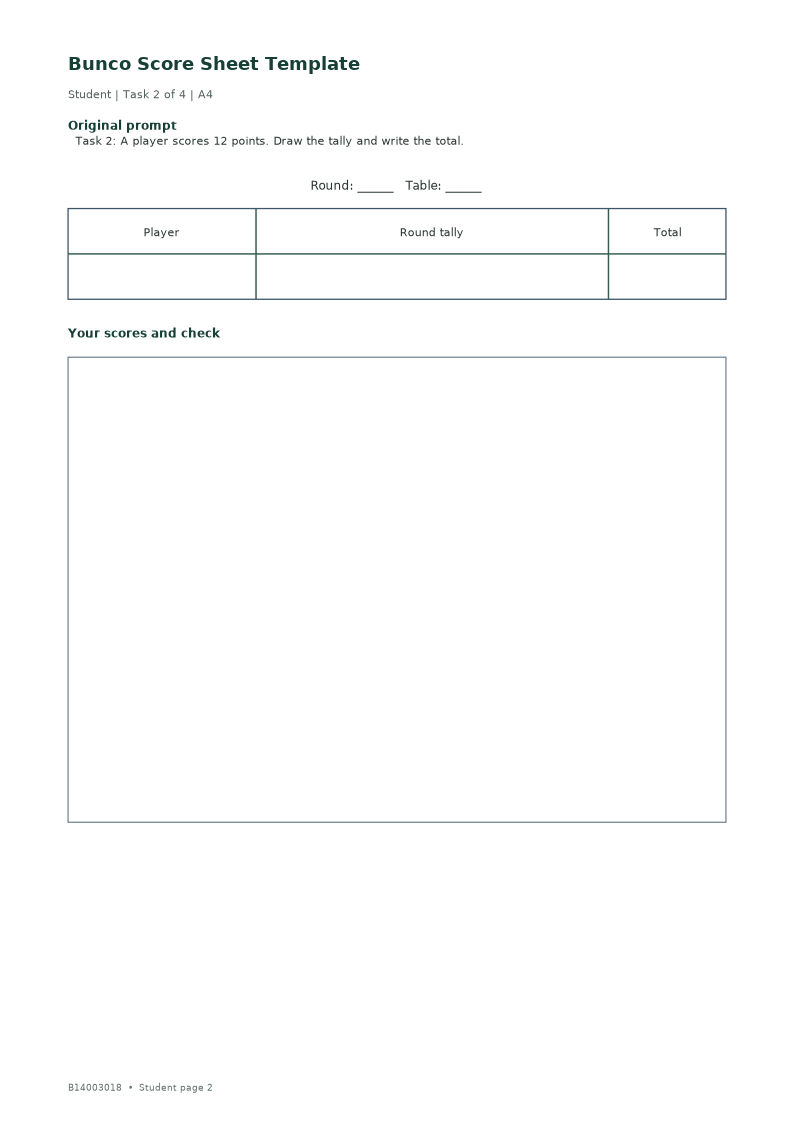
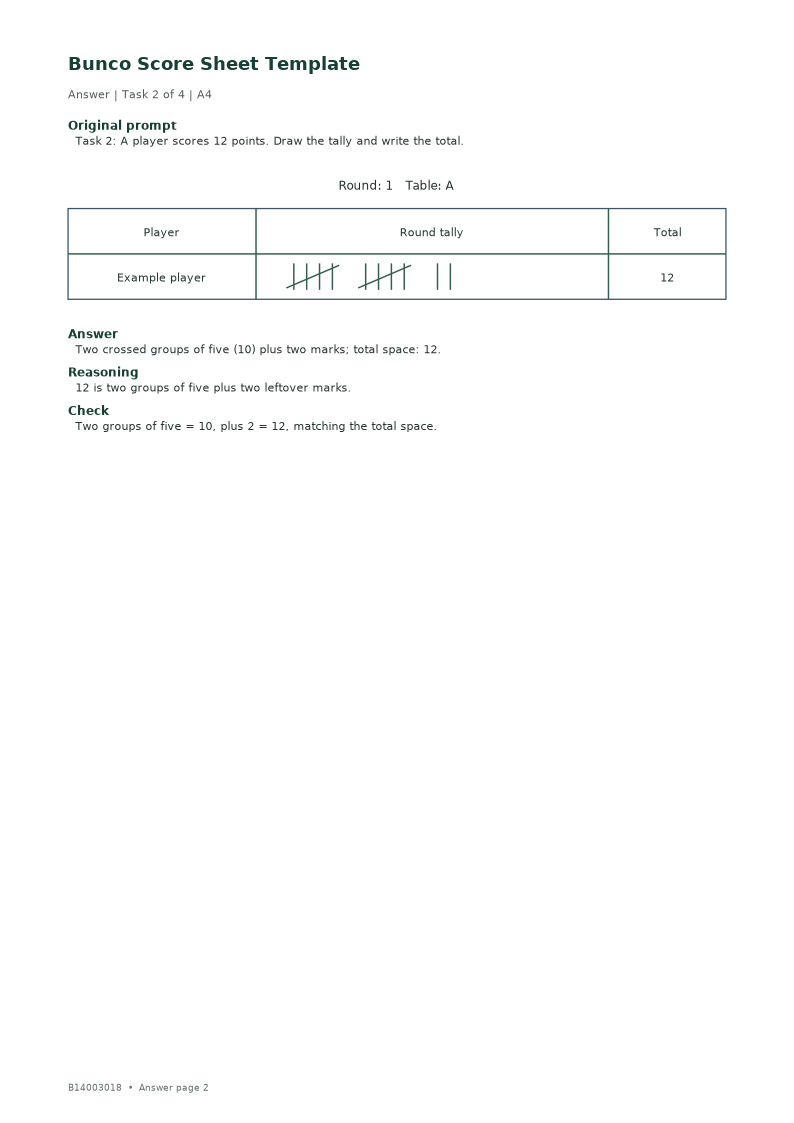
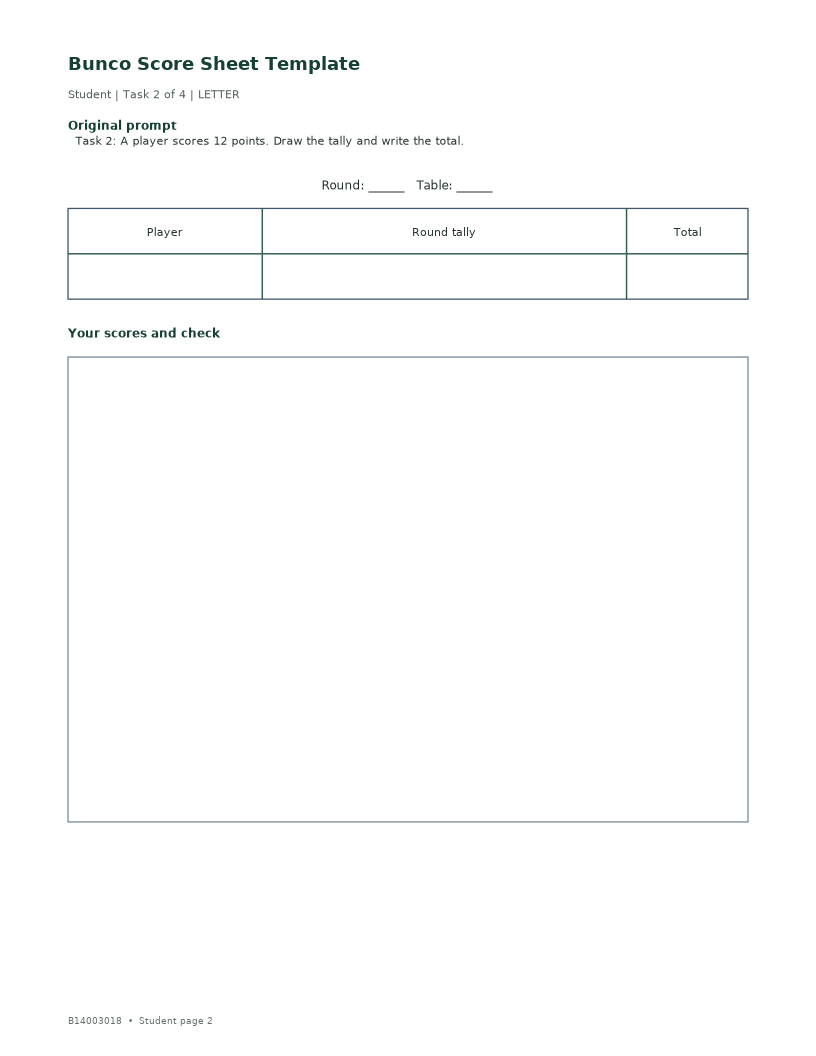
Task 2: Draw a tally for 12 points and write a total. Use the answer section to compare the groups and leftover marks after you try it.
Download the complete resource pack
All individual SVG pages (20)
- A4 reference page 1
- A4 reference page 2
- A4 student page 1
- A4 student page 2
- A4 student page 3
- A4 student page 4
- A4 answer page 1
- A4 answer page 2
- A4 answer page 3
- A4 answer page 4
- LETTER reference page 1
- LETTER reference page 2
- LETTER student page 1
- LETTER student page 2
- LETTER student page 3
- LETTER student page 4
- LETTER answer page 1
- LETTER answer page 2
- LETTER answer page 3
- LETTER answer page 4
Print at 100% / actual size. Use the stated scale on any schematic diagram; physical cutting templates are identified separately. A4 and US Letter are separate files. Free access, no signup; CC BY 4.0.
How to use these pages
- The sheet layout
- Worked example
- Practice tasks
Worked example
Example: A player scores 7 points. Show the tally and total.
Answer: Draw four upright marks crossed by a fifth (5), then two more marks. Total space: 7. Check: 5 + 2 = 7.
Reasoning: Tally marks group in fives, so 7 is one crossed group of five plus two marks.
Check: Count groups of five, then leftover marks, and compare to the written total.
Four practice tasks and complete answers
Task 1
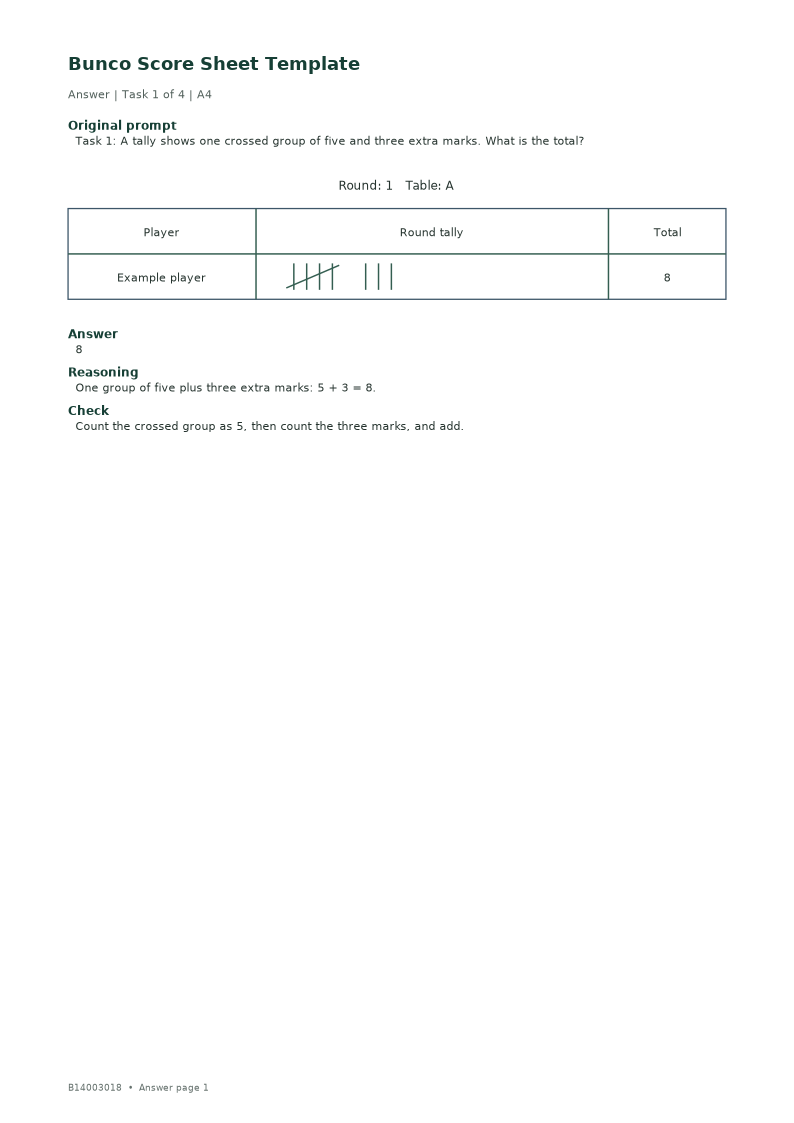
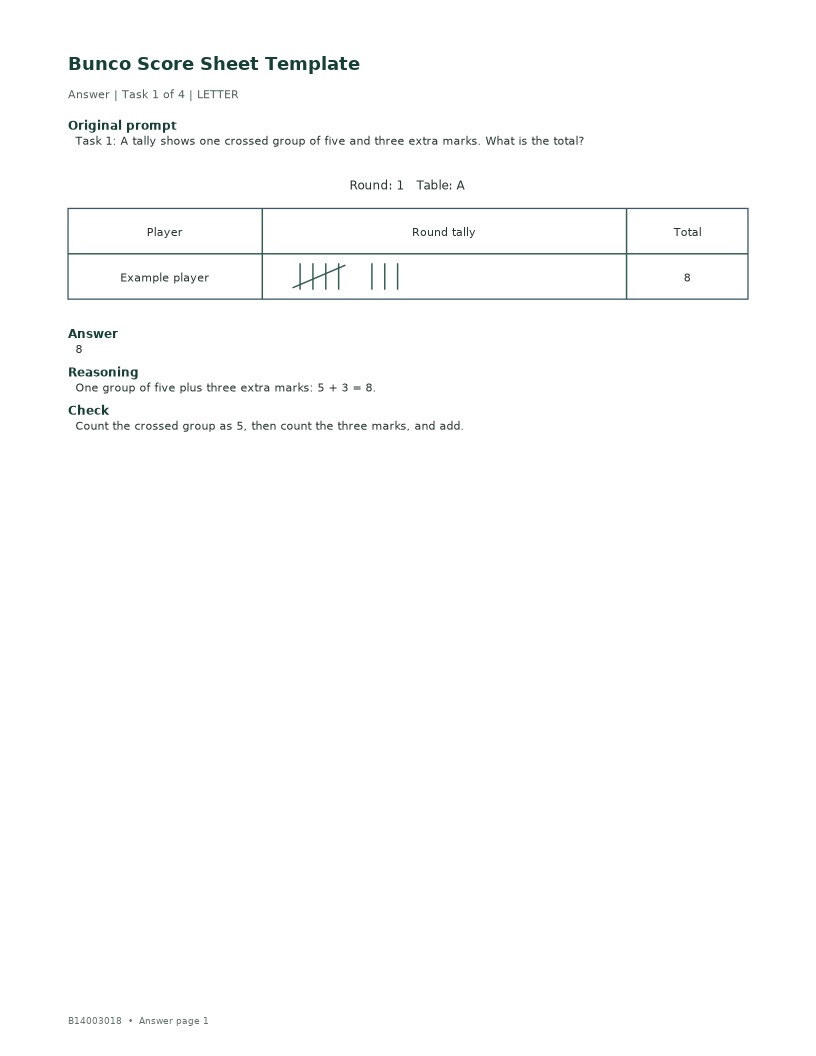
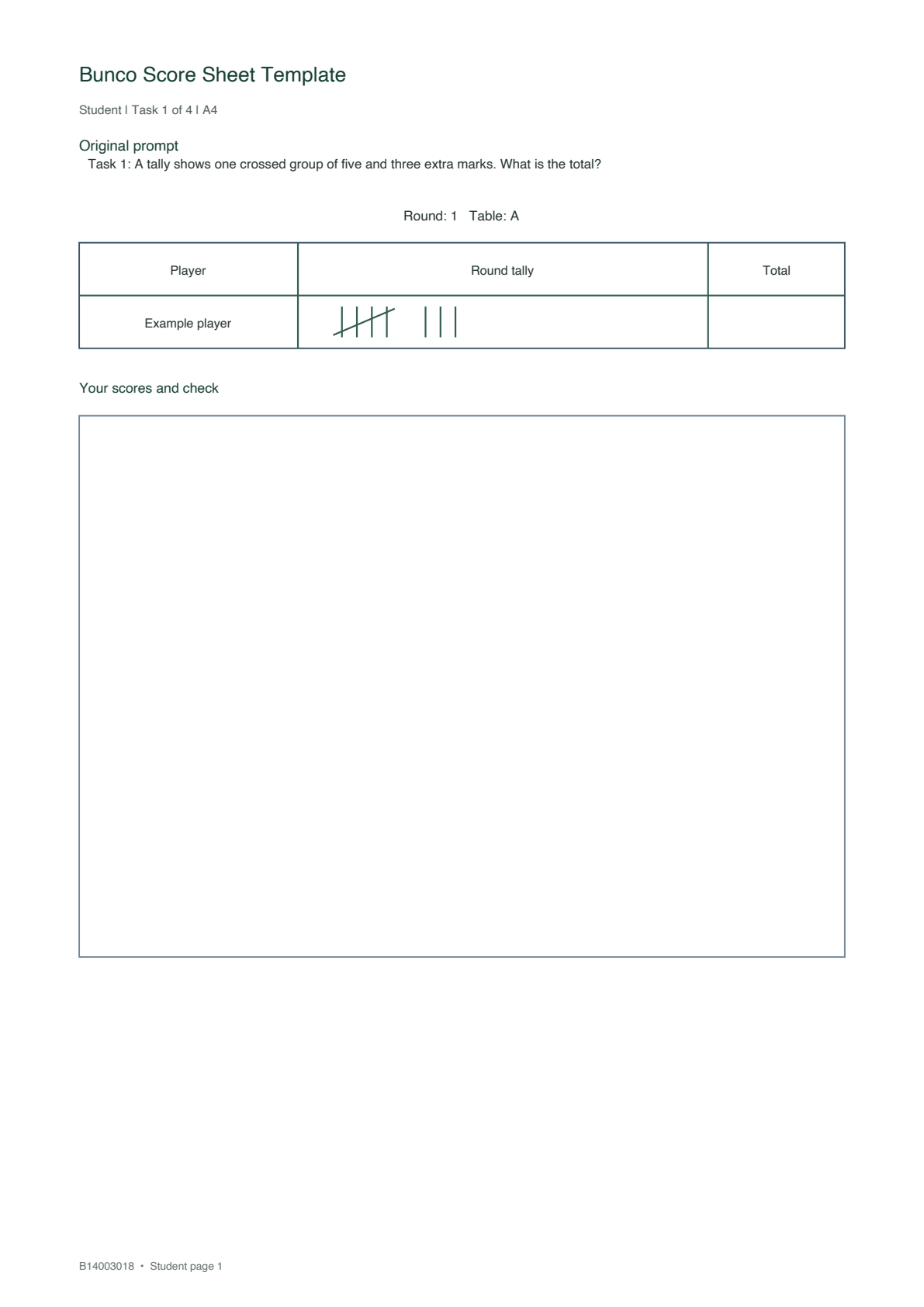
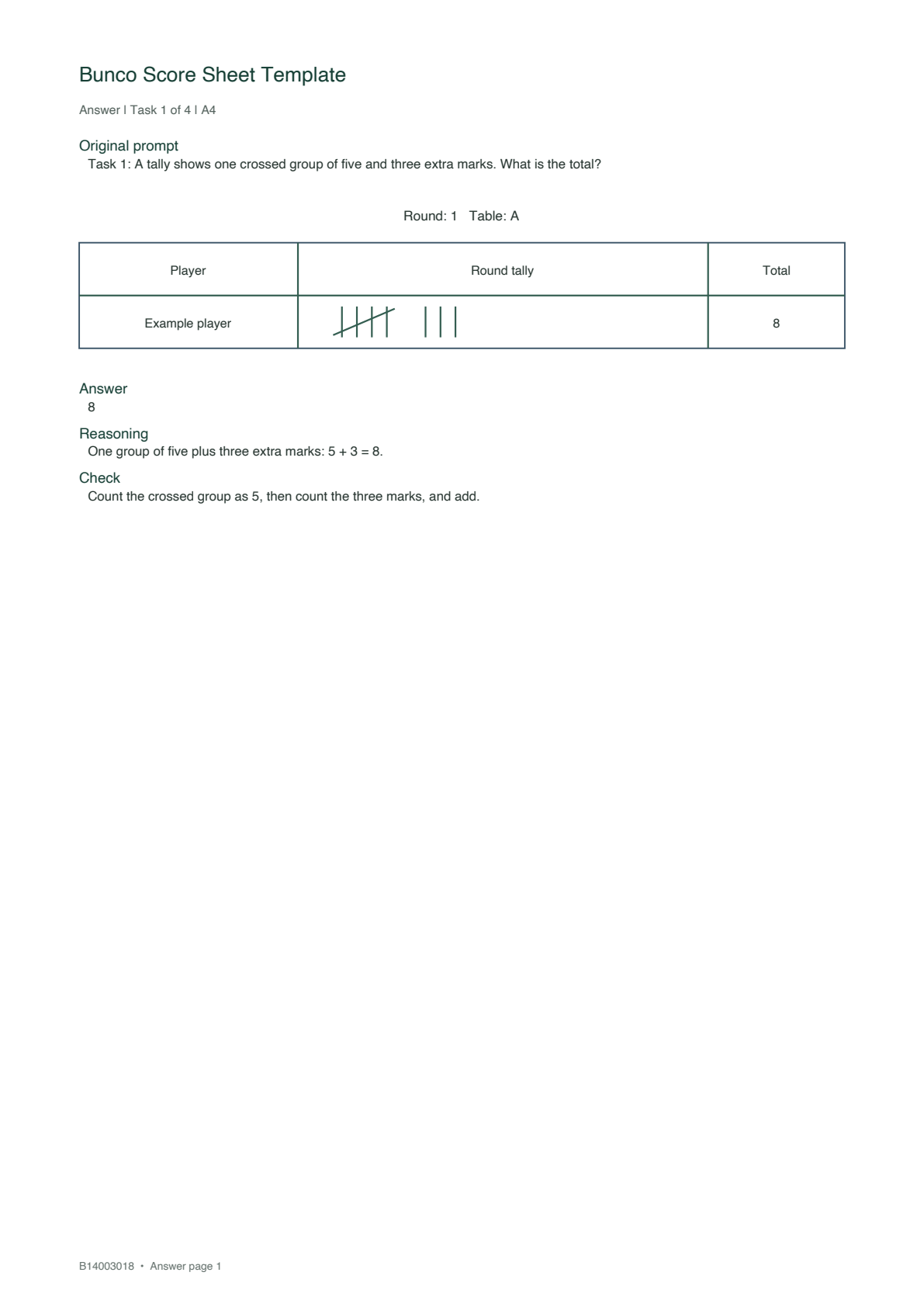
Task 1: A tally shows one crossed group of five and three extra marks. What is the total?
Show answer 1
8
One group of five plus three extra marks: 5 + 3 = 8.
Check: Count the crossed group as 5, then count the three marks, and add.
Task 2
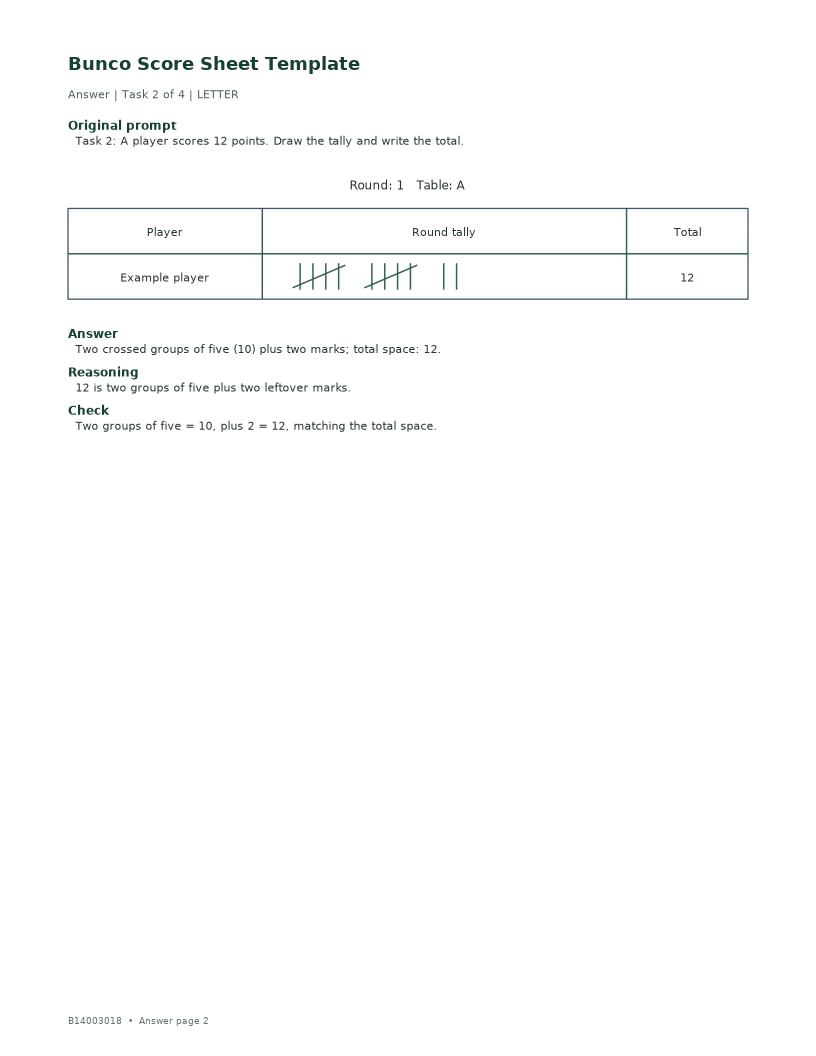
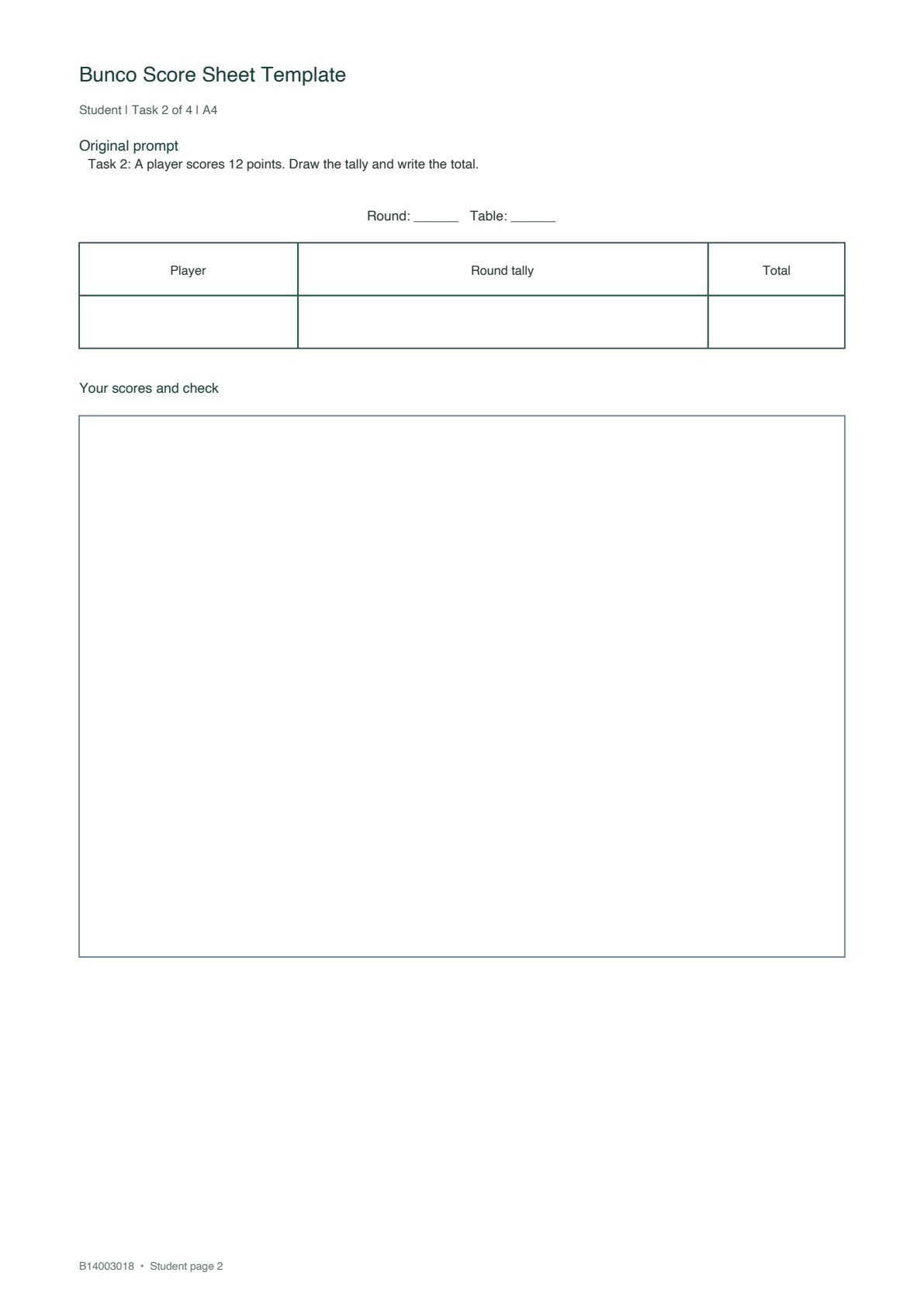
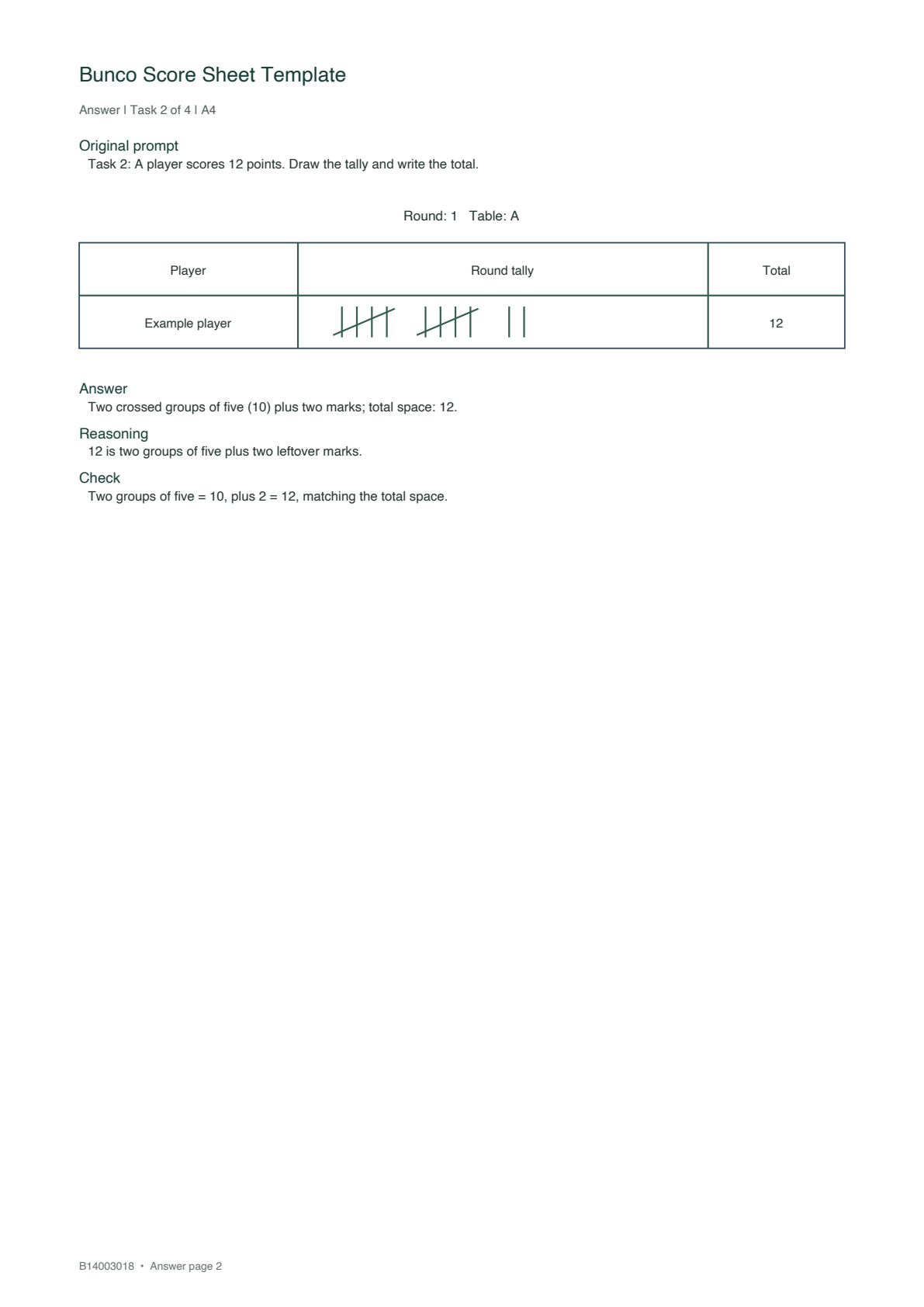
Task 2: A player scores 12 points. Draw the tally and write the total.
Show answer 2
Two crossed groups of five (10) plus two marks; total space: 12.
12 is two groups of five plus two leftover marks.
Check: Two groups of five = 10, plus 2 = 12, matching the total space.
Task 3
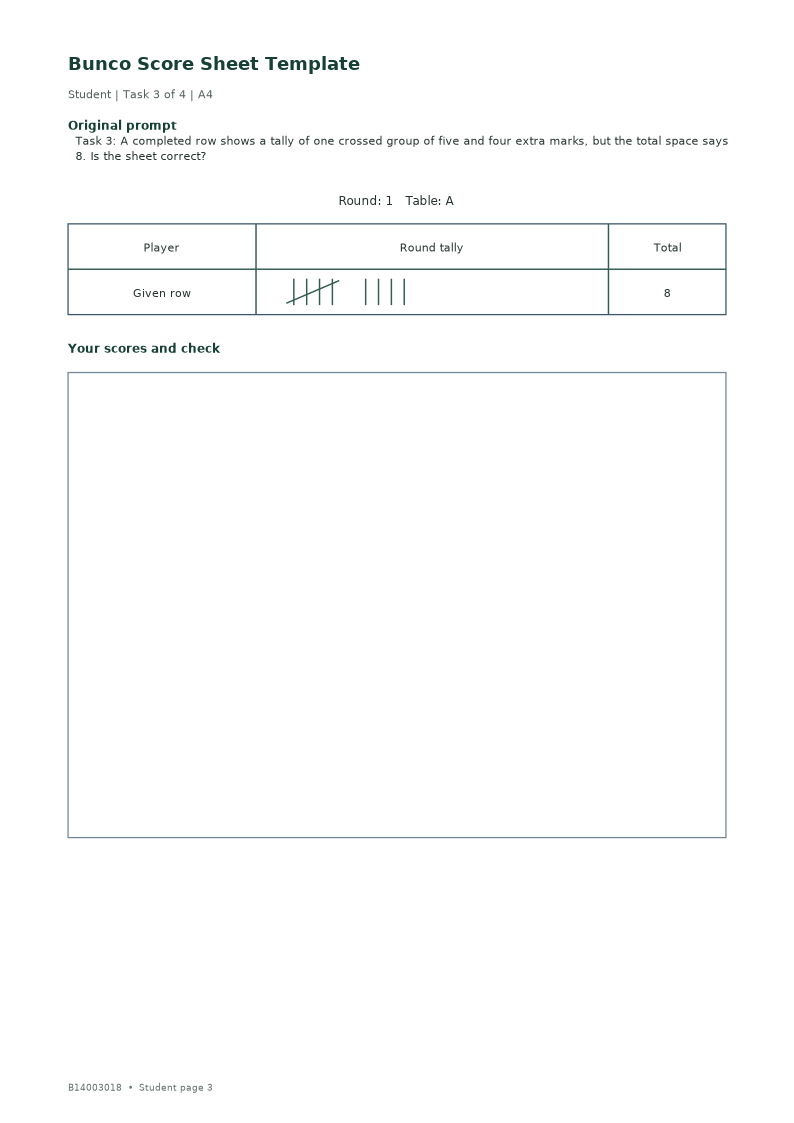
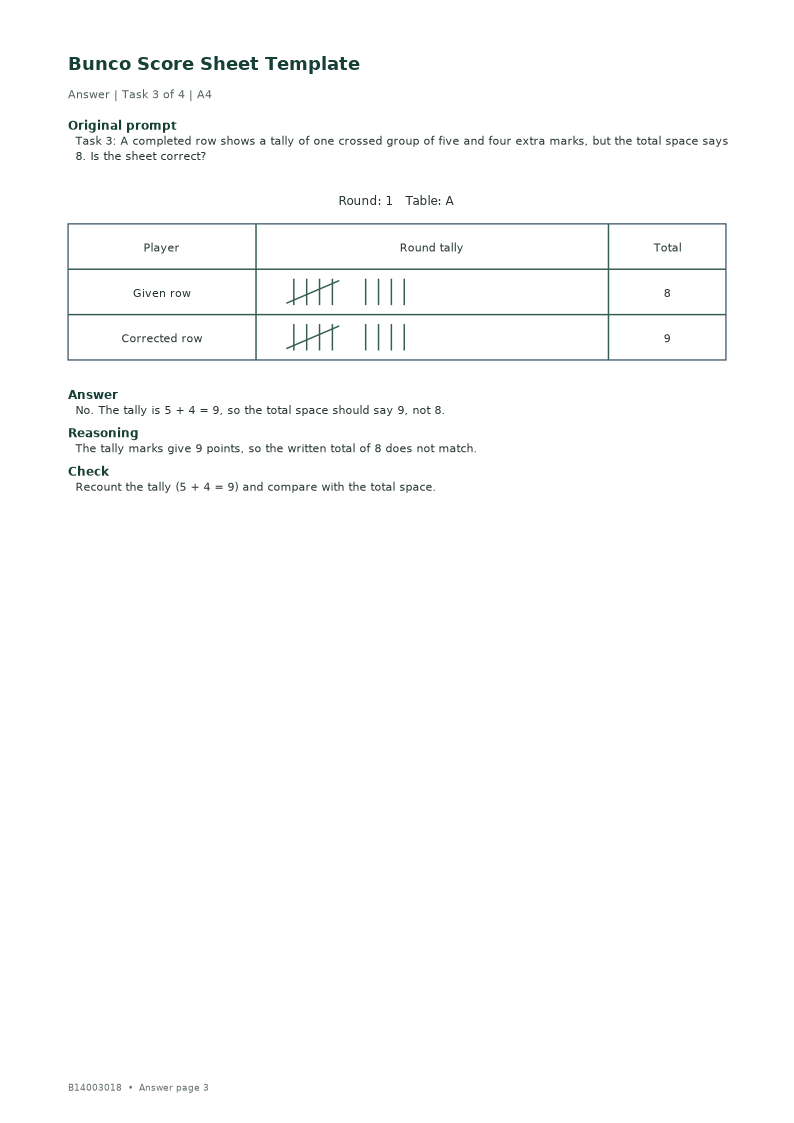
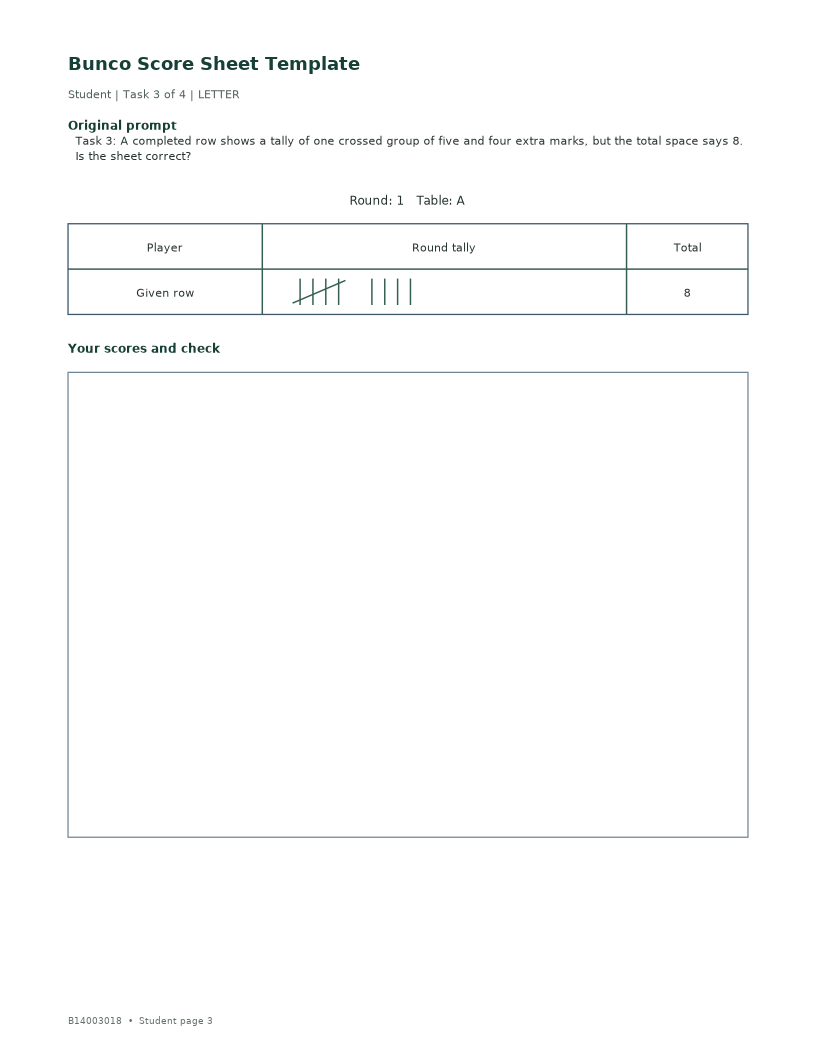
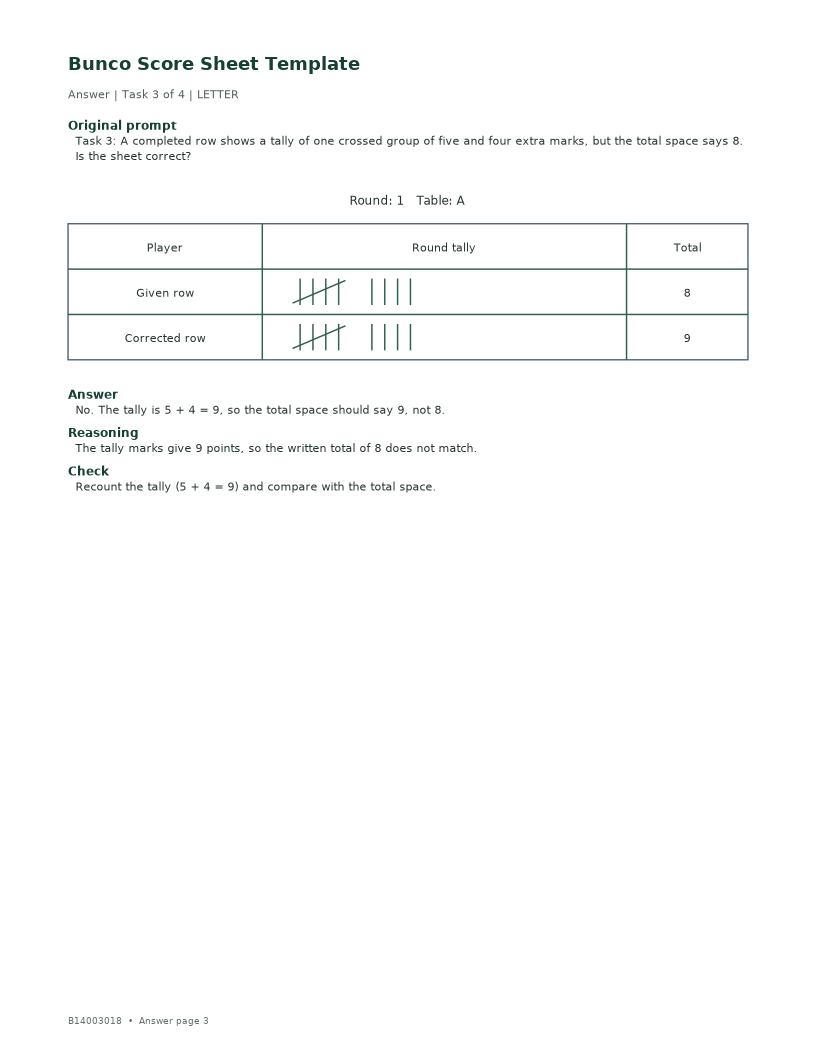
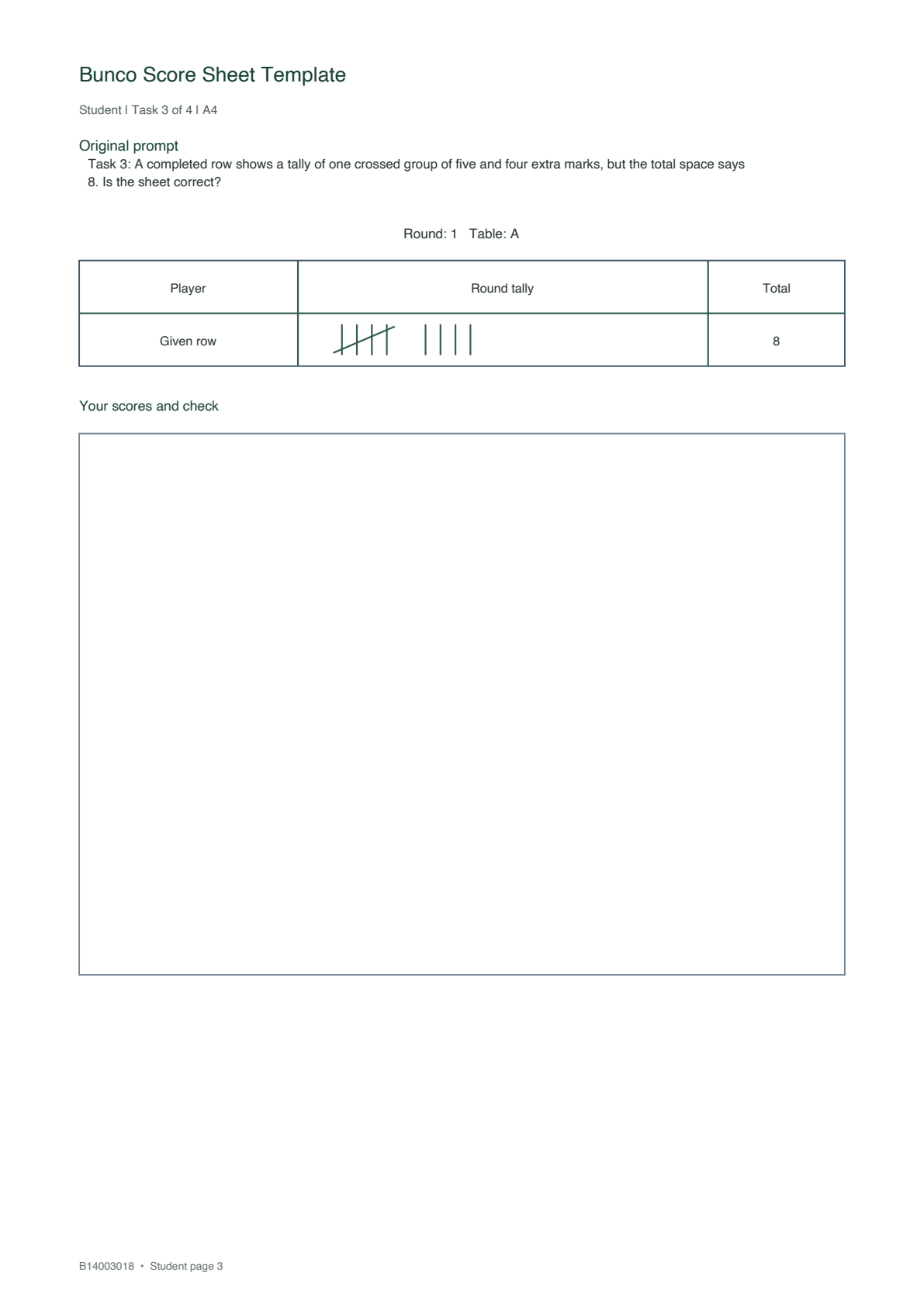
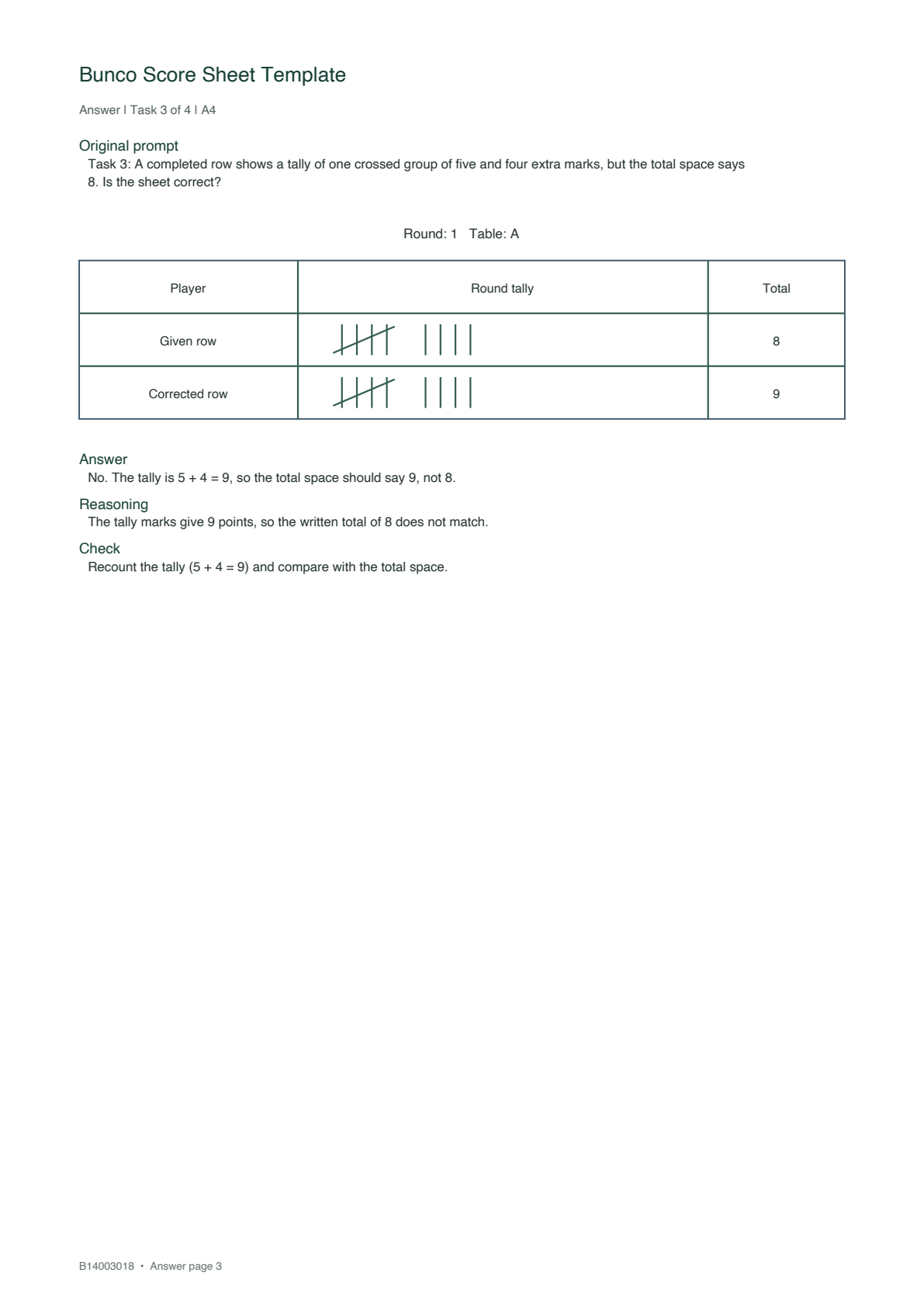
Task 3: A completed row shows a tally of one crossed group of five and four extra marks, but the total space says 8. Is the sheet correct?
Show answer 3
No. The tally is 5 + 4 = 9, so the total space should say 9, not 8.
The tally marks give 9 points, so the written total of 8 does not match.
Check: Recount the tally (5 + 4 = 9) and compare with the total space.
Task 4
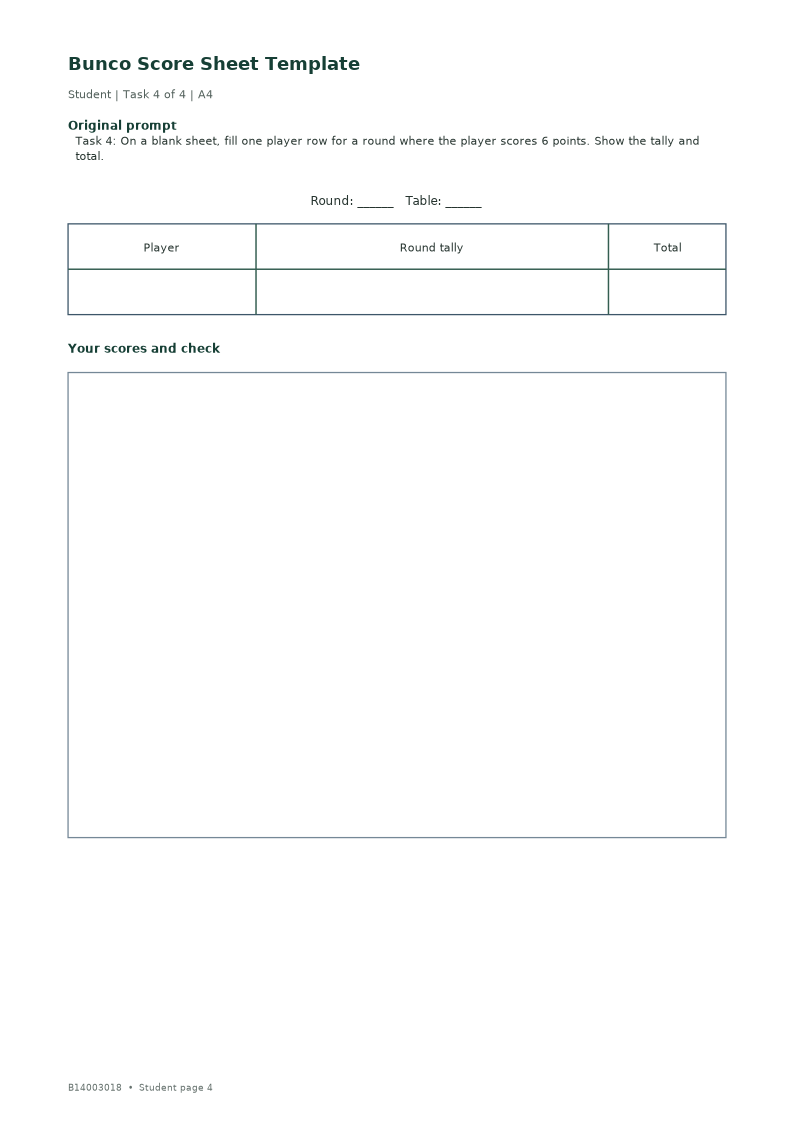
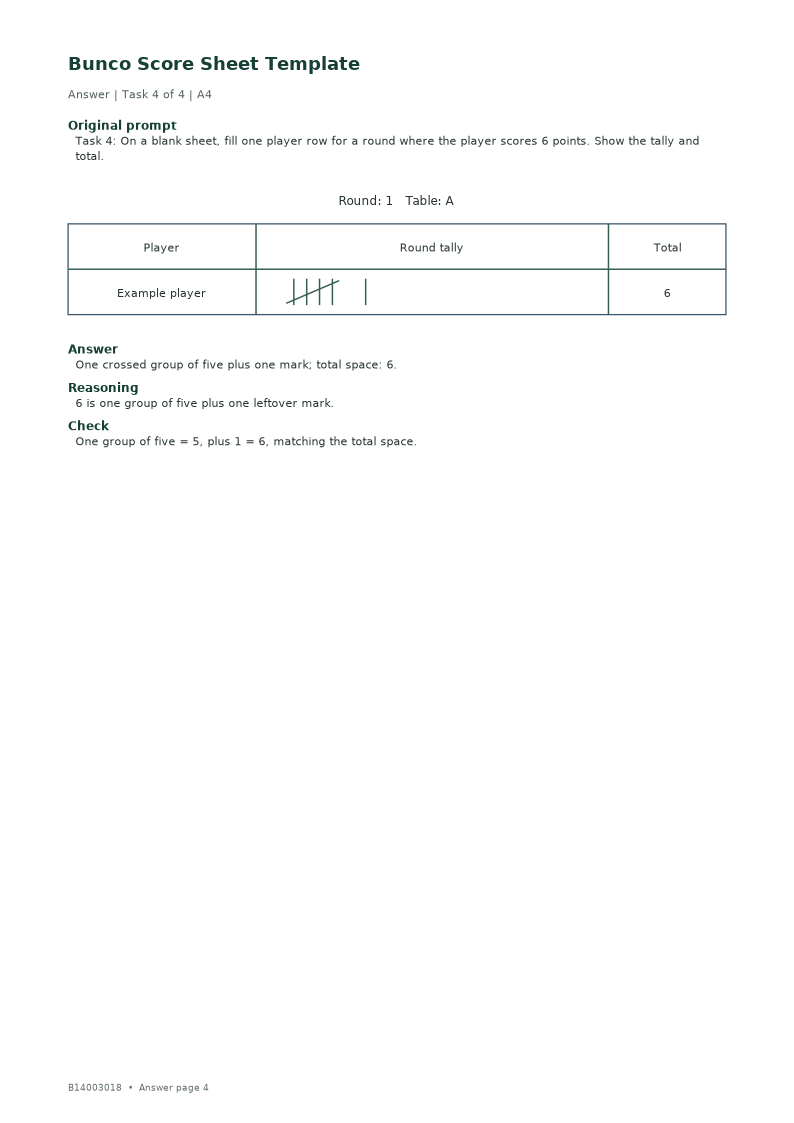
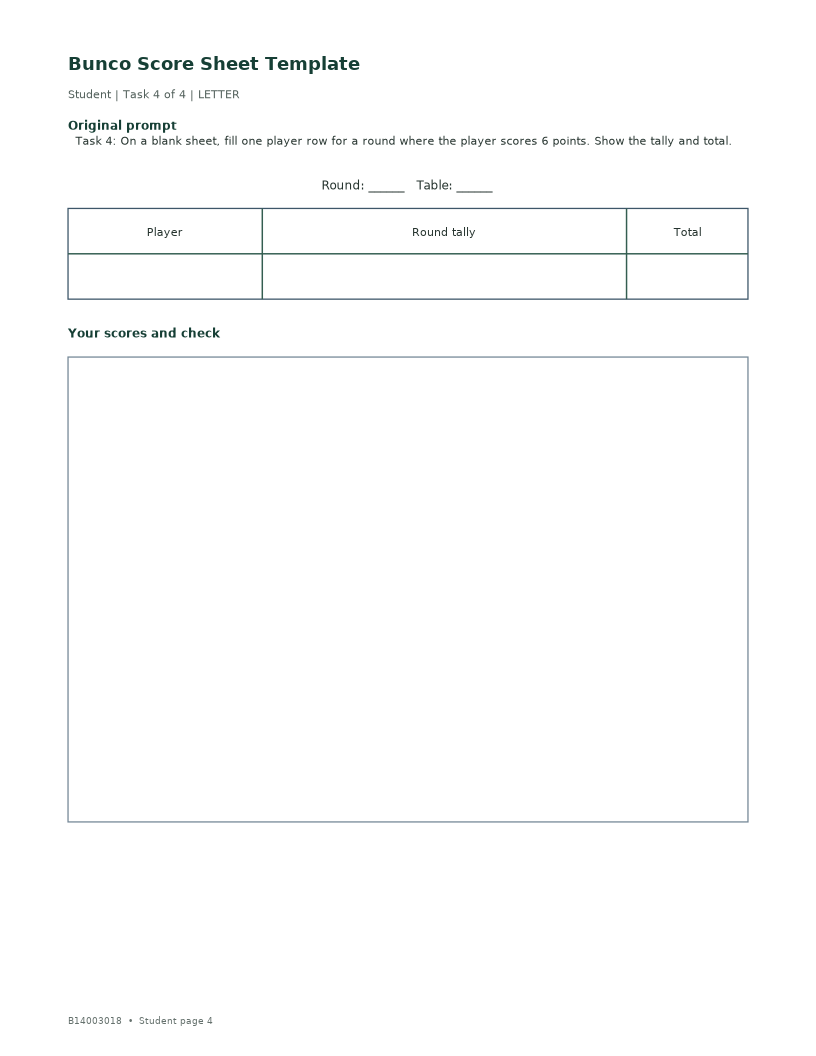
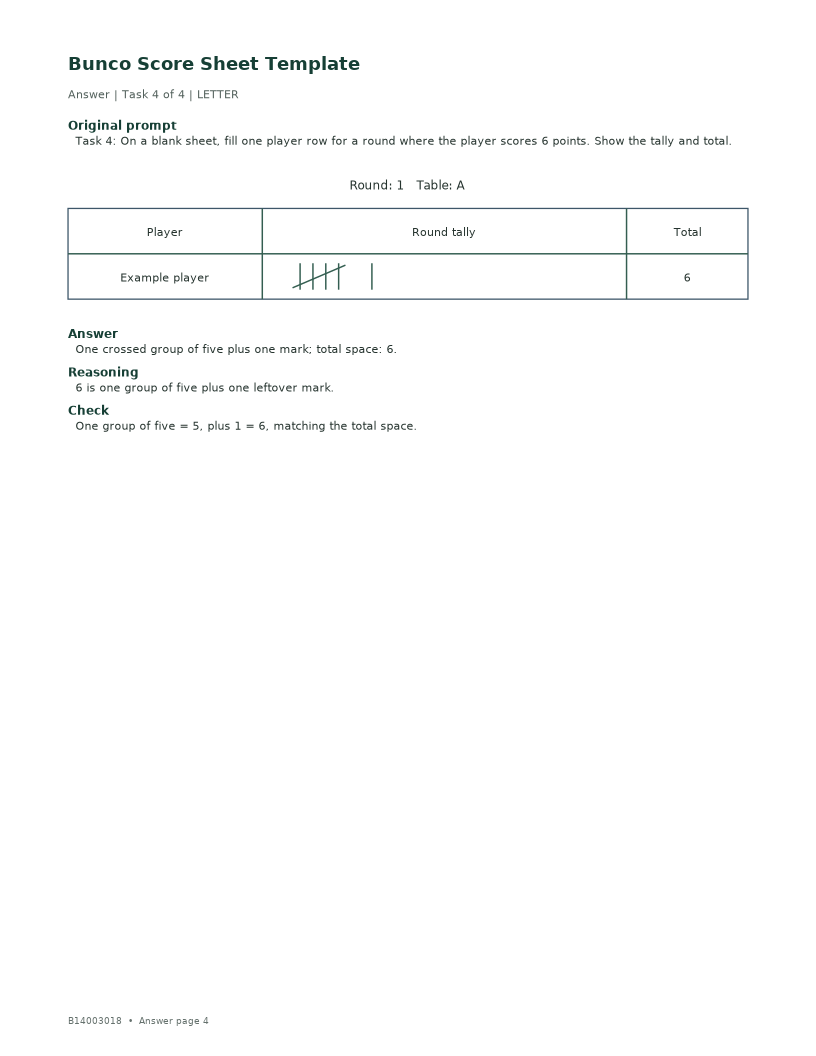
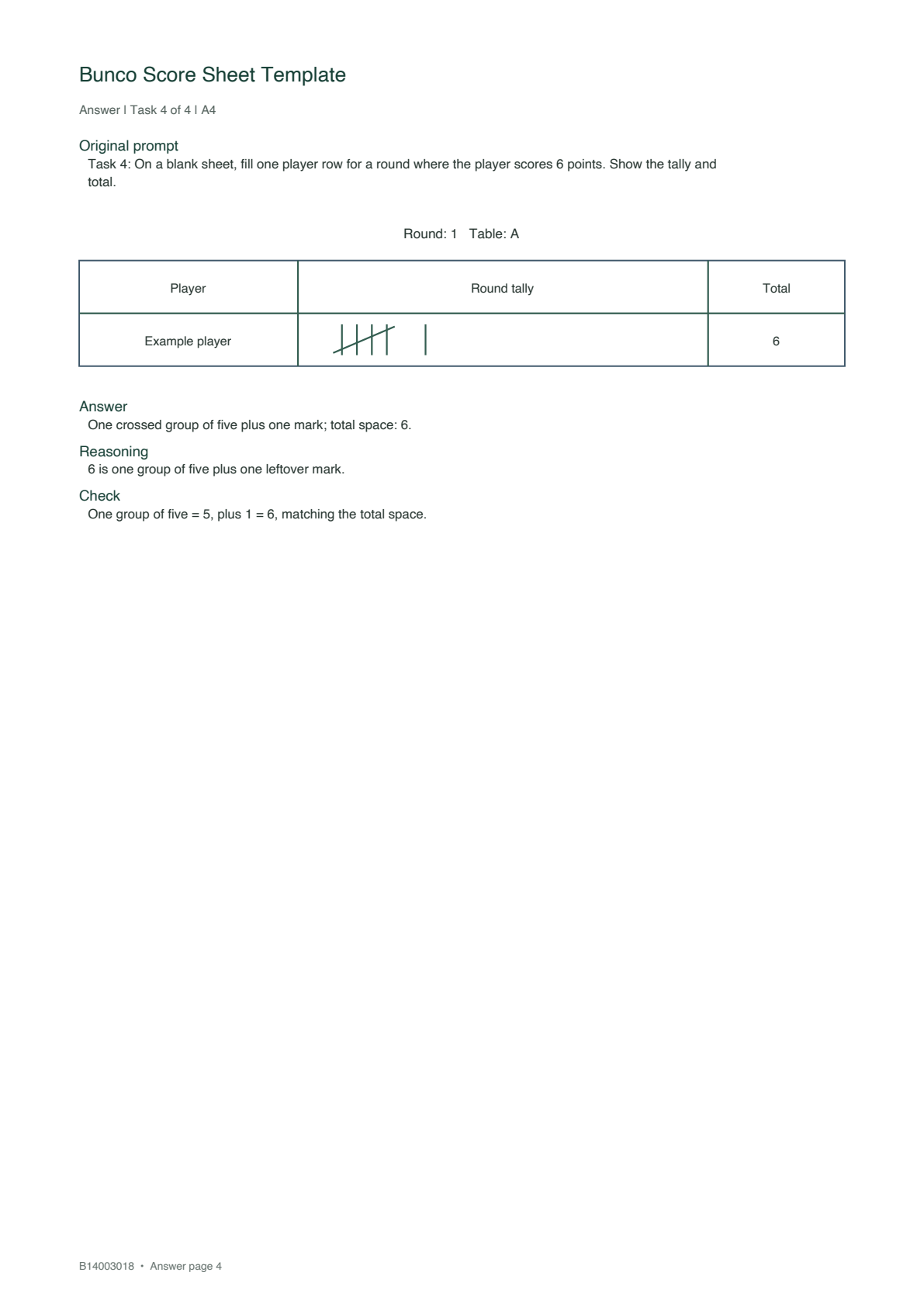
Task 4: On a blank sheet, fill one player row for a round where the player scores 6 points. Show the tally and total.
Show answer 4
One crossed group of five plus one mark; total space: 6.
6 is one group of five plus one leftover mark.
Check: One group of five = 5, plus 1 = 6, matching the total space.
Useful checks
- Writing the total without grouping tally marks in fives. Group marks in fives with a crossed fifth mark so totals are quick to count and check.
- Copying the total space without recounting the tally. Always recount the tally marks and compare the result to the written total.
Questions about this resource
Is this an official Bunco score sheet?
No. The layout here is an original classroom choice for learning to read and check tally columns, not an official game or printer standard.
Why group tally marks in fives?
Grouping in fives makes long tallies easier to count and check, since each crossed group stands for 5 points.