Free original lessons
Checkers Rules Printable
This sheet teaches English draughts (American checkers) using the World Checkers/Draughts Federation rule set on an 8×8 board. It covers setup, movement, captures, and kinging. A man that reaches the king-row completes the turn; if it arrives by a jump, it is crowned but does not continue jumping in that turn. Read the worked example and then complete the four practice tasks.
Letter & A4
PDF & SVG
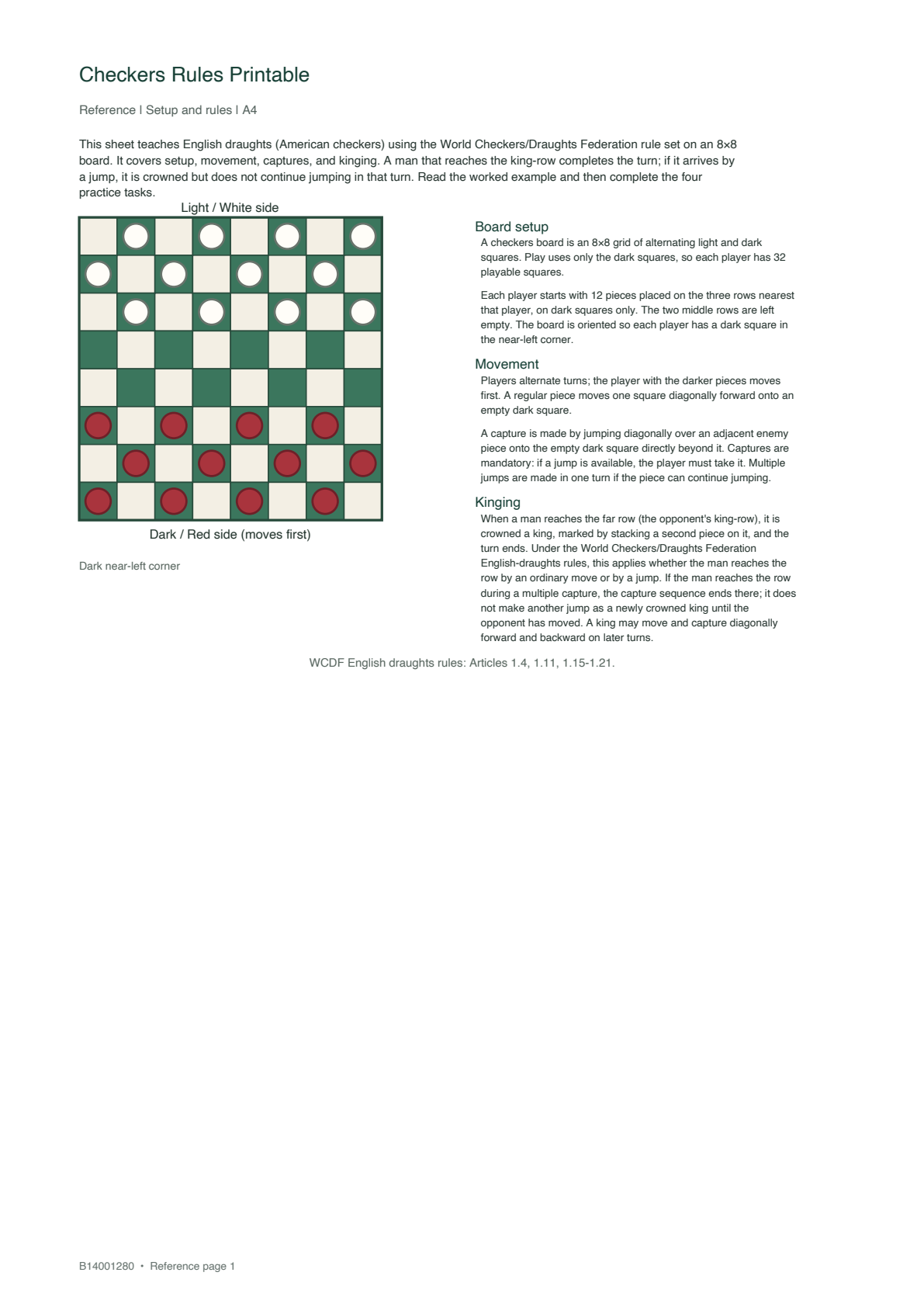
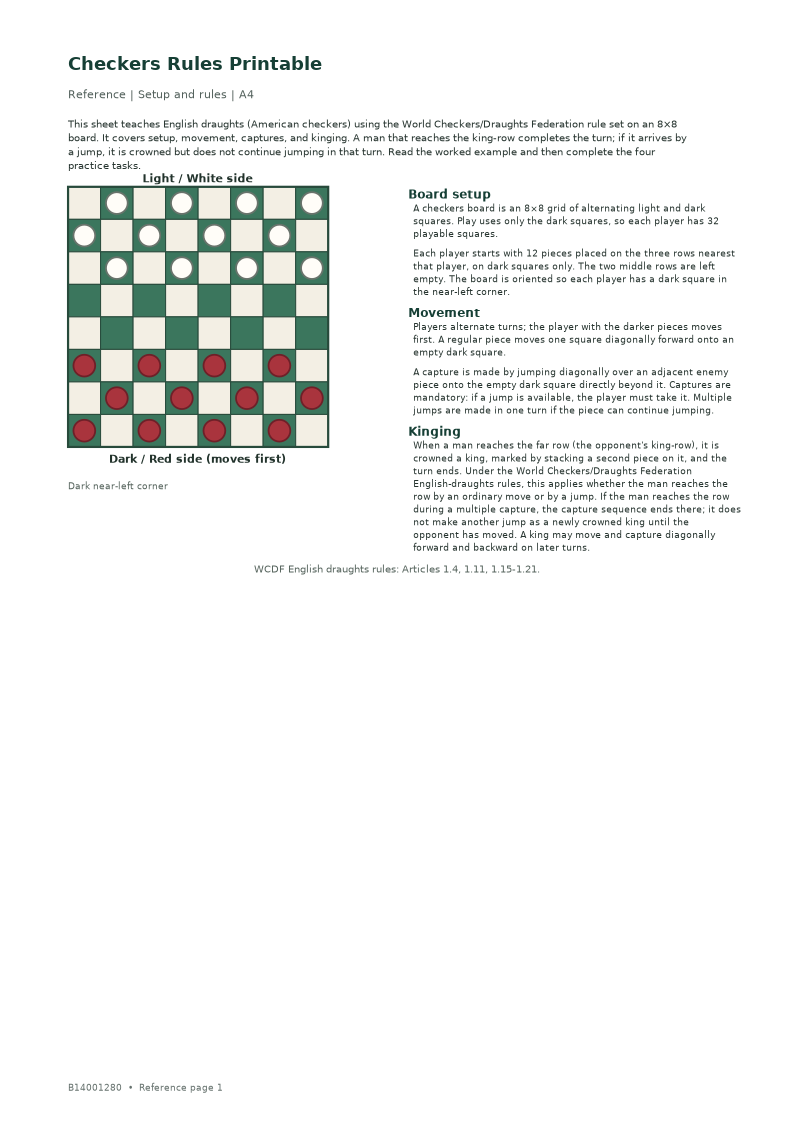
Board setup
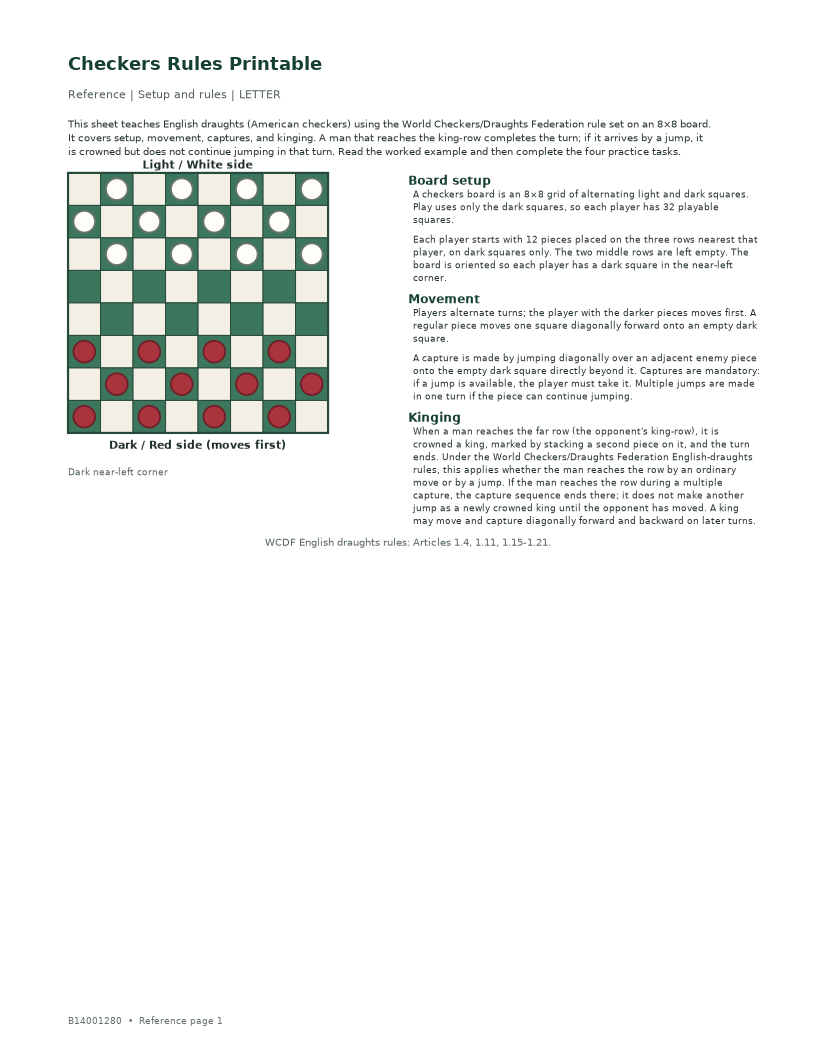
A checkers board is an 8×8 grid of alternating light and dark squares. Play uses only the dark squares, so each player has 32 playable squares.
Each player starts with 12 pieces placed on the three rows nearest that player, on dark squares only. The two middle rows are left empty. The board is oriented so each player has a dark square in the near-left corner.
Movement
Players alternate turns; the player with the darker pieces moves first. A regular piece moves one square diagonally forward onto an empty dark square.
A capture is made by jumping diagonally over an adjacent enemy piece onto the empty dark square directly beyond it. Captures are mandatory: if a jump is available, the player must take it. Multiple jumps are made in one turn if the piece can continue jumping.
Kinging
When a man reaches the far row (the opponent's king-row), it is crowned a king, marked by stacking a second piece on it, and the turn ends. Under the World Checkers/Draughts Federation English-draughts rules, this applies whether the man reaches the row by an ordinary move or by a jump. If the man reaches the row during a multiple capture, the capture sequence ends there; it does not make another jump as a newly crowned king until the opponent has moved. A king may move and capture diagonally forward and backward on later turns.
Download the complete resource pack
All individual SVG pages (20)
- A4 reference page 1
- A4 reference page 2
- A4 student page 1
- A4 student page 2
- A4 student page 3
- A4 student page 4
- A4 answer page 1
- A4 answer page 2
- A4 answer page 3
- A4 answer page 4
- LETTER reference page 1
- LETTER reference page 2
- LETTER student page 1
- LETTER student page 2
- LETTER student page 3
- LETTER student page 4
- LETTER answer page 1
- LETTER answer page 2
- LETTER answer page 3
- LETTER answer page 4
Print at 100% / actual size. Use the stated scale on any schematic diagram; physical cutting templates are identified separately. A4 and US Letter are separate files. Free access, no signup; CC BY 4.0.
How to use these pages
- Board setup
- Movement
- Kinging
Worked example
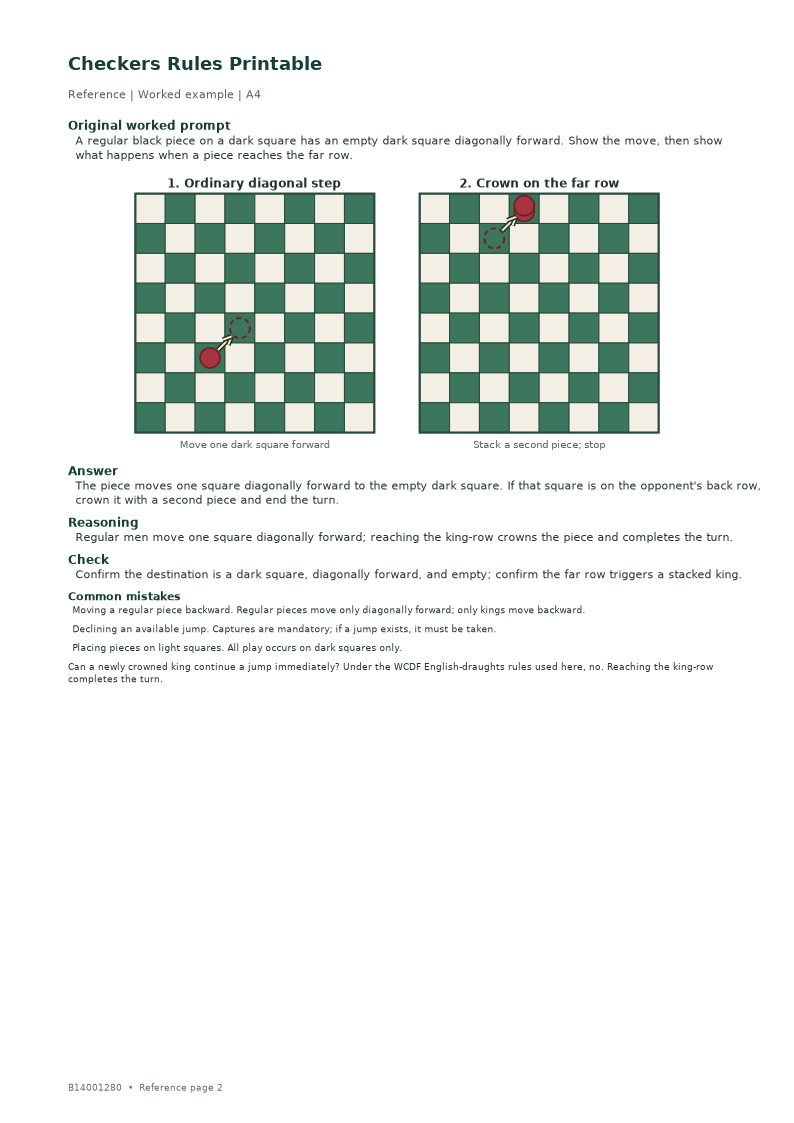
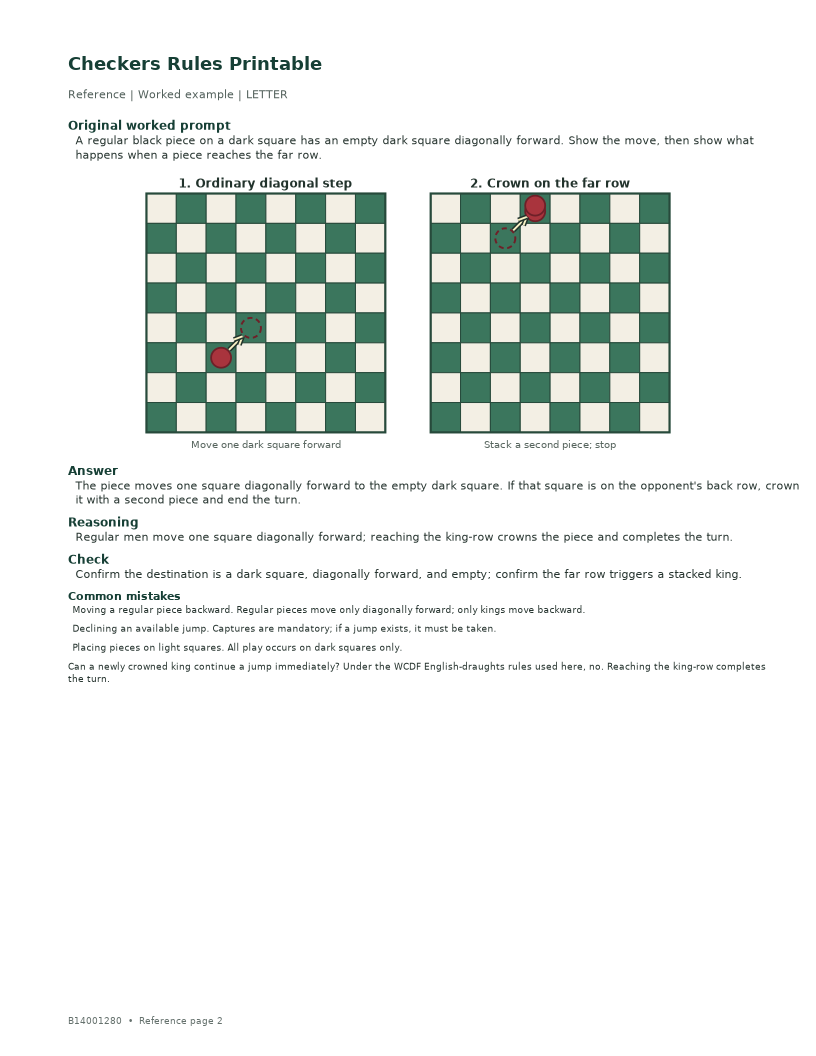
Example: A regular black piece on a dark square has an empty dark square diagonally forward. Show the move, then show what happens when a piece reaches the far row.
Answer: The piece moves one square diagonally forward to the empty dark square. If that square is on the opponent's back row, crown it with a second piece and end the turn.
Reasoning: Regular men move one square diagonally forward; reaching the king-row crowns the piece and completes the turn.
Check: Confirm the destination is a dark square, diagonally forward, and empty; confirm the far row triggers a stacked king.
Four practice tasks and complete answers
Task 1
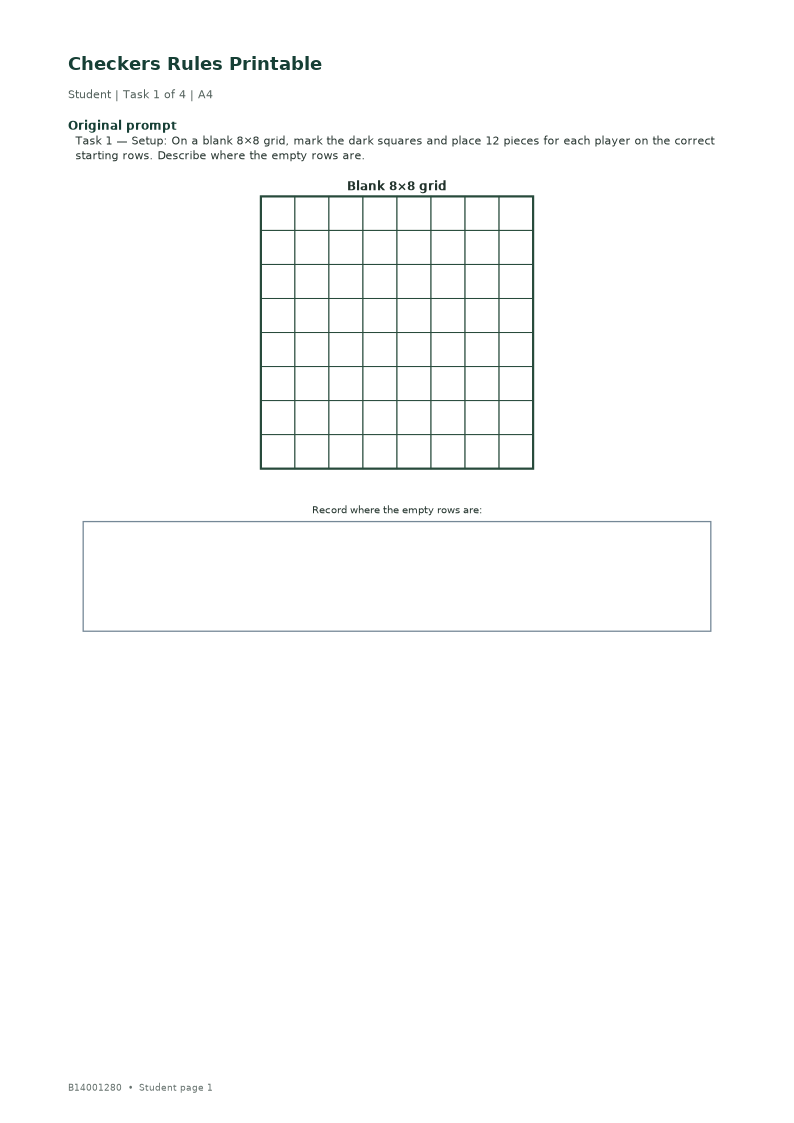
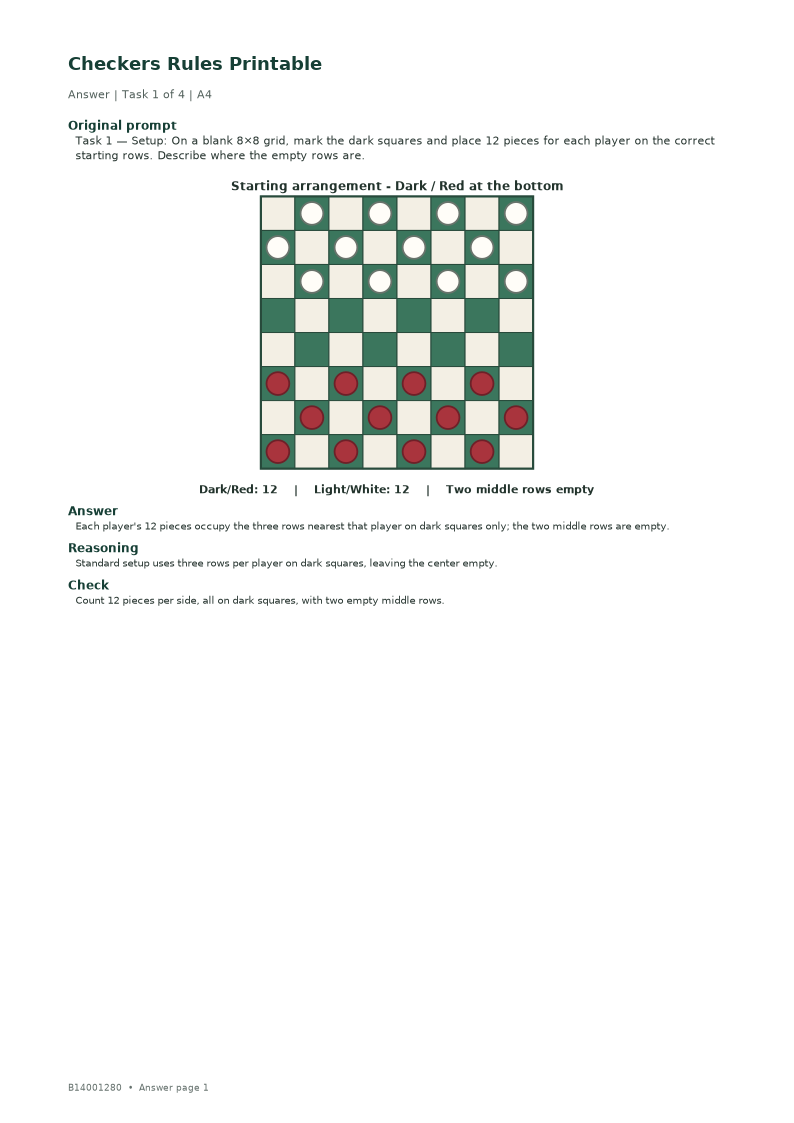
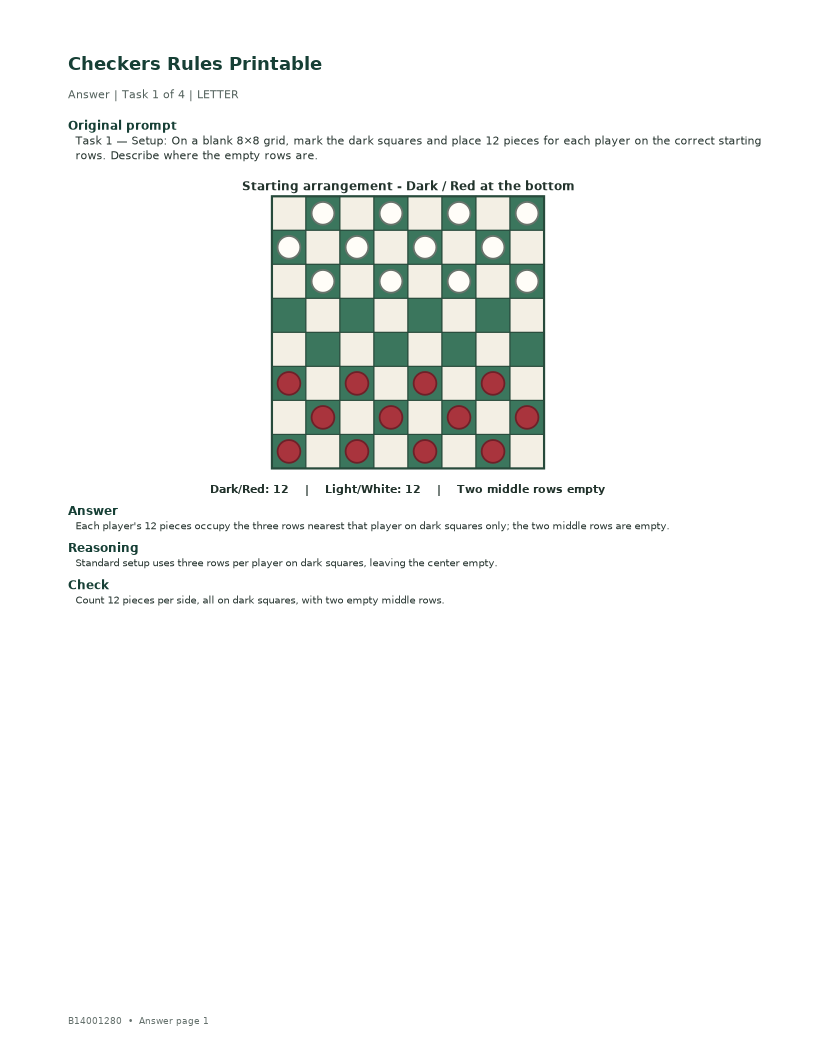
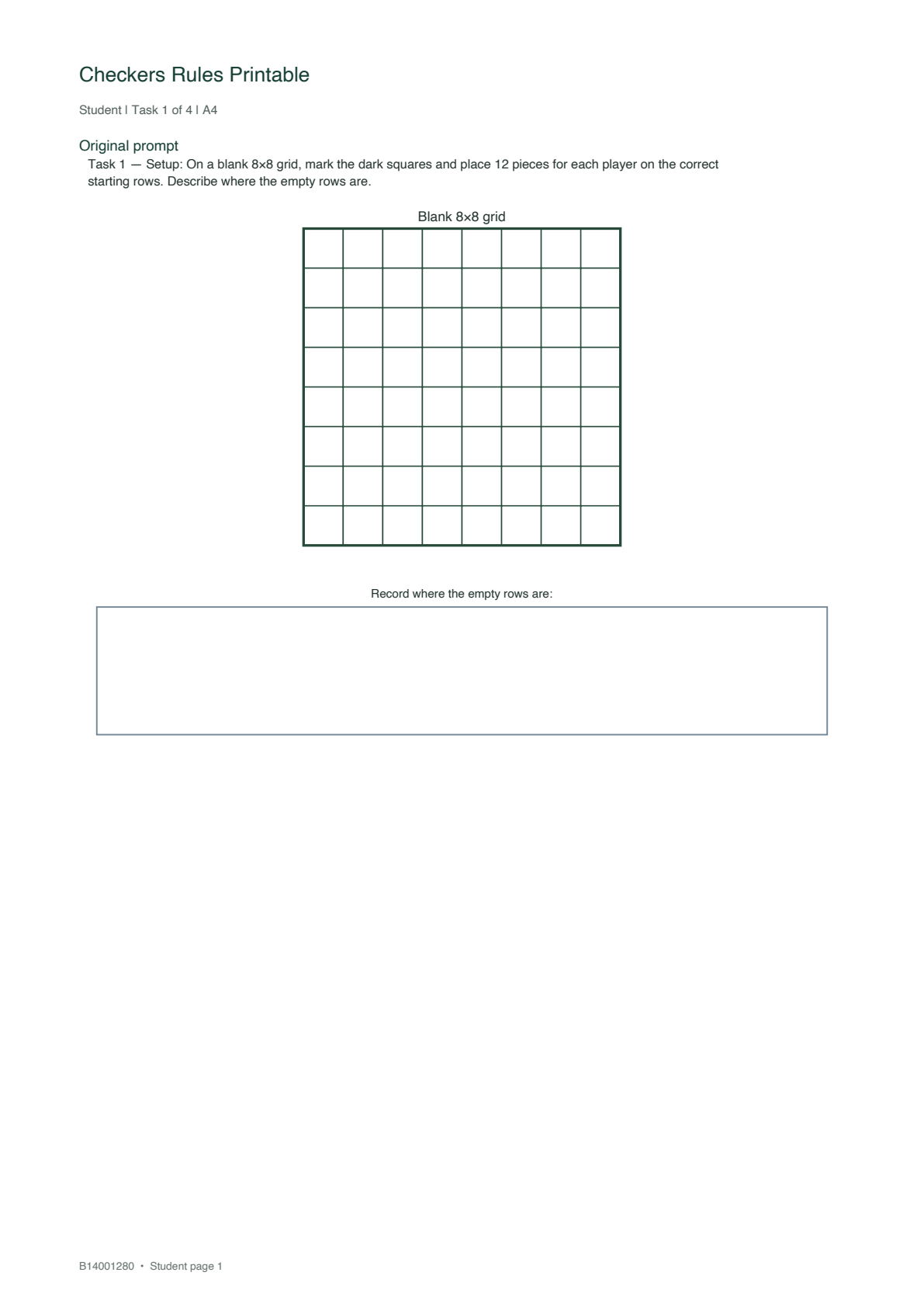
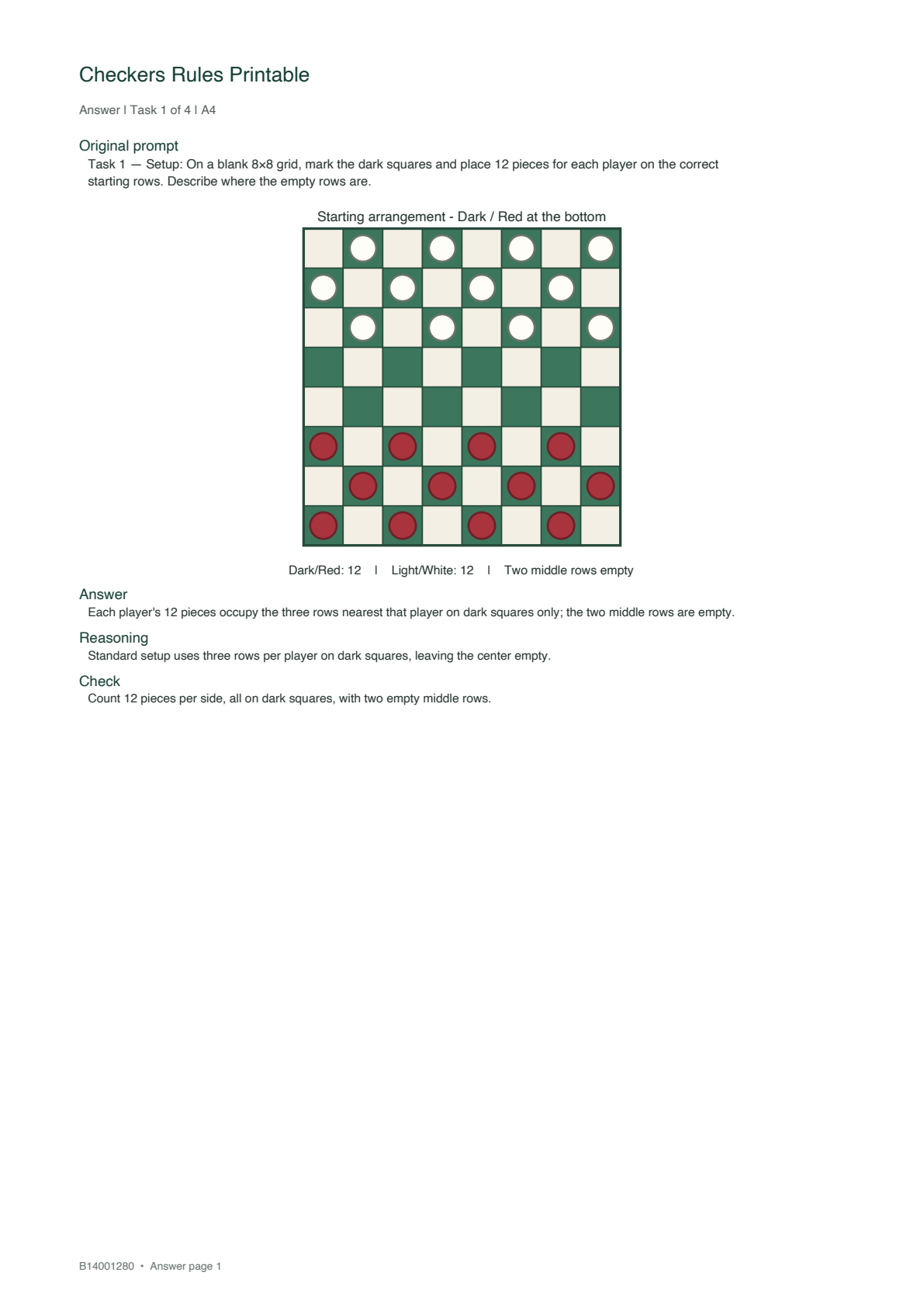
Task 1 — Setup: On a blank 8×8 grid, mark the dark squares and place 12 pieces for each player on the correct starting rows. Describe where the empty rows are.
Show answer 1
Each player's 12 pieces occupy the three rows nearest that player on dark squares only; the two middle rows are empty.
Standard setup uses three rows per player on dark squares, leaving the center empty.
Check: Count 12 pieces per side, all on dark squares, with two empty middle rows.
Task 2
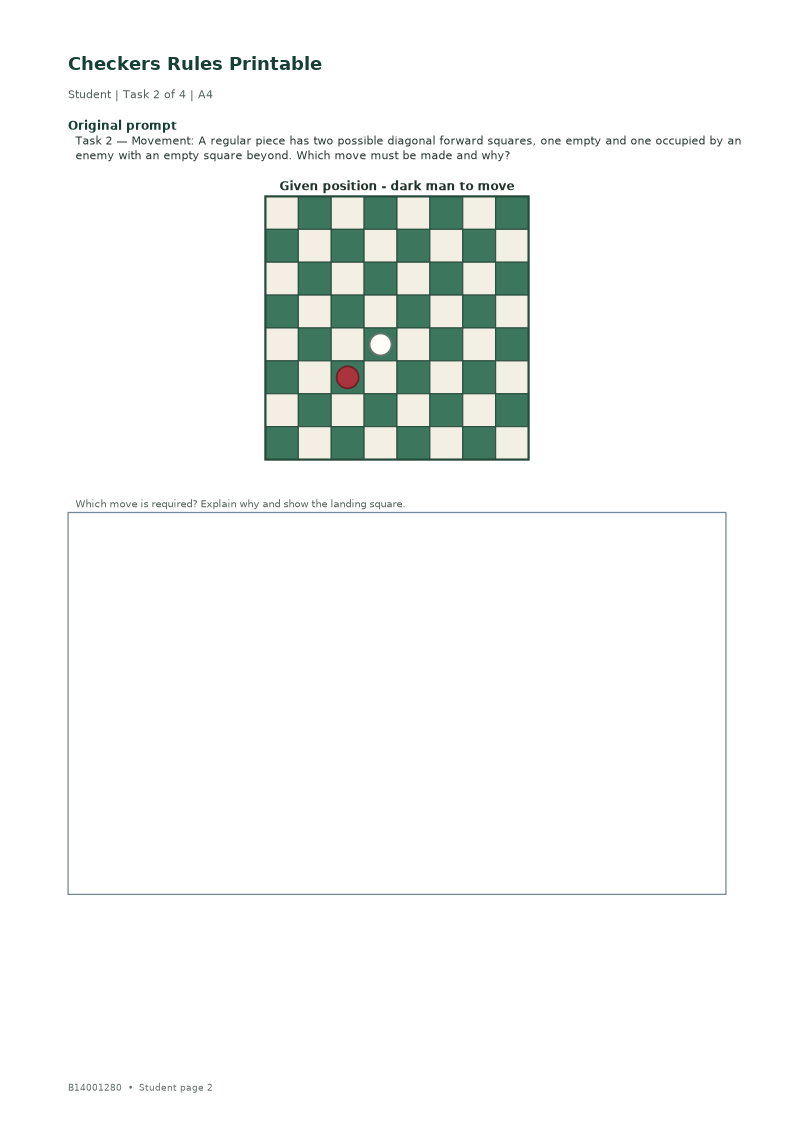
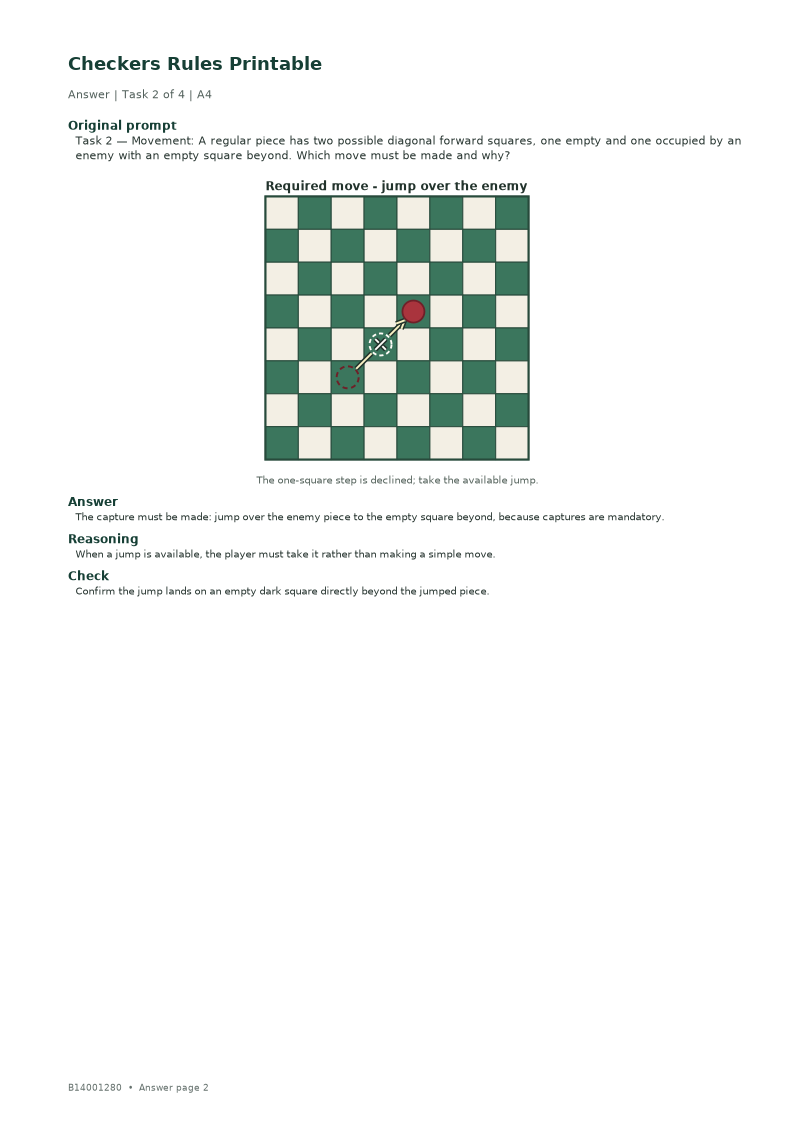
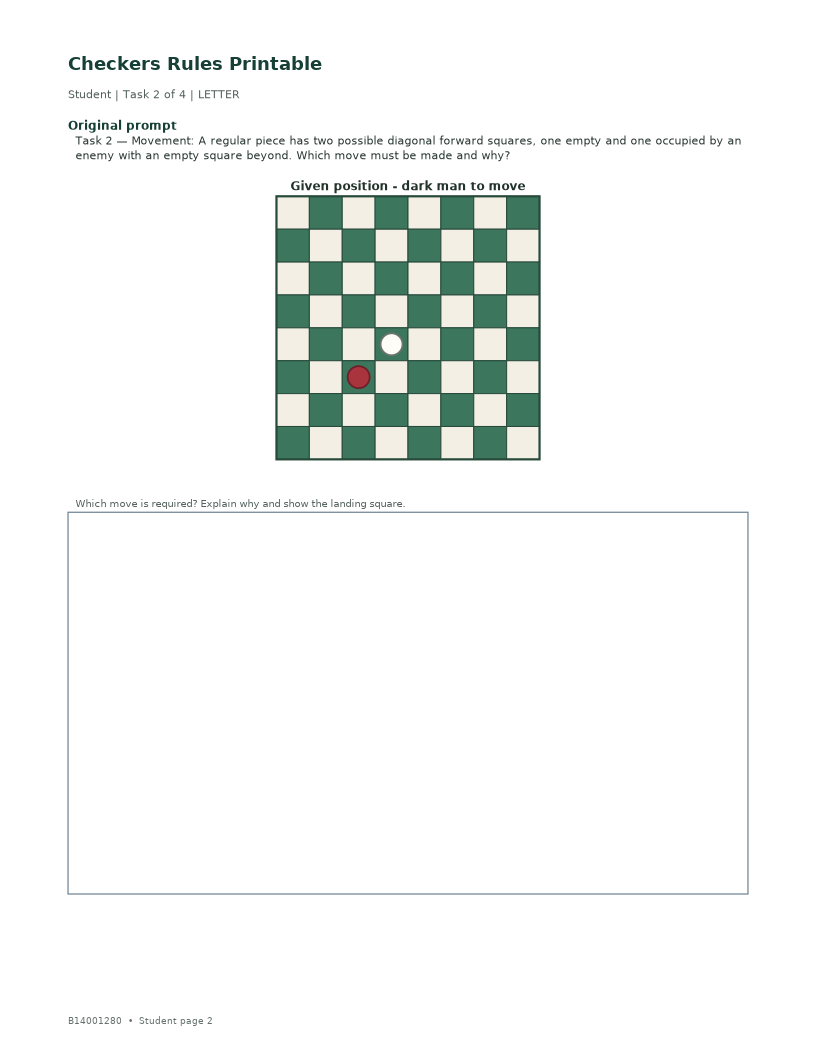
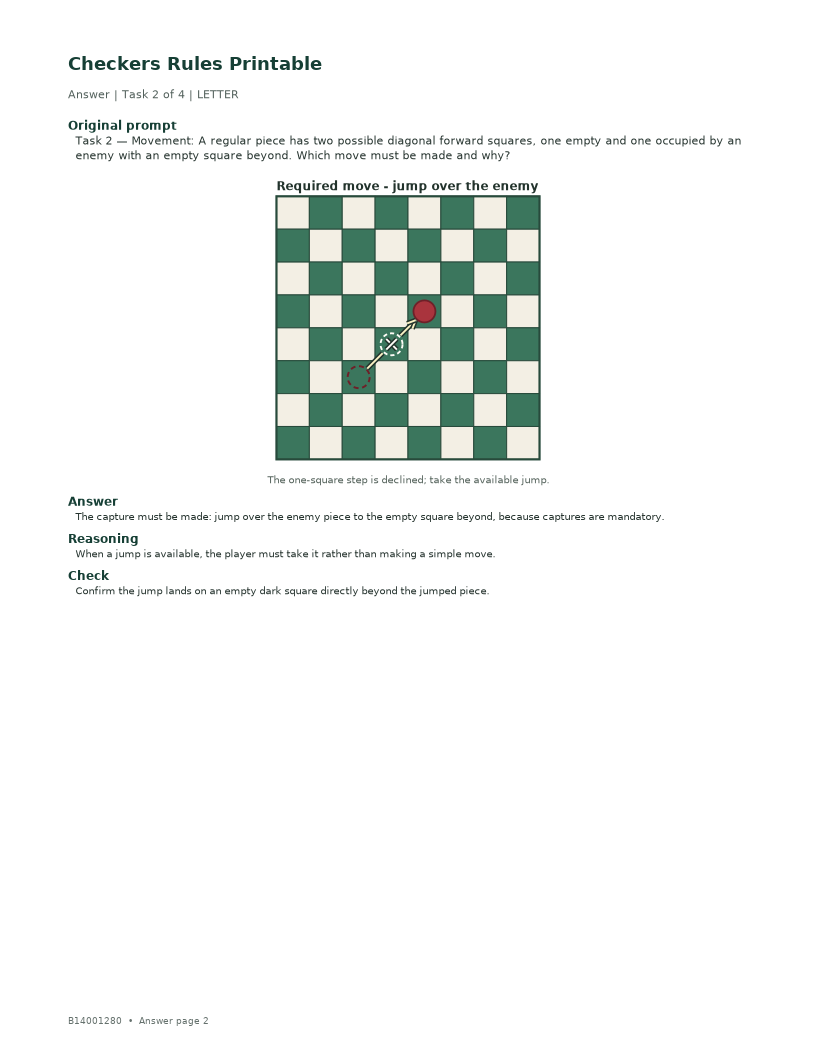
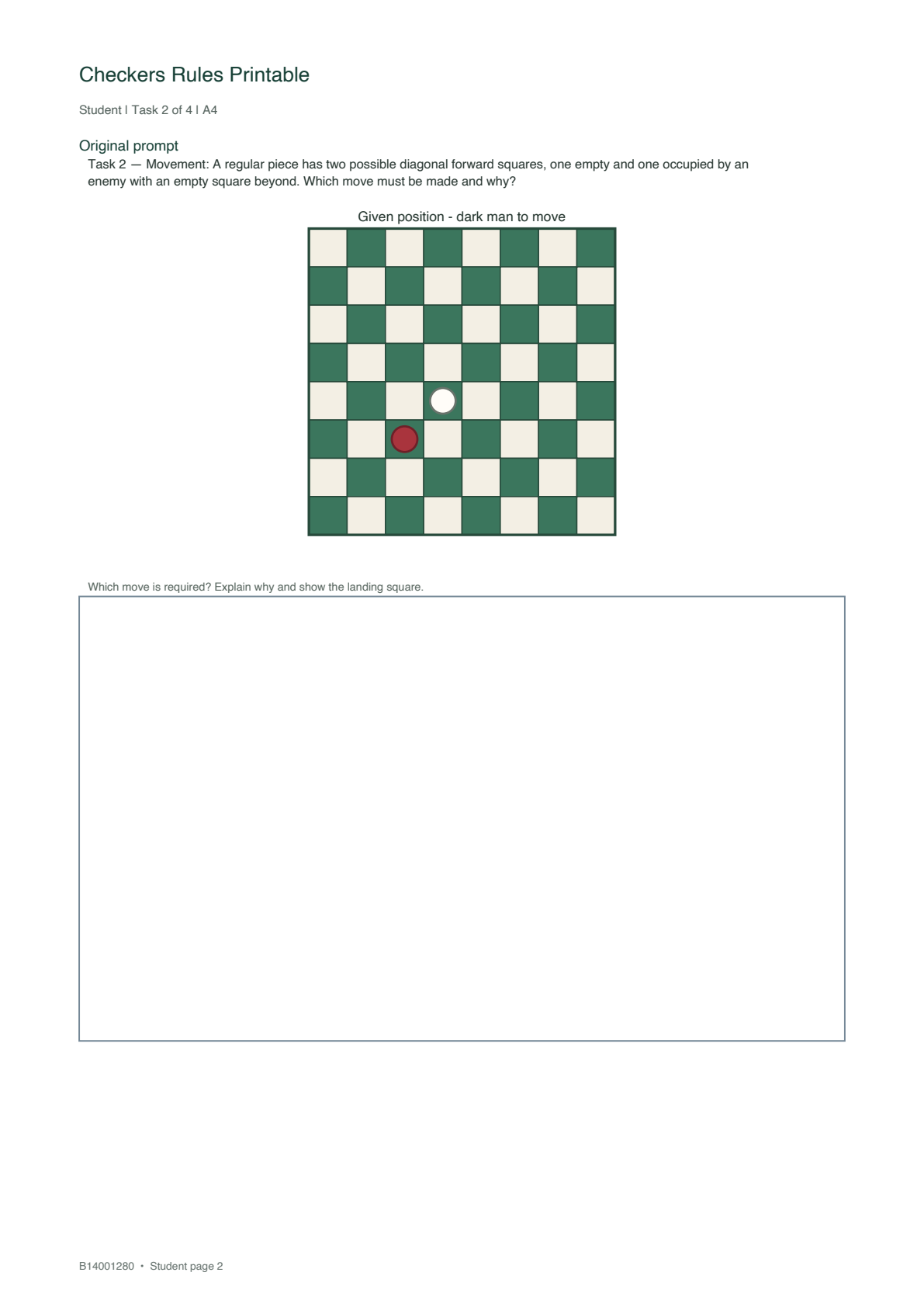
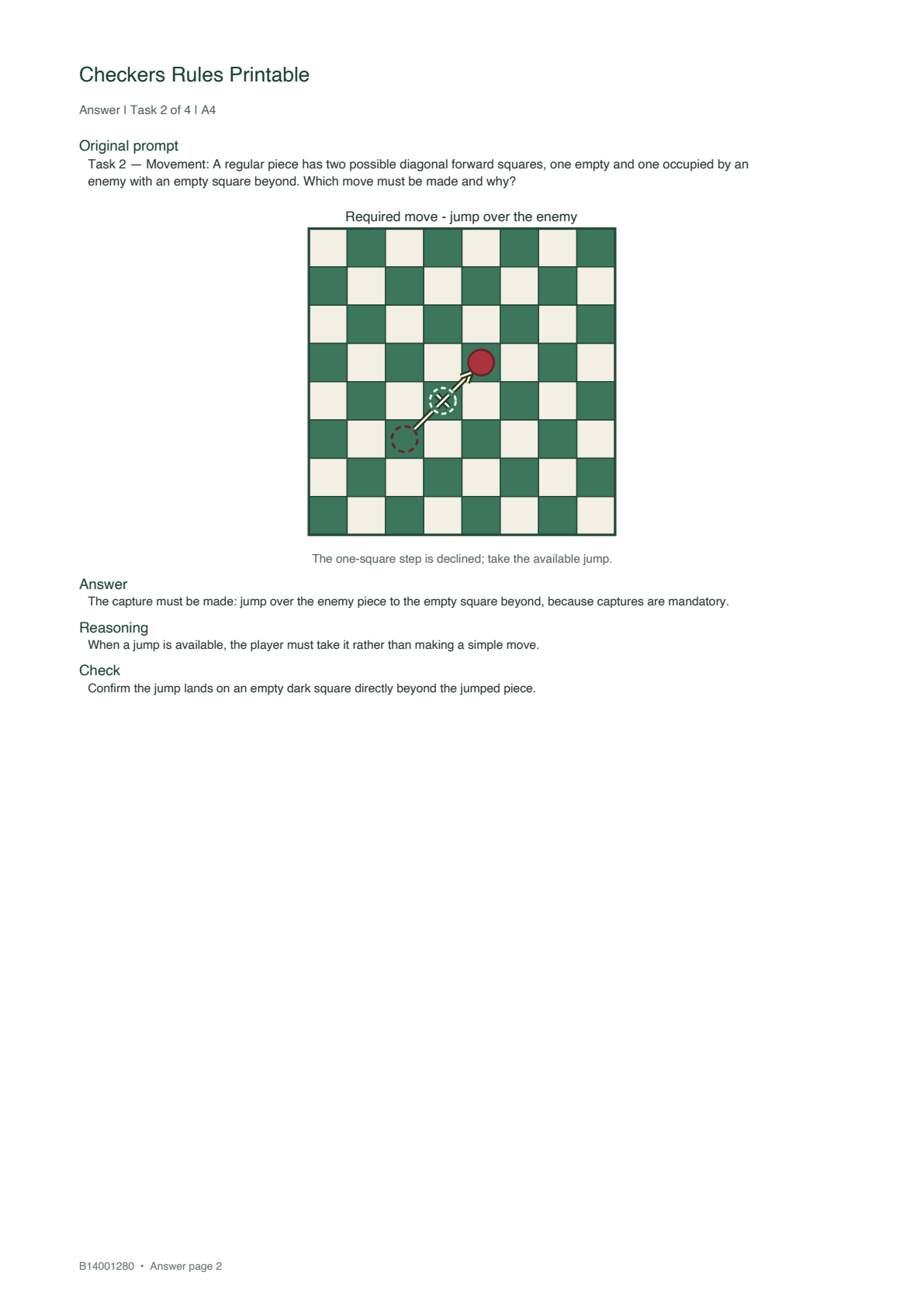
Task 2 — Movement: A regular piece has two possible diagonal forward squares, one empty and one occupied by an enemy with an empty square beyond. Which move must be made and why?
Show answer 2
The capture must be made: jump over the enemy piece to the empty square beyond, because captures are mandatory.
When a jump is available, the player must take it rather than making a simple move.
Check: Confirm the jump lands on an empty dark square directly beyond the jumped piece.
Task 3
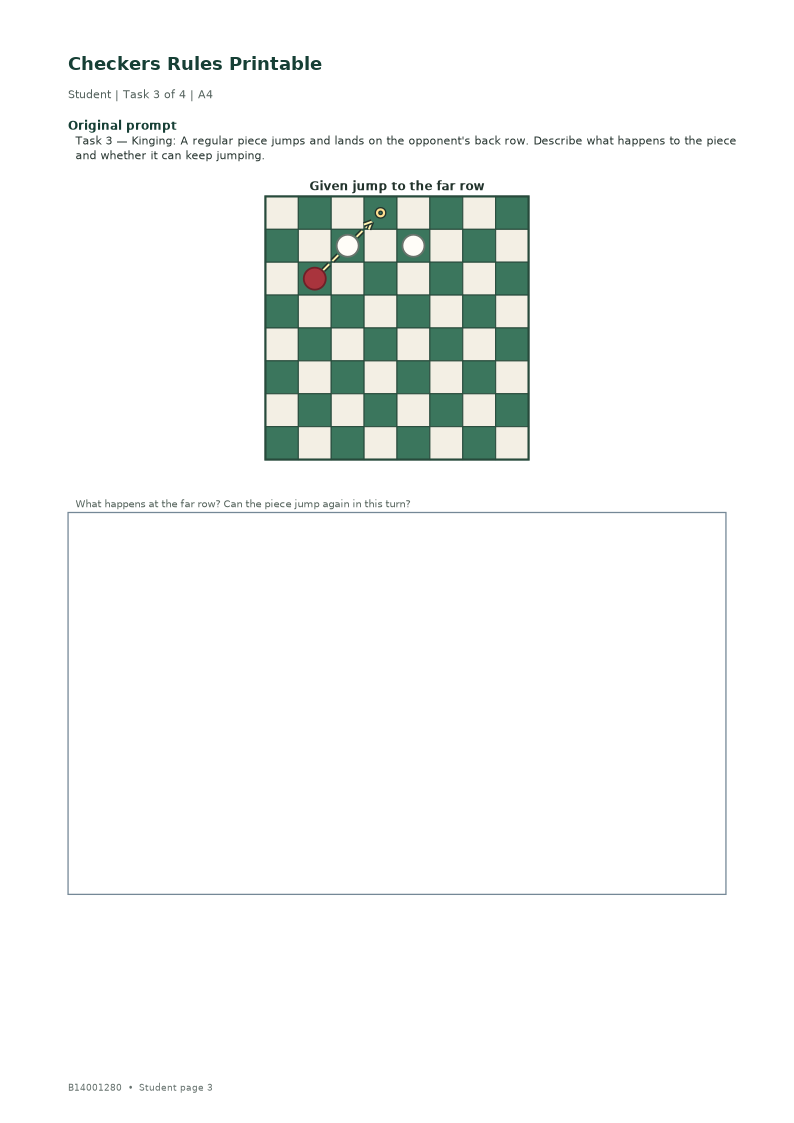
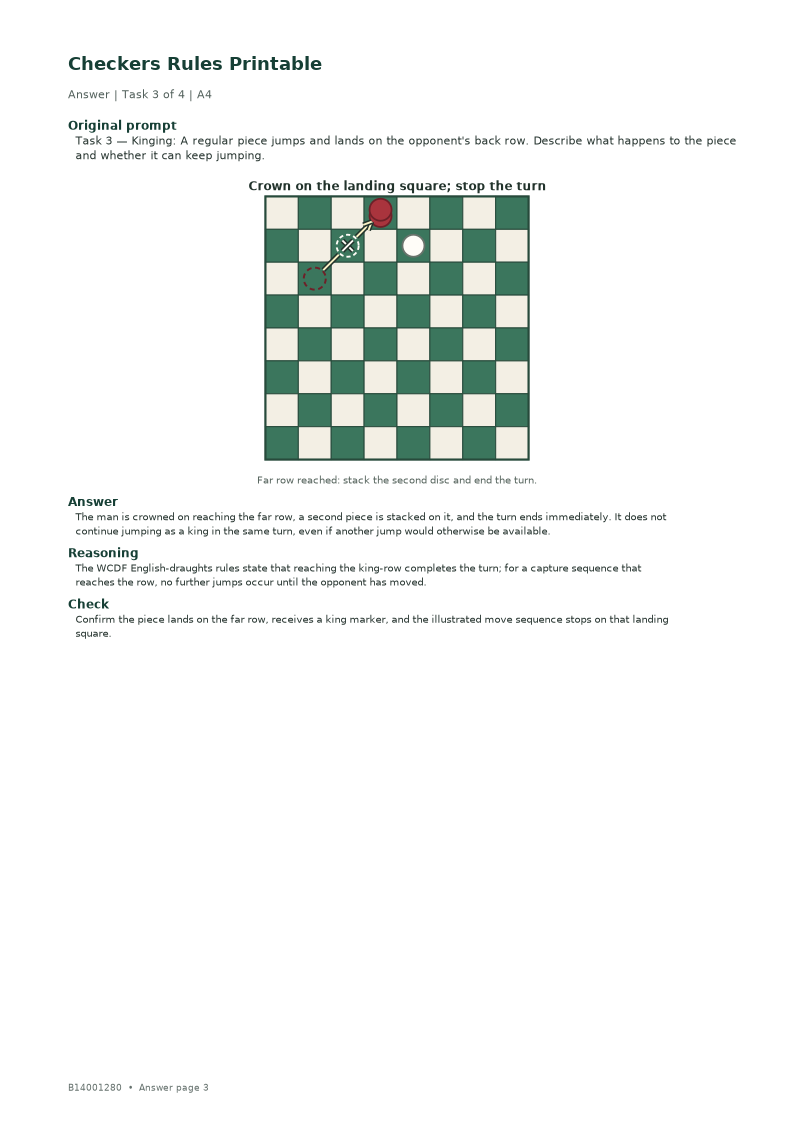
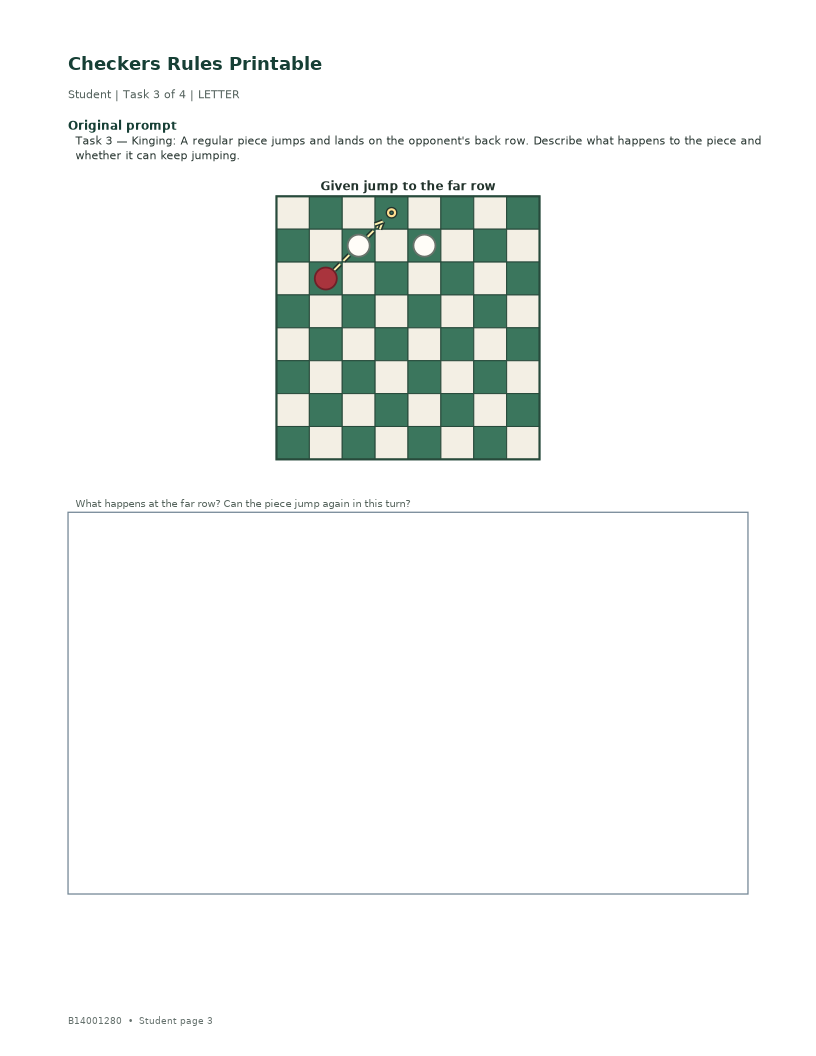
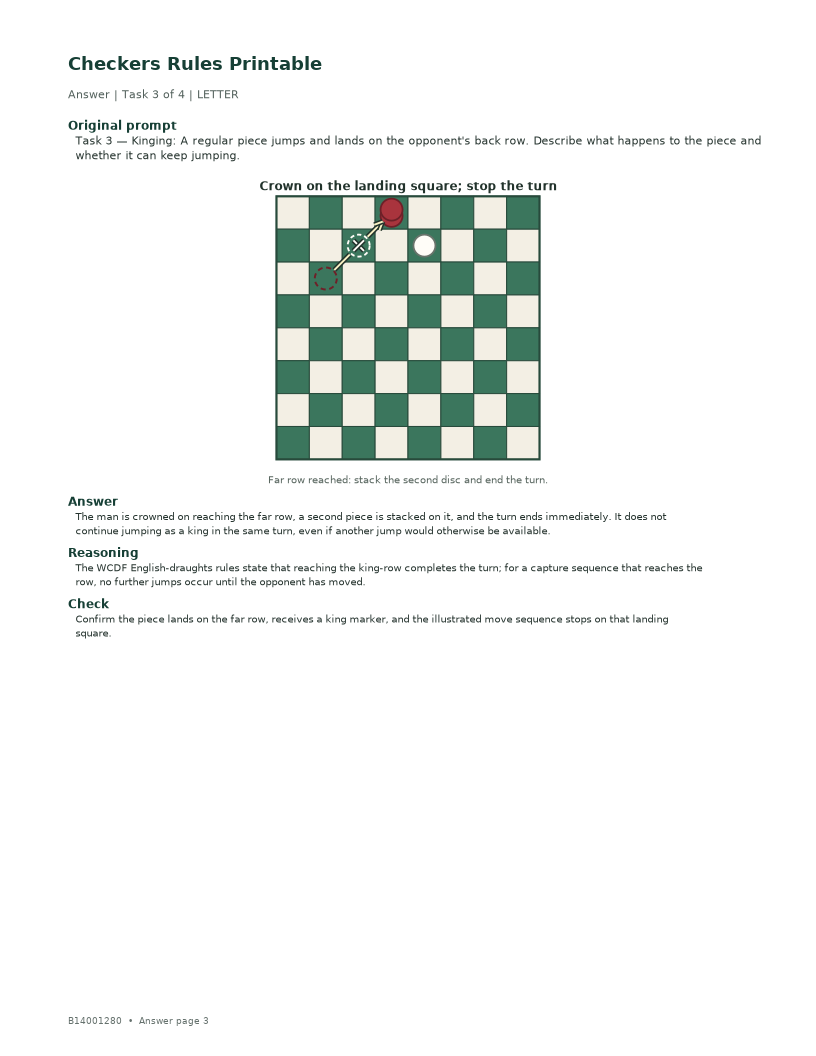
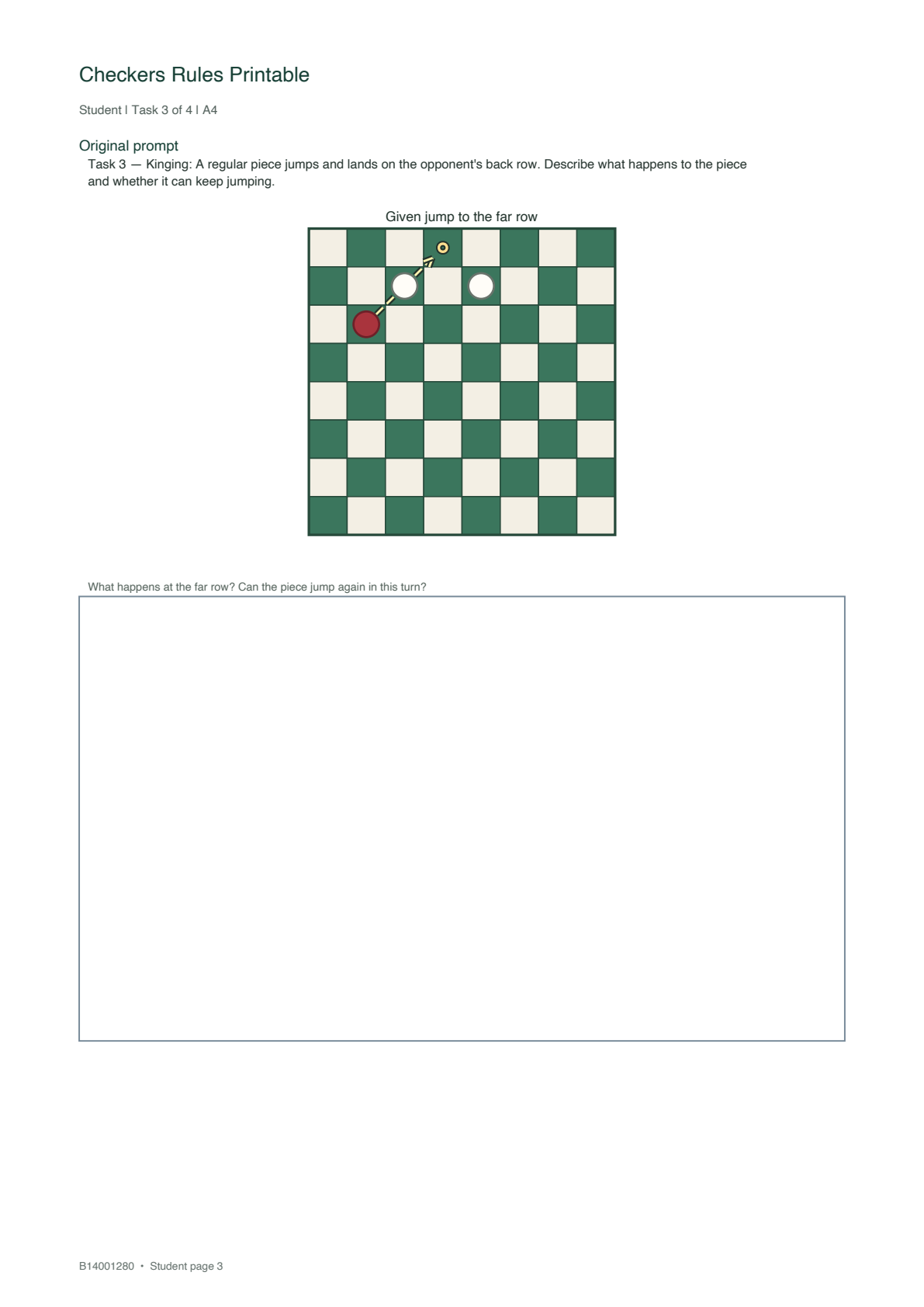
Task 3 — Kinging: A regular piece jumps and lands on the opponent's back row. Describe what happens to the piece and whether it can keep jumping.
Show answer 3
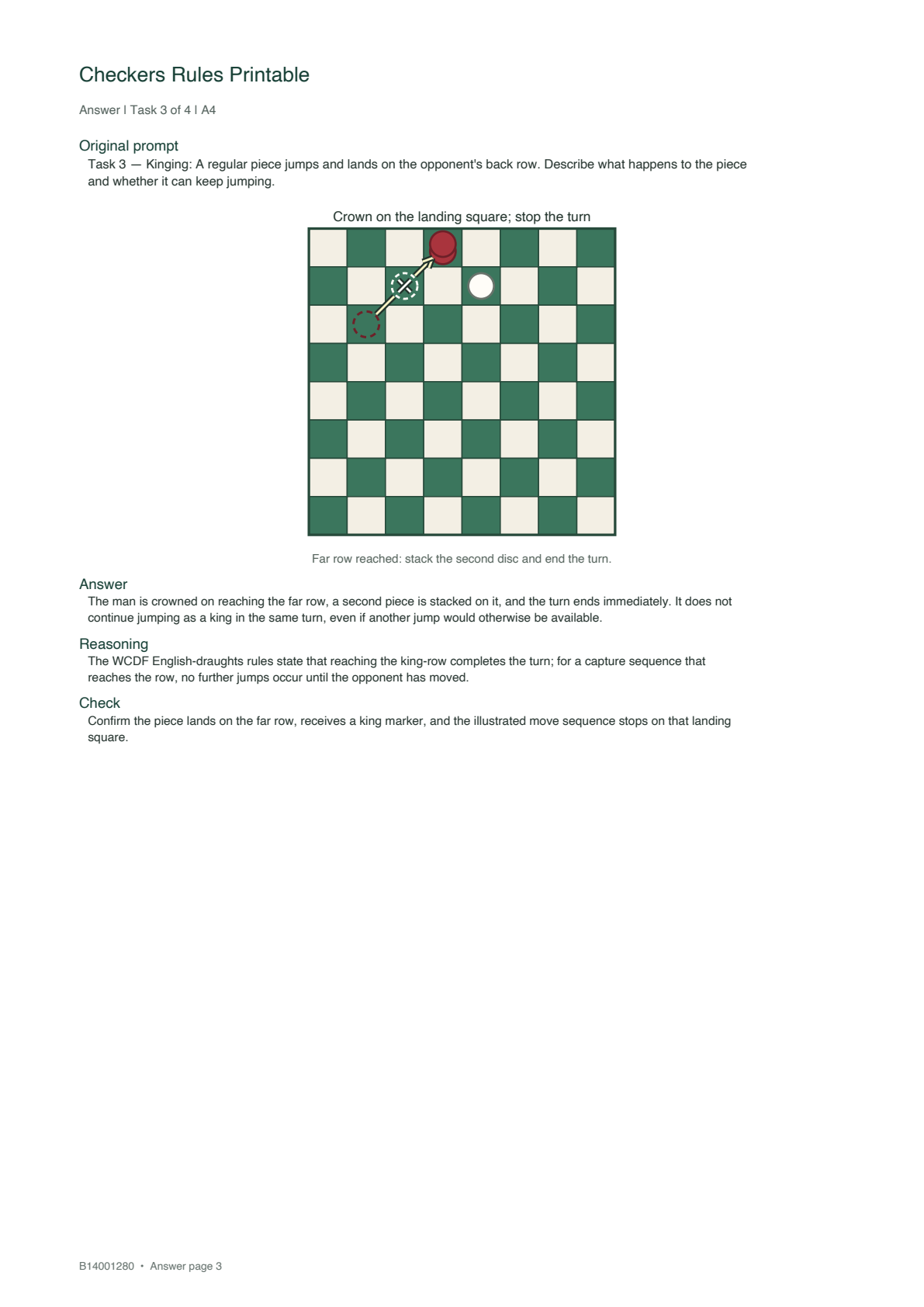
The man is crowned on reaching the far row, a second piece is stacked on it, and the turn ends immediately. It does not continue jumping as a king in the same turn, even if another jump would otherwise be available.
The WCDF English-draughts rules state that reaching the king-row completes the turn; for a capture sequence that reaches the row, no further jumps occur until the opponent has moved.
Check: Confirm the piece lands on the far row, receives a king marker, and the illustrated move sequence stops on that landing square.
Task 4
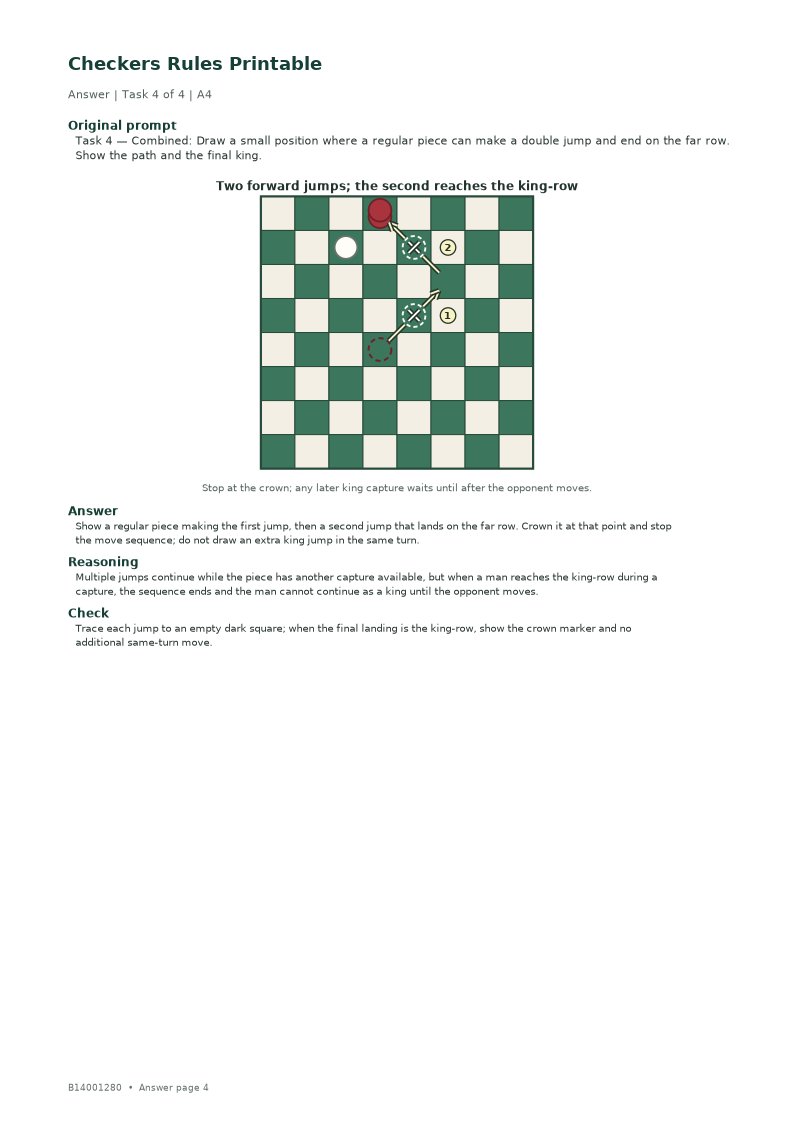
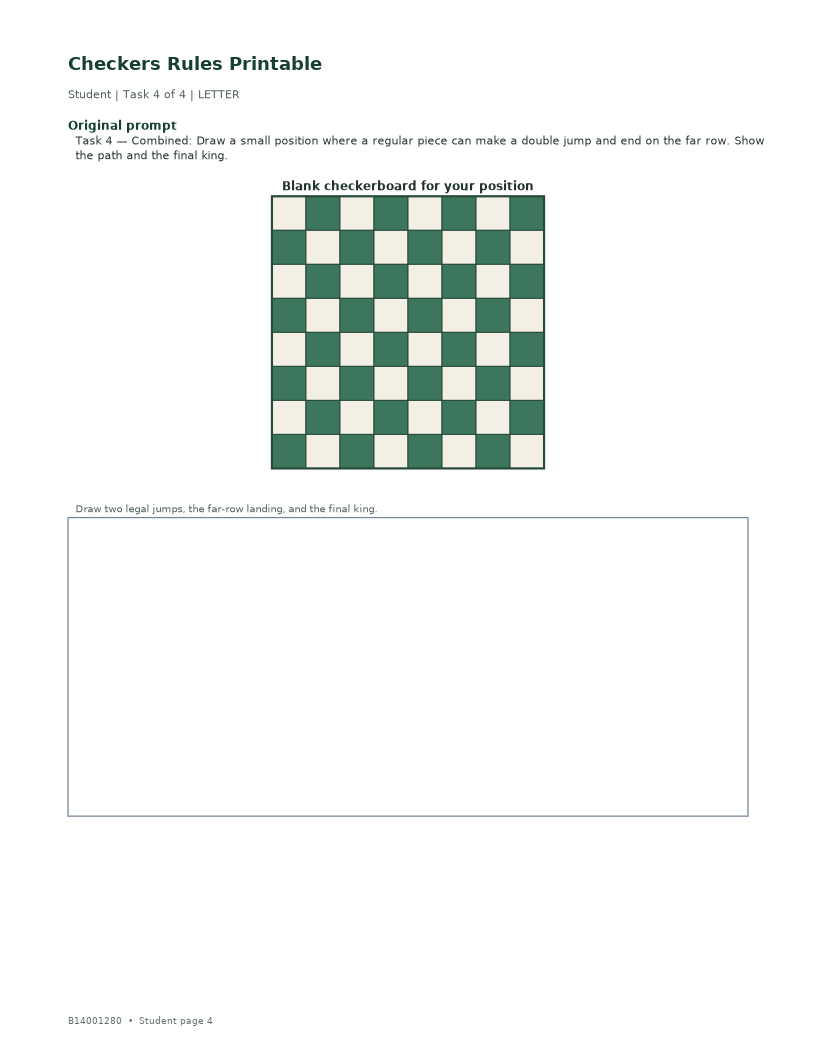
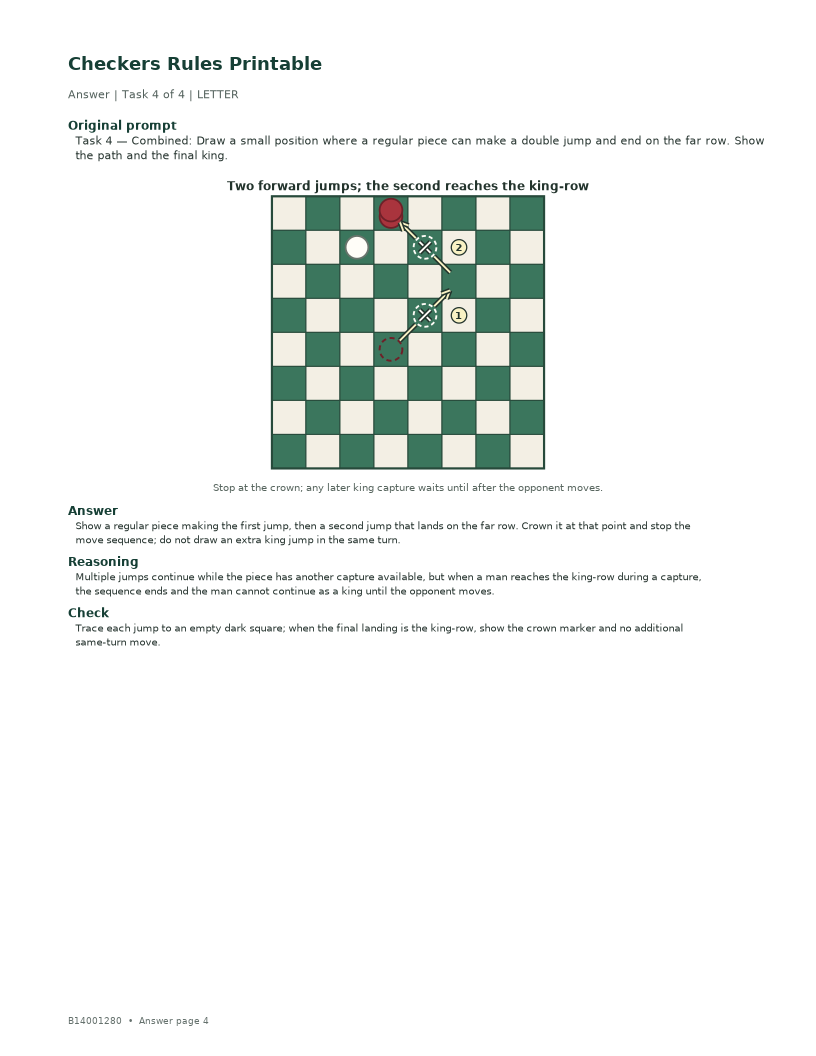
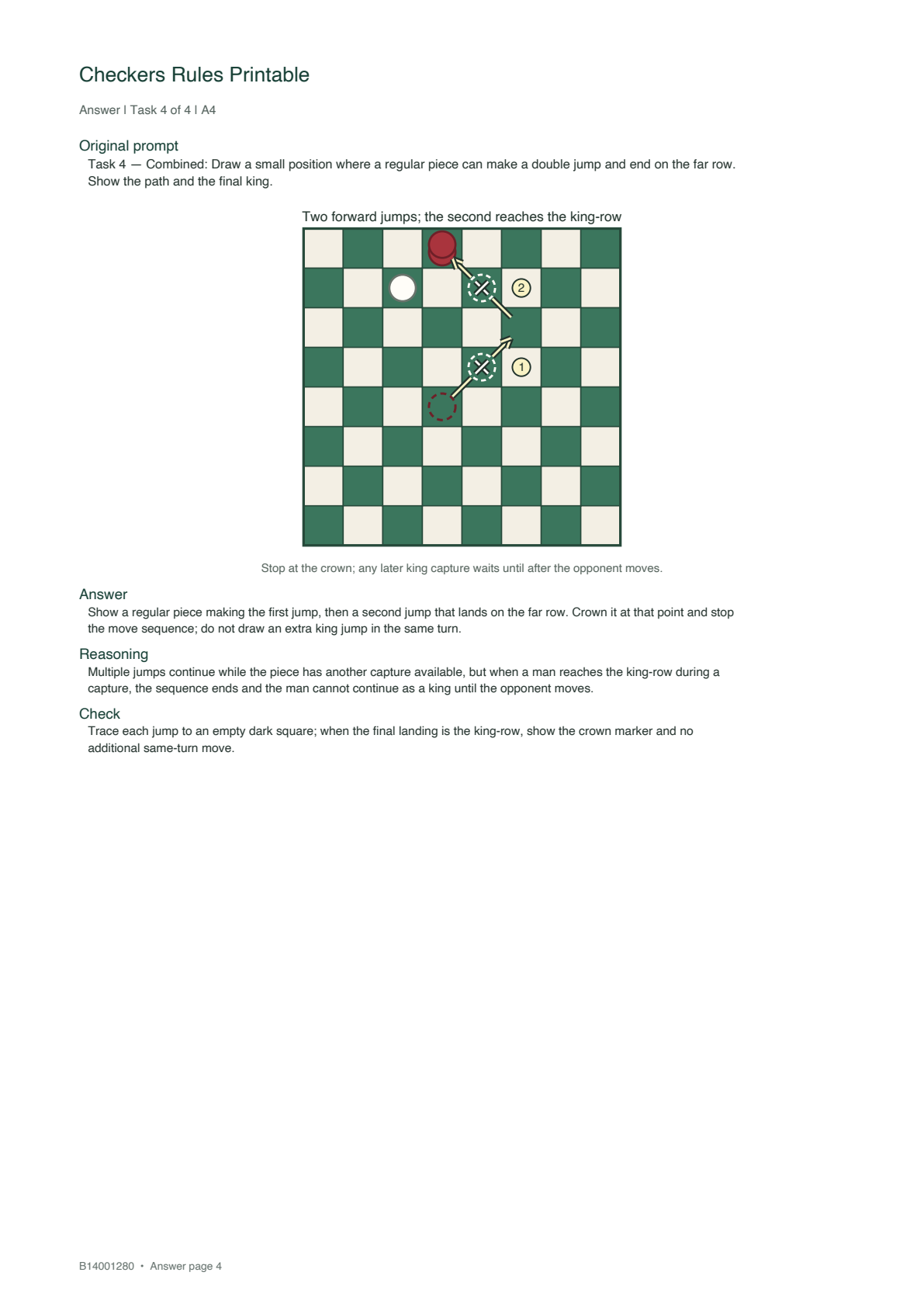
Task 4 — Combined: Draw a small position where a regular piece can make a double jump and end on the far row. Show the path and the final king.
Show answer 4
Show a regular piece making the first jump, then a second jump that lands on the far row. Crown it at that point and stop the move sequence; do not draw an extra king jump in the same turn.
Multiple jumps continue while the piece has another capture available, but when a man reaches the king-row during a capture, the sequence ends and the man cannot continue as a king until the opponent moves.
Check: Trace each jump to an empty dark square; when the final landing is the king-row, show the crown marker and no additional same-turn move.
Useful checks
- Moving a regular piece backward. Regular pieces move only diagonally forward; only kings move backward.
- Declining an available jump. Captures are mandatory; if a jump exists, it must be taken.
- Placing pieces on light squares. All play occurs on dark squares only.
Questions about this resource
Can a newly crowned king continue a jump immediately?
Under the WCDF English-draughts rules used here, no. Reaching the king-row completes the turn.
Which rules does this sheet use?
The 8×8 English-draughts rules published by the World Checkers/Draughts Federation, including mandatory captures and the king-row turn-ending rule.