Free original lessons
Draw 2D Shapes Worksheet
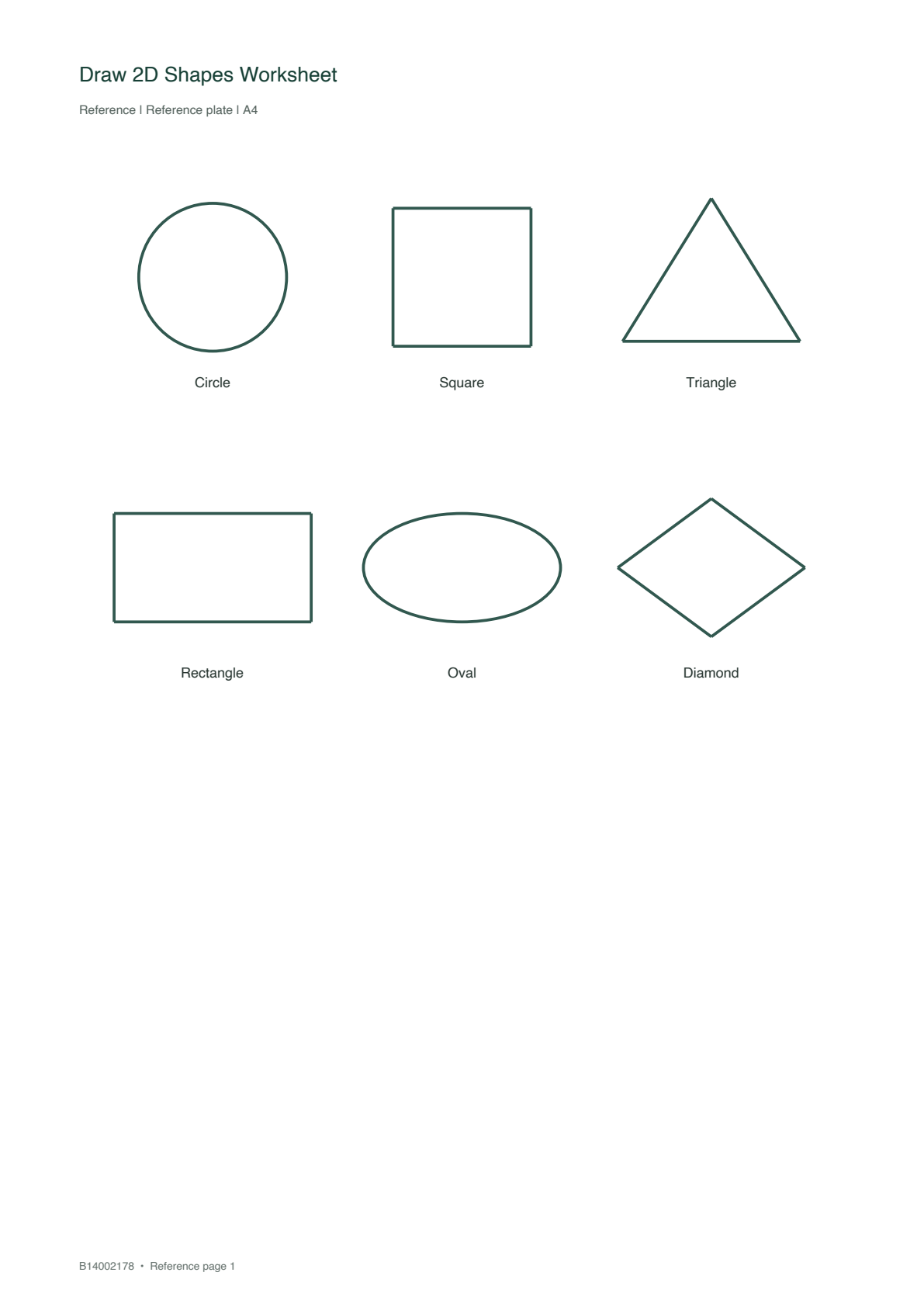
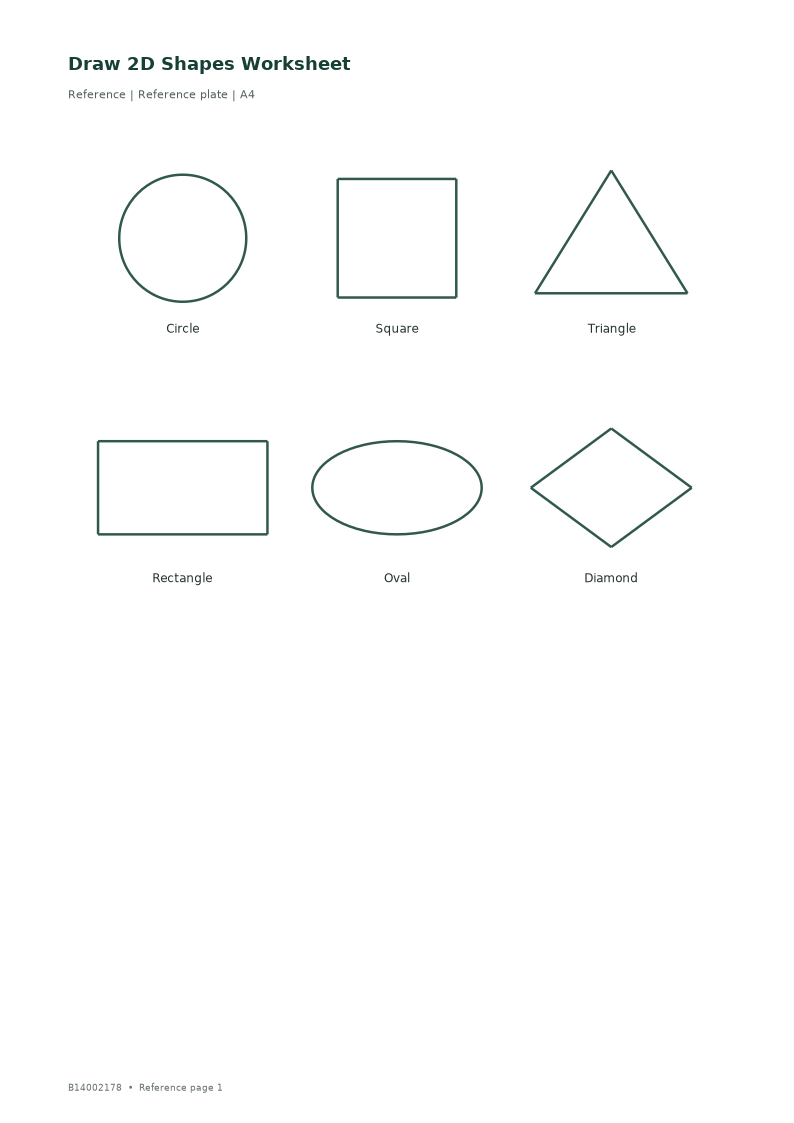
This pack teaches you to draw named 2D shapes by copying a reference, tracing a light guide, and checking the result. Each task names the shapes, gives a reference to look at, and asks for a drawing you can check against the answer key.
Letter & A4
PDF & SVG
What this worksheet asks you to do
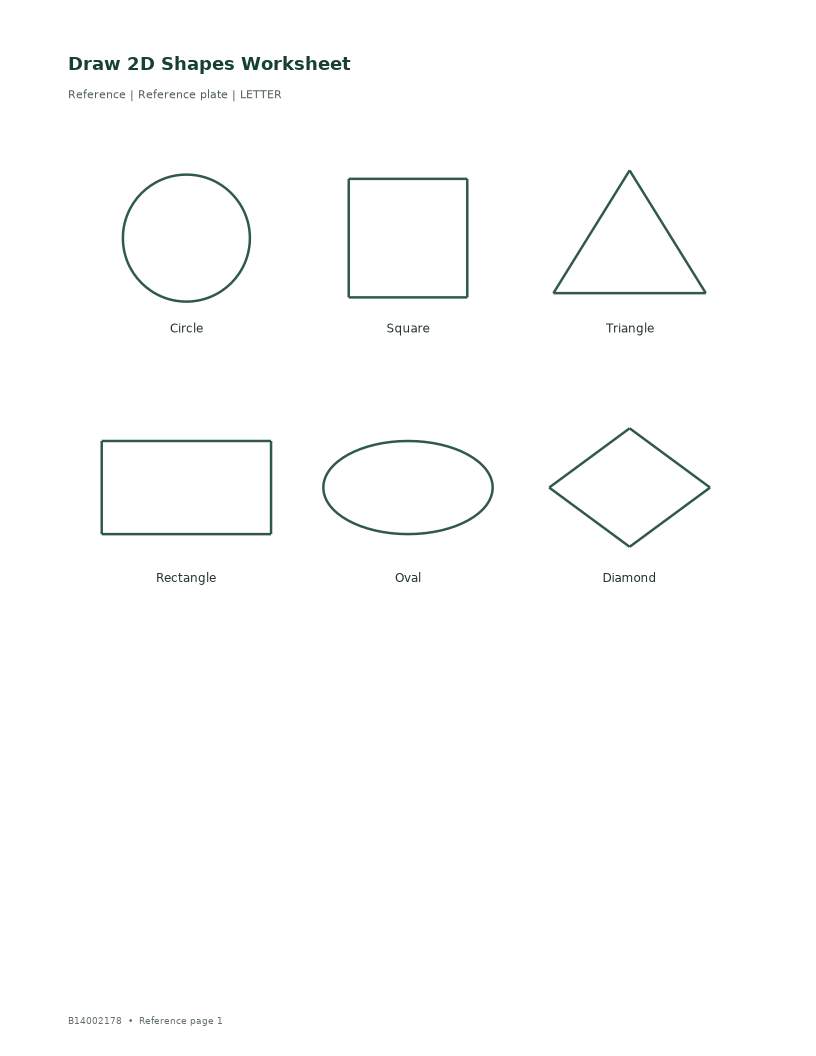
A 2D shape is a flat shape. This pack uses a circle, square, triangle, longer rectangle, oval, and diamond-shaped rhombus. A square is also a rectangle. The worksheet sets them side by side to compare an equal-sided example with a longer example.
How to draw a named 2D shape
Look at the reference shape first and name its parts: straight sides or a curved edge, corners, and whether the sides are equal. Then draw the outline in one clear closed line, keeping the form you observed.
Worked example: drawing a square and a circle
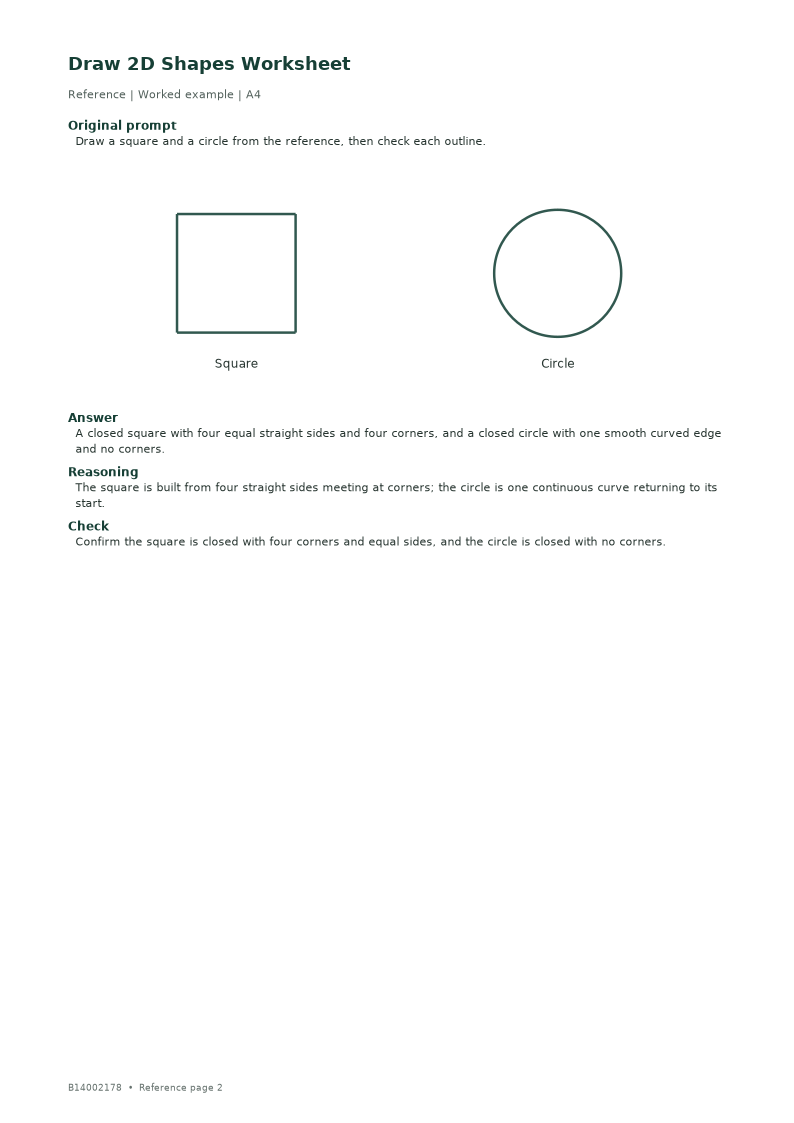
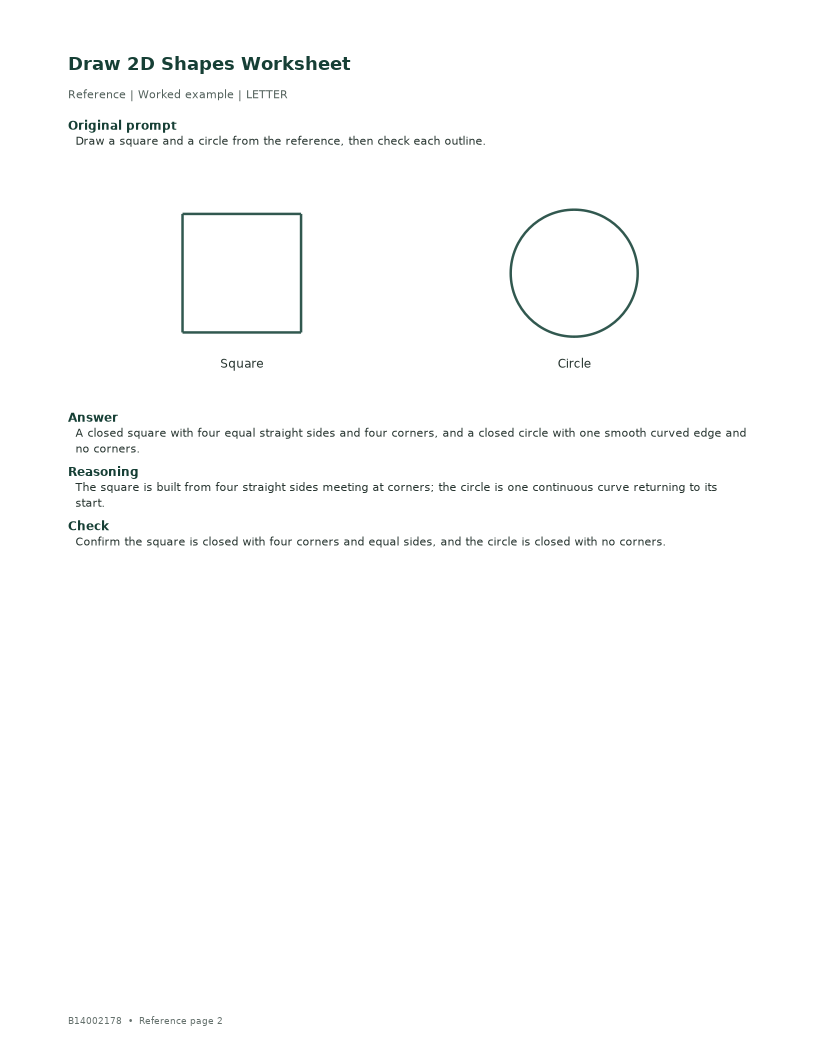
Reference: a square with four equal straight sides and four corners, and a circle with one continuous curved edge and no corners. Draw the square as four straight sides meeting at corners, then draw the circle as one smooth closed curve. Check: the square has four corners and equal sides; the circle is closed and has no corners.
Task 1: Trace named shapes
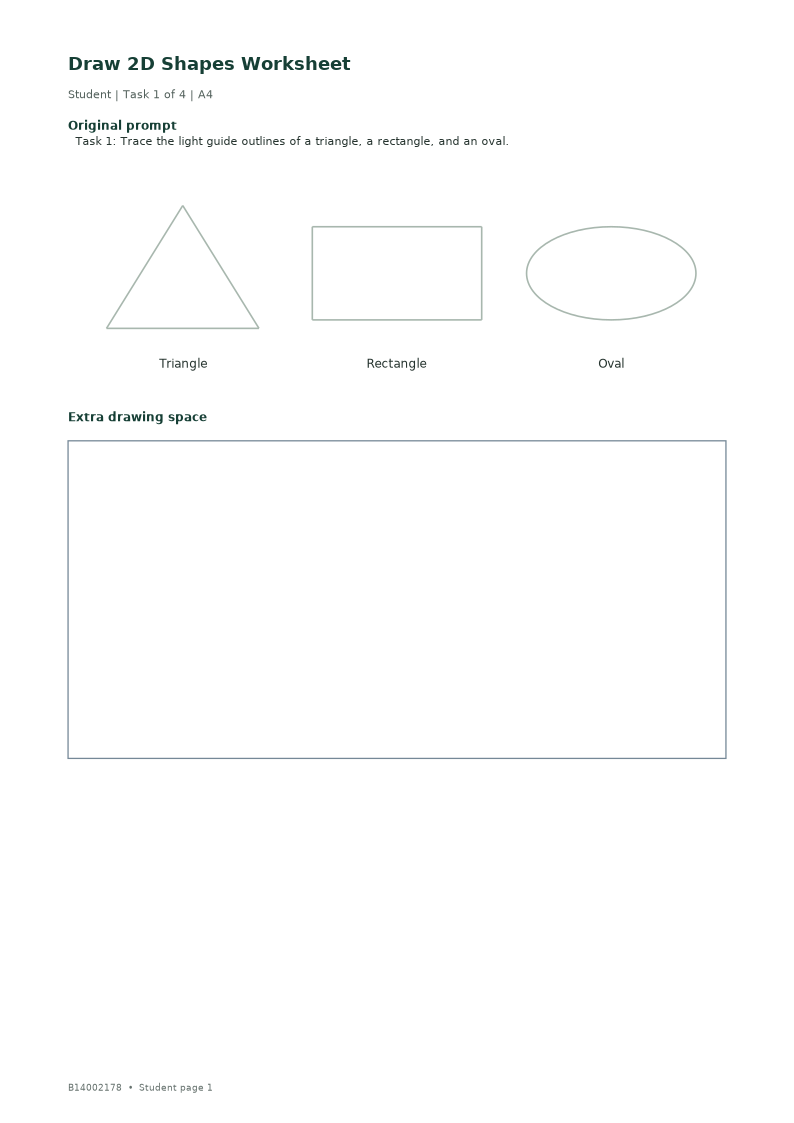
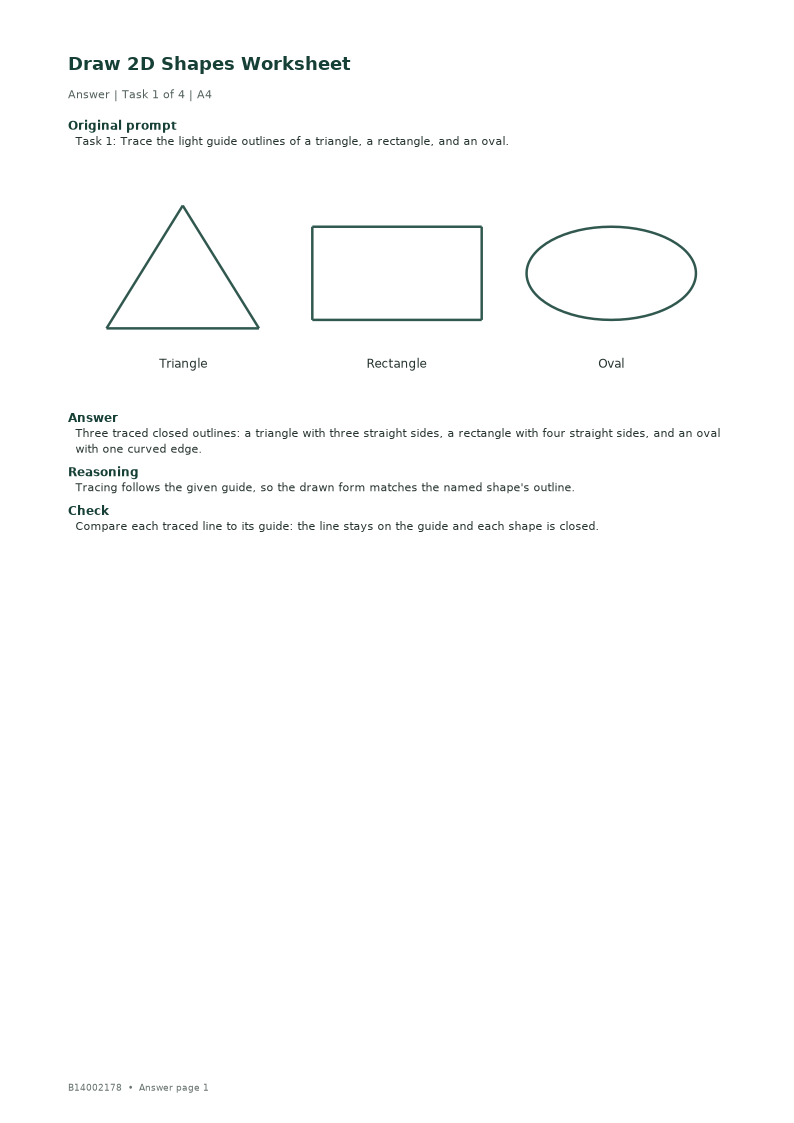
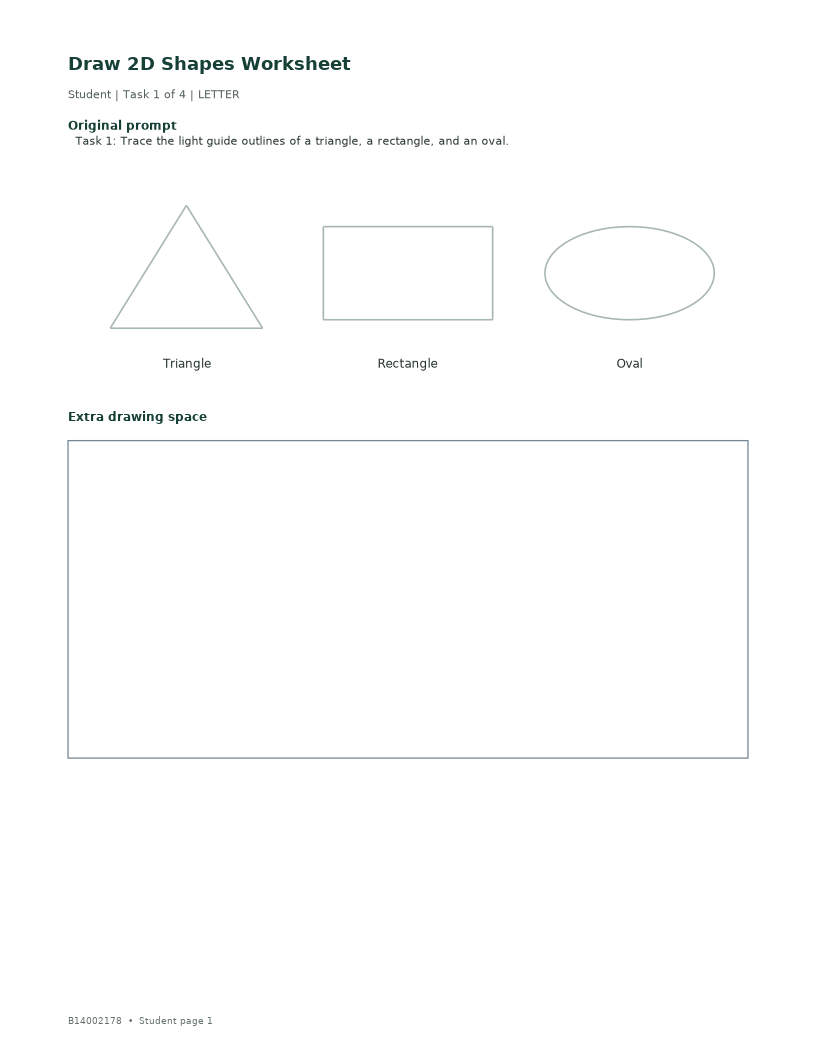
Trace over the light guide outlines of a triangle, a rectangle, and an oval. Keep your line on the guide and close each shape. Check each traced outline against the guide: triangle has three straight sides, rectangle has four straight sides with two long and two short, oval is a stretched closed curve.
Download the complete resource pack
All individual SVG pages (20)
- A4 reference page 1
- A4 reference page 2
- A4 student page 1
- A4 student page 2
- A4 student page 3
- A4 student page 4
- A4 answer page 1
- A4 answer page 2
- A4 answer page 3
- A4 answer page 4
- LETTER reference page 1
- LETTER reference page 2
- LETTER student page 1
- LETTER student page 2
- LETTER student page 3
- LETTER student page 4
- LETTER answer page 1
- LETTER answer page 2
- LETTER answer page 3
- LETTER answer page 4
Print at 100% / actual size. Use the stated scale on any schematic diagram; physical cutting templates are identified separately. A4 and US Letter are separate files. Free access, no signup; CC BY 4.0.
How to use these pages
- What this worksheet asks you to do
- How to draw a named 2D shape
- Worked example: drawing a square and a circle
- Task 1: Trace named shapes
Worked example
Example: Draw a square and a circle from the reference, then check each outline.
Answer: A closed square with four equal straight sides and four corners, and a closed circle with one smooth curved edge and no corners.
Reasoning: The square is built from four straight sides meeting at corners; the circle is one continuous curve returning to its start.
Check: Confirm the square is closed with four corners and equal sides, and the circle is closed with no corners.
Four practice tasks and complete answers
Task 1
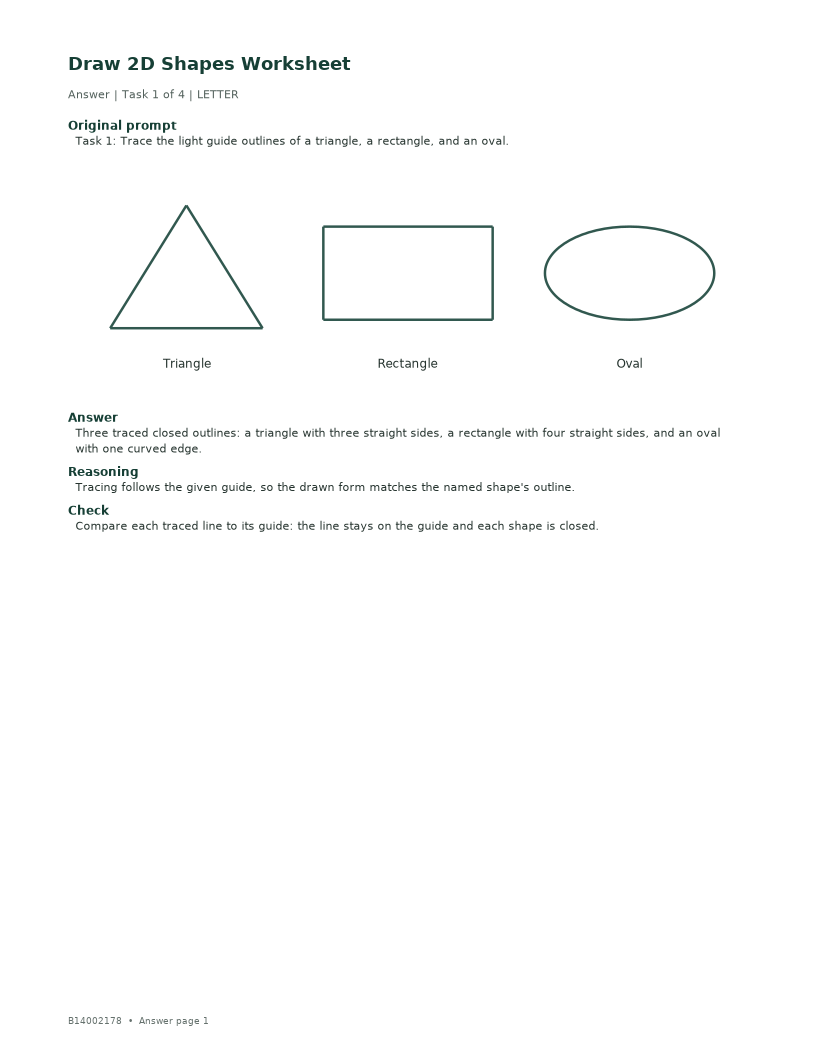
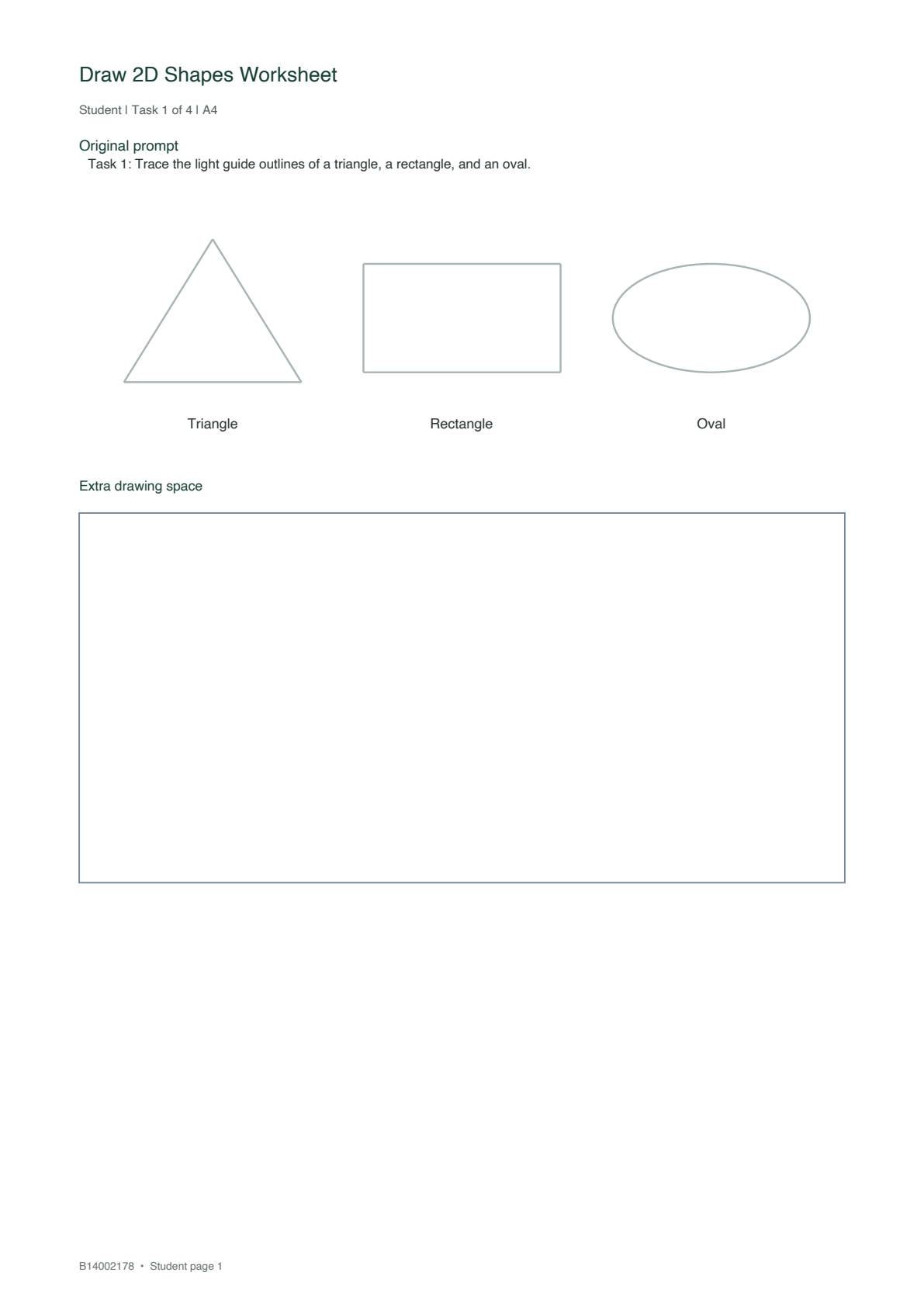
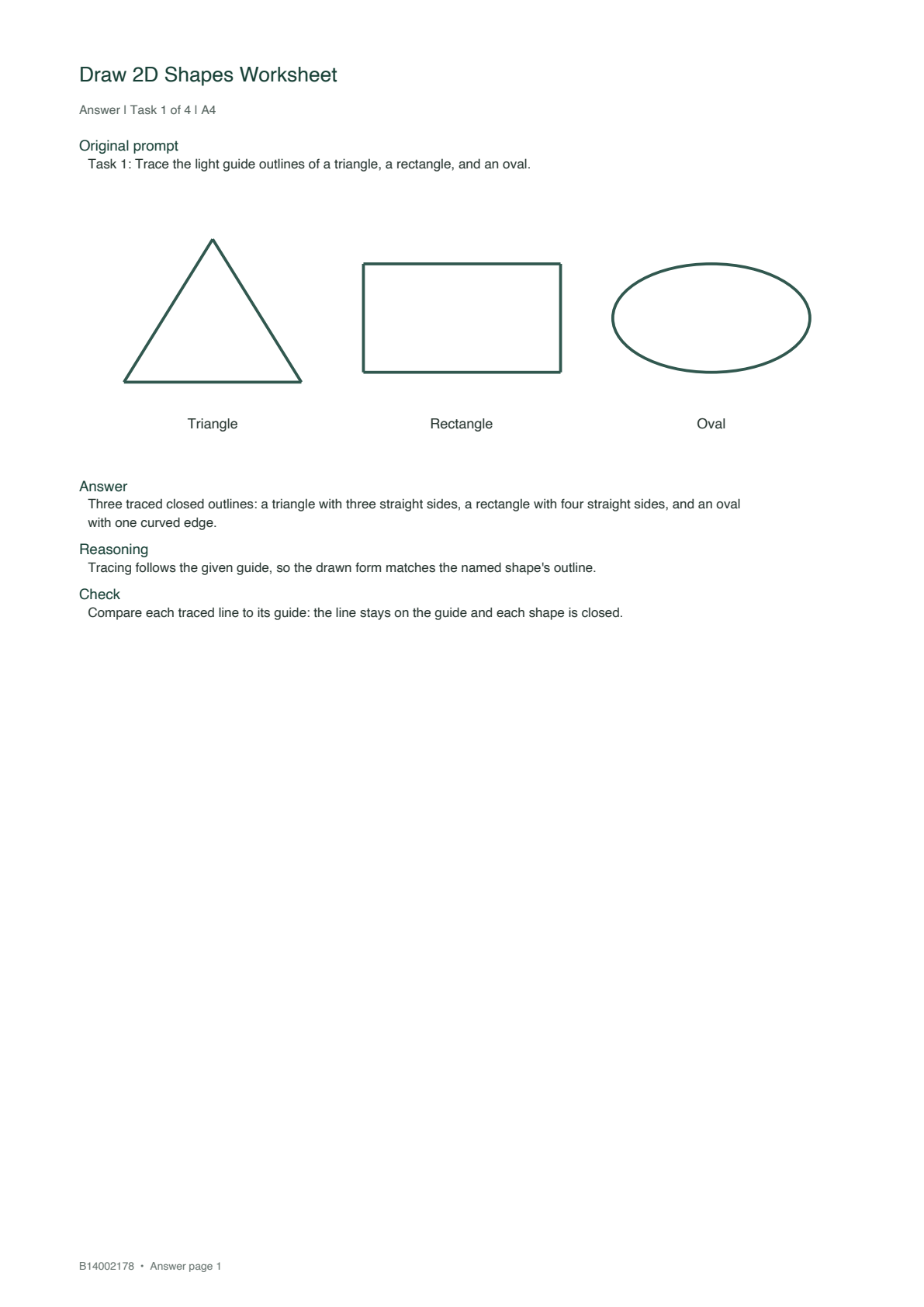
Task 1: Trace the light guide outlines of a triangle, a rectangle, and an oval.
Show answer 1
Three traced closed outlines: a triangle with three straight sides, a rectangle with four straight sides, and an oval with one curved edge.
Tracing follows the given guide, so the drawn form matches the named shape's outline.
Check: Compare each traced line to its guide: the line stays on the guide and each shape is closed.
Task 2
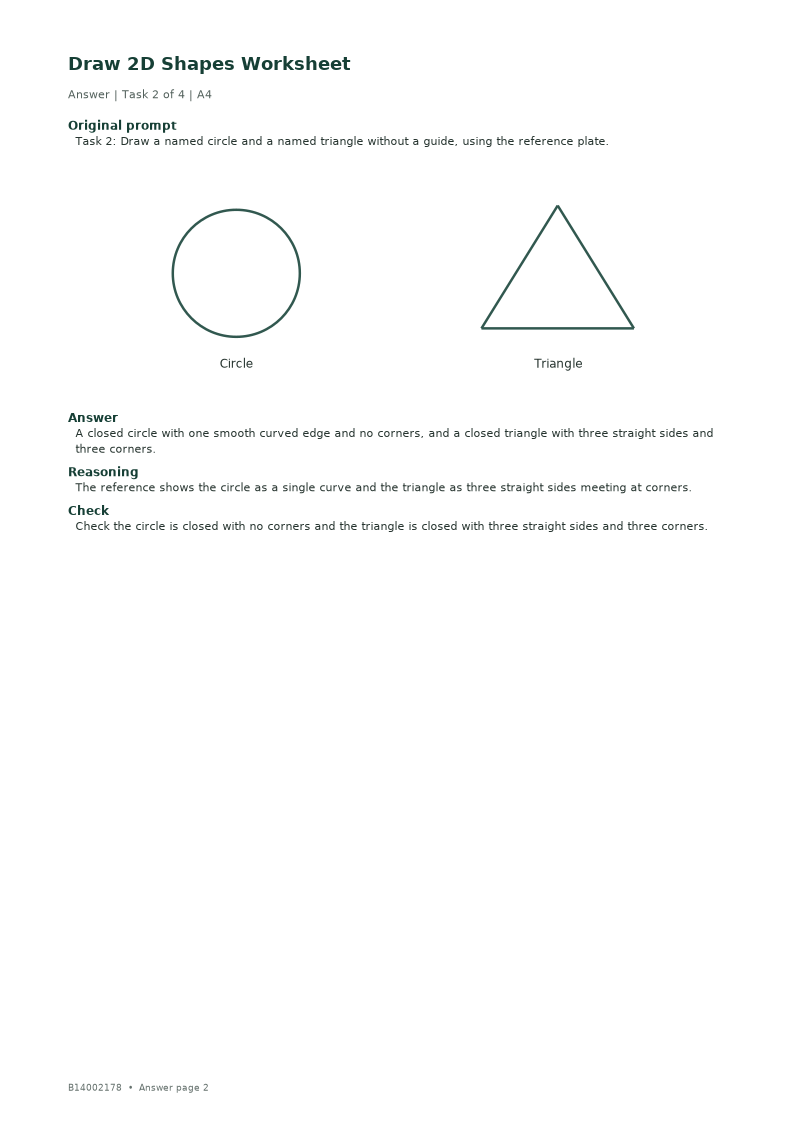
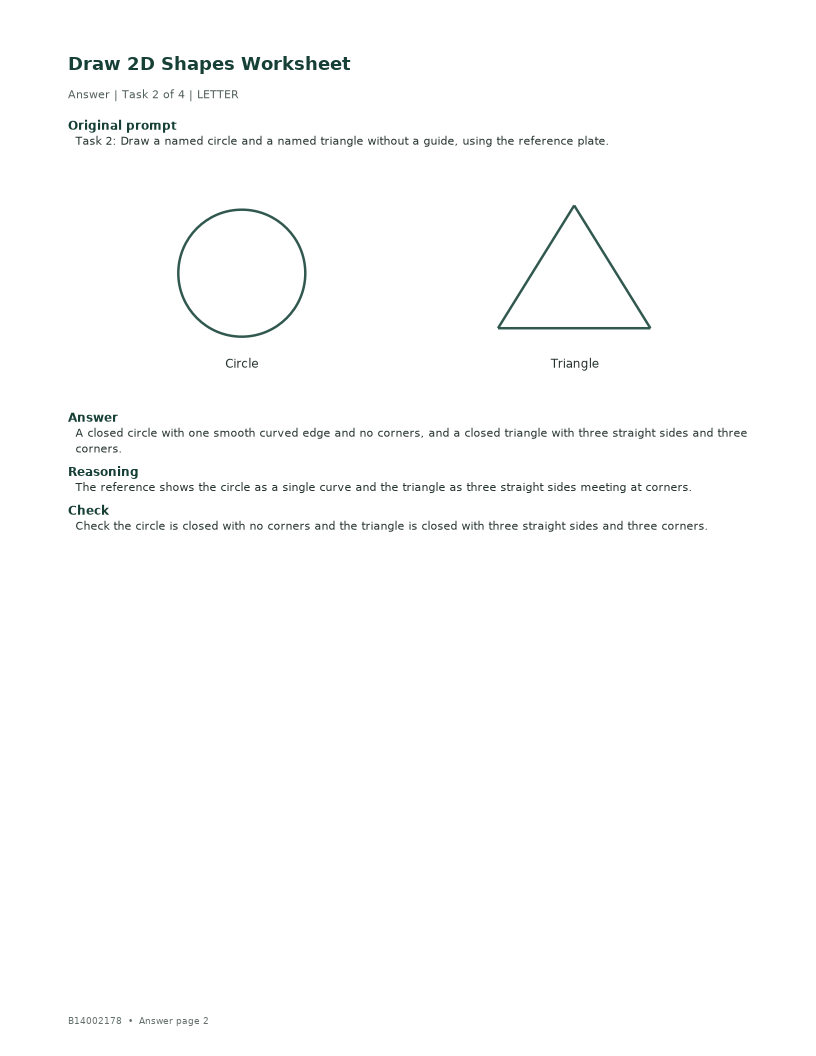
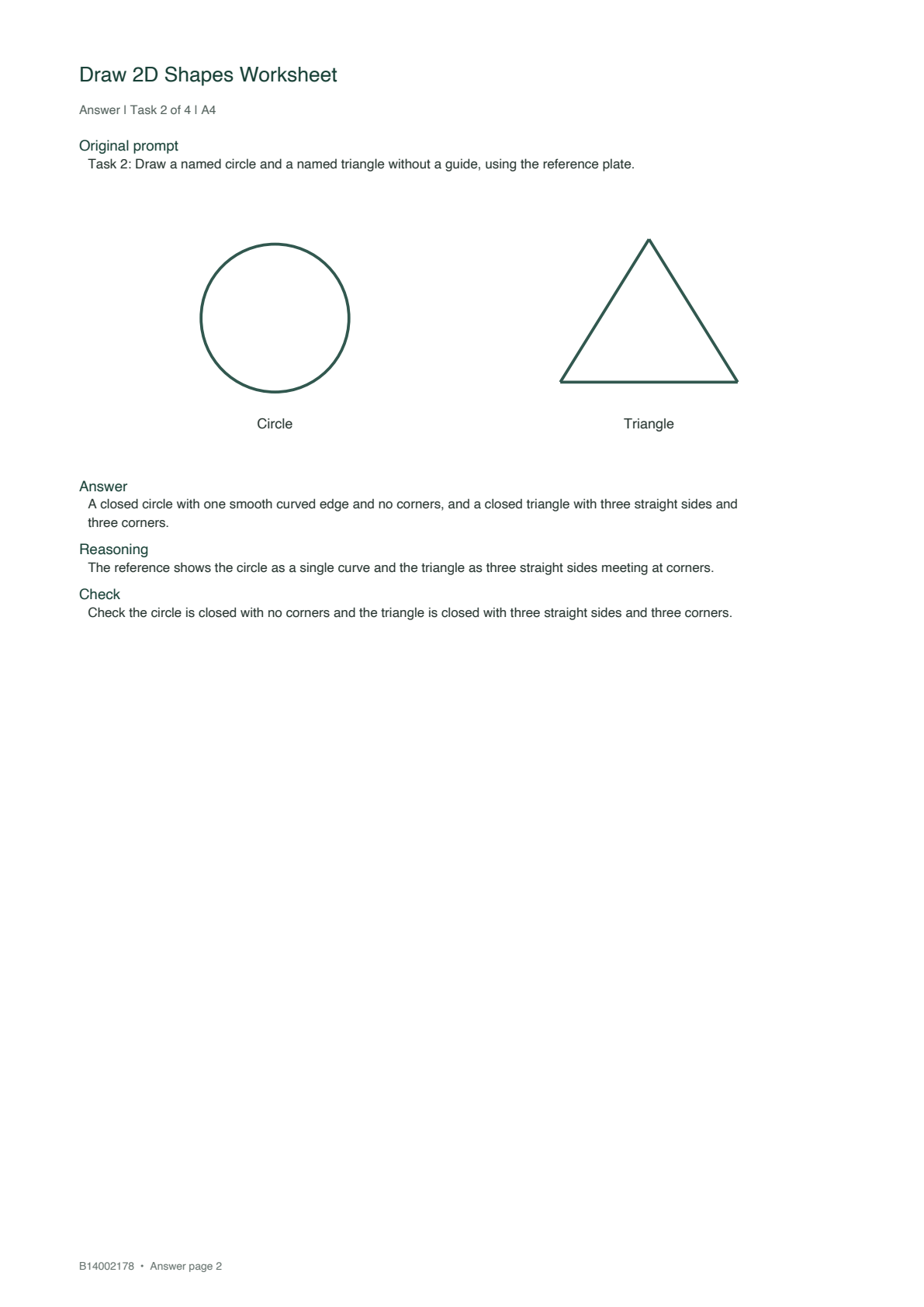
Task 2: Draw a named circle and a named triangle without a guide, using the reference plate.
Show answer 2
A closed circle with one smooth curved edge and no corners, and a closed triangle with three straight sides and three corners.
The reference shows the circle as a single curve and the triangle as three straight sides meeting at corners.
Check: Check the circle is closed with no corners and the triangle is closed with three straight sides and three corners.
Task 3
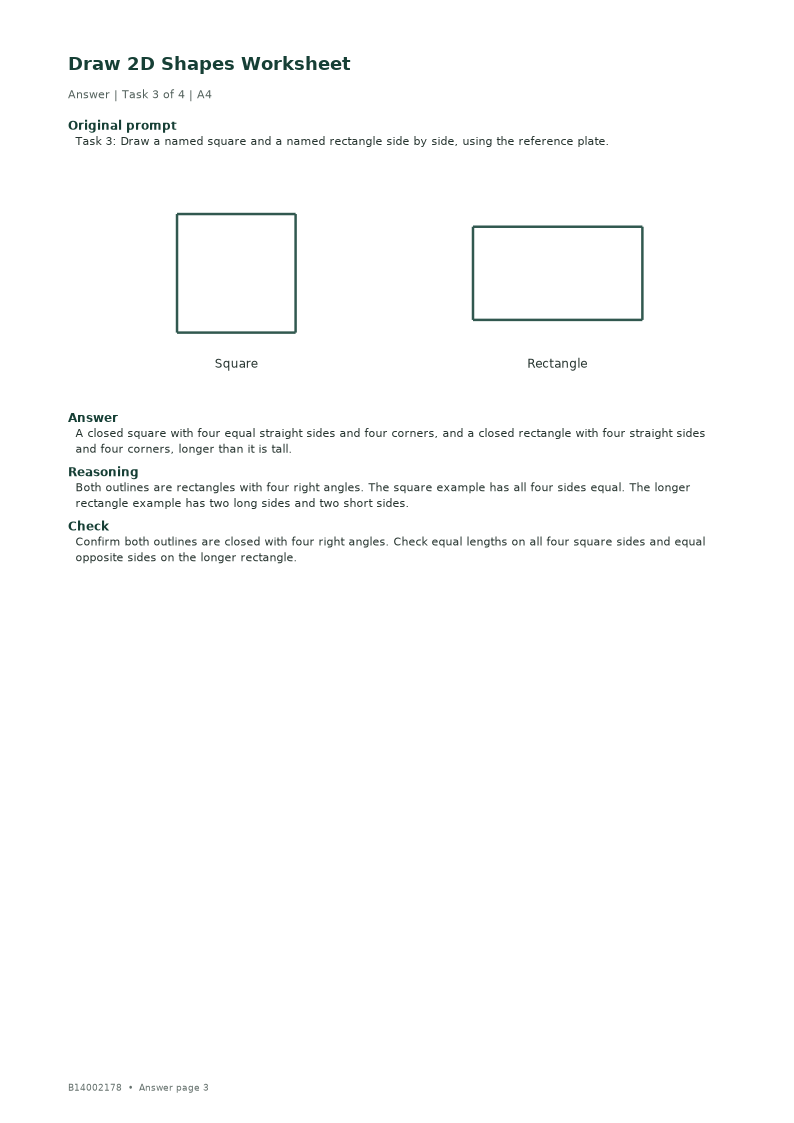
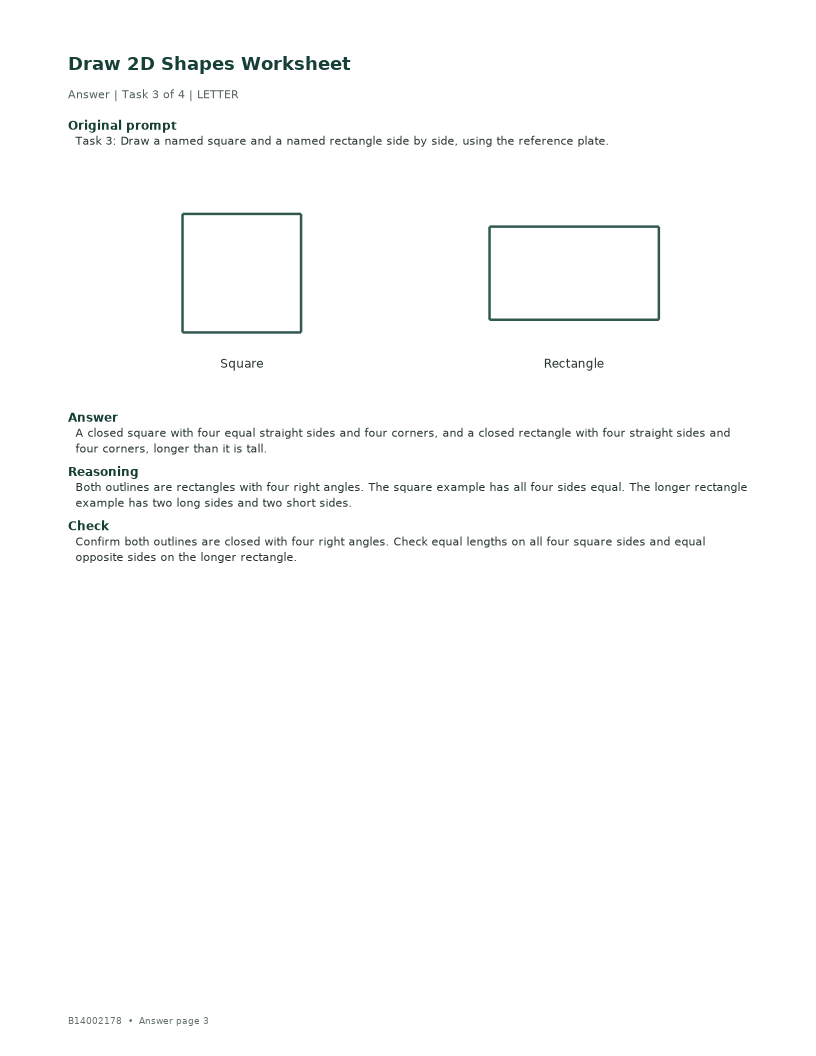
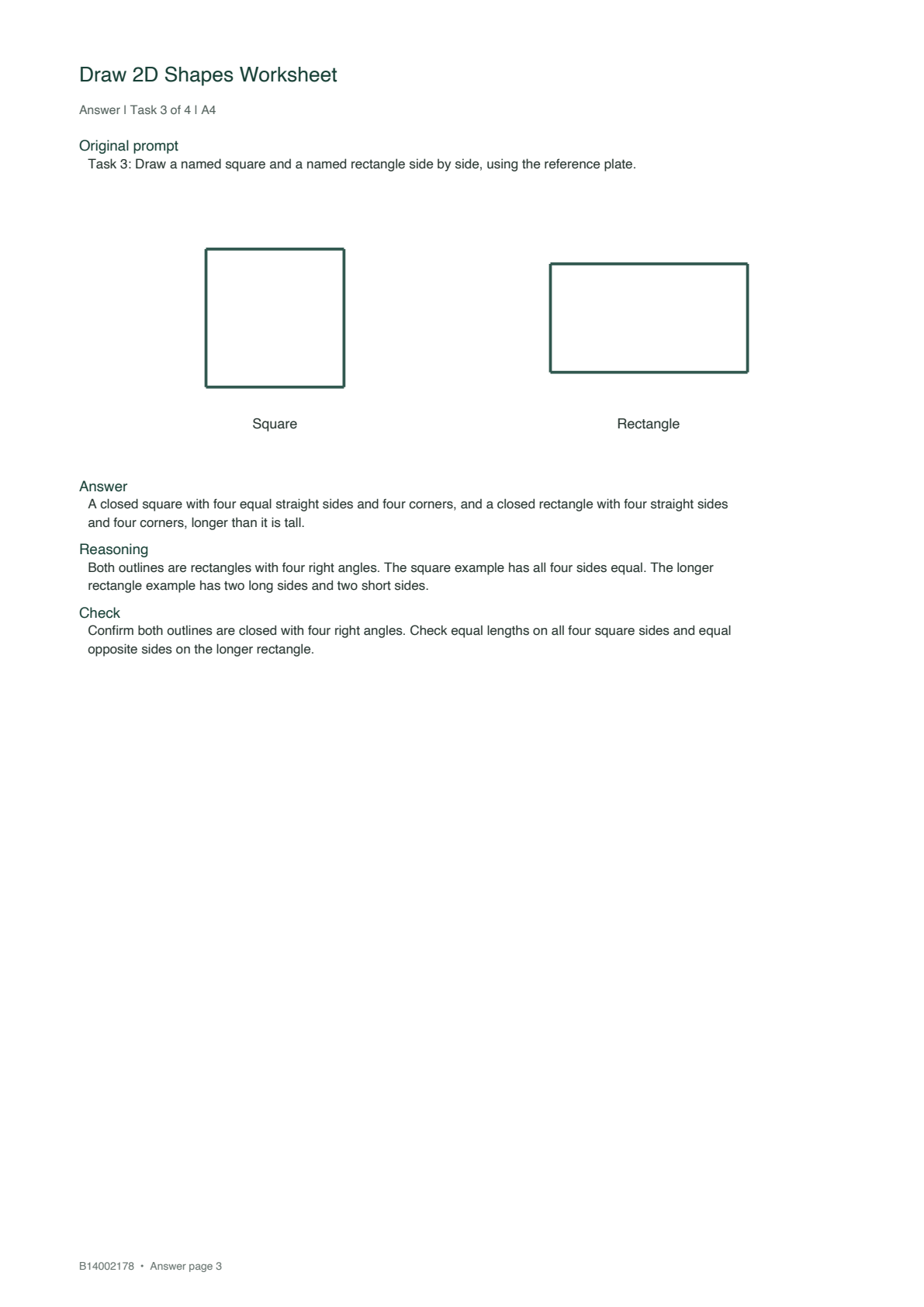
Task 3: Draw a named square and a named rectangle side by side, using the reference plate.
Show answer 3
A closed square with four equal straight sides and four corners, and a closed rectangle with four straight sides and four corners, longer than it is tall.
Both outlines are rectangles with four right angles. The square example has all four sides equal. The longer rectangle example has two long sides and two short sides.
Check: Confirm both outlines are closed with four right angles. Check equal lengths on all four square sides and equal opposite sides on the longer rectangle.
Task 4
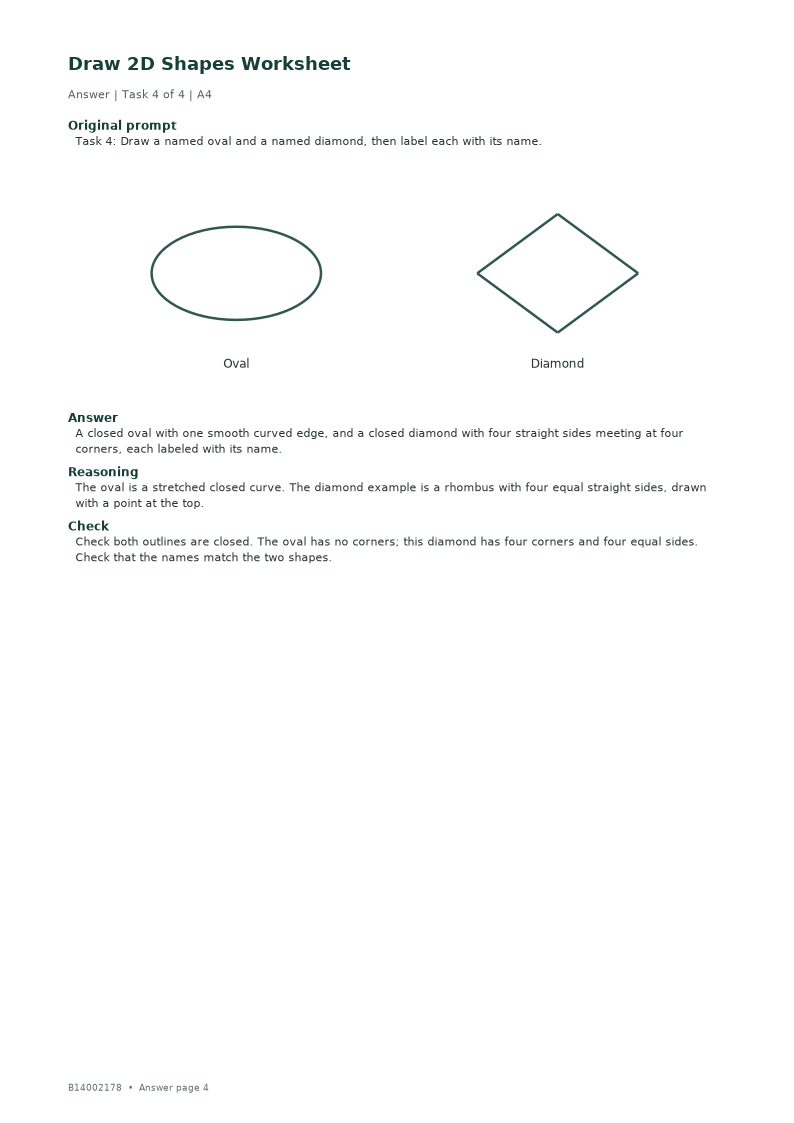
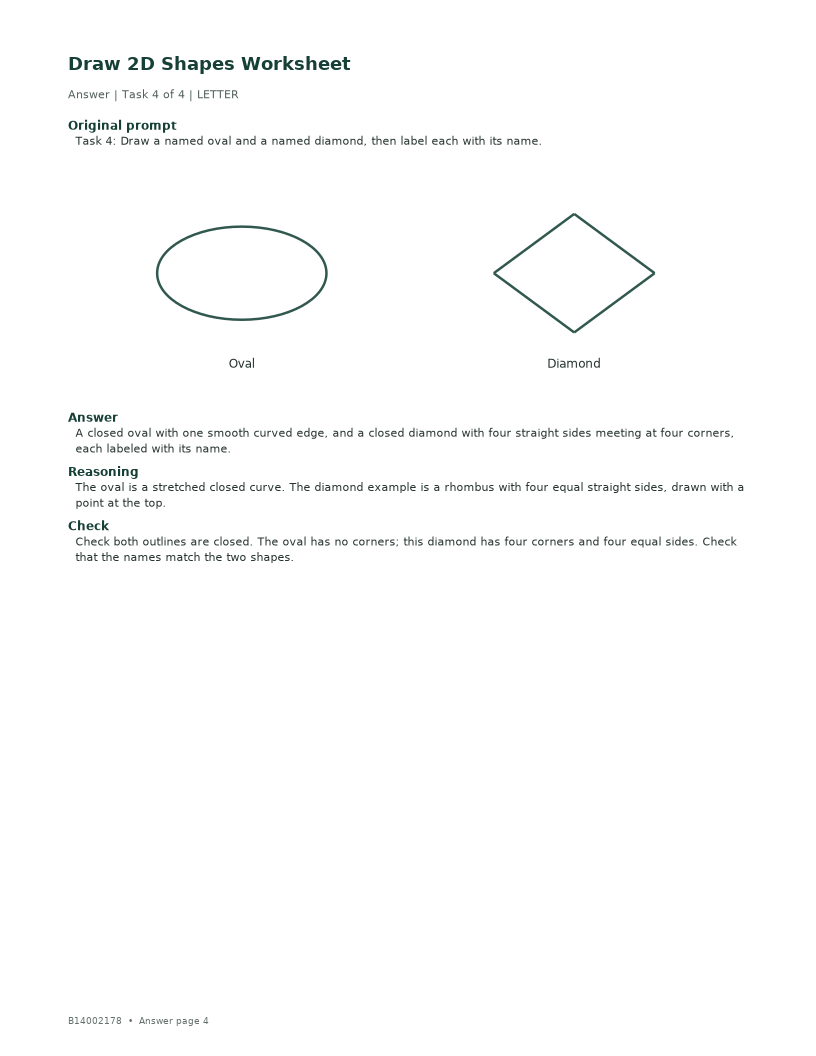
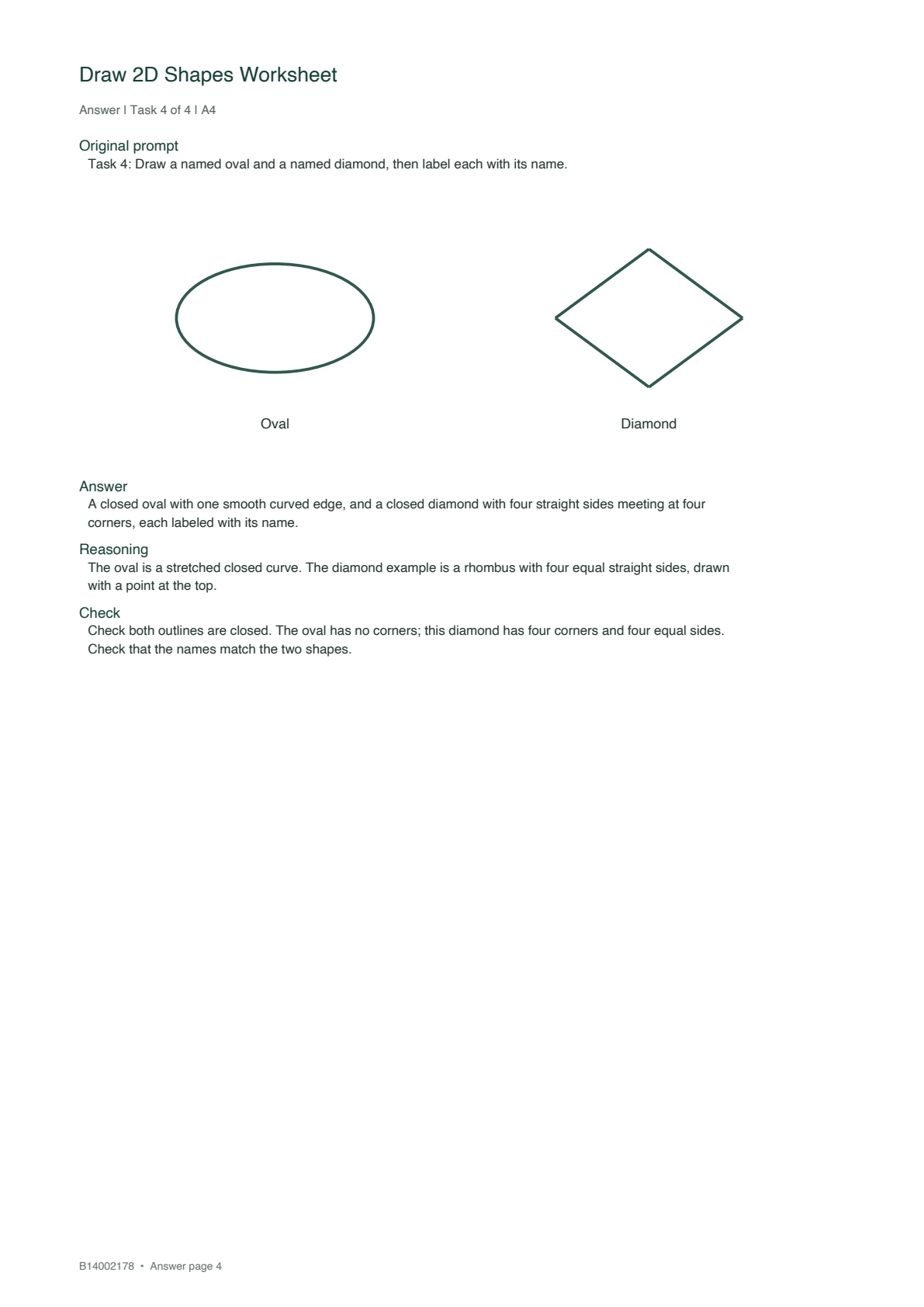
Task 4: Draw a named oval and a named diamond, then label each with its name.
Show answer 4
A closed oval with one smooth curved edge, and a closed diamond with four straight sides meeting at four corners, each labeled with its name.
The oval is a stretched closed curve. The diamond example is a rhombus with four equal straight sides, drawn with a point at the top.
Check: Check both outlines are closed. The oval has no corners; this diamond has four corners and four equal sides. Check that the names match the two shapes.
Useful checks
- Leaving a shape open instead of closing the outline. Return the line to its starting point so the outline is a complete closed shape.
- Drawing a circle with corners or a square with curved sides. Match the reference: circles use one smooth curve, squares use four straight sides.
Questions about this resource
Do I need to shade the shapes?
No. This worksheet is about drawing and tracing the named outlines, not shading or making them look solid.
Can I use the answer key while drawing?
Use the reference plate while drawing and the answer key afterward to check your outlines.