HomeHiragana Tracing Grid: Stroke-Order Practice Sheet Free original lessons
Hiragana Tracing Grid: Stroke-Order Practice Sheet
Plan a printable hiragana tracing grid with stroke-order arrows and repeated cells. Includes teaching steps, common mistakes, and four practice tasks.
Free downloads
Letter & A4
PDF & SVG
Writing and Handwriting Paper Guides
This instructional plan describes a free, printable hiragana tracing grid sheet for beginners. The sheet provides large tracing cells with numbered stroke-order arrows, followed by grid rows for repeated practice. The convention for letter height is baseline to midline: the x-height zone is the space between the baseline and the midline, and all hiragana bodies sit within that zone unless a stroke intentionally extends above or below. Letter styles vary, so the rubric accepts valid alternatives that preserve stroke order, relative shape, and spacing. The sheet excludes kanji practice and genkouyoushi manuscript grids; it focuses only on hiragana drawing practice. The standard pack is available in both paper sizes, with reference, practice, and answer pages.
Practice materials: Download the free reference pages, practice sheets and separate answer keys below, in A4 and US Letter PDF and SVG formats.
Sheet layout and tracing convention
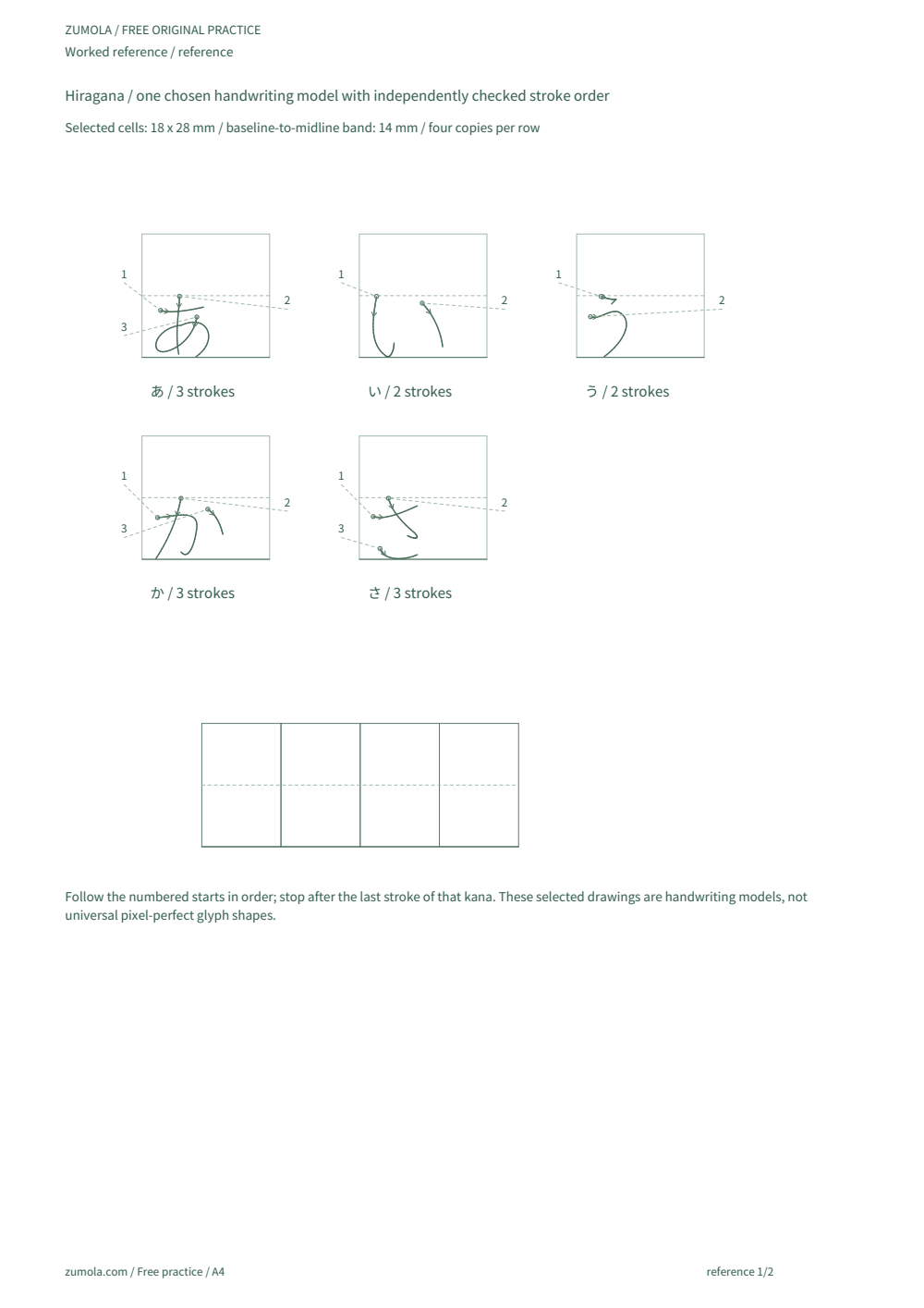
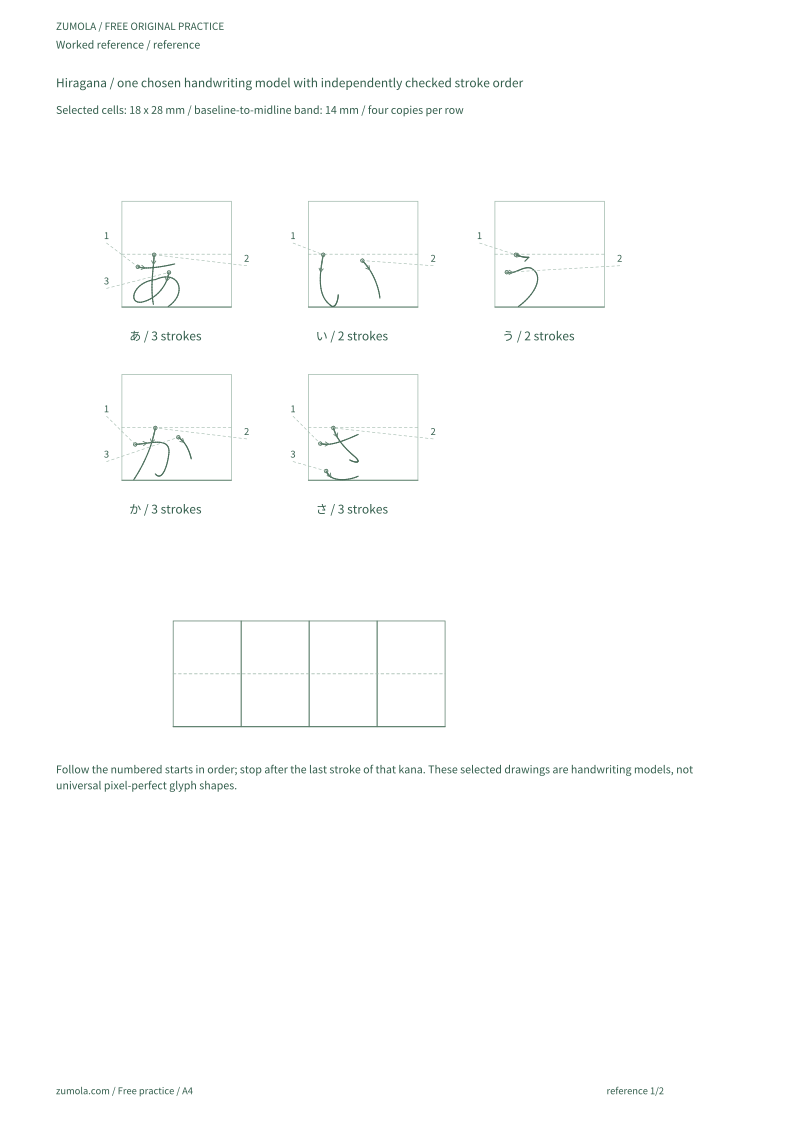
Each character block contains a large tracing cell with a light gray model character, numbered stroke-order arrows, and a start dot for the first stroke. Below the tracing cell, a row of empty grid cells allows repeated practice without the model. The grid rows use the same baseline and midline as the tracing cell so learners transfer the x-height convention consistently.
The x-height convention is baseline to midline. The midline marks the top of the x-height zone, and hiragana bodies sit between the baseline and the midline. Strokes may extend above the midline only as intentional style extensions required by the character style, but the body should remain anchored to the baseline. This convention is explicitly defined so that valid stylistic alternatives are not penalized.
- Measure the actual paper and printer margins, then label the writing zone height as a hypothetical example such as 12 mm.
- Draw a baseline and a midline at half the zone height, for example 6 mm above the baseline.
- Place one large tracing cell per character with a light gray model and numbered arrows.
- Add a row of four empty grid cells beneath each tracing cell for repeated practice.
- Include a small legend showing the baseline-to-midline x-height convention and the arrow numbering.
Teaching stroke order with arrows
Stroke-order arrows are numbered and placed at the start of each stroke. The arrow direction shows the path of the stroke, and the number shows the sequence. Learners trace the gray model first, following the numbers, then copy the character into the empty grid cells while saying the stroke numbers aloud. This builds motor memory and reinforces correct order.
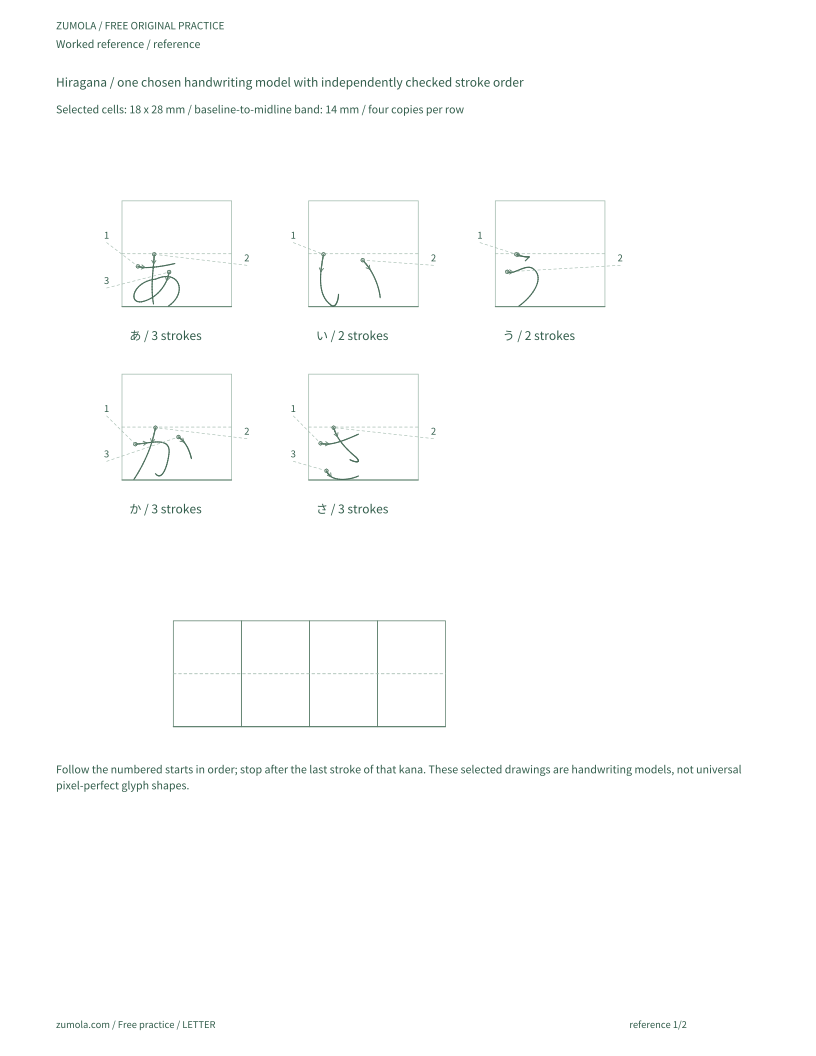
Because letter styles vary, the arrows describe the order and general direction rather than a single universal shape. A learner may produce a slightly different curve or proportion and still meet the rubric if the stroke order, start points, and relative placement are correct. The teacher should compare the learner's character to the model for order and proportion, not for pixel-perfect matching. In the selected reference set, あ, か and さ have three strokes, while い and う have two. These counts specify which last numbered stroke to follow.
- Trace stroke one from its start dot to its end, following the arrow.
- Trace the remaining numbered strokes in order and stop after the last one: two-stroke models end after stroke two; three-stroke models include stroke three.
- Copy the character into the first empty grid cell without the model.
- Repeat in the remaining grid cells, checking order and x-height after each copy.
- Compare the final copy to the model using the rubric criteria.
Using the grid rows for repeated practice
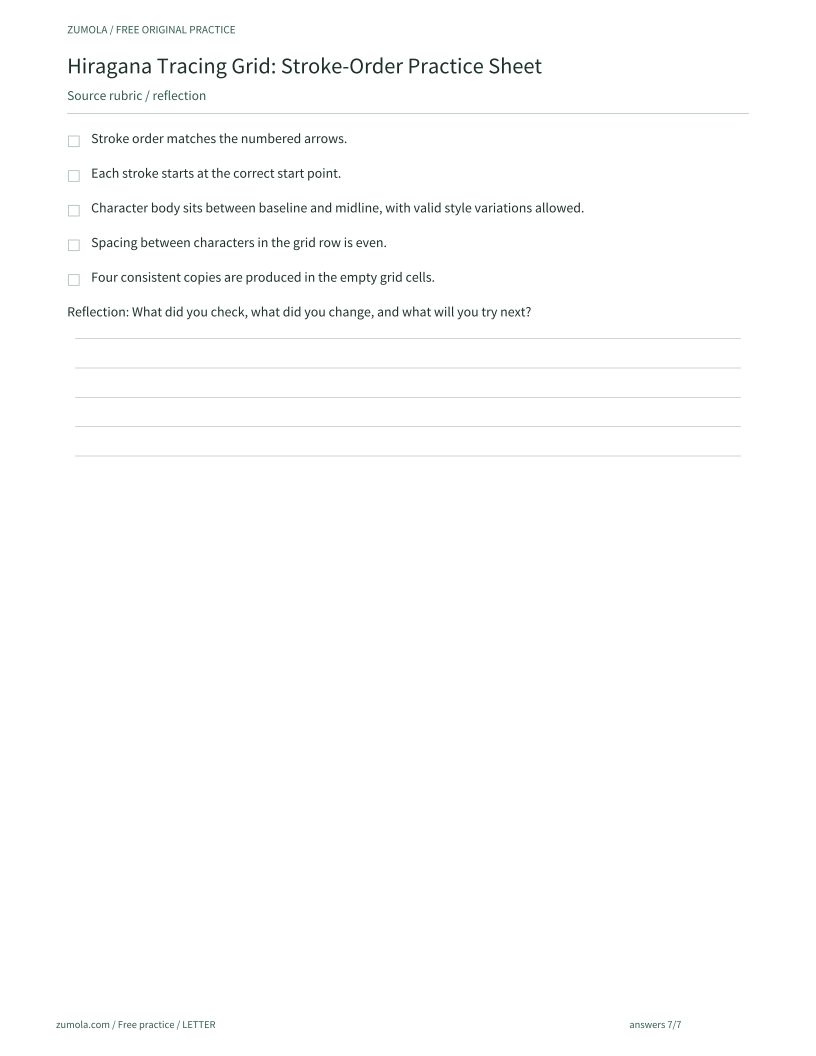
The grid rows are for repetition after tracing. Each row contains four empty cells of the same size as the tracing cell. Learners write one character per cell, keeping the body between baseline and midline. The repeated cells help build consistency in size and spacing without the gray model.
Spacing between characters should be even. Compare the actual empty gap between adjacent character outlines, not only the grid-cell widths. Keep the hypothetical measurements stated in the original practice questions unchanged; record measurements of your own printed sheet separately rather than replacing those question values.
- Write the character in the first empty cell, keeping the body between baseline and midline.
- Write the same character in the next three cells, matching size and spacing.
- Check that each stroke follows the numbered order from the tracing cell.
- Mark any cell where the body crosses the midline unintentionally and rewrite it.
- Repeat the row until four consistent copies are produced.
Assessment and valid alternatives
Assessment uses a rubric that rewards stroke order, start points, relative shape, x-height placement, and spacing. Because letter styles vary, the rubric does not require a single universal shape. A learner who uses a different but valid curve or proportion can still score full marks if the order and placement are correct.
The rubric is applied to each practice cell. Teachers should note that the x-height is baseline to midline and that strokes extending above the midline are acceptable when the character style requires them. The rubric should be shared with learners before practice so they know the criteria.
- Check stroke order against the numbered arrows.
- Check that each stroke starts at the correct start point.
- Check that the body sits between baseline and midline, allowing valid style variations.
- Check spacing between characters in the grid row.
- Record the rubric score and note any cell that needs rewriting.
Worked example
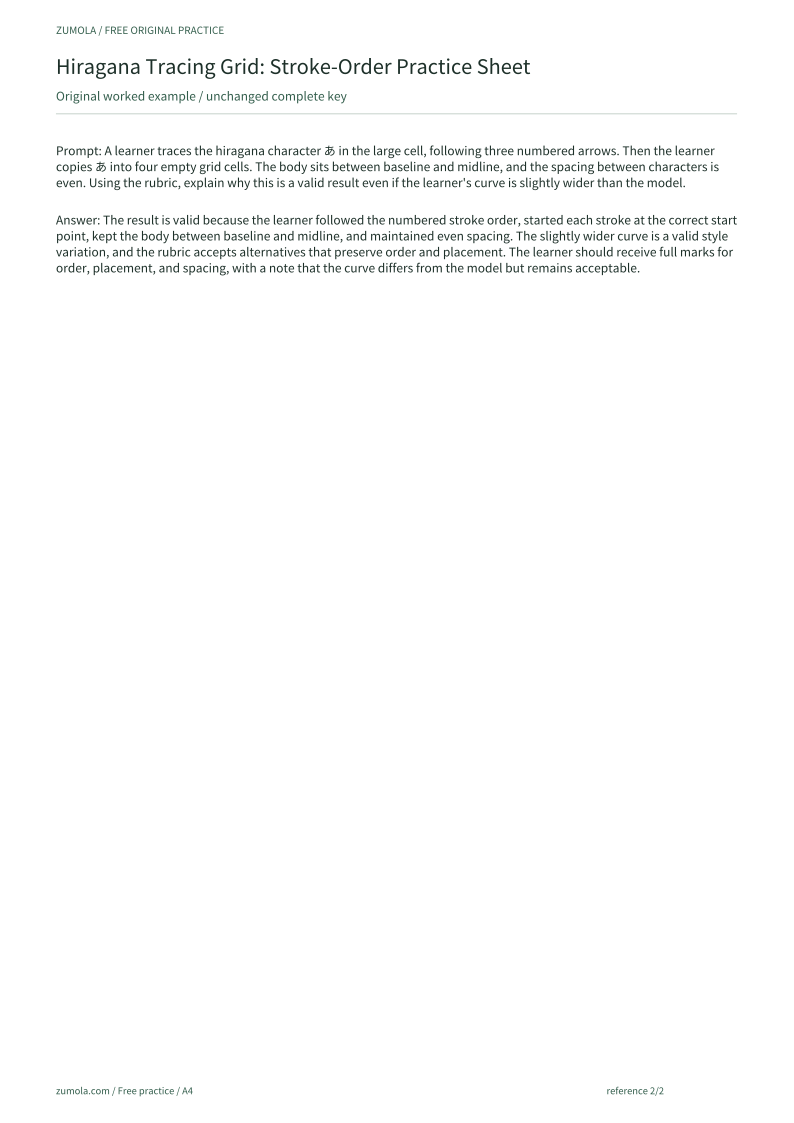
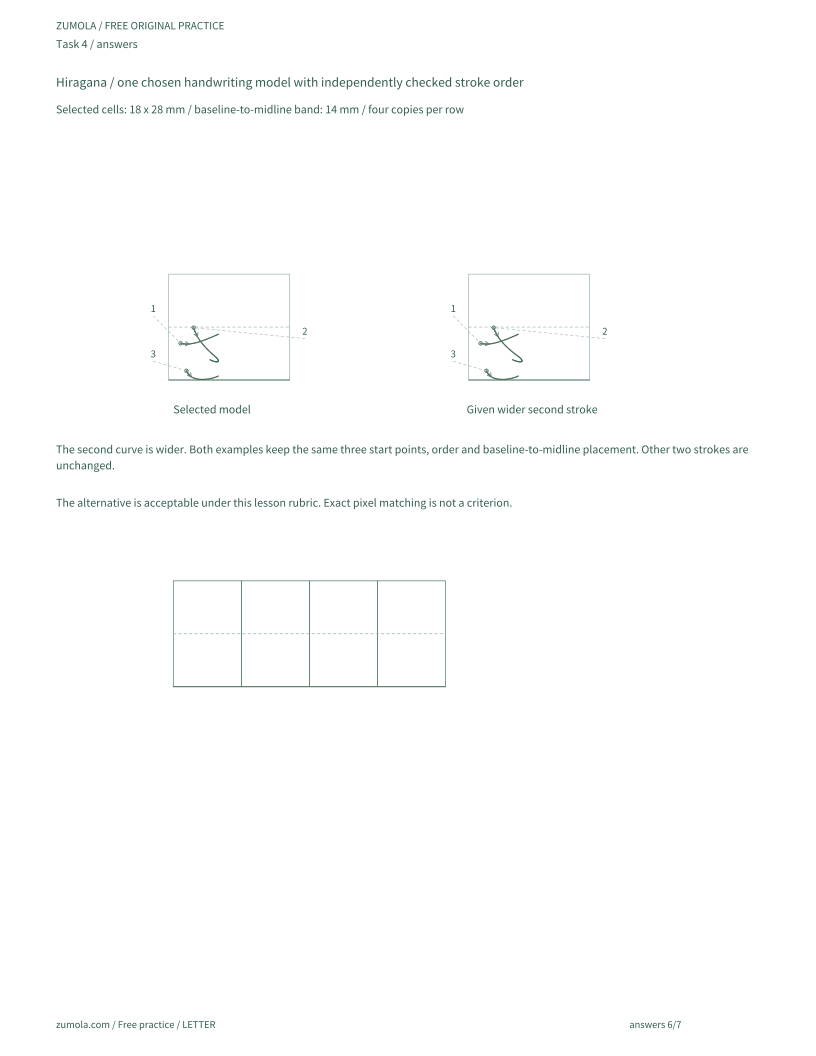
A learner traces the hiragana character あ in the large cell, following three numbered arrows. Then the learner copies あ into four empty grid cells. The body sits between baseline and midline, and the spacing between characters is even. Using the rubric, explain why this is a valid result even if the learner's curve is slightly wider than the model.
Worked answer
The result is valid because the learner followed the numbered stroke order, started each stroke at the correct start point, kept the body between baseline and midline, and maintained even spacing. The slightly wider curve is a valid style variation, and the rubric accepts alternatives that preserve order and placement. The learner should receive full marks for order, placement, and spacing, with a note that the curve differs from the model but remains acceptable.
Four practice exercises
Exercise 1
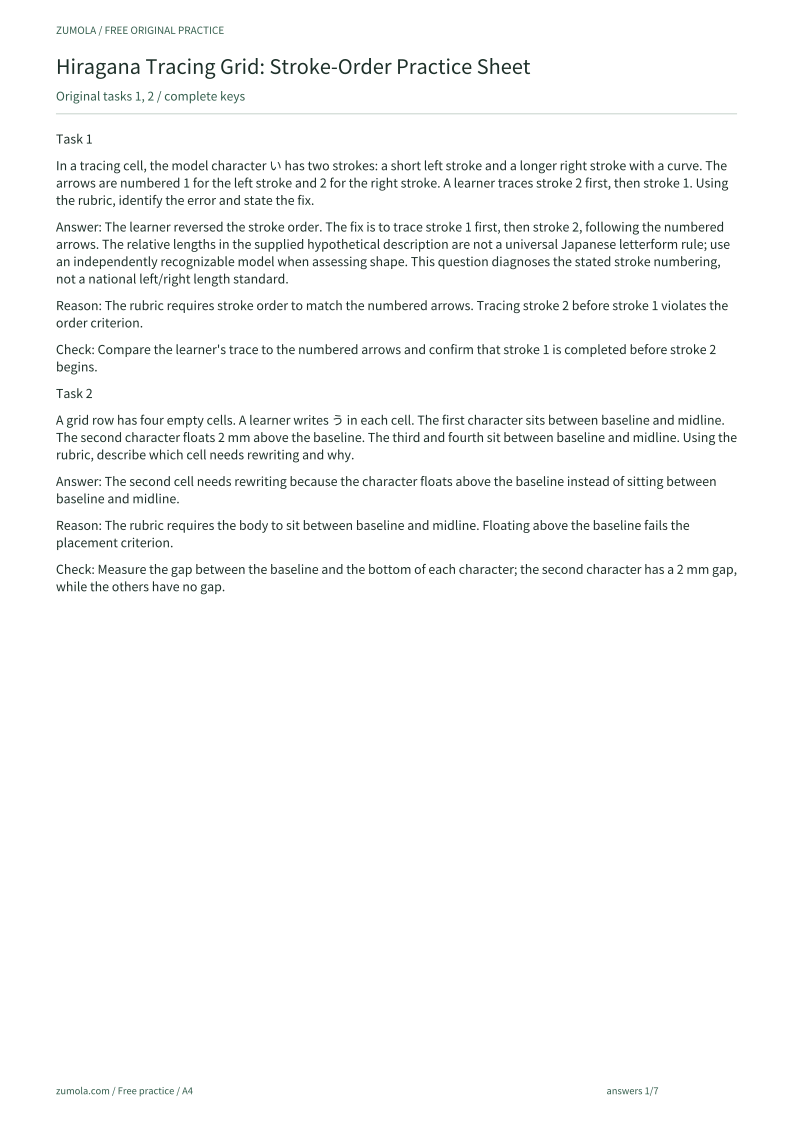
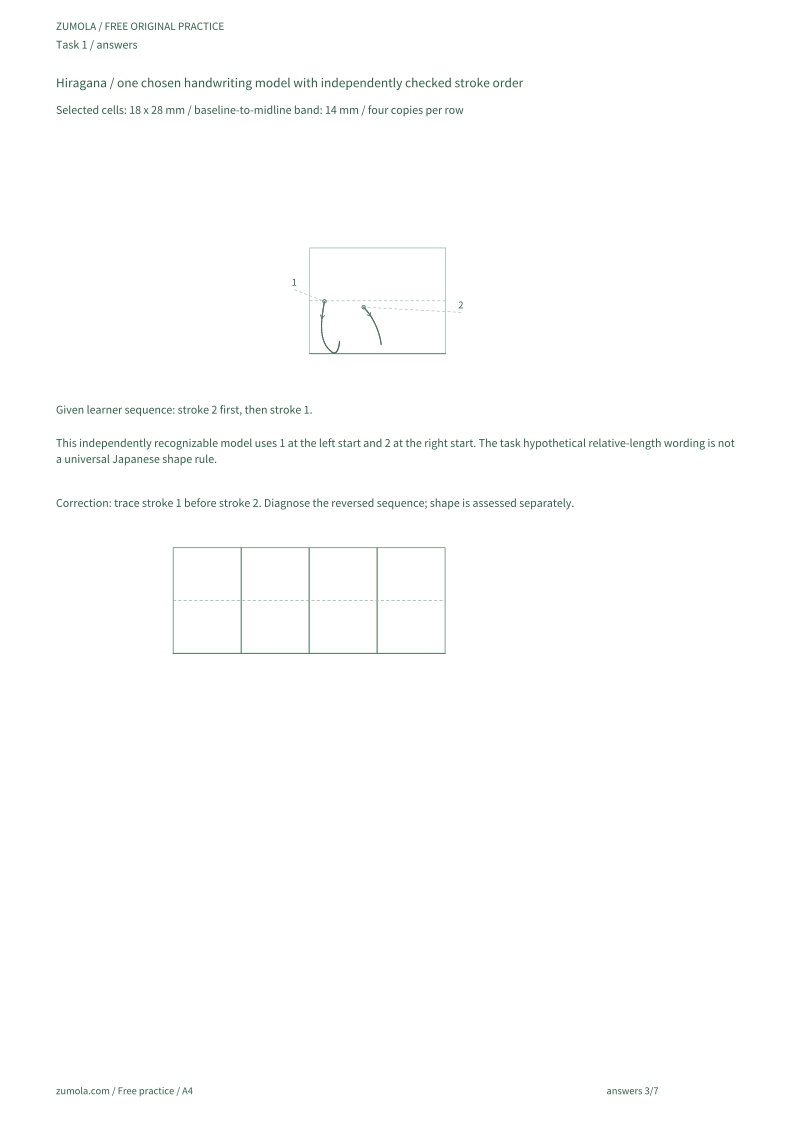
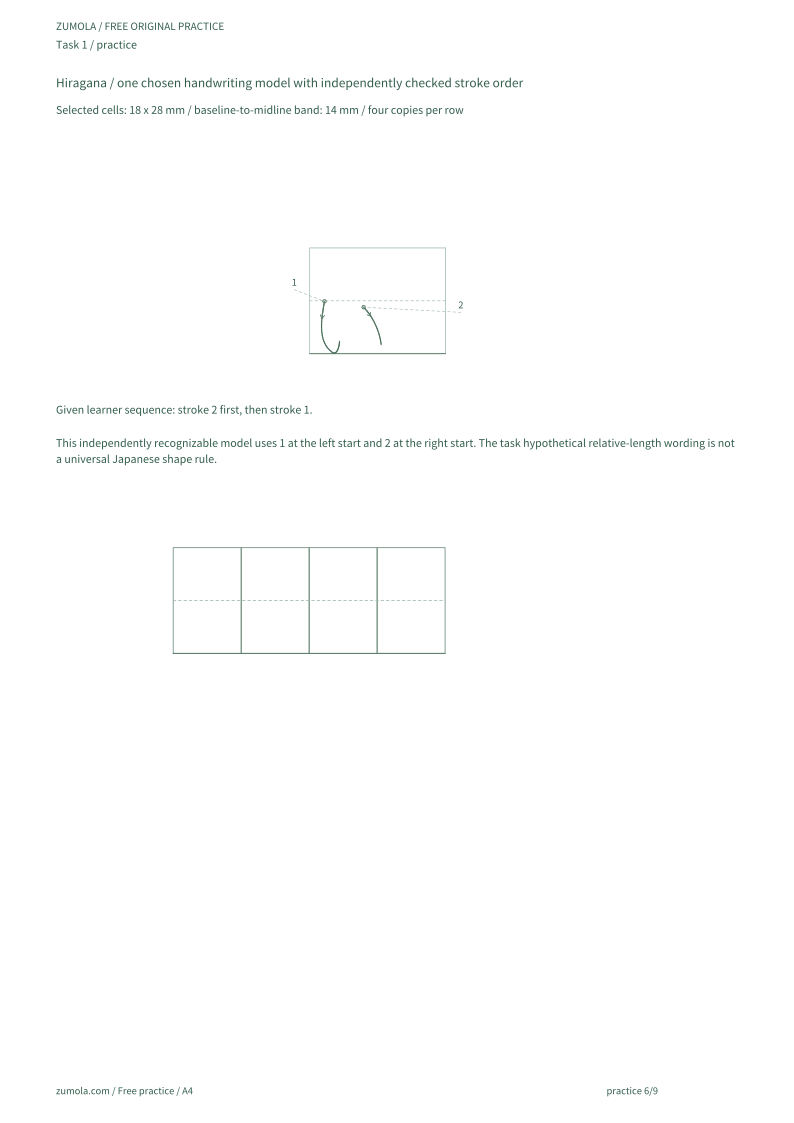
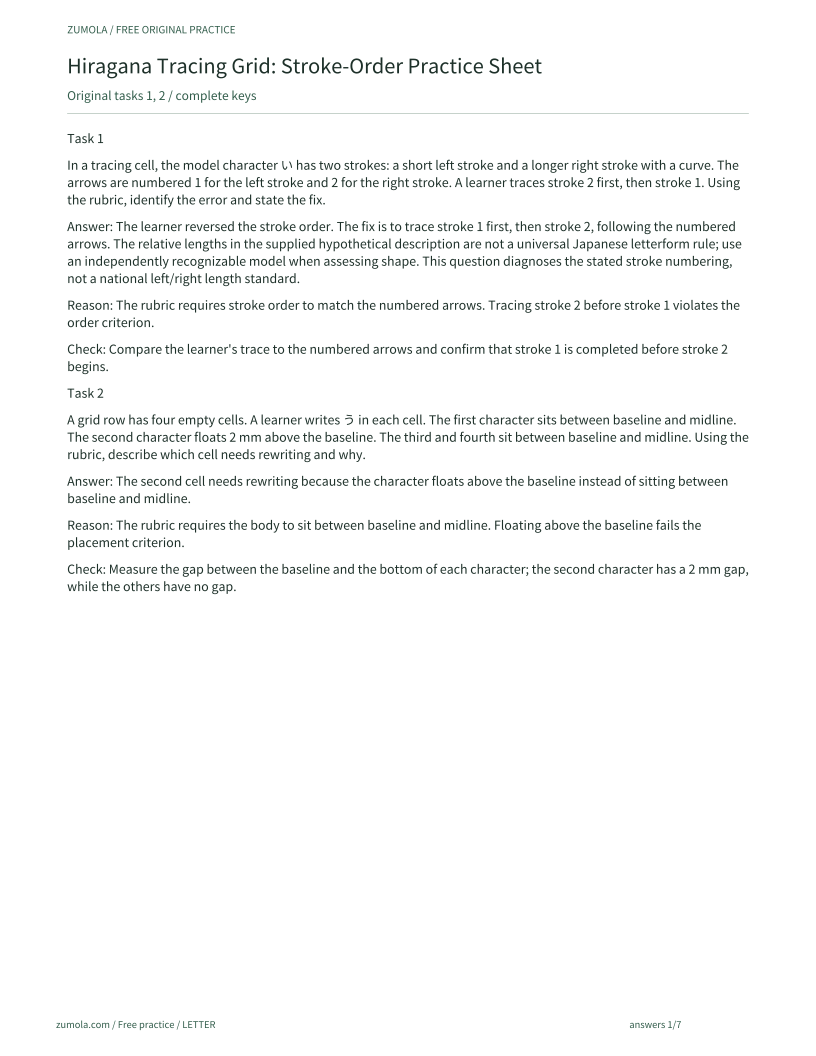
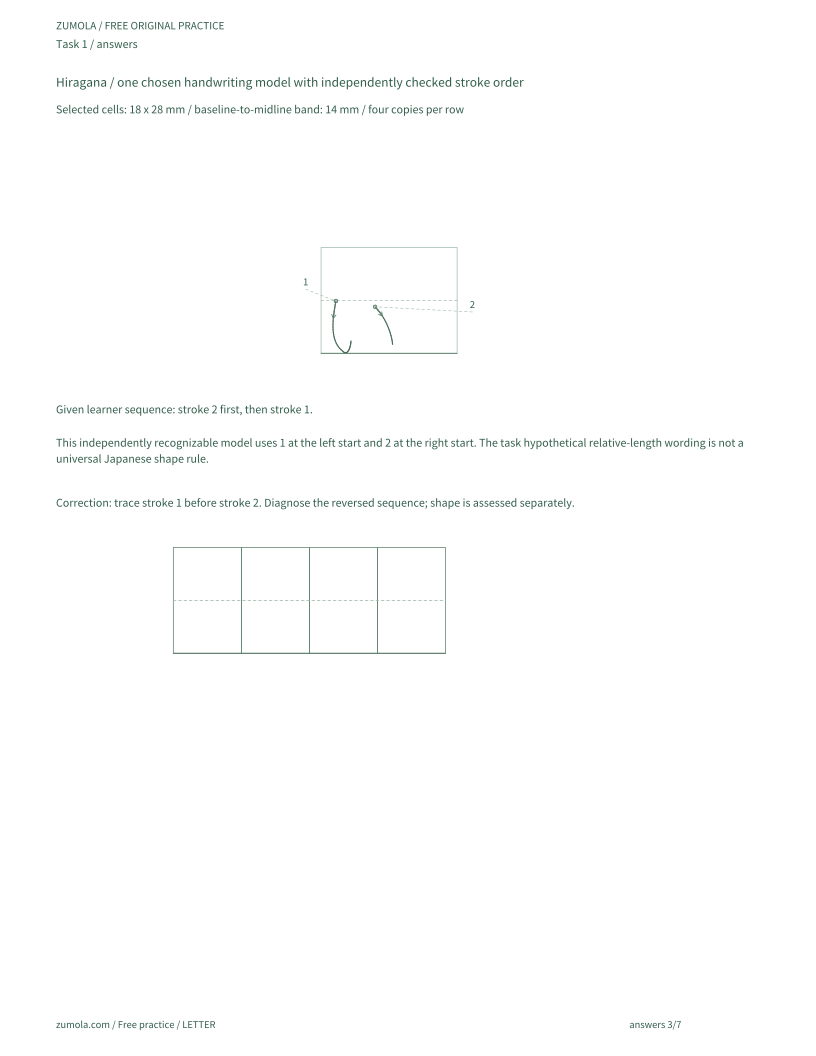
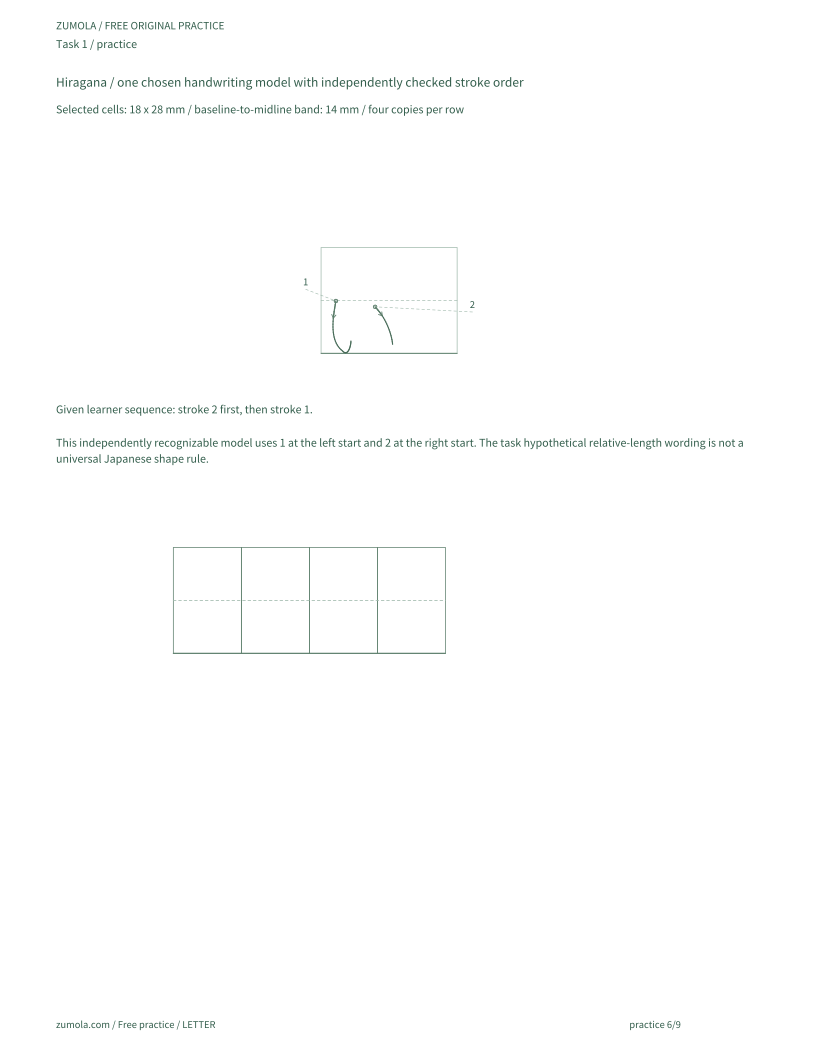
In a tracing cell, the model character い has two strokes: a short left stroke and a longer right stroke with a curve. The arrows are numbered 1 for the left stroke and 2 for the right stroke. A learner traces stroke 2 first, then stroke 1. Using the rubric, identify the error and state the fix.
Show answer and check
The learner reversed the stroke order. The fix is to trace stroke 1 first, then stroke 2, following the numbered arrows. The relative lengths in the supplied hypothetical description are not a universal Japanese letterform rule; use an independently recognizable model when assessing shape. This question diagnoses the stated stroke numbering, not a national left/right length standard.
Why: The rubric requires stroke order to match the numbered arrows. Tracing stroke 2 before stroke 1 violates the order criterion.
Check: Compare the learner's trace to the numbered arrows and confirm that stroke 1 is completed before stroke 2 begins.
Exercise 2
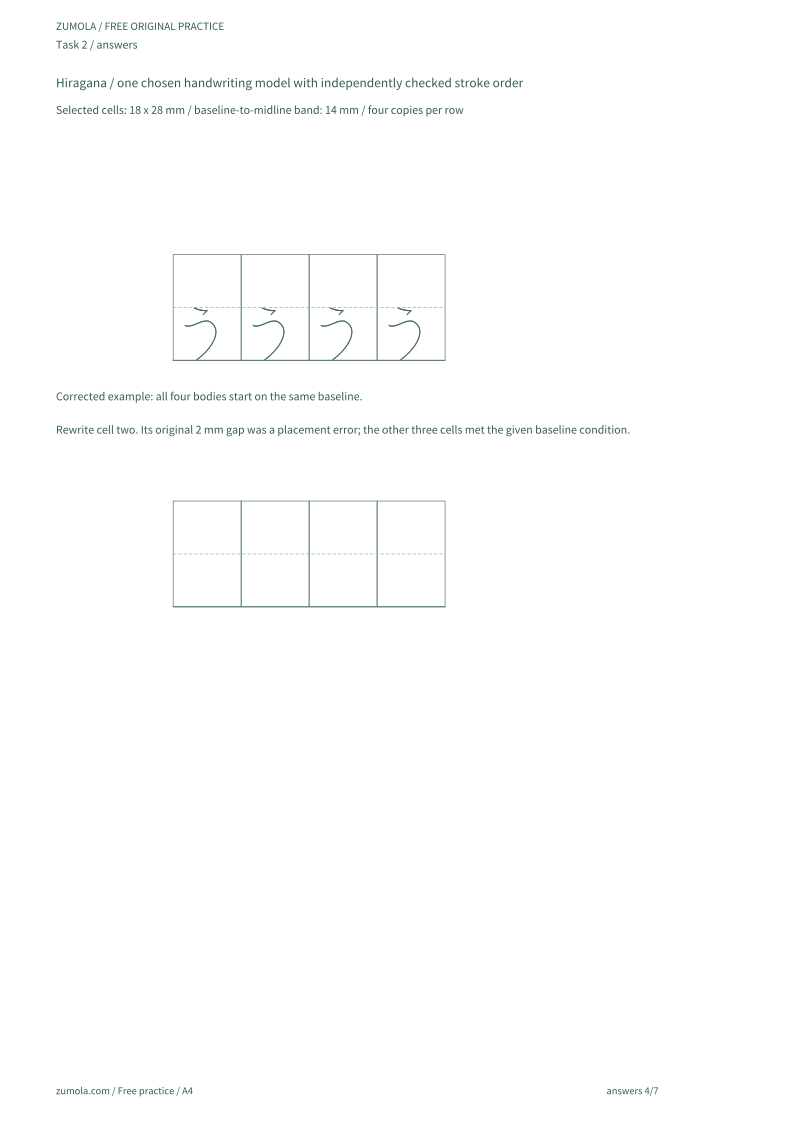
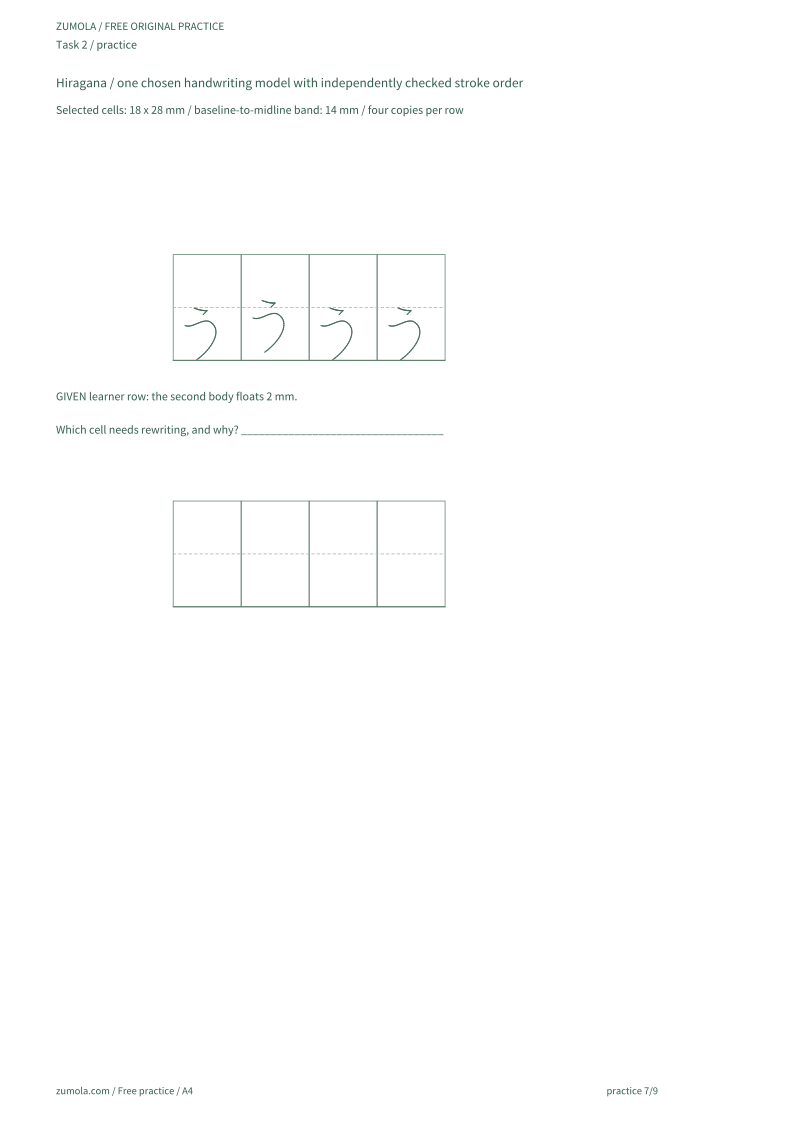
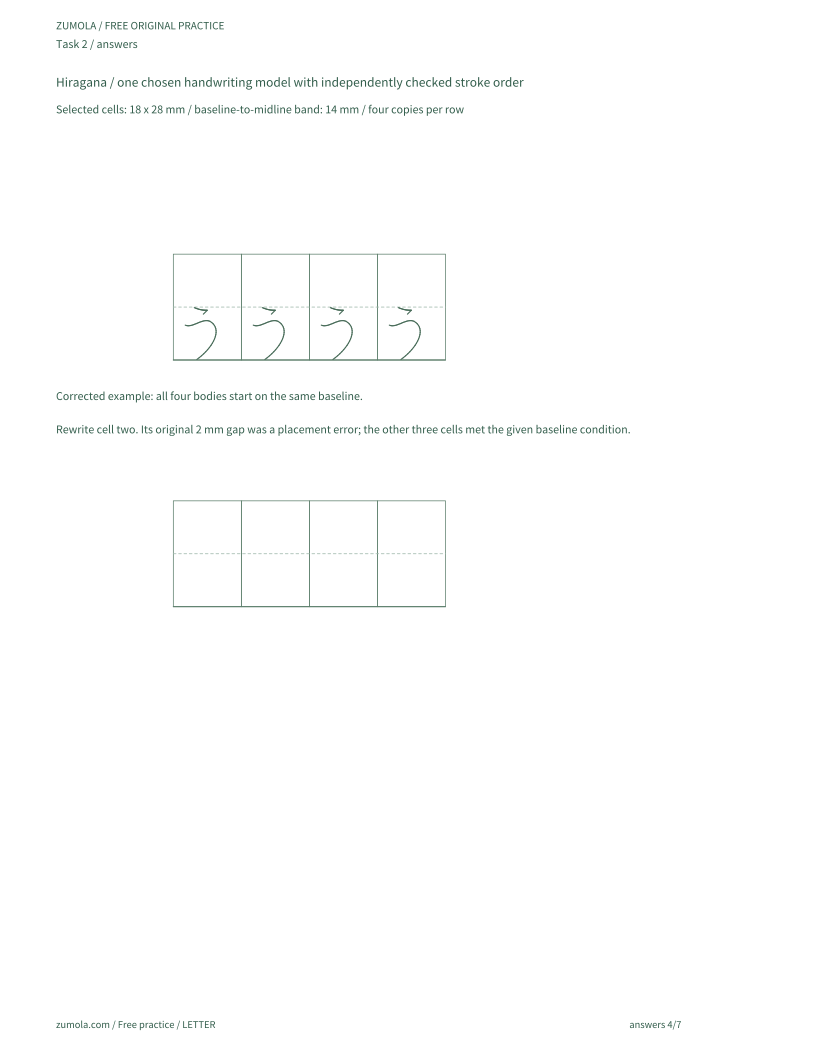
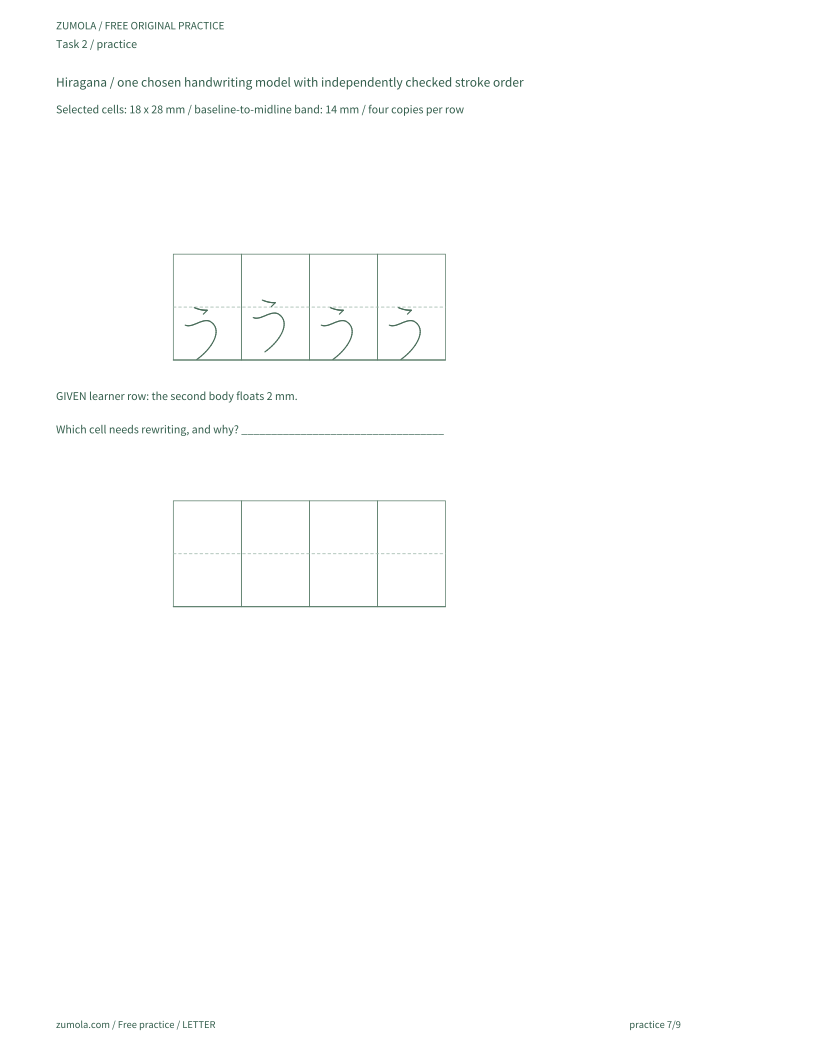
A grid row has four empty cells. A learner writes う in each cell. The first character sits between baseline and midline. The second character floats 2 mm above the baseline. The third and fourth sit between baseline and midline. Using the rubric, describe which cell needs rewriting and why.
Show answer and check
The second cell needs rewriting because the character floats above the baseline instead of sitting between baseline and midline.
Why: The rubric requires the body to sit between baseline and midline. Floating above the baseline fails the placement criterion.
Check: Measure the gap between the baseline and the bottom of each character; the second character has a 2 mm gap, while the others have no gap.
Exercise 3
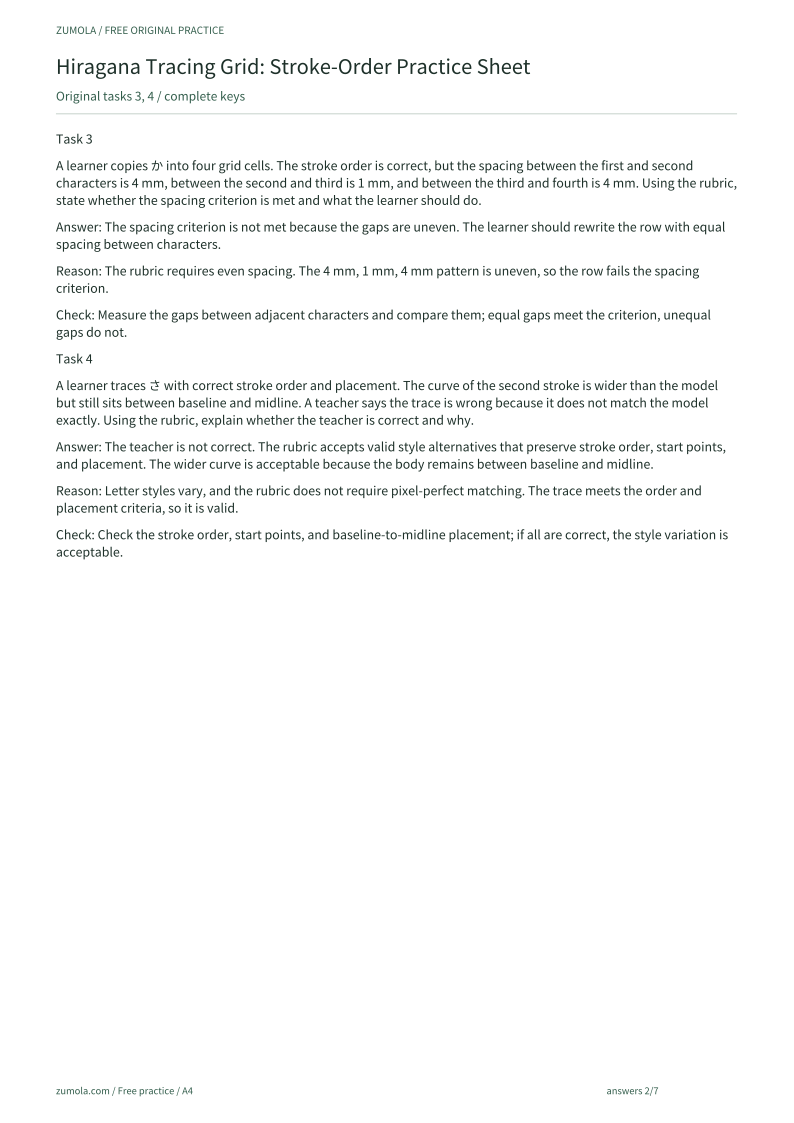
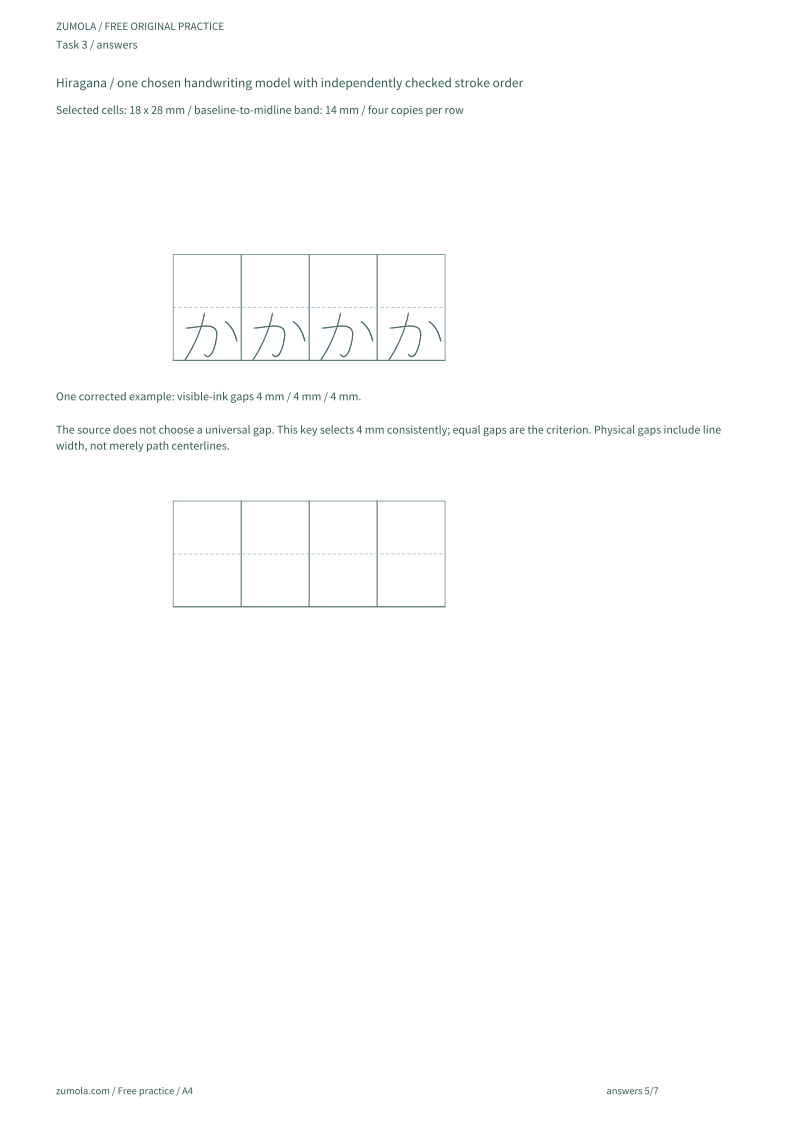
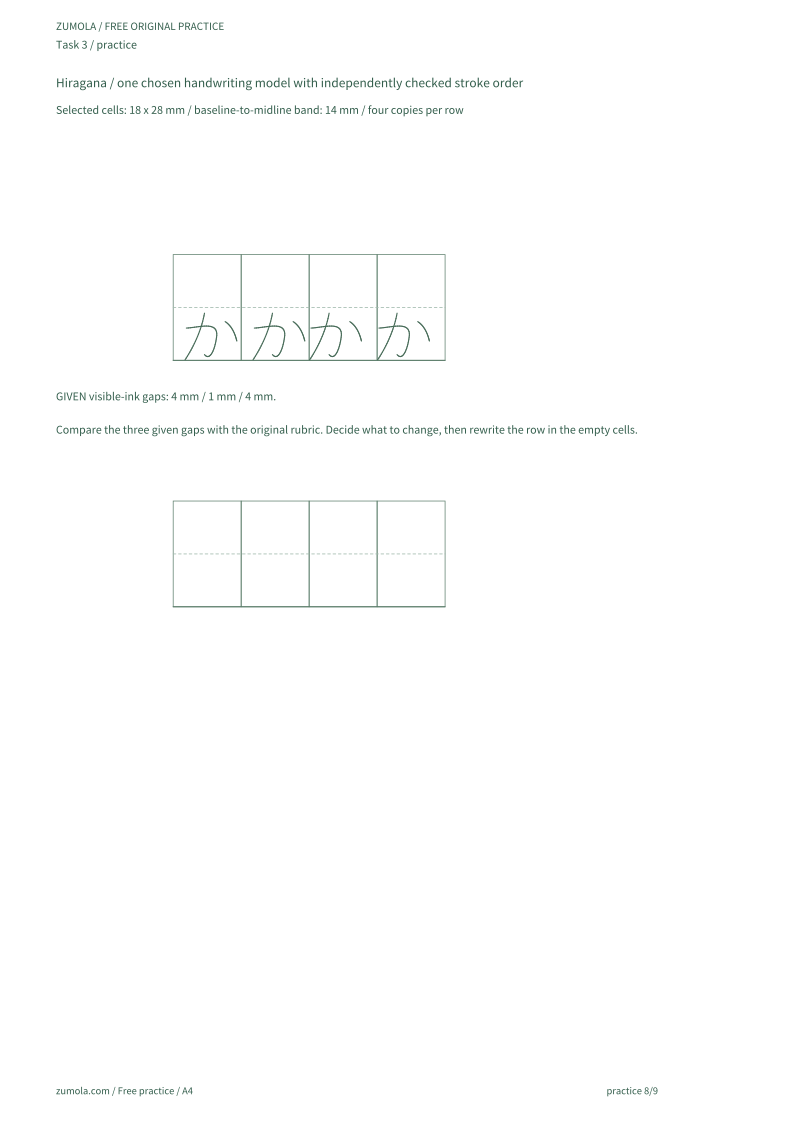
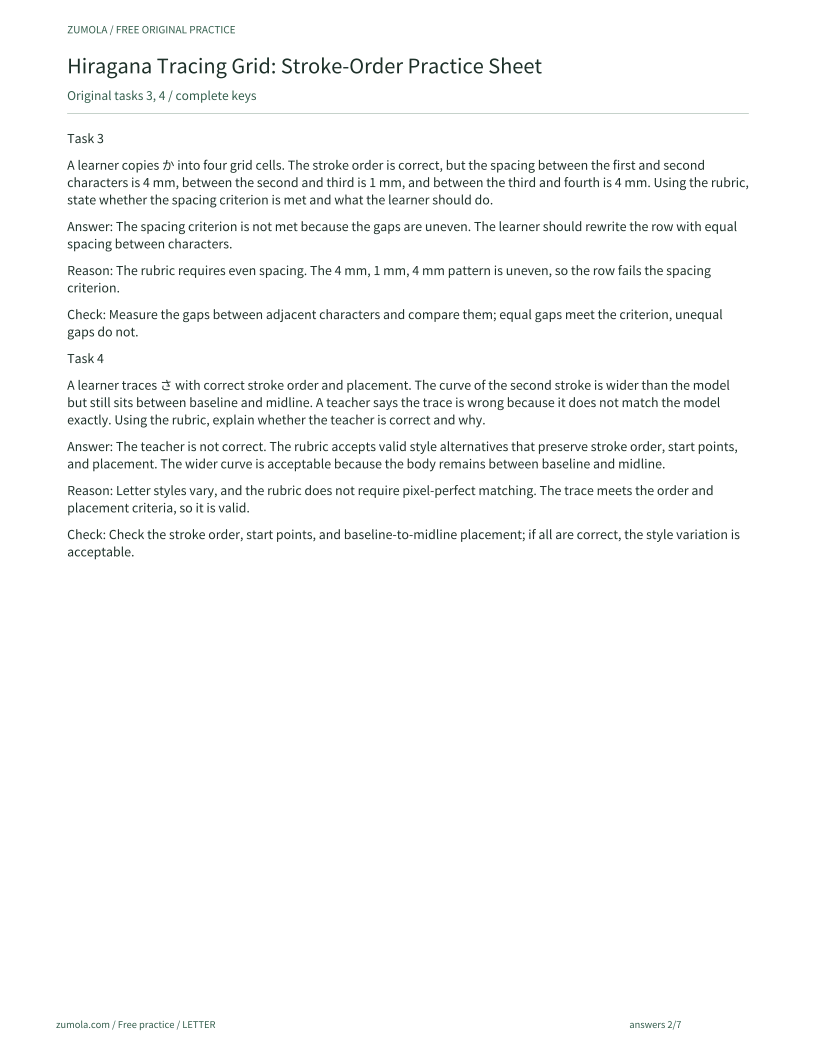
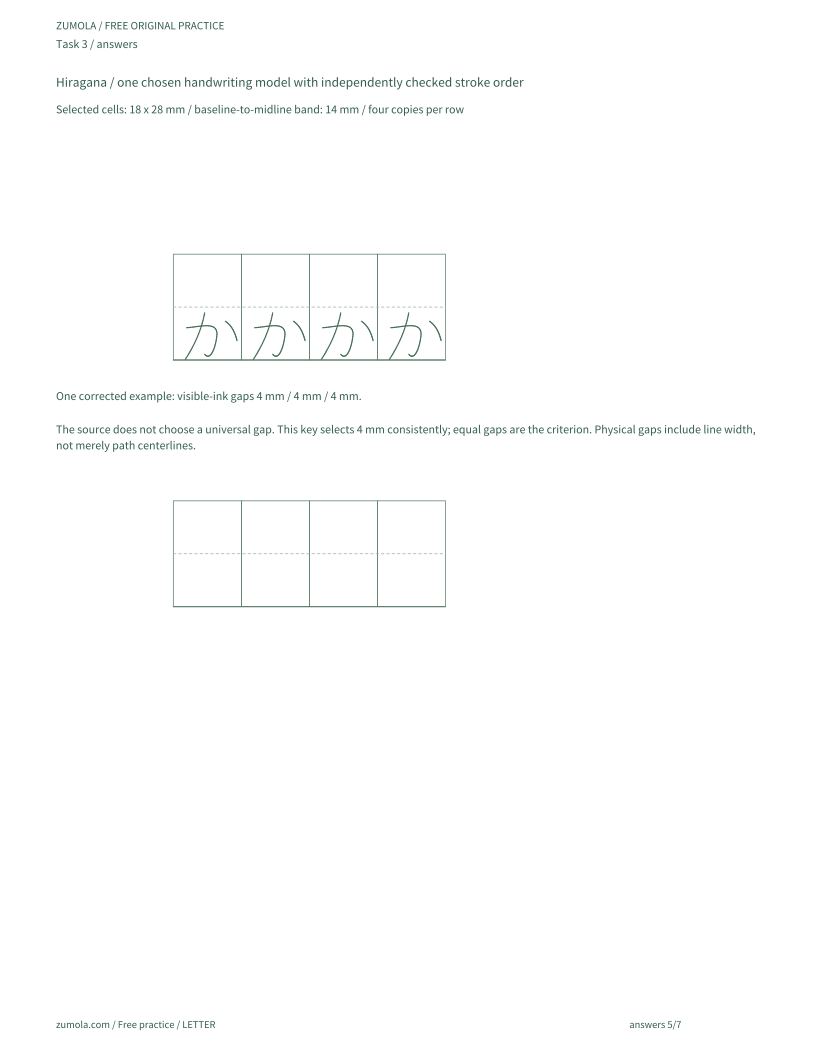
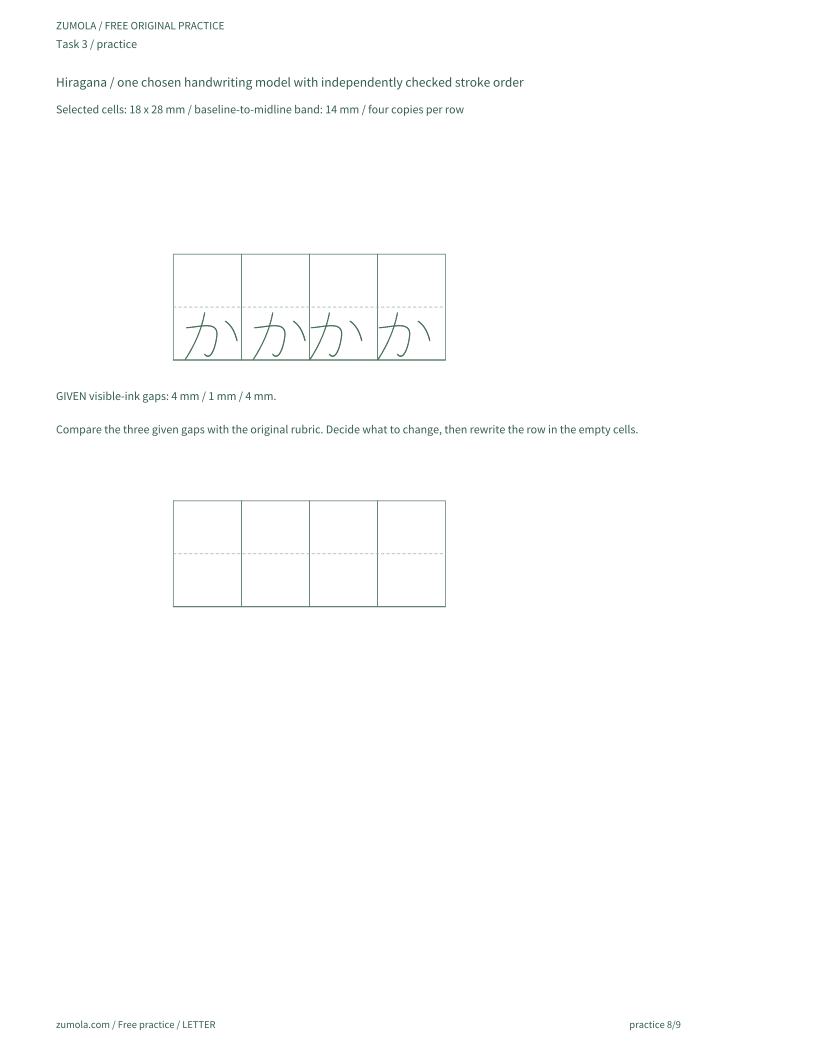
A learner copies か into four grid cells. The stroke order is correct, but the spacing between the first and second characters is 4 mm, between the second and third is 1 mm, and between the third and fourth is 4 mm. Using the rubric, state whether the spacing criterion is met and what the learner should do.
Show answer and check
The spacing criterion is not met because the gaps are uneven. The learner should rewrite the row with equal spacing between characters.
Why: The rubric requires even spacing. The 4 mm, 1 mm, 4 mm pattern is uneven, so the row fails the spacing criterion.
Check: Measure the gaps between adjacent characters and compare them; equal gaps meet the criterion, unequal gaps do not.
Exercise 4
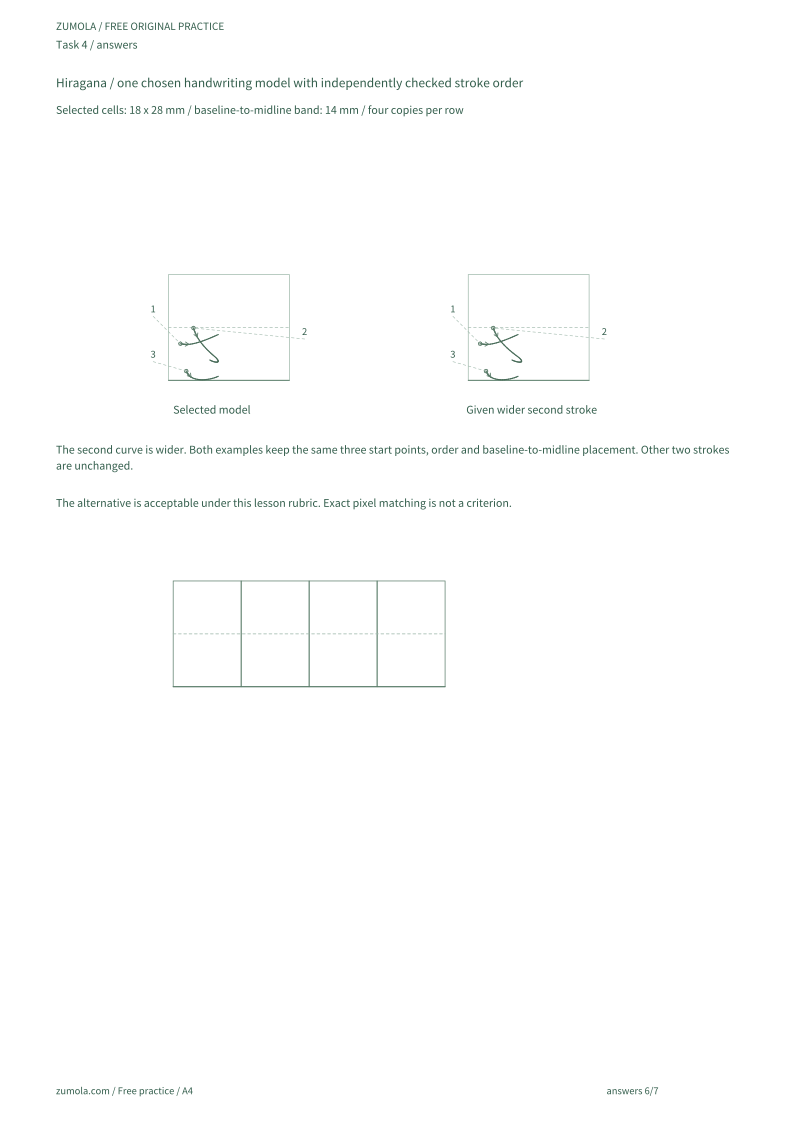
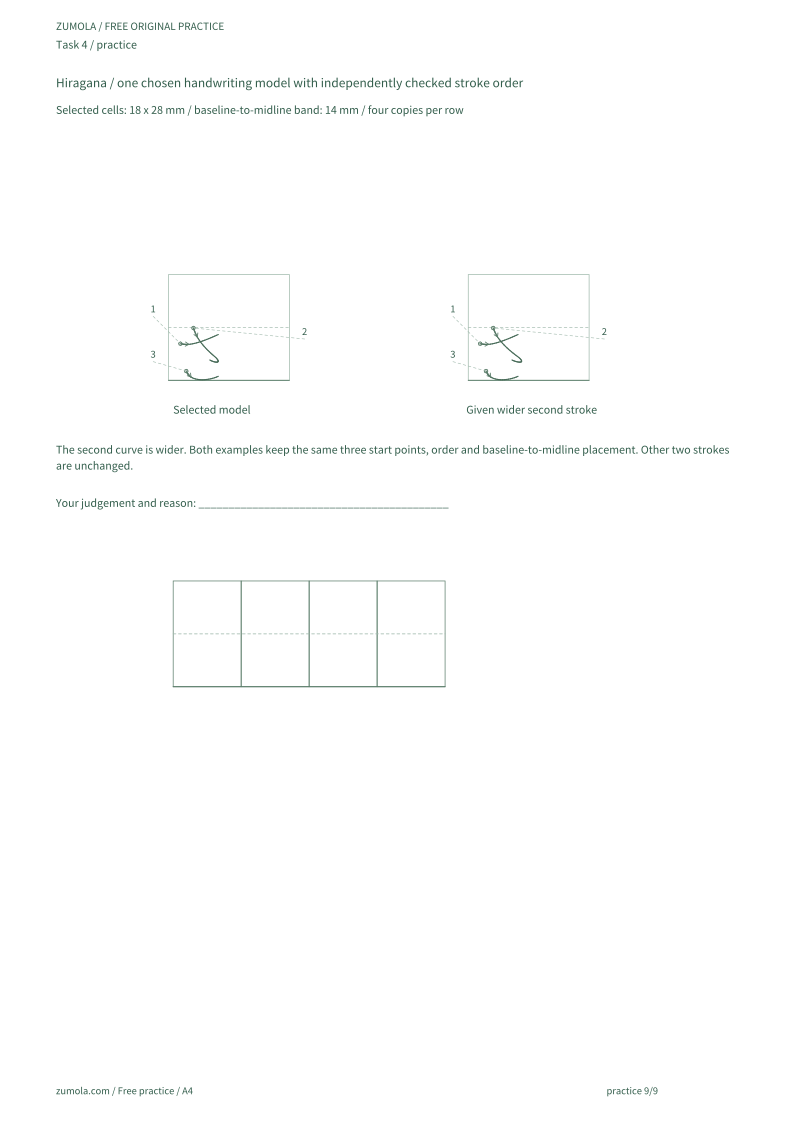
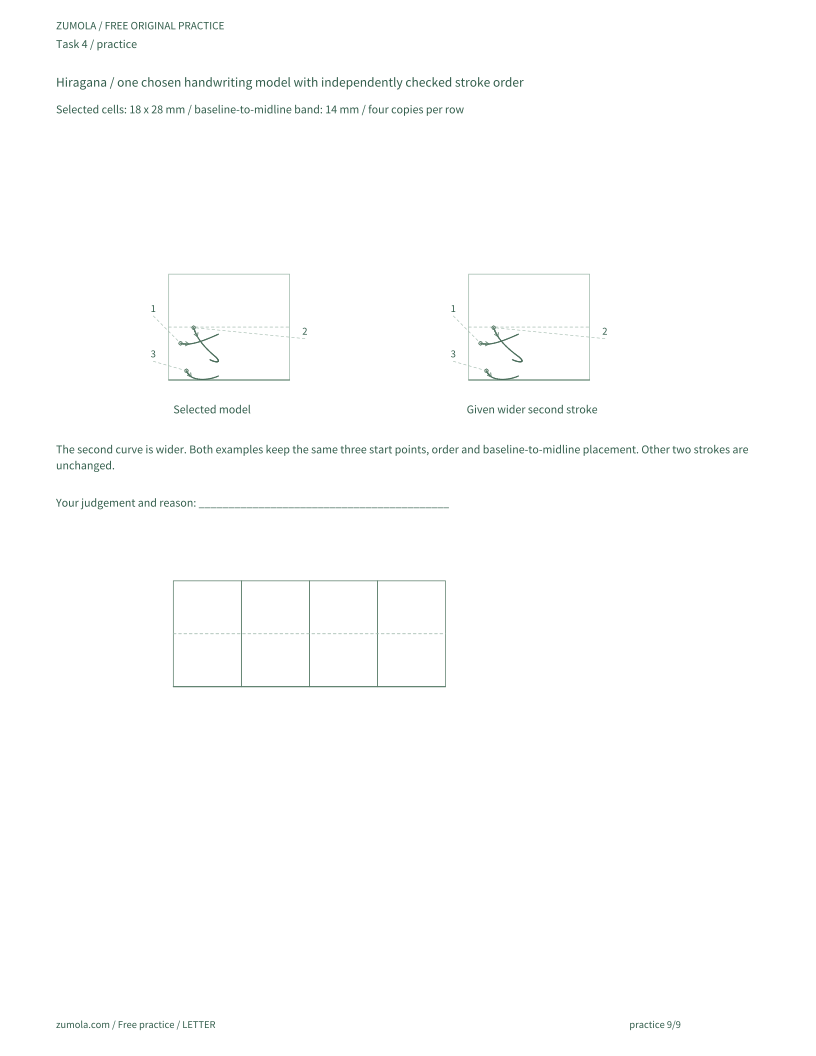
A learner traces さ with correct stroke order and placement. The curve of the second stroke is wider than the model but still sits between baseline and midline. A teacher says the trace is wrong because it does not match the model exactly. Using the rubric, explain whether the teacher is correct and why.
Show answer and check
The teacher is not correct. The rubric accepts valid style alternatives that preserve stroke order, start points, and placement. The wider curve is acceptable because the body remains between baseline and midline.
Why: Letter styles vary, and the rubric does not require pixel-perfect matching. The trace meets the order and placement criteria, so it is valid.
Check: Check the stroke order, start points, and baseline-to-midline placement; if all are correct, the style variation is acceptable.
Common mistakes
- Tracing the gray model without following the numbered stroke order. Cover the model after one trace and copy from memory using the numbers as a checklist.
- Writing the character body above the midline or floating above the baseline. Use the printed baseline and midline guides, and rewrite in a fresh cell if the character floats or crosses its body band; do not alter the printed guides to fit the error.
- Making characters uneven in size across the grid row. Compare character height and width against the printed cells, and compare the gaps between neighboring outlines separately. Rewrite an uneven copy or gap without changing the given question values.
- Treating one letter style as the only correct answer. Use the rubric to accept valid alternatives that preserve stroke order, start points, and relative placement.
Self-check rubric
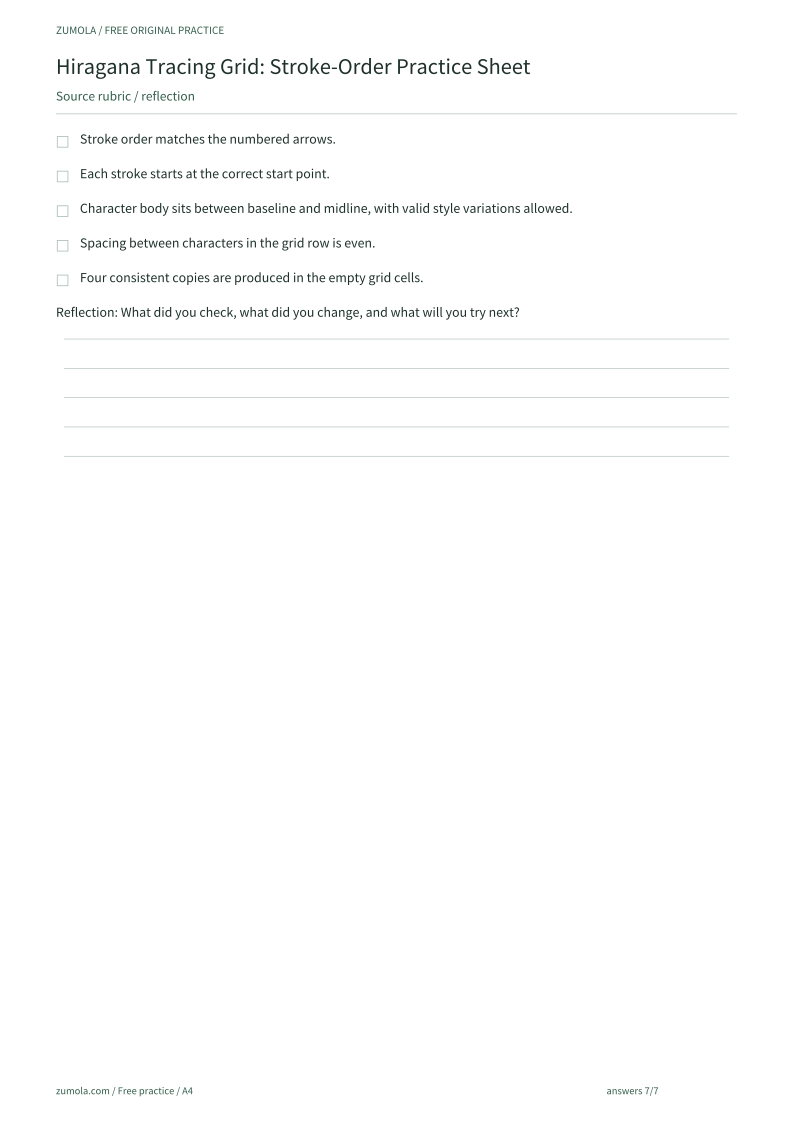
- Stroke order matches the numbered arrows.
- Each stroke starts at the correct start point.
- Character body sits between baseline and midline, with valid style variations allowed.
- Spacing between characters in the grid row is even.
- Four consistent copies are produced in the empty grid cells.
Questions and answers
What does x-height mean on this sheet?
X-height is the zone from the baseline to the midline. Hiragana bodies sit in this zone, though some strokes may extend above the midline when the character style requires it.
Are the stroke-order arrows the only correct way to draw a character?
The arrows show the standard stroke order and direction. Letter styles vary, so the rubric accepts valid alternatives that keep the same order, start points, and relative placement.
Can I use this sheet for kanji practice?
No. This sheet is for hiragana only and excludes kanji practice and genkouyoushi manuscript grids.
How many empty grid cells follow each tracing cell?
This worksheet convention uses four empty copy cells per selected model, matching the four-copy tasks and rubric. A separate personal practice sheet may use a different count, but that does not change these exercise rows.
Free printable downloads
Choose a paper size. Practice sheets and answer keys are separate. Download every file free, without registration.
This standard pack covers the four original exercises, blank work areas, complete keys and necessary figures. Additional extension sets described in the lesson are outside this download.
PDF bundles
Individual SVG pages
Reference-page preview