Free original lessons
Mexican Train Score Sheet
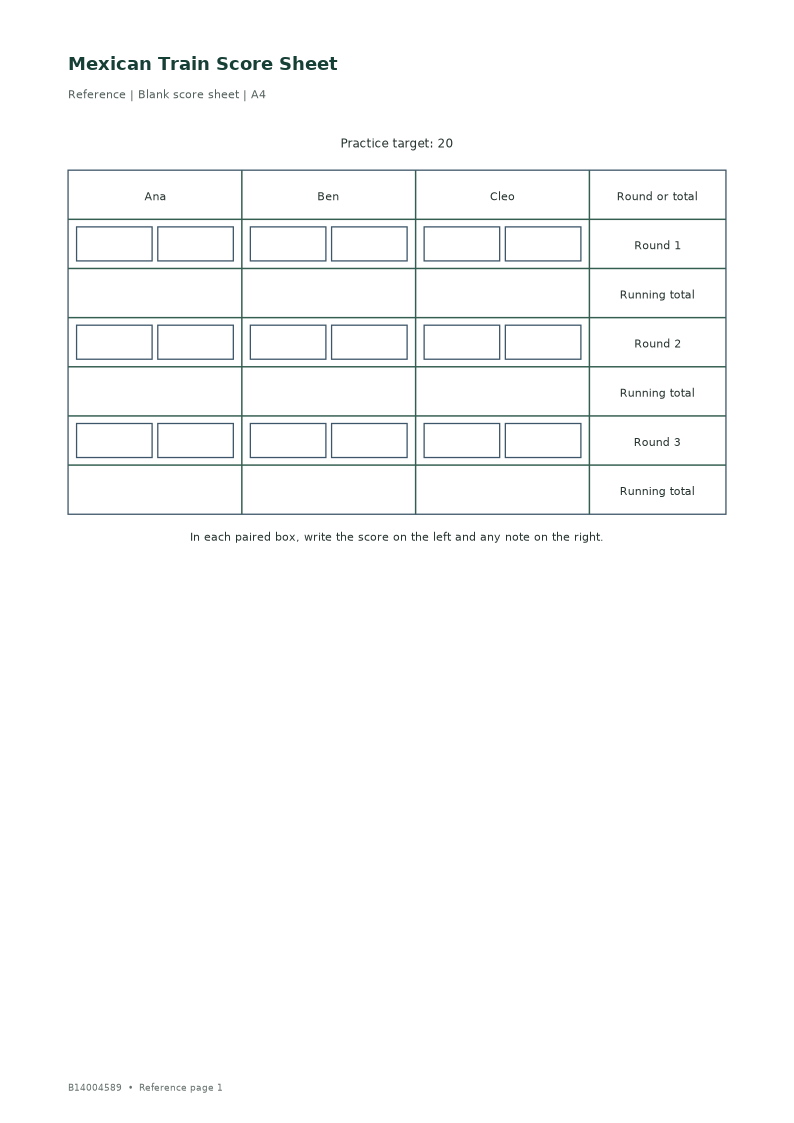
Record the pips left in each player's hand at the end of a round. Use one row per round and one column per player. The small boxes in each player cell hold the round score and an optional note. The target in these exercises is a classroom stopping rule.
Letter & A4
PDF & SVG
How the scorecard is laid out
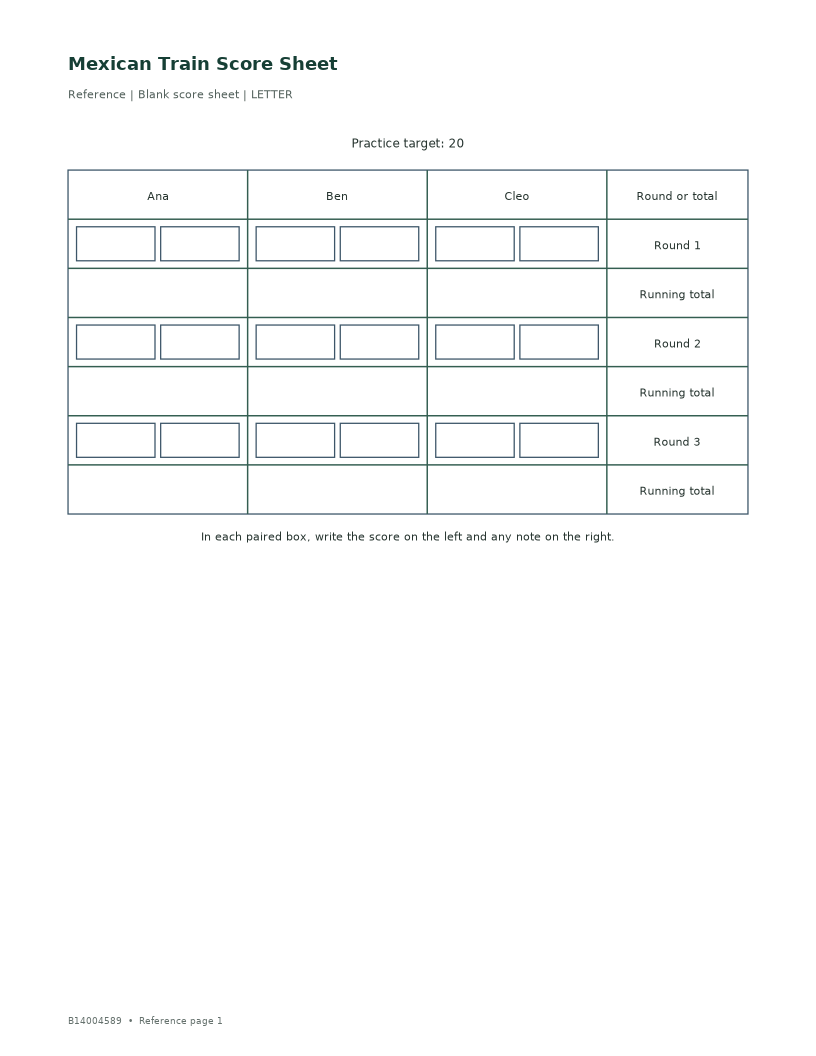
The header row names the players, one column each, with a final column for the round number. Below the header, each round is one row. Inside each player's cell is a train line: a small set of boxes drawn left to right, one box per scoring entry, so a player's round score sits in the first box and any note or correction sits in the next.
A running-total row sits at the bottom of the sheet. After each round you add that round's score to the player's previous running total and write the new total in the running-total row for that player.
How to score a round
At the end of a round, each player counts the pips on the dominoes still in their hand. Write that number in the first box of that player's train line for the round. A player who played all their dominoes scores zero for the round.
Add each round score to the player's previous total. In exercises with a target, stop after the first round in which anyone meets or exceeds it. Compare the running totals then. The lowest wins, with equal lowest totals tied.
Worked example
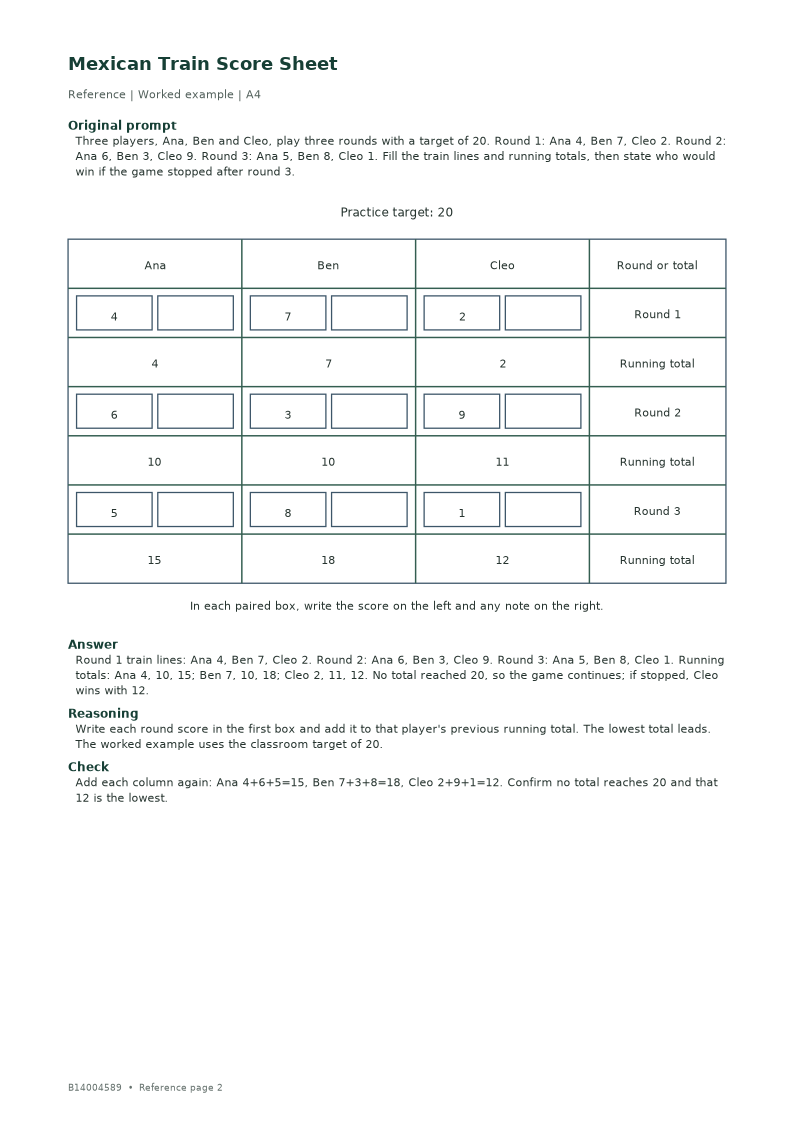
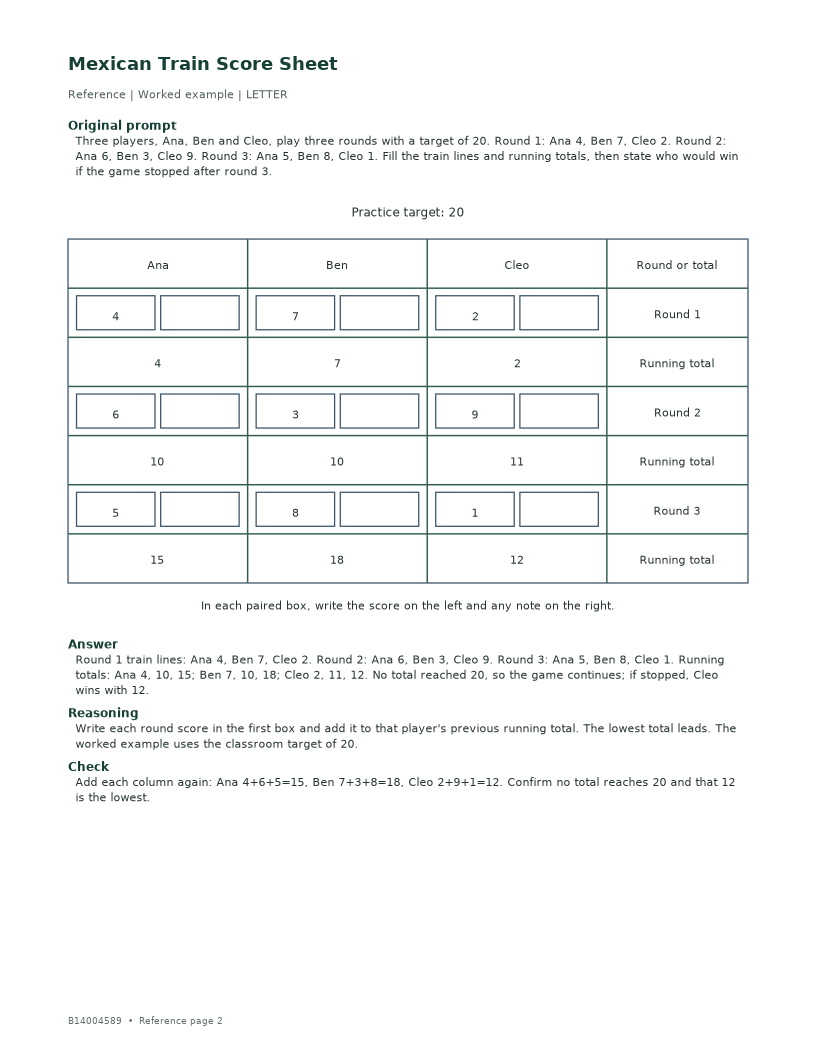
Three players, Ana, Ben and Cleo, play three rounds with a target of 20. Round 1: Ana 4, Ben 7, Cleo 2. Round 2: Ana 6, Ben 3, Cleo 9. Round 3: Ana 5, Ben 8, Cleo 1.
Running totals after round 1: Ana 4, Ben 7, Cleo 2. After round 2: Ana 10, Ben 10, Cleo 11. After round 3: Ana 15, Ben 18, Cleo 12. No total reached 20, so the game would continue; if it had stopped here, Cleo would win with 12.
Practice tasks
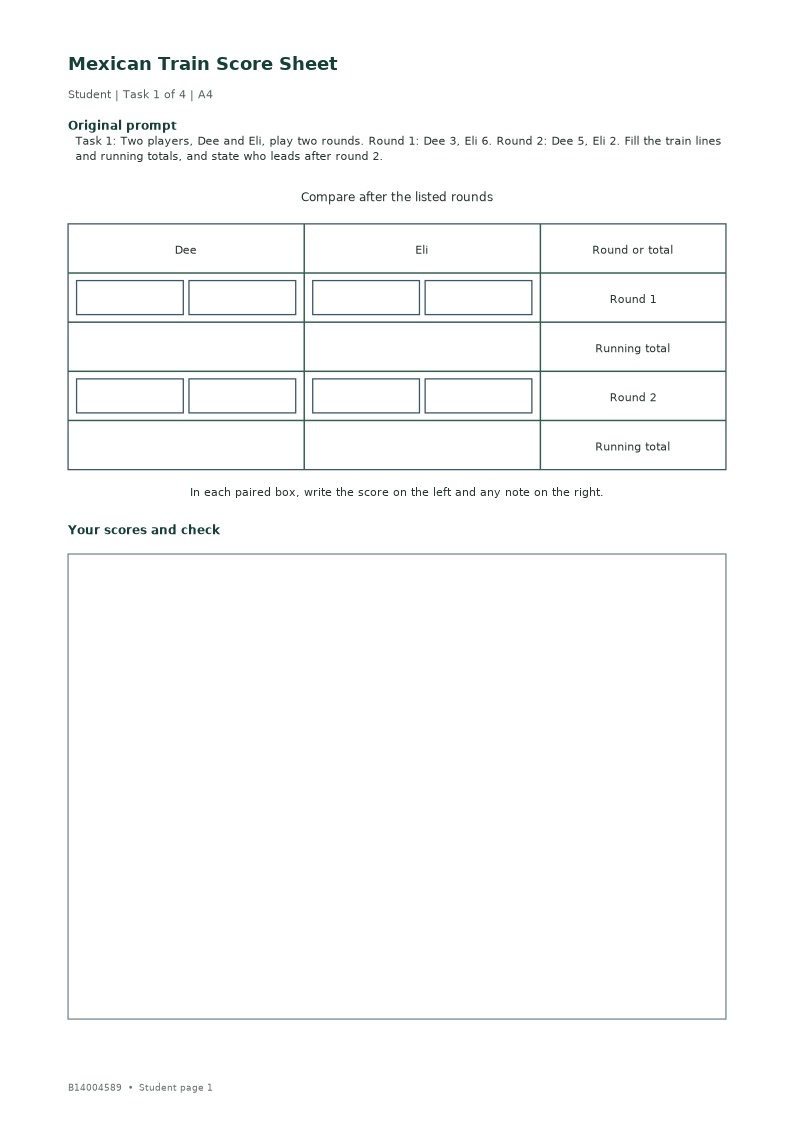
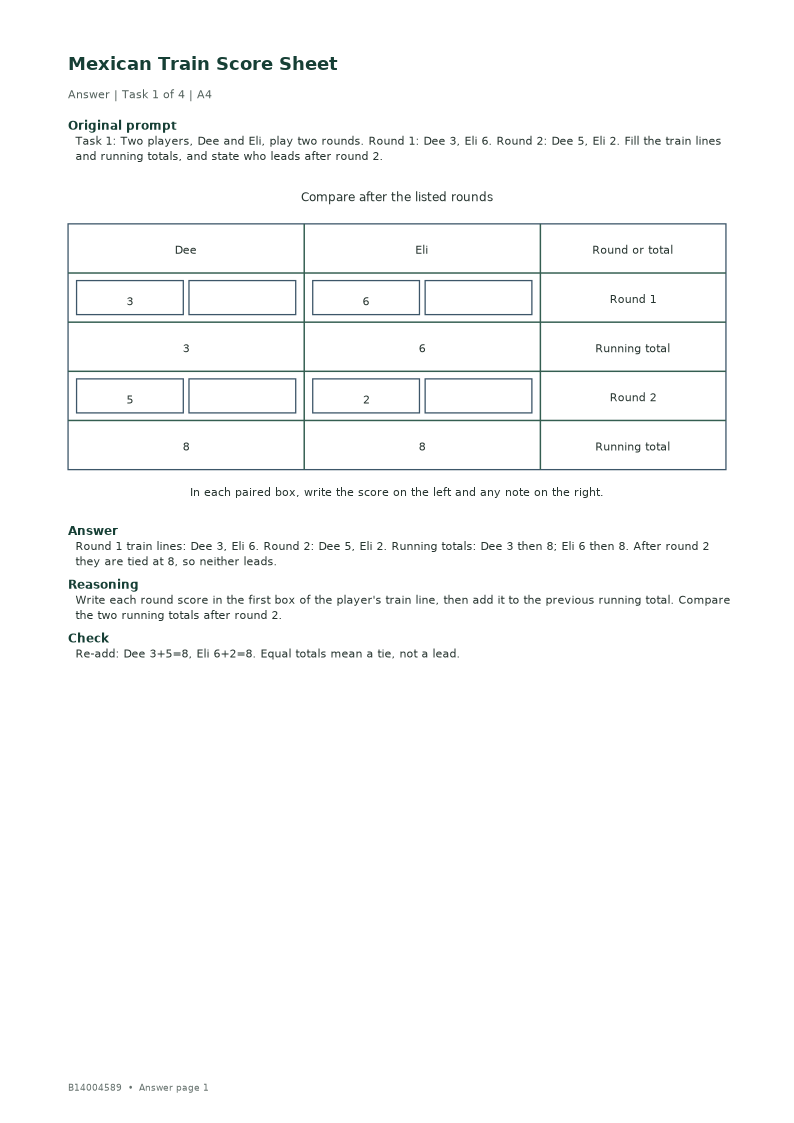
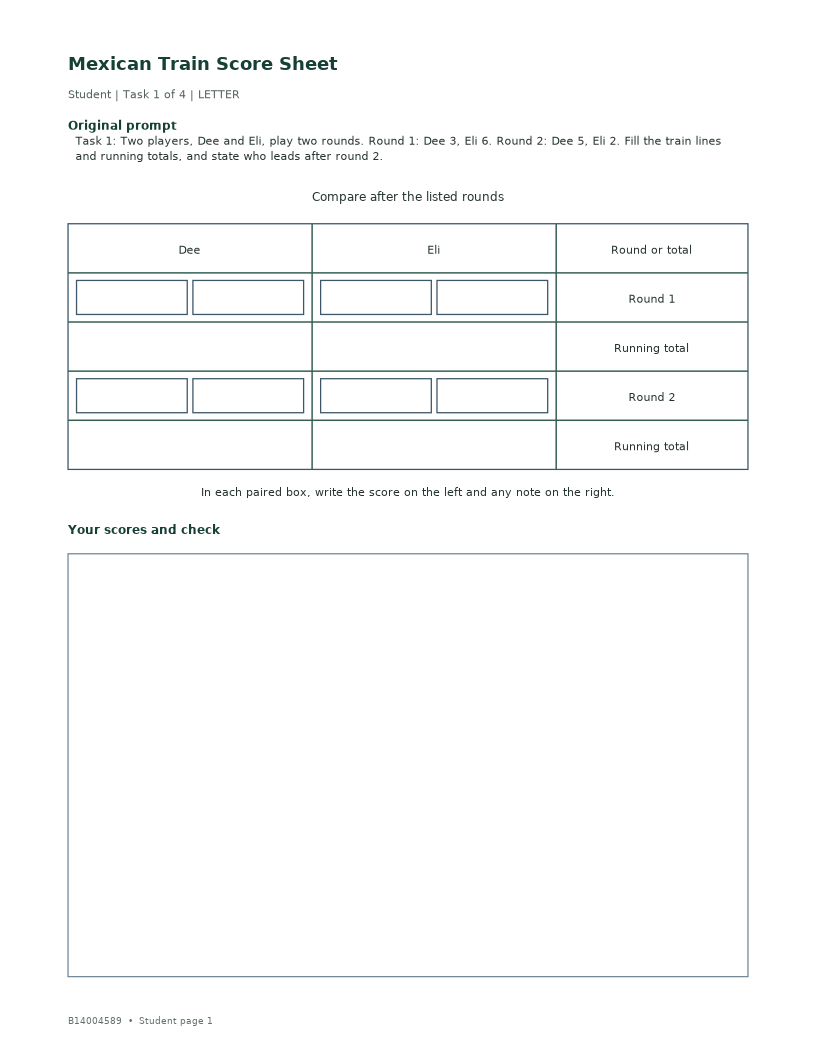
Task 1: Two players, Dee and Eli, play two rounds. Round 1: Dee 3, Eli 6. Round 2: Dee 5, Eli 2. Fill the train lines and running totals, and state who leads after round 2.
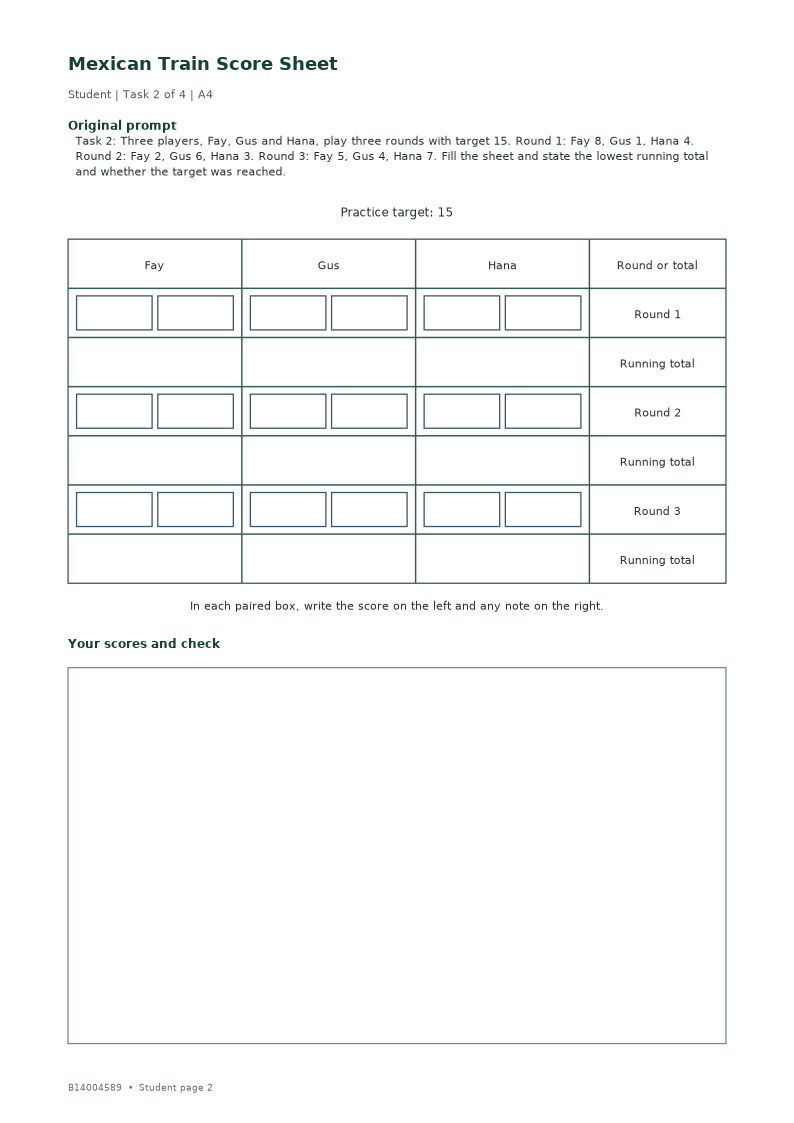
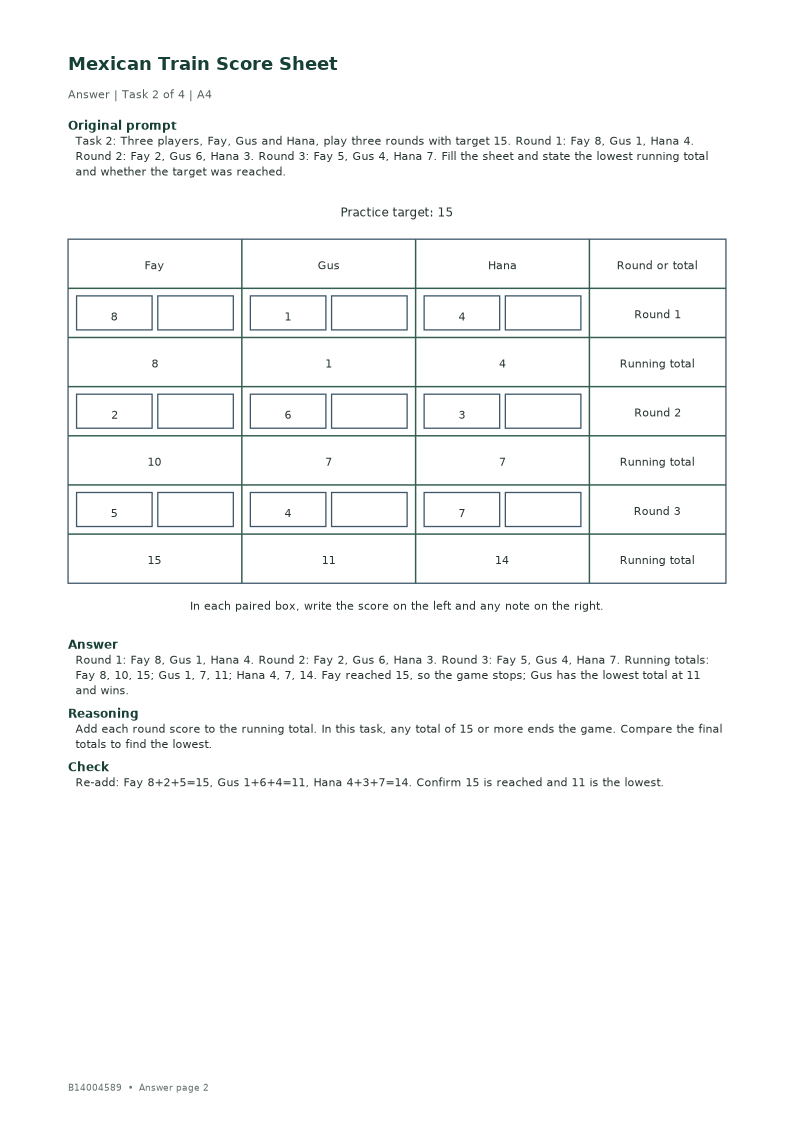
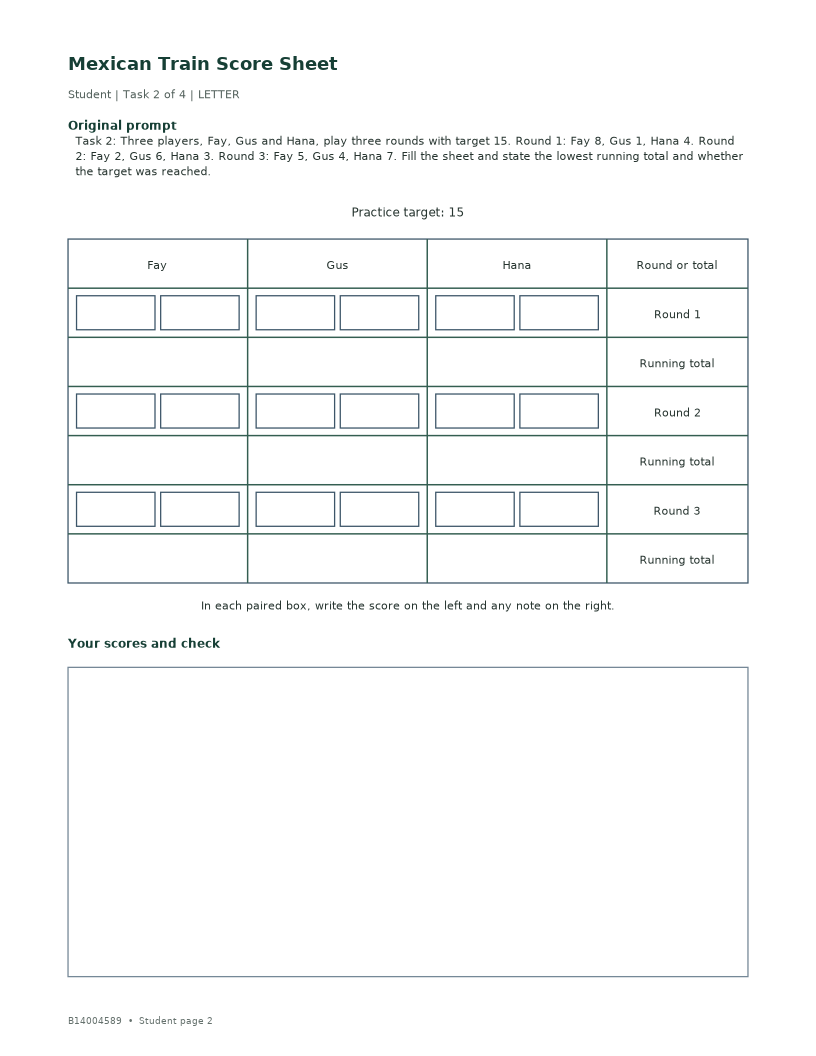
Task 2: Three players, Fay, Gus and Hana, play three rounds with target 15. Round 1: Fay 8, Gus 1, Hana 4. Round 2: Fay 2, Gus 6, Hana 3. Round 3: Fay 5, Gus 4, Hana 7. Fill the sheet and state the lowest running total and whether the target was reached.
Download the complete resource pack
All individual SVG pages (20)
- A4 reference page 1
- A4 reference page 2
- A4 student page 1
- A4 student page 2
- A4 student page 3
- A4 student page 4
- A4 answer page 1
- A4 answer page 2
- A4 answer page 3
- A4 answer page 4
- LETTER reference page 1
- LETTER reference page 2
- LETTER student page 1
- LETTER student page 2
- LETTER student page 3
- LETTER student page 4
- LETTER answer page 1
- LETTER answer page 2
- LETTER answer page 3
- LETTER answer page 4
Print at 100% / actual size. Use the stated scale on any schematic diagram; physical cutting templates are identified separately. A4 and US Letter are separate files. Free access, no signup; CC BY 4.0.
How to use these pages
- How the scorecard is laid out
- How to score a round
- Worked example
- Practice tasks
Worked example
Example: Three players, Ana, Ben and Cleo, play three rounds with a target of 20. Round 1: Ana 4, Ben 7, Cleo 2. Round 2: Ana 6, Ben 3, Cleo 9. Round 3: Ana 5, Ben 8, Cleo 1. Fill the train lines and running totals, then state who would win if the game stopped after round 3.
Answer: Round 1 train lines: Ana 4, Ben 7, Cleo 2. Round 2: Ana 6, Ben 3, Cleo 9. Round 3: Ana 5, Ben 8, Cleo 1. Running totals: Ana 4, 10, 15; Ben 7, 10, 18; Cleo 2, 11, 12. No total reached 20, so the game continues; if stopped, Cleo wins with 12.
Reasoning: Write each round score in the first box and add it to that player's previous running total. The lowest total leads. The worked example uses the classroom target of 20.
Check: Add each column again: Ana 4+6+5=15, Ben 7+3+8=18, Cleo 2+9+1=12. Confirm no total reaches 20 and that 12 is the lowest.
Four practice tasks and complete answers
Task 1
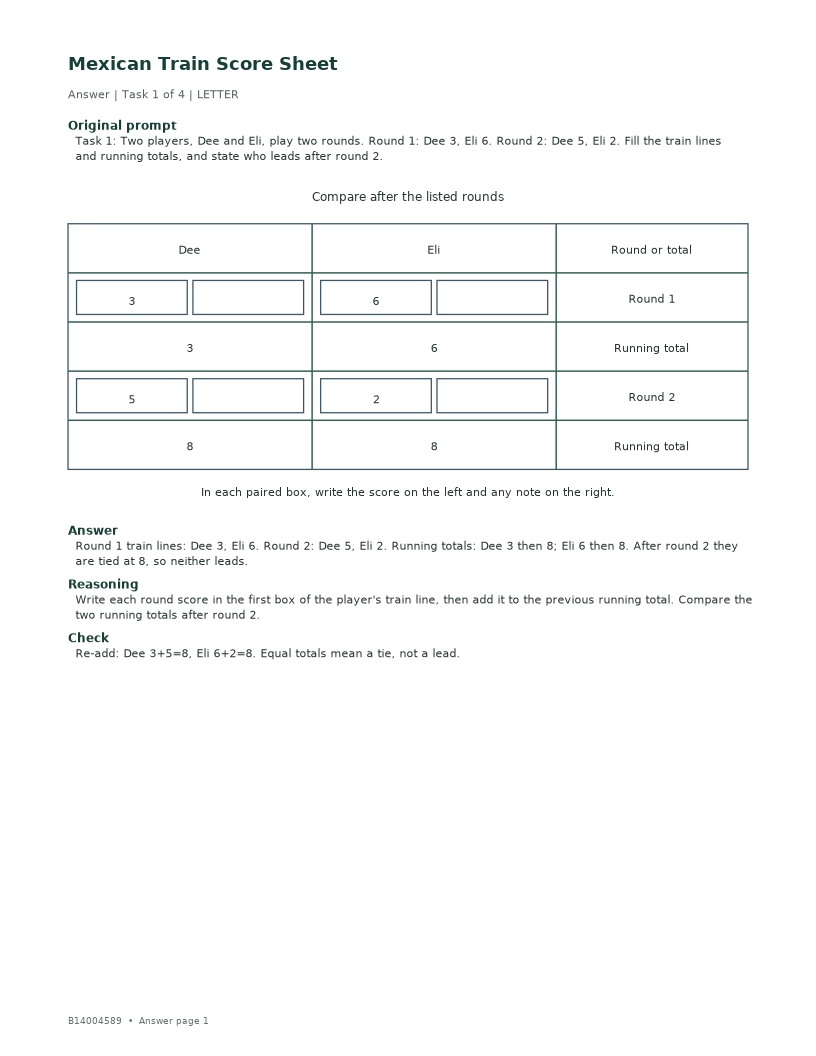
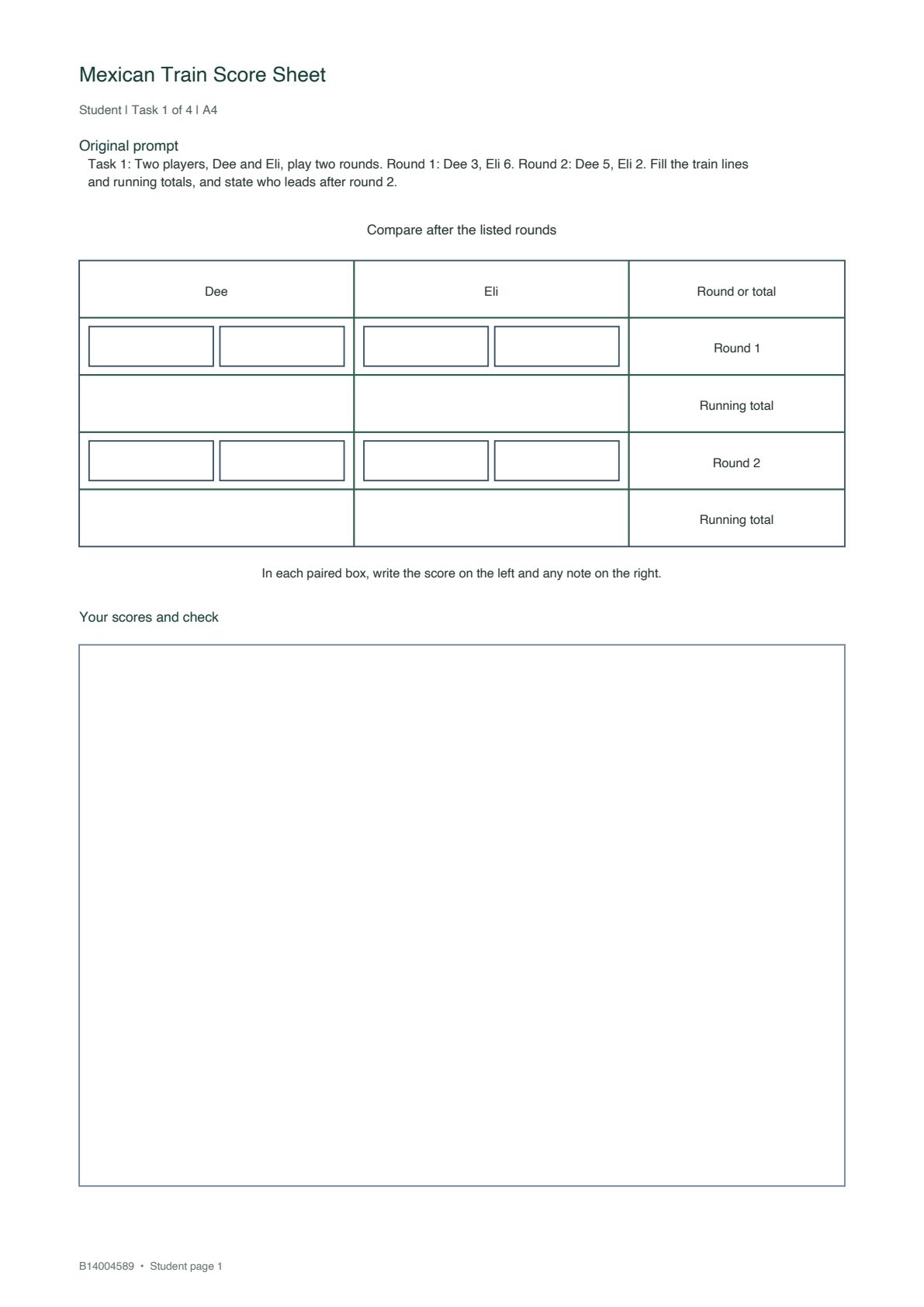
Task 1: Two players, Dee and Eli, play two rounds. Round 1: Dee 3, Eli 6. Round 2: Dee 5, Eli 2. Fill the train lines and running totals, and state who leads after round 2.
Show answer 1
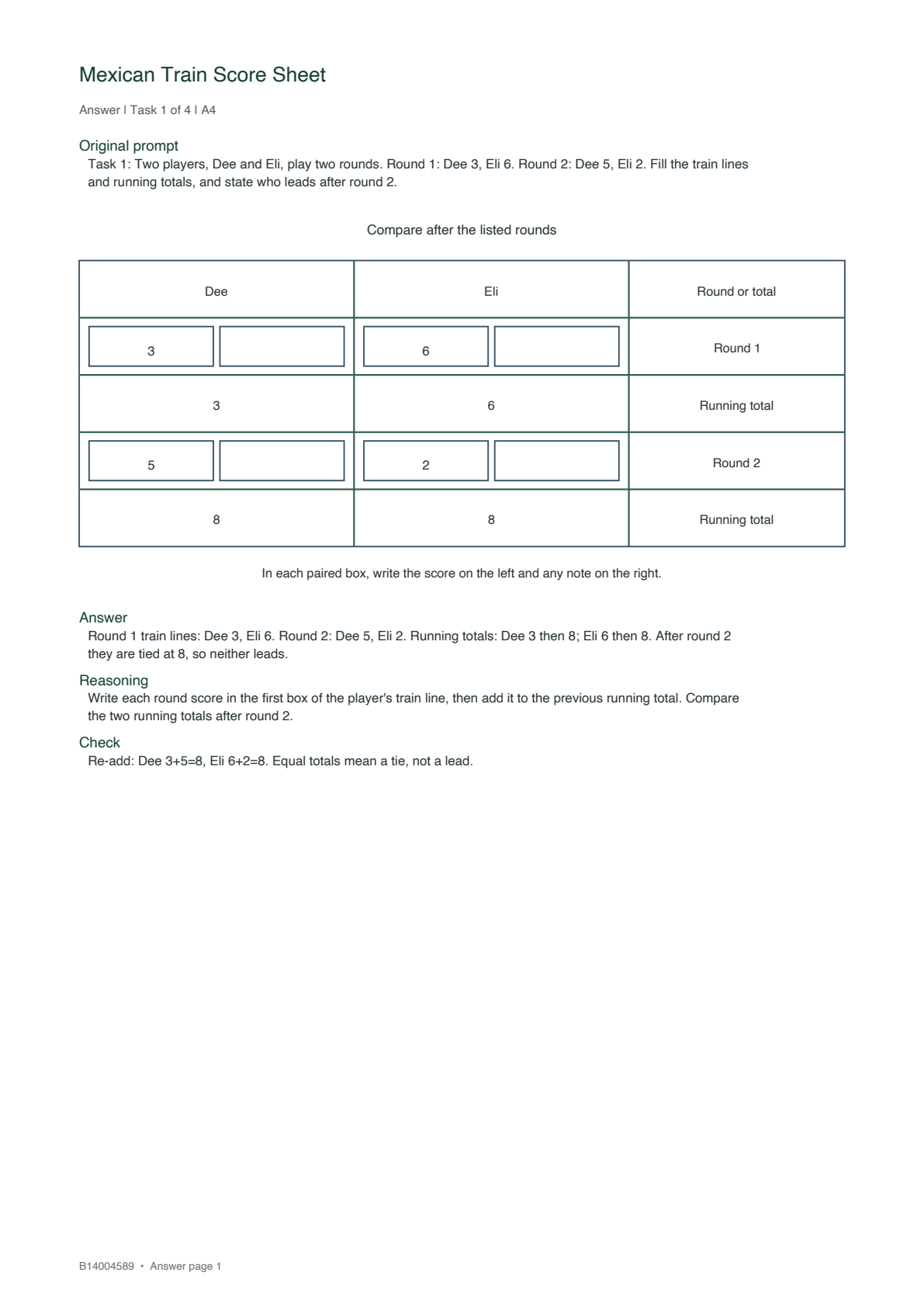
Round 1 train lines: Dee 3, Eli 6. Round 2: Dee 5, Eli 2. Running totals: Dee 3 then 8; Eli 6 then 8. After round 2 they are tied at 8, so neither leads.
Write each round score in the first box of the player's train line, then add it to the previous running total. Compare the two running totals after round 2.
Check: Re-add: Dee 3+5=8, Eli 6+2=8. Equal totals mean a tie, not a lead.
Task 2
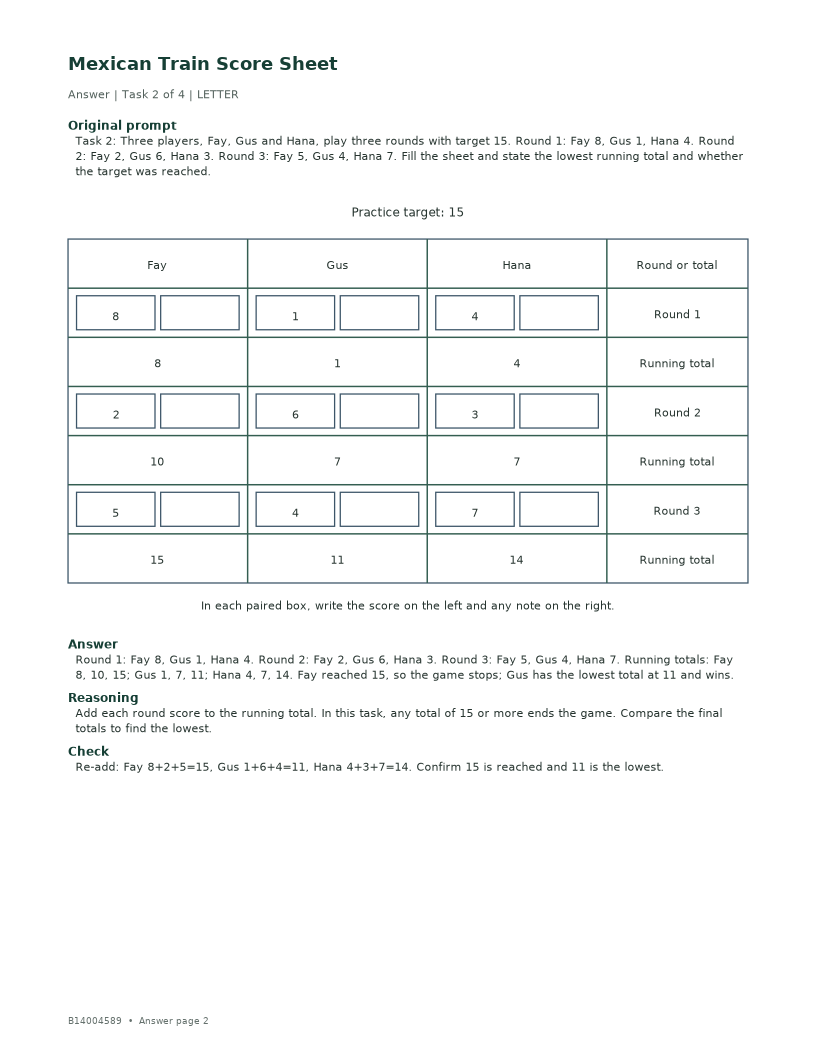
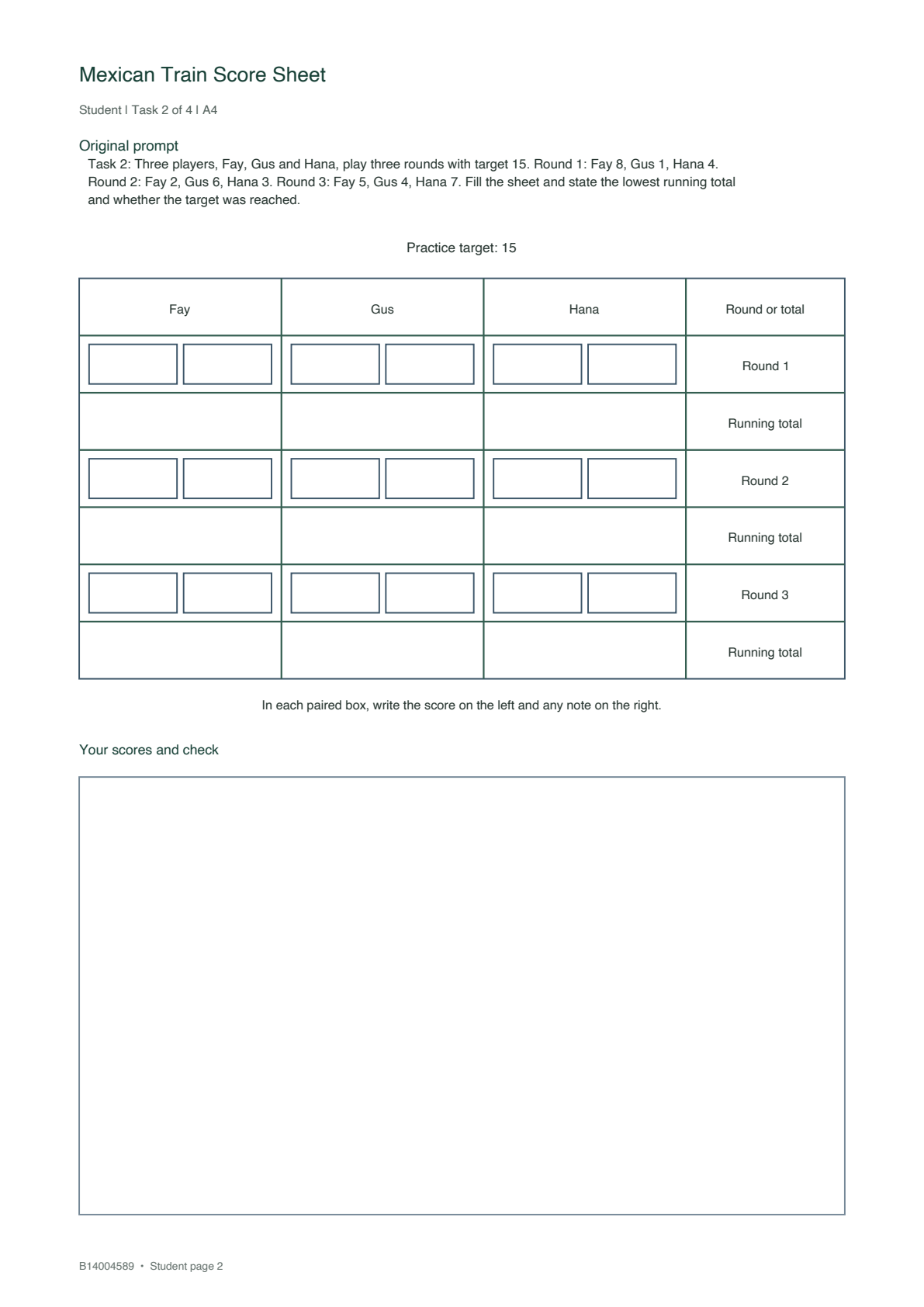
Task 2: Three players, Fay, Gus and Hana, play three rounds with target 15. Round 1: Fay 8, Gus 1, Hana 4. Round 2: Fay 2, Gus 6, Hana 3. Round 3: Fay 5, Gus 4, Hana 7. Fill the sheet and state the lowest running total and whether the target was reached.
Show answer 2
Round 1: Fay 8, Gus 1, Hana 4. Round 2: Fay 2, Gus 6, Hana 3. Round 3: Fay 5, Gus 4, Hana 7. Running totals: Fay 8, 10, 15; Gus 1, 7, 11; Hana 4, 7, 14. Fay reached 15, so the game stops; Gus has the lowest total at 11 and wins.
Add each round score to the running total. In this task, any total of 15 or more ends the game. Compare the final totals to find the lowest.
Check: Re-add: Fay 8+2+5=15, Gus 1+6+4=11, Hana 4+3+7=14. Confirm 15 is reached and 11 is the lowest.
Task 3
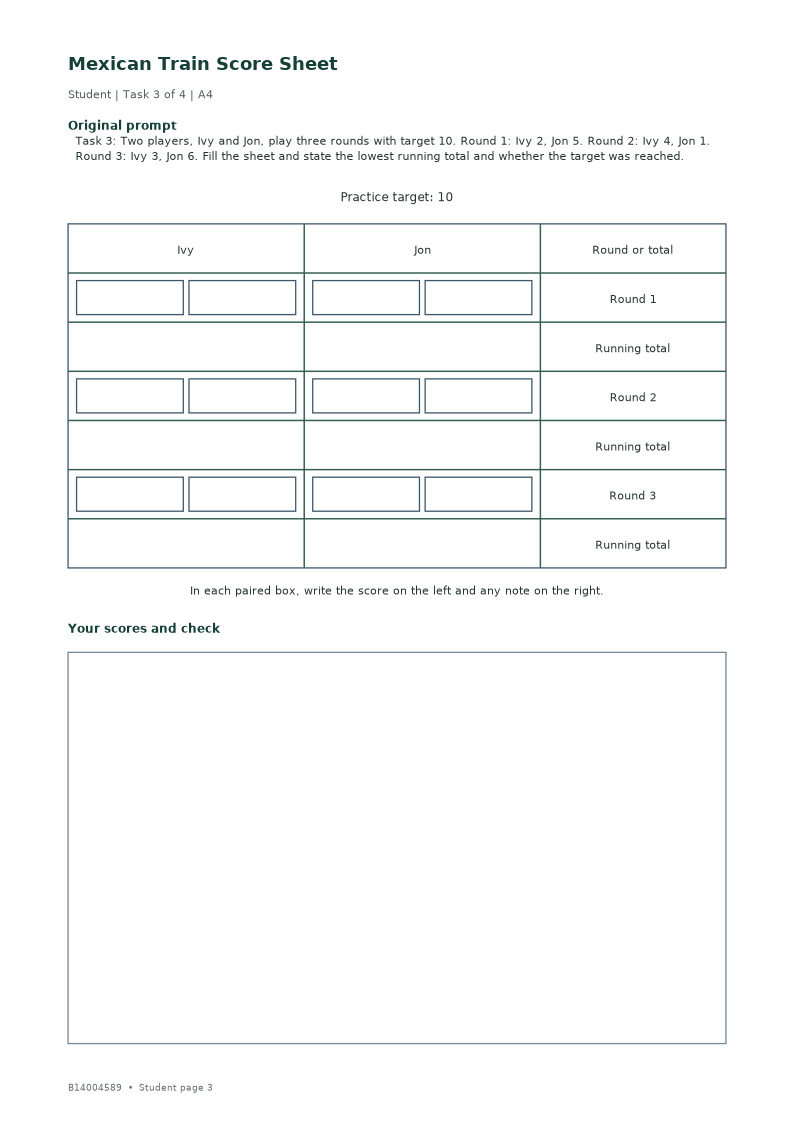
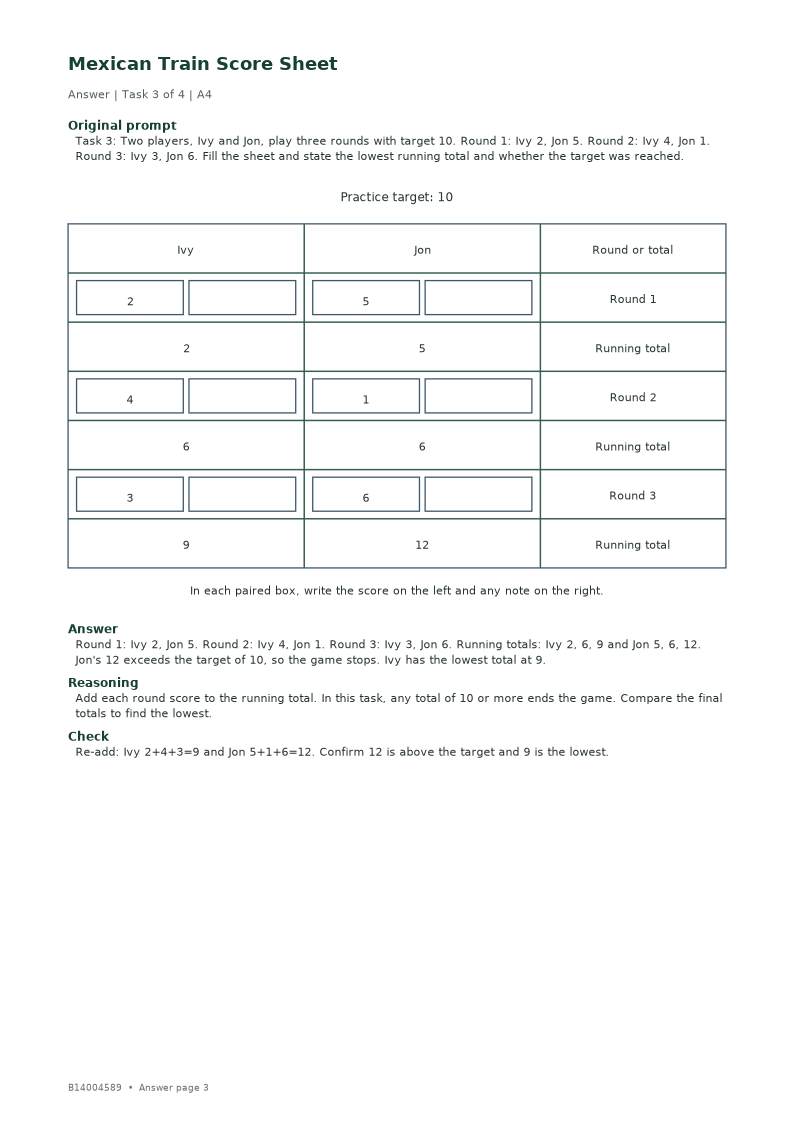
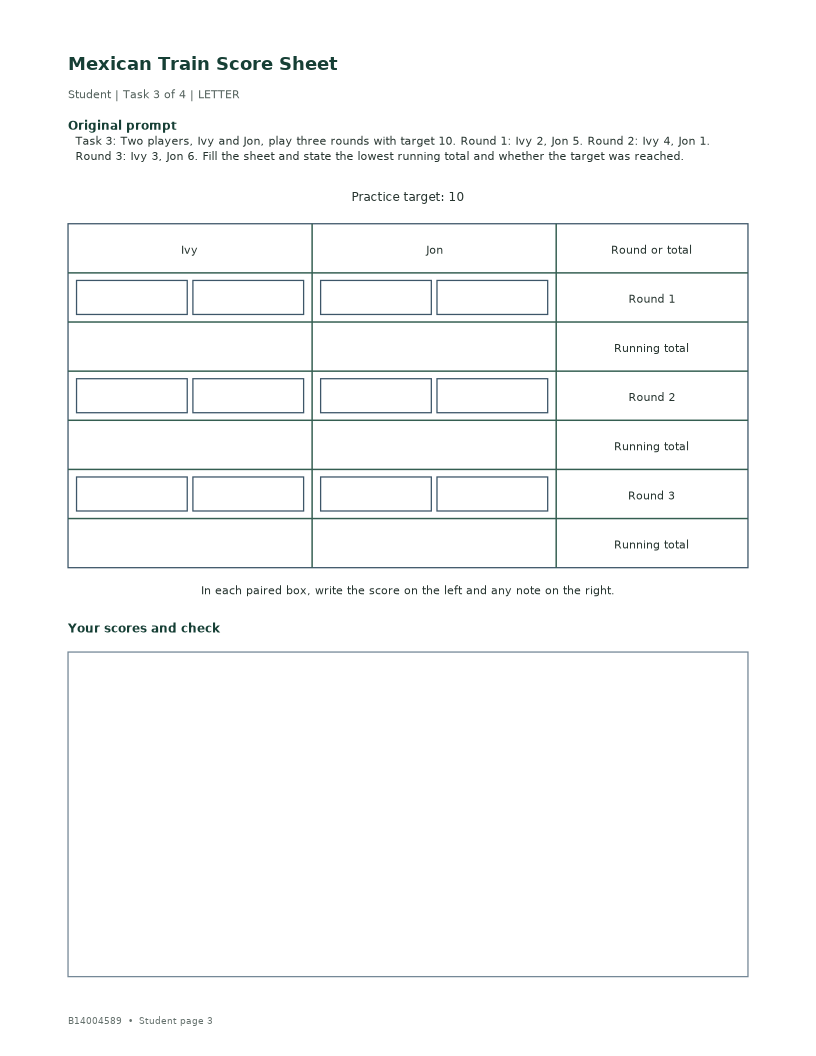
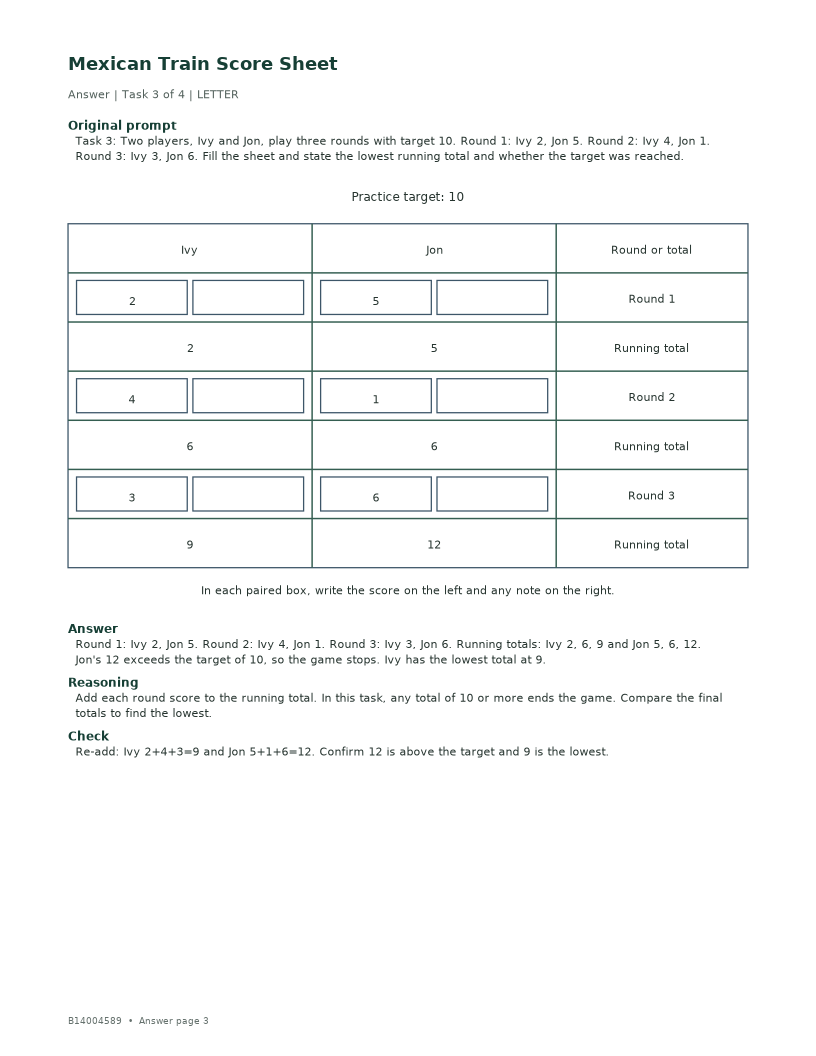
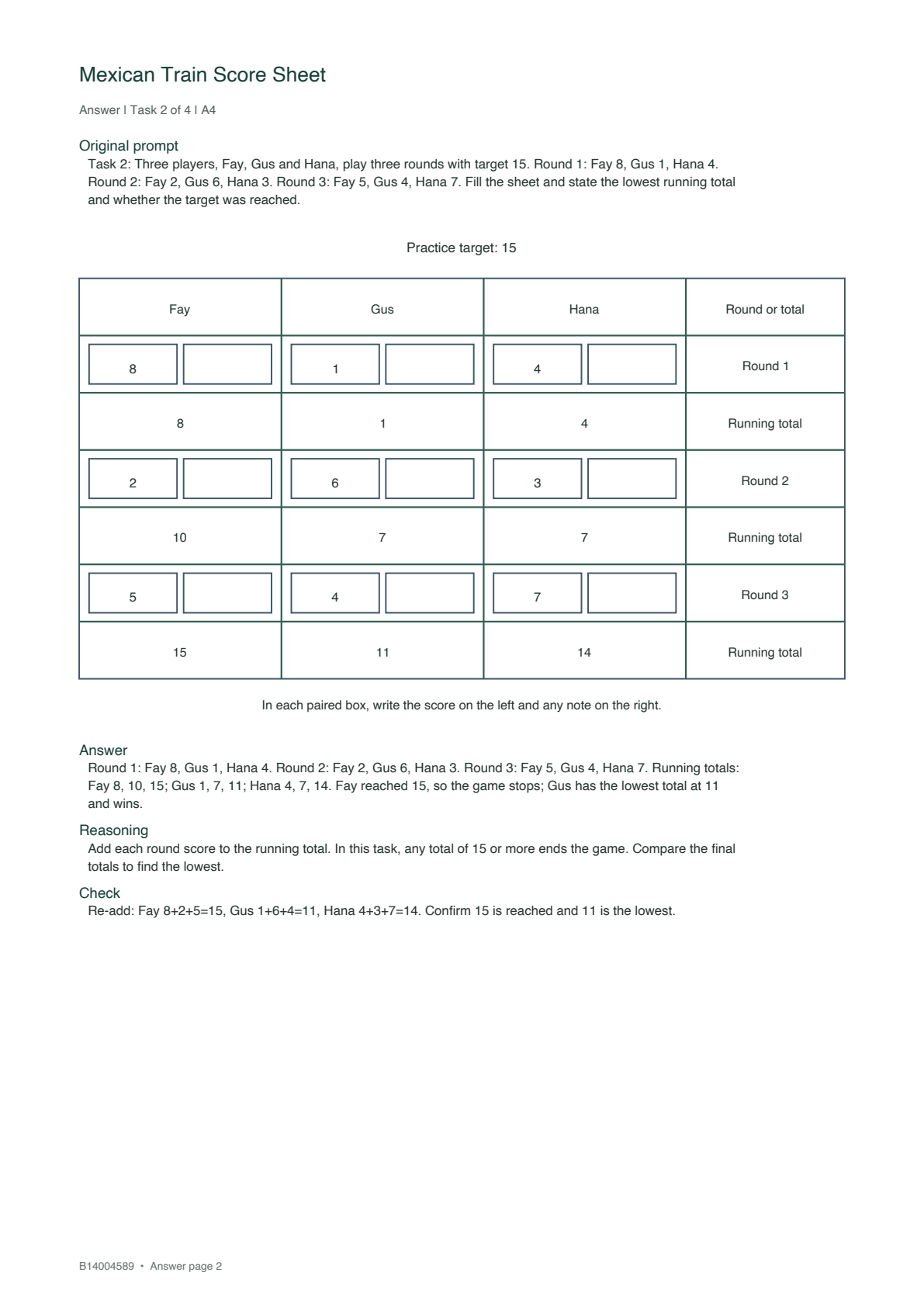
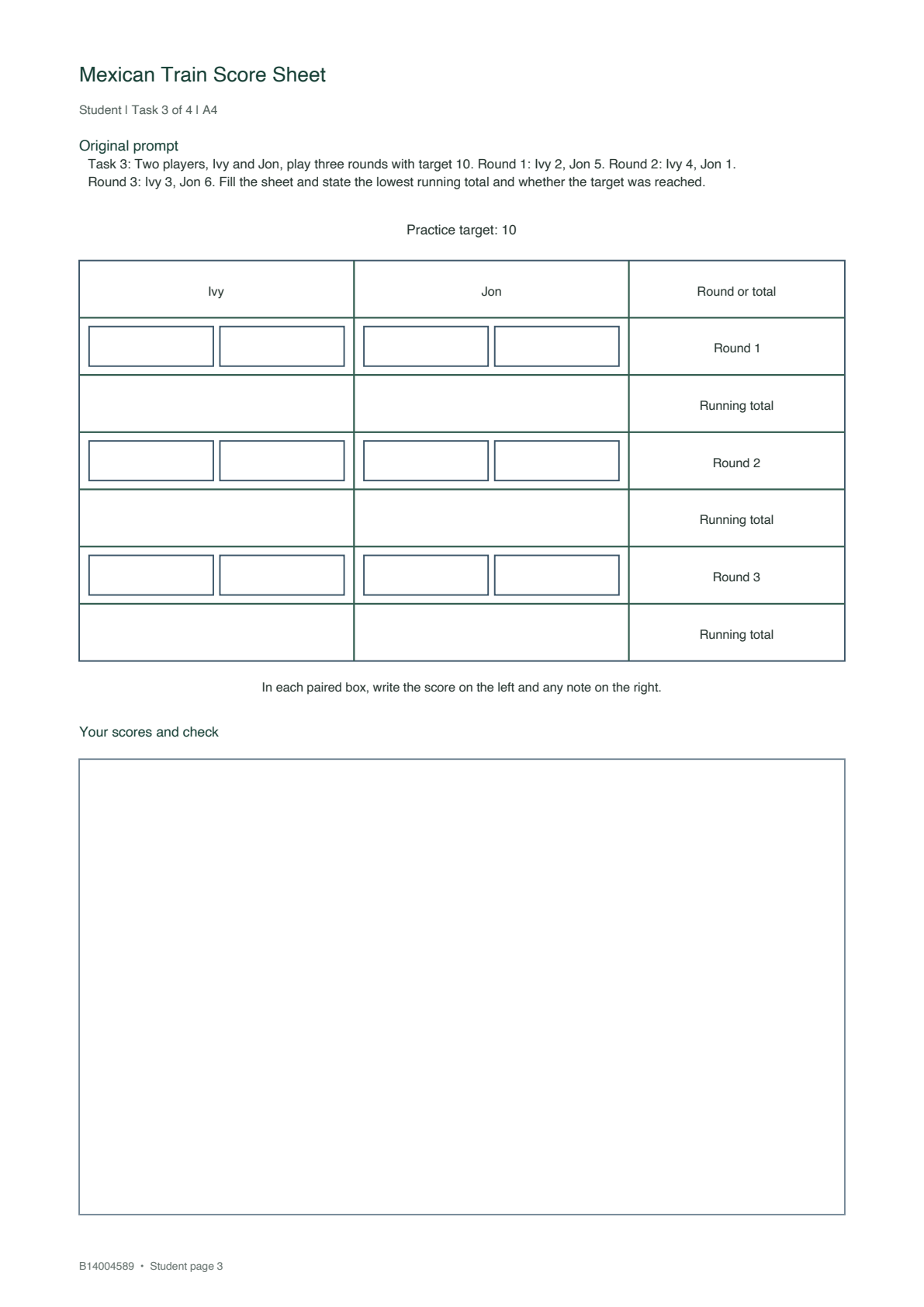
Task 3: Two players, Ivy and Jon, play three rounds with target 10. Round 1: Ivy 2, Jon 5. Round 2: Ivy 4, Jon 1. Round 3: Ivy 3, Jon 6. Fill the sheet and state the lowest running total and whether the target was reached.
Show answer 3
Round 1: Ivy 2, Jon 5. Round 2: Ivy 4, Jon 1. Round 3: Ivy 3, Jon 6. Running totals: Ivy 2, 6, 9 and Jon 5, 6, 12. Jon's 12 exceeds the target of 10, so the game stops. Ivy has the lowest total at 9.
Add each round score to the running total. In this task, any total of 10 or more ends the game. Compare the final totals to find the lowest.
Check: Re-add: Ivy 2+4+3=9 and Jon 5+1+6=12. Confirm 12 is above the target and 9 is the lowest.
Task 4
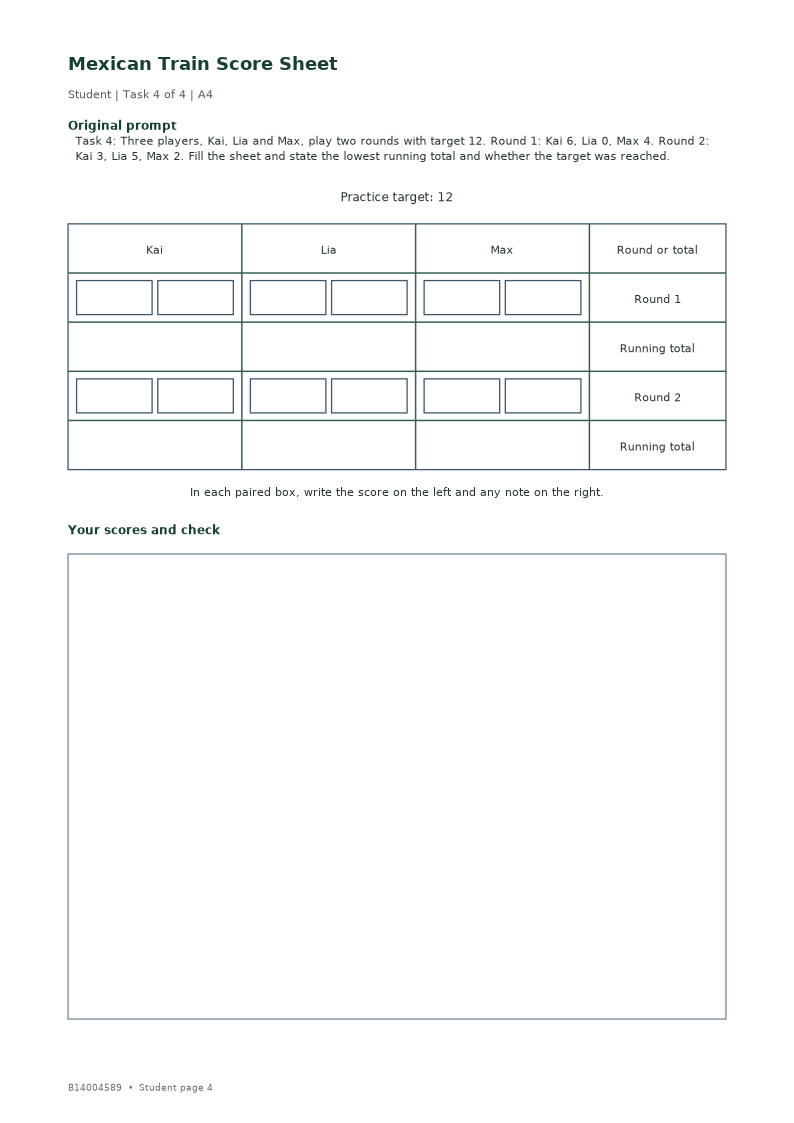
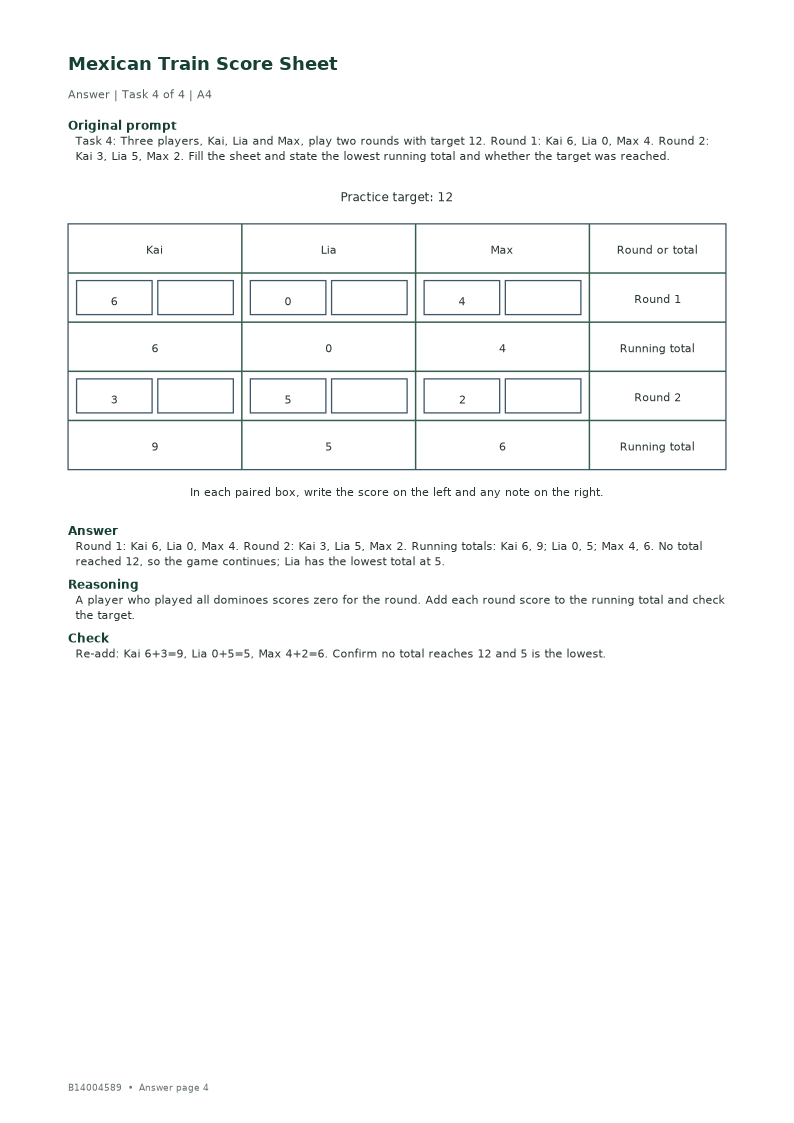
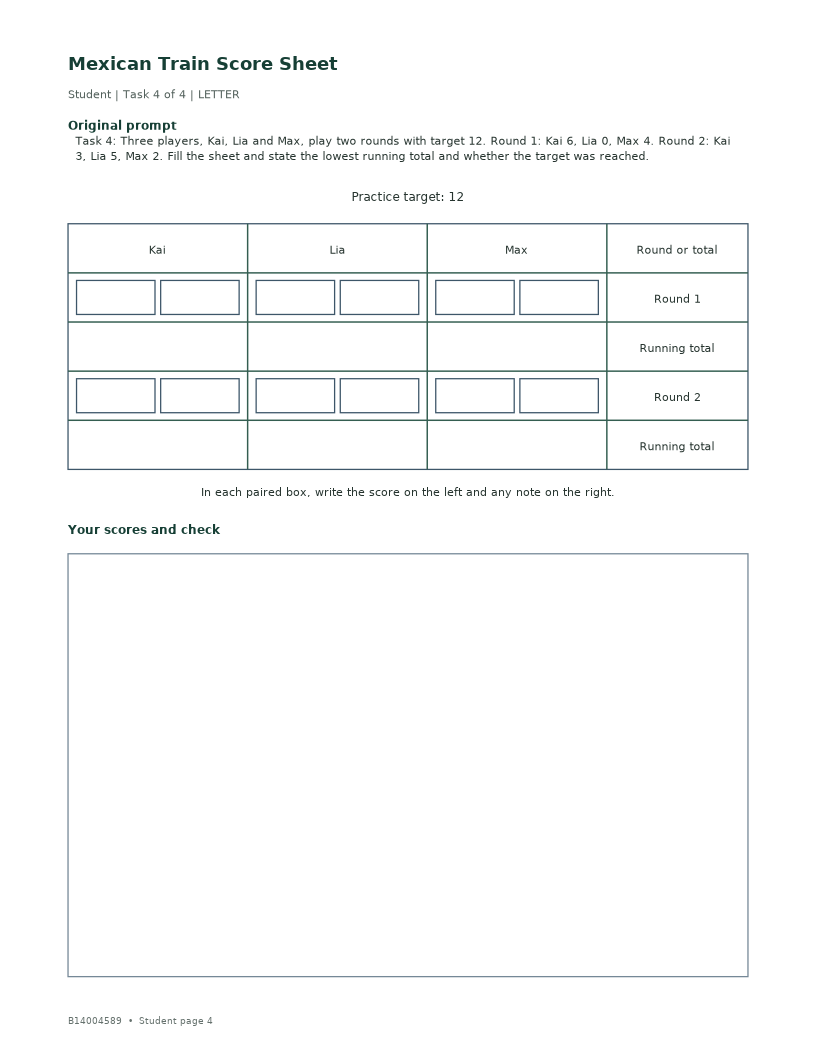
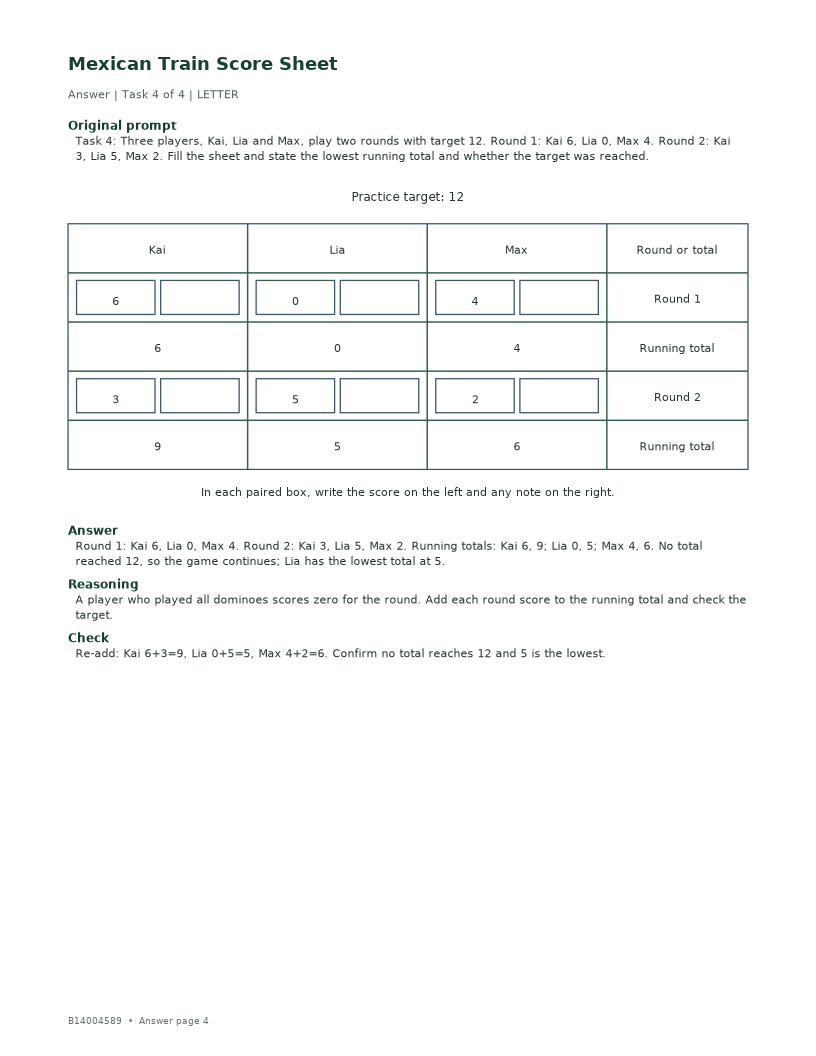
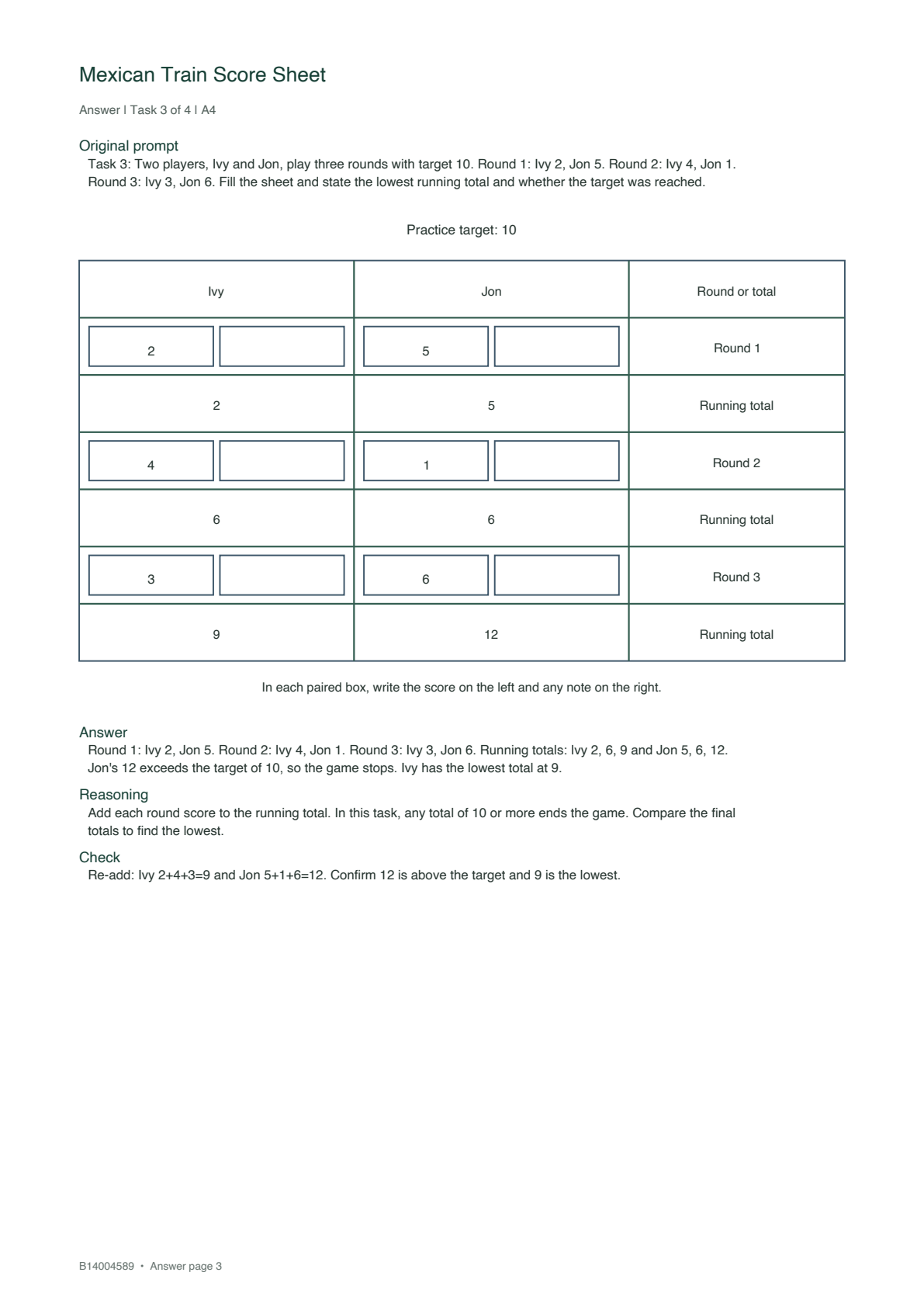
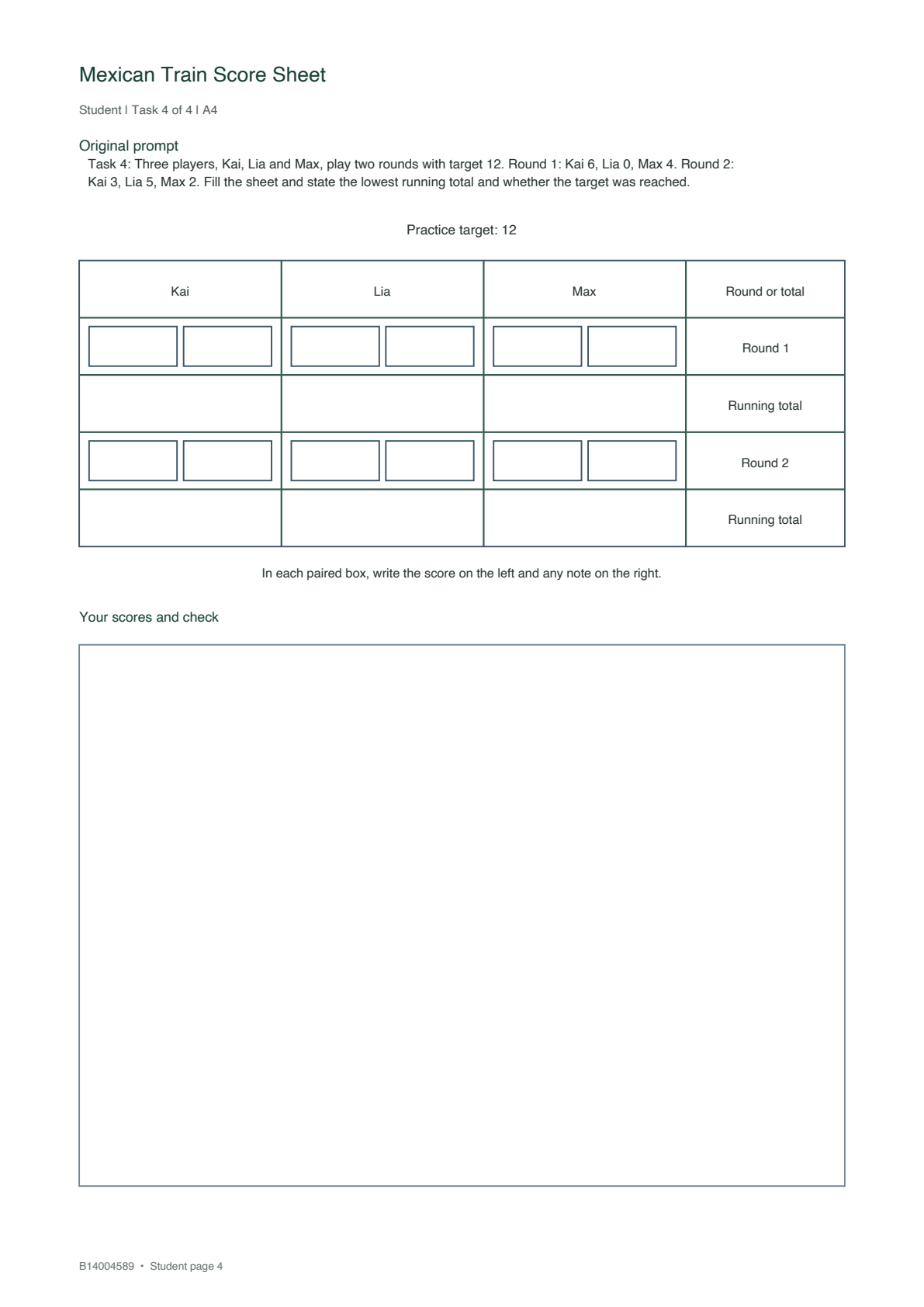
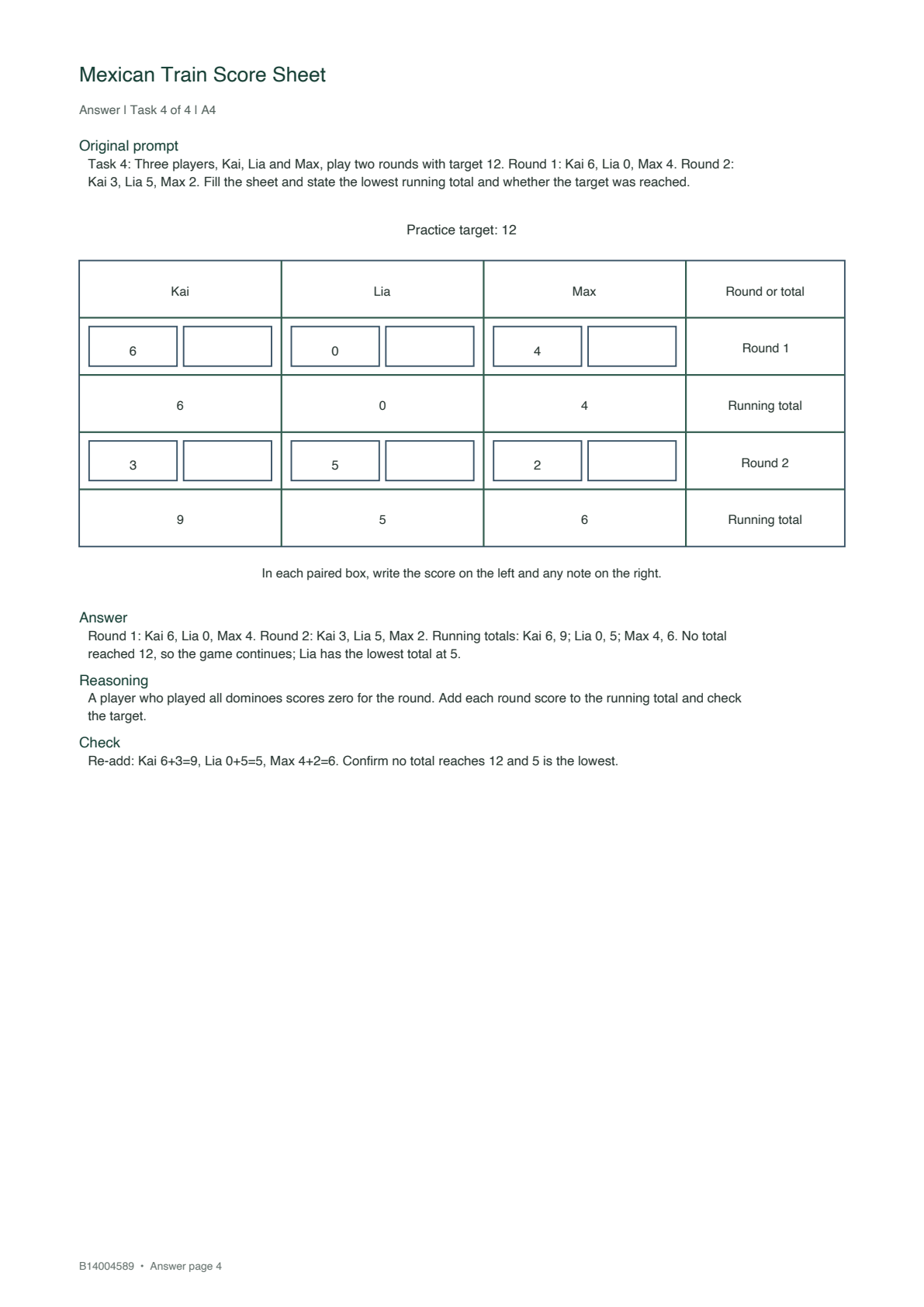
Task 4: Three players, Kai, Lia and Max, play two rounds with target 12. Round 1: Kai 6, Lia 0, Max 4. Round 2: Kai 3, Lia 5, Max 2. Fill the sheet and state the lowest running total and whether the target was reached.
Show answer 4
Round 1: Kai 6, Lia 0, Max 4. Round 2: Kai 3, Lia 5, Max 2. Running totals: Kai 6, 9; Lia 0, 5; Max 4, 6. No total reached 12, so the game continues; Lia has the lowest total at 5.
A player who played all dominoes scores zero for the round. Add each round score to the running total and check the target.
Check: Re-add: Kai 6+3=9, Lia 0+5=5, Max 4+2=6. Confirm no total reaches 12 and 5 is the lowest.
Useful checks
- Writing the round score in the running-total row instead of the train line. Put the round score in the first box of the player's train line, then add it to the previous running total and write the new total in the running-total row.
- Forgetting that a player who played all dominoes scores zero. Write 0 in that player's train line for the round; zero is a real score, not a blank.
- Declaring a winner when no total has reached the target. Check the target first; if no running total reaches it, the game continues and you only report the lowest total so far.
Questions about this resource
What goes in each train-line box?
The first box holds that player's round score; later boxes can hold a note or correction. The running-total row holds the cumulative total.
When does the game stop?
For a practice task with a target, stop as soon as a round leaves any total at or above the target. In a live game, agree on the play and scoring rules before starting.