Free original lessons
Pattern Block Grid Paper
Pattern-block grid paper is a printable sheet whose cells are the outlines of the standard pattern-block shapes, so you can plan designs by placing shapes edge-to-edge. This pack defines the five shapes precisely, shows one worked placement, and gives four design tasks with answers and a visual check.
Letter & A4
PDF & SVG
What the sheet is
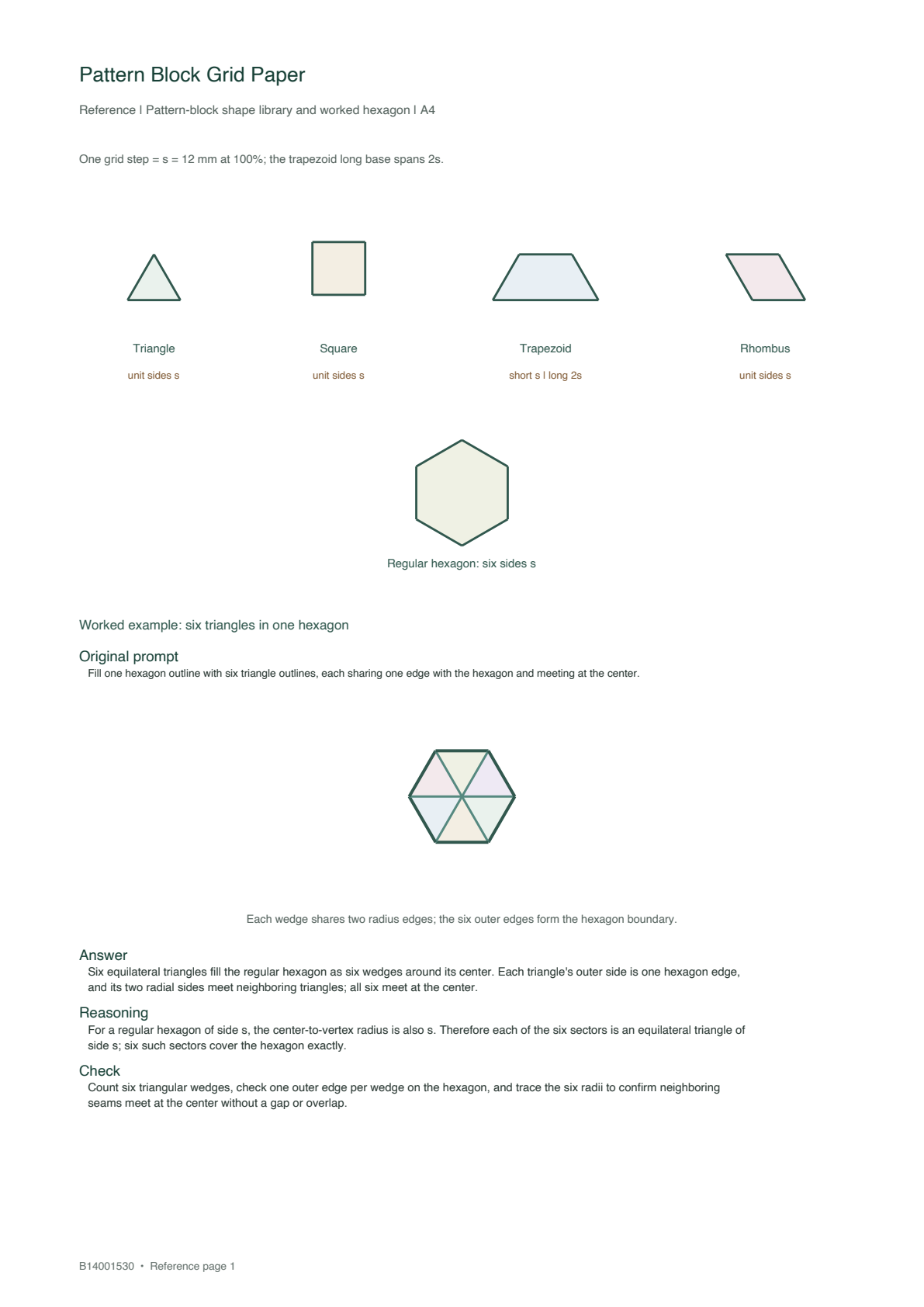
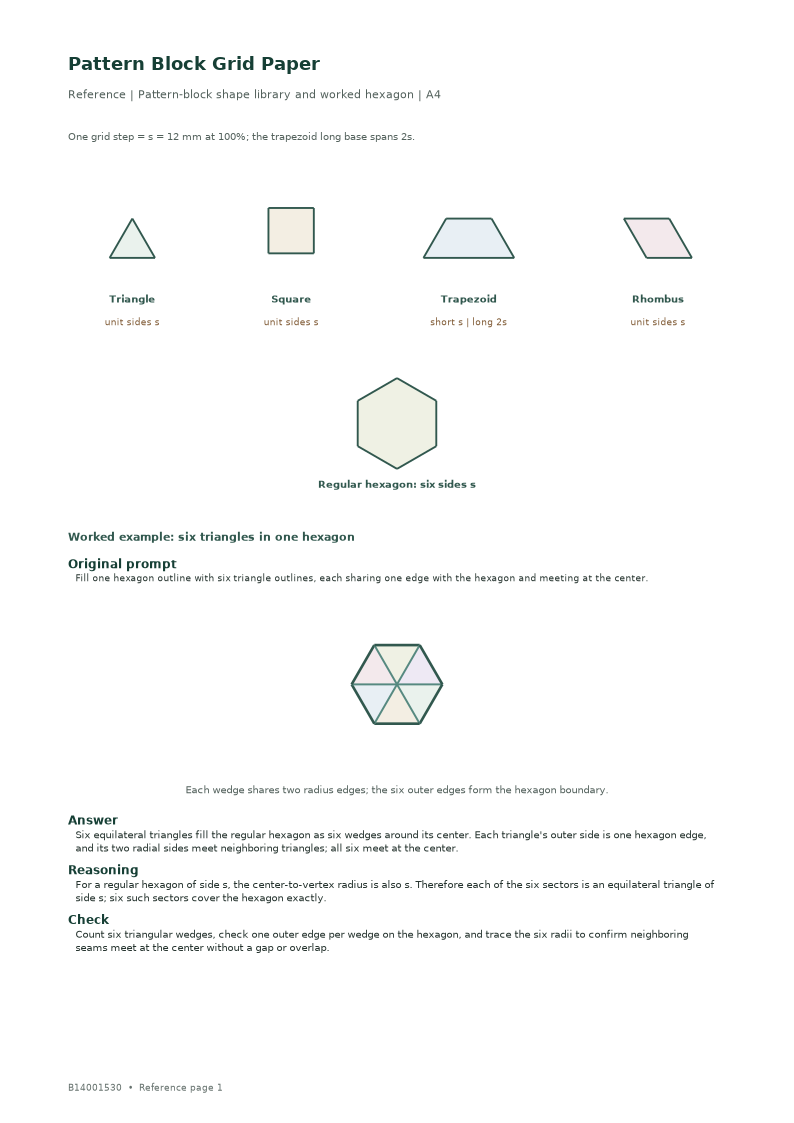
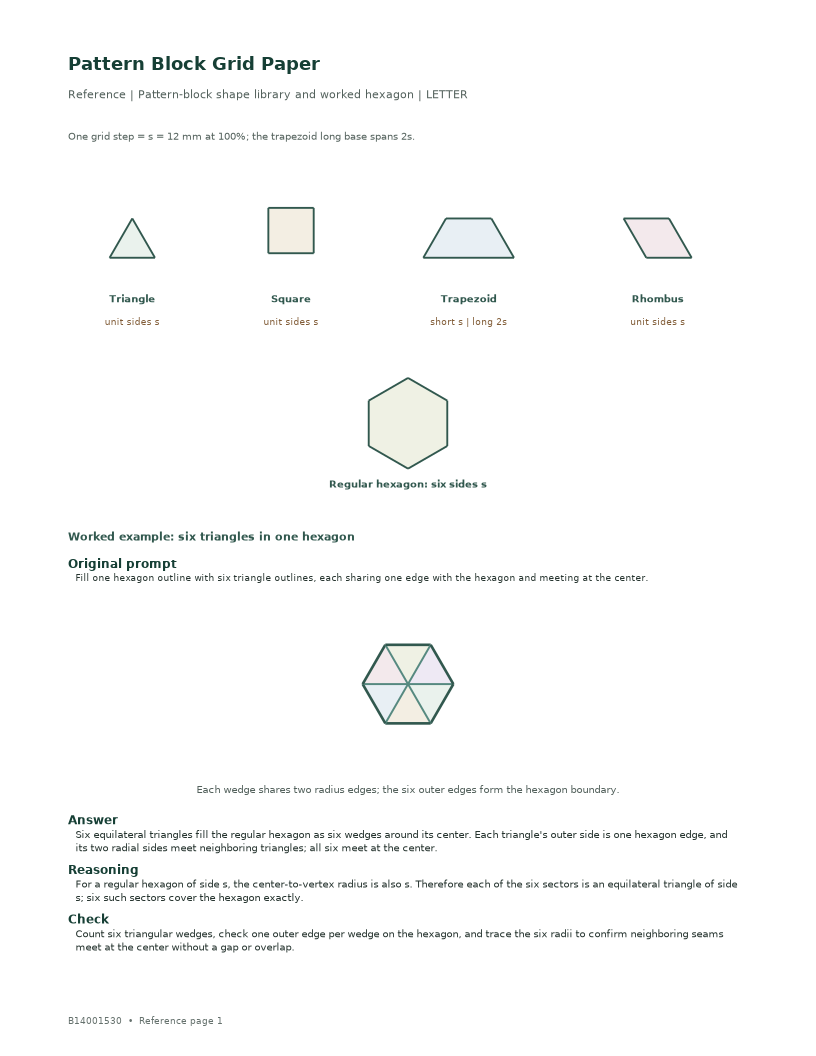
The sheet is a set of separate pattern-block outlines: equilateral triangle, square, trapezoid, rhombus, and regular hexagon. Let s be the unit edge length: triangle sides, square sides, rhombus sides, hexagon sides, and the trapezoid's short base and slanted sides are s; the trapezoid's long base is 2s. Only matching full lengths share one complete edge; example outlines have visible gutters.
Use the outlines to plan the requested motifs, matching the named full edges and checking for gaps or overlaps inside the design. Unshared edges remain exposed on the union's outside perimeter; a task does not require filling or closing that perimeter unless it says so.
How the shapes fit
The common unit is s. The trapezoid is isosceles with 60-degree base angles, short base s, slanted sides s, and long base 2s; the rhombus has 60- and 120-degree angles and side length s. With these proportions, the trapezoid is exactly three unit equilateral triangles in area, and the regular hexagon can be divided into six unit triangles.
With the stated proportions, the trapezoid consists of three unit equilateral triangles and the regular hexagon of six. A 60/120 rhombus splits along its short diagonal between the obtuse vertices into two equilateral triangles: the short diagonal is s. Named shared edges must match for their entire length; a 2s trapezoid base can span two adjacent unit edges, while any unshared edges remain exposed on the outside perimeter.
Worked example
Worked example: join the six equilateral triangles around the center of one regular hexagon, one triangle per hexagon side. Each triangle's outer side is one hexagon edge; its two other sides are radii to neighboring triangles. The six wedges meet at the center with no gaps or overlaps.
Check: count six triangles; each has one perimeter edge on the hexagon and two center-to-vertex edges shared with its neighbors. The center closes exactly because a regular hexagon's center-to-vertex distance equals its side length.
Practice tasks
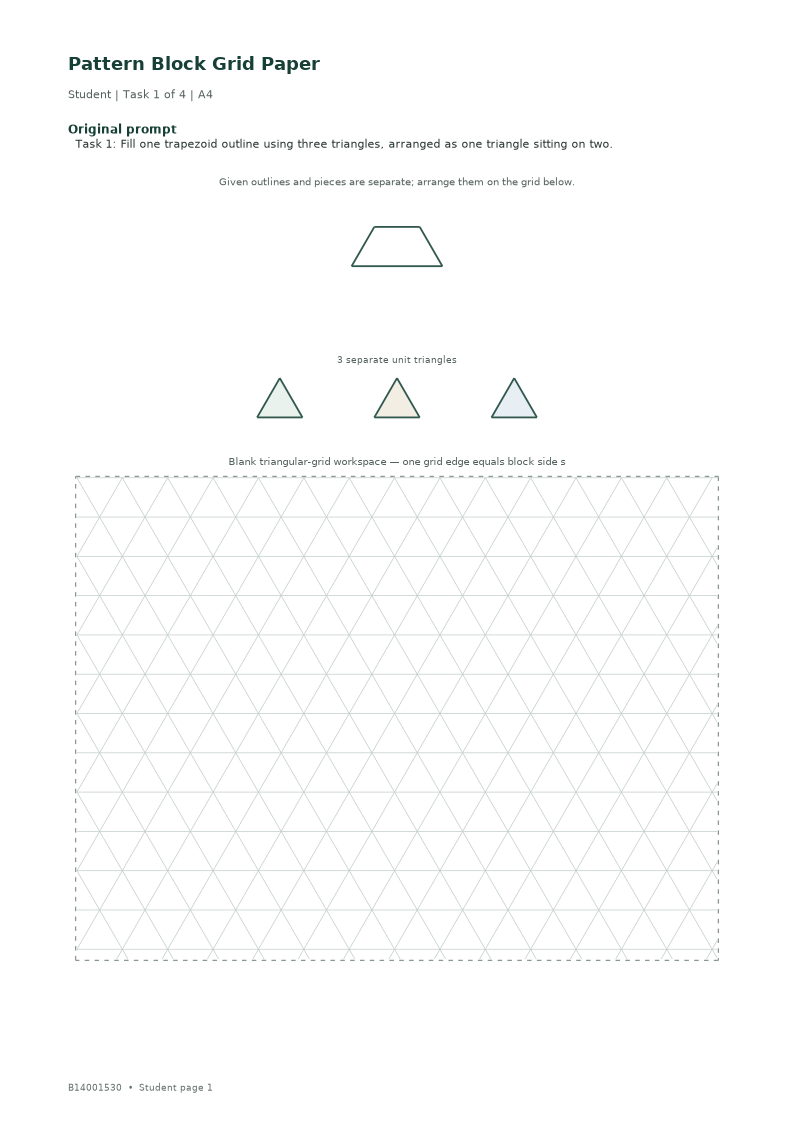
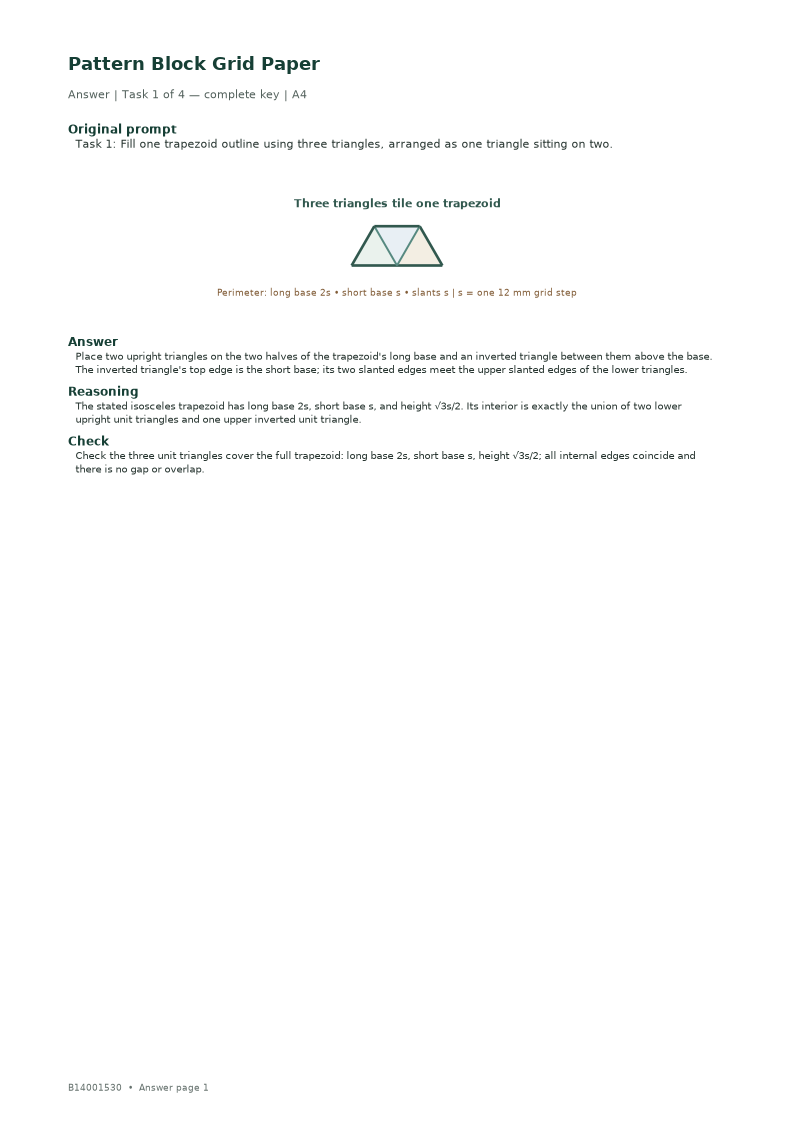
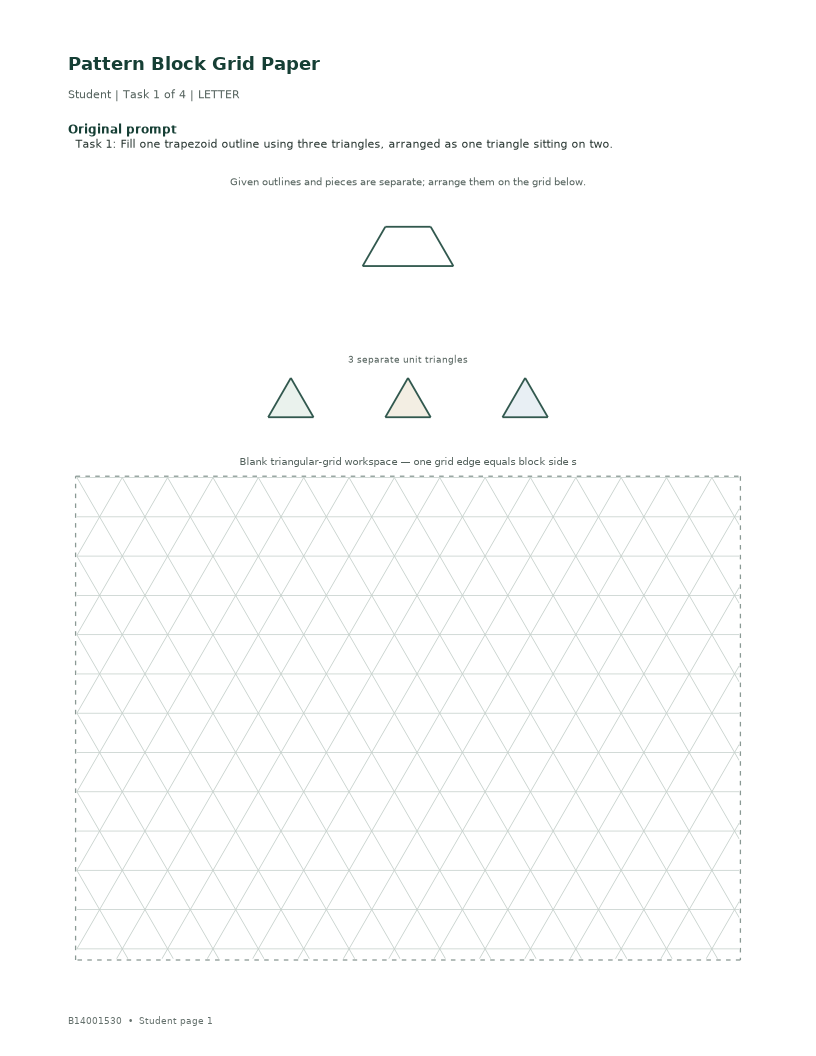
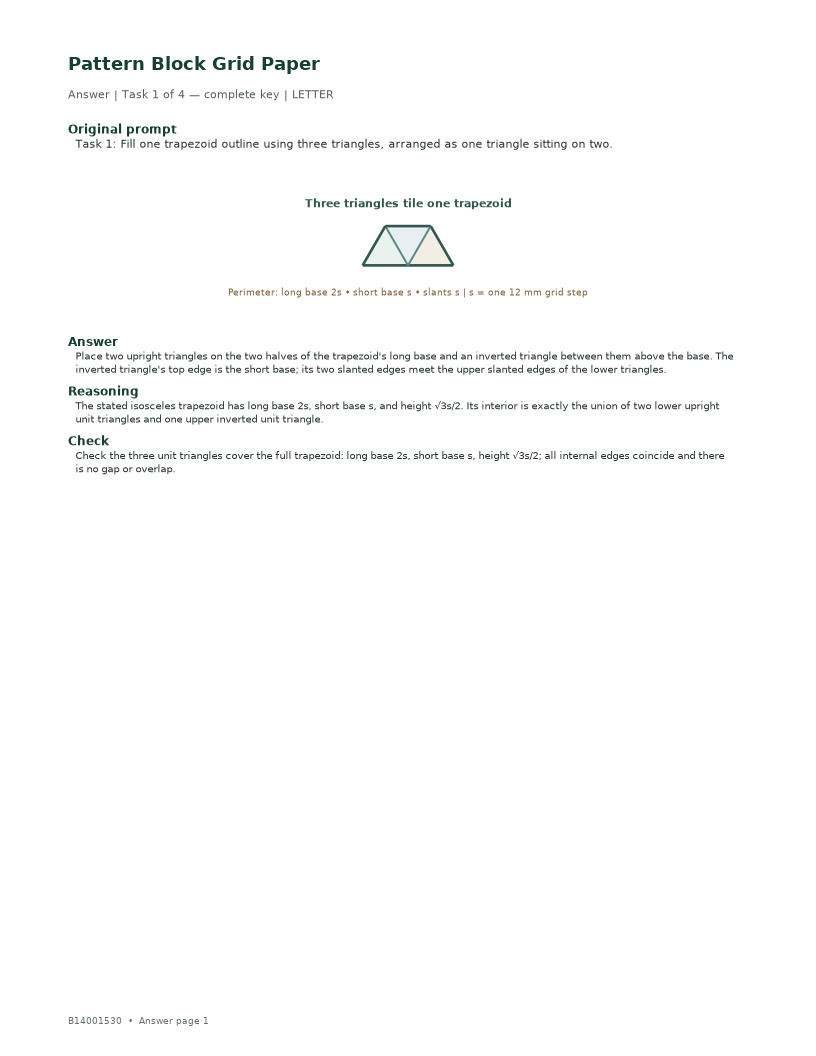
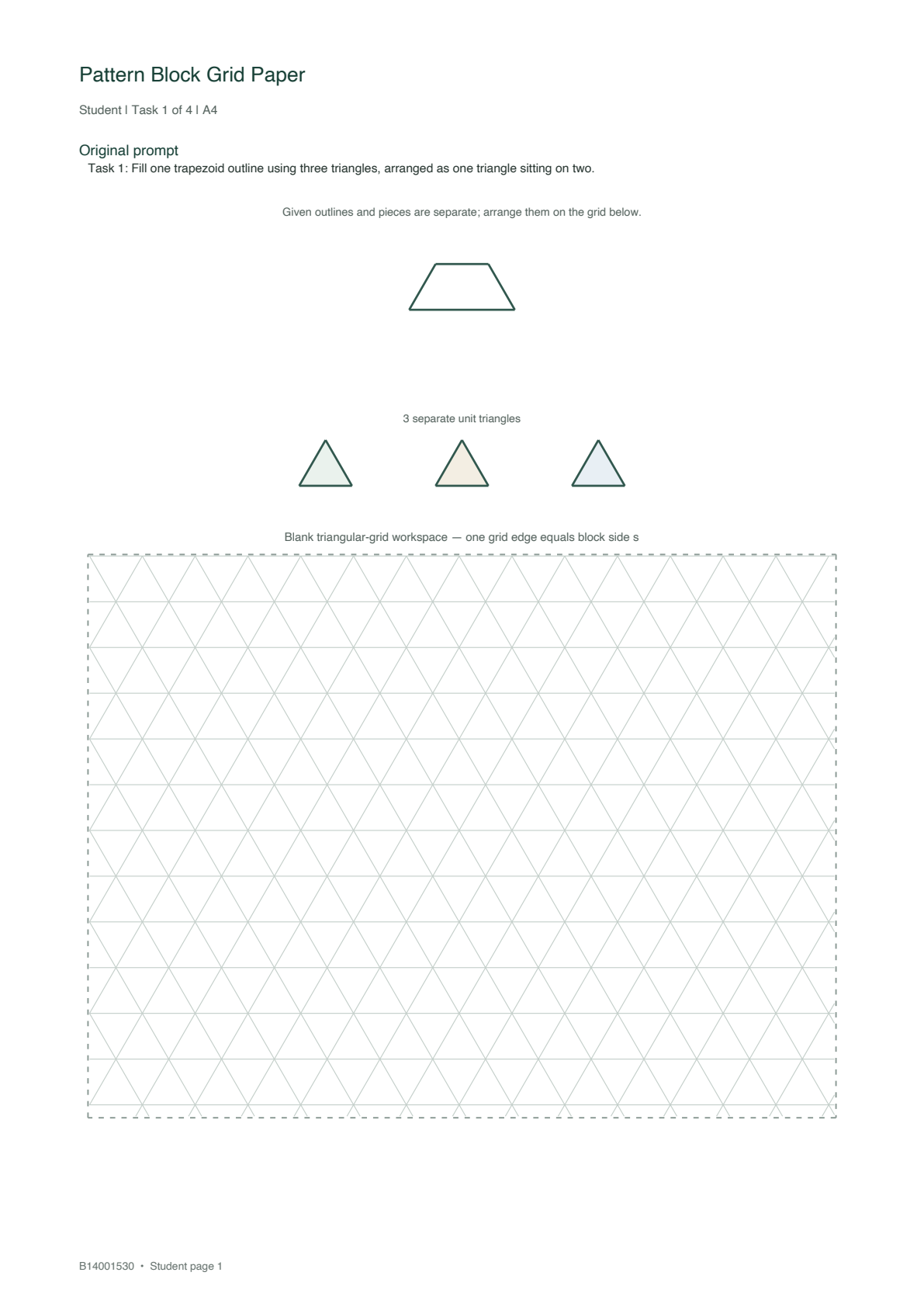
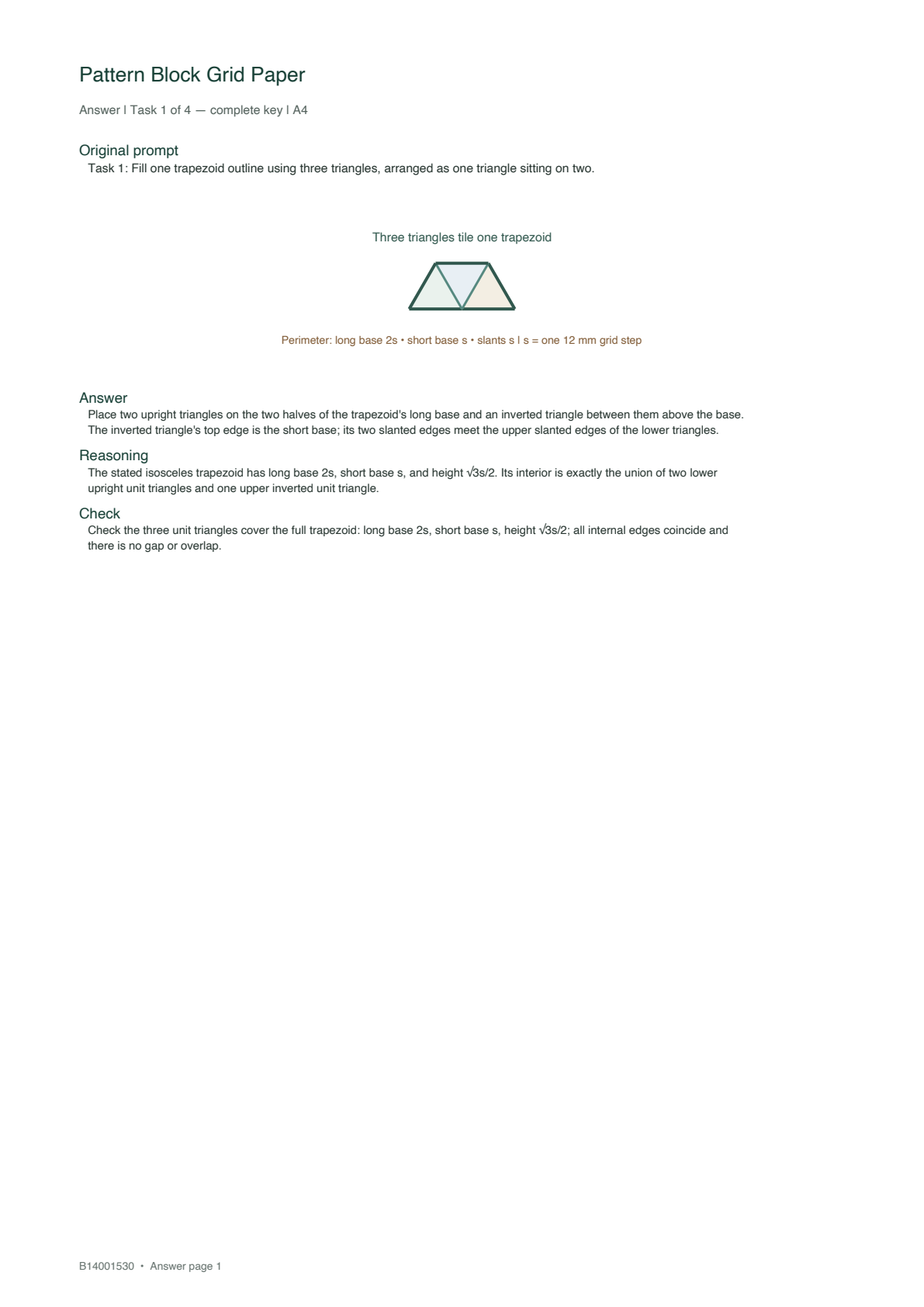
Task 1: Fill one trapezoid outline using three triangles, arranged as one triangle sitting on two. Answer: put one upright equilateral triangle on each half of the long base; place the third, inverted triangle above them, with its upper edge forming the short base. The three triangles share exactly two interior seams: the inverted triangle meets the left and right lower triangles along the two edges from the long-base midpoint to the short-base corners. Neither seam lies on the trapezoid outline. The outer perimeter is the full long base 2s (two unit segments), the short base s, and the two outer slanted sides s. Check: the outline has bases 2s and s, height √3s/2, and no gap or overlap.
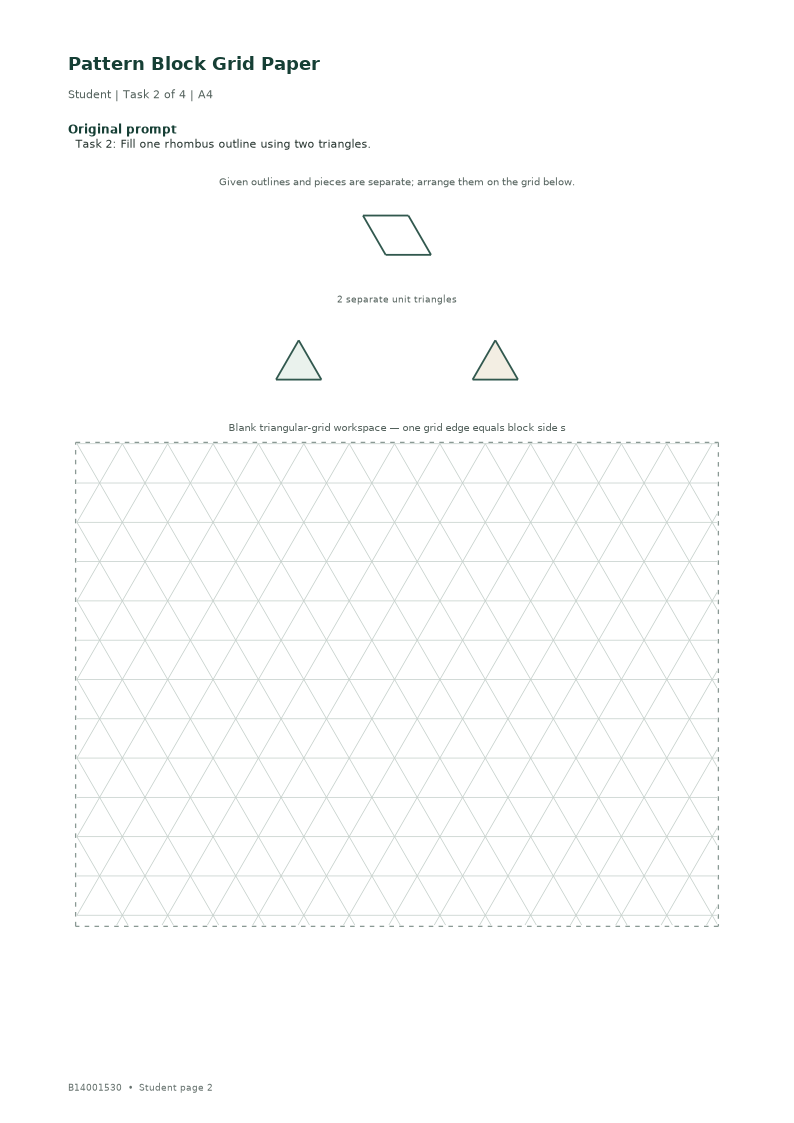
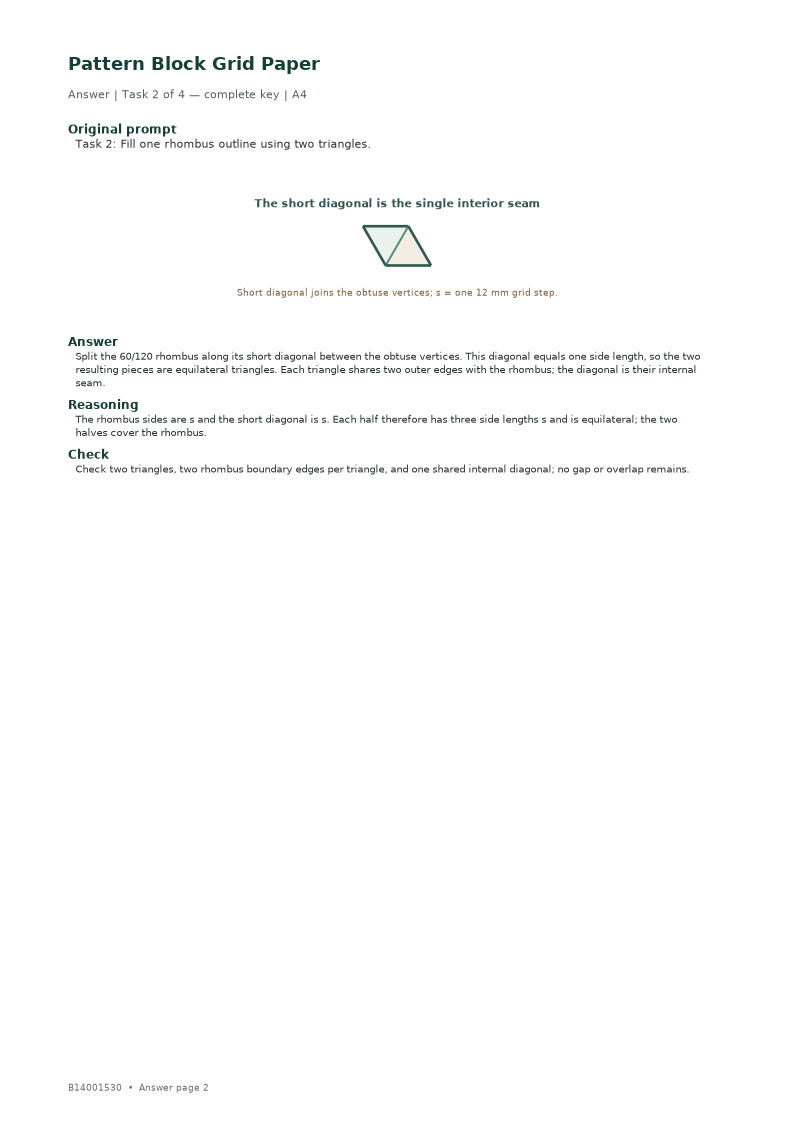
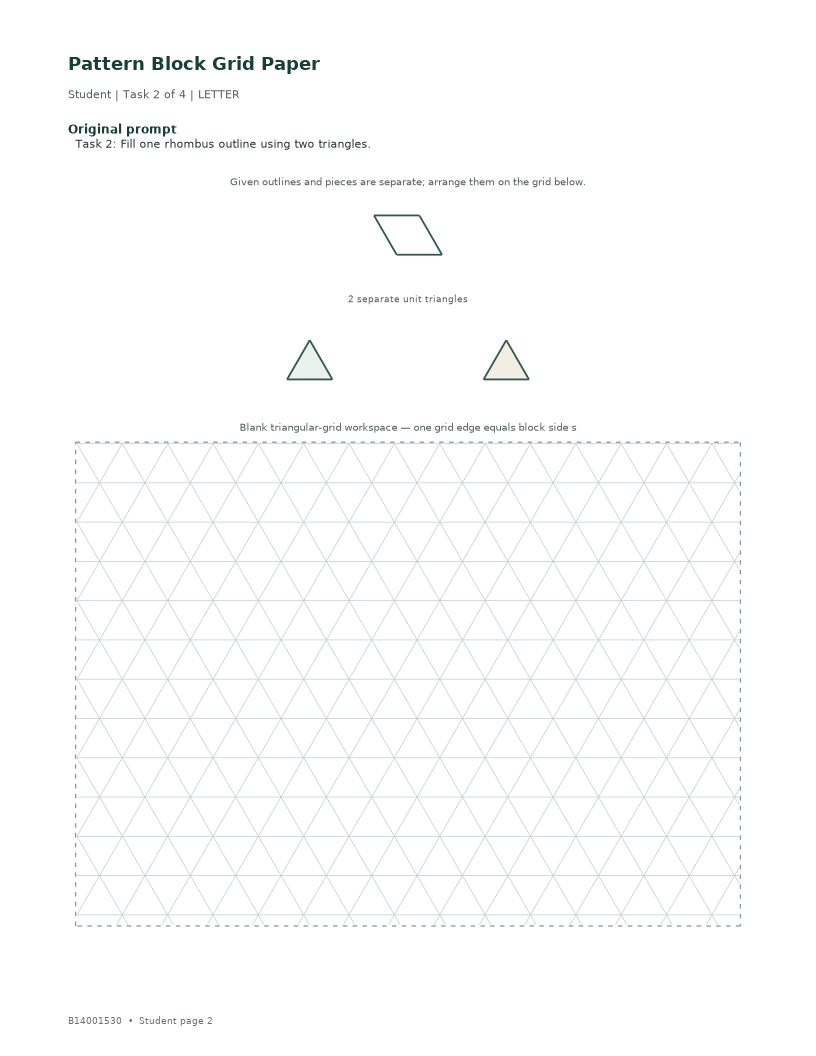
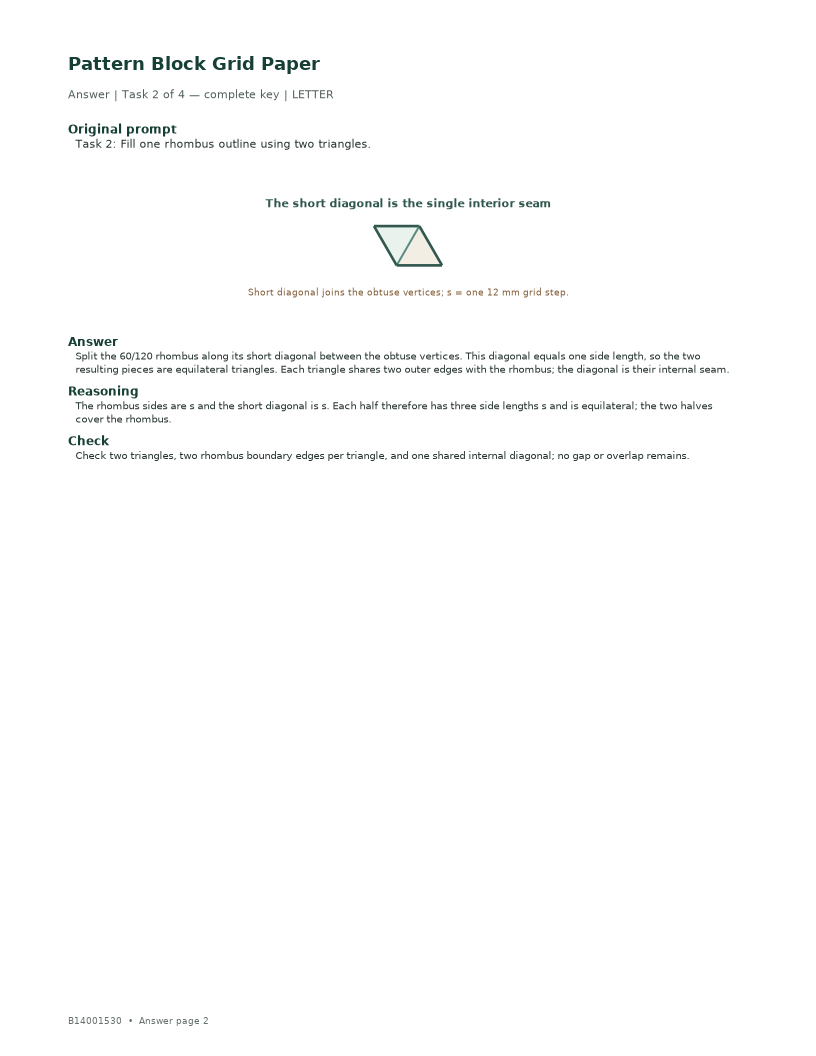
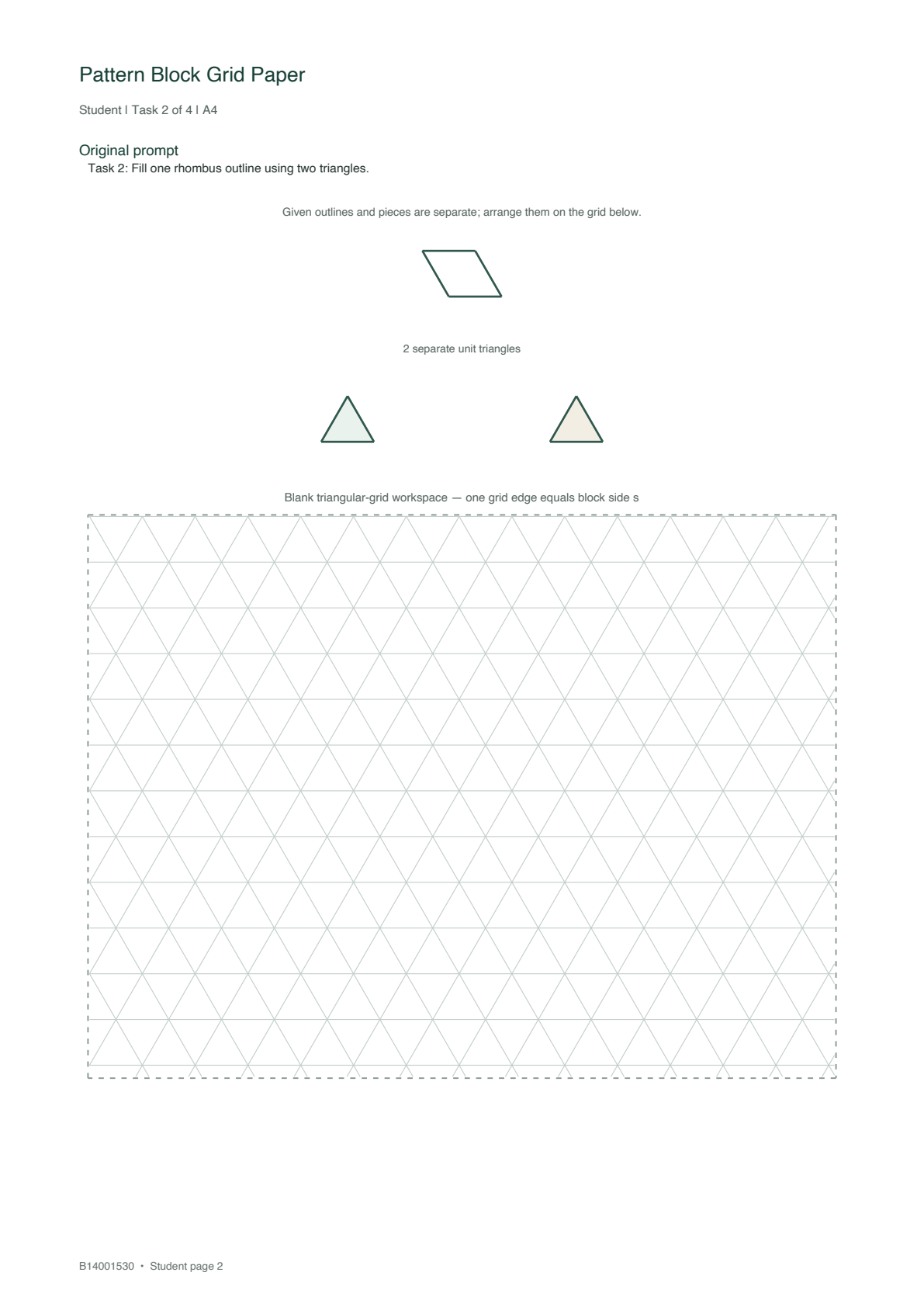
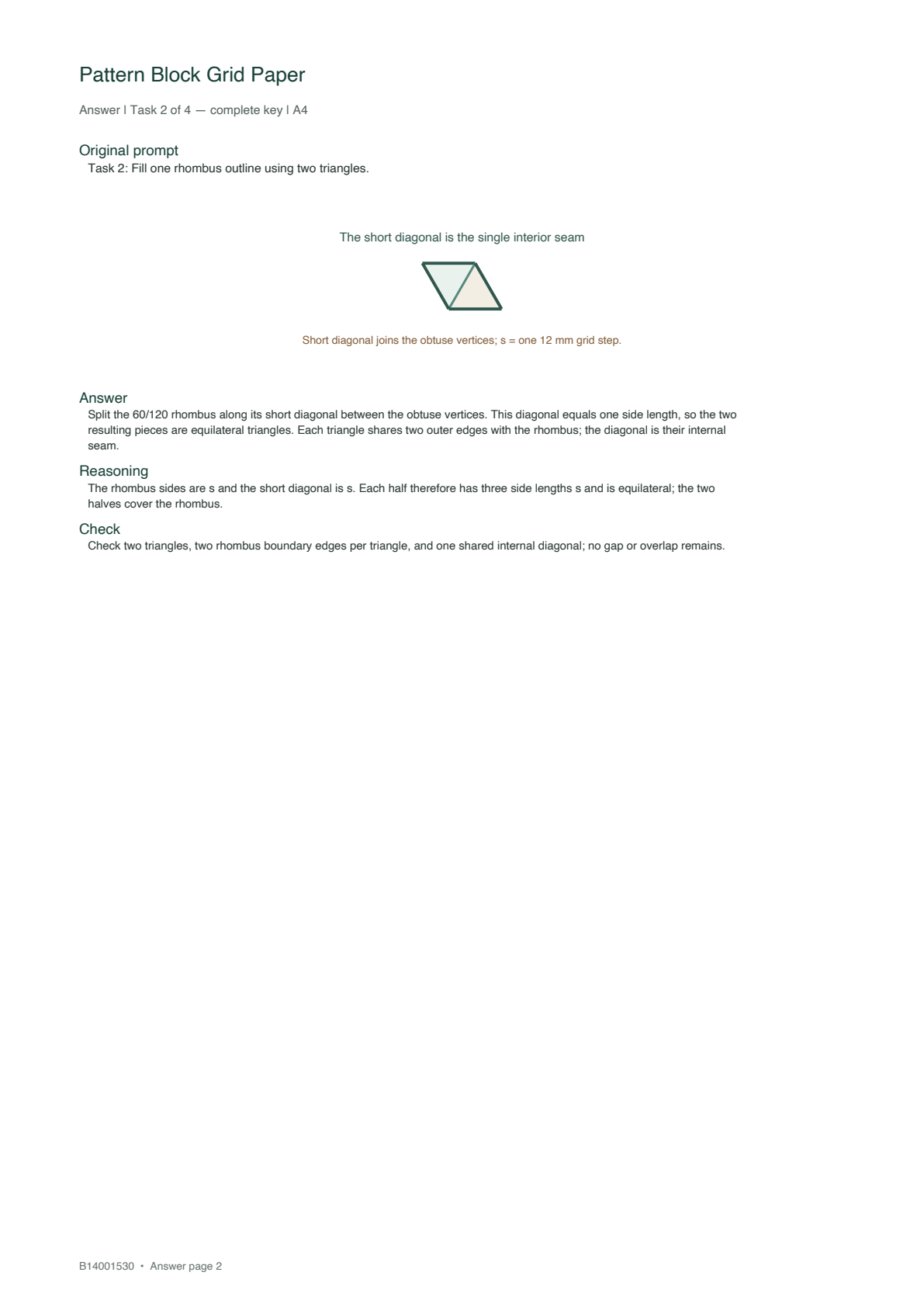
Task 2: Fill one rhombus outline using two triangles. Answer: draw the short diagonal between the obtuse vertices; it equals one side length and divides the 60/120 rhombus into two equilateral triangles. Each triangle shares two boundary edges with the rhombus and their diagonal is the internal seam. Check: both triangles fill the rhombus with no gap or overlap.
More practice tasks
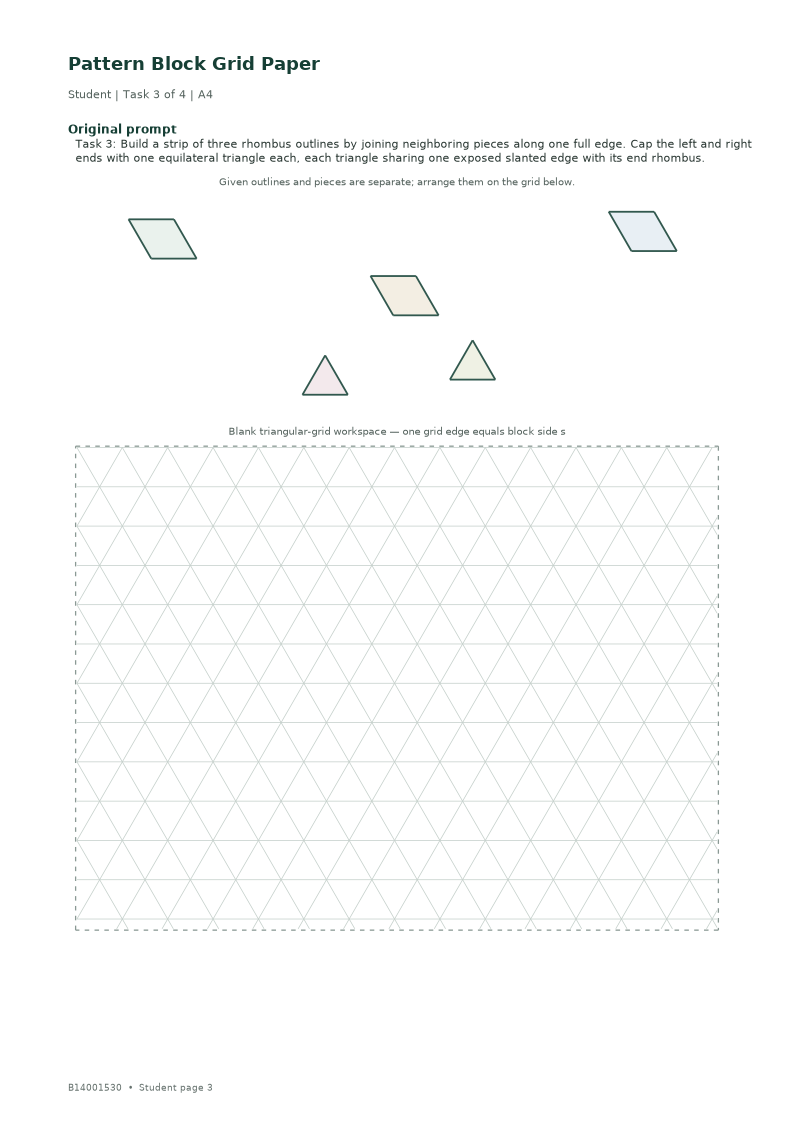
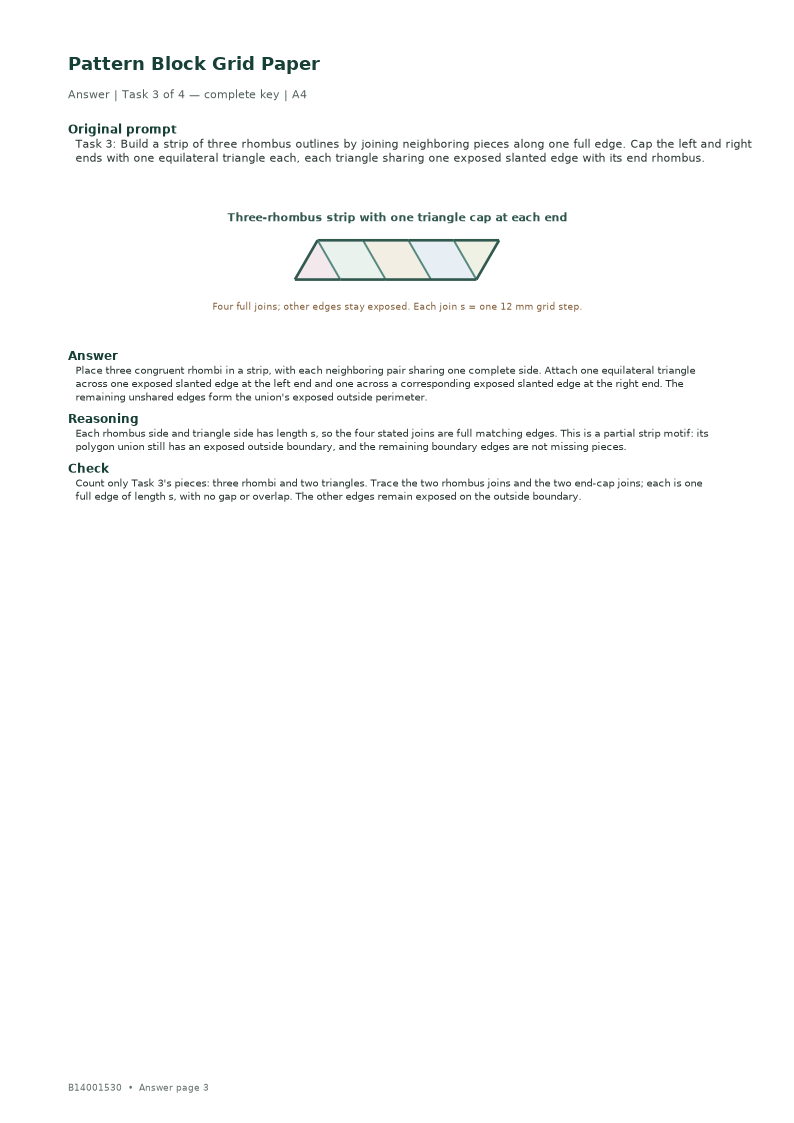
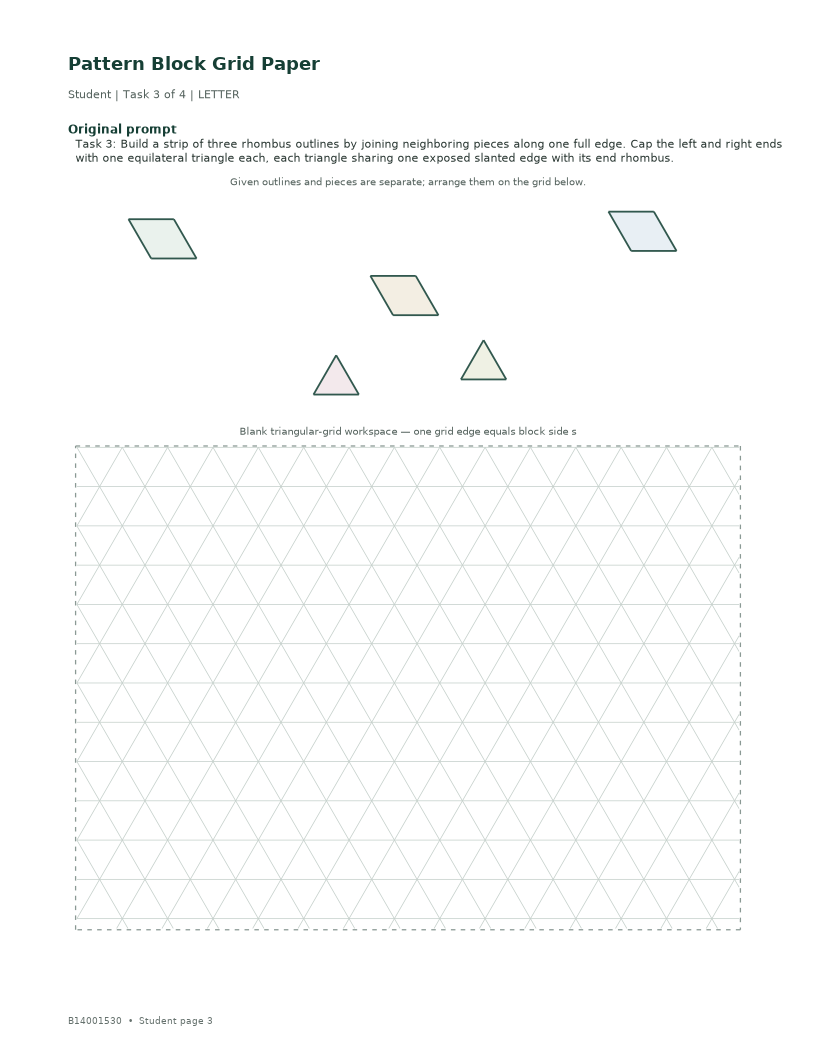
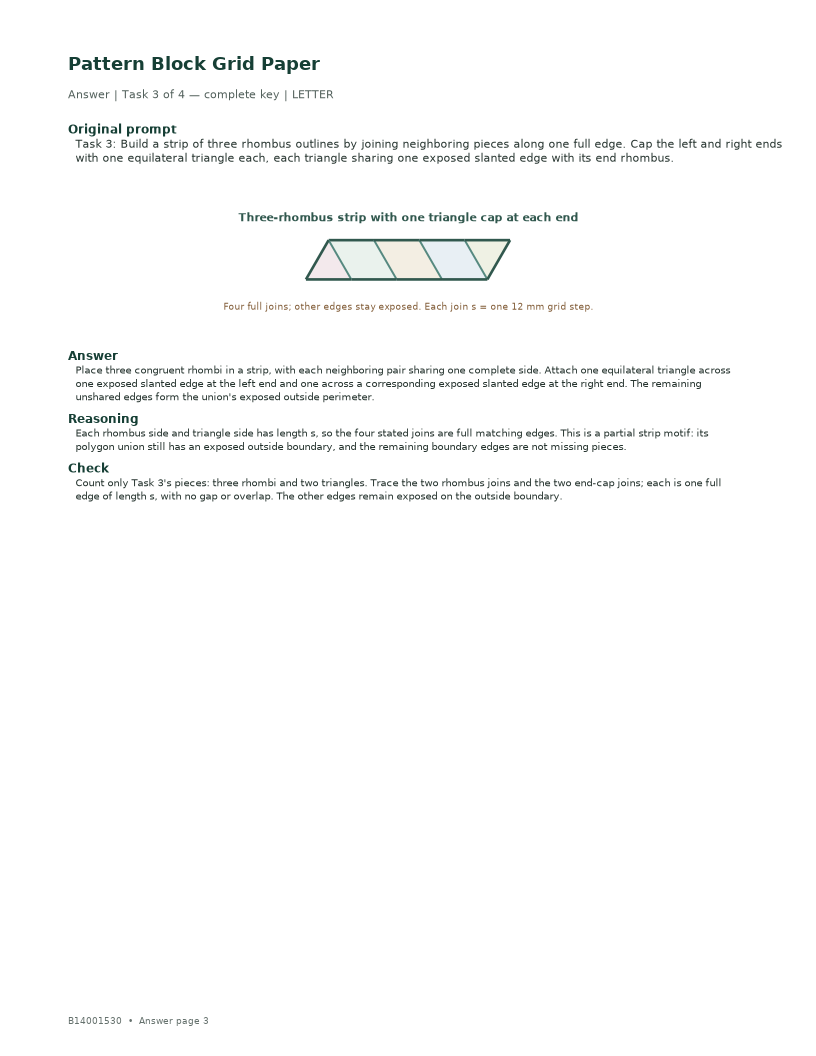
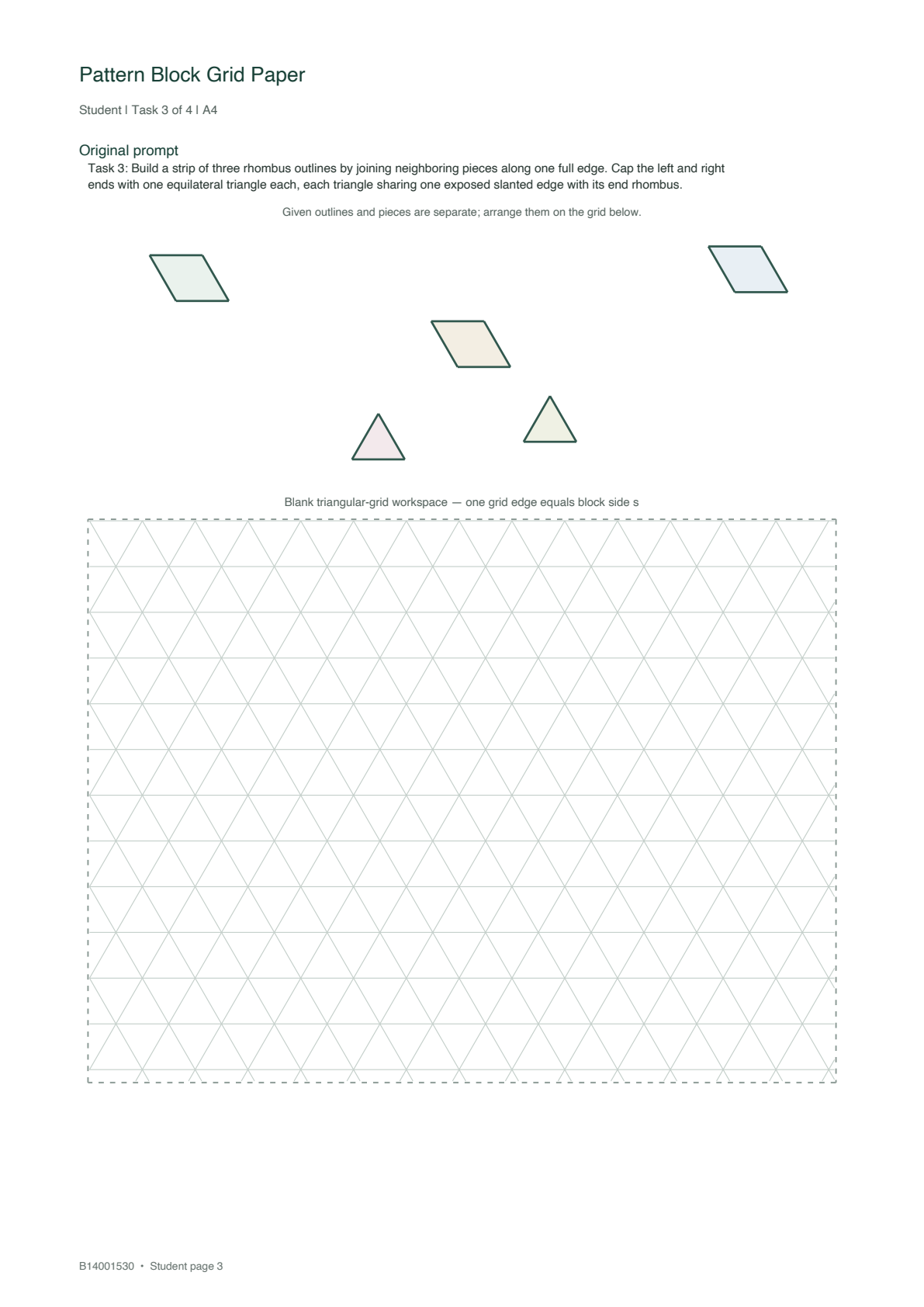
Task 3: Build a strip of three rhombus outlines by joining neighboring pieces along one full edge; cap the left and right ends with one equilateral triangle each, each sharing one exposed slanted edge with its end rhombus. Answer: place three congruent rhombi in a strip, with two full rhombus-to-rhombus joins and one triangle cap at each end. Check: count three rhombi and two triangles; trace those four joins, each of length s. The other unshared edges remain exposed on the outside perimeter.
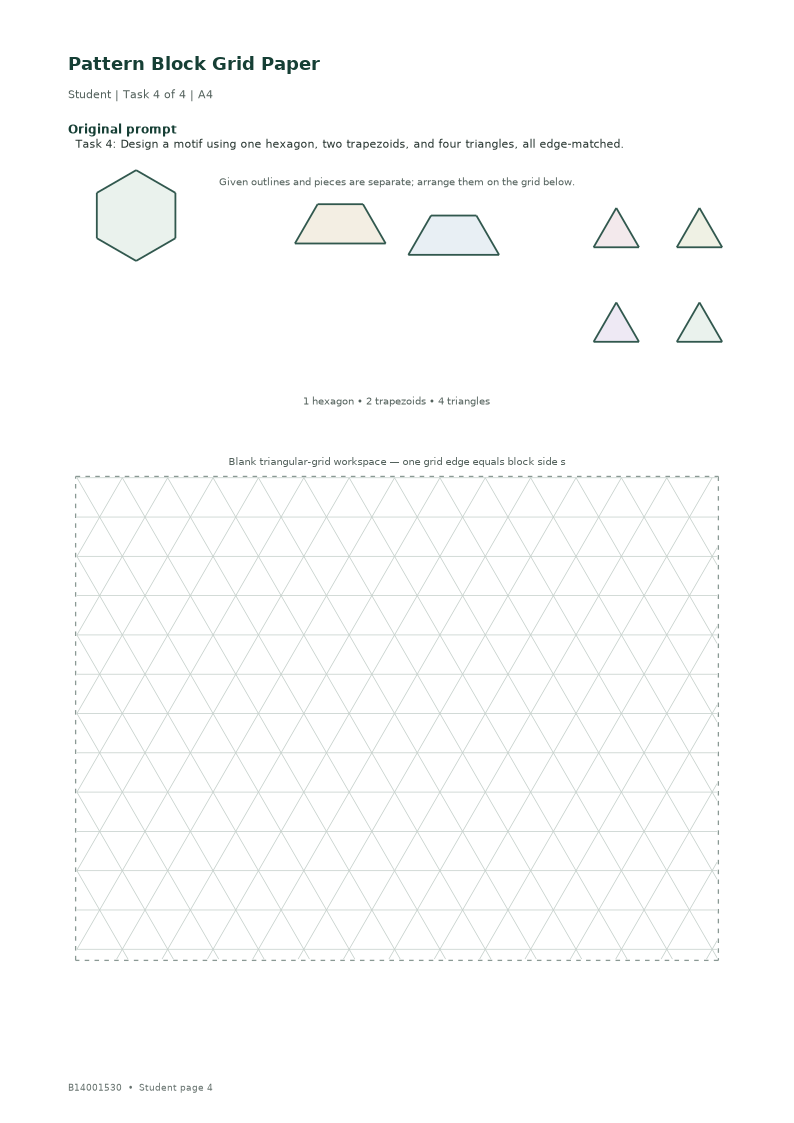
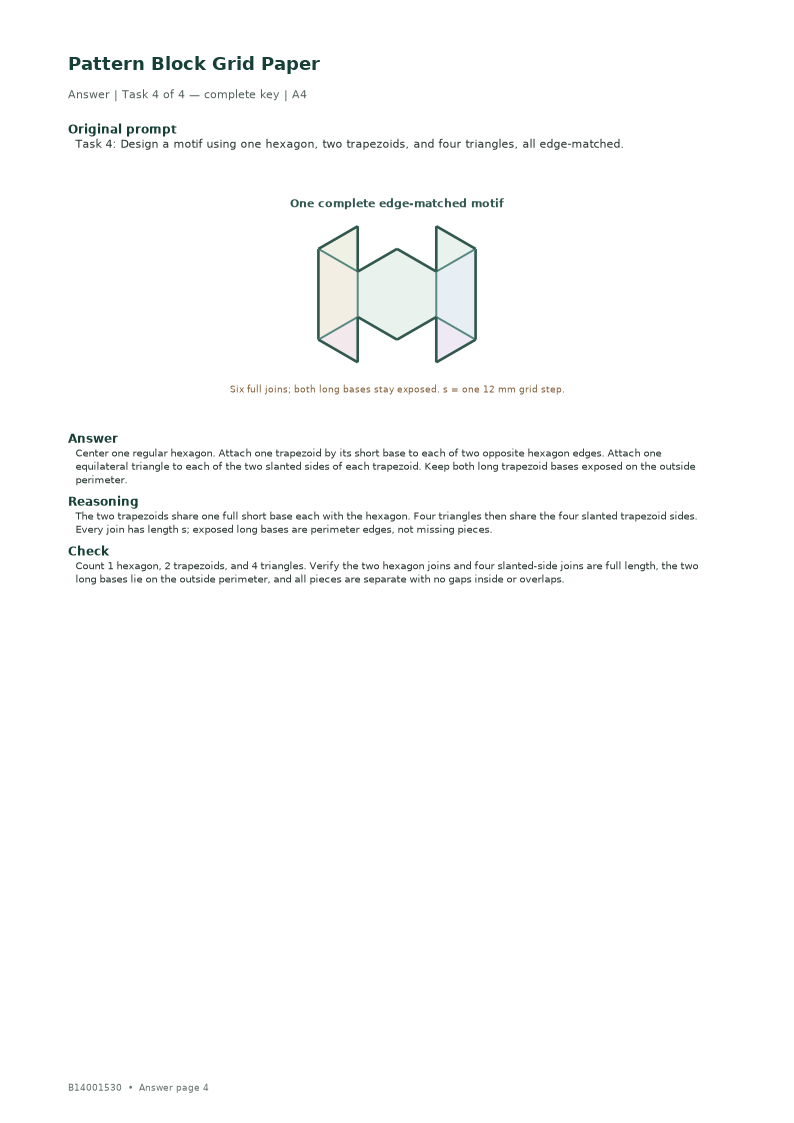
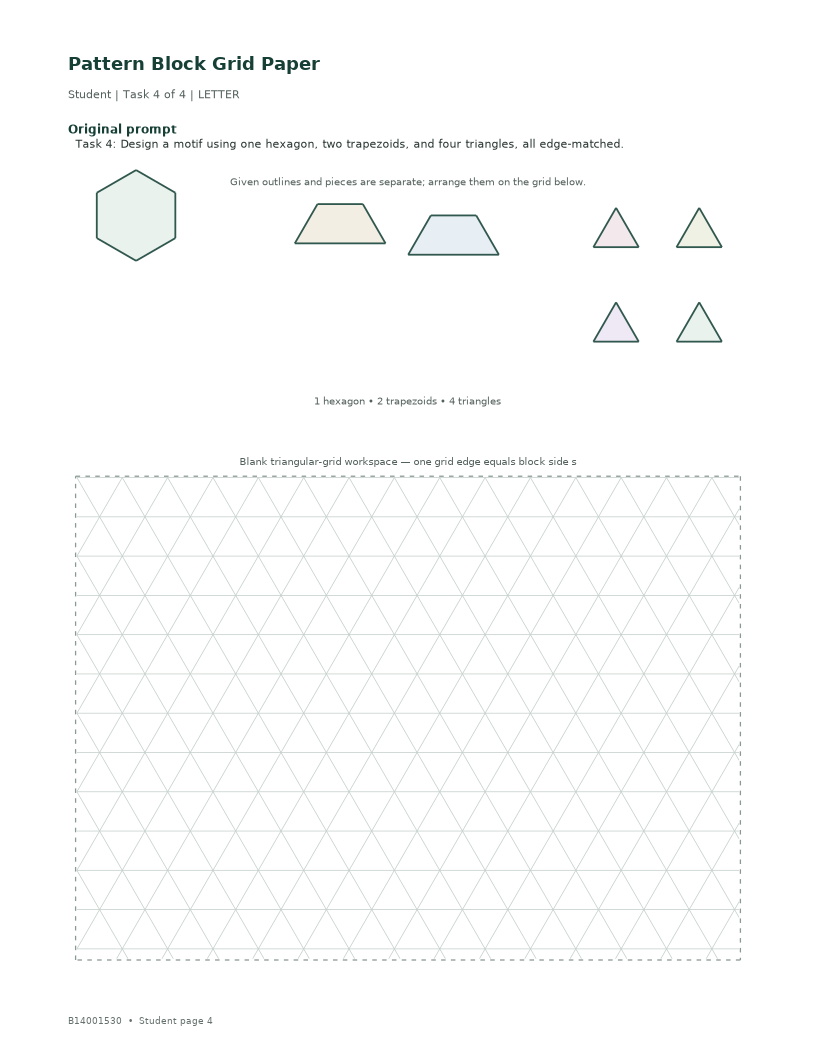
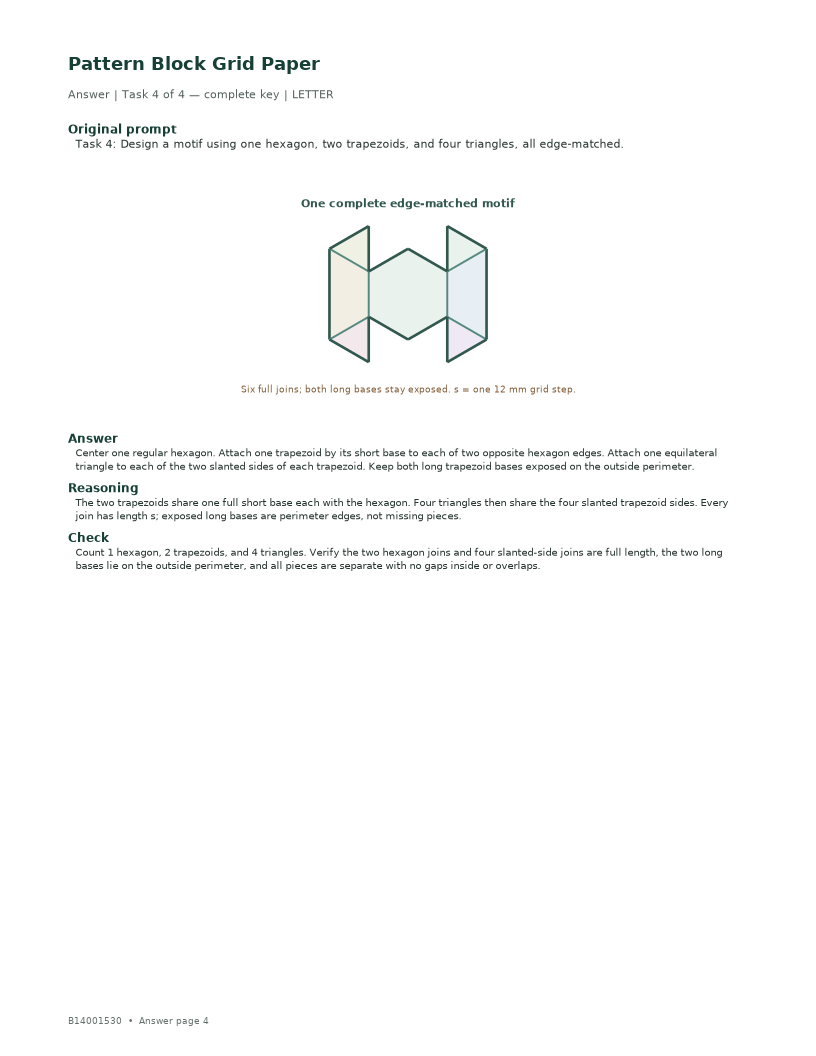
Task 4: Design a motif using one hexagon, two trapezoids, and four triangles, all edge-matched. Answer: place one regular hexagon in the center; attach one trapezoid by its short base s to each of two opposite hexagon edges. Attach one equilateral triangle to each of the four slanted trapezoid sides. Check: count 1 hexagon, 2 trapezoids, and 4 triangles; verify the two short-base joins and four slanted-side joins. Each join is one full length s. Both trapezoid long bases (2s) remain exposed on the union's outside perimeter; there are no gaps or overlaps at the six joins.
Download the complete resource pack
All individual SVG pages (18)
- A4 reference page 1
- A4 student page 1
- A4 student page 2
- A4 student page 3
- A4 student page 4
- A4 answer page 1
- A4 answer page 2
- A4 answer page 3
- A4 answer page 4
- LETTER reference page 1
- LETTER student page 1
- LETTER student page 2
- LETTER student page 3
- LETTER student page 4
- LETTER answer page 1
- LETTER answer page 2
- LETTER answer page 3
- LETTER answer page 4
Print at 100% / actual size. Use the stated scale on any schematic diagram; physical cutting templates are identified separately. A4 and US Letter are separate files. Free access, no signup; CC BY 4.0.
How to use these pages
- What the sheet is
- How the shapes fit
- Worked example
- Practice tasks
- More practice tasks
Worked example
Example: Fill one hexagon outline with six triangle outlines, each sharing one edge with the hexagon and meeting at the center.
Answer: Six equilateral triangles fill the regular hexagon as six wedges around its center. Each triangle's outer side is one hexagon edge, and its two radial sides meet neighboring triangles; all six meet at the center.
Reasoning: For a regular hexagon of side s, the center-to-vertex radius is also s. Therefore each of the six sectors is an equilateral triangle of side s; six such sectors cover the hexagon exactly.
Check: Count six triangular wedges, check one outer edge per wedge on the hexagon, and trace the six radii to confirm neighboring seams meet at the center without a gap or overlap.
Four practice tasks and complete answers
Task 1
Task 1: Fill one trapezoid outline using three triangles, arranged as one triangle sitting on two.
Show answer 1
Place two upright triangles on the two halves of the trapezoid's long base and an inverted triangle between them above the base. The inverted triangle's top edge is the short base; its two slanted edges meet the upper slanted edges of the lower triangles.
The stated isosceles trapezoid has long base 2s, short base s, and height √3s/2. Its interior is exactly the union of two lower upright unit triangles and one upper inverted unit triangle.
Check: Check the three unit triangles cover the full trapezoid: long base 2s, short base s, height √3s/2; all internal edges coincide and there is no gap or overlap.
Task 2
Task 2: Fill one rhombus outline using two triangles.
Show answer 2
Split the 60/120 rhombus along its short diagonal between the obtuse vertices. This diagonal equals one side length, so the two resulting pieces are equilateral triangles. Each triangle shares two outer edges with the rhombus; the diagonal is their internal seam.
The rhombus sides are s and the short diagonal is s. Each half therefore has three side lengths s and is equilateral; the two halves cover the rhombus.
Check: Check two triangles, two rhombus boundary edges per triangle, and one shared internal diagonal; no gap or overlap remains.
Task 3
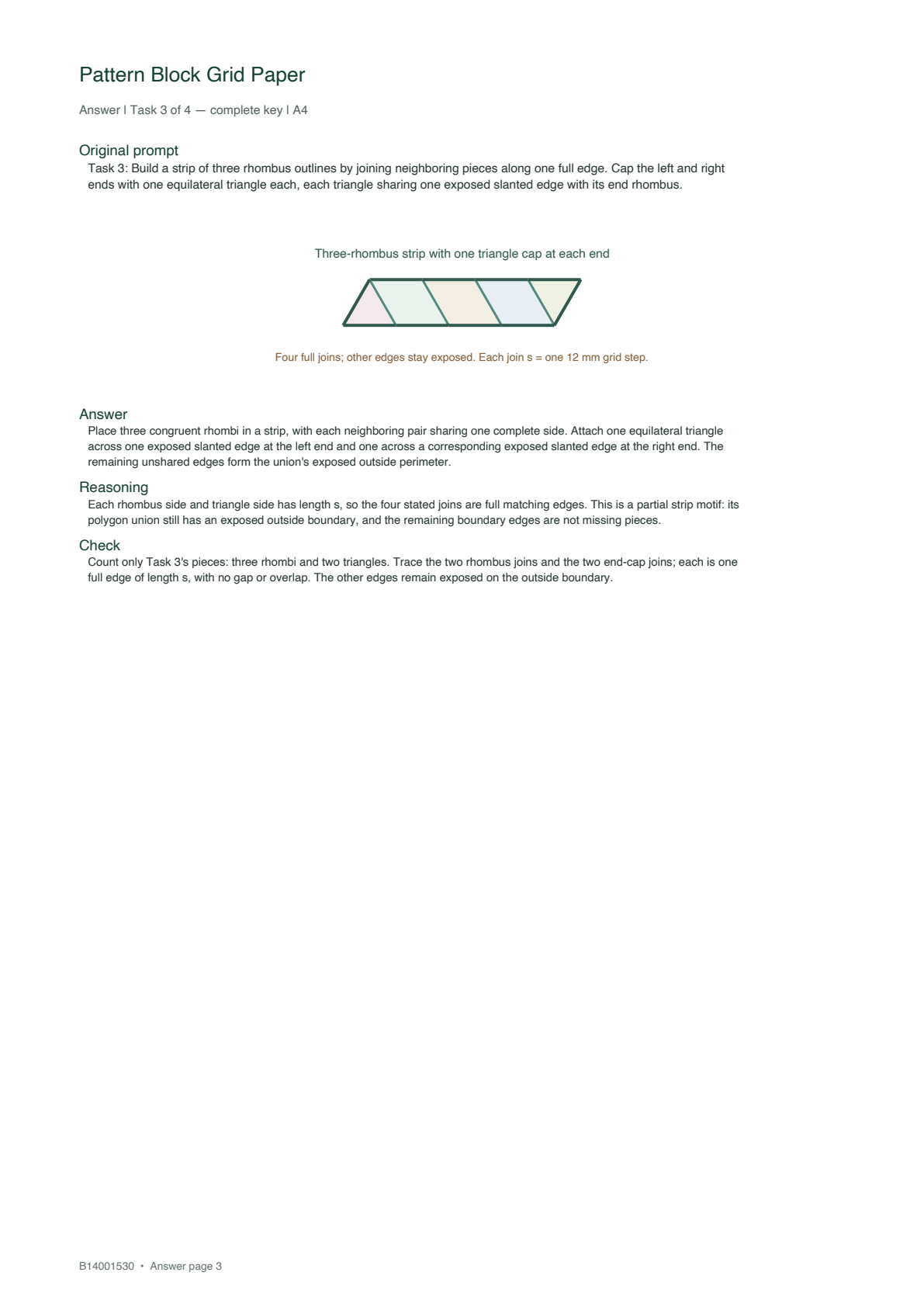
Task 3: Build a strip of three rhombus outlines by joining neighboring pieces along one full edge. Cap the left and right ends with one equilateral triangle each, each triangle sharing one exposed slanted edge with its end rhombus.
Show answer 3
Place three congruent rhombi in a strip, with each neighboring pair sharing one complete side. Attach one equilateral triangle across one exposed slanted edge at the left end and one across a corresponding exposed slanted edge at the right end. The remaining unshared edges form the union's exposed outside perimeter.
Each rhombus side and triangle side has length s, so the four stated joins are full matching edges. This is a partial strip motif: its polygon union still has an exposed outside boundary, and the remaining boundary edges are not missing pieces.
Check: Count only Task 3's pieces: three rhombi and two triangles. Trace the two rhombus joins and the two end-cap joins; each is one full edge of length s, with no gap or overlap. The other edges remain exposed on the outside boundary.
Task 4
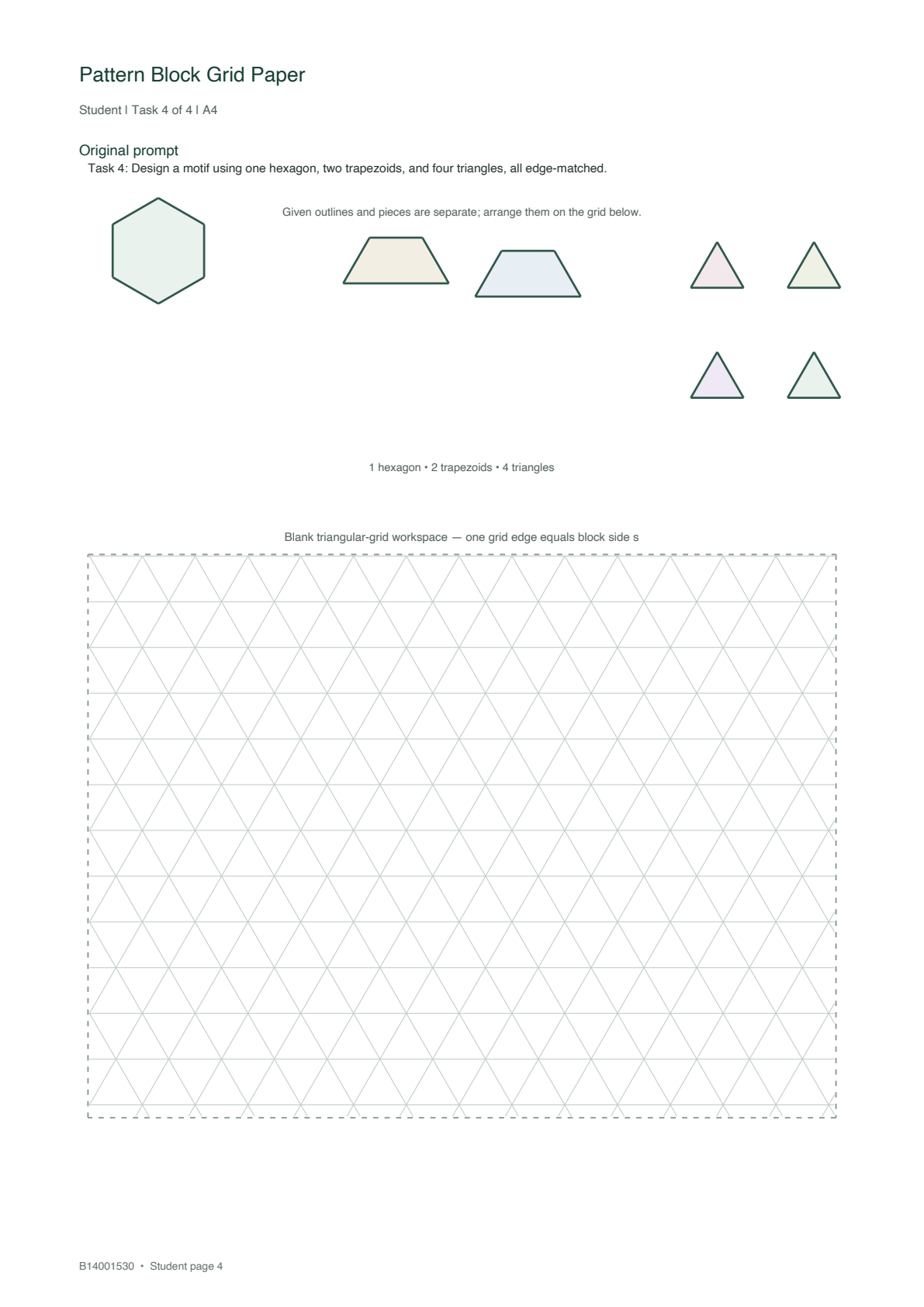
Task 4: Design a motif using one hexagon, two trapezoids, and four triangles, all edge-matched.
Show answer 4
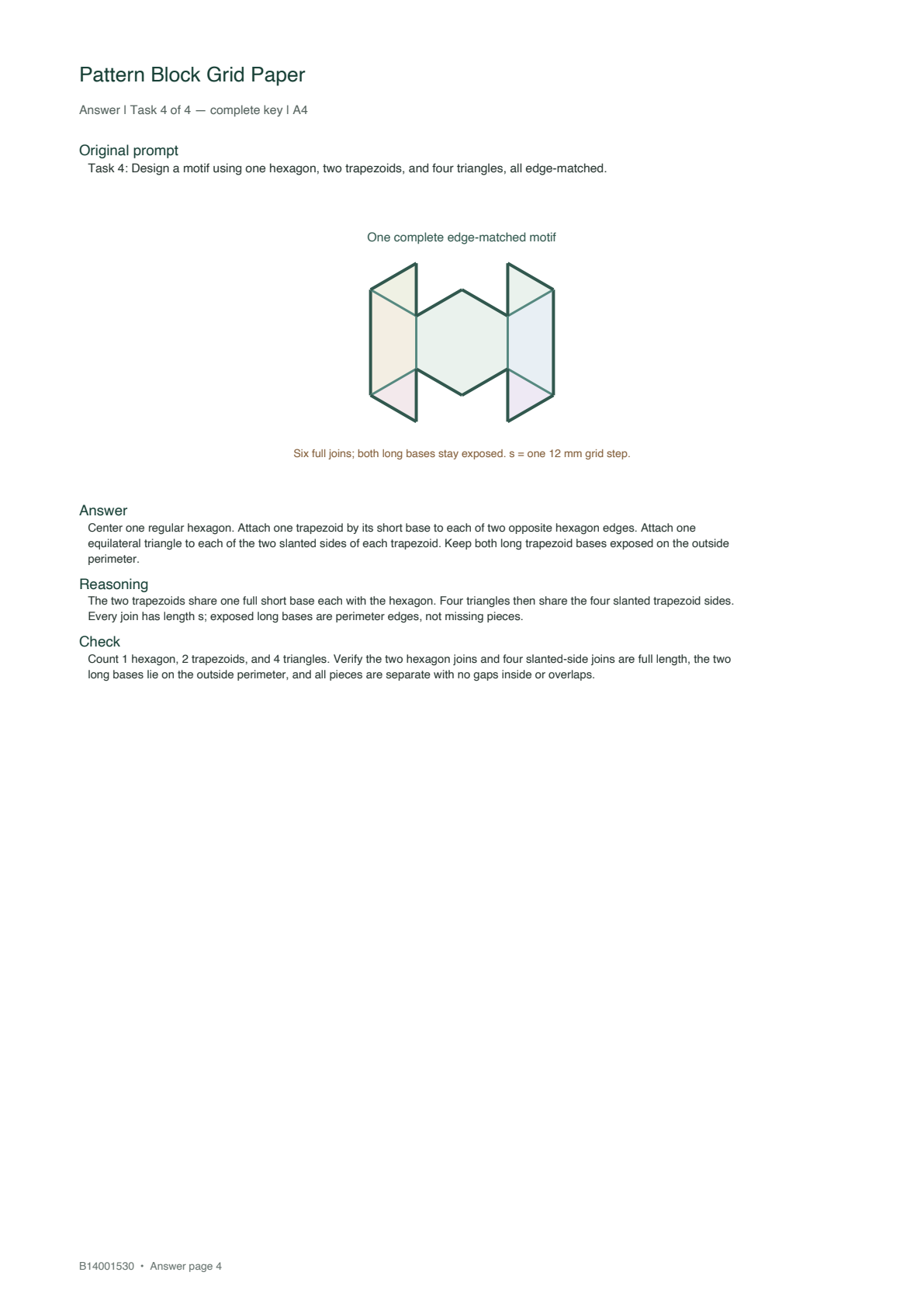
Center one regular hexagon. Attach one trapezoid by its short base to each of two opposite hexagon edges. Attach one equilateral triangle to each of the two slanted sides of each trapezoid. Keep both long trapezoid bases exposed on the outside perimeter.
The two trapezoids share one full short base each with the hexagon. Four triangles then share the four slanted trapezoid sides. Every join has length s; exposed long bases are perimeter edges, not missing pieces.
Check: Count 1 hexagon, 2 trapezoids, and 4 triangles. Verify the two hexagon joins and four slanted-side joins are full length, the two long bases lie on the outside perimeter, and all pieces are separate with no gaps inside or overlaps.
Useful checks
- Leaving a half-filled outline. Trace each seam and fill both sides before moving on.
- Overlapping shapes. Match edges exactly; do not let outlines cross.
Questions about this resource
Do I need exact measurements?
No. Use the common unit edge s; the trapezoid's long base is 2s. The worksheet gives the relative lengths and asks you to match the specified edges.
Can I invent new shapes?
No. Use only the five pattern-block outlines on the sheet.