HomePrintable Hebrew Alphabet Chart: Block Letters and Stroke Order Free original lessons
Printable Hebrew Alphabet Chart: Block Letters and Stroke Order
Plan a printable Hebrew alphabet chart with block letterforms, numbered stroke order, tracing rows, and a blank practice row. Clarifies diacritics and final forms.
Free downloads
Letter & A4
PDF & SVG
Writing and Handwriting Paper Guides
This page explains how to design and use a printable Hebrew alphabet chart focused on block letterforms and stroke order. It covers the 22 base letters, the five final forms, and the difference between base strokes and diacritic dots such as dagesh or the Shin/Sin distinguishing point. The standard pack is available in both paper sizes, with reference, practice, and answer pages. Artwork has multiple valid outcomes, so a rubric is used rather than a single exact answer.
Practice materials: Download the free reference pages, practice sheets and separate answer keys below, in A4 and US Letter PDF and SVG formats.
What the chart should show
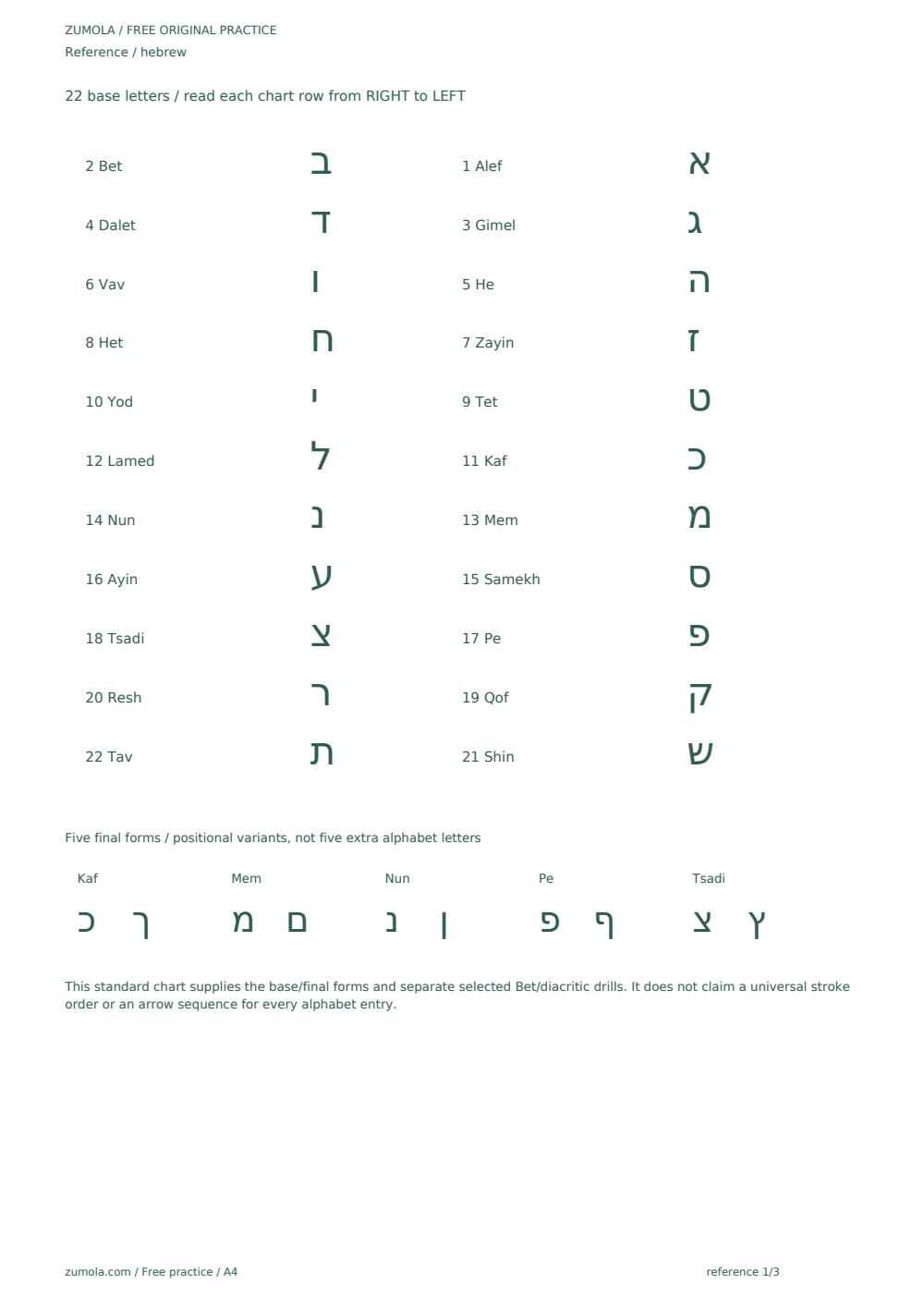
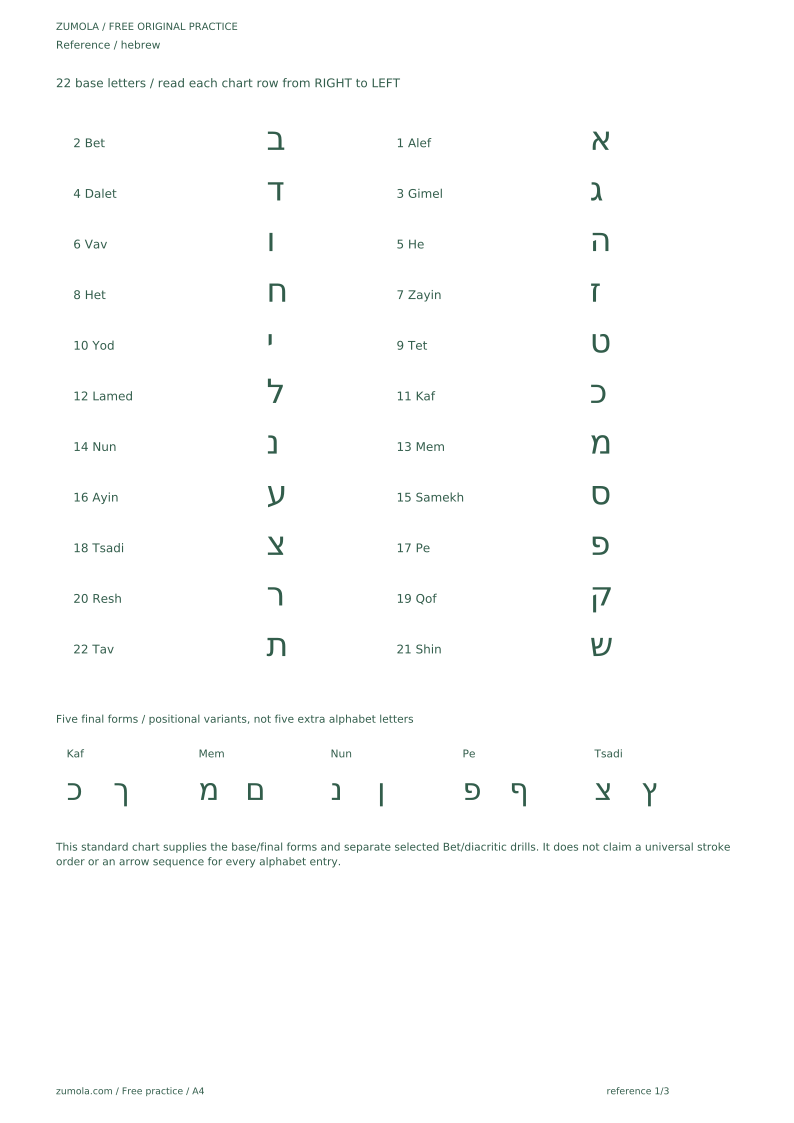
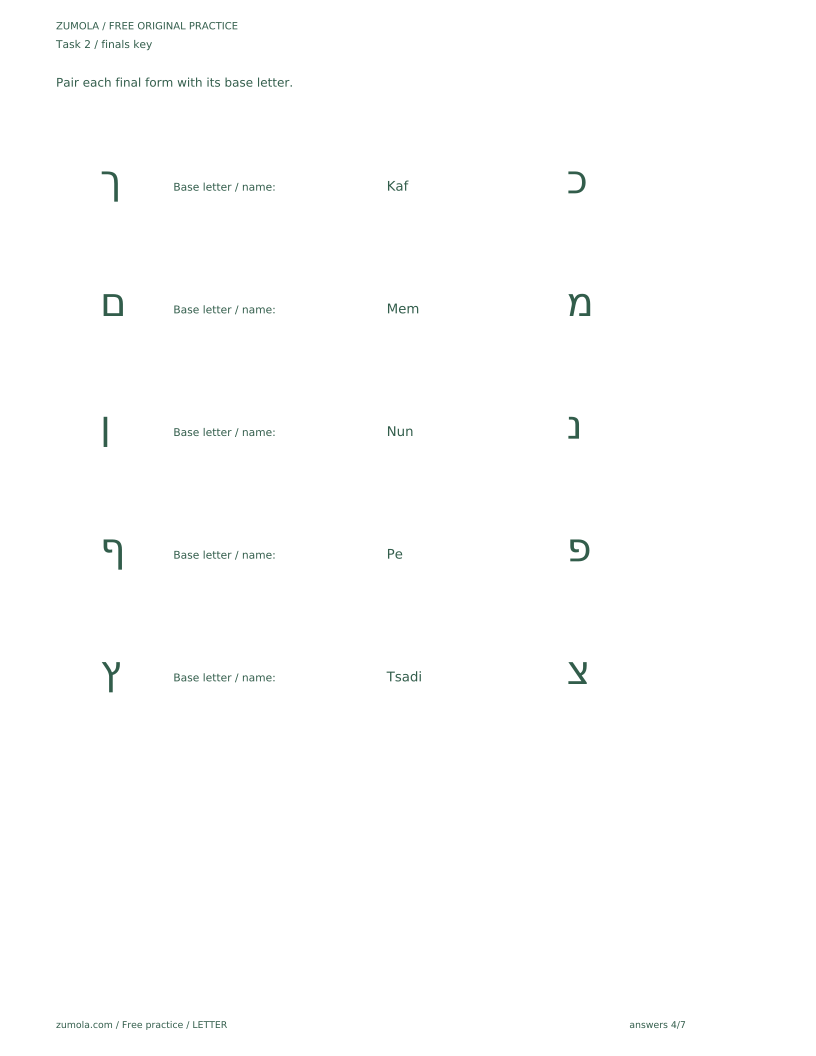
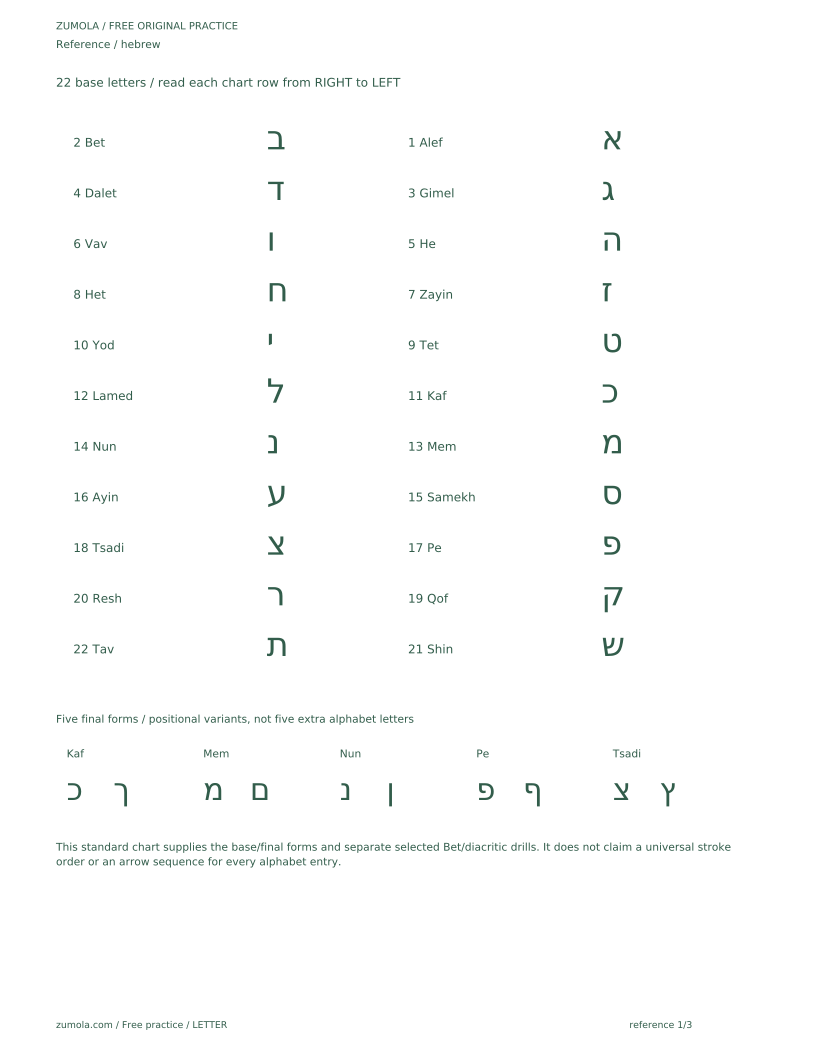
A block-letter Hebrew chart should present each of the 22 letters as a clear, stable shape. Final forms (Kaf, Mem, Nun, Pe, Tsadi) are additional positional forms of five letters, not extra letters, so the chart can label them separately without implying a 27-letter alphabet. Each letter entry should show the base letterform, a numbered stroke sequence, a tracing row, and a blank practice row.
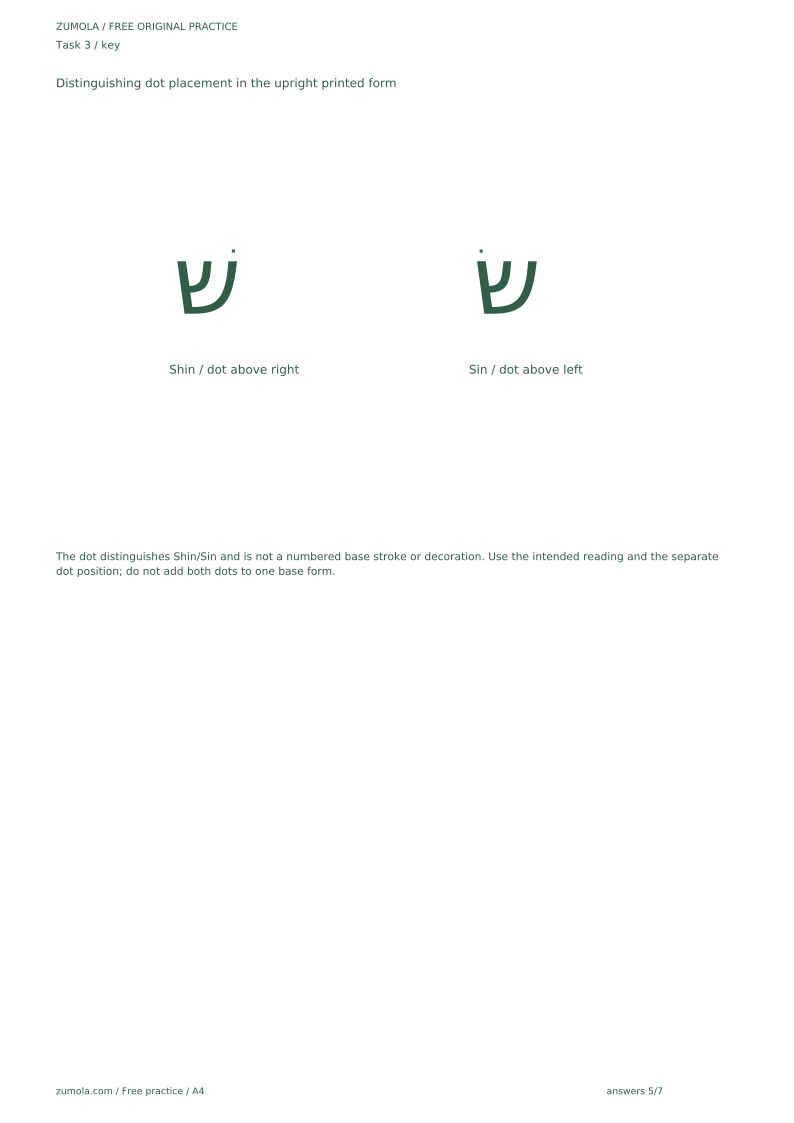
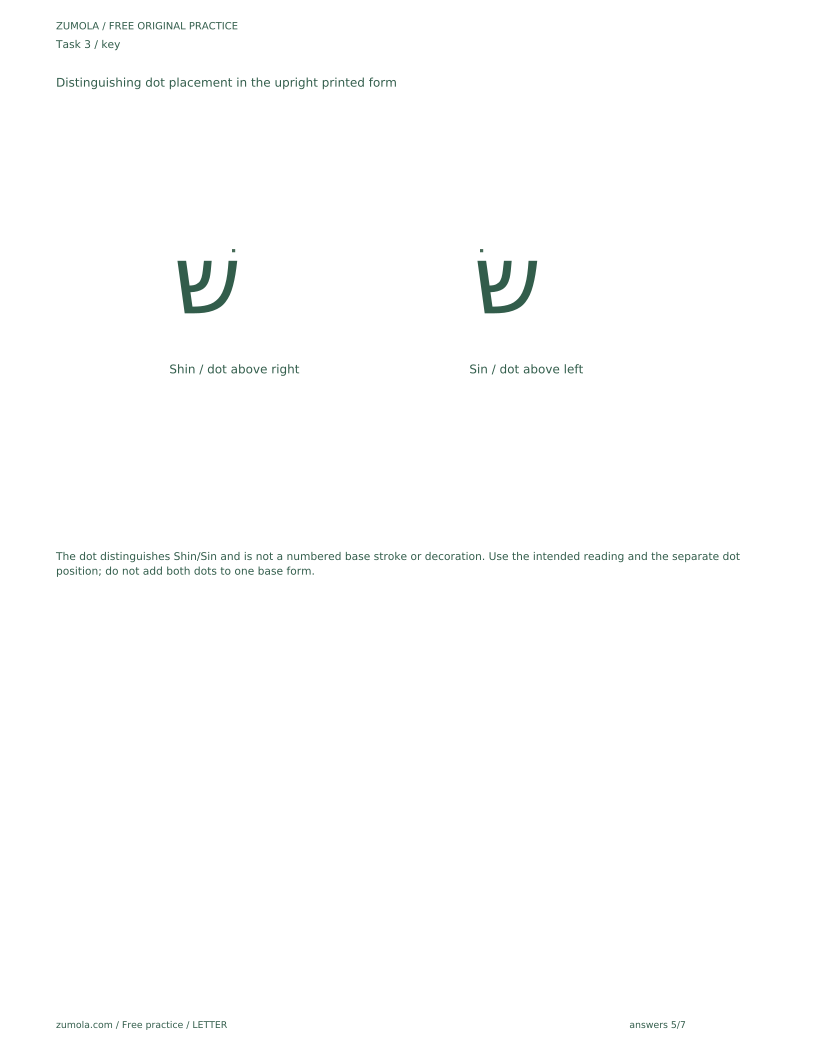
Diacritics are not base strokes. The dagesh is a dot that may appear inside certain letters depending on vocalization; it is not part of the letter's intrinsic construction. The dot on Shin distinguishes Shin from Sin and belongs on the correct side; it is a distinguishing mark, not a decorative stroke. The chart should show such marks separately from the numbered base strokes and state that their presence depends on the writing context being taught.
- List the 22 base letters in order, then list the five final forms separately with a note that they are positional variants.
- For each base letter, draw one clear block form and number only the strokes that construct that base shape.
- Show any dagesh or Shin/Sin dot as a separate mark with a short label, not as a numbered base stroke.
- Add a tracing row with faint guide forms and a blank row for independent writing.
Stroke order and letterform accuracy
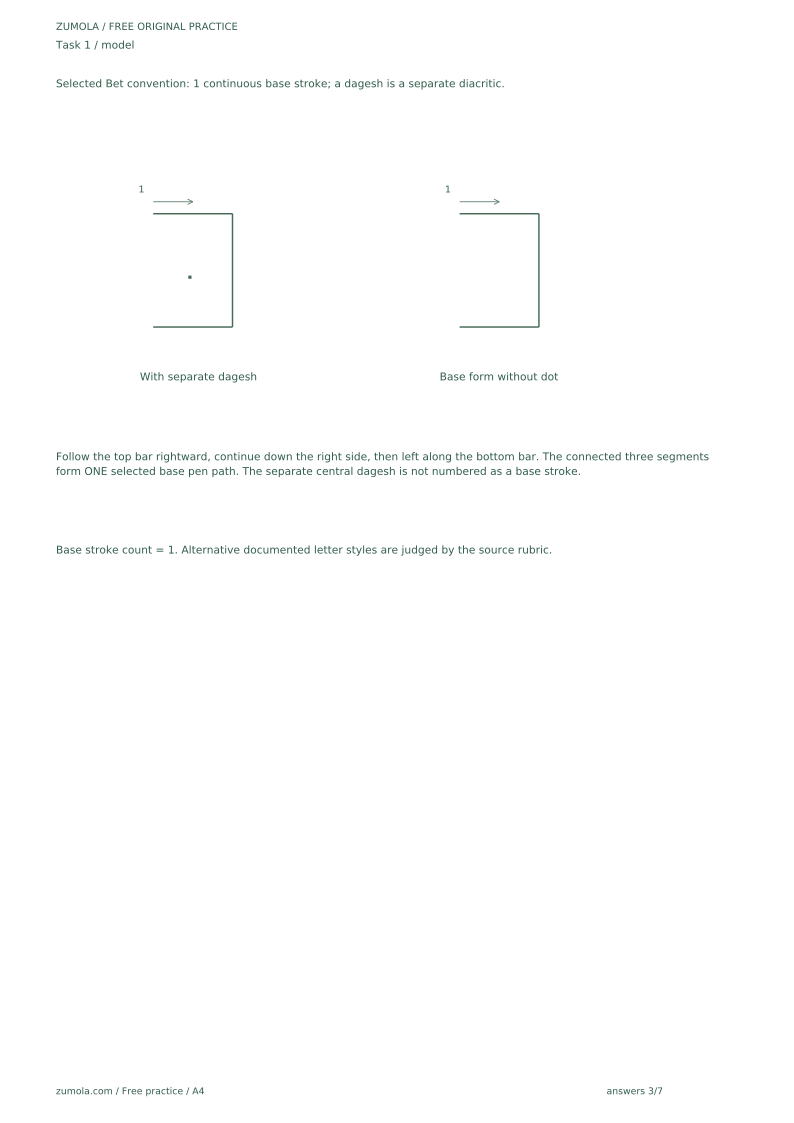
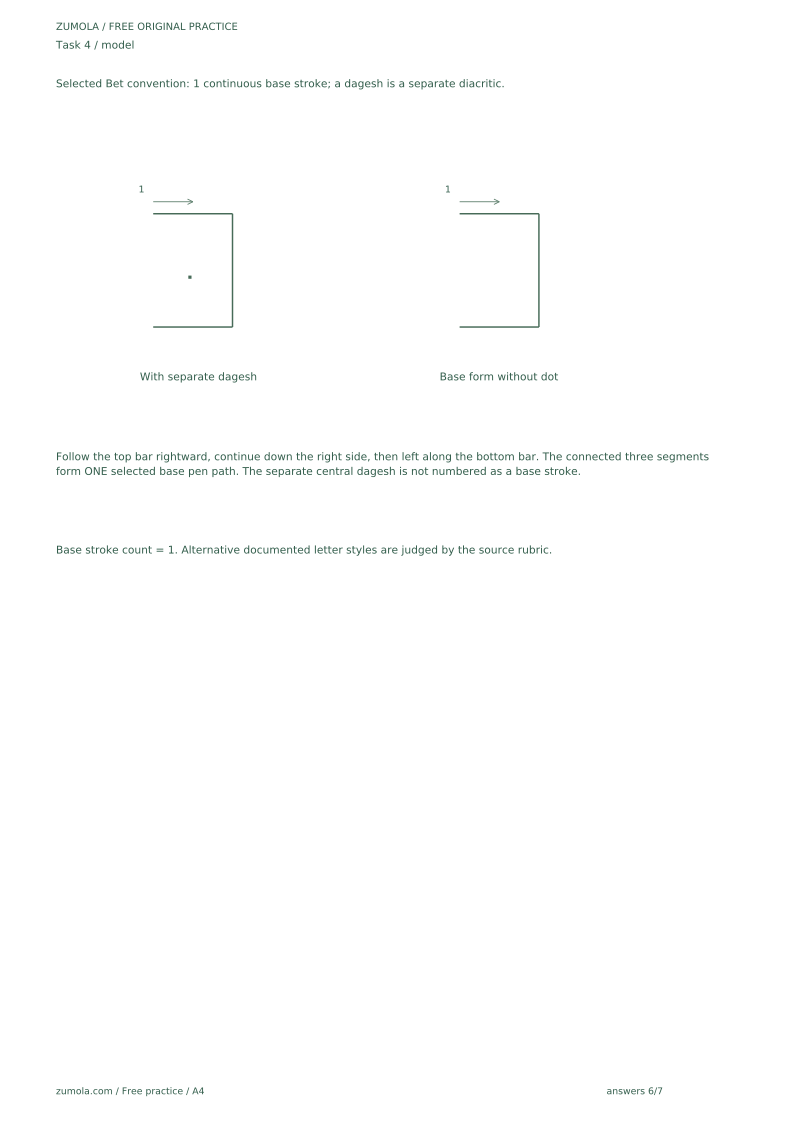
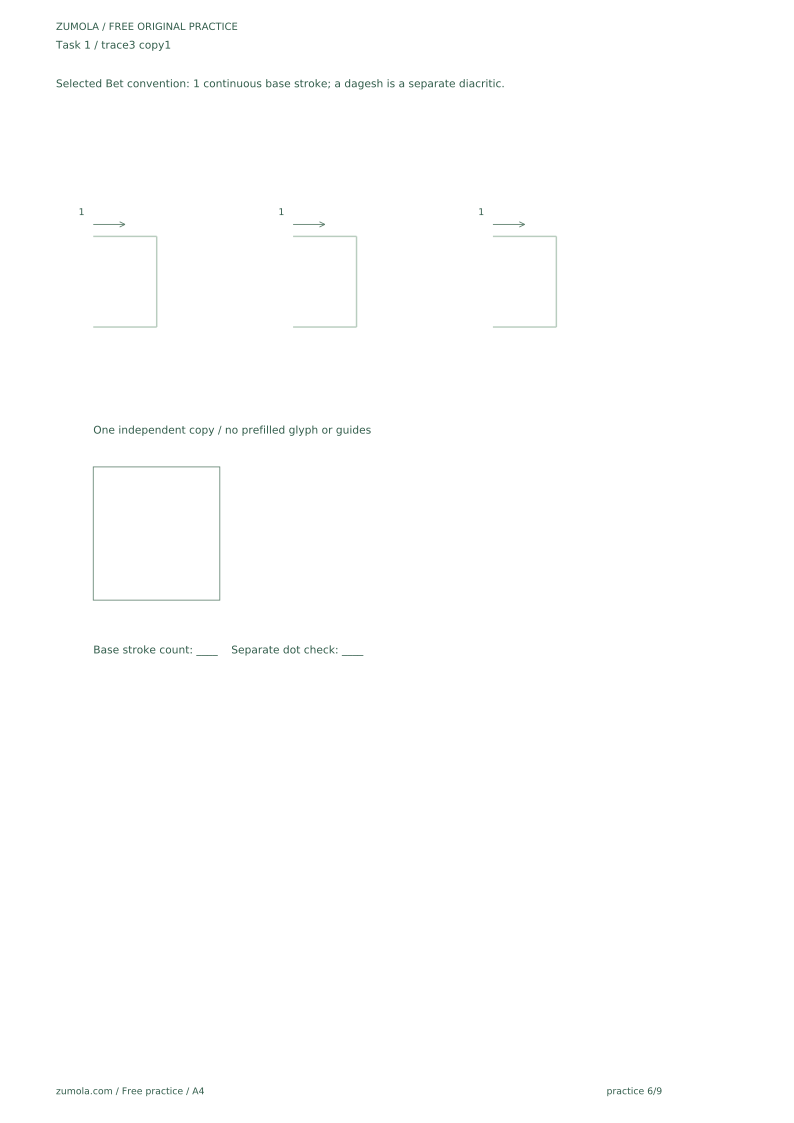
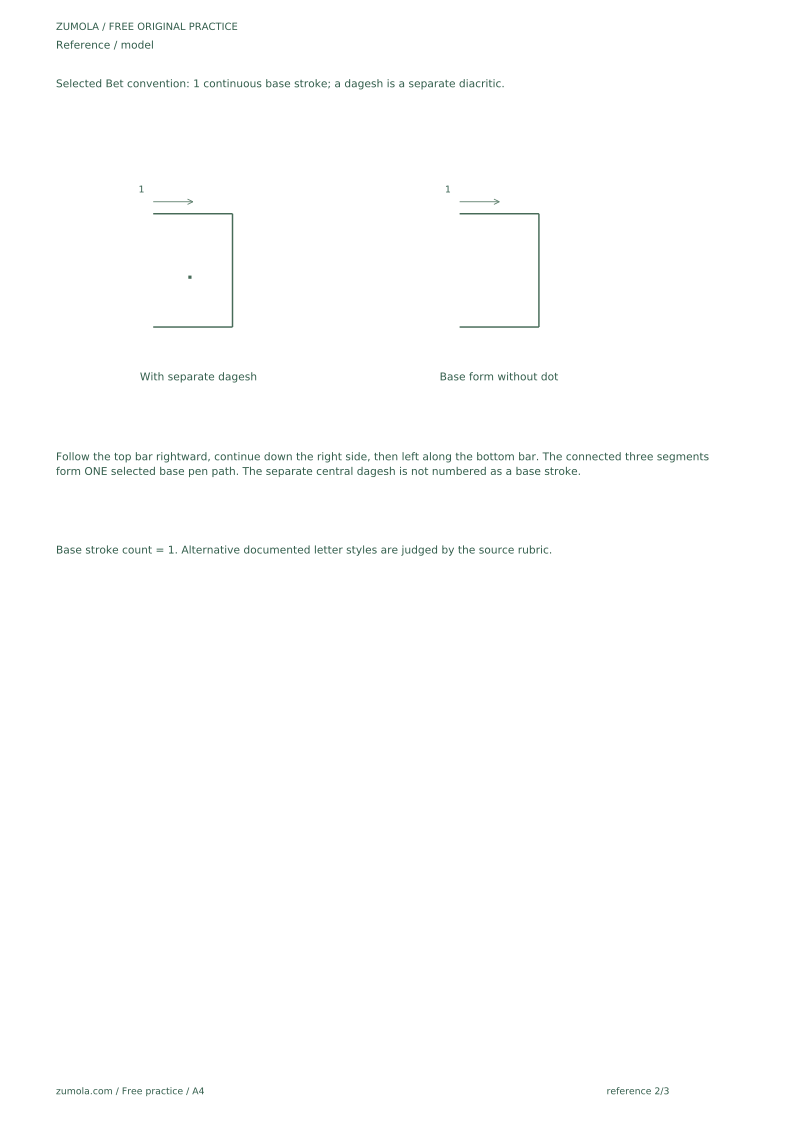
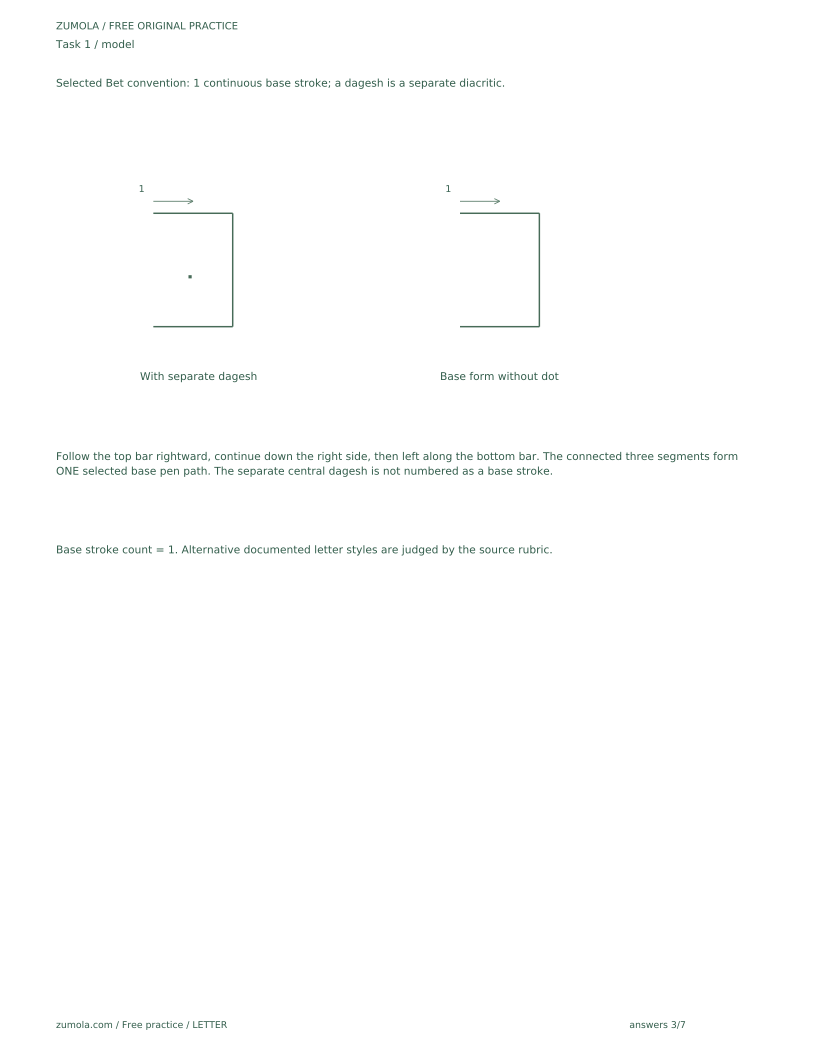
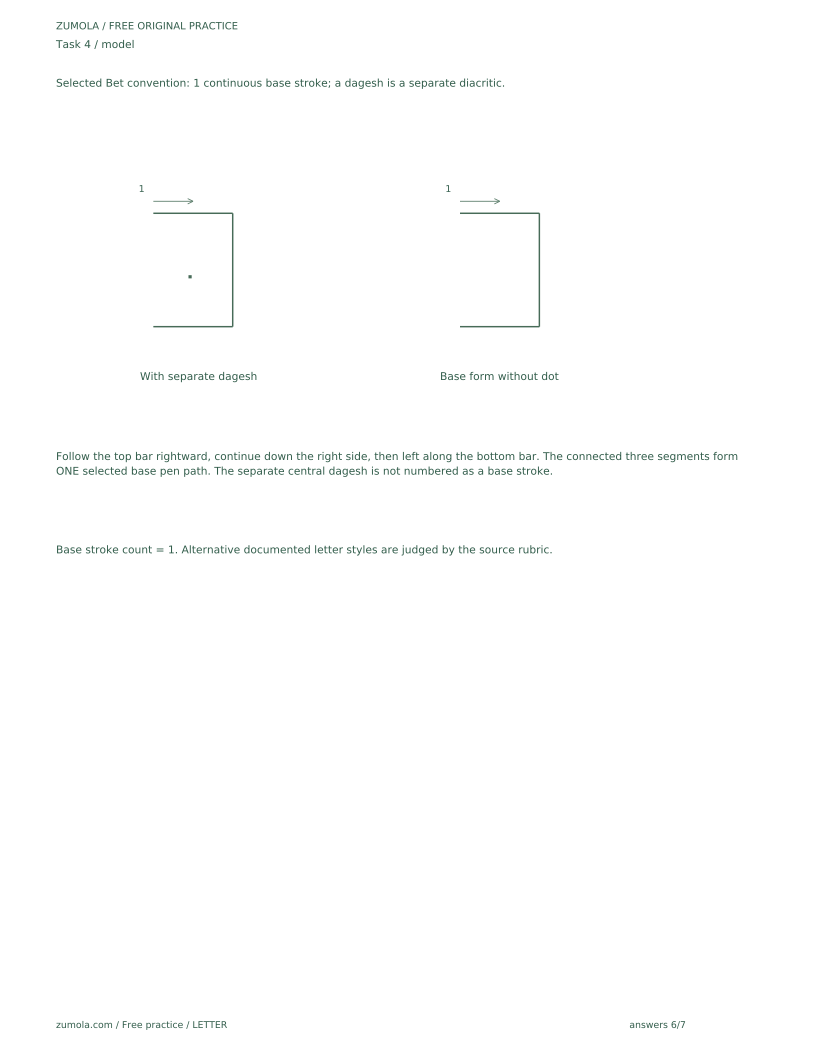
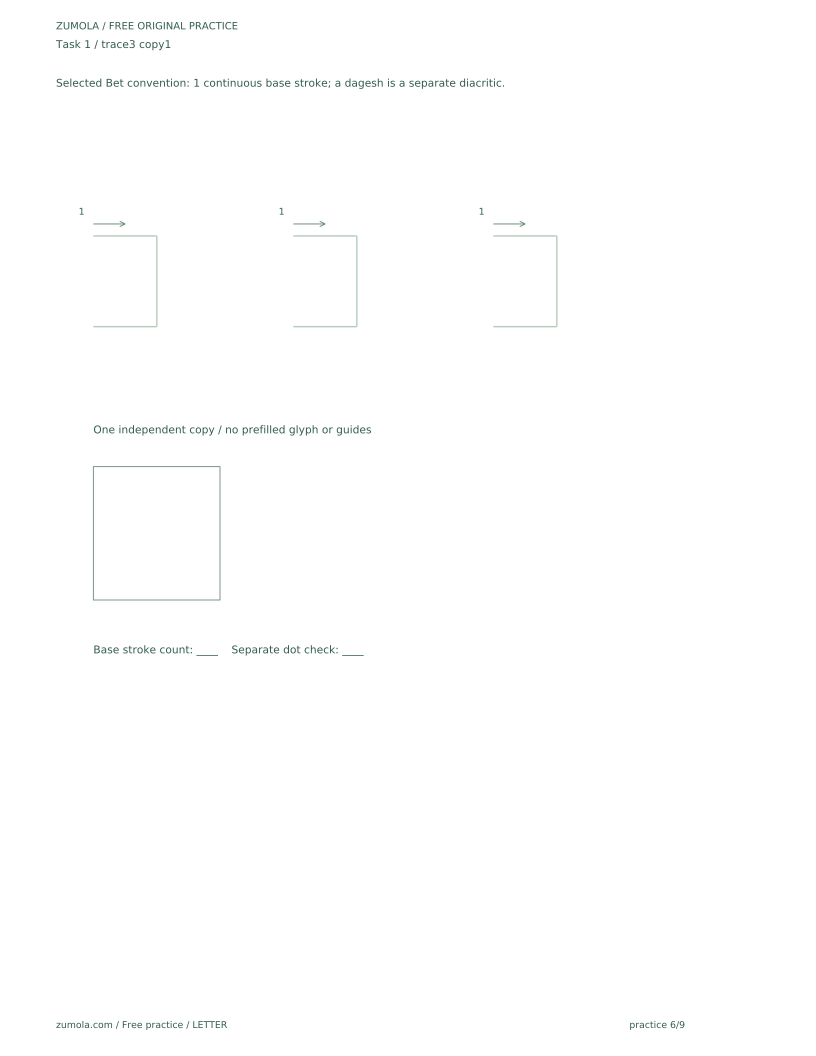
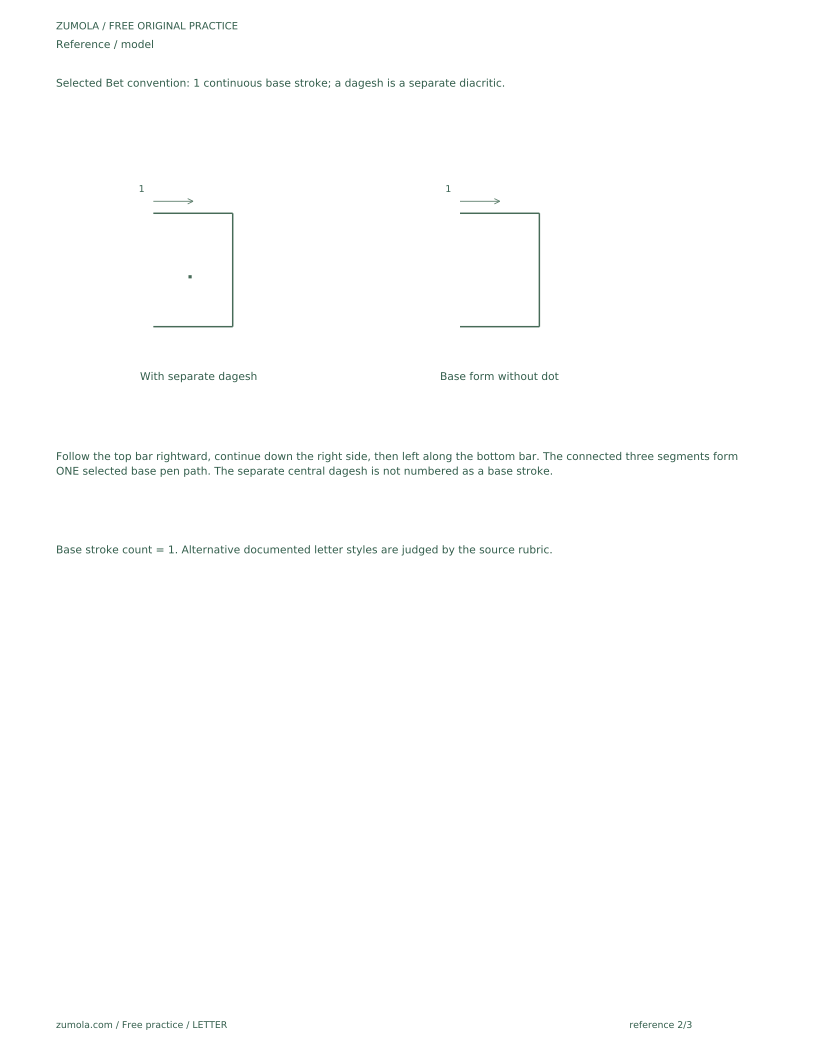
Stroke order in block Hebrew is a teaching convention, not a single universal law. The chart should state its convention and number strokes consistently. For Bet, describe one continuous base form: a top horizontal that turns down the right side and then continues left along the bottom bar. Do not present the dagesh dot as an intrinsic stroke of Bet. Letters that may carry a dot (dagesh) or a distinguishing dot (for example Shin/Sin) should be described as carrying diacritics, not as having extra base strokes. This chart adopts exactly one continuous Bet base stroke through top, right side and bottom bar; its base stroke count is 1. This sequence is a selected worksheet convention, not a universal requirement.
Accuracy means the base shape is recognizable and stable across the tracing and blank rows. A learner should be able to follow the numbered sequence and produce a shape that matches the chart's convention in stroke count and proportion. Because block letterforms vary by style, the chart should choose one style and apply it consistently rather than mixing conventions.
- Write a one-line convention note at the top of the chart, such as top-to-bottom and right-to-left stroke direction where applicable.
- Number strokes on the base letter only; place diacritic dots in a separate labeled column or note.
- Check that each tracing row uses the same stroke count and shape as the numbered example.
- Keep the blank row free of guides so the learner writes independently.
Using the chart for practice
Practice should move from observation to tracing to independent writing. The learner first reads the numbered strokes, then traces the faint forms, then writes in the blank row. The chart is a reference, not a test sheet; the goal is a stable, recognizable block form that follows the chart's stated convention.
When printing, measure your own paper and printer before setting any margins or hole positions. Example values are hypothetical only; do not treat them as universal requirements. A brief note on the chart can remind users to adjust layout to their equipment.
- Read the numbered strokes aloud or point to each number before tracing.
- Trace the faint forms slowly, matching stroke count and direction to the chart.
- Write the letter in the blank row without guides, then compare shape and stroke count to the example.
- Repeat with final forms and with diacritic marks shown separately.
Worked example
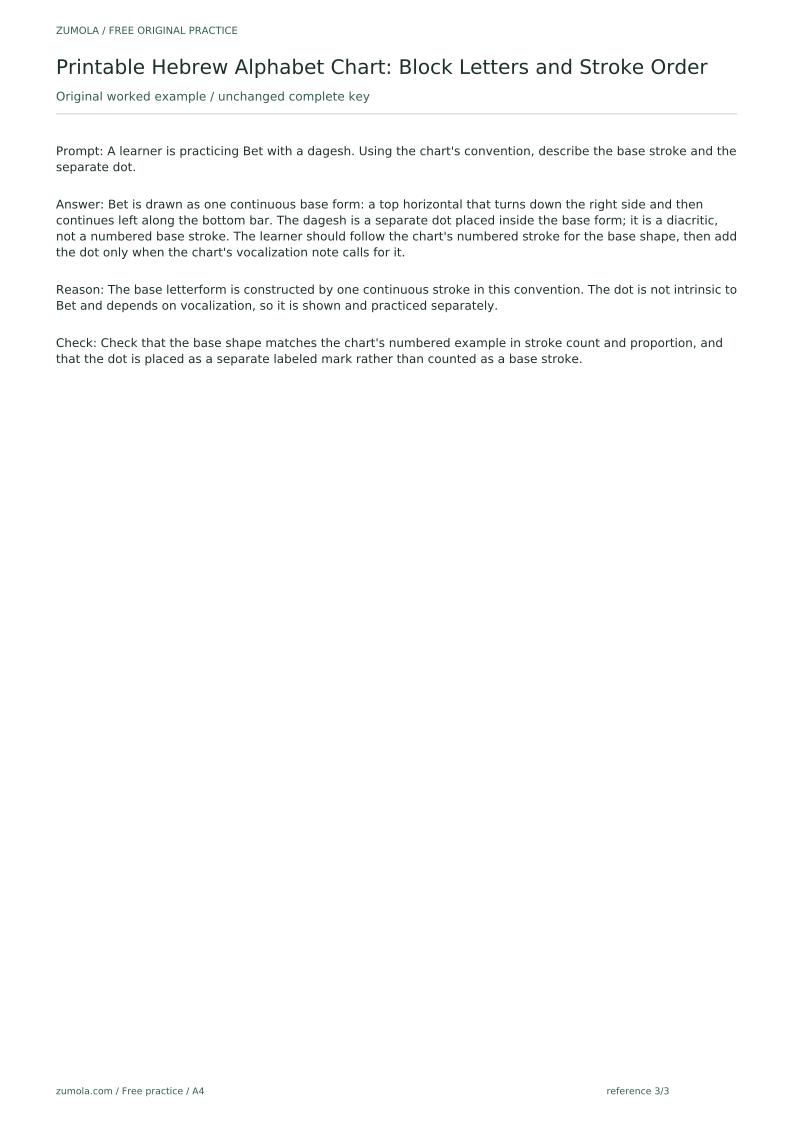
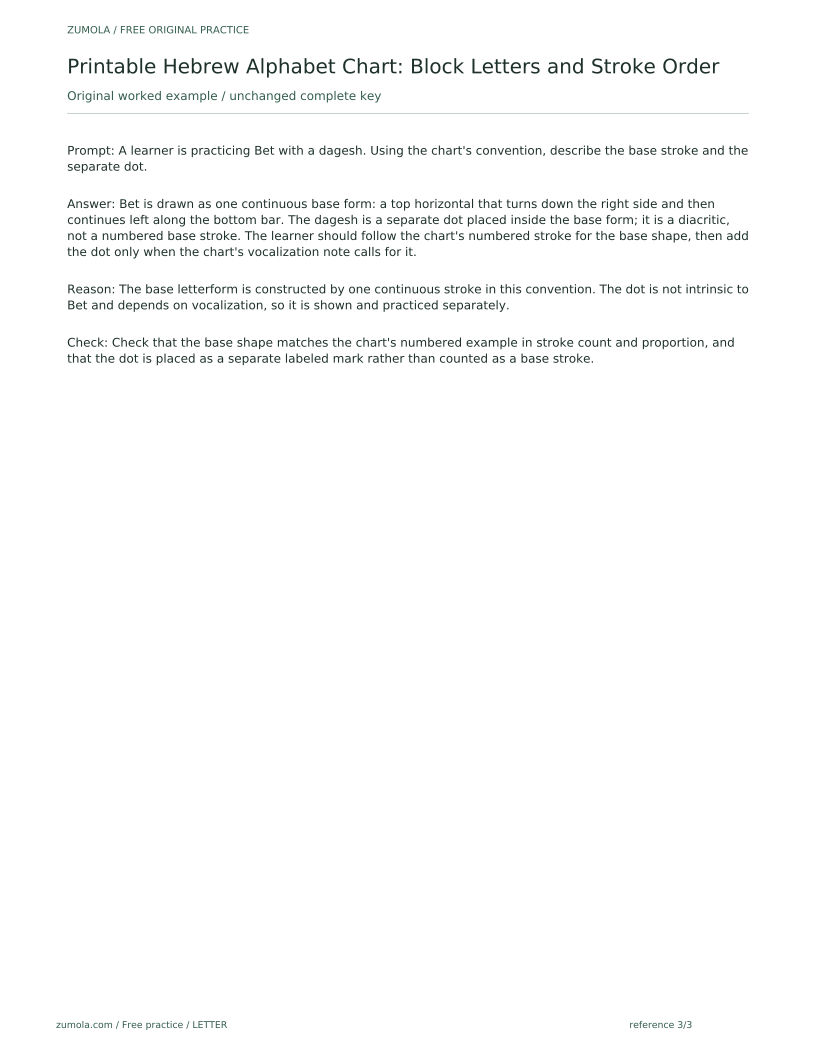
A learner is practicing Bet with a dagesh. Using the chart's convention, describe the base stroke and the separate dot.
Worked answer
Bet is drawn as one continuous base form: a top horizontal that turns down the right side and then continues left along the bottom bar. The dagesh is a separate dot placed inside the base form; it is a diacritic, not a numbered base stroke. The learner should follow the chart's numbered stroke for the base shape, then add the dot only when the chart's vocalization note calls for it.
Why: The base letterform is constructed by one continuous stroke in this convention. The dot is not intrinsic to Bet and depends on vocalization, so it is shown and practiced separately.
Check: Check that the base shape matches the chart's numbered example in stroke count and proportion, and that the dot is placed as a separate labeled mark rather than counted as a base stroke.
Four practice exercises
Exercise 1
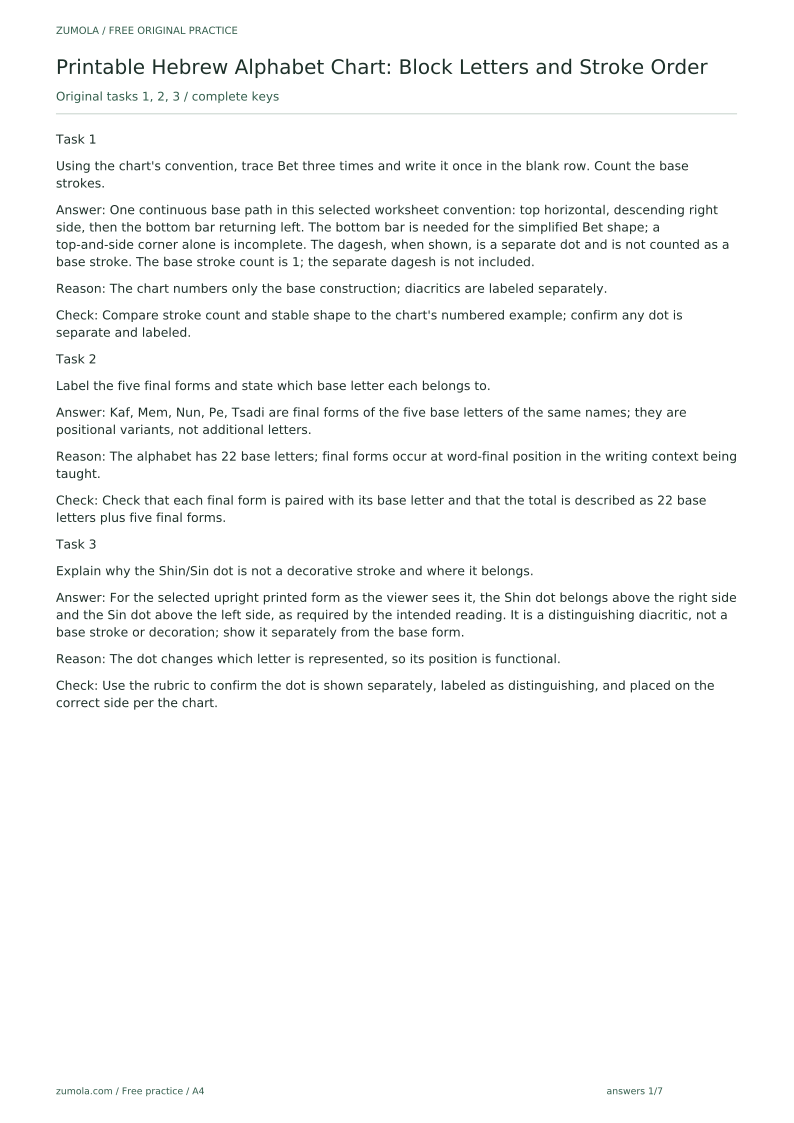
Using the chart's convention, trace Bet three times and write it once in the blank row. Count the base strokes.
Show answer and check
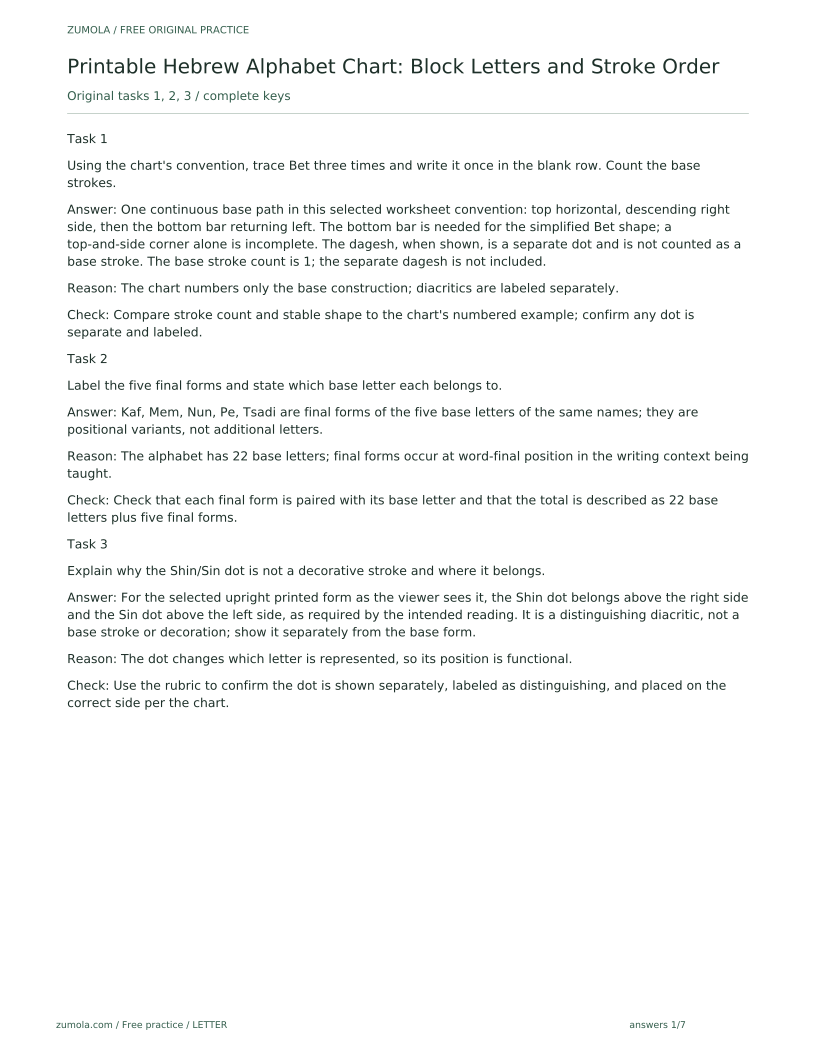
One continuous base path in this selected worksheet convention: top horizontal, descending right side, then the bottom bar returning left. The bottom bar is needed for the simplified Bet shape; a top-and-side corner alone is incomplete. The dagesh, when shown, is a separate dot and is not counted as a base stroke. The base stroke count is 1; the separate dagesh is not included.
Why: The chart numbers only the base construction; diacritics are labeled separately.
Check: Compare stroke count and stable shape to the chart's numbered example; confirm any dot is separate and labeled.
Exercise 2
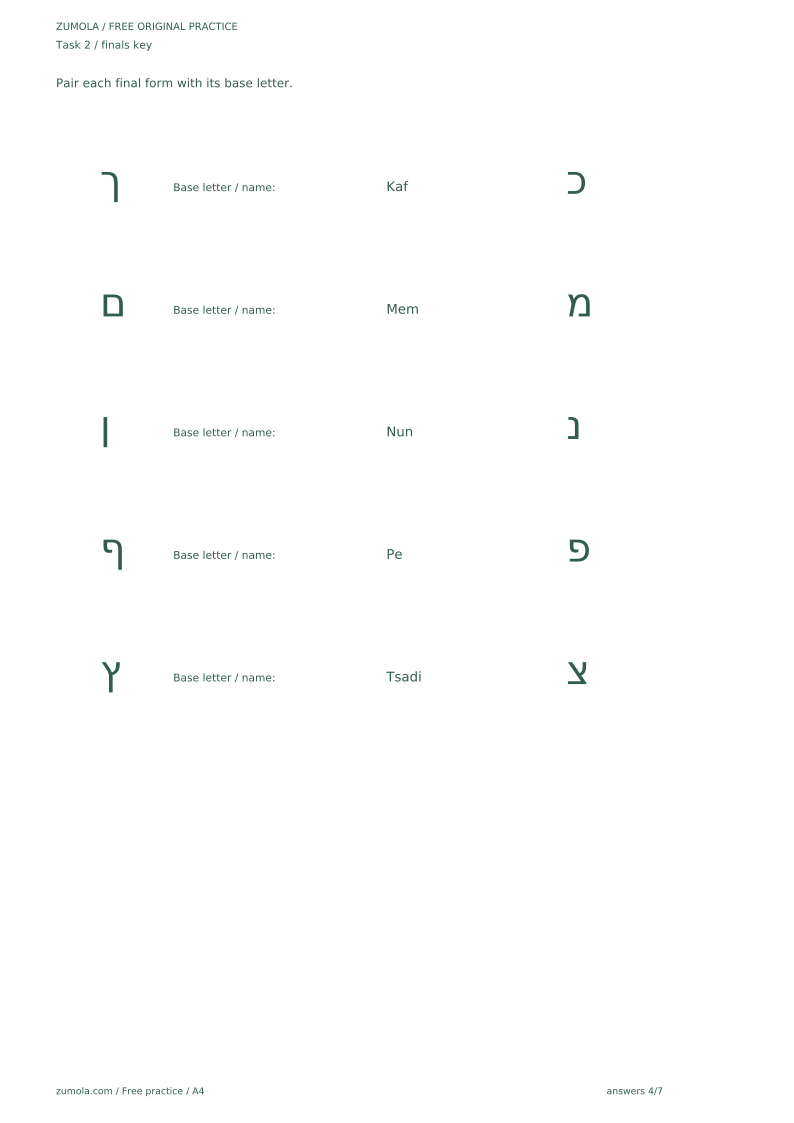
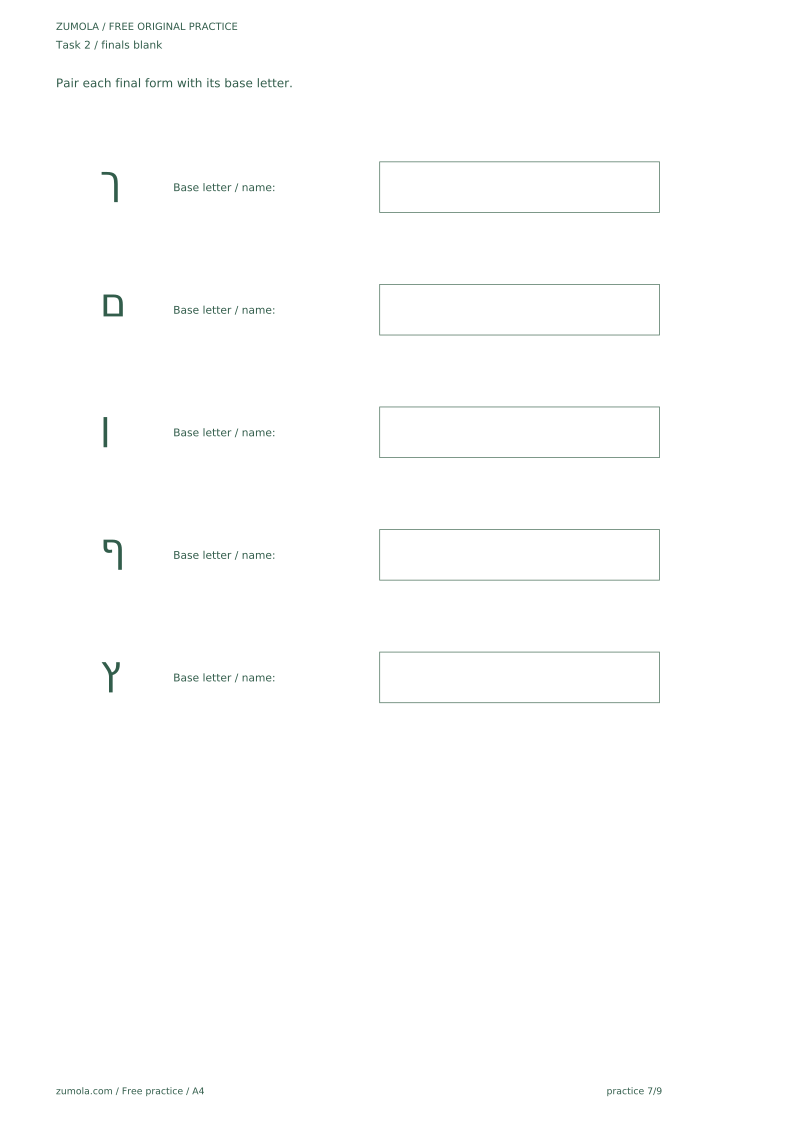
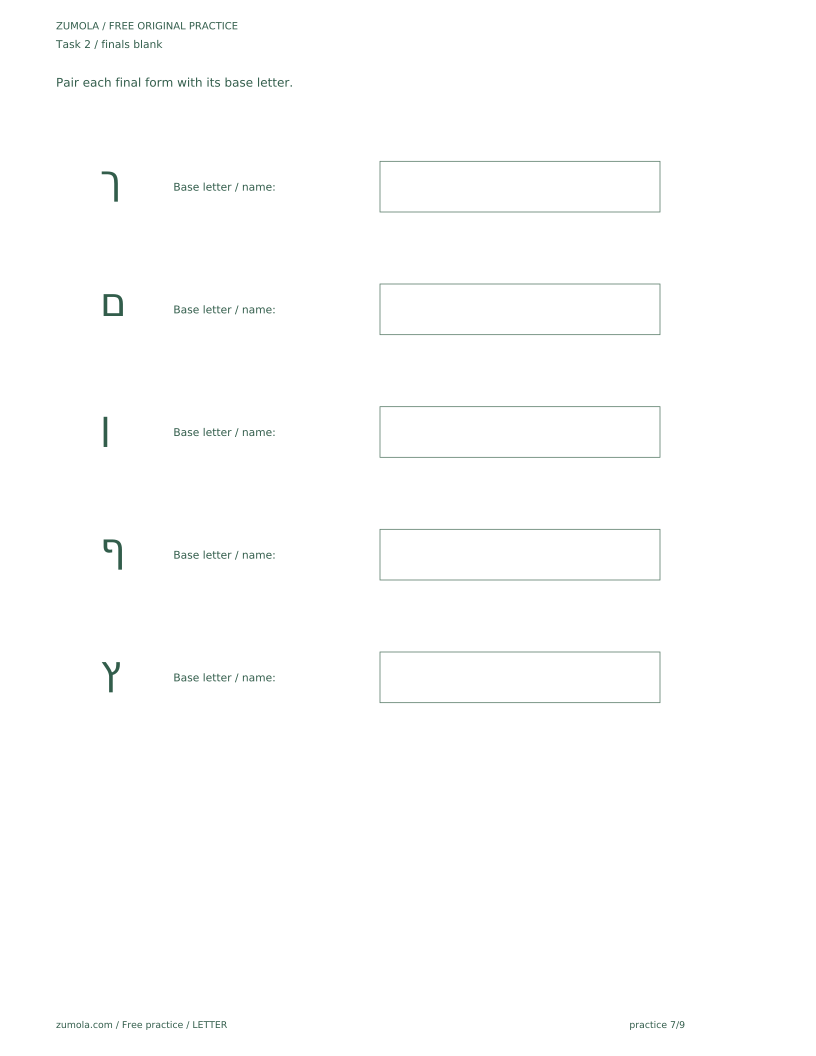
Label the five final forms and state which base letter each belongs to.
Show answer and check
Kaf, Mem, Nun, Pe, Tsadi are final forms of the five base letters of the same names; they are positional variants, not additional letters.
Why: The alphabet has 22 base letters; final forms occur at word-final position in the writing context being taught.
Check: Check that each final form is paired with its base letter and that the total is described as 22 base letters plus five final forms.
Exercise 3
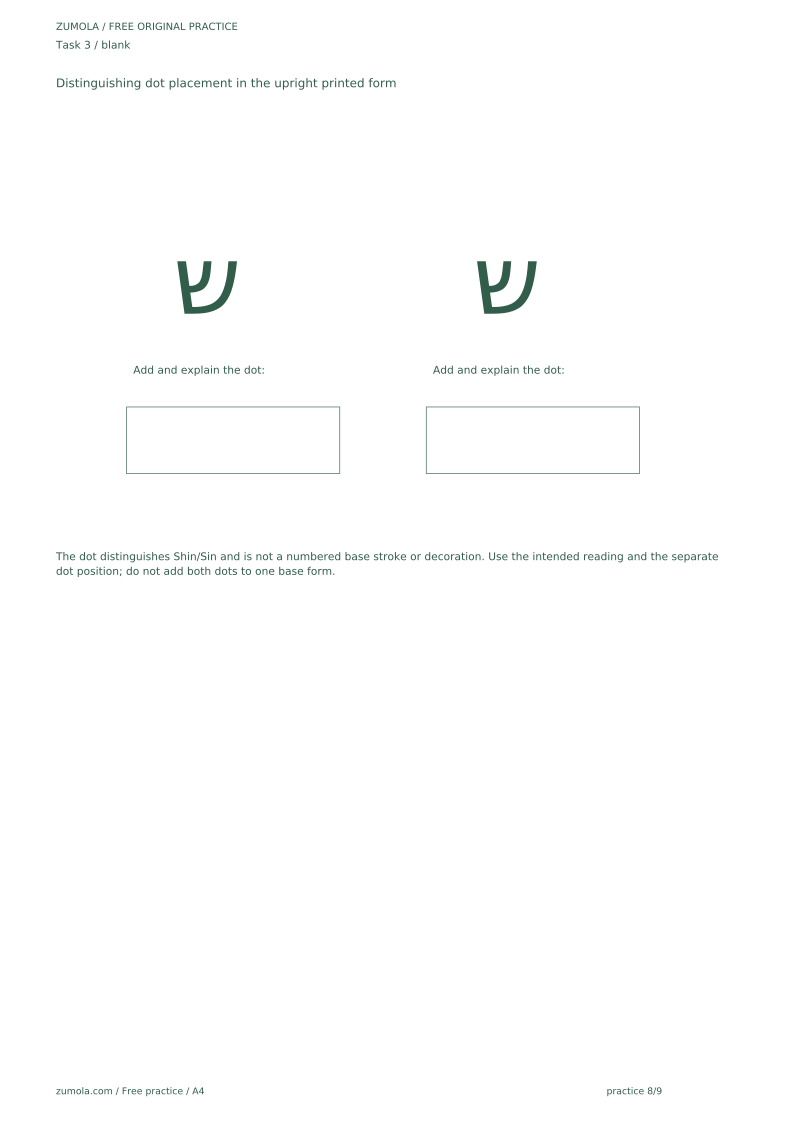
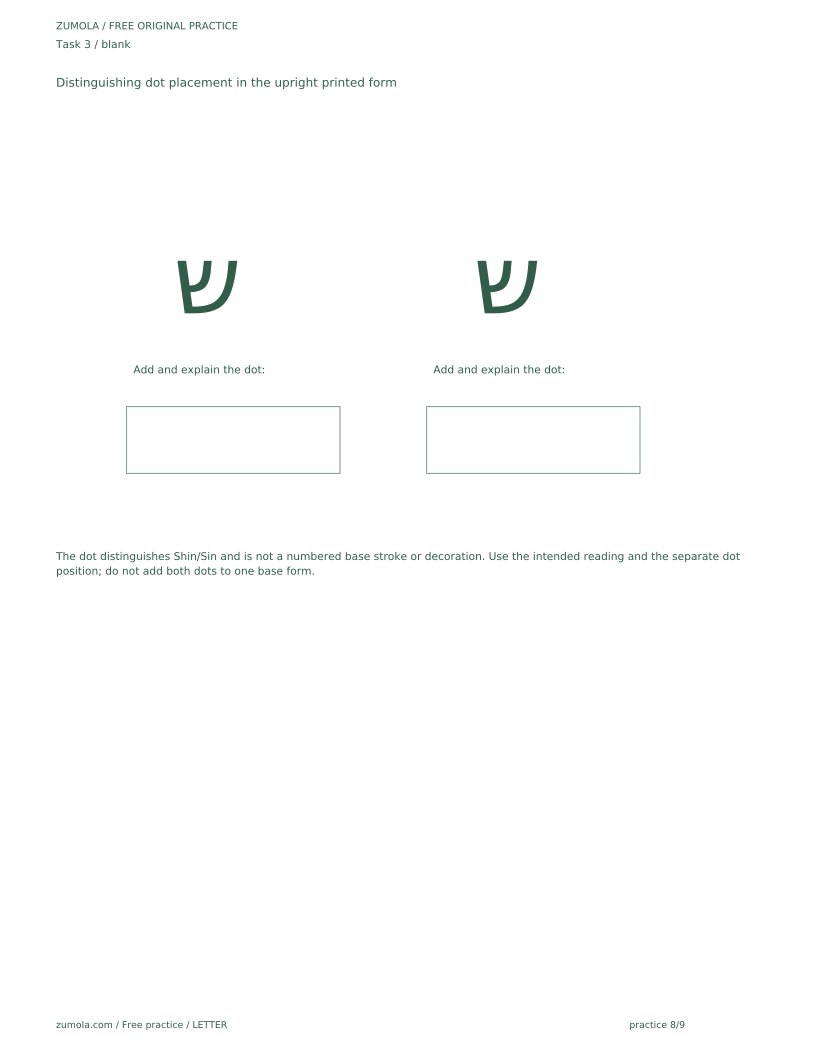
Explain why the Shin/Sin dot is not a decorative stroke and where it belongs.
Show answer and check
For the selected upright printed form as the viewer sees it, the Shin dot belongs above the right side and the Sin dot above the left side, as required by the intended reading. It is a distinguishing diacritic, not a base stroke or decoration; show it separately from the base form.
Why: The dot changes which letter is represented, so its position is functional.
Check: Use the rubric to confirm the dot is shown separately, labeled as distinguishing, and placed on the correct side per the chart.
Exercise 4
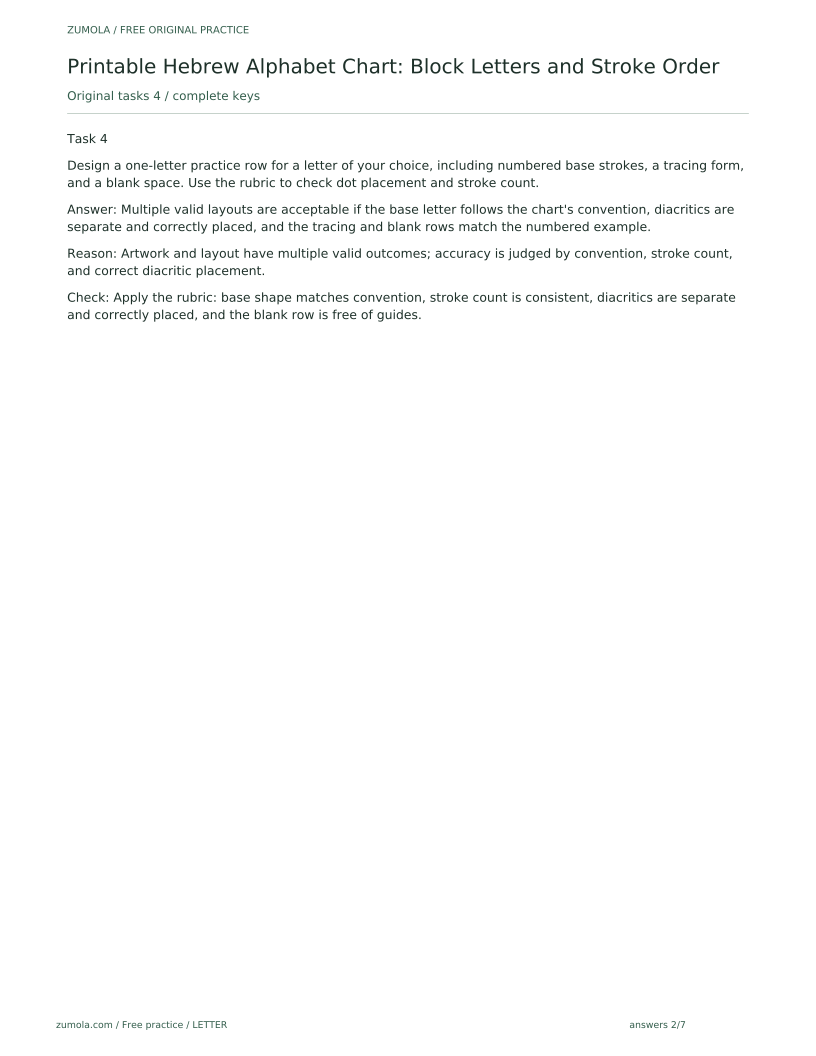
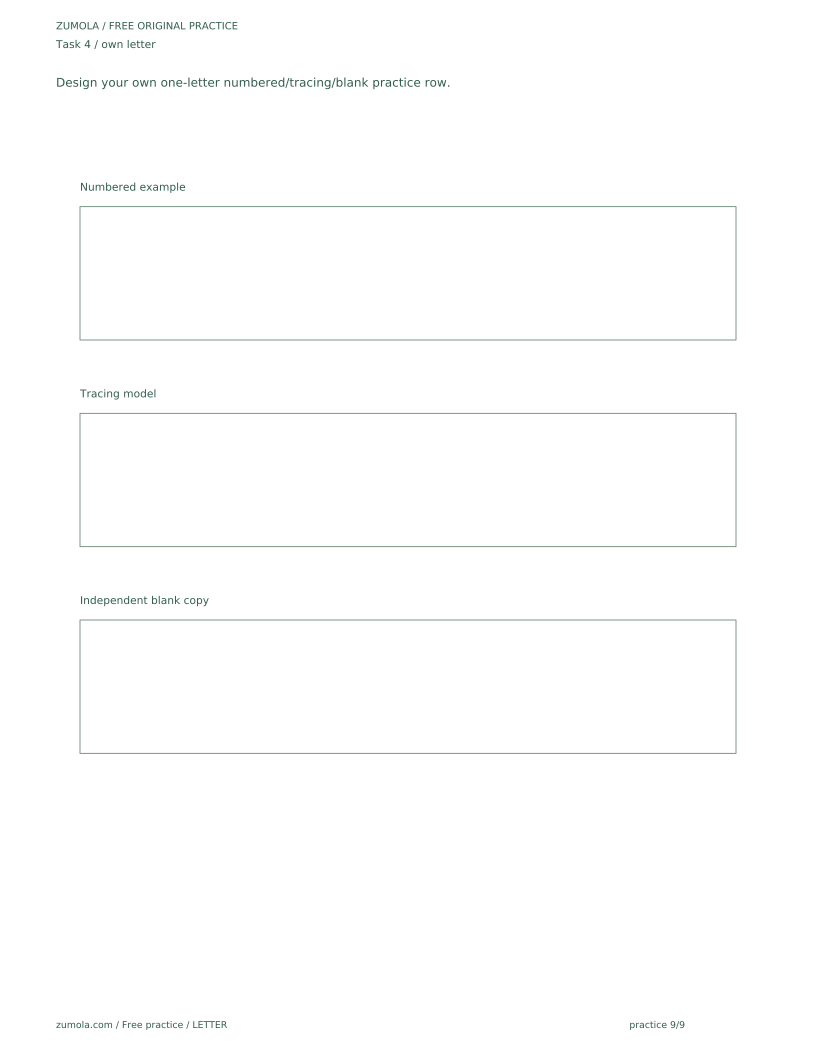
Design a one-letter practice row for a letter of your choice, including numbered base strokes, a tracing form, and a blank space. Use the rubric to check dot placement and stroke count.
Show answer and check
Multiple valid layouts are acceptable if the base letter follows the chart's convention, diacritics are separate and correctly placed, and the tracing and blank rows match the numbered example.
Why: Artwork and layout have multiple valid outcomes; accuracy is judged by convention, stroke count, and correct diacritic placement.
Check: Apply the rubric: base shape matches convention, stroke count is consistent, diacritics are separate and correctly placed, and the blank row is free of guides.
Common mistakes
- Treating the dagesh dot as a base stroke of Bet, Kaf, Pe, or Shin. Keep the chosen base-stroke sequence specific to each letter; do not claim every letter has one stroke. This Bet example may join top, right side and bottom in one continuous path. Show any dagesh or Shin/Sin dot separately and use the required writing/reading context.
- Implying the chart contains 27 letters by listing final forms as separate letters. Label the five final forms as positional variants of five base letters, and state that the alphabet has 22 base letters.
- Mixing stroke conventions across letters or rows. State one convention at the top and apply the same stroke count and direction in the numbered example, tracing row, and blank row.
Self-check rubric
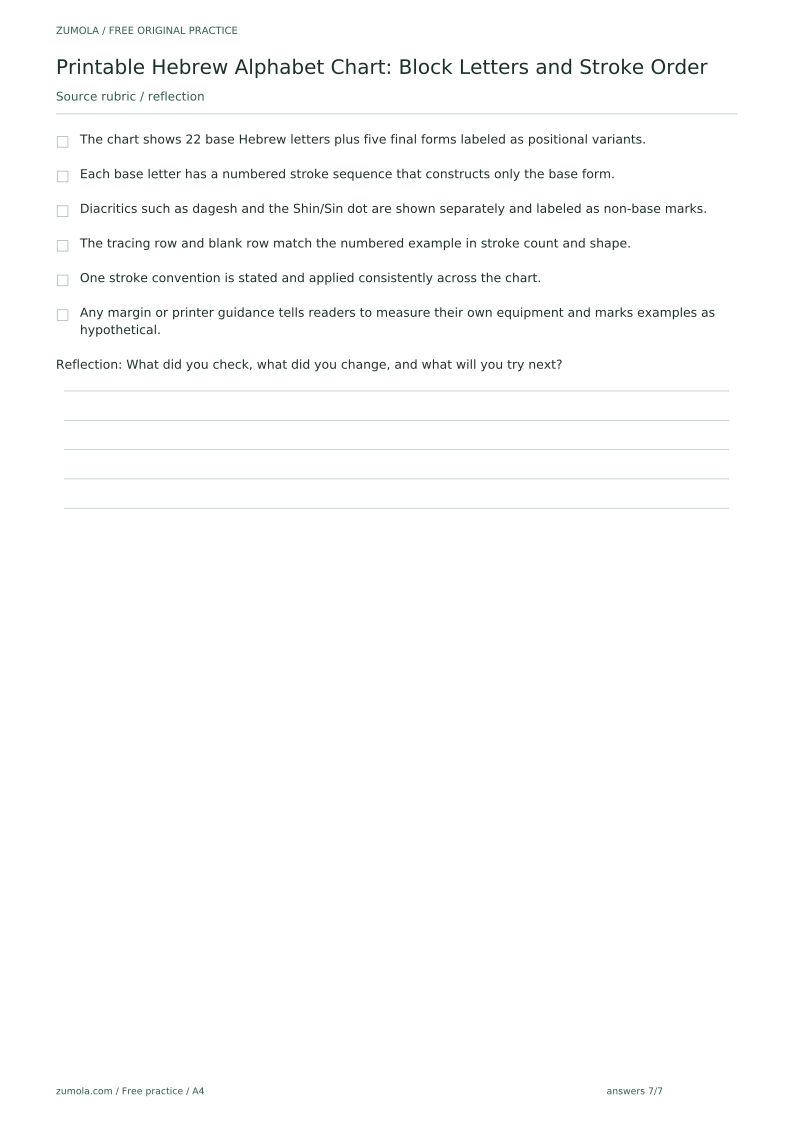
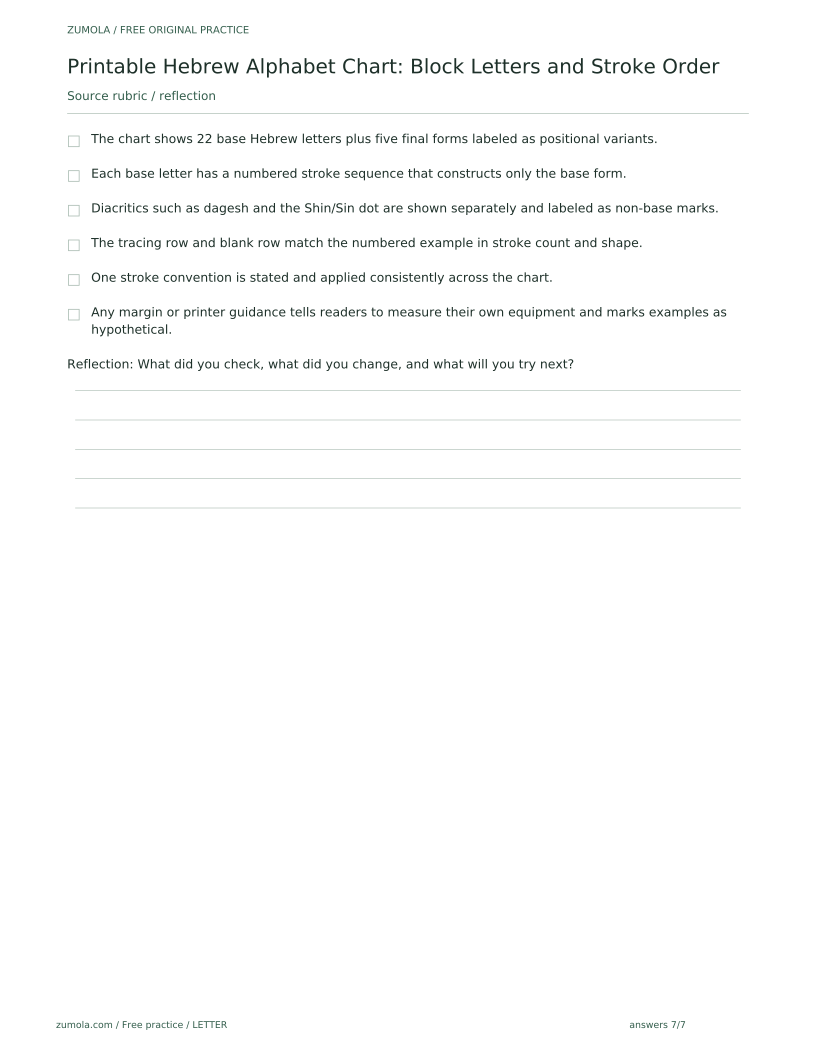
- The chart shows 22 base Hebrew letters plus five final forms labeled as positional variants.
- Each base letter has a numbered stroke sequence that constructs only the base form.
- Diacritics such as dagesh and the Shin/Sin dot are shown separately and labeled as non-base marks.
- The tracing row and blank row match the numbered example in stroke count and shape.
- One stroke convention is stated and applied consistently across the chart.
- Any margin or printer guidance tells readers to measure their own equipment and marks examples as hypothetical.
Questions and answers
Does the chart include final forms?
The chart includes the five final forms as positional variants, labeled separately from the 22 base letters. The standard pack is available in both paper sizes.
Is the dagesh part of the letter's stroke order?
No. The dagesh is a diacritic dot that may appear depending on vocalization; it is shown separately from the numbered base strokes.
Can I set margins or hole positions from this page?
No universal values are given. Measure your own paper and printer and use hypothetical example inputs only as illustrations, not requirements.
Free printable downloads
Choose a paper size. Practice sheets and answer keys are separate. Download every file free, without registration.
This standard pack covers the four original exercises, blank work areas, complete keys and necessary figures. Additional extension sets described in the lesson are outside this download.
PDF bundles
Individual SVG pages
Reference-page preview